Introduction
One of the consequences of discovering that a wild plant species contains a compound effective in the treatment of cancer and other diseases is that it is often heavily exploited and may become endangered (e.g. Hartzell, Reference Hartzell1991). Thus, when species are identified as being sources of medically valuable compounds, management strategies to prevent the species from becoming extinct in the wild are needed. One aspect of such a plan is to grow the species in cultivation, leaving the native populations as sources of genetic material for development of cultivars with high yields of the desirable medicinal compounds. If the species is rare at the time when its medicinal value is discovered, it is especially important that wild populations be preserved in their natural habitats and thus serve as sources of material for propagation of the species.
In Taiwan, three plant species that have great potential medicinal value are rare in the wild and need to be propagated. Nothapodytes nimmoniana (J. Graham) Mabberley (Icacinaceae) contains high levels of camptothecin (CTP), an important anti-cancer compound (Govindachari and Viswanathan, Reference Govindachari and Viswanathan1972; Fulzele and Satdive, Reference Fulzele and Satdive2005). The CPT derivatives, water-soluble irinotecan and topotecan, have been approved by the Federal Drug Administration of the USA for treating colorectal and ovarian cancer (Lilenbaum et al., Reference Lilenbaum, Ratain, Miller, Hargis, Hollis, Rosner, O'Brien, Brewster, Green and Schilsky1995; Takimoto et al., Reference Takimoto, Wright and Arbuck1998; Vladu et al., Reference Vladu, Woynarowski, Manikumar, Wani, Von Hoff and Wadkins2000). Gomphandra luzoniensis (Merr.) Merr. (Stemonuraceae) also contains CPT (Ramesha et al., Reference Ramesha, Suma, Senthilkumar, Priti, Ravikanth, Vasudeva, Santhosh Kumar, Ganeshaiah and Uma Shaanker2013), but this species has not yet been exploited commercially. Extracts of seeds, bark, stems and leaves of Goniothalamus amuyon (Blanco) Merr. (Annonaceae) contain compounds with significant cytotoxicity against various kinds of tumour cells (Wu et al., Reference Wu, Duh, Chang, Chang, Wang, Chang, McPhail, McPhail and Lee1991; Alali et al., Reference Alali, Zhang, Rogers and McLaughlin1998; Surivet and Vatèle, Reference Surivet and Vatèle1999; Lan et al., Reference Lan, Chang, Yu, Yang, Chang, Lee and Wu2003, Reference Lan, Chang, Liaw, Wu, Chiang and Wu2005; Wiart, Reference Wiart2007).
In Taiwan, N. nimmoniana is restricted to Lanyu (Orchid Island, 22°00′–22°05′N, 121°29′–121°36′E) and Green Islands (22°37′–22°40′N, 121°27′–121°30′E) off the southern coast of the country, where mean temperatures are 18.5°C in January, 26.3°C in July and 22.7°C for the whole year (Chang, Reference Chang1993; Central Weather Bureau of Taiwan, 2014). G. luzoniensis occurs in the Philippines and grows only on Lanyu and Green islands in Taiwan, where the temperature conditions in its habitat are the same as those for N. nimmoniana (Chang, Reference Chang1993; Schori and Utteridge, Reference Schori and Utteridge2012). G. amuyon is distributed in the Philippines and in the Hengchun area (22°01′N, 120°46′E) at the southern tip of Taiwan, where mean temperatures are 20.7°C in January, 28.4°C in July and 25.1°C for the whole year (Liao, Reference Liao1996; Central Weather Bureau of Taiwan, 2014). The species is critically endangered in Taiwan (Council of Agriculture, 1996; Liao, Reference Liao1996).
Although N. nimmoniana, G. luzoniensis and G. amuyon are rare in the wild in Taiwan, trees of each species can produce many seeds each year if they are well managed (personnel observation). Propagation of these species via cuttings is expensive and labour intensive. Thus, learning how to grow the three species from seeds would facilitate not only their propagation per se but also the possibility of selection of high-yielding cultivars (Ho et al., Reference Ho, Chang, Tsay, Chen, Wu, Huang, Ho, Chien and Liao2007; Chang et al., Reference Chang, Tsay, Yeh and Ho2008). Little is known about propagation of these species. Seeds of N. nimmoniana are large and desiccation sensitive (Engelmann, Reference Engelmann1997), and the species can be propagated by multiplication in vitro using young shoots of germinated seeds (Chang et al., Reference Chang, Tsay, Yeh and Ho2008; Dandin and Murthy, Reference Dandin and Murthy2012). We are not aware of any studies on seed germination in this species. However, Sharma et al. (Reference Sharma, Puri, Srivastava, Handa and Kaul2000) showed that seeds of N. foetida are dormant and pretreatment with 100 ppm gibberellic acid enhanced germination from 5–6% in the control to 70%. Seeds of G. amuyon required 84 d for complete germination (Yang, Reference Yang2011), indicating that the seeds are dormant. No studies seem to have been done on germination of the seeds of G. luzoniensis, but Ng (Reference Ng1992) reported that those of G. quadrifida germinated in 77–102 d, suggesting that they were dormant. Consequently, the primary objective of our study was to determine the germination requirements of seeds of each of the three species, in order to provide an effective protocol to produce plants of species with anti-cancer properties.
Materials and methods
Seed collection and handling
Mature fruits of G. luzoniensis were collected from three planted trees in June 2013, those of N. nimmoniana from two planted trees in June 2013 and those of G. amuyon from three planted trees in October 2013; all trees were growing in Chashan (22°00′N, 120°50′E), Manjhou township, Pingtung County, southern tip of Taiwan. We caution that the low number of samples may not be totally representative of the range of genetic diversity nor of the variation in dormancy-breaking/germination requirements of these species in natural populations. Seeds were extracted from fruits by removing the pulp by hand in water. The cleaned seeds that sank in water were air-dried overnight at ambient laboratory temperature (~25°C), after which they were stored for 6–7 d in a sealed polyethylene bag at 5°C until used in experiments. These storage conditions prevent fungal contamination, embryo growth and loss of water from the embryo of the desiccation-sensitive seeds of the three study species, and presumably they did not affect the subsequent results of experiments on seed dormancy and germination. Information on seed moisture content and size/mass of fresh seeds of the three study species from the same seed lots used in our experiments is given in Table 1. These measurements are from the same seed lots used in the study. Moisture content was measured following International Seed Testing Association (Nijēnstein et al., Reference Nijënstein, Nydam, Don and McGill2007) procedures of oven drying for 17 h at 103°C.
Information on fresh seeds of the three study species

Effect of temperature on seed germination
Seeds were mixed with moist sphagnum moss (cut into small pieces; water content of the sphagnum was about 400% of its dry mass) and sealed inside transparent polyethylene bags (0.04 mm in thickness). The moist sphagnum provided a good germination medium and prevented the spread of mould because it contains the fungi Trichoderma and actinomycetes which are antagonistic to microorganisms (Wang et al., Reference Wang, Lin and Chang1998). The seeds were covered with small pieces of sphagnum moss with light in the incubator. Due to the coarse nature of the sphagnum, most seeds received some light, but at any given point in time a few of them may have been in darkness. However, at weekly intervals the contents of each bag were poured out on a table to facilitate examination of seeds for germination. After germination was monitored, seeds and sphagnum were returned to the bag, resulting in a re-shuffling of seeds with regard to their position in the sphagnum and thus the amount of light they received. Consequently, all seeds were in light for part (or all) of the time that the lights were on in the incubators.
Seeds of G. luzoniensis and G. amuyon were incubated at alternating temperature regimes of 30/20, 30/15, 25/15, 20/10 and 15/5°C and at constant temperatures of 25 and 30°C, and those of N. nimmoniana at 30/20, 25/15, 25 and 30°C. These temperatures were selected to test the responses of the seeds of these three tropical species to a broad range of low to high temperatures, including those that occur in the natural habitat of these species. These responses, along with germination rates (T 50), were used to determine optimum germination temperature(s). The daily photoperiod (cool white fluorescent light, 60–80 μmol m− 2s− 1, 400–700 nm; hereafter light) during incubation was 12 h, which corresponded to the high temperature in the alternating regimes. There were three replicates of 25 seeds for G. luzoniensis and G. amuyon and three of 20 seeds of N. nimmoniana.
Germination was recorded weekly and seeds with a radicle ≥ 2 mm long were considered to be germinated. Results are expressed as mean ( ± 1SE) germination percentage or as germination rate, i.e. the time to reach 50% germination (T 50) (Bewley et al., Reference Bewley, Bradford, Hilhorst and Nonogaki2013).
Embryo growth
Embryo length and seed length were measured for fresh seeds and for seeds incubated in light at 30/20°C for 1–8 weeks, depending on how fast the embryos grew, until the seed coat had split but none of the radicle had emerged ( = critical embryo length for germination) (Baskin and Baskin, Reference Baskin and Baskin2005). Seeds were dissected using a razor blade, and seed and embryo lengths were measured under a dissecting microscope equipped with a calibrated micrometer. For every measurement time, ten seeds each of G. luzoniensis and of G. amuyon and five of N. nimmoniana were used.
Statistical analysis
Germination data based on number of seeds in a treatment were converted to percentages, and means (three replicates) and standard errors were calculated. Statistical analysis of mean germination percentage and of T 50 was carried out using the GLM procedure of SAS, and means were compared by Least Significant Difference (LSD) (SAS Institute Inc., Cary, North Carolina, USA; Microsoft Office Excel 2007). Percentage data were arcsine square-root transformed before analysis, but only non-transformed data are shown in figures and table.
Results
Seed germination and embryo growth
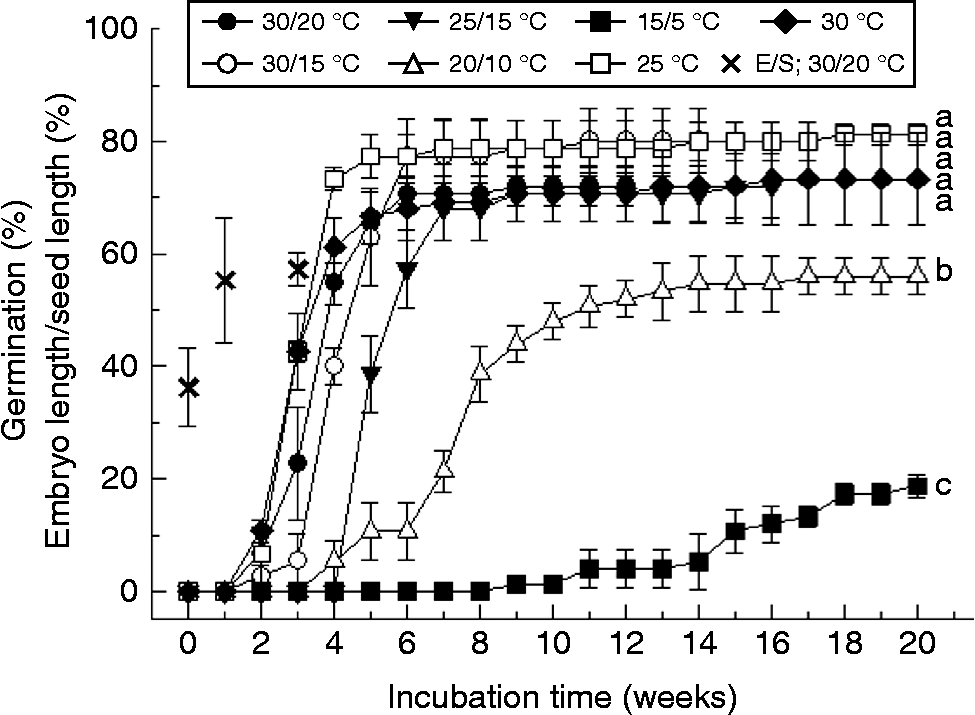
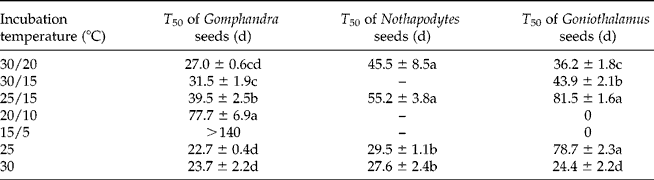
Fresh seeds of G. luzoniensis incubated at the seven temperature regimes germinated to 0–73% in 4 weeks and to 1.3–79% in 10 weeks (Fig. 1). The optimum temperatures of incubation for 20 weeks, based on germination percentage and rate, were 30, 25 and 30/20°C. T 50 ranged from 22.7 ± 0.4 d at 25°C to >140 d at 15/5°C (Table 2). The E:S ratio in fresh seeds was 0.36 ± 0.07 (Figs 1 and 2A), and it increased to 0.55 ± 0.11 in seeds incubated for 1 week, and to 0.57 ± 0.03 in those incubated for 3 weeks, at 30/20°C (Figs 1 and 2B).
Cumulative germination percentages (n= 3, means ± SE) of Gomphandra luzoniensis (Stemonuraceae) incubated at seven temperatures. Final germination percentages among the incubation temperatures followed by different letters differ significantly (LSD, α = 0.05). E:S ratio percentages (n= 10, means ± SE) in freshly matured seeds and seeds incubated at 30/20°C for 1 and 3 weeks are shown.

Time to 50% germination (T 50) of fresh seeds of Gomphandra luzoniensis and Goniothalamus amuyon incubated at seven temperatures, and of Nothapodytes nimmoniana incubated at four temperatures. Means (n=3)± SE within a column followed by different letters differ significantly (LSD, α=0.05)

–, Data not available; 0, no seeds germinated; >140 d means that seeds did not germinate to 50% in 20 weeks of incubation.
Embryo growth in seeds of Gomphandra luzoniensis (A, B), Nothapodytes nimmoniana (C, D) and Goniothalamus amuyon (E, F). Underdeveloped embryos in fresh seeds (A, C, E) and fully developed embryos (B, D, F) are shown; em, embryo; es, endosperm; sc, seed coat. Pulp has been removed.

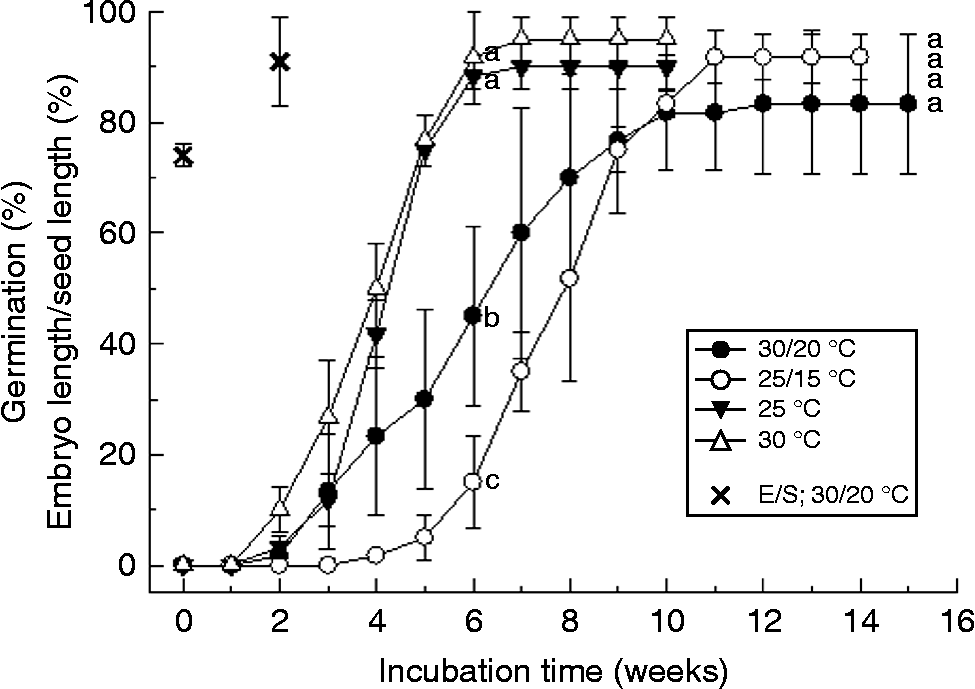
Fresh seeds of N. nimmoniana incubated at the four temperature regimes germinated to 2–50% in 4 weeks and to 52–95% in 8 weeks (Fig. 3). The optimum temperatures for germination of seeds incubated for 6 weeks, based on germination percentage and rate, were 25 and 30°C. T 50 ranged from 27.6 ± 2.4 d at 30°C to 55.2 ± 3.8 d at 25/15°C (Table 2). The E:S ratio in fresh seeds was 0.74 ± 0 (Figs 2C and 3), and it increased to 0.91 ± 0.08 in seeds incubated at 30/20°C for 2 weeks (Figs 2D and 3).
Cumulative germination percentages (n= 3, means ± SE) of Nothapodytes nimmoniana (Icacinaceae) incubated at four temperatures. Final germination percentages among the incubation temperatures followed by different letters differ significantly (LSD, α = 0.05). E:S ratio percentages (n= 5, means ± SE) in freshly matured seeds and in seeds incubated at 30/20°C for 2 weeks are shown.

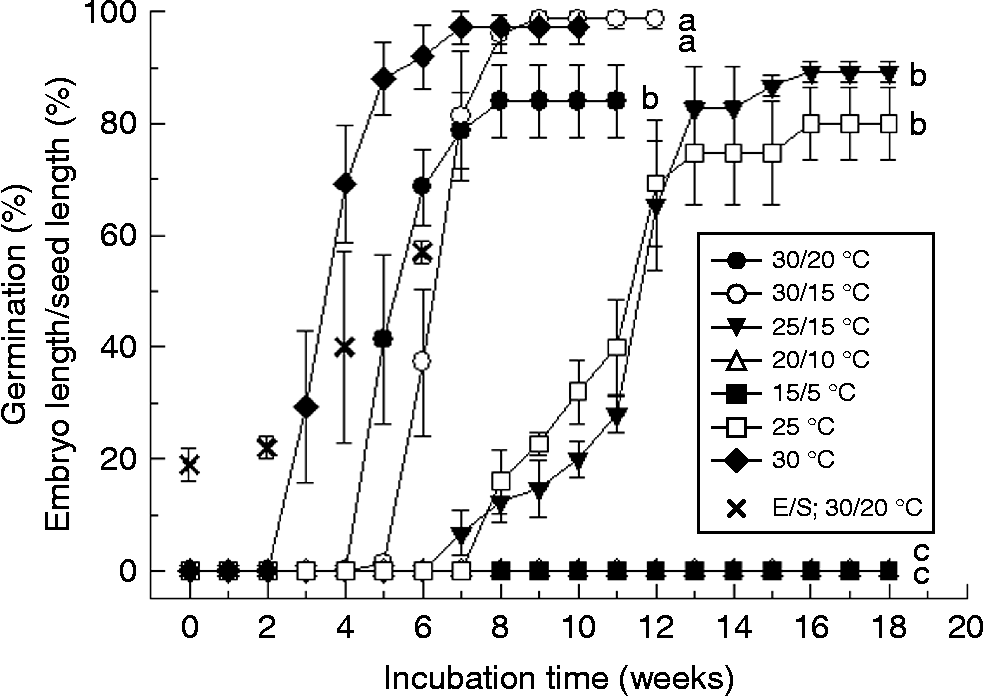
Fresh seeds of G. amuyon incubated at the seven temperature regimes germinated to 0–70% in 4 weeks and to 0–97% in 8 weeks (Fig. 4). No seeds germinated at 20/10 or 15/5°C (Fig. 4). Based on percentage and rate of germination, the optimum temperature for germination was 30°C. T 50 ranged from 24.4 ± 2.2 d at 30°C to 81.5 ± 1.6 d at 25/15°C (Table 2). The E:S ratio in fresh seeds was 0.19 ± 0.03 (Figs 2E and 4), and it increased to 0.57 ± 0.02 in seeds incubated at 30/20°C for 6 weeks (Figs 2F and 4).
Cumulative germination percentages (n= 3, means ± SE) of Goniothalamus amuyon (Annonaceae) incubated at seven temperatures. Final germination percentages among the incubation temperatures followed by different letters differ significantly (LSD, α = 0.05). E:S ratio percentages (n= 10, means ± SE) in freshly matured seeds and in seeds incubated at 30/20°C for 2, 4 and 6 weeks are shown.

Discussion
Embryos of the three study species are small, and they must grow before radicle emergence (germination). Thus, the seeds have either morphological dormancy (MD) or morphophysiological dormancy (MPD). The seed population of all three species consists of a mixture of seeds with MD and MPD, and whether a seed has MD or MPD is temperature dependent.
Various levels of MPD have been identified, based on requirements to break dormancy and promote germination, temperature requirements for embryo growth and response to gibberellic acid (GA3) (Grushvitzky, Reference Grushvitzky and Borris1967; Nikolaeva, Reference Nikolaeva1969; Baskin and Baskin, Reference Baskin and Baskin2014). For seeds of G. luzoniensis, N. nimmoniana and G. amuyon that required >4 weeks to germinate, incubation at high temperatures was the only requirement to break dormancy. Thus, both embryo growth and germination occurred at warm-stratifying temperatures, which indicates that seeds have one of the simple levels of MPD. When seeds of these three species that had been planted in containers in the greenhouse began to germinate, shoots emerged within 2 weeks after radicle emergence. Thus, seeds do not have epicotyl or double MPD. Further, since a short (4–8 weeks) warm stratification period was the only requirement to break dormancy, we conclude that seeds of the three species had Type 1 non-deep simple MPD. The formula for this kind of dormancy is C1bBb, where C1b is non-deep physiological dormancy (C1) that is broken by warm temperatures (b of subscript 1b) and Bb an underdeveloped embryo (B) that grows at warm temperatures (subscript b). The dormancy formula for seeds of the three species with MD is Bb, i.e. dormancy break requires only growth of the underdeveloped embryo (B) at warm temperatures (subscript b) (Baskin and Baskin, Reference Baskin and Baskin2014).
Embryos in seeds of the three species require relatively high temperatures for growth. Thus, from a propagation perspective, sowing seeds in summer (>25°C) will speed up seed germination and seedling production. The large seeds of N. nimmoniana have a high percentage moisture content [55.7% (48.4% in our study)], and they lose viability within a short period of time after maturity (Engelmann, Reference Engelmann1997; Radha et al., Reference Radha, Decruse and Krishnan2010), i.e. they are desiccation intolerant (recalcitrant) and thus will be difficult to store. Although we did not test their storage behaviour, the high moisture content of seeds of G. luzoniensis (42.4%) suggests that they might also be recalcitrant. Seeds of G. amuyon could be stored dry at 4°C for 2 years, but germination was reduced from 85 to 67% (Yang, Reference Yang2011), suggesting that seeds might be intermediate in their storage behaviour, or perhaps even orthodox. Thus, we recommend that freshly harvested seeds of G. luzoniensis and N. nimmoniana must be sown immediately, whereas those of G. amuyon can be stored dry (at least at low above-freezing temperatures) for 1 year or longer prior to germination.
Acknowledgements
The authors thank Yu-Cheng Hsieh and Wen-Yu Hsu, Taiwan Forestry Research Institute, for technical assistance.
Financial support
This research was supported by a grant (102AS-8.1.2-F1-G1) from the Council of Agriculture, the Executive Yuan, Taiwan.
Conflicts of interest
None.