Nucleated red blood cells (NRBCs) are immature red blood cells which are formed in the bone marrow during the early stages of haematopoiesis. Under normal conditions, the bone marrow consists of small pores in the endothelium. Mature red blood cells are deformable and able to squeeze through these pores into the peripheral circulation, while immature cells such as NRBCs are less deformable, preventing premature release into the peripheral circulation, although they may be seen in healthy newborns up to 5 days of life. Reference Constantino and Cogionis1 When released into the peripheral circulation, NRBCs rarely exceed 10/100 WBC, and are quickly cleared by the spleen within the first few days of life. Reference Constantino and Cogionis1-Reference Baschat, Gungor, Kush, Berg, Gembruch and Herman3 NRBC elevations have been reported following intrauterine/perinatal asphyxia or in hypoxic neonates. This causes cytokine and erythropoietin release, resulting in disruption of the bone marrow endothelial architecture allowing release of NRBCs into the peripheral circulation. Reference Constantino and Cogionis1-Reference Kurt, Holland-Letz, Friese and Stachon5
Several studies have suggested an association between elevated NRBC and poor outcome in critically ill adults and neonates. Additionally, a correlation between NRBCs in the peripheral circulation and end-organ damage in adults, as evidenced by the direct relationship with elevations in serum lactate, creatinine and alanine aminotransferase have been reported. Reference Poryo, Wissing and Zemlin6,Reference Li, Kobata and Kamei7
In very low birth weight and premature neonates, elevated NRBCs have been observed during periods of sepsis, necrotising enterocolitis, intraventricular haemorrhage, hypoxic ischaemic encephalopathy and bronchopulmonary dysplasia. Reference Cremer, Roll, Graf, Weimann, Buhrer and Dame2,Reference Li, Kobata and Kamei7 NRBCs can appear as early as 90 minutes following the inciting event and have been detected 1–3 weeks before mortality occurs, suggesting their potential utility as a clinical biomarker. Reference Stachon, Segbers, Holland-Letz, Kempf, Hering and Krieg8-Reference Stachon, Kempf, Holland-Letz, Friese, Becker and Krieg11
While the presence of NRBCs in the peripheral blood has been studied in several clinical settings, it has yet to be studied in neonates following cardiac surgery. Therefore, the primary objective of our study was to determine if increases in NRBC values following cardiac surgery and following clinical events during the hospital stay can be used as a biomarker to monitor for mortality risk in neonates, post-cardiac surgery.
Materials and methods
The study was approved by the Institutional review board at Louisiana State University. Medical records of neonates requiring cardiac surgery in the first month of life at Children’s Hospital of New Orleans between 1 January, 2011 and 30 June, 2020 were retrospectively reviewed. Neonates undergoing cardiac surgery at ≥30 days of age were excluded. Demographics included gestational age, birth weight, age at surgery and gender. Pre-operative variables included the use of pre-operative mechanical ventilation and pre-operative inotropic medication use. Peri-operative and post-operative variables collected included mortality, clinical events, requirement for extracorporeal membrane oxygenation (ECMO), Society of Thoracic Surgeons-European Association for Cardio-Thoracic Surgery (STAT) category, whether surgery required cardiopulmonary bypass (CPB), vasoactive inotropic score and acute kidney injury (AKI). NRBC value per/100 WBC were recorded (manual count rather than automated). NRBC values were recorded pre-operatively, in the 14-day period post-cardiac surgery, then following clinical events. NRBC values were recorded until they normalised or until discharge or death.
Definition of variables
Prematurity was defined as gestational age <37 weeks. Mortality was defined using the Society of Thoracic Surgeons definition: a death which occurs during the hospital stay in which the procedure was performed, regardless of how long the patient remains in the hospital, death occurring at another hospital because the patient is transferred but never discharged, or death occurring within 30 days of the operation even if the patient is discharged home. Reference Overman, Jacobs and Prager12 AKI was diagnosed using the Kidney Disease: Improving Global Outcomes Clinical Practice Guideline (KDIGO), based on the change in creatinine from the pre-cardiac surgery baseline and the peak creatinine in the 7-day period post-cardiac surgery. Reference Kellum and Lameire13 Stage 2/3 AKI was used as a categorical variable since these stages of AKI have been associated with increased morbidity and mortality. Reference Gist, Kwiatkowski and Cooper14-Reference Soni, Piggott and DeCampli16 Normal NRBC value was considered ≤1/100 WBC. Common events occurring following cardiac surgery were monitored to see if they resulted in an increased NRBC value. These clinical events included: chest closure, cardiac arrest, systemic pulmonary/Sano shunt thrombosis or narrowing leading to hypoxia and clinical deterioration (requiring intervention), cannulation to ECMO (in cardiovascular intensive care unit), decannulation from ECMO, sepsis (defined as a clinical change leading to the ordering of blood cultures and at least 7 days of antibiotics as determined by the covering physician at that time or culture proven sepsis) or necrotising enterocolitis (NEC, defined as pneumatosis on X-ray plus stoppage of feeds and use of antibiotics and/or surgical exploration ± resection of bowel). Peak Vasoactive Inotropic Score was defined as the maximum dose of inotropic medications used in the 14-day period following the primary cardiac surgery. It was calculated as the sum of the equation: dopamine dose (microgram/kilogram/minute) + dobutamine dose (microgram/kilogram/minute) + 100 x epinephrine dose (microgram/kilogram/minute) + 100 x norepinephrine dose (microgram/kilogram/minute) + 10 x milrinone dose + 10,000 x vasopressin dose. Reference Gaies, Jeffries and Niebler17 Pre-operative shock was defined as inotropic requirement in pre-operatively, metabolic acidosis requiring sodium bicarbonate and/or worsening lactic acidosis (>2, if available).
Statistical analysis
Continuous variables were expressed as means with standard deviation. Categorical variables were expressed as number with percentage or interquartile range. Normally distributed continuous variables were analysed using Students t-test. Non-normally distributed continuous variables were analysed using Mann–Whitney test. Categorical variables were analysed using Chi-squared test. Variables with a p value of ≤ 0.1 following univariate analysis underwent multi-variable logistic regression analysis. Variables in the multi-variable analysis included: ECMO utilisation, NRBC ≥10/100 WBC, term gestation, age at cardiac surgery, NRBC ≥5/100 WBC, experienced two clinical events post-surgery, experienced three events post-surgery, NRBC value immediately prior to cardiac surgery, pre-operative mechanical ventilation, NRBC detected preoperatively, peak vasoactive inotropic score, stage 2/3 AKI, peak NRBC in 14 days post-surgery and peak NRB entire hospitalisation. A p value of <0.05 was considered statistically significant. Adequacy of the regression analysis was monitored using Hosmer–Lemeshow goodness-of-fit. Statistical analysis was performed using IBM SPSS version 27 statistical software. Receiver operating characteristic (ROC) curves with area under the curve (AUC) were used to evaluate accuracy of NRBC as a biomarker. Sensitivity and specificity were calculated using a cut-off NRBC value of ≥10/100 WBC and mortality.
Results
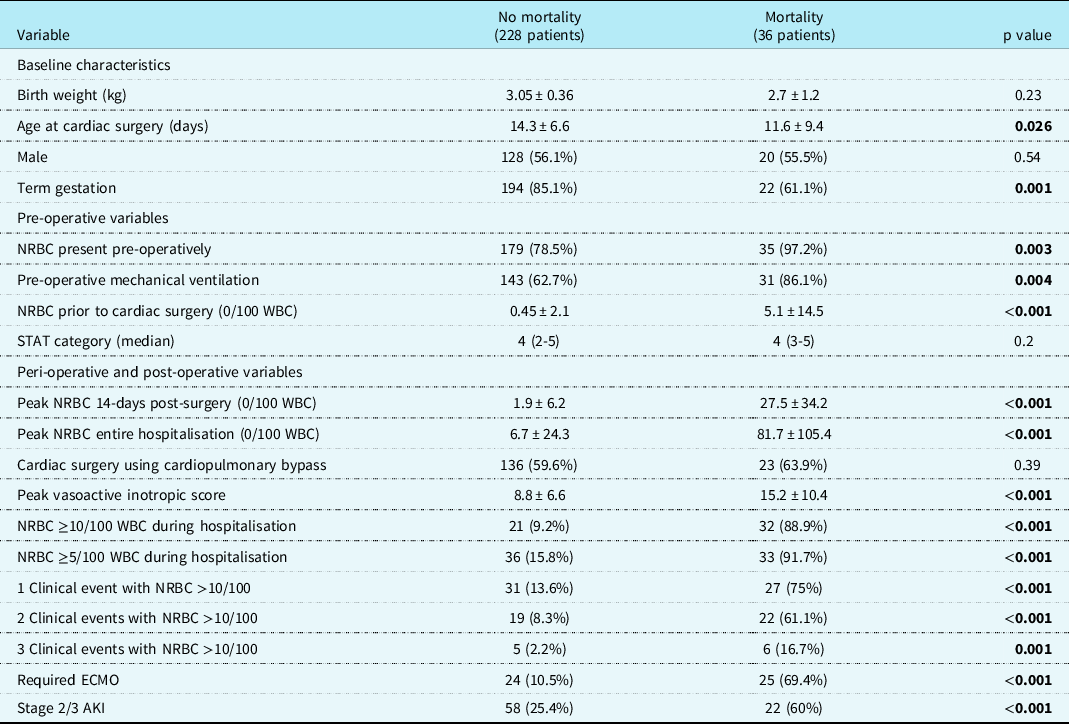
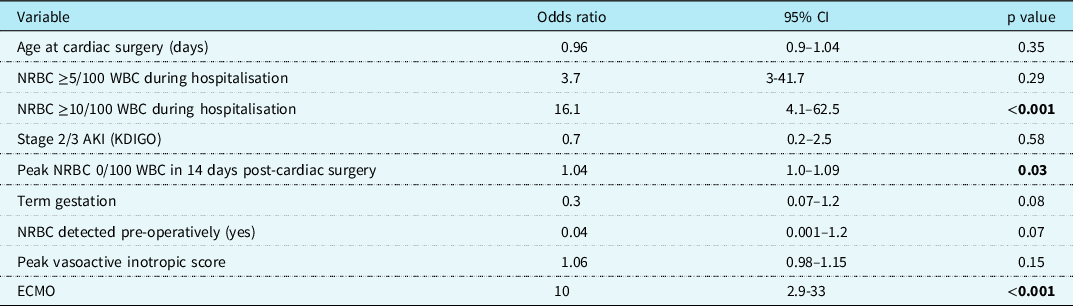
A total of 264 neonates were included in the study. Fourteen neonates were excluded due to incomplete medical records. Fifty-three patients (20%) experienced an NRBC ≥10/100 WBC at some point during their hospitalisation. Thirty-six patients (13.6%) died, of which 32 had an NRBC ≥10/100 WBC (88.9%). A comparison of baseline characteristics and variables between the survival and mortality groups is presented in Table 1. There was a statistical difference in age at cardiac surgery and the number of term gestations between the groups by univariate analysis, however these were not significant by multi-variable analysis. Table 2 shows the results of the multi-variable logistic regression analysis. The Hosmer and Lemeshow goodness-of-fit was 0.94. Experiencing an NRBC value of ≥10/100 WBC during the hospital stay was independently associated with mortality (OR 16.1, 95% CI 4.1–62.5, p ≤ 0.001) by multi-variable analysis, suggesting that when this occurs, there may be up to 16 times greater risk of mortality (Table 2).
Demographic, pre/peri-operative data and univariate analysis of variables comparing all neonates

ECMO = extracorporeal membrane oxygenation; NRBC = nucleated red blood cell; WBC = white blood cell. Categorical variables reported as number with percentage. Continuous variables reported as mean ± standard deviation. Statistically significant variables are in bold type.
Multivariable logistic regression analysis of the association between NRBCs and mortality among all neonates post-cardiac surgery

NRBC = nucleated red blood cell; ECMO = extracorporeal membrane oxygenation; WBC = white blood cell; CI = confidence interval. Statistically significant variables are in bold type. Hosmer-Lemeshow goodness-of-fit = 0.94.
Peak NRBC value in the 14-day period following cardiac surgery (continuous variable) was also independently associated with mortality (OR 1.05, 95% CI 1.0–1.09, p = 0.03) by multi-variable analysis (Table 2). This finding suggests that for every increase in NRBC value by 1, there may be a 1.05 times greater risk of mortality. Meaning, as an example, if the NRBC value post-cardiac surgery is 10, there may be a 10.5 times greater risk of death.
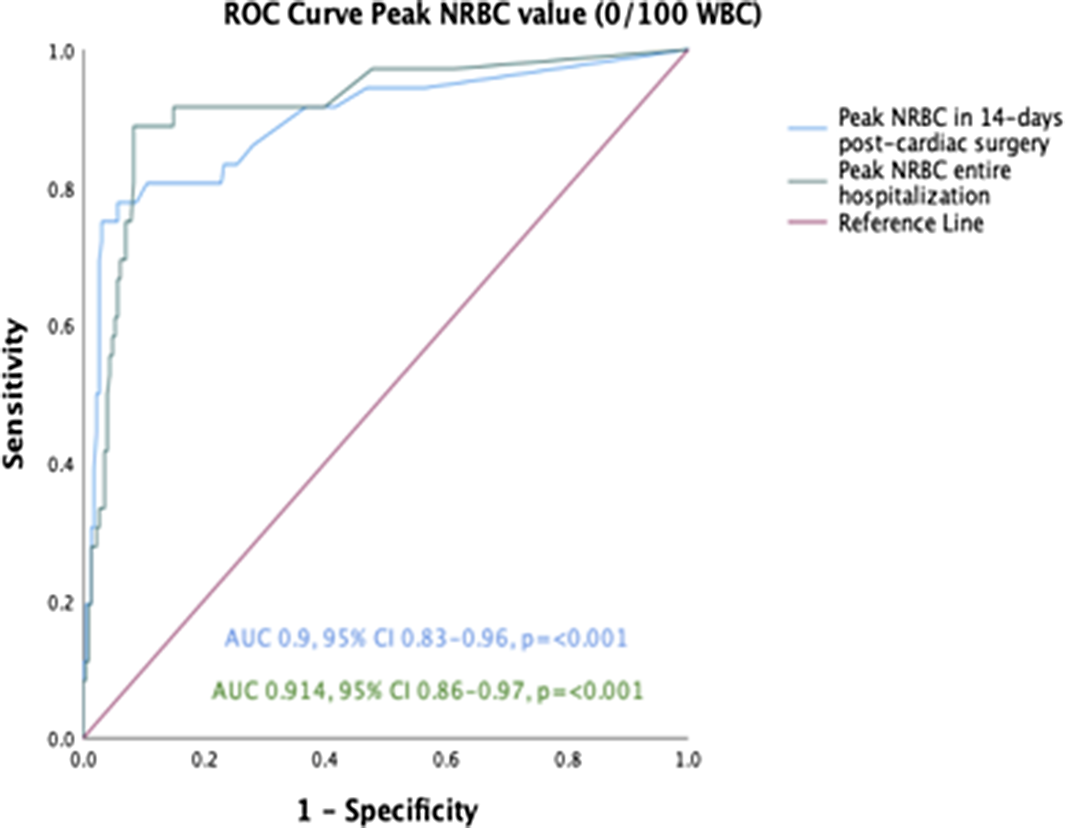
ROC curves were performed for the continuous variables (1) NRBC peak in the 14-day period post-cardiac surgery and (2) NRBC peak during entire hospitalisation. ROC curve for the NRBC peak in 14 days post-cardiac surgery had an AUC of 0.9 (95% CI 0.83–0.96, p ≤ 0.001), while the ROC curve for NRBC peak during entire hospitalisation had an AUC of 0.914 (95% CI 0.86–0.97, p ≤ 0.001) (Fig 1). Both suggesting that NRBC value appears to be an accurate biomarker for mortality.
ROC Curve for Peak NRBC value in 14-day period post-cardiac surgery and during entire hospitalisation.

Discussion
Identification of a clinical biomarker that can help predict mortality and recovery in critically ill neonates, post-cardiac surgery would prove to be invaluable. While the presence of NRBCs in the peripheral circulation prior to morality has been well described in adults, trending NRBC value as a biomarker to monitor for mortality risk or likelihood of recovery following periods of clinical stress in neonates post-cardiac surgery has yet to be described. Reference Constantino and Cogionis1,Reference Stachon, Segbers, Holland-Letz, Kempf, Hering and Krieg8,Reference Schaer, Schmugge and Frey9 The potential uses as a biomarker, appear to be many and could prove to be a vital piece of clinical data when determining the clinical trajectory of critical neonates post-surgically or in the peri-operative period.
In our cohort, 32/36 (88.9%) patients who died experienced an NRBC value ≥10/100 WBC at some point post-operatively during their hospital stay, while 21/228 (9.2%) patients who survived experienced an NRBC value ≥10/100 WBC. Experiencing more than one clinical event post-operatively, which resulted in an NRBC value ≥10/100 WBC was not associated with a greater risk of mortality. Our study suggests that those experiencing an NRBC value of ≥10/100 WBC post-operatively should not be ignored and may carry as much as a 16-fold greater risk of mortality. Trending this number over time following cardiac surgery or following clinical events in the post-operative period may help determine if recovery is likely or if the patient is responding or deteriorating following a clinical intervention. The sensitivity (89%) and specificity (90.8%) suggest NRBC ≥10/100 WBC may be a useful cut-off value for monitoring mortality risk in neonates post-cardiac surgery.
ROC curves were performed using the continuous variables (1) NRBC peak in the 14 days period following cardiac surgery and (2) NRBC peak during the entire hospitalisation and suggest NRBC value may be an accurate biomarker for monitoring mortality risk (Fig 1). Interestingly, while both variables appear to function accurately as a biomarker for mortality, the peak NRBC value throughout the hospital course had a higher AUC (0.914 versus 0.9). This is important because it highlights that while there is substantial risk in the immediate post-operative period, in many patients there is continued risk until discharge, which can be monitored by trending the NRBC value. It also suggests that the NRBC value during the hospital course is an accurate biomarker for predicting mortality.
While the following comments are observations that require more study to validate, we felt it was important to share some interesting observations. While an NRBC value above ≥10/100 WBC appears to be clinically important, absolute values beyond that appear less important. Instead, the NRBC trend appears useful in helping determine clinical trajectory following surgery or clinical events. For example, we observed patients with NRBC values >400/100 WBC in whom the trend normalised, and eventually went on to survive to discharge, while others had values ≥10/100 WBC in whom the NRBC value never normalised, and ultimately died. Interestingly, there were patients who underwent complex operations such as the Norwood procedure, who returned to the cardiac intensive care unit on ECMO support but who experienced no increase in NRBC value whatsoever, and who survived to discharge while others with less complex cardiac surgery showed elevations in NRBC following surgery or following a significant clinical event, who ultimately died. All patient in our cohort who died had an elevated NRBC value at the time of death, while all patients who survived to discharge had a normal NRBC value at that time. When analysing those who underwent CPB versus those who did not and analysing differences by STAT category, there was no independent association with mortality by multi-variable analysis. Additionally, having an elevated NRBC value prior to surgery was not independently associated with mortality by multi-variable analysis. Steroid use in the peri-operative periods was also analysed and was not found to be associated with mortality, nor did we see significant increases in NRBC value following steroid administration.
We feel NRBC trend in the post-operative period following neonatal congenital heart surgery has true potential as a clinical biomarker for mortality as well as for monitoring recovery and survival, particularly following cardiac surgery as well as in the post-operative period following clinical events. The final points regarding the potential use of NRBC as a biomarker following neonatal cardiac surgery is its practicality and cost profile. The NRBC value is routinely reported on a standard complete blood cell count with differential, so the value is often available daily in the cardiac critical care setting, which allows for easy trending at no additional cost. It merely requires close monitoring of the NRBC trend and correlation with clinical events and changes. We feel these findings are exciting and important, however, we recognise that larger, multi-institutional studies are needed to validate these findings.
Conclusion
In our single centre cohort of neonates, an NRBC value ≥10/100 WBC following cardiac surgery and an elevated NRBC value in the 14-day period post-cardiac surgery may be associated with mortality. Additionally, NRBC value may have potential as a biomarker for monitoring mortality risk post-cardiac surgery.
Limitations
There are several limitations of this study, including the retrospective nature of this study, which does not allow determination of causality but only association. Also, this is a single-institution study with a small number or mortalities. Due to the fact that this was a retrospective study, data were obtained from the medical records which relies on accuracy of documentation. Therefore, it is possible that clinical events could have been missed if they were not documented. It is important to note that until 2018, lactate was not consistently monitored at our institution, therefore it was not possible to analyse as a potential confounding variable for mortality.
Acknowledgements
We would like to thank Marla Johnston for her help with protocol development and IRB submission. We would also like to thank Sanchitha Guruchandrasekar for her help with data collection.
Financial support
This research received no specific grant from any funding agency, commercial or not-for-profit sectors.
Conflicts of interest
None.