INTRODUCTION
Cryptosporidium spp. and Giardia spp. are intestinal protozoan parasites which are recognized as prevalent and wide-spread pathogens of humans and many other species of mammals. Both parasites share a broad host range, including livestock, companion animals and wildlife (Bednarska et al. Reference Bednarska, Bajer and Siński1998; Kloch et al. Reference Kloch, Bednarska and Bajer2005; Bajer and Bednarska, Reference Bajer and Bednarska2007; Paziewska et al. Reference Paziewska, Bednarska, Niewęgłowski, Karbowiak and Bajer2007). Both cryptosporidiosis and giardiosis are believed to be zoonoses (Monis and Thompson, Reference Monis and Thompson2003; Smith et al. Reference Smith, Caccio, Tait, Mclauchlin and Thompson2006; Xiao and Fayer, Reference Xiao and Fayer2008). Each comprises complexes of different species and genotypes, with a number of pathogenic species/genotypes, some of which are specific to humans, others being zoonotic (Xiao et al. Reference Xiao, Fayer, Ryan and Upton2004; Caccio et al. Reference Caccio, Thompson, Mclauchlin and Smith2005; Smith et al. Reference Smith, Caccio, Tait, Mclauchlin and Thompson2006). Many studies on Cryptosporidium and Giardia distribution have been conducted in a range of animals world-wide, including insects, birds, shellfish, game animals, pets and livestock (Szostakowska et al. Reference Szostakowska, Kruminis-Łozowska, Racewicz, Knight, Tamang, Myjak and Graczyk2004; Graczyk et al. Reference Graczyk, Conn, Lucy, Minchin, Tamang, Moura and da Silva2004, Reference Graczyk, Majewska and Schwab2008; Paziewska et al. Reference Paziewska, Bednarska, Niewęgłowski, Karbowiak and Bajer2007; Appelbee et al. Reference Appelbee, Thompson and Olson2005). Small mammals including commensal and rural rodents have also been studied extensively (Marino et al. Reference Marino, Brown, Waddington, Brockie and Kelly1992; Bull et al. Reference Bull, Chalmers, Sturdee and Healing1998; Chalmers et al. Reference Chalmers, Sturdee, Bull, Miller, Betts, Casemore, Fricker, Smith and Watkins1995, Reference Chalmers, Sturdee, Bull, Miller and Wright1997; Bajer et al. Reference Bajer, Bednarska, Pawelczyk, Behnke, Gilbert and Sinski2002; Kimura et al. Reference Kimura, Edagawa, Okada, Takimoto, Yonesho and Karanis2007).
However, there are not many studies on the ecology of these parasites in naturally infected hosts. Rodents constitute a very good model for such studies due to the high heterogeneity and dynamics of their populations which facilitates investigations on the contribution of intrinsic and extrinsic factors. Little is currently known about the long-term dynamics of intestinal protozoa in host species, due to the limited number of long-term studies in naturally infected populations. In our previous studies extrinsic factors, such as season and year of study, had much stronger influence on prevalence and abundance of protozoa than intrinsic factors (host age and sex) (Bajer et al. Reference Bajer, Bednarska, Pawelczyk, Behnke, Gilbert and Sinski2002).
We also reported a very high value for parasite prevalence in studied hosts. The aims of this present study were (1) to evaluate the stability of intestinal protozoa infections in these 3 host species by the monitoring of infection during a long time-period (8-year study at 1 site); (2) to confirm the wide distribution of these parasites in Mazury Lake district by extending the study area to include ecologically similar but spatially isolated study sites (4-year study at 3 sites) and finally (3) to confirm the significance of selected ecological factors affecting infection parameters in rodent populations. Improved knowledge of the ecology of these parasites in naturally infected rodent populations will result in a better understanding of the epidemiology of these opportunistic protozoa in nature.
MATERIALS AND METHODS
Study sites and collection of rodents
Study sites were located in the Mazury Lake District region of N.E. Poland. Rodents were caught alive in locally constructed wooden traps. Trapping was conducted in 2 different habitats. Common vole (Microtus arvalis) populations were studied for 5 years (in 1997–2000 and 2003–2004) on abandoned agricultural fields situated near the field station of the University of Warsaw in Urwitałt. The majority of common voles were caught during the summer period (July/August) in each year.
Forest species – bank vole (Myodes glareolus) and yellow-necked mouse (Apodemus flavicollis) – were sampled over an 8-year period during 3 seasons (spring, summer, autumn) in mature woodland located in the vicinity of the field station in Urwitałt (site 1). Additionally, these 2 species were trapped in 2 other woodland sites situated near the towns of Ryn (site 2 named ‘Tałty’) and Pisz (site 3 named ‘Pilchy’) in spring (May/June) and autumn (September/October) in 2001–2004. These 3 woodlands have been fully described by Behnke et al. (Reference Behnke, Barnard, Bajer, Bray, Dinmore, Frake, Osmond, Race and Sinski2001).
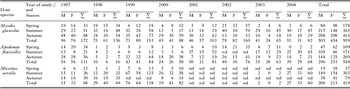
Procedures in the field have been described in detail (Bajer et al. Reference Bajer, Bednarska, Pawelczyk, Behnke, Gilbert and Sinski2002). The months between March and November were divided into 3 seasons, comprising spring (March to early June), summer (late June to mid-September) and autumn (late September to November). The number of sampled host by year, season, site of study and host sex are shown in Table 1. Host relative density was estimated to enable comparison of the dynamics of each of the host populations between the years of the study. The density of rodents was expressed as the number of trapped animals divided by the product of the number of traps set and the duration of trapping hours ×104.
The structure of the sampled host populations by year, season, host species and sex, (A) in an 8-year period in Urwitałt and (B) in a 4-year period in 3 forest sites
(A)

M, males.
F, females.
(B)

M, males.
F, females.
Sampling of hosts
At the field station in Urwitałt, all animals were inspected, identified, sexed, relevant morphometric data were recorded and they were weighed (to the nearest 0·5 g). After inspection most animals were marked and released as near as possible to the original site of capture, whilst others (approx. 35%) were killed for recovery of endoparasites (data to be published elsewhere).
Ageing rodents
Three age classes were established on the basis of body weight (Morris, Reference Morris1972) and sexual development, supported with dry lens weight (when available), corresponding to immature juveniles (age class 1), young mature animals (age class 2) and adults (age class 3) (see Behnke et al. Reference Behnke, Barnard, Bajer, Bray, Dinmore, Frake, Osmond, Race and Sinski2001; Bajer et al. Reference Bajer, Bednarska, Pawelczyk, Behnke, Gilbert and Sinski2002).
Faecal analysis
Individual faecal samples were collected from the traps of the captured rodents. Detection of Cryptosporidium spp. and Giardia spp. infections was done using an immunofluorescent assay (IFA) MerIFluor Cryptosporidium/Giardia (Meridian Diagnostics, Cincinnati, Ohio, USA) on samples condensed by the Sheather's flotation technique as described previously (Bajer et al. Reference Bajer, Bednarska, Pawelczyk, Behnke, Gilbert and Sinski2002). Intensity/abundance of infection were expressed as the number of cysts/oocysts/ml of concentrated sediment.
A few pellets were used to prepare thin faecal smears that were stained according to the modified Ziel-Neelsen technique (Henriksen and Pohlenz, Reference Henriksen and Pohlenz1981), after drying and fixation in methanol. Then 200 fields of vision under ×400 magnification were carefully examined on each slide for the presence or absence of Cryptosporidium oocysts. These were identified on the basis of their size (4–5×3·5–4·5 μm), general morphology and bright red/pink colour. For some animals (<15%) only this method provided evidence of infection and in such cases we recorded a minimum detectable intensity, entered into the quantitative analysis as 400 oocysts/ml of concentrated sample (Bajer et al. Reference Bajer, Bednarska, Pawelczyk, Behnke, Gilbert and Sinski2002).
Statistical analysis
Prevalence (percentage of animals infected) was analysed by maximum likelihood techniques based on log linear analysis of contingency tables, implemented by the software package, SPSS v. 14. For each parasite species in turn, prevalence of infection as a binary factor (infected =1, not infected =0) and then host species (3 levels, M. glareolus, A. flavicollis and M. arvalis), year (number of levels depending on sampling period), host age (3 levels), host sex (2 levels) and additionally site (3 levels) were entered as factors. Beginning with the most complex model, involving all possible main effects and interactions, those combinations not contributing significantly to explaining variation in the data were eliminated stepwise, beginning with the highest-level interaction. A minimum sufficient model was then obtained, for which the likelihood ratio of χ2 was not significant, indicating that the model was sufficient in explaining the data. The analysis of prevalence of infection was first conducted for all 3 host species together, and when host species appeared as a significant main effect, the analysis was repeated for each host species and parasite species separately. Season of study (3 levels, spring, summer and autumn) was involved in analysis of prevalence where appropriate data were available (Table 1). Two datasets were analysed separately: (1) Cryptosporidium spp. and Giardia spp. in 3 host species in Urwitałt over the 8-year period (1997–2004), (2) Cryptosporidium spp. and Giardia spp. in 2 host species (M. glareolus, A. flavicollis) in 3 sites over a 4-year period (2001–2004).
Quantitative data reflecting parasite abundance within hosts were expressed as geometric means (GM) because the data were highly overdispersed (Elliott, Reference Elliott1977; Dash et al. Reference Dash, Hall and Barger1988). These means reflect the abundance of infection as defined by Margolis et al. (Reference Margolis, Esch, Holmes, Kuris and Schad1982) and include all subjects within the specified group, infected and not infected, for which relevant data were available.
Parasite abundance was analysed by multifactorial GLM using models with normal errors after normalization of the data by Log10 (x+1) transformation (Crawley, Reference Crawley1993; Wilson and Grenfell, Reference Wilson and Grenfell1997). The same factors and the same approach as that used for analysing prevalence were employed for analysis of abundance.
Co-occurrence of intestinal parasites was analysed by maximum likelihood techniques based on log linear analysis of contingency tables (in SPSS v. 14), with both species fitted as a binary (infected=1, not infected=0 with Cryptosporidium spp., and infected or not infected with Giardia spp.). Quantitative associations between parasites were examined by correlation analysis (Spearman rank-order correlation test) of raw parasite data from animals carrying both species.
RESULTS
Rodents sampled
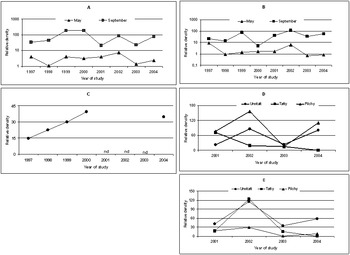
Overall a total of 2579 rodents were sampled over the 8-year period and of these 59% were bank voles, 24·7% were yellow-necked mice and 16·2% were common voles. The structure of the sampled host population by year, season, site, host species and sex is summarized in Table 1. Dynamics of host relative densities are presented in Appendix 1.
Overall summary statistics
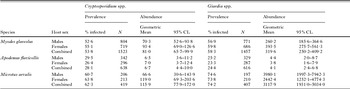
Overall prevalence and abundance values across the 8 years of the study by host species and by host sex are presented in Table 2. The highest prevalence and abundance of Cryptosporidium were found in M. arvalis compared with woodland host species, and both parameters were considerably lower in A. flavicollis. Much the same picture emerged for Giardia spp. except that prevalence was relatively higher across both vole species and abundance more intense. The data indicate that over a long time-scale A. flavicollis was the least important reservoir host for both species of intestinal protozoa. However, in addition to the variation arising from between host differences and from sexes, animals were sampled across years of study, 3 seasons and 3 sites and samples comprised animals of different age. The analysis that follows quantifies the relative contribution of each factor and their interactions to variation in distribution of intestinal protozoa in the 3 rodent species.
Overall prevalence and abundance of Cryptosporidium spp. and Giardia spp. in rodent hosts
(All host species, all sites and all years combined.)

The dynamics of Cryptosporidium spp. and Giardia spp. in three host species during an eight-year period in Urwitałt
The effect of host species, sex and age was analysed in a dataset comprising 1927 animals trapped in Urwitałt. In the resulting minimal sufficient model for Cryptosporidium, the influence of host species on prevalence was marked (host species×Cryptosporidium prevalence; χ2=138·7, d.f.=2, P<0·001; goodness of fit for model: χ2=13·8, d.f.=13, P=0·338). Cryptosporidium spp. prevalence was 57·5, 28·6 and 62·3% respectively for M. glareolus, A. flavicollis and M. arvalis. Also the multifactorial GLM generated one strong main effect of host species on the abundance of Cryptosporidium (F2, 1926=66·3, P<0·001). As earlier in the analysis of prevalence, abundance was higher in the two vole species (geometric mean [GM] in M. glareolus=96·5 [75·0–124·0]; in M. arvalis=115·9 [77·9–172·0]) than in yellow-necked mice (GM=6·9 [4·4–10·6]).
Due to this strong influence of host species on both infection parameters, the analysis was repeated for each host species separately using full factorial models with year and season of study, host sex and age as factors.
The dynamics of Cryptosporidium spp. in M. glareolus
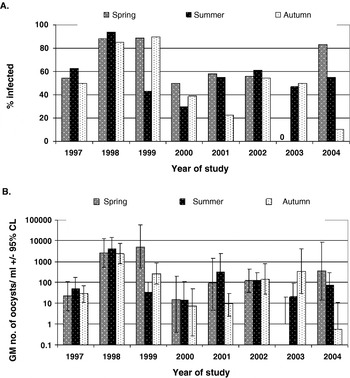
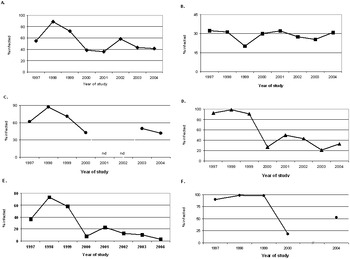
This dataset consisted of 959 bank voles trapped in the Urwitałt forest site during the 8-year period. In analysis of the prevalence of Cryptosporidium spp., 2 interaction terms comprised the minimal sufficient model (goodness of fit: χ2=62·4, d.f.=80, P=0·927). The year of study was a component of both interactions (year×season×Cryptosporidium prevalence: χ2=25·1, d.f.=14, P<0·001; year×sex×age×Cryptosporidium prevalence: χ2=79·4, d.f.=14, P=0·034) but no further simplification of the model was justified. Cryptosporidium spp. infection in the bank vole population clearly showed dynamic changes over a long time-frame, with a maximum infection rate in 1998 (89% prevalence) and dropping to half this value in other years (39% in 2000; 36% in 2001) (Appendix 2A).
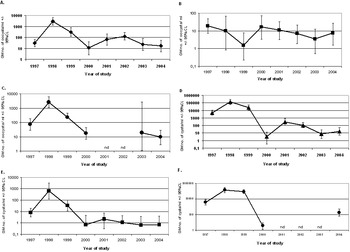
Multifactorial GLM generated a simpler model for the abundance of Cryptosporidium spp. with 2 main effects (year of study and host age) and 1 interaction of year and season of study. The geometric mean number of Cryptosporidium oocysts produced by the bank vole population underwent similar fluctuations to prevalence rates over the 8-year period of study (main effect of year on Cryptosporidium abundance: F7, 958=66·3, P<0·001) (Appendix 3A). Again, the highest GM was noted in year 1998 (over 2970 oocysts/ml [1373–6411]) and the lowest in year 2000 (11·4 oocysts/ml [2·5–42·5]).
The between-year dynamic changes in prevalence and abundance of Cryptosporidium and no consistent pattern of seasonal changes observed in consecutive years for both infection parameters (Fig. 1A, B) were responsible for the year×season interactions in the minimal sufficient models (year×season×Cryptosporidium prevalence: χ2=25·1, d.f.=14, P<0·001; year×season×Cryptosporidium abundance: F14, 958=3·95, P<0·001). No consistent pattern of seasonal changes was evident, with peaks occurring in all seasons (3 of 8 peaks in spring and 3 in summer, 2 in the autumn) depending on the year of study. In 2002 both prevalence and abundance were very similar across 3 seasons; in 2003 a step-wise increase in both parameters was observed across the seasons but in 2004 the pattern was reversed (Fig. 1A, B).
Annual changes in seasonal dynamics of Cryptosporidium spp. infections in bank voles in Urwitałt. (A) Prevalence dynamics. (B) Abundance dynamics.

Both intrinsic factors – host sex and age – were involved in the interaction with year and presence/absence of Cryptosporidium, but this could not be further simplified. However, host age constituted a main effect in the analysis of the abundance of Cryptosporidium (F2, 958=4·46, P=0·012). The geometric mean number of Cryptosporidium oocysts produced by juvenile bank voles (age class 1) was as much as 4 times higher than in the two other age classes (GM=193·1 [99–376·6] vs 67·1 [38·5–116·5] and 50·2 [27·0–92·5], in age class 1, 2 and 3, respectively). Also, prevalence was highest in juvenile voles, with a tendency to decrease in older age classes (62·7% vs 58 and 51·3% in age class 1, 2 and 3, respectively).
Host sex did not appear in statistical analyses as a significant factor influencing Cryptosporidium infection in bank voles.
The dynamics of Cryptosporidium spp. in A. flavicollis
This dataset consisted of 549 yellow-necked mice trapped in the Urwitałt forest site over the 8-year period. In analysis of both prevalence and abundance of Cryptosporidium spp., none of the initially fitted extrinsic or intrinsic factors significantly affected either infection parameter. Overall prevalence and abundance were the lowest in this host species (28·6% and GM=6·9 oocysts/ml). Very little variation was observed in prevalence across age classes (in range 27–30%), between 3 seasons (26–33%) and sexes (30·1% in males, 27% in females). However, some non-significant fluctuations were noted between years over the long term, with a minimal infection rate of 20·2% in 1999 and a maximum of 32% in 1997 and 2001 (Appendix 2B). The same picture was found for abundance (Appendix 3B). Females excreted higher numbers of oocysts than males (GM=11·1 [5·6–21·4] vs 5·4 [2·5–10·6]) but again this difference was not significant.
The dynamics of Cryptosporidium spp. in M. arvalis
This dataset consisted of 419 common voles trapped on the Urwitałt fallow site in 6 years, mainly in summer time, so season was excluded from statistical analysis (Table 1). In analysis of both prevalence and abundance of Cryptosporidium spp., only the year of study appeared as a significant factor (year×Cryptosporidium prevalence: χ2=49·0, d.f.=5, P<0·001; main effect of year on the abundance of Cryptosporidium: F5, 418=18·8, P<0·001). Between-year dynamics in prevalence and abundance of Cryptosporidium in the common vole population are shown in Appendices 2C and 3C, respectively. Both infection parameters were at their highest in 1998 (87% and GM=2617 [1090–6265]) and lowest in 2004 (41·7% and GM=9·6 [2·8–28·6]).
As in the bank vole population, the same tendency was observed in common voles with respect to the effects of host age on the prevalence and abundance of Cryptosporidium. The geometric mean number of excreted oocysts was higher in age classes 1 and 2, in comparison to the oldest voles (GM=119·5 [56·8–250·2] and 102·8 [40·4–259·6] vs 55·9 [24·8–124·6], in age class 1, 2 and 3, respectively). Prevalence was slightly higher in juvenile voles (66·7% vs 57·7 and 62·3% in age class 1, 2 and 3, respectively).
Prevalence and abundance were similar in each vole sex (60·7% and GM=66·6 [30·6–143·9] in males, 63·8% and GM=119·0 [69·3–203·6] in females).
The dynamics of Giardia spp. in three host species during an eight-year period in Urwitałt
The effect of host species, sex and age was analysed in a dataset comprising 1858 animals trapped in the Urwitałt site. The influence of host species was a significant component of the minimal sufficient model for the prevalence of Giardia (host species×Giardia prevalence; χ2=267·4, d.f.=2, P<0·001; goodness of fit for model: χ2=10·2, d.f.=10, P=0·42). The prevalence of Giardia spp. was 64·8, 25·9 and 74·2% for M. glareolus, A. flavicollis and M. arvalis, respectively. Multifactorial GLM revealed only the main effect of host species on the abundance of Giardia (F2, 1857=195·9, P<0·001). Similarly to prevalence, abundance was higher in the 2 vole species (GM for M. glareolus=726·8 cysts/ml [536·0–987·6]; for M. arvalis=3117·9 [1931–5034]) than in yellow-necked mice (GM=5·0 [2·7–8·6]).
Because of this strong effect of host species on both infection parameters, the analysis was repeated for each host species separately using full factorial models.
The dynamics of Giardia spp. in M. glareolus
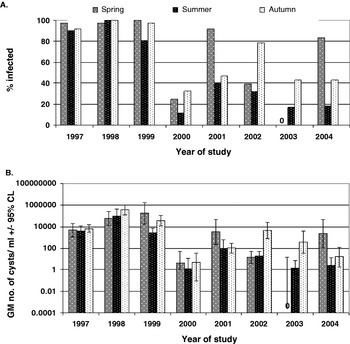
This dataset consisted of 922 bank voles trapped in the Urwitałt forest site during the 8-year period. Minimal sufficient models for the prevalence of Giardia spp. incorporated 2 interactions (goodness of fit: χ2=97·5, d.f.=115, P=0·88). Year of study was an essential component of the first interaction (year×season×Giardia prevalence: χ2=42·7, d.f.=14, P<0·001) and no further simplification of the model was justified. Infections with Giardia spp. in the bank vole population showed clear dynamics over the long term, exceeding >90% in the first 3 years of the study (1997–1999) but then dropping lower in subsequent years with a dip to below 30% in 2000 (Appendix 2D).
Multifactorial GLM generated a simpler model for the abundance of Giardia spp. with 2 main effects (year and season of study) and a single interaction between these factors. The geometric mean number of Giardia cysts produced by the bank vole population showed significant fluctuations over the period of 8 years, similar to those described for prevalence (main effect of year on Giardia abundance: F7, 921=57·8, P<0·001) (Appendix 3D). Again the highest GMs were noted in 1998–99 (about 140 000 and 24 000 cysts/ml, respectively) and the lowest in 2000 and 2003 (below 10 cysts/ml).
The between-year dynamics in prevalence and abundance of Giardia and the variable patterns of seasonal changes observed for both infection parameters in consecutive years (Fig. 2A, B) were responsible for the year×season interactions in the minimal sufficient models (year×season×Giardia prevalence: χ2=42·7, d.f.=14, P<0·001; year×season×Giardia abundance: F14, 921=3·9, P<0·001). No consistent pattern of seasonal changes was evident, with peaks occurring mostly in spring or autumn depending on the year of study (Fig. 2). Generally, the lowest values of both prevalence and abundance were observed in the summer months, a conclusion supported by the significant main effect of season on the abundance of Giardia (F2, 921=14·9, P<0·001) (GM=142·9 cysts/ml in summer [87·1–234·5], and GM=710·2 [336·3–1495·2] and 1108·2 [647·6–1895·7] cysts/ml in spring and autumn, respectively). Overall infection rates for Giardia spp. were 70·1, 53·9 and 71·9% in spring, summer and autumn, respectively.
Annual changes in seasonal dynamics of Giardia spp. infections in bank voles in Urwitałt. (A) Prevalence dynamics. (B) Abundance dynamics.

Both intrinsic factors were involved in an independent interaction influencing the prevalence of Giardia (sex×age×Giardia prevalence: χ2=11·4, d.f.=2, P=0·003). The highest infection rate was found in age class 2 (young adults) for male voles (66·7%) but in females the highest prevalence was observed in age class one (75%). However, with sexes combined, the prevalence of Giardia did not vary significantly across age classes, being slightly higher in youngest bank voles (age class 1 – 68·2%, age class 2 – 63·3%, age class 3 – 62·7%). The mean number of excreted cysts was 270·0 [159–458] in age class 2, 500·2 [262–954] in age class 1 and 748·9 [330–1336] in the oldest group of voles (NS).
Host sex did not appear in statistical analysis as a significant factor influencing Giardia infection in bank voles.
The dynamics of Giardia spp. in A. flavicollis
This dataset consisted of 529 yellow-necked mice trapped in the Urwitałt forest site over the 8-year period. The year of study was the only component of the minimal sufficient models for the prevalence and abundance of Giardia spp. (year×Giardia prevalence: χ2=111·8, d.f.=7, P<0·001; main effect of year on abundance of Giardia: F7, 528=7·7, P<0·001). Significant fluctuations were noted between years over the long-term period, with a minimal infection rate of 2·9% in 2004 and a maximum prevalence of 73·3% in 1998 (Appendix 2E). A similar pattern was found for abundance; the lowest GM number of cysts was excreted in the years 2003 and 2004 (GM<1), and the highest, over 630 cysts/ml, in 1998 (Appendix 3E).
Although there was some variation in infection parameters between seasons, generally following the same pattern as for Giardia infection in the bank vole population, these were not significant. The prevalence rate was 18·2% during the summer months and 32·6% in autumn. Abundance was very similar in spring and summer (GM=3·95 [1·28–9·81] and 4·37 [1·69–9·74], respectively) and slightly higher in autumn (GM=9·0 [4·9–16·0]).
There was little age-related variation in prevalence (age class 1 – 17·1%, age class 2 – 26·1%, age class 3 – 28·4%; NS) and abundance (in range 3·3–7·3 cysts/ml). No differences were found between the sexes (Giardia prevalence: 27·0% in males, 24·6% in females; abundance 6·9 [3·6–12·4] in males, 4·6 [2·3–8·6] in females).
The dynamics of Giardia spp. in M. arvalis
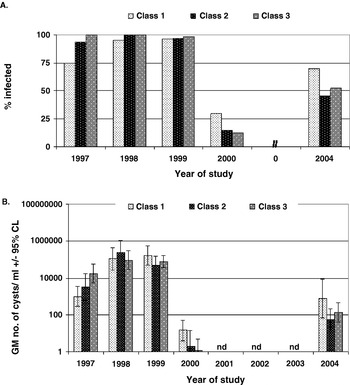
This dataset consisted of 407 common voles trapped in the Urwitałt fallow site over 5 years, with season excluded from the statistical analysis (Table 1A). In analysis of the prevalence and abundance of Giardia spp., the year of study was a significant main factor, contributing to 3 significant interactions (year×age×Giardia prevalence: χ2=18·4, d.f.=8, P=0·019; main effect of year on abundance of Giardia: F4, 406=131·7, P<0·001). Between-year variation in the prevalence and abundance of Giardia in the common vole population is presented in Appendices 2F and 3F, respectively. Both infection parameters were elevated in 1998 (98·5% and GM=136 457 [62 516–298 537] cysts/ml) and the lowest in 2000 (18·3% and GM=3·62 [1·17–8·84] cysts/ml). In both minimal sufficient models, the interactions of year of study with host age were significant components of the model (year×age×Giardia prevalence: χ2=18·37, d.f.=8, P=0·019; 2-way interaction of year×age on the abundance of Giardia: F8, 406=2·79, P=0·005) (Fig. 3A, B). The highest infection rates (in the range of 98–100%) were observed in age class 3 during the first 3 years of the study (1997–99), and the lowest in 2000. In other years with much lower overall prevalence of Giardia, the highest infection rates were found in juvenile voles (age class 1). However, a different pattern was observed in respect of abundance. The overall highest GM number of Giardia cysts was noted in age class 2 in 1998 (GM=245 470), but in 3 years (1999, 2000 and 2004) highest abundance was detected in age class 1.
Annual changes in Giardia spp. dynamics across 3 age classes in common voles in Urwitałt. (A) Prevalence dynamics. (B) Abundance dynamics.

Due to these diverse patterns of age-related differences in both infection parameters, the main effect of host age was not significant. The overall prevalence of Giardia was very similar in the 3 age classes (ranging from 72·5 to 75%). The mean number of excreted cysts showed no significant variation between age classes; GM for age class 1=2971 [1475–5997], age class 2=1441 [744–2792], age class 3=2083 [1296–3349].
The prevalence of Giardia was almost identical in both vole sexes (74·6% in males, 73·8% in females), and the mean number of excreted cysts was similar in female and male voles (males – 3980·1 [1997·3–7942·3], females – 2442·4 [1252·1–4774·3]; NS).
The dynamics of Cryptosporidium spp. and Giardia spp. in two host species during a four-year period in three forest sites
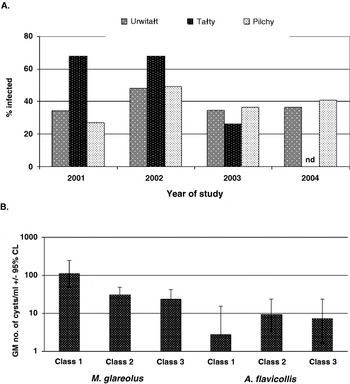
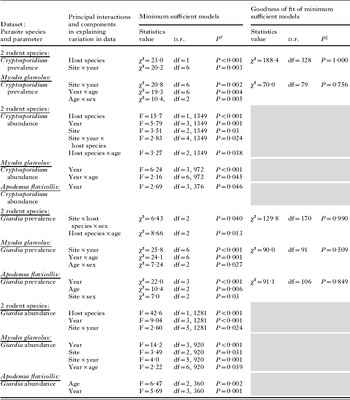
The effects of site in relation to other significant factors – year of study, host species, sex and age was analysed in a dataset comprising 1350 animals trapped in 3 separated forest sites. Appropriate minimal sufficient models from analysis of prevalence and abundance for the two parasites are presented in Table 3. Site appeared as a main effect in the analysis of abundance and was an essential component in an interaction with year (site×year×Cryptosporidium prevalence: χ2=20·2, d.f.=6, P=0·003) in the minimal sufficient model for the prevalence of Cryptosporidium. During the first 2 years of the study, 2001–2002, the highest prevalence (about 68%) was observed in rodents at the Tałty site (Fig. 4A). Then, a clear reduction in prevalence was observed in 2003. The prevalence of Cryptosporidium was similar at Urwitałt and Pilchy, but peaked in 2002. Overall, the prevalence of Cryptosporidium did not vary significantly between the 3 forest sites being 39·5, 54·1 and 40·6% for rodents from Urwitałt, Tałty and Pilchy, respectively. However, the geometric mean number of Cryptosporidium oocysts excreted by 2 rodent species was twice as high at the Tałty site (GM=35·6 [16·3–76·6]) compared to the other 2 sites (Urwitałt: GM=17·1 [11·3–25·8]; Pilchy: GM=15·9 [7·8–31·5]) (main effect of site on abundance of Cryptosporidium: F2, 1349=3·51, P=0·03).
(A) Between-year and between-site differences in Cryptosporidium spp. prevalence in rodents in the 3 study sites. (B) The effect of host species and age on Cryptosporidium spp. abundance in rodents in the 3 sites.

Minimum sufficient models of factors affecting the intestinal parasites prevalence and abundance in 2 rodent species in 3 forest sites

P† – Probability that excluding the effect will make a significant change to the model.
P‡ – Probability that the data do not differ significantly from the minimum sufficient model described by the principal interactions and components.
Dark fields- goodness of fit of minimum sufficient model not tested.
Differences between host species, between-year dynamics as well as the influence of host age were generally similar to that found in the first dataset (8 years in Urwitałt) so only one significant interaction of host species and age on Cryptosporidium abundance (Table 3) is illustrated in Fig. 4B. The mean number of excreted oocysts was the highest in juvenile bank voles and lower and identical in the 2 older age classes. However, in yellow-necked mice the pattern was reversed (Fig. 4B).
Host species appeared in significant interaction in the analysis of the abundance of Cryptosporidium (3-way interaction, site×year×host species; Table 3). In 2001, for both host species, the highest Cryptosporidium abundance was observed at the Tałty site. However, in 2003 Cryptosporidium was once again most prevalent at the Tałty site in A. flavicollis, but this time Talty was the site of the lowest prevalence for the bank vole populations.
Due to the strong influence of host species on both infection parameters, analysis was repeated for each host species separately using full factorial models with year and site of study, host sex and age as factors.
The dynamics of Cryptosporidium spp. in M. glareolus
This dataset consisted of 973 bank voles trapped in 3 forest sites in the 4-year period. Site did not appear as a significant factor influencing either infection parameter but was a component of one 2-way interaction in the minimum sufficient model for prevalence (Table 3). As in the earlier analysis combining both host species (Fig. 4A), in the first 2 years of the study, 2001 and 2002, the highest prevalence (71·8 and 68·1%, respectively) was observed in voles from the Tałty site. However, in 2003 the lowest prevalence was noted at this site in comparison to the other sites. For the bank vole populations in Urwitałt and Pilchy the highest Cryptosporidium prevalence was detected also in 2002 (58 and 51%, respectively).
Overall the prevalence of Cryptosporidium varied only marginally between the bank vole populations from the 3 sites, being 46·7, 60·3 and 43·3% in Urwitałt, Tałty and Pilchy, respectively. Although not significant, the same tendency was observed for the overall abundance of Cryptosporidium. The geometric mean number of excreted oocysts was 68·5 [26·9–172·4] at Tałty site and almost identical in the other 2 sites (Urwitałt: GM=39·4 [24·1–63·7]; Pilchy: GM=33·8 [18·7–60·7]; NS).
The dynamics of Cryptosporidium spp. in A. flavicollis
This dataset consisted of 377 yellow-necked mice trapped in 3 forest sites over a 4-year period. Mouse populations were not sampled at Tałty in the years 2002 and 2004 (Table 1B). None of the fitted extrinsic or intrinsic factors significantly affected the prevalence of Cryptosporidium spp. The prevalence of this parasite was similar in A. flavicollis populations from Urwitałt and Tałty sites (29·2 and 33·3%, respectively) and was half these values in the Pilchy population (17·0%) (NS). A similar tendency was observed for abundance, which was the highest at Tałty (9·2 [1·9–34·6]) and lower in the other 2 sites (Urwitałt GM=6·6 [3·2–12·6]; Pilchy GM=5·4 [0·9–20·5]), but again these differences were not significant.
The dynamics of Giardia spp. in two host species during a four-year period in three sites
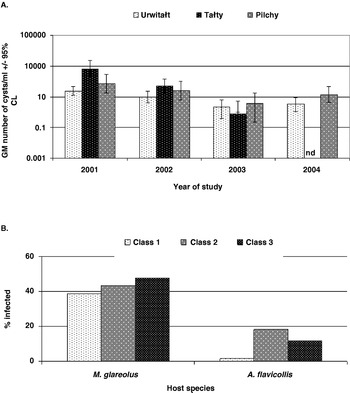
The effects of site in relation to other significant factors – year of study, host species, sex and age were analysed in a dataset comprising 1282 animals trapped in 3 sites. Appropriate minimal sufficient models from analysis of prevalence and abundance of Giardia spp. are presented in Table 3. Site as a factor contributed to two 4-way interactions in analysis of the prevalence of Giardia, and to one 3-way interaction and one 2-way interaction in analysis of the abundance of Giardia. Two complex interactions of weak statistical significance incorporating site, year of study and host age were not analysed further (site×year×age×Giardia prevalence and 3-way interaction of site×year×age on abundance of Giardia). Overall, the prevalence and abundance of Giardia followed a similar pattern in the 3 rodent communities with almost identical values of both infection parameters in Tałty and Pilchy (Tałty: 43·3% and GM=22·0 cysts [9·9–47·4]; Pilchy: 42·3% and GM=19·1 cysts [9·4–38·0]) and with lower values for Urwitałt (28·4% and GM=6·5 cysts [4·1–10·1]). Between-year differences affected abundance of Giardia in the 3 sites (2-way interaction of site×year on abundance of Giardia; main effect of year on abundance of Giardia: Table 3) (Fig. 5A). The highest GM number of excreted cysts was observed in 2001 in the rodents from the Tałty forest (GM=643·2 [169·2–2436·8]). In this year mean abundance was also the highest for the other 2 sites. In 2003, the lowest GM abundance was noted in all 3 rodent communities, being the lowest at the Tałty site.
(A) Between-year and between-site differences in Giardia spp. abundance in rodents in the 3 sites. (B) The effect of host species and age on Giardia spp. prevalence in rodents in the 3 forest sites.

Host species contributed to interaction in the analysis of the prevalence of Giardia (site×species×sex×Giardia prevalence: χ2=6·43, d.f.=2, P=0·040). The interaction arose from the different distribution of Giardia among the two sexes at the different sites, depending on host species. In all 3 populations of bank vole, prevalence was very similar in male and female voles. However, different patterns were noted in mice. In Urwitałt, the prevalence of Giardia among mice was twice as high in males compared with females; in the Tałty population only females were found to be infected with this parasite and at Pilchy Giardia was again more prevalent in males; however, this time the difference between sexes was only 5%.
The significant interaction of host species and age is illustrated in Fig. 5B. Overall prevalence increased with age in bank voles. In yellow-necked mice, the lowest number of infected individuals was found among juvenile mice (1·8%), and the highest in age class 2 mice (18%), being 12% in the oldest mice.
Because of the influence of host species on both infection parameters, analysis was repeated for voles and mice separately using full factorial models with year and site of study, host sex and age as factors.
The dynamics of Giardia spp. in M. glareolus
This dataset consisted of 921 bank voles trapped in 3 forest sites over a 4-year period. Site appeared as a significant factor influencing the abundance of Giardia (Table 3) and contributed to 2 identical interactions in each minimum sufficient model for prevalence and abundance (site×year×Giardia prevalence and site×year on abundance of Giardia; Table 3). The picture of the second interaction was very similar to that found in analysis of 2 host species (Fig. 5A). These interactions arose from the different dynamics of Giardia infections in the 3 sites depending on the year of study. Both infection parameters were at maximum in 2001 in the Tałty population and at a minimum in 2003. In 2004 both infection parameters were higher in the Pilchy population compared with Urwitałt. Generally, there was dynamic variation between-years in the Tałty and Pilchy populations, with values decreasing and increasing, respectively, but either parameter was far more stable in the Urwitałt population.
Significant differences between sites were observed for the overall abundance of Giardia (Table 3). The geometric mean number of excreted cysts was the highest at the Tałty site (GM=74·2 [27·2–199·0]) compared with the other two sites (Urwitałt: GM=22·5 [13·0–38·4]; Pilchy: GM=57·2 [30·4–106·6]). Overall, the prevalence of Giardia showed a similar pattern of variation between sites to abundance (39·6, 53·3 and 45·0% in Urwitałt, Tałty and Pilchy, respectively; NS).
Between-year dynamics, as well as tendencies in influence of host age and sex, were generally similar to that found in the first dataset (8 years in Urwitałt) so they are not going to be described in detail.
The dynamics of Giardia spp. in A. flavicollis
This dataset consisted of 361 yellow-necked mice trapped in 3 forest sites over a 4-year period. Mouse populations were not sampled at Tałty in the years 2002 and 2004 (Table 1B). Interaction of study site and host sex affected Giardia prevalence (Table 3). In the Urwitałt and Pilchy mouse populations Giardia infections were more prevalent in males than females (Urwitałt: males – 16·7%, females – 7·6%; Pilchy: males – 21·4%, females – 16·7%). At Tałty site no infected males were found in comparison to 16% of females being infected. Overall, the prevalence of Giardia was the highest in A. flavicollis populations from Pilchy (19·6%) and lower and similar in the 2 other populations (Urwitałt – 12·8%; Tałty – 9·8%). A similar tendency was observed in respect of abundance, which was the highest at Pilchy (3·9 [1·2–9·7]) and lower in the 2 other sites (Urwitałt GM=1·2 [0·48–2·1]; Tałty GM=1·1 [0–3·8]), but these differences were not significant. As for M. glareolus, between-year dynamics as well as tendencies in influence of host age and sex were generally similar to that found in first dataset (8 years in Urwitałt) so they are not going to be described in detail.
Associations between intestinal protozoa
Associations between parasites based on categorical data
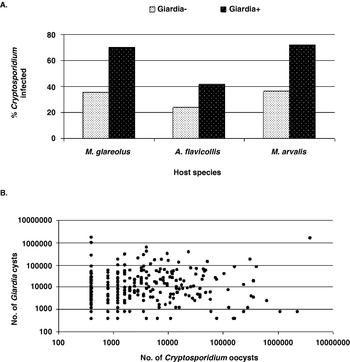
Interactions between parasites were first tested at the level of co-occurrence/exclusion by maximum likelihood analysis of prevalence data. Two datasets (Urwitałt, 8 years and 3 sites, 4 years) were analysed separately. The presence of infection/absence of infection, and the appropriate factors (year, species, age and sex or year, site, species, sex, age) were entered into the analysis. In the analysis of data from the 8-year period in Urwitałt, a single interaction appeared, which incorporated both species of parasites and host species (host species×Giardia prevalence×Cryptosporidium prevalence: χ2=7·42, d.f.=2, P=0·024) (Fig. 6A). Across 3 species of rodents, prevalence of Cryptosporidium spp. was twice higher among individuals that also harboured Giardia spp. Positive co-occurrence of the 2 species was particularly marked in voles (M. glareolus and M. arvalis), but was clearly evident even in A. flavicollis despite much lower prevalence of both intestinal parasites in this host species.
(A) The co-occurrence of Cryptosporidium spp. and Giardia spp. in rodents in Urwitałt. (B) Positive correlation between the intensity of infection with Cryptosporidium spp. and Giardia spp. in rodents in the 3 sites.

In the analysis of the data from the 4-year period in the 3 forest sites, a significant interaction incorporating both species of parasites was also detected, and this was not confounded by any of the fitted factors (Giardia prevalence×Cryptosporidium prevalence: χ2=72·8, d.f.=1, P<0·001). So the positive association (co-occurrence) was independent from the other factors. Again, prevalence of Cryptosporidium spp. was twice as high among individuals that also harboured Giardia spp. (61·1% versus 32·1%).
Associations between species based on quantitative data
Quantitative associations were tested only in rodents carrying both species of parasites. In the first dataset from 8 years study in Urwitałt, 694 animals of 3 species were analysed. In the second dataset from the 4-year study in 3 forest sites there were 277 animals, bank voles and mice. Analysis of the raw data from Urwitałt gave a highly significant positive correlation (r s=0·385, n=694, P<0·001). Moreover, the analysis of the raw data from the 3 sites gave a highly positive correlation between the intensity of infection of Cryptosporidium spp. with Giardia spp. (Fig. 6B; r s=0·277, n=277, P<0·001).
DISCUSSION
The results reported in this paper, based on a long-term study in the Mazury Lake District region of Poland, confirm the role of 3 species of the most common rodents as reservoir hosts of Cryptosporidium spp. and Giardia spp. due to high prevalence and abundance of infections. The role of rodents as a reservoir of pathogens of public health interest depends on the parasite genotypes that actually occur in naturally infected populations. Only 1 Cryptosporidium genotype was found in the rodents sampled here, during our preliminary genotyping studies – C. parvum ‘mouse’ genotype (Bajer et al. Reference Bajer, Caccio, Bednarska, Behnke, Pieniazek and Sinski2003). This genotype is closely related to the zoonotic genotype of C. parvum (previously known as genotype 2 or calf). The C. parvum ‘mouse’ genotype was recently found in an Indian child, thus the zoonotic potential for this genotype has been confirmed (Ajjampur et al. Reference Ajjampur, Gladstone, Selvapandian, Muliyil, Ward and Kang2007). Our preliminary genotyping results for rodent Giardia isolates revealed only 1 genotype – G. intestinalis Assemblage A, a well-known zoonotic genotype widespread among mammals and humans throughout the world (Bajer et al. unpublished). The finding of these zoonotic parasite genotypes supports a role of rodents in the contamination of the environment with parasites cysts/oocysts and calls for recognition of the ecological factors influencing their distribution in natural hosts.
In the present study, during the long-term monitoring of the rodent populations, significant fluctuations were found in both infection parameters (prevalence and abundance). Between-year variation was well marked for both pathogens in bank and common vole populations but was less evident in yellow-necked mouse for Cryptosporidium spp. infections. This variation was found in both the long-term study at Urwitałt site and also over a shorter period in the 4-year study of 3 separated forest sites. The between-year dynamics of infection were more marked for the more common parasite- Giardia spp., than for the somewhat rarer Cryptosporidium spp. For both infection parameters there were clearly evident periods characterized by elevated values of both prevalence and abundance (i.e. years 1997–99 for Giardia infections in Urwitałt or year 2002 for Cryptosporidium infections) and also years with much lower values when infections dipped (i.e. year 2001 or 2003). Because we consistently monitored the relative densities of the rodent populations during the period (Appendix 1), it was possible to link changes in the infection parameters to host population sizes and to establish the host density-dependence of these relationships. They are most apparent during the last 4-year period of the study, when the severe winter of 2002/03 dramatically reduced the populations of all small animals (insects, frogs or mice/voles). So severe was the drop in numbers that we were not able to catch any rodents during a 5-day trapping session at the Pilchy site in May using 300 traps set out in our normal formation. The significant reduction in both infection parameters in both datasets is particularly well reflected in our results in 2003. In contrast, the increase in rodent population densities in the summer of 2002, preceding the severe winter, was associated with a marked increase in the prevalence of Cryptosporidium in bank voles at Urwitalt site and in the prevalence of both intestinal parasites in rodents in the 3 forest sites. Rodent populations constitute unpredictable environments for parasites because of the significant fluctuations in population size between seasons and years (Appendix 1). Years of high density are being interspersed with years of low-density levels. Usually only a small proportion of animals survives the winter period, serving as a source of infection for newly-born cohorts. Parasite infections follow the same pattern. Very similar observations were made for the directly transmitted nematode Syphacia petrusewiczi in bank voles at our study sites (Bajer et al. Reference Bajer, Behnke, Pawełczyk, Kuliś, Sereda and Siński2005). The importance of host densities for parasite transmission has been noted also in other studies of rodents (Begon et al. Reference Begon, Hazel, Baxby, Bown, Cavanagh, Chantrey, Jones and Bennett1999). However, despite the marked between-year dynamics in both parasite infections, both infection parameters remained high across the whole of the period of study.
Although there were significant differences in the prevalence and abundance of Cryptosporidium spp. infections between the seasons, no regular pattern of seasonal changes was detected in rodent hosts. However, a pattern was observed for Giardia spp. infections, which regularly peaked in the spring or in autumn. Such seasonal effects may result from a combination of host densities and external conditions (i.e. temperature and humidity at ground level). Rodent densities are highest in the autumn months (Appendix 1) and temperature and humidity are most suitable for cyst/oocyst survival in spring and autumn, creating conditions for enhanced efficiency of transmission at this time of the year. Other authors have correlated the autumnal peak in Cryptosporidium prevalence with calving periods on local farms (Chalmers et al. Reference Chalmers, Sturdee, Bull, Miller and Wright1997), but no active farms were present in the vicinity of our study sites.
Due to the high prevalence of intestinal protozoa in rodents from the Urwitałt site (Bajer et al. Reference Bajer, Bednarska, Pawelczyk, Behnke, Gilbert and Sinski2002), our studies were extended to assess the generality of these findings for the region and hence I assessed infections also in 2 more selected sites in other localities in the area of the Mazury Lake District. Despite the marked distance between study sites (20–40 km) and the different composition of helminth communities at each, no significant differences were found in the prevalence of Cryptosporidium spp. and Giardia spp. between these 3 rodent communities. In all 3 localities prevalence of these parasites among the 2 forest species was high. The only significant differences detected were in the abundance of Cryptosporidium and Giardia in M. glareolus, with hosts from Tałty excreting the highest numbers of oocysts/cysts. Interestingly, this was the site with the highest prevalence of mixed infections with the nematodes Heligmosomum mixtum and Heligmosomoides glareolus in bank voles (Behnke et al. Reference Behnke, Barnard, Bajer, Bray, Dinmore, Frake, Osmond, Race and Sinski2001). These nematodes belong to families that are well known as parasites that can depress host immunological responses in order to facilitate their own survival (Behnke et al. Reference Behnke, Gilbert, Abu-madi and Lewis2005; Behnke, Reference Behnke2008). Our preliminary studies revealed the highest prevalence of both intestinal protozoan parasites among rodents co-infected with these two nematode species (Bajer et al. Reference Bajer, Behnke, Bednarska, Kuliś and Siński2004). Moreover, similar to our earlier findings for Cryptosporidium spp. in M. glareolus, some associations with host population densities were observed also in mice. Mouse populations were the largest at the Tałty and Urwitałt sites, and very low in Pilchy. The same spatial differences were observed for the prevalence of Cryptosporidium. The pattern was reversed for Giardia infections. However, spatial variation for these parasites was of marginal significance and overall the distribution of these parasites in the area of Mazury Lake District should be considered to be equally high throughout. This suggests that the routes for transmission for intestinal parasites are well established and conserved in this area.
Intrinsic factors were far less important in influencing the community of intestinal protozoa. Neither prevalence nor abundance of both species varied significantly between the two sexes in any of the host species nor over time, despite significant differences found in several laboratory and field studies on these parasites (Daniels and Belosevic, Reference Daniels and Belosevic1995; Torres et al. Reference Torres, Gracenea, Gomez, Arrizabalaga and Gonzales-Moreno2000; Bajer et al. Reference Bajer, Harris, Behnke, Bednarska, Barnard, Sherif, Clifford, Gilbert, Siński and Zalat2006; Bednarska et al. Reference Bednarska, Bajer and Siński2008).
Host age played a more important role in shaping protozoan communities than host sex. Again, contrasting patterns of infections were observed for Cryptosporidium spp. and Giardia spp. In agreement with our earlier findings from laboratory and field studies (Bajer et al. Reference Bajer, Bednarska, Pawelczyk, Behnke, Gilbert and Sinski2002; Donskow et al. Reference Donskow, Bajer, Bednarska and Siński2005), infections were more prevalent and intense in juvenile M. glareolus and M. arvalis. As juvenile voles are more mobile than territorial adults, they may spread the infections between different populations in the local ecosystem. In contrast, in yellow-necked mice Cryptosporidium infections were more prevalent in older age classes than in juvenile individuals. Generally, Cryptosporidium infections are commonly found in young livestock and pet animals, whilst adults are often resistant to this opportunistic infection (Bednarska et al. Reference Bednarska, Bajer and Siński1998; Bajer and Bednarska, Reference Bajer and Bednarska2007). In the case of naturally infected vole populations, the infection rate in adults remained very high rather than dropping to lower levels that might have reflected acquired resistance to infection. This failure to cure infections with age might be a consequence of the concurrent infections with the range of helminth parasites that affect voles in the region. The great majority of bank voles (about 80%) in our study was infected with nematodes from the family Heligmosomoididae (Behnke et al. Reference Behnke, Barnard, Bajer, Bray, Dinmore, Frake, Osmond, Race and Sinski2001; Bajer et al. Reference Bajer, Behnke, Pawełczyk, Kuliś, Sereda and Siński2005) and, as explained earlier, these are known for their immunomodulatory properties and positive impact on concurrent infections (Behnke et al. Reference Behnke, Gilbert, Abu-madi and Lewis2005; Kulis-Małkowska, Reference Kuliś-Małkowska2006; Behnke, Reference Behnke2008). Laboratory studies in C57Bl/6 mice confirmed that concurrent infections of Helimosomoides bakeri and C. parvum resulted in better survival of both parasites and in a higher number of excreted oocysts (Bednarska et al. Reference Bednarska, Bajer and Siński2008). It is possible that as worm burdens increase with rodent age (Behnke et al. Reference Behnke, Barnard, Bajer, Bray, Dinmore, Frake, Osmond, Race and Sinski2001; Bajer et al. Reference Bajer, Behnke, Pawełczyk, Kuliś, Sereda and Siński2005) the cumulative immunomodulatory effects on the host mount with age also, indirectly generating the relatively high prevalence of intestinal protozoa in older animals.
In Giardia spp. infections, the pattern was different. In all 3 rodent species Giardia prevalence was high in the oldest age class. In the case of voles, infections were common also in juveniles, but in mice the highest infection rate was always observed in age class 3, and in the study of 3 sites, Giardia prevalence increased with age of bank voles and mice. As with Cryptosporidium, Giardia spp. infections are also believed to affect mainly young individuals, but are well known as opportunistic infections prevalent in individuals with any kind of immunodeficiencies/immunosuppression. This high prevalence of both intestinal parasites in naturally infected rodent hosts is intriguing. It provides an opportunity for the exploration of the importance of immunomodulatory effects of parasites in wild animal populations and the role of variation in the genetic background responsible for resistance/susceptibility to infection.
Despite the many differences found in the extrinsic and intrinsic factors influencing infection parameters of each parasite species, the parasites also showed significant co-occurrence and in animals carrying both species, in which there was a strong positive correlation between the abundance of infection with each. The same correlation was found in our first studies in these hosts, and was confirmed in our studies in other host species – spiny mice and dogs (Bajer et al. Reference Bajer, Bednarska, Pawelczyk, Behnke, Gilbert and Sinski2002, Reference Bajer, Harris, Behnke, Bednarska, Barnard, Sherif, Clifford, Gilbert, Siński and Zalat2006; Bajer and Bednarska, Reference Bajer and Bednarska2007). The presence of one parasite may facilitate infection with the second species, or both protozoa may be focused in especially susceptible individuals with primary (genetic) or secondary (i.e. heavy worm burdens) immunodeficiencies (Behnke, Reference Behnke2008).
Finally, this paper constitutes the first comprehensive report based on a long-term study of the distribution of the intestinal protozoa, Cryptosporidium spp. and Giardia spp., in 3 common species of naturally infected rodents. Similar studies were first done in livestock and mammals living on the lowland farm (Sturdee et al. Reference Sturdee, Bodley-Tickell, Archer and Chalmers2003). To my knowledge, this is the first such long-term study on the dynamics of natural infections in wildlife, that also took account of the range of intrinsic and extrinsic factors known to influence intestinal protozoa communities and of the dynamics of relative host densities. Both of these large datasets confirmed that Giardia spp. and Cryptosporidium spp. are prevalent in rodent hosts despite between-year, seasonal and spatial variation, resulting in the continued contamination of the environment with oocysts/cysts. Extrinsic factors played a more significant role than intrinsic factors in the ecology of these protozoa. Association between host age and infections in naturally infected hosts were less apparent than in laboratory studies probably due to high levels of co-infection with helminths.
I am grateful to the British Council, UK and Ministry of Science and Higher Education (previous State Committee for Scientific Research [KBN]), Poland for the financial support for these studies (KBN grants 6PO4C02318, 6PO4C09721, 2PO4C09827; KBN-BC grants 855, 930 and grant Young Scientist Program WAW/342/06). I would like to thank all Ph.D. and M.Sc. students from the Department of Parasitology for their valuable help during many weeks of field work, especially to my hard-working friends: dr Agnieszka Pawełczyk, dr Karolina Kuliś-Małkowska, mgr Maria Ogrzewalska and mgr Anna Paziewska, and the staff of the field station in Urwitałt, mgr Grzegorz Górecki and mgr Anna Zaborowska, for their continued hospitality and help. My esteemed colleagues from the School of Biology, University of Nottingham deserved special acknowledgments – Professor Jerzy M. Behnke and Professor Chris J. Barnard. Finally, I am grateful to the Head of Department, Professor Edward Siński for his continued support for these studies.
Long-term dynamics of relative densities of rodent populations. (A) Bank voles in Urwitałt. (B) Yellow-necked mice in Urwitałt. (C) Common voles in Urwitałt. (D) Bank voles in 3 sites. (E) Yellow-necked mice in 3 sites.

Long-term dynamics of prevalence for (A) Cryptosporidium spp. infection in bank voles in Urwitałt, (B) Cryptosporidium spp. infection in yellow-necked mice in Urwitałt, (C) Cryptosporidium spp. infection in common voles in Urwitałt, (D) Giardia spp. infection in bank voles in Urwitałt, (E) Giardia spp. infection in yellow-necked mice in Urwitałt and (F) Giardia spp. infection in common voles in Urwitałt.

Long-term dynamics of abundance for (A) Cryptosporidium spp. infection in bank voles in Urwitałt, (B) Cryptosporidium spp. infection in yellow-necked mice in Urwitałt, (C) Cryptosporidium spp. infection in common voles in Urwitałt, (D) Giardia spp. infection in bank voles in Urwitałt, (E) Giardia spp. infection in yellow-necked mice in Urwitałt and (F) Giardia spp. infection in common voles in Urwitałt.