

Saturday 16 April (London)
Called again at Lord Beaconsfield [sic] to enquire and had a talk with Barrington.Footnote 719 He told me a characteristic story of Disraeli, when very ill, if not at quite the worst stage. The Queen wrote a letter to him about himself Footnote 720 but at that time as no one was allowed to see him but the doctors: so Barrington, to whom it was sent under flying seal, handed it to the doctors to read. Whereupon Disraeli insisted on seeing Barrington, who found him with the letter crushed up in his hand, and refusing to allow it to be read by the doctor. He said, “I have sent for you as the only person in the house who is a Privy Councillor and who ought to read this to me” – very curious and characteristic, with some humour but on the whole more reality.
He has been, Barrington told me, very anxious to know his state, repeatedly asking if the doctors thought that he would die, and was in danger. Every sort of nostrum has been sent or suggested, the last being a proposal to put a two foot long pipe down his throat as a certain and infallible cure! There is a very wide interest in and anxiety about him, and each time I have been there I have seen a crowd round the door, waiting and watching.
Lansdowne, seeing the windows open as he passed the house, called to see me and we had some talk on political matters, particularly the Irish land bill.Footnote 721 He dislikes it much, but his tone is that of a man who thinks it must pass. Lowe, whom he had previously met, said to him, “You ought to be thankful it is no worse.” He believes that Bright and Chamberlain are now the governing spirits in the Cabinet.
Easter Day 17 April (London)
Called at Disraeli's and saw Barrington. Disraeli seems to be holding his ground but it is clearly very precarious. I heard a story of him today which I believe to be true. The Queen sent during a previous part of his illness to propose to come to see him, to which he said, “No – no – do not let her come. She only wants to send a message by me to Albert.” It sounds like him.
Townsend dined here – very agreeable. He says that all sorts of intrigues are going on amongst the Conservatives as to the succession to the leadership, and of the three, Richmond, Cairns, Salisbury, he believes Richmond has the best chance. But his name is unknown in the large towns, he has no real ability and Townsend quickly added he is weighted with four dukedoms – one he inherits, one that he covets, one that he has stolen and one that he does not like.Footnote 722
Tuesday 19 April (Hampton Lodge)
This morning I had a telegram announcing the death of Lord Beaconsfield at 4 a.m. It is a large character disappearing off the stage, great qualities, coupled doubtless with great faults, but a man who will be a puzzle and a subject of wonder. I am personally very glad that I returned in time to call and to send him a message. I wrote a few lines to Barrington in which I said that I hoped that he had found an opportunity of conveying my message to Lord B.Footnote 723
Wednesday 20 April (Hampton Lodge)
Received two letters of some consequence – one from Cairns enclosing a copy of his late speech on Transvaal matters,Footnote 724 written evidently with the strongest desire to be friendly to which I replied at once in the same friendly tone,Footnote 725 the other from Gladstone, asking me to serve on the new Commission to consider the ecclesiastical laws.Footnote 726 To this I think I must reply in the negative.Footnote 727 I have not time for more work of this kind: the defence Commission is quite enough for me and will not be an easy task. The letter is not a very satisfactory one. It is a formal one with Gladstone's signature but copied out by a clerk giving no information as to objects, number, chairman, etc. This looks like a large body like what I remember the Ritual Commission was.
I have heard from Barrington saying that he did give Lord Beaconsfield my message, the last indeed that he communicated to him. I am glad.
Thursday 12 May (London)
Barrington asked me when in the House whether I would give my name to the Committee forming to consider a public memorial to Lord Beaconsfield,Footnote 728 and I assented. I had rather the request should not have been made, but being made I did not like to refuse.
My estimate of his character is not at all affected by the exaggerated and sometimes most false and absurd eulogies; but I think him as I have long thought, a man of genius who from public service is entitled to an honour which he shares with others, also eminent for public work. My difference with him was confined to one question of policy (for other questions grew out of the first) and but for that one I should have gone on with him, I conclude, to the end of his government. My name therefore on the Committee is a sign that there was no personal ill will or quarrel and I think will be so understood.
Saturday 28 May (London)
A very long conversation with Northcote, ranging over many of the most important of present and pressing questions – the state of feeling in the country, House of Commons, London – the action of the Whigs as regards the Irish Land billFootnote 729 – who make furious noises but who are terrified beyond measure at it being supposed that they have formed a cave and who are therefore totally unreliable – the threatening of Free trade and Protection lines in the towns and as he tells me in some parts of the country – and lastly many matters which occurred after I left the Cabinet. Amongst these he explained to me his apparent want of sincerity in the House of Commons, when he let them adjourn for the Easter (or Whitsuntide) holidays with the idea that there was nothing fresh to be done or in contemplation and the next day the news of the Indian troops being sent to Malta appeared. It was all owing to Lytton, who was certainly as bad a Governor-General as could well be. But Northcote really was not untruthful, though he could not afterwards explain.Footnote 730
Monday 20 June (London)
A meeting at Northcote's to consider course and amendments on Irish Land bill. Present, Northcote, Salisbury, Stanley, Smith, Sandon, J. Manners and Gibson.Footnote 731
We discussed and settled various questions of detail on the bill, then some discussion as to Transvaal, then some conversation as to Tunis affair. Smith and some House of Commons members said the wish there was that something should be authoritatively stated to the effect that nothing further had been said or promised to France as to Tunis than that which had appeared in the parliamentary papers. Salisbury stated distinctly that nothing further had passed, but he did not seem very anxious that any discussion should take place.Footnote 732
Househunting again.Footnote 733
Tuesday 5 July (London)
Heavy day's work at the Commission.Footnote 734 We examined Northbrook who gave some remarkable evidence, admitting that the French Navy was very nearly equal to ours and in some classes of ships actually superior.Footnote 735 He evidently was not quite easy.
Attended also an ex-cabinet meeting at Northcotes, but I was not able to stay for more than a short time. Dined in the evening at the Northcotes.
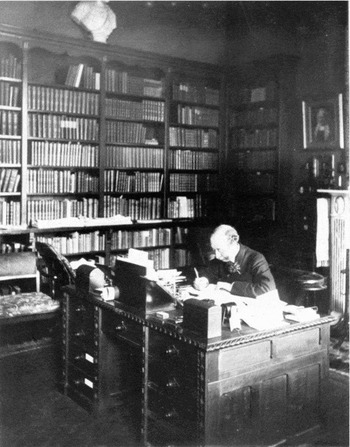
Earl of Carnarvon at his desk in his study, Highclere Castle, c.1880.

Thursday 21 July (London)
Heavy Commission day, the last sitting except one, to wind up our present business in August, after which we adjourn to probably the end of October or beginning of November.
In the House of Lords I had a long talk with Shaftesbury, who was in a very cheerful mood, and told a variety of anecdotes, amongst others this which he had had from Palmerston. When Prince Albert was yet alive he was perplexed as to what he would do to instil into the mind of the Prince of Wales “a greater sense of reserve,” and accordingly determined to send him to the Holy Land, which was done.Footnote 736
Monday 1 August (London)
Elsie and I came up for the second reading of the Land bill.
A long debate in the House. It was good but to my mind not so good as many a debate which I have heard there or as good as it should have been for the occasion. The consciousness that it was to a certain extent a sham fight and that there would be no division weighed on every speaker and affected the speech. In particular I thought Salisbury was below his best level, but for some time past I have thought him less good than formerly. I had told him I would speak or not as I was wanted and as there were many speakers I remained silent. Perhaps I may say something on the third.
Dunraven's speechFootnote 737 was a curious see saw, Lansdowne's was good.Footnote 738
Monday 8 August (London)
I went up alone but with our departing guests, leaving Elsie at Highclere. The House of Lords received the report and took the third reading of the Irish Land Bill, and on this last I made a speech which was answered by Granville, who looked very ill, barely recovered from a very severe fit of gout. It is remarkable how his presence seems to strengthen the Government. During his absence they have been weaker than weak, Kimberley sometimes losing temper, Carlingford extremely feeble and the ChancellorFootnote 739 much too forensic to be forcible. But Granville seems to give at once a new character to the discussion and makes himself felt. The debate which followed was not a very vigorous one.Footnote 740
Tuesday 9 August (London – Highclere)
I had a very busy morning [. . .] and finally got to Northcote's by 11.30 for a private caucus there, to discuss the course to be taken as to our Amendments on the Land bill.
Present Gibson, Salisbury, Smith, J. Manners, Sandon, Northcote, D. of Northumberland and self. Salisbury declared himself determined to vote for his own amendments when they came back from the Commons. I doubt whether the rest, except the D. of Northumberland, quite liked the uncompromising temper of Salisbury's line of proceeding but they assented. No one believes that Gladstone will dissolve, the worst they anticipate is an adjournment of Parliament to October to resume the discussion of the amendments, if one cannot come to an agreement. But the most serious contingency is the coming winter in Ireland and Salisbury seems here to be alive to this and to be prepared for a falling away in the House of the Irish landlords. PortarlingtonFootnote 741 last night showed what may be expected in this quarter.Footnote 742
Saturday 13 August (Highclere)
Yesterday morning Elsie and I went up to town by the early train, in pouring rain [. . .]. A little after 2 I went to the Peers meeting at Salisbury's.Footnote 743 It was fairly attended. Salisbury made a rather combative speech which was a good deal cheered. No one offered any expression of a different opinion and I came to the conclusion, though not without surprise, that the very large majority present agreed with him against compromise. It is true that he spoke of resisting the Commons’ view with some idea of coming afterward to an agreement but he did not disguise that notion of an agreement was thus conceding entirely to our amendments. Cairns who was sitting by me evidently did not agree in what Salisbury said but neither he nor I said anything. He felt it as difficult I think from his position as I did from mine to seem to oppose.
In the House matters opened badly and they went from bad to worse. Salisbury's words and manner were hard and unconciliatory, and we reinserted all our amendments by the force of numbers without an attempt to come to any compromise or common line.Footnote 744 As the evening went on a good many peers spoke to me – Bathurst,Footnote 745 Jersey,Footnote 746 Clinton,Footnote 747 Cadogan, (and Shaftesbury and Bath very strongly) deprecating the course pursued and expressing great alarm. Then Northcote, Gibson, Cross, Smith came into the House and talked to me in the same strain saying that the House of Commons was getting into a great ferment, that the SpeakerFootnote 748 was anxious and that the results would be very unfortunate. I only agreed too well in all they said; but I found myself in an awkward position. However after some conversation with Cairns who deprecated Salisbury's line of action very strongly I said something to Salisbury to warn him that there was great dissatisfaction. At first he was incredulous or affected to be so; then he showed that he did not like it, but having said so much I left the matter to work.Footnote 749
This morning I attended another private meeting at Northcote's where I found all the H. of Commons members very seriously alarmed, believing that we are in the midst of a very grave crisis. The risks are that the Government may dissolve (unlikely) or resign, or adjourn the consideration of the bill for two months, or drop the bill which without exception they thought fraught with the direst consequences in Ireland. All of them also were evidently impressed with the idea of Salisbury's headstrong, reckless, tendencies, and determined to resist them, but they seemed not much to like this part of the matter. The D. of Northumberland, Cairns and I were the only three Peers present. We very soon got into the discussion and I strongly represented the feeling of dissatisfaction afloat amongst the Conservative Peers and with all the others urged a reasonable compromise on the different aspects of continuing. Salisbury was very stiff and did not actually promise to give up anything but he found every one against him and we broke up with the understanding that Gibson should at once try to effect a transaction with HerschellFootnote 750 on Clause 8 and that we should endeavour afterwards to compromise the other points of difference. He also consented to call another meeting of Peers on Tuesday, and we are to meet in private conclave on Monday at 2.30. But he has agreed to all this most reluctantly and I am afraid he is disposed to avoid any real concession if he can. He is I much fear justifying all the predictions that have been made of his impracticability on violence. We are on the edge of a collision of the two Houses. Cairns gave very prudent and conciliatory counsel.
Monday 15 August (London)
I came up by myself leaving E. at Highclere and drove at once to Northcote's, where we had another ex-cabinet meeting.Footnote 751 It was a meeting in which every one was in favour of coming to terms with the Government and H. of Commons except Salisbury who was I thought very stiff.Footnote 752 The differences between him and Cairns showed themselves at one moment very strongly. For Cairns defined the functions of the H. of Lords in such a crisis as this as of a body to suspend, debate, modify but not veto questionable legislation, to which Salisbury took very decided exception in language which showed a good [deal] of pent up personal feeling. I found myself obliged to express myself distinctly in favour of compromise; but it was very plain that my comments were not much relished. It is hard to say on what understanding we parted. Salisbury wished to have one and I think his desire now as from the first is to engage in a struggle à outrance. It is very unwise and his harsh unconciliatory manner in the House has done I think a great deal of mischief. It has stirred up a very bitter feeling to him which makes it all the more difficult to arrive at any common conclusion in such a case.
Lansdowne wrote to me at Highclere imploring me to do my best to promote moderate counsels and he called on me in Bruton St. with the same view on my arrival there from the station.
Tuesday 16 August (Highclere)
Gladstone in the H. of Commons last night made a succession of very conciliatory speeches and gave up a variety of controversial points.Footnote 753 The Radical wing were furious: but they had to submit and the result was a triumph for the H. of Lords. I was however not without alarm for Salisbury's manner and language had been so harsh and uncompromising that I was afraid that he might insist on all the amendments we had made and refuse all compromise. I called on Northcote in the morning and found him laid up with a bad cold in bed; but I talked over the situation and he undertook to see Salisbury. At 2.30 we had a meeting of Conservative Peers in Arlington St. and then there was no doubt as to the feeling of the party. Everyone was jubilant, delighted to have escaped from the collision which some few were prepared to face but which all dreaded especially as we could escape with honour. Salisbury himself advocated a complete acceptance of Gladstone's terms and everyone who spoke urged strongly the same view.Footnote 754
It is a success, and a success due in a great measure to standing firm, but we have also steered very near the shoals and if Gladstone had been unbending we should have incurred a great defeat. We have been in great danger: and I do not think that the policy will safely bear repetition.
The matter being now concluded I came down here by the last train to the surprise and satisfaction of Elsie and the children.
Wednesday 17 August (Highclere)
I wrote a long letter to WhitbreadFootnote 755 on the subject of the Commission and of my resignation after our meeting in October or November. I enclosed it to Jekyll.