Introduction
Several lines of research are exploring the role of prenatal factors and retarded foetal growth in influencing later susceptibility to certain chronic conditions, such as cardiovascular and metabolic diseases (Gluckman et al. Reference Gluckman, Hanson, Cooper and Thornburg2008). Studies in animal models and observations in humans suggest that prenatal factors leading to a retarded foetal growth may also impact the risk of developing psychiatric disorders (Verdoux & Sutter, Reference Verdoux and Sutter2002; Costello et al. Reference Costello, Worthman, Erkanli and Angold2007; Mittal et al. Reference Mittal, Ellman and Cannon2008; Seckl, Reference Seckl2008). An impairment of foetal growth is considered to be a marker for poor intra-uterine conditions, but also the result of an adjustment in foetal physiological growth, with long-term consequences for health. These adjustments may maximize chances for survival during early development but could produce considerable problems in adaptation later in life (Bateson et al. Reference Bateson, Barker, Clutton-Brock, Deb, D'Udine, Foley, Gluckman, Godfrey, Kirkwood, Lahr, McNamara, Metcalfe, Monaghan, Spencer and Sultan2004). The concept of developmental plasticity or ‘foetal programming’ has been used to describe those stable modulations of gene expression, mediated, at least in part, by epigenetic processes, that influence the mature phenotype and determine sensitivity to later environmental factors and the subsequent risk of disease (Bateson et al. Reference Bateson, Barker, Clutton-Brock, Deb, D'Udine, Foley, Gluckman, Godfrey, Kirkwood, Lahr, McNamara, Metcalfe, Monaghan, Spencer and Sultan2004). The hypothalamic–pituitary–adrenal (HPA) axis seems to play a crucial role in foetal programming and represents a specific target for environmental influences. The long-lasting programming effect on stress response systems involves both exaggerated behavioural responses to stress and enhanced HPA activity (Welberg & Seckl, Reference Welberg and Seckl2001; Phillips & Jones, Reference Phillips and Jones2006), which may confer an increased vulnerability to psychiatric disorders under stressful conditions.
Although the comprehension of these processes might have a valuable impact on the understanding of the pathogenesis of psychiatric disorders, few studies to date have provided evidence in favour of the ‘foetal programming hypothesis’ in human psychiatric diseases. In a large representative population-based sample, Costello et al. (Reference Costello, Worthman, Erkanli and Angold2007) tested two competing hypotheses to explain the relationship between low birthweight and adolescent depression in females. Their findings supported a foetal origins hypothesis above alternatives. In a longitudinal cohort study, Nomura & Chemtob (Reference Nomura and Chemtob2007) found a significant interaction between low birthweight and childhood abuse in the determination of later adaptation and psychological well-being.
There are several reasons to hypothesize that the foetal programming of stress response systems could play a role in the pathogenesis of eating disorders. The first is that there is evidence that perinatal complications increase the risk for developing eating disorders (Cnattingius et al. Reference Cnattingius, Hultman, Dahl and Sparen1999; Foley et al. Reference Foley, Thacker, Aggen, Neale and Kendler2001; Lindberg & Hjern, Reference Lindberg and Hjern2003; Favaro et al. Reference Favaro, Tenconi and Santonastaso2006). These studies are difficult to compare because of different methods and recruitment procedures (Favaro et al. Reference Favaro, Tenconi and Santonastaso2006). They found that complications linked to neonatal immaturity, such as preterm birth (Cnattingius et al. Reference Cnattingius, Hultman, Dahl and Sparen1999; Foley et al. Reference Foley, Thacker, Aggen, Neale and Kendler2001) or neonatal signs of dysmaturity (Favaro et al. Reference Favaro, Tenconi and Santonastaso2006), were among the possible risk factors for anorexia nervosa (AN). Neonatal dysmaturity was defined as the presence of functional signs of immaturity often, but not necessarily, associated with prematurity or low birthweight, such as hypothermia, delayed respiration or hypotonia (Zornberg et al. Reference Zornberg, Buka and Tsuang2000; Soll, Reference Soll2008). In a previous study (Favaro et al. Reference Favaro, Tenconi and Santonastaso2008), we found that female eating disordered subjects who were dysmature at birth were more likely to develop a high harm-avoidant temperament and high anticipatory anxiety as adults, features that are associated with a lower ability to cope with stressful situations and with an increased risk for affective, anxiety and eating disorders (Klump et al. Reference Klump, Bulik, Pollice, Halmi, Fichter, Berrettini, Devlin, Strober, Kaplan, Woodside, Treasure, Shabbout, Lilenfeld, Plotnicov and Kaye2000; Cloninger et al. Reference Cloninger, Svrakic and Przybeck2006).
According to the foetal programming hypothesis, the association between retarded foetal growth and increased risk for psychiatric disorders (Räikkönen et al. Reference Räikkönen, Pesonen, Heinonen, Kajantie, Hovi, Järvenpää, Eriksson and Andersson2008; Seckl, Reference Seckl2008) is due to an impairment of the stress response and lower ability to adapt (Costello et al. Reference Costello, Worthman, Erkanli and Angold2007). If this hypothesis is true, it should be possible to observe a synergistic effect of retarded foetal growth and severe stressful events, as in the study by Nomura & Chemtob (Reference Nomura and Chemtob2007). The present study aimed to test the hypothesis of a synergistic effect between retarded foetal growth and childhood abuse in the determination of the risk of developing AN. Childhood abuse is considered a non-specific, significant retrospective correlate for AN (Favaro et al. Reference Favaro, Ferrara and Santonastaso2003; Jacobi et al. Reference Jacobi, Hayward, de Zwaan, Kraemer and Agras2004; Pike et al. Reference Pike, Hilbert, Wilfley, Fairburn, Dohm, Walsh and Striegel-Moore2008), that seems to have important effects on behavioural characteristics and outcome (Steiger & Bruce, Reference Steiger and Bruce2007; Yackobovitch-Gavan et al. Reference Yackobovitch-Gavan, Golan, Valevski, Kreitler, Bachar, Lieblich, Mitrani, Weizman and Stein2008). A retarded foetal growth can result in several perinatal conditions, such as low birthweight or length for gestational age, excessive thinness at birth, or the presence of other signs of dysmaturity, such as hypothermia or delayed respiration. For the purposes of the present study we explored the effects of three groups of perinatal conditions: (1) prematurity; (2) measurable retarded growth, such as being small/short/thin for gestational age, and (3) having functional signs of dysmaturity, such as hypothermia, hypotonia, low reactivity, delayed respiration and feeding difficulties.
Method
We tested the hypothesis of an interaction between neonatal dysmaturity or retarded foetal growth and childhood abuse on the sample who took part in our study on the aetiopathogenetic role of perinatal complications in eating disorders (Favaro et al. Reference Favaro, Tenconi and Santonastaso2006). In this previous study, part of the sample with eating disorders and all of the controls took part in a prevalence study carried out in two randomly selected areas of Padua (Favaro et al. Reference Favaro, Ferrara and Santonastaso2003), recruiting all subjects born between January 1971 and December 1979. Of the 934 subjects interviewed in the prevalence study, 591 (37 subjects with an eating disorder and 554 controls) were born in Padua Hospital and were therefore included in the study. An additional sample of subjects with eating disorders comprised all cases referred to the out-patient Eating Disorders Unit of Padua and were born in the two obstetric wards of Padua Hospital in the same period. At that time, these wards were the only public obstetric facilities in the Padua area; the Eating Disorders Unit is located in the same hospital and is the only public Eating Disorders Unit in the city and surrounding area. The two samples were merged before analysing obstetric records to allow for blindness of data collection as regards diagnostic status. For the present study, we selected all subjects with data available concerning childhood abuse (96% of AN subjects and 100% of controls) and we excluded subjects with bulimia nervosa or an eating disorder not otherwise specified without a previous history of AN (22 subjects of the birth cohort). We coded only episodes of abuse that occurred before the age of the onset of AN.
All subjects were female and Caucasian. The final sample consists of 109 subjects with lifetime AN and 554 control subjects (15 AN and all control subjects belong to the birth cohort sample). All subjects gave informed written consent for the use of data in an anonymous form and institutional approval was obtained. Lifetime AN was defined according to the DSM-IV criteria, waiving the single criterion of amenorrhoea for 3 consecutive months because, in some cases, hormone replacement therapy made it difficult to assess the presence of the criterion.
Measures
All subjects underwent a structured clinical interview to assess lifetime eating disorder diagnosis (SCID for DSM-IV, Eating Disorders section; First et al. Reference First, Spitzer, Gibbon and Williams1995). All subjects were interviewed face-to-face. Social class was determined using an Italian adaptation of Havighurst's formula (Favaro et al. Reference Favaro, Ferrara and Santonastaso2003, Reference Favaro, Ferrara and Santonastaso2007), which calculates social class using paternal and maternal professional status and degree of education. The formula results in a score that ranges from 1 (very high) to 6 (very low social class). We considered as high and medium-high social class subjects who scored ⩽3. The mean age of onset in subjects with AN was 17.8 (s.d.=3.0) years, and mean lifetime lowest body mass index (BMI) was 15.5 (s.d.=1.7, range 10.0–17.5). Age of onset of AN was defined as the first occurrence of a complete or partial diagnosis of AN according to DSM-IV (Favaro et al., in press).
A semi-structured interview was administered to gather sociodemographic and clinical information, including data concerning childhood abuse (Favaro et al. Reference Favaro, Ferrara and Santonastaso2007). During the interview, subjects were asked about the occurrence of any lifetime experience of victimization or violence. The questions were: Have you ever been in a situation in which you were the victim of violence, in some way? Have you ever been in a situation in which you were forced to have some form of sexual contact? Every affirmative answer was followed by a request for a detailed description of the experience, including information about age of abuse, perpetrator, and number of episodes. In the definition of sexual abuse, we included both sexual molestation (such as exposing or unwanted sexual kissing, fondling and touching) and unwanted sexual intercourse or attempts at intercourse. Childhood sexual abuse was defined as the history of any type of sexual assault before the age of 18. Childhood physical abuse was defined as any of the following occurring before the age of 18: getting hit with something, having something thrown at them, being kicked, burned, pushed, shoved or being physically attacked in some other way. Slapping or spanking were considered only when they were very frequent and led to some physical injury. Abuse experiences tended to occur earlier in the control group than in the AN subjects (12.0±4.4 v. 14.4±3.6 years, t=1.84, p=0.07). Other characteristics of the abuse experiences were not statistically different in the two groups. Abuse was perpetrated by a family member in 23% of controls and 43% of AN cases, was of a sexual nature in 60% of controls and 50% of cases, and was multiple in 36% of controls and 57% of cases.
Perinatal data
Data records about obstetric complications were available from hospital archives. The collection of information from records was performed by A.F. and E.T. with the supervision of a gynaecologist. A detailed list of all the types of pregnancy, delivery and neonatal complications is reported in our previous study (Favaro et al. Reference Favaro, Tenconi and Santonastaso2006). Recorded information about the mothers included age at birth (age in completed years at the infant's birth), parity (number of births, including the present birth), and weight gain during pregnancy. Descriptive data about these general characteristics of pregnancies are reported in our previous paper (Favaro et al. Reference Favaro, Tenconi and Santonastaso2006). For the purposes of this study, we considered the following neonatal complications: prematurity, low birthweight or length for gestational age, low ponderal index, and signs of dysmaturity (tremors, hypotonia, hyporeactivity, hypothermia, delayed respiration or early apnoea attacks, and early feeding problems). Early feeding difficulties were defined as problems in breastfeeding or the presence of vomiting in the first few days after birth. Definitions of the neonatal complications considered were: prematurity (gestational age <37 weeks); low birthweight or length for gestational age (weight and length below the 10th percentile for sex and gestational week); low ponderal index [<25; ponderal index was expressed as 1000×(birthweight in grams)/(length in centimetres)3], functional signs of dysmaturity (the presence of at least one of the following: tremors, hypotonia, hyporeactivity, hypothermia, delayed respiration or early apnoea attacks, early feeding problems).
Statistics
All odds ratios (ORs) were adjusted for socio-economic status, multiple births, parity and maternal age at delivery as potential confounders using a logistic regression analysis. The sample was divided into four groups according to the presence of the two risk factors. ORs were calculated using the group with neither form of adversity as the reference group. We analysed data using a case-control design (109 AN versus 554 control subjects). However, because a recruitment bias of the AN sample could affect the association with risk factors and their interaction, we performed the same statistical analyses including only the 15 AN subjects who belonged to the original cohort sample (cohort design). The amount of excess risk resulting from the synergy of having both risk factors was measured using the additive interaction model described by Rothman et al. (Reference Rothman, Greenland and Walker1980). Interaction in epidemiology refers to the extent to which the joint effect of two risk factors on a disease differs from the independent effects of each of the factors. It is considered to be present on a multiplicative scale when the joint effect of risk factors differs from the product of the effects of the individual factors. Conversely, statistical interaction is present on the additive scale when the joint effect of risk factors differs from the sum of the effects of the individual factors. Interaction measured on the additive scale has been argued to be better correlated with biological interaction than when measured on the multiplicative scale (Skrondal, Reference Skrondal2003). Moreover, information concerning an additive interaction between two factors is more relevant to disease prevention and intervention (Zou, Reference Zou2008). In our study, additive interaction exists when the risk of having two adversities exceeds the sum of the risk of perinatal complications and abuse. The presence/absence of an additive interaction was tested using the synergy index (SI) (Rothman et al. Reference Rothman, Greenland and Walker1980; Skrondal, Reference Skrondal2003). The 95% confidence interval (CI) was estimated using the method described by Zou (Reference Zou2008) for case-control and cohort studies. Lack of interaction is indicated by SI=1. Thus, the 95% CI that does not include a value of 1 indicates statistical significance.
Results
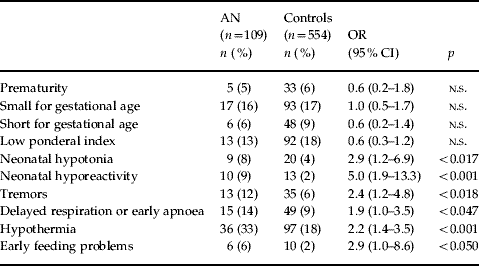
Table 1 shows the association between perinatal conditions and AN, in the case-control analysis. AN was significantly associated with the presence of one or more signs of dysmaturity (49% v. 26%; OR 2.6, 95% CI 1.7–4.1, p<0.001) but not with prematurity, low birthweight for gestational age, being shorter for gestational age, and a ponderal index <25. With the exception of early feeding difficulties, which correlated significantly only with neonatal tremors and hyporeactivity, all the various signs of dysmaturity were highly correlated among themselves [Spearman's ρ: from 0.10 (p<0.01) to 0.44 (p<0.001)]. In the case-control comparison, the association between AN and childhood physical/sexual abuse was not significant (13% v. 8%; OR 1.5, 95% CI 0.8–2.8, p=0.25), nor was the association between childhood abuse and dysmaturity (30% v. 28%; OR 0.88, 95% CI 0.5–1.6, p=0.68).
Associations between anorexia nervosa (AN) and perinatal factors (prematurity, signs of retarded foetal growth and signs of neonatal immaturity)

OR, Odds ratio; CI, confidence interval; n.s., not significant.
ORs were adjusted for social status, maternal age, parity, and multiple births.
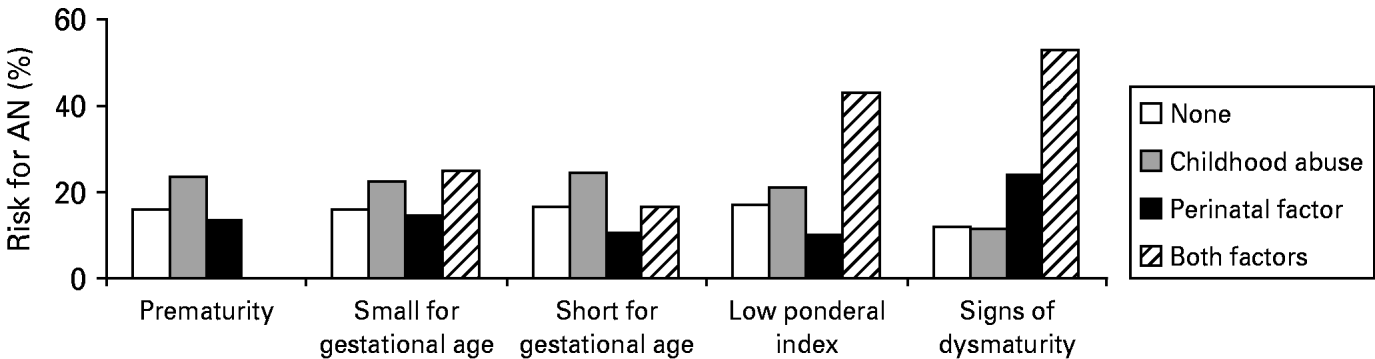
The presence of additive interaction was tested for the different perinatal conditions (Fig. 1). A significant additive interaction was observed only between childhood abuse and neonatal signs of dysmaturity. The pattern of interaction was very similar for sexual and physical childhood abuse when the two types of abuse were analysed separately (data not shown).
Risk of anorexia nervosa (AN) in the case-control sample by childhood sexual/physical abuse and neonatal perinatal complications. Odds ratios (ORs) adjusted for social status, multiple birth, parity and maternal age were not significant for prematurity by childhood abuse, small/short for gestational age by childhood abuse, and low ponderal index by childhood abuse. ORs for neonatal signs of immaturity by childhood abuse were 8.0 [95% confidence interval (CI) 2.8–22.4, p<0.001] for exposure to both childhood abuse and immaturity, 2.2 (95% CI 1.4–3.6, p<0.002) for exposure to neonatal immaturity alone, and 0.8 (95% CI 0.3–2.2; not significant) for childhood abuse alone. No additive interaction was significant, with the exception of the interaction between childhood abuse and neonatal signs of immaturity [synergy index (SI)=5.89, 95% CI 1.3–26.8].

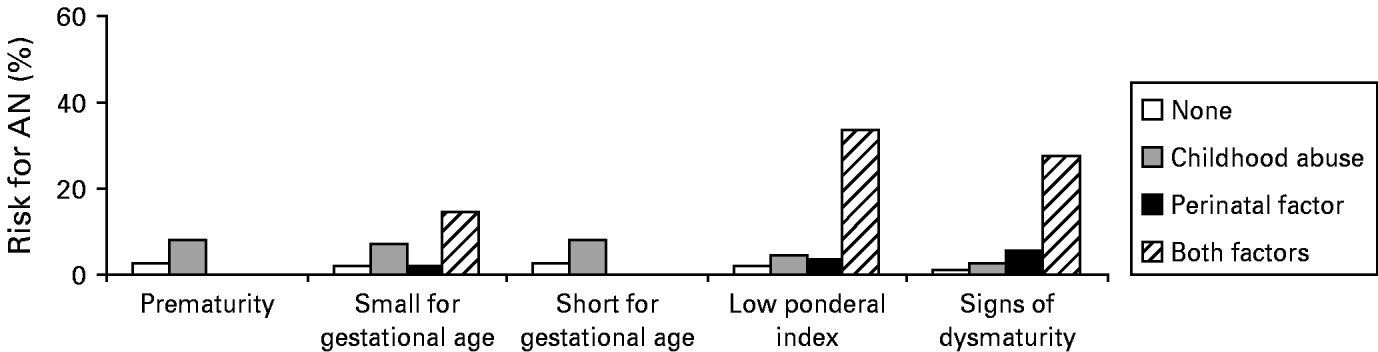
As a recruitment bias of the AN sample could affect the association with risk factors and their interaction, we performed the same statistical analyses including only the 15 AN subjects who belonged to the original cohort sample. Subjects with AN from the cohort sample (n=15) did not differ from those recruited in the clinical setting (n=94) as regards age of onset, lifetime lowest BMI, rate of childhood abuse, degree of urbanization, social class, or any of the perinatal variables. In the whole cohort sample, AN was associated with the presence of one or more signs of dysmaturity (73% v. 26%; OR 10.2, 95% CI 3.1–34.4, p<0.001) and a low ponderal index (33% v. 18%; OR 3.1, 95% CI, 1.0–9.7, p<0.05), but not with prematurity (0% v. 6%), low birthweight (20% v. 17%; OR 1.4, 95% CI 0.4–5.1) or low length for gestational age (0% v. 9%). In this sample, childhood physical/sexual abuse was significantly associated with AN (27% v. 8%; OR 3.8, 95% CI 1.1–12.6, p<0.03). The interaction between childhood abuse and perinatal factors is significant only for neonatal dysmaturity (Fig. 2). The interaction between childhood abuse and low ponderal index also seems to be additive, but the interaction is not statistically significant.
Risk of anorexia nervosa (AN) in the cohort sample by childhood sexual/physical abuse and neonatal perinatal complications. Odds ratios (ORs) adjusted for social status, multiple birth, parity and maternal age were not significant for prematurity by childhood abuse, small for gestation age by childhood abuse, and short for gestational age by childhood abuse. ORs for ponderal index by childhood abuse were 43.1 [95% confidence interval (CI) 5.0–370.8, p<0.002] for exposure to both abuse and low ponderal index, 2.3 (95% CI 0.6–9.1, n.s.) for exposure to low ponderal index alone, and 2.7 (95% CI 0.5–13.2, n.s.) for exposure to childhood abuse alone. ORs for neonatal signs of immaturity by childhood abuse were 58.0 (95% CI 9.2–365.0, p<0.001) for exposure to both childhood abuse and immaturity, 9.5 (95% CI 2.4–38.0, p<0.002) for exposure to neonatal immaturity alone, and 3.4 (95% CI 0.3–34.8, n.s.) for childhood abuse alone. Additive interaction was not significant for ponderal index and childhood abuse [synergy index (SI)=8.0, 95% CI 0.8–82.6)] but was significant for neonatal signs of immaturity and childhood abuse (SI=4.2, 95% CI 1.0–17.1).

As delayed respiration and apnoea attacks are signs of immaturity, but are also potential causes of brain hypoxic damage, we repeated the interaction analyses excluding subjects who reported this sign (22 controls and six AN subjects). Additive interaction was still significant in both the case-control sample (SI=5.9, 95% CI 1.2–29.8) and the cohort sample (SI=4.6, 95% CI 1.1–19.4).
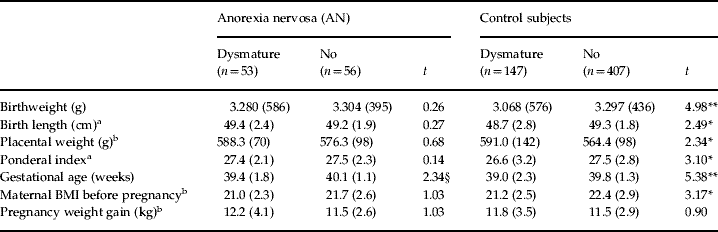
In control subjects, the presence of at least one dysmaturity sign was significantly associated with lower birthweight, lower ponderal index, shorter gestational age and higher placental weight. In AN subjects, on the contrary, no relationship was found between immaturity and foetal growth indicators, but only a significant relationship with gestational age emerged (Table 2).
Birthweight and placental weight, ponderal index, and gestational age in subjects with dysmaturity signs

BMI, Body mass index.
a Birth length and ponderal index were available for 103 AN subjects and 519 controls.
b Placental weight was available for 96 AN subjects and 480 controls; maternal BMI before pregnancy for 64 AN subjects and 275 controls; pregnancy weight gain for 108 AN and 552 controls.
* p<0.02, ** p<0.001.
Discussion
The present study explored one of the possible pathways to explain the relationship between perinatal factors and the risk of developing a psychiatric disorder. In particular, the study found a significant additive interaction between the presence of neonatal signs of dysmaturity and the later resilience to childhood abuse, confirming the hypothesis of an involvement of stress response systems. According to our findings, childhood abuse represents a significant risk factor for AN only in the presence of dysmaturity at birth. This observation confirmed our hypothesis that dysmaturity of the newborn baby is an early indicator of an impairment of the stress response systems, which implies a dysregulation of anxiety symptoms after a traumatic experience. According to the foetal programming hypothesis, dysmaturity at birth could be associated with an exaggerated behavioural response to stress later in life due to enhanced HPA activity and an increase in the activity of the amygdala, which is particularly important in the acquisition of avoidance responses (Meaney et al. Reference Meaney, Szyf and Seckl2007). Our previous observation of high harm-avoidant features in subjects who had dysmaturity problems at birth are in line with this hypothesis (Favaro et al. Reference Favaro, Tenconi and Santonastaso2008). AN might represent an attempt to regain control over anxiety (Kaye, Reference Kaye2008) and could be interpreted as an extreme avoidant behaviour that limits social contact and leads to a focus of obsessive thoughts on food and body size. The reduction of food intake in subjects who are developing AN could be, at least in part, precipitated or mediated by stress. About this point, it is interesting to observe that, in animals, stress-induced inhibition of food intake seems to be gender specific (Iwasaki-Sekino et al. Reference Iwasaki-Sekino, Mano-Otagiri, Ohata, Yamauchi and Shibasaki2009).
Although the alterations of the HPA axis in AN are difficult to study because of the confounding effects of weight loss and starvation, there are several indications that in these patients the negative feedback mechanisms of HPA axis are impaired (Connan et al. Reference Connan, Lightman, Landau, Wheeler, Treasure and Campbell2007; Lo Sauro et al. Reference Lo Sauro, Ravaldi, Cabras, Faravelli and Ricca2008; Iwasaki-Sekino et al. Reference Iwasaki-Sekino, Mano-Otagiri, Ohata, Yamauchi and Shibasaki2009). It is possible that this impairment has a prenatal origin and contributes to the risk of developing the illness (Connan et al. Reference Connan, Campbell, Katzman, Lightman and Treasure2003).
Most studies to date have considered birthweight or birth thinness as the main indicator, or proxy, of foetal exposure to adversities that might cause abnormal developmental programming. In the field of psychiatry, the literature seems to indicate an association between low birthweight and the subsequent development of depression (Costello et al. Reference Costello, Worthman, Erkanli and Angold2007; Nomura & Chemtob, Reference Nomura and Chemtob2007; Räikkönen et al. Reference Räikkönen, Pesonen, Heinonen, Kajantie, Hovi, Järvenpää, Eriksson and Andersson2008), but other studies show inconsistent results (Herva et al. Reference Herva, Pouta, Hakko, Laksy, Joukamaa and Vijola2008). Although many of the signs of dysmaturity that we considered in this study have an important negative prognostic impact on short-term infant health (Young Infants Clinical Signs Study Group, 2008), no studies to our knowledge have explored their influence on adult health. Neonatal dysmaturity is a condition, usually associated with prematurity or a low birthweight, characterized by often transient problems in neuromuscular tone, reactivity, and ability to preserve heat. If these symptoms are the result of a retarded or impaired foetal growth (Baschat, Reference Baschat2004), it would be important to include them in future studies about the influence of prenatal factors on adult health. The identification of early environmental signals of exposure is an opportunity for the identification of high-risk subjects and for planning early interventions. The observation that, in AN subjects (but not in controls), dysmaturity signs and low birthweight are not associated needs to be explored in future studies to comprehend its implications for the understanding of the pathogenesis of this illness.
Our findings need replication because alternative explanations are possible. There could be environmental and/or genetic factors that explain, at least partially, our findings because of their effects on both prenatal life and future ability in response to stress. Maternal psychological features, for example, can influence pregnancy exposure to stress, can play an important role in the postnatal programming of the stress response systems (Meaney et al. Reference Meaney, Szyf and Seckl2007), and could also be implicated in the risk of exposure to childhood abuse. Furthermore, some genetic factors could influence both the presence of dysmaturity signs and the response to stressful situations. For example, the variants of the serotonin transporter gene are known to have an important impact on the development of depressive symptoms after stressful events, probably because of their effects on serotonin reuptake (Caspi et al. Reference Caspi, Sugden, Moffitt, Taylor, Craig, Harrington, McClay, Mill, Martin, Braithwaite and Poulton2003). The role of serotonin-related genes in the resilience to stressful events is a matter of investigation in many psychiatric disorders, including eating disorders (Steiger et al. Reference Steiger, Richardson, Joober, Gauvin, Israel, Bruce, Ying Kin, Howard and Young2007). However, although the effects of prenatal exposure to maternal cortisol are mediated by an increased serotonin uptake in the hyppocampus and amygdala (Welberg & Seckl, Reference Welberg and Seckl2001; Meaney et al. Reference Meaney, Szyf and Seckl2007), the role of the polymorphisms of the serotonin transporter gene in the developmental programming processes and neonatal growth has not been explored to date.
The present study has several methodological advantages and also important limitations that should be taken into consideration. Although in the case-control analysis the sample of AN subjects is the result of the merging of two samples (one recruited from the general population and one in an out-patient setting), all subjects belong to the same population birth cohort. Subjects referred for out-patient treatment cannot be considered totally representative of all cases existing in the general population because only a percentage of eating disordered cases usually ask for some type of treatment (Favaro et al. Reference Favaro, Ferrara and Santonastaso2003). However, we did not find significant differences between the two samples as regards lowest BMI, age of onset, social class, urbanization and childhood abuse. Moreover, we have no reason to believe that the out-patient cases were drawn from a different population from that assessed in the prevalence study because they are matched for gender, ethnicity, town of residence, period and hospital of birth. Although the cohort analysis has a low power because of the small number of subjects with lifetime AN in the general population, we chose to perform these analyses to evaluate whether the merging of the two samples could bias our main findings. In addition, only cohort studies can give an idea of the amount of risk that is explained by the risk factors. Concerning the control group, it is important to note that the two geographical areas where we carried out the prevalence study were selected randomly and were considered representative of the entire female population cohort of the city (Favaro et al. Reference Favaro, Ferrara and Santonastaso2003).
Other limitations concern the retrospective assessment of abuse experiences and the lack of information about the psychiatric morbidity of the first-degree relatives, which prevented us from investigating the role of maternal psychopathology as a confounding factor. Finally, although the number of subjects in this study is not small as a whole, the interaction data relied on a relatively small group that was exposed to both risk factors. For these reasons, our findings need replication.
In conclusion, the present study found a significant additive interaction between two risk factors implicated in the pathogenesis of AN. Information on an additive interaction between two factors is important because of its relevance to disease prevention and intervention. If the joint effect of two factors surpasses the sum of their single effects, then the reduction of either one would also reduce the risk of the other factor in causing the disease. Furthermore, both risk factors are implicated in the pathogenesis of several other psychiatric disorders, including depression and post-traumatic stress disorder (Seckl, Reference Seckl2008). If future studies confirm the hypothesis that these disorders have a developmental origin, there will be an obvious opportunity for early intervention. For this reason, our findings, if replicated, could be of relevance to the general understanding of the relationship between prenatal/perinatal factors and the risk of developing AN and other psychiatric disorders.
Acknowledgements
This study was performed without any financial help from sources other than the University of Padua.
Declaration of Interest
None.