Background
Climate change poses a threat to global health with rising overall ambient temperatures. Reference Watts, Amann and Arnell1,2 The global one-degree Celsius temperature rise Reference Watts, Amann and Arnell1,Reference Costello, Abbas and Allen3,Reference Haustein, Allen and Forster4 since 1880 has led to more frequent, longer, and more intense heat wave periods. Reference Meehl and Tebaldi5,Reference Lead, Stocker and Clarke6 This has an impact on health systems and the economy, Reference Xu, FitzGerald, Guo, Jalaludin and Tong7 where losses can total up to US$2.7billion Reference Liu, Saha, Hoppe and Convertino8 annually in the US. One-half of South Asia’s population lives in areas stricken by heat waves, where extreme temperatures have led to lower crop yields, lower productivity, and poorer health outcomes. Reference Mani, Bandyopadhyay, Chonabayashi, Markandya and Mosier9 Periods of heat wave are associated with an increase in mortality and morbidity. Reference Basu10–Reference Schwartz, Daley, Rubin, Le Tertre, Gotway and Kaiser15 Some of the major heat waves, such as in Ahmedabad, India in 2010, led to an excess of mortality of up to 43%. Reference Sheffield, Jaiswal and Mavalankar13,Reference Schwartz, Daley, Rubin, Le Tertre, Gotway and Kaiser15 Besides direct heat-related mortality, heat waves can also impact mortality through increased spread of infectious diseases, infrastructure disruption, and impact on health services. Reference Xu, FitzGerald, Guo, Jalaludin and Tong7 This global problem needs a stepwise approach, tailored to each country’s unique system.
Heat illness in low-and-middle-income countries (LMICs) Reference Basu10,Reference Basu and Ostro11,Reference Kjellstrom16 is an under-reported problem due to issues with case definitions, lack of centralized data collection, and lack of descriptive data in the prehospital setting. There is limited literature in the LMIC context, especially in the prehospital setting. Reference Gaudio and Grissom17 As most of the heat illness cases occur in the community, it is important to understand their presentation and recognition by the prehospital system. This helps develop targeted public health efforts aiming at prevention, adaptive responses, and first aid measures for heat illness victims. This paper is the first to describe the characteristics of heat illness victims in the prehospital setting in the state of Telangana in India during the annual heat wave period. India has been heavily hit by annual heat waves. In 2015, the recorded maximum temperature was six to eight degrees more than the average maximum in 2014, resulting in 2,422 human deaths. During this period, temperatures rose considerably, sometimes reaching 48.9° Celsius. 18 In Telangana, this is a major problem resulting in increasing deaths during intense heat wave seasons. 19 During the 2016 heat wave, there was a worrying 5.9% mortality recorded by their ambulance services.
Objectives
The objective was to describe the epidemiology of patients calling the ambulance service in Telangana state, India with heat illness symptoms during the annual heat wave period. Secondly, the aim was to map the geospatial location of calls and relate it to the ambient temperature of the area. Thirdly, the aim was to uncover common presenting symptoms and correlate between the dispatch and paramedics’ working diagnosis of heat illness. Lastly, the aim was to describe the ambulance response times and prehospital interventions for these cases. Understanding this can inform plans to improve community first aid measures, ambulance deployment, and prehospital interventions such as dispatch-assisted first aid and cooling devices to be carried on vehicles.
Methods
Overview
This was a retrospective observational study of patients presenting to Telangana’s prehospital emergency care system, known as 108, with heat illness symptoms during the heat wave period (March, April, May, and June of 2018 and 2019), as defined by their local climatology data. 20 Heat illness Reference Bouchama and Heat Stroke21 refers to a spectrum of conditions. In this paper, it refers to the symptoms related to a rise in ambient temperatures in the context of a heat wave. These include heat syncope, heat exhaustion, and heat stroke. Reference Bouchama and Heat Stroke21
All patients presenting with heat illness symptoms, where the emergency medical technicians (EMTs; paramedic equivalent in the local setting) indicated a working diagnosis of “sun stroke” or “heat stroke” on their Prehospital Care Record (PCR) form, were included. Patients were excluded if they were inter-facility transfers, presumed dead on arrival, or their PCR forms were incomplete.
Approval was obtained from the local ethics authority/board in Telangana (GVK EMRI/EMLC/Research/IRB/0014//2021) for analysis of these data under an exemption from the local ethics review committee.
Setting
Telangana is the 29th state of India and Hyderabad is the capital city. Comprising of 33 districts, it has an area of 1,12,077km 2 and a population of 35,003,674. 22 The largest district is Bhadradri Kothagudem, whereas Hyderabad is the smallest. The population of Telangana and India can be divided into the Scheduled Castes (SC), Scheduled Tribes (ST), and Backward Castes (BC). These groups of people vary in aspects such as their location of dwelling, jobs, and their socioeconomic and education background. Based on the latest 2017 Telangana Social Report, people from the SCs and STs tend to have lower socioeconomic statuses and literacy rates as compared to the BCs, Reference Kannabiran23 where the people from each group receive different forms of socioeconomic support and protective legislation from the government. 24 The population can also be divided according to the two income groups – below and above the poverty line of Rs60,000 in rural areas and Rs75,000 in urban areas. Those below the poverty line were assigned with white cards, while those above the poverty line were assigned with pink cards, and they are known as the white and pink groups. 25
The Emergency Medical Services (EMS) System in Telangana State
Telangana state is covered by the 108-ambulance service, which is under the GVK Emergency Management and Research Institute (GVK EMRI). 26 It was established in April 2005 as a Not-for-Profit Registered Society and operates as a Public Private Partnership with state governments. It coordinates medical, fire, and police-related emergencies through a single toll-free number, 108, across 15 states and two union territories of India. Each ambulance provides free service to those living within 346km 2 of the ambulance station and will bring patients to the nearest and most appropriate hospital. With 351 ambulances in Telangana state, the population covered per ambulance is 106,006. It has a comprehensive system and a well-developed head office located at Hyderabad.
When the public calls 108, they are directed to an Emergency Response Center (ERC). The dispatcher, also known as an Emergency Response Officer (ERO), at the ERC assigns ambulances to the cases based on the location and chief complaint. The ambulance crew consists of a driver and an EMT. Dispatch is from an ambulance point and the crew would manage patients according to ambulance protocols.
Emergency call data are collected electronically by a Computer Telephonic Integration (CTI) system at the 108 ERC. A second set of data are collected on PCR forms filled by the EMT when they attend to patients in the community. The paramedics will manually write the details of the patient encounter on this PCR form. There are three copies of the PCR – one retained in the ambulance, one by GVK EMRI, and one by the hospital. The cases encountered are coded by their presentations and prehospital diagnosis. These cases are linked by a common incident number.
Data Collection and Statistical Methods
Data were collated from two sources – the CTI and the PCR. The hard copy PCR forms that documented a written chief complaint of “sunstroke” or “heat stroke” were collated onto Excel (Microsoft Corp.; Redmond, Washington USA). The data from the PCR forms were corroborated with the CTI of the same patient using the unique identification number. Environmental, patient, and EMS system-related characteristics were collected from these two forms.
The population census data of Telangana were retrieved from the state’s online portal. 22 The state-wide incidence was calculated by dividing the total number of cases by the population of Telangana. The incidence within the various groups of Telangana (districts, regions, and social status) were also calculated by obtaining population data from the state online portal. Lastly, meteorological data were obtained from the Telangana state website, and this was matched with the period of the study. 27 A simple descriptive analysis and geospatial mapping was done using R version 1.0.136 (R Foundation for Statistical Computing; Vienna, Austria).
Variables and Definitions
There is no universal definition of a heat wave period. March-June was assigned as the heat wave period according to local climatology data. 20 Patients’ presenting symptoms, demographics, vital signs, the need for medical direction, and prehospital care provided were obtained from the PCR. From the CTI, data relating to the callers’ demographics, location, complaint, and arrival timings of ambulances were retrieved.
Results
From March-June, there were 295 cases in year 2018 and 230 cases in year 2019 with the prehospital diagnosis of “sun stroke” or “heat stroke” documented by the paramedics/EMTs (Figure 1). The overall incidence of calls with symptoms of heat illness in Telangana during this period was found to be 1.5 cases per 100,000 people.
Flowchart of Patient Selection within the Study.

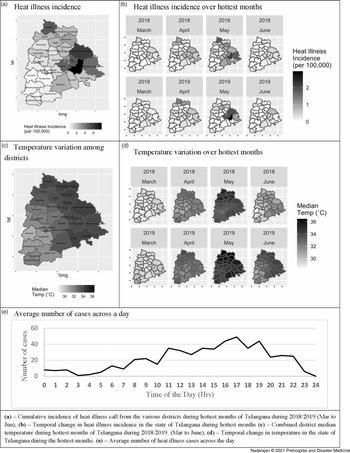
Figure 2a and Figure 2b illustrate the variation of heat illness incidence among the various districts in Telangana during the period of study. The median temperature of Telangana ranged between 29.0˚C to 35.2˚C and maximum temperature ranged between 35.8˚C to 41.9˚ during the study period of 2018 and 2019. Figure 2c and Figure 2d illustrate the temperature variation in Telangana based on districts and during the period of study – the North and Eastern regions of Telangana appear to have higher temperatures correlating with the higher number of heat illness incidences in these areas, as seen in Figure 2a. From Figure 2b and Figure 2d, it can be seen that May is the hottest month, with median temperatures >34˚C and maximum temperatures >40˚C, and has the highest incidence of heat illness cases. Figure 2e shows that the number of calls peak at around 16:00-17:00 hours.
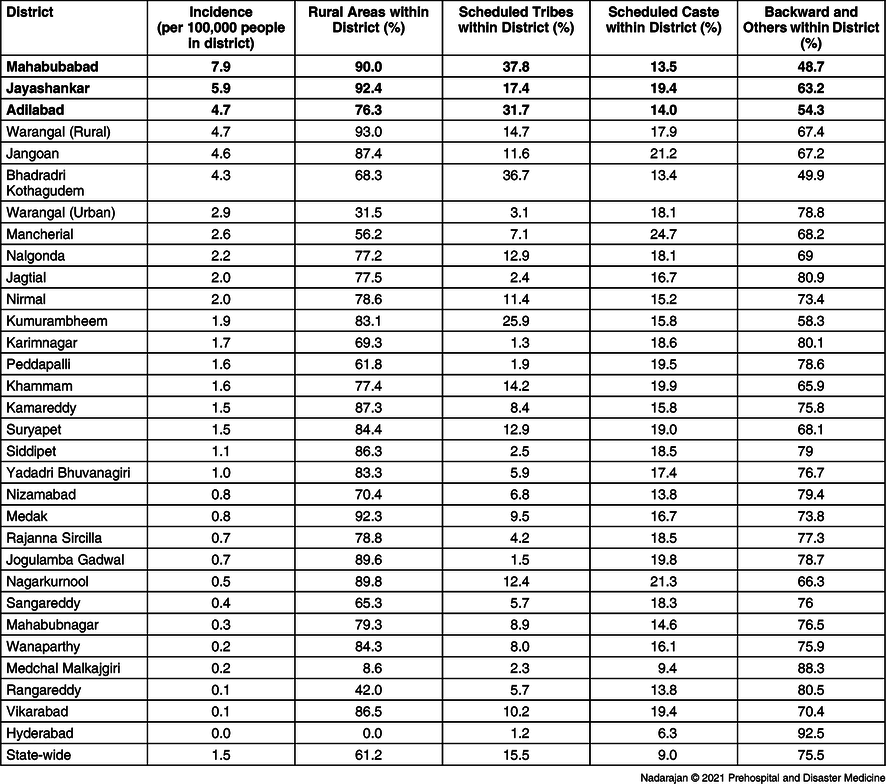
Table 1 28 shows the three districts with the highest heat illness incidence, which were Mahabubabad, Jayshankar Bhupalpally, and Adilabad, with incident rates of 7.9, 5.9, and 4.9 per 100,000 people. The districts with the lowest incidence of heat illness were Rangareddy, Vikarabad, and Hyderabad.
Visual Representation of Heat Illness Incidence and Temperature in the State of Telangana for March-June of 2018 and 2019.

Incidence of Emergency Calls with Prehospital Diagnosis of Heat Illness in Districts of Telangana Compared with Socio-Geographical-Economic Characteristics

Note: Urban area consists of Statutory Towns, Census Towns, and Outgrowths. A Statutory Town refers to all places with a municipality, corporation, cantonment board, or notified town area committee. A Census Town refers to places that have a minimum population of 5000, have at least 75% of the male main working population engaged in non-agricultural pursuits, and a density of population of at least 400 per sq.km. An Outgrowth is a viable unit such as a village contiguous to a Statutory Town and possess the urban features in terms of infrastructure and amenities such as pucca roads, electricity, sewerage system, education and medical facilities, post offices, banks, etc. A rural area consists of all other areas that are not urban and the basic unit is the revenue village. 28 The Scheduled Tribes (ST), Scheduled Caste (SC), and Backward Class (BC) are groups based on the people’s existing caste, social, financial and educational states.
The highest incidence of heat illness calls came from the rural, tribal areas and the ST with an incidence of 4.5 per 100,000 of the population. This is despite the BC forming the majority of the population. This corresponds to the three districts with the highest incidence, which are also predominantly rural in nature. It was also found that the white income group, which refers to those below poverty line, had a higher incidence of heat-related illness (96.3% were from the white income group versus 2.0% from the pink income group).
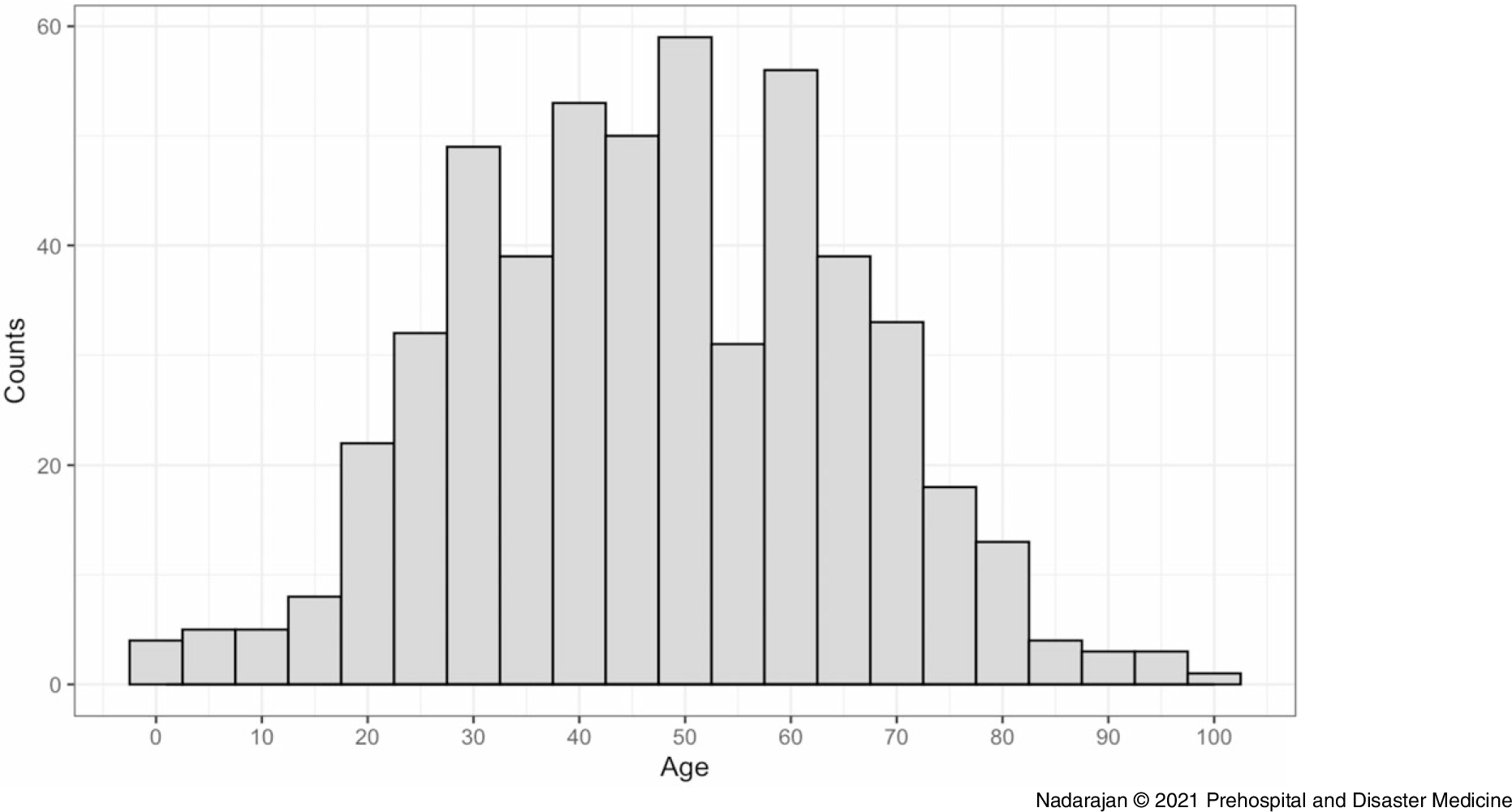
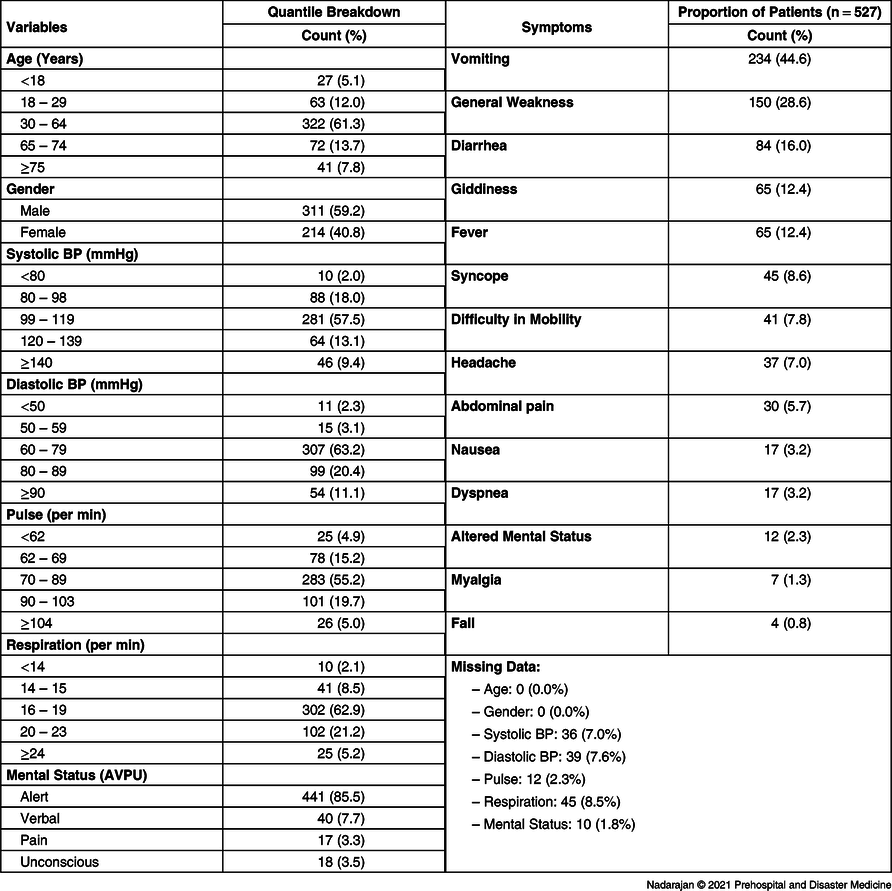
The patient demographics and clinical parameters are shown in Table 2 and Figure 3. Majority of the affected cases were men (59.4%). The age distribution followed a bell-shaped curve with an average age of 47 years (Figure 3). Within each clinical parameter, the missing data were less than 10%. Most of them were hemodynamically stable with an average pulse rate of 82, systolic blood pressure (SBP) of 108mmHg, and respiration rate of 18. Majority were fully conscious with 85.5% having an “Alert” status on the Alert, Verbal, Pain, Unconscious (AVPU) scale. Though thermometers were present on the ambulances, it was not a requirement to record the temperature on the PCR, and hence it was not captured in the data.
Age Distribution of Patients.

Patient Demographics, Vitals, and Symptoms Obtained on Scene

The three most common symptoms recorded by the first responders among the patients were vomiting (44.4%), general weakness (28.7%), and diarrhea (15.9%). Other symptoms included giddiness, fever, syncope, difficulty in mobility, headache, nausea, dyspnea, body pains, and falls, as shown in Table 3.
Ambulance Response Timing in Different Areas of Telangana

The three most common medical interventions on scene were oxygen therapy (35.1%), oral rehydration salt (ORS) solution administration (26.9%), and intravenous fluid administration (27.0%). Other medical interventions included administration of antacid, ondansetron (anti-emetic), tramadol (analgesic), glucose oral solution, and intravenous dextrose solution. Cold sponging was infrequently mentioned as a medical intervention. It was only given to those with a documented fever. Patients with documented symptoms of dyspnea, tachypnoea, and a “non-Alert” AVPU status were more likely to receive oxygen therapy. Patients with documented symptoms of vomiting, diarrhea, and SBP <100mmHg were more likely to receive intravenous fluids and ORS.
Table 3 shows that the average ambulance response time from call to scene arrival was under 25 minutes, with urban areas having the shortest response time (18 minutes 35 seconds) and tribal areas having the longest response time (28 minutes 47 seconds). More than 95% of the destination hospitals were government owned.
All the cases coded by the dispatch as sun stroke were also diagnosed as sun stroke by the paramedics. However, the dispatch pick-up of sun stroke cases was only a portion of the paramedics’ diagnosis, where 129 of the 525 cases were picked up by dispatch. This is important as it shows the challenge in the dispatch identification of heat illness cases and a potential area to develop.
Discussion
In this study, it was found that the incidence of heat-related calls correlated with areas inflicted with higher temperatures. There was also a higher incidence in rural areas and amongst the lower socioeconomic groups. However, ambulance response times for these areas were longer than in the urban areas. The number of calls peaked in the evening and patients presented with a range of general symptoms with vomiting, general weakness, and diarrhea as the most frequent symptoms. The generalized symptomology makes dispatch diagnosis challenging. Prehospital interventions could be optimized: cold sponging or its equivalent was infrequently done, and supplemental oxygen was often given without an objective indication.
A higher incidence was found in rural areas, which is different from the existing literature. It may be due to the unique characteristics of the Indian rural environment and the utilization of an ambulance may be the main way of seeking medical help (as compared to urban dwellers seeking medical aid in hospitals via their own form of transport). In the rural areas, lack of public shelters, enclosed households with restricted ventilation, lack of awareness, and the occupational hazard of farmers working in the open may contribute to their risk profile. There may also be fewer community interventions in rural areas such as public education and lack of first aid water points compared to urban areas. These findings are important to help with planning for public education, waterpoints, and first aid posts. It also helps with planning for ambulance deployment during heat wave periods.
Another interesting finding was the high incidence of heat illness amongst the ST and lower income groups. This may be due to their higher exposure while outdoor (eg, travelling or outdoor labor), potential co-morbidities, as well as health illiteracy. Reference Kannabiran23 It may also reflect the higher use of 108 ambulance services by STs. Reasons for this will need further analysis.
Peak calls in the evening may reflect the scenario where the workforce returns home to find their family members suffering from heat illness or it may be related to delayed recognition of heat illness and in seeking help. It may also reflect delayed effects of high ambient temperatures. For those working outdoors, some may not seek help during work hours and might tolerate their symptoms until after work. Workplace policies and public education may help such areas. This is also important to consider when planning deployment of ambulances.
In this study, incidence by age follows a bell curve, while previous studies suggested that the elderly were the most vulnerable to heat illness. This may be linked to a clinical bias in diagnosing heat illness in the prehospital setting. When the elderly present with non-specific symptoms, the paramedics may link the symptoms to their concurrent illness rather than as a presentation of heat illness. This may occur even in the hospitals where investigations are kept to the minimum due to constraints in resources. Hence the diagnosis code may not be heat illness, though it may have contributed to the symptoms. Conciliation of prehospital data with the hospital data is required to accurately analyze the age distribution.
There is a myriad of symptoms heat illness can present with. There is also a large overlap with symptoms of gastroenteritis. This poses a challenge for identification of heat illness and data collection. The current study reviews only prehospital identification of heat illness. It would be ideal if these data can be matched with the hospital diagnosis to confirm heat illness. This calls for further studies in the prehospital and emergency setting. It will be important to identify the correlation between symptom presentation and heat illness diagnosis as this will enable early identification by the community as well as by the EROs and paramedics.
There were no records of core body temperature monitoring which is vital to the monitoring of management of heat illness patients. Cold sponging was not a common intervention, which also prompts for further review. A possible reason for this maybe the lack of cold-water availability. Prevention and early treatment in the community by the prehospital services is important to prevent premature morbidity and mortality.
Limitations
The actual incidence of heat illness is probably higher than reported in this study as it was not possible to capture the cases managed by other ambulance services or cases that walked into hospital. Heat illness may also present with other symptoms and may only be a retrospective diagnosis after management in the hospital.
Another limitation is that the paramedics handwrite the PCR form; there may be issues with data accuracy, especially with event timings. The form is also written retrospectively and may not capture some of the interventions such as cold sponging. Temperature was not a compulsory component of vital signs recording and was usually missing. Hence, correlation of the symptomology with core body temperature was not possible. A limitation was the inability to study the outcomes of patients after being transferred to the hospitals.
Lastly, this study lacks external validity. Perhaps such a methodology may be used to characterize heat illness in a prehospital setting to help plan early interventions.
Conclusion
This study characterizes the burden of heat illness during the heat wave period on the prehospital system. The higher incidence in certain regions calls for action for public health efforts in prevention. These data may aid planning of prehospital resources and preparation of community first responders during heat wave periods. Further studies are needed in the prehospital setting to develop timely, effective interventions for different settings, such as LMICs as well as urbanized and rural areas.
Conflicts of interest/funding
GDN, RR, KR, AG, RJ, AY, CTZW, NTH, and WXY report no conflicts of interest. Prof. Marcus Ong (MO) has licensing agreement and patent filing (Application no: 13/047,348) with ZOLL Medical Corporation for a study titled “Method of Predicting Acute Cardiopulmonary Events and Survivability of a Patient.” He is also scientific advisor to Global Healthcare, a start-up which develops the Carboncool suit. No further conflict of interests for other authors.
Author Contributions
GDN, RR, KR, AG, RJ, and MO conceptualized the paper and helped with data collection. AY, CTZW, NTH, and WXY helped with data collection and analysis. All contributed to the paper.
Acknowledgements
The authors acknowledge: SingHealth Duke Global Health Institute; Mr. Keng Liang Cheng; and Dr. Uma Maheshwar Rao.