I. INTRODUCTION
The use of copper in power-supply interconnections such as electric cables and connectors requires not only excellent electrical conductivity but also good mechanical properties. The mechanical properties of soft copper are typically improved through alloying with metallic elements and thermomechanical processing, as this leads to solid-solution and age-precipitation strengthening. However, even just a small amount of solid-solution metal alloying significantly increases the electrical resistivity of copper.Reference Nagarjuna, Balasubramanian and Sarma1–Reference Semboshi and Konno3 There is, therefore, a need for new techniques and processes to improve the mechanical properties of copper without degrading its electrical conductivity.
An attractive solution to this problem lies in pure copper-based composites that are strengthened by a fine dispersion of hard and inert particles. Since the copper matrix retains essentially the same electrical conductivity as that of the pure metal, the decrease in conductivity of the composite is limited to just a few percent by virtue of the small volume fraction of added particles. Moreover, the mechanical properties are enhanced by the hard nanoparticles, ideally measuring several tens of nanometers in diameter, through an Orowan mechanismReference Gladman4,Reference Zhang and Chen5 that is similar to conventional age-precipitation strengthening.
Various processes have been proposed for fabricating bulk-copper-matrix composites, including melting and casting-based processes,Reference Viswanathan, Laha, Balani, Agarwal and Seal6–Reference Barmouz, Asadi, Besharati Givi and Taheirishargh9 internal oxidation methods,Reference Viswanathan, Laha, Balani, Agarwal and Seal6,Reference Afshar and Simchi10,Reference Fathy, Shehata, Abdelhameed and Elmahdy11 powder metallurgical techniques,Reference Viswanathan, Laha, Balani, Agarwal and Seal6,Reference Mizuuchi, Inoue, Agari, Morisada, Sigioka, Tanaka, Takeuchi, Kawahara and Makino12–Reference Mula, Sahani, Pratihar, Mal and Koch14 and electroforming-based procedures.Reference Viswanathan, Laha, Balani, Agarwal and Seal6,Reference Chen, Lakshminarayanan and Sautter15–Reference Musiani18 The latter have evolved from the principles of electroplating and electrodeposition, and they provide the ability to embed inert particles suspended in an electrolyte solution in a metal matrix during electrolysis. Composite electroforming offers two advantages. First, a high-purity metal matrix can be easily prepared, particularly in the case of copper, and it helps preserve the electrical conductivity. Second, the electroformed composites have the potential to host a uniform dispersion of inert particles, which is an important feature as it can help attain sufficient mechanical strengthening.
There have been a number of previous reports pertaining to the dispersion of microscale and submicroscale inert particles, including SiC,Reference Zhu, Liu, Hu, Shen, Hu and Ding19 Al2O3,Reference Verelst, Bonino and Rousset20,Reference Zhu, Liu, Liu, Zhao, Shen and Hu21 TiO2,Reference Ramalingam, Muralidharan and Subramania22 CeO2,Reference Mangam, Das and Das23 and so on,Reference Robin, Santana and Sartori24,Reference Zhao, Liu, Wu and Hu25 into a metal matrix such as copper or nickel by electroforming. More recently, the size of these inert particles has been reduced from several micrometers to tens of nanometers in a bid to further improve the mechanical and physical performance of the resulting composite. From a practical perspective, however, it is difficult to obtain a uniform dispersion of fine particles (<100 nm) in the matrix using electroforming. This is often attributed to the effects of particle aggregation and the surface potential of nanoparticles in the electrolyte solution, although inert particles have been successfully kept in suspensions during electroplating and electroforming through either mechanical stirring or using appropriate organic surfactants, such as fluorocarbon or gelatin.Reference Lee and Wan17,Reference Musiani18,Reference Verelst, Bonino and Rousset20–Reference Zhao, Liu, Wu and Hu25 With the use of surfactants, however, a large amount of impurities in the form of carbon and oxygen are present in the final composites, resulting in serious embrittlement of the materials.Reference Viswanathan, Laha, Balani, Agarwal and Seal6,Reference Musiani18,Reference Ibanez and Fatas26 Thus, although the use of organic surfactants in suspensions may be useful in the case of electroplated surface coatings for wear resistance, their use should be avoided when fabricating bulk composites where high toughness and high electrical conductivity are required.
In this study, we aimed to fabricate bulk copper-matrix composites reinforced with oxide nanoparticles by using an electrolyte without surfactants to avoid contamination. To this end, a range of nanoparticles were tested (Al2O3, SiO2, TiO2, ZrO2, and CeO2) to find the one most suitable for this procedure. The mechanical properties and electrical conductivity of the resulting composites were examined; based on the results, the critical factor that governs the electroforming of copper-matrix composites with nanoparticles is discussed here.
II. EXPERIMENTAL
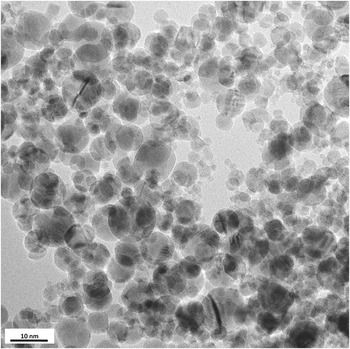
The electrolyte used in this study was a copper sulfate–sulfuric acid solution, which consisted of pure water (1000 mL), copper sulfate (140 g), and sulfuric acid (70 mL). The pH value of the electrolyte was approximately 0.4. Nanoparticles of Al2O3, SiO2, TiO2, ZrO2, or CeO2 were added to the electrolyte at a concentration of 1 cm3/L (i.e., the volume density of the oxide). The mean size of these nanoparticles ranged from 10 to 30 nm, and a representative micrograph of TiO2 nanoparticles is shown in Fig. 1. The resulting electrolyte mixtures were agitated by magnetic stirring at a speed of 250 revolutions per minute (rpm) to suppress settling of the nanoparticles; they were stabilized for approximately 3 h prior to electroforming. The cathode plate (80 × 40 × 0.5 mm3; type 304 stainless steel) for electroforming was thoroughly washed using ethanol, and then rinsed with distilled water. Insulating tape was then used to tightly cover all but a 40 × 30 mm2 electroforming area of the cathode plate. The anode plate (80 × 40 × 1.5 mm3 phosphor copper) was submerged in dilute nitric acid for a few minutes to remove the surface contamination, and then rinsed with distilled water. It should be noted that in a preliminary experiment, we confirmed that the components used in electroforming, such as the nanoparticles, stainless steel, and insulating tape, were resistant to decay in the acid electrolyte over test periods of at least three days. This means that no reaction should occur in the system without applying an electrical charging. Electroforming was performed over 24 h using an applied current density of 0.5 mA/mm2 (i.e., an applied current of 0.6 A was applied to the 40 × 30 mm2 electroforming area); agitation was realized by magnetic stirring at a speed of 250 rpm. The electrolyte temperature was maintained at 298 K.
TEM image of a typical TiO2 nanoparticle used in this study.

The composition of metallic elements, sulfur, and phosphor in the electroformed specimens was determined through inductively coupled plasma-optical emission spectrometry (IRIS Advantage DUO, Thermo Fisher Scientific, Waltham, MA). The oxygen content was obtained through helium-carrier fusion thermal-conductivity measurements (TC-436, LECO, St. Joseph, MI). The microstructures of the electroformed specimens were observed using a transmission electron microscope (TEM; JEM3010, JEOL, Tokyo, Japan) operated at 300 kV. Samples for TEM observations were prepared from thin foils ground to less than 50 μm in thickness. The ground samples were then subjected to low-angle ion milling (GATAN, PIPS Model 691, Tokyo, Japan) using an argon ion beam accelerated by voltages below 3 kV. High-purity (99.9999 mass% pure) argon gas was used as the ion-beam source.
To examine the electrical charge of the oxide nanoparticle surface in the electrolyte, measurements of surface potential, i.e., zeta potential, were carried out at 298 K using a zeta potential analyzer (ELSZ-1000ZS, Otsuka Electronics Co. Ltd., Osaka, Japan). It should be noted that before the measurement, the electrolytes were passed once through a filter with a pore diameter of 30 μm to remove the aggregated powder. The values of zeta potential were obtained by averaging the results of five measurements; the maximum and minimum values were excluded. The Vickers hardness of the electroformed specimens was measured by applying a load of 4.9 N and holding it for 10 s. All hardness values obtained were based on an average of values from 12 indentations; the maximum and minimum values were excluded from this calculation. Tensile tests were performed at 298 K using a universal tensile testing machine (TENSIRON UTA-10 KN, A&D Co. Ltd., Tokyo, Japan) and a strain rate of 1.67 × 10⁻⁴ s−1. Tensile-test specimens measuring 10 mm in length, 1.7 mm in width, and 0.7–1.0 mm in thickness (obtained with a gauge) were cut from the electroformed specimens using electrical-discharge machining (EDM), and their surfaces were mechanically polished using diamond slurry. Three tensile tests were performed for each specimen. The electrical resistivity was measured at 298 K using a constant-DC-current four-terminal technique (current: 100 mA). For these measurements, the electroformed specimens were first cold-rolled and then cut by EDM to a size of 80 × 2 × 0.2 mm3.
III. RESULTS AND DISCUSSION
A. Nanoparticle selection for fabrication of copper-matrix composite
During electroforming at a current density of 0.5 mA/mm2, it appeared that the copper film was deposited and grown on the type 304 stainless steel cathode without H2 bubbling. After electroforming for 24 h, bulk copper specimens with a thickness of approximately 1.5 mm were formed on the cathode, regardless of whether the electrolyte contained oxide nanoparticles. After electroforming, the copper specimens were easily separated from the cathode, which was not corroded after electroforming. The current efficiency to electroform the copper-matrix composites was calculated from its weight to be almost 100%. As reported previously,Reference Zhu, Liu, Liu, Zhao, Shen and Hu21,Reference Winand27 all of the electroformed specimens had some nodular units and rough surfaces. Hereafter, the copper specimen electroformed in the electrolyte without oxide nanoparticles is referred to as EF-Cu, and the specimens electroformed in the electrolytes with Al2O3, SiO2, TiO2, ZrO2, and CeO2 particles are referred to as EF-Cu/Al2O3, EF-Cu/SiO2, EF-Cu/TiO2, EF-Cu/ZrO2, and EF-Cu/CeO2, respectively.
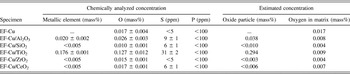
Table I lists the concentration of oxygen, sulfur, phosphor, and metallic element in the oxide nanoparticles presented in the electroformed specimens. This indicates that the Cu content of the EF-Cu specimen was greater than 99.98 mass%, with the sulfur and phosphor content below the detectable limit. The oxygen content was measured as 170 ppm, which is similar to the value for commercial tough-pitch copper. In the EF-Cu/SiO2, EF-Cu/ZrO2, and EF-Cu/CeO2 specimens, the concentrations of oxygen, sulfur, and phosphor were all similar to those of the EF-Cu specimen; however, the concentrations of the metallic elements in the oxide (i.e., Si, Zr, and Ce) were below the detection limit of 0.005 mass%. This suggests that these particular electroformed specimens did not contain any significant distribution of oxide nanoparticles. In the EF-Cu/Al2O3 and EF-Cu/TiO2 specimens, the concentrations of Al and Ti in the oxides were found to be 0.020 and 0.176 mass%, respectively. If we assume that all of the metallic elements were contained within oxide nanoparticles dispersed in the EF-Cu/Al2O3 and EF-Cu/TiO2 specimens, the amount of oxide nanoparticles in each specimen can be estimated as 0.038 and 0.294 mass%, respectively. Note that the concentrations of oxygen in the matrices of the EF-Cu/Al2O3 and EF-Cu/TiO2 specimens were also estimated, as shown in Table I; these values are not considerably different from those of the other electroformed specimens.
Chemically analyzed concentration of metallic elements, oxygen, sulfur, and phosphorus in the electroformed specimens; the estimated concentration of oxide nanoparticles and oxygen in the electroformed specimens.

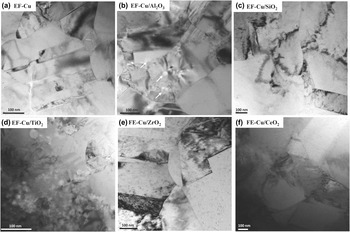
Figures 2(a)–2(f) show typical bright-field TEM images of the electroformed specimens. The TEM image of the EF-Cu specimen in Fig. 2(a) shows fine grains of copper, and their mean size of several hundred nanometers was much smaller than those in conventionally annealed pure copper (several tens to hundreds of micrometers). This is in agreement with previous reportsReference Cziraki, Gerocs, Toth-Kadar and Bakonyi28,Reference Hakamada, Nakamoto, Matsumoto, Iwasaki, Chen, Kusuda and Mabuchi29 ; the other electroformed specimens exhibited similar fine grain size [Figs. 2(b)–2(f)]. TEM observation failed to identify any nanoparticles in the EF-Cu/SiO2, EF-Cu/ZrO2, and EF-Cu/CeO2 specimens, as shown in Figs. 2(c), 2(e), and 2(f), respectively. On the other hand, nanoparticles measuring a few tens of nanometers in diameter were found to be dispersed in the copper matrix in the EF-Cu/Al2O3 and EF-Cu/TiO2 specimens, as shown in Figs. 2(b) and 2(d). Interestingly, the quantity of nanoparticles in the EF-Cu/TiO2 specimen was greater than that in the EF-Cu/Al2O3 specimen, although their distribution was less uniform. These observations are consistent with the results of the chemical analysis listed in Table I. It is therefore concluded that it is possible to efficiently fabricate copper-matrix composites with dispersed oxide nanoparticles through electroforming when TiO2 nanoparticles are used in the electrolyte. Conversely, copper-matrix composites containing SiO2, ZrO2, or CeO2 nanoparticles are not readily achieved by electroforming when a surfactant-free electrolyte is used.
TEM images of (a) EF-Cu, (b) EF-Cu/Al2O3, (c) EF-Cu/SiO2, (d) EF-Cu/TiO2, (e) EF-Cu/ZrO2, and (f) EF-Cu/CeO2 composites.

Among possible mechanisms proposed for the electroforming of copper with inert particles, a few have generally been accepted.Reference Buelens, Celis and Roos16 In the first scenario, particles migrate to the cathode via an electrophoretic action and are therefore embedded in the copper during electroforming. Alternatively, particles may be brought to the cathode by agitation and become mechanically entrapped in the copper. In the present study, the fact that the electrolyte solution was stirred at a constant rate (250 rpm) should pose little difference in mechanical agitation of various electroforming specimens. Consequently, the electrophoretic action of nanoparticles in the electrolyte solution is considered to be the more critical factor.
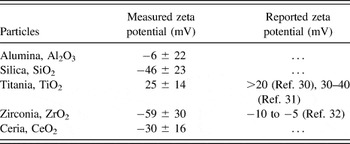
To further explore the contribution of this electrophoretic action to the fabrication of copper-matrix composites by electroforming, we examined the zeta potential of nanoparticles in the electrolyte solution. The values obtained are listed in Table II, which also includes previously reported zeta potentials for TiO2 and ZrO2 (Ref. Reference Mattson, Sedin and Theliander30–Reference Simunkova, Pessenda-Garcia, Wosik, Angerer, Kronberger and Nauer32) in a solution with a similar pH value for comparison. The values show a significant variation in the measured zeta potential values, which is probably attributable to particle aggregation in the electrolyte. However, it can be qualitatively stated that the SiO2, ZrO2, and CeO2 nanoparticles exhibited negative values in zeta potential for the electrolyte solution, whereas the TiO2 nanoparticles had a positive value. In the case of the Al2O3 nanoparticles, the polarization of the surface potential is believed to have been near neutral. These zeta potential data therefore closely reflect the codeposition by electroforming, i.e., only nanoparticles with a positive charge in the electrolyte followed the copper ions in the migration to the cathode during electroforming. Therefore, when selecting nanoparticles for dispersion in a copper-matrix composite, a positive surface potential in the electrolyte solution should be considered as one of the most critical factors.
Zeta potential of nanoparticles in the copper sulfate–sulfuric acid solution.

It should be noted that the magnitude of the zeta potential of nanoparticles in the electrolyte solution is a significant measure of the solution stability. Lower values toward zero, regardless of whether they are positive or negative, indicate an unstable solution with a tendency to flocculate because of the small electrostatic repulsive force among the nanoparticles. All the zeta potentials measured in this study showed relatively low magnitudes (see Table II), which means that it was difficult for the nanoparticles to disperse homogeneously in the solution without agitation. Therefore, it is important to understand how an electrolyte solution can be agitated during electroforming; this topic will be discussed in a future paper.
B. Electrical and mechanical properties
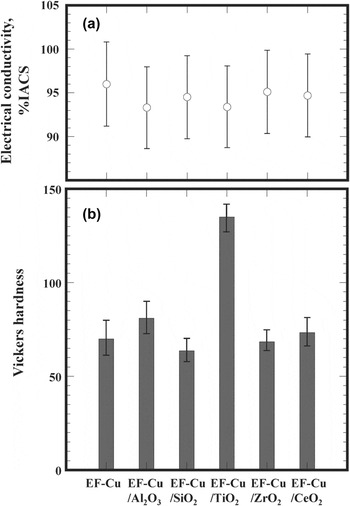
The electrical conductivity and Vickers hardness of the electroformed specimens are shown in Fig. 3. Here, the conductivity is expressed in terms of “% IACS”, which is defined as the percentage of an International Annealed Copper Standard at 298 K, 5.8 × 10⁷ Ω−1 m−1. The conductivity of the EF-Cu specimen, 96 ± 5% IACS, is close to that of pure copper (100% IACS); the conductivities of the other electroformed specimens were at a slightly lower level, but within the margin of experimental accuracy. These high values can be attributed to the low concentration of contaminants such as oxygen, sulfur, and phosphor in the copper matrix of the electroformed specimens, as demonstrated in Table I. Figure 3(a) indicates that the TiO2 nanoparticles contained in the EF-Cu/TiO2 specimen had little overall effect on the electrical conductivity of the composite, despite the electrical conductivity of TiO2 (10−8–10−10 Ω−1 m−1) being much lower than that of pure copper, 5.8 × 10⁷ Ω−1 m−1.Reference Pomoni, Safianou, Georgakopoulos, Boukos and Trapalis33 This can be explained by the very low concentration of the nanoparticles, which was less than 0.3 mass%.
(a) Electrical conductivity and (b) Vickers hardness of the electroformed composites.

The hardness of the EF-Cu specimen was approximately 70 Hv, which is much higher than the value of 45 Hv obtained for well-annealed pure copper. This is attributable to the hardening induced by the fine grains of the EF-Cu specimen.Reference Hakamada, Nakamoto, Matsumoto, Iwasaki, Chen, Kusuda and Mabuchi29 The hardness values of the EF-Cu/SiO2, EF-Cu/ZrO2, and EF-Cu/CeO2 specimens were not significantly different from that of the EF-Cu specimen owing to their lack of oxide nanoparticles. The hardness was increased slightly to 80 Hv for the EF-Cu/Al2O3 specimen, but a far more significant (90%) increase to 135 Hv was observed for the EF-Cu/TiO2 specimen.
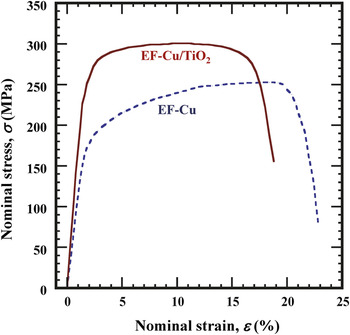
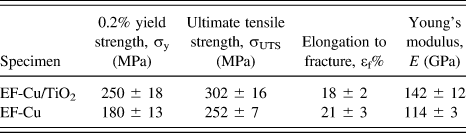
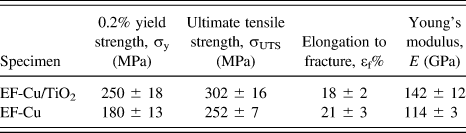
Figure 4 shows representative nominal stress–strain curves for the EF-Cu and EF-Cu/TiO2 specimens subjected to tensile testing. Table III summarizes the 0.2% yield strength, ultimate tensile strength, elongation to fracture, and Young's modulus for the two specimens. It can be seen that the yield strength (250 MPa) and ultimate tensile strength (302 MPa) of the EF-Cu/TiO2 specimen are notably greater than those of the EF-Cu specimen. This means that the mechanical strength could be improved without significant degradation of the electrical conductivity, although the elongation to fracture was decreased by a few percent.
Typical nominal stress–strain curves for EF-Cu and EF-Cu/TiO2 composites.

0.2% yield strength, ultimate tensile strength, elongation to fracture, and Young's modulus of EF-Cu and EF-Cu/TiO2 composites.
On the basis of the microstructural information presented thus far, the mechanism by which strengthening is attained through a dispersion of TiO2 nanoparticles can be explained as follows. First, according to the Orowan mechanism, dislocations in the copper matrix must bypass any embedded TiO2 nanoparticles, as these are much harder than the matrix. The strengthening induced by such nondeformable particles is given by the Ashby–Orowan equationReference Gladman4,Reference Zhang and Chen5
 $$\Delta {\sigma _{\rm{p}}} = \left( {{{0.538Gb{f^{{1 \mathord{\left/ {\vphantom {1 2}} \right. \kern-\nulldelimiterspace} 2}}}} \mathord{\left/ {\vphantom {{0.538Gb{f^{{1 \mathord{\left/ {\vphantom {1 2}} \right. \kern-\nulldelimiterspace} 2}}}} d}} \right. \kern-\nulldelimiterspace} d}} \right)\ln \left[ {{d \mathord{\left/ {\vphantom {d {\left( {2b} \right)}}} \right. \kern-\nulldelimiterspace} {\left( {2b} \right)}}} \right]\quad ,$$
where G is the shear modulus of the copper matrix, b is the magnitude of the Burgers vector, f is the volume fraction of the particles, and d is the effective diameter of the circular cross-section of the obstacle particles. Assuming that the nanoparticles are uniformly dispersed in the matrix, d can be regarded as equivalent to the mean size of the TiO2 nanoparticles, 15 nm (Fig. 1). The volume fraction (f) of TiO2 particles was calculated to be 0.61% using a density of 4.27 g/cm2, and the mass fraction listed in Table I. By inserting G = 48.3 GPa and b = 0.255 nmReference Semboshi, Nishida and Numakura34 for copper in Eq. (1), Δσp arising from the dispersion of TiO2 nanoparticles was estimated to be 117 MPa. This provides a qualitative estimate of the contribution of TiO2 nanoparticles to the strengthening of the copper matrix, but it does quantitatively differ from the measured Δσp (approximately 70 MPa in 0.2% yield stress) that was calculated from Table III. This discrepancy must be the result of the nonuniform dispersion and partial agglomeration of the embedded TiO2 nanoparticles that are evident in Fig. 2(d), suggesting that the strength of the copper-matrix composites could be further enhanced if this agglomeration of nanoparticles is controlled. In addition, the potential, at least according to Eq. (1), could further increase the concentration of TiO2 nanoparticles. These modifications of the electroforming process will form the basis of a future paper. It should be noted that the Young's modulus of the EF-Cu/TiO2 specimen was also greater than that of the EF-Cu specimen (Table III). This is possibly because of the high Young's modulus of anatase TiO2, which has been reported to be more than 150 GPa,Reference Borgese, Gelfi, Bontempi, Goudeau, Geandier, Thiaudiere and Depero35 although further work is needed to confirm the hypothesis.
IV. CONCLUSION
Copper-matrix composites containing dispersed oxide nanoparticles were prepared by electroforming in a copper sulfate–sulfuric acid solution containing 1 cm3/L of the nanoparticles. From an evaluation of its microstructure and mechanical and electrical properties, the following conclusions were obtained:
(1) Nanoparticle-reinforced copper-matrix composites can be electroformed using an electrolyte containing TiO2 or possibly Al2O3 nanoparticles. However, it is difficult to obtain such a composite using SiO2, ZrO2, or CeO2 nanoparticles in a surfactant-free electrolyte. This can be explained by the nature of the surface potential: TiO2 has a positive zeta potential in the electrolyte solution, whereas SiO2, ZrO2, and CeO2 have negative zeta potentials. The zeta potential of Al2O3 nanoparticle is near neutral.
(2) The electrical conductivity of the EF-Cu/TiO2 specimen is not significantly different from that of pure copper, as the TiO2 nanoparticles amount to less than 0.3 mass% (0.6% by volume) of the total composite. Nevertheless, the hardness, yield, and ultimate tensile strength are significantly improved by the TiO2 nanoparticles primarily owing to strengthening by Orowan mechanics.
ACKNOWLEDGMENTS
The authors are grateful to Prof. Y. Takigawa and Prof. S. Yagi of Osaka Prefecture University (OPU) and Y. Nakai, Dr. T. Kuwabara, and A. Inoue of Sumitomo Electric Industries Ltd. for their valuable discussions and comments. The authors also wish to thank E. Aoyagi and Y. Hayasaka of the Institute for Materials Research of Tohoku University, and S. Shiraishi of OPU for their technical assistance. Financial support was provided by the Japan Society for the Promotion of Science (JSPS) through a Grant-in-Aid for Scientific Research (C) (No. 26420663).