Implications
This study investigated possible dietary associations with differences in milk fever incidence among herds in Sweden. The results indicate that decreasing the amount of K in the diet of dry cows during the last 3 weeks of gestation may prevent a high incidence of milk fever. The study indicates that the amount of Mg fed should be higher than the current Nordic recommendation to avoid a high incidence of milk fever.
Introduction
On average, 3% to 7% of all dairy cows are affected by milk fever at calving (Curtis et al., Reference Curtis, Erb, Sniffen, Smith and Kronfeld1985; Swedish Dairy Association, 2010; Hossein-Zadeh and Ardalan, Reference Hossein-Zadeh and Ardalan2011), and the incidence of milk fever is highly variable among herds (Hardeng and Edge, Reference Hardeng and Edge2001). Milk fever is associated with an increased risk of other problems, such as mastitis, retained placenta and displaced abomasum (Curtis et al., Reference Curtis, Erb, Sniffen, Smith and Kronfeld1985; Correa et al., Reference Correa, Curtis, Erb, Scarlett and Smith1990). Subclinical hypocalcaemia also has a negative impact on, for example, feed intake, thus predisposing the cow to other periparturient diseases (Hansen et al., Reference Hansen, Nørgaard, Pedersen, Jørgensen, Mellau and Enemark2003). According to Reinhardt et al. (Reference Reinhardt, Lippolis, McCluskey, Goff and Horst2011), the prevalence of subclinical hypocalcaemia, defined as plasma Ca concentrations below 2.0 mM, may be more than 40% after calving in multiparous cows. Houe et al. (Reference Houe, Østergaard, Thilsing-Hansen, Jørgensen, Larsen, Sørensen, Agger and Blom2001) estimated that the incidence of subclinical hypocalcaemia in a herd may be 5 to 10 times higher than the incidence of milk fever.
The risk of milk fever can be affected by the composition of the dry cow feed. A model developed by Lean et al. (Reference Lean, DeGaris, McNeil and Block2006) based on a meta-analysis showed a quadratic relationship between Ca concentration in the dry cow diet and the predicted incidence of milk fever, with both low and high Ca concentrations resulting in a lower predicted incidence. The highest predicted milk fever incidence was found with Ca concentrations of 13 g/kg dry matter (DM). Experimental studies with decreased Ca intake during the dry period have shown a decreased risk of milk fever and hypocalcaemia at calving (Goings et al., Reference Goings, Jacobson, Beitz, Littledike and Wiggers1974; Shappell et al., Reference Shappell, Herbein, Deftos and Airello1987). This is suggested to be an effect of activation of Ca-saving mechanisms before calving, and thereby better preparation for increased Ca losses after calving (Goings et al., Reference Goings, Jacobson, Beitz, Littledike and Wiggers1974).
Dietary Mg is also important for the incidence of milk fever. Lean et al. (Reference Lean, DeGaris, McNeil and Block2006) showed a relationship between an increased dietary Mg concentration and a decreased risk of developing milk fever. The Mg status of the animal affects Ca homeostasis, with Mg deficiency reducing the production of the Ca-saving hormone parathyroid hormone as a response to hypocalcaemia (Suh et al., Reference Suh, Tashjian, Matsuo, Parkinson and Fraser1973), and also tissue responsiveness to parathyroid hormone (Reddy et al., Reference Reddy, Coburn, Hartenbower, Friedler, Brickman, Massry and Jowsey1973). Cows with hypomagnesaemia may thus respond more slowly and less efficiently to the hypocalcaemia occurring at parturition and may thus be more likely to develop milk fever.
A high intake of K before calving has been shown to increase the risk of milk fever (Goff and Horst, Reference Goff and Horst1997). Potassium intake has an alkalotic influence on the acid–base status of the cow (Rérat et al., Reference Rérat, Philipp, Hess and Liesegang2009) and it has been shown in several experiments that cows that are more alkalotic have a lower plasma Ca at calving and a higher incidence of milk fever (Goff and Horst, Reference Goff and Horst1997; Kurosaki et al., Reference Kurosaki, Yamato, Mori, Imoto and Maede2007). Other minerals with a strong influence on the acid–base balance are Na, Cl and S. However, variations in the concentration of these minerals in Swedish forages have a smaller influence on the dietary cation–anion difference (DCAD) value of the feed, calculated as (Na + K) − (Cl + S), than variations in the K concentration (Pehrson et al., Reference Pehrson, Svensson, Gruvaeus and Virkki1999).
The aim of this study was to investigate whether differences in the incidence of milk fever among Swedish dairy herds can to some extent be explained by differences in feeding of minerals (Ca, P, Mg and K) during the last 3 weeks of gestation. Our starting hypothesis was that a dry cow diet with a high amount of Mg and low amounts of Ca and K during the last 3 weeks of gestation would be associated with a low incidence of milk fever.
Material and methods
The study was performed as a case–control study at the herd level, based on data from the Swedish cattle database maintained by the Swedish Dairy Association. Cases of milk fever were defined as veterinary-treated cases. Swedish regulation states that veterinarians must record the diagnosis and treatment of a clinical disease and report these data to the national disease recording database maintained by the Swedish Board of Agriculture. Milk fever is a disease that is largely treated by veterinarians (Mörk et al., Reference Mörk, Lindberg, Alenius, Vågsholm and Egenvall2009), and as the treatment is only provided when symptoms are present, the recorded number of veterinary treatments could therefore be assumed to provide an accurate estimate of milk fever cases. About 85% of Swedish dairy cows are included in the official milk recording scheme (Swedish Dairy Association, 2010), where data on milk production, reproductive events, etc. are combined with disease recording data in the cattle database.
Inclusion criteria
Only herds in the Swedish official milk recording scheme with a recorded number of more than 45 cows (n = 2582) in the period September 2006 to August 2007 were considered eligible for inclusion, to ensure that single milk fever cases had a limited influence on the incidence. On the basis of data for the period September 2004 to August 2007, the 100 herds with the highest reported mean annual milk fever veterinary treatment incidence, that is, the number of cows treated for milk fever that was registered in the database divided by the total number of cows registered, were chosen as cases, whereas the 145 herds with no reported milk fever treatments were chosen as controls. However, herds with less than 2% recorded average incidence of the most frequent treatment, that is, treatment for mastitis, were excluded to avoid including herds for which a veterinarian had not reported any treatment incidences. This excluded 43 of the 145 control herds with no reported milk fever treatments, but none of the 100 case herds with the highest incidence of milk fever treatments. Case herds had a recorded incidence rate of milk fever treatments of between 8.8% and 16.3%.
Data collection
A questionnaire covering feeding routines and the diet fed to dry cows at two time-points during late gestation, 3 weeks before expected calving and at expected calving, was prepared and tested on four dairy farmers who had not been selected for the study. After adjustments, the questionnaire was sent by post together with a letter with information on the background and objectives of the study to each of the selected farmers in April 2008. The farmers were asked to provide information about the feedstuffs used in the dry cow diet, the amounts fed, the DM content and amount of metabolisable energy, CP and minerals (Ca, P, Mg and K) in the silage used for the cows at the two time-points, and the composition of mineral supplements. Where no mineral analysis had been carried out on the silage, the farmers were offered a free analysis at a commercial laboratory, and three agreed to send in silage samples. All farmers were also asked about the use of prophylactic treatment with oral Ca around calving for prevention of milk fever, which, together with alterations in the diet and restricted milking, is the most common way to prevent milk fever (Hansen et al., Reference Hansen, Ersbøll, Blom and Jørgensen2007). To verify the absence of milk fever in control herds with no recorded veterinary treatments, all farmers were asked to estimate the number of milk fever cases during the previous year and during the previous three years.
Farmers who had not responded after 4 weeks (n = 144) were sent a reminder by letter and after 2 more weeks, at least two attempts were made to contact farmers who had not responded (n = 129) by phone. Returned questionnaires with incomplete or unclear answers (n = 31) were followed up by a telephone interview, and an additional 10 farmers chose to answer all questions by phone. In total, 101 questionnaires were answered, representing 55 case herds and 46 control herds. Information on the breed composition of the herd, the total frequency of veterinary treatments, herd size, the number of cows in different lactation numbers and herd average milk production was based on data from the official milk recording scheme.
Calculations and statistics
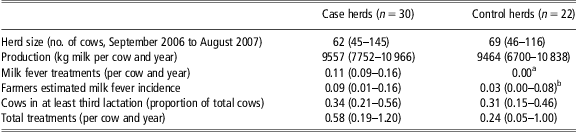
Total DM, roughage proportion of DM and intake of metabolisable energy, CP, Ca, P, Mg and K in the dry cow diet 3 weeks before calving and at calving were calculated from the answers. The difference between DM intake 3 weeks before calving and at calving was calculated in order to estimate the change in diet during the last 3 weeks of gestation. Data on nutrient composition of the feedstuffs used, except for silage, were taken from Swedish feed tables (Spörndly, Reference Spörndly2003) or from product sheets provided by the feed manufacturers when the feeds consisted of commercially available mixtures. Herds without nutrient and mineral analysis of the silage fed during the last 3 weeks of gestation were not included in the comparison between case and control herds (n = 13 cases and n = 18 controls). Herds with ad libitum feeding of mineral supplements were also excluded from the comparison (n = 11 cases and n = 4 controls). When an individual farmer was not able to estimate the silage intake per cow per day, the average intake for all herds with complete information (8.9 kg DM/cow per day) was used. This was done in 14 case herds and 6 control herds. A total DM intake of 15 kg was assumed to be the maximum level (Ramos-Nieves et al., Reference Ramos-Nieves, Thering, Waldron, Jardon and Overton2009). Reported DM intakes higher than this were recalculated to 15 kg DM if the cows were fed a total mixed ration or a large amount of forage (n = 3 cases); otherwise, the herd was excluded (n = 1 case and n = 1 control). Also, one control herd was excluded because the farmer estimated a high milk fever incidence. Of the 46 farmers in control herds who answered the questionnaire, only one farmer reported no milk fever cases during the previous 3 years and additionally nine farmers in control herds reported no milk fever cases during the previous year. Data on the farmers’ estimation of the milk fever incidence can be found in Table 1.
Characteristics of case herds with a high recorded frequency of veterinary treatments for milk fever and of control herds with no recorded milk fever treatments

Data are based on the period September 2004 to August 2007 and are presented as mean (range).
aA selection criterion for control herds was no recorded milk fever treatments the last 3 years.
bControl herds estimating more than 8.8% milk fever were excluded from the study.
All statistical analyses were carried out using SAS version 9.1 (SAS Institute, Cary, USA). The risk of being a case herd was analysed using a multivariable logistic regression model, where the variables of main interest were the amount of minerals fed (Ca, P, Mg and K) 3 weeks before calving and at calving, and the increase in dietary DM during the last 3 weeks of gestation. Basic variables included in the model were herd size, the proportion of cows in their third lactation or older, herd average milk yield and breed, classified as ⩾80% Swedish Holstein cows, ⩾80% Swedish Red cows or a mixture of Swedish Holstein and Swedish Red cows. All variables were checked for a linear relationship with the logarithmic odds of being a case herd. If the assumption of linearity was not fulfilled, the variable was categorised into three classes, with one-third of the herds in each class. The variables regarding the diet, that is, Ca, Mg, K and P 3 weeks before calving and at calving, and the increase in DM during the last 3 weeks before calving, were added one by one in a model with the four basic variables. Dietary variables with P < 0.20 were checked for colinearity and, together with the basic variables, were entered into a logistic regression model with the binary outcome case or control herd. Both dietary and basic variables were removed stepwise from the model at P > 0.10. The association between case/control and use of prophylactic treatments was evaluated by a χ 2-test and the association with the total incidence of veterinary treatments was evaluated by a univariable logistic regression model, after linearity was checked. Model fit was checked using the Hosmer–Lemeshow test.
Results
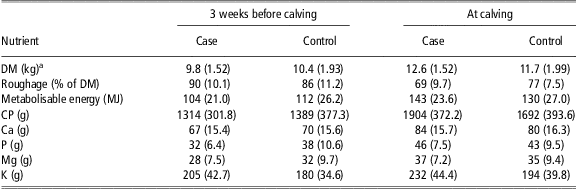
General information on the selected 30 case herds and 22 control herds is presented in Table 1. The total intake of DM, proportion of roughage and intake of minerals (Ca, P, Mg and K) per cow and day in case and control herds 3 weeks before calving and at calving are shown in Table 2. All herds except one case herd received Ca according to or above the Nordic feed recommendation of 33 g/day, and all herds except three (one case and two control herds) received Mg at or above the recommended level of 14 g/day (Nielsen and Volden, Reference Nielsen and Volden2011).
Daily intake of DM, roughage proportion, metabolisable energy, CP, Ca, P, Mg and K per cow in case herds with a high incidence of veterinary treatments for milk fever, and in control herds with no incidence of milk fever treatments, 3 weeks before expected calving and at expected calving

DM = dry matter.
Data are presented as mean (s.d.).
aMaximum DM intake was set at 15 kg.
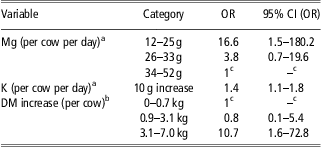
The only variable with a linear relationship with the outcome in the statistical analysis was K, both 3 weeks before and at calving. The final statistical model included K 3 weeks before calving (P = 0.01), Mg 3 weeks before calving classified into three groups (P = 0.05) and the increase in DM intake during the last 3 weeks of gestation classified into three groups (P = 0.03). Increasing amount of dietary K was associated with higher odds of high milk fever incidence (Table 3). High K intake at calving was also significantly associated with increased odds of being a case herd, but this variable was highly correlated to the intake of K 3 weeks before calving and was therefore not included in the model. Feeding less than 26 g Mg/day 3 weeks before calving and feeding more than an extra 3.1 kg DM/day at calving compared with 3 weeks before calving were also associated with higher odds of high milk fever incidence (Table 3). The amount of P fed 3 weeks before calving, herd size, average milk production in the herd, breed composition of the herd and percentage of cows in their third or higher lactation had P > 0.10 in the model and were therefore excluded. Calcium fed 3 weeks before calving and Ca, P and Mg at calving had P > 0.20 when tested one by one together with the basic variables for a relationship with the outcome and were therefore not included in the multivariable model. The results from the final model were not affected when the previously excluded variables were included in the model. The Hosmer–Lemeshow test of model fit was not significant (P = 0.145).
OR and CI for being a herd with a high incidence of milk fever according to the variables included in the final logistic regression model

OR = odds ratio; CI = confidence interval; DM = dry matter.
aEstimated 3 weeks before expected calving.
bEstimated as the difference in DM feeding between 3 weeks before expected calving and at expected calving.
cUsed as the reference level.
Of the 52 herds included in the study, 45 herds (87%) reported that they used an oral Ca supplement around calving to prevent milk fever. There was a tendency towards a higher frequency of case herds using oral Ca supplements than control herds, 93% and 77%, respectively (P = 0.09). The incidence of all recorded veterinary treatments per cow and year was higher in case than in control herds (P = 0.001).
Discussion
There was no difference in the amount of Ca in the diet between case and control herds 3 weeks before calving or at calving, and dry cows in all herds were fed more than 20 g Ca/day. This is in agreement with Thilsing-Hansen et al. (Reference Thilsing-Hansen, Jørgensen and Østergaard2002), who concluded that Ca intake had to be decreased to less than 20 g/day to decrease the incidence of milk fever. In addition, differences in Ca intake have been found to have no effect on the incidence of milk fever or subclinical hypocalcaemia in experimental studies when the minimum level exceeds 20 g/day (Goff and Horst, Reference Goff and Horst1997; Kamiya et al., Reference Kamiya, Kamiya, Tanaka and Shioya2005; Kronqvist et al., Reference Kronqvist, Emanuelson, Spörndly and Holtenius2011). Curtis et al. (Reference Curtis, Erb, Sniffen and Smith1984) found no effect of dietary Ca in commercial herds on the incidence of milk fever, although they concluded that all cows in their study were fed well above the recommendations. However, the models developed by Lean et al. (Reference Lean, DeGaris, McNeil and Block2006) and Oetzel (Reference Oetzel1991) showed a large increase in predicted milk fever incidence when the Ca concentration in the diet increased up to 13 g/kg DM. The herds in the present study received Ca in the range from 4.9 to 10.2 g/kg DM, which, according to the model developed by Lean et al. (Reference Lean, DeGaris, McNeil and Block2006), would result in considerable differences in predicted milk fever incidence. The conclusion of Lean et al. (Reference Lean, DeGaris, McNeil and Block2006) is supported by the results obtained by Shappell et al. (Reference Shappell, Herbein, Deftos and Airello1987), where cows fed 11.6 g Ca/kg DM experienced subclinical hypocalcaemia to a much greater degree than cows fed 5.2 g Ca/kg DM. However, the results from the present study do not support the theory that a decrease in Ca intake within the range from 4.9 to 10.2 g Ca/kg DM prevents milk fever when the cows are fed Ca above the recommended level of 33 g/day.
Herds belonging to the lowest third in Mg intake 3 weeks before calving (Mg intake 12 to 26 g/day) had an increased risk of having a high incidence of milk fever. Similarly, Lean et al. (Reference Lean, DeGaris, McNeil and Block2006) showed that an increase in dietary Mg substantially reduced the risk of developing milk fever. Because of the effect of Mg on the excretion and effect of parathyroid hormone, cows suffering from hypomagnesaemia may have impaired Ca homeostatic mechanisms, and Van de Braak et al. (Reference Van de Braak, Van't Klooster and Malestein1987) showed that low Mg intake during the dry period reduced the ability of the cow to mobilise Ca at parturition. However, more than 80% of the present herds that belonged to the lowest third in Mg intake received Mg at rates above the current Nordic recommendation (Nielsen and Volden, Reference Nielsen and Volden2011), and the NRC (NRC, 2001) recommendations and the former Swedish recommendations (Spörndly, Reference Spörndly2003) recommend even lower levels of Mg. There are also other indications that the current recommendation is too low (Kronqvist et al., Reference Kronqvist, Emanuelson, Spörndly and Holtenius2011). For example, Goff (Reference Goff2008) suggests more than twice the dietary Mg level stated in Nordic recommendations to ensure adequate Mg absorption during the dry period. In the present study, herds feeding more than 26 g Mg daily were less likely to have a high incidence of milk fever, and this level is close to twice the recommended amount of 14 g/day. The present results thus indicate that Mg should be fed at a considerably higher level than the current Nordic recommendation in order to decrease the risk of milk fever.
Intake of K had a linear relationship with the odds of being a case herd, with higher K intake being associated with higher odds. Potassium has an alkalotic impact on the acid–base balance in dairy cows (Rérat et al., Reference Rérat, Philipp, Hess and Liesegang2009), which has been shown to increase the risk of milk fever (Kurosaki et al., Reference Kurosaki, Yamato, Mori, Imoto and Maede2007). Lean et al. (Reference Lean, DeGaris, McNeil and Block2006) found a linear relationship between the DCAD value of the diet and the risk of milk fever. However, the difference in the K concentration between the two groups in the present study was relatively small and, if the other minerals were maintained at the same level, would result in a difference in DCAD of +65 mEq/kg DM for the case herds compared with the control herds. With silage and concentrate levels of Cl, S and Na at the mean Swedish level (Pehrson et al., Reference Pehrson, Svensson, Gruvaeus and Virkki1999; Spörndly, Reference Spörndly2003), the average DCAD values in the dry cow diet, calculated as (Na + K) − (S + Cl), were more than 200 mEq/kg DM. At that level, it may be difficult to alter the acid–base status of the cow with such small changes in the DCAD (Thilsing-Hansen et al., Reference Thilsing-Hansen, Jørgensen and Østergaard2002). Goff and Horst (Reference Goff and Horst1997) found an increased incidence of milk fever when the K intake increased from 85 to 157 g/day, but there was no further increase when the K intake was increased to 230 g/day. They suggested that the effect of the alkalosis on Ca homeostasis was fully expressed at an intake of 157 g dietary K/day. In contrast, the results from the present study indicate that differences in K intake may be important for the incidence of milk fever even at higher K intake rates, and confirm the linear relationship between DCAD and milk fever reported by Lean et al. (Reference Lean, DeGaris, McNeil and Block2006). However, because of the lack of information on the levels of Cl, S and Na in the feeds, there is no information on the actual DCAD values of the diets in the present study. There is a negative effect of a high dietary K concentration on Mg uptake, especially at low Mg concentrations (Weiss, Reference Weiss2004). However, this effect does not seem to be important for an increased incidence of hypocalcaemia (Goff and Horst, Reference Goff and Horst1997; Lean et al., Reference Lean, DeGaris, McNeil and Block2006).
The statistical analysis showed an increased risk of milk fever when the increase in DM intake was high (>3.1 kg) during the last 3 weeks before calving. Other studies have found an increased risk of milk fever associated with lead feeding (Correa et al., Reference Correa, Curtis, Erb, Scarlett and Smith1990) and with grain feeding (Emery et al., Reference Emery, Hafs, Armstrong and Snyder1969). Increasing the DM intake results in a concomitant increase in the intake of all nutrients and of energy; thus, it is difficult to determine the factors causing the increased risk of milk fever. Furthermore, in the present study, there was no information on when the feed intake was increased during the last 3 weeks of gestation. Lean et al. (Reference Lean, DeGaris, McNeil and Block2006) showed that the time at which the cow is fed the prepartum diet is important for the effect of, for example, Ca on the risk of developing milk fever.
Herds with a high reported frequency of veterinary treatment for milk fever also had a higher frequency of all veterinary treatments. This may have been the result of increased susceptibility to other diseases associated with milk fever, differences in the farmer's willingness to seek veterinary help, differences in recording of treatments by veterinarians or a combination of these. Several studies have reported an increased risk of disease associated with milk fever (Curtis et al., Reference Curtis, Erb, Sniffen, Smith and Kronfeld1985; Correa et al., Reference Correa, Curtis, Erb, Scarlett and Smith1990). Meanwhile, Mörk et al. (Reference Mörk, Lindberg, Alenius, Vågsholm and Egenvall2009) showed that 90% of milk fever cases identified by the farmer were treated by a veterinarian and, of these, 86% were recorded. The discrepancy between the recorded number of milk fever treatments and the number stated by the farmers is probably caused, to a large extent, by recall bias.
The difference in the frequency of milk fever between case herds and control herds was not explained by more extensive use of prophylactic treatments in the control herds, because the use of oral Ca supplementation was equally high in case herds and control herds. Other studies have also shown that prophylactic treatment is as high in herds with milk fever problems as in herds with no milk fever problems (Hansen et al., Reference Hansen, Ersbøll, Blom and Jørgensen2007). It is well documented that milk fever frequency increases with age (Rajala-Schultz et al., Reference Rajala-Schultz, Gröhn and McCulloch1999; Reinhardt et al., 2011). High individual cow milk yield has also been associated with an increased risk of milk fever (Curtis et al., Reference Curtis, Erb, Sniffen and Smith1984), although not in all studies (Gröhn et al., Reference Gröhn, Eicker and Hertl1995). However, in the present study, the high frequency of milk fever in case herds compared with control herds was not associated with the frequency of cows in their third or higher lactation, average herd milk yield, breed composition or herd size. Also, the potential confounders, that is, proportion of cows in their third lactation or older, use of prophylactic oral treatment with Ca, herd size and breed, were re-entered into the statistical model, but had only minor effects on the parameter estimates and were thus not retained.
The selection of herds may have had an influence on the result. In herds with a high incidence of milk fever, efforts may have been made to decrease the incidence, and the actual risk factors for milk fever may thus have been masked. Further, the selection of herds may have caused a bias, which in this case is likely to decrease the difference among herds, as, for example, herds feeding a separate dry cow silage were excluded from the study to a large extent due to lack of mineral analysis of the silage. The results must be interpreted with this in mind.
Conclusions
The results of this study indicate that differences in the frequency of milk fever among herds can be partly explained by nutritional factors. A low amount of Mg in the diet 3 weeks before calving was associated with an increased risk of high milk fever frequency, even though dietary Mg was fed above the recommended level of 14 g/day in almost all herds. Increasing K intake was linearly associated with an increased risk of high milk fever incidence, with no threshold at high levels of K, suggesting that a reduction in K intake may decrease the incidence of milk fever. Calcium intake did not differ between herds with a high recorded incidence of veterinary treatments for milk fever and those with no recorded milk fever treatments.
Acknowledgements
The authors would like to thank all the farmers for their interest and participation. The Swedish Farmers’ Foundation for Agricultural Research is acknowledged for financial support.