Introduction
A white spot on the vocal fold mucosa is a common sign of vocal fold leukoplakia. It affects between 1 and 6 per cent of people.Reference Fang, Yang, Chen, Chen, He and Cheng1 The pathological types of vocal fold leukoplakia include hyperplasia, mild dysplasia, moderate dysplasia and severe dysplasia. Surgery is the preferred treatment option. However, post-operative recurrence and malignant transformation require additional attention. According to available data, the recurrence rate of vocal fold leukoplakia ranges between 9.5 and 46.4 per cent.Reference Minni, Barbaro, Rispoli, Diaferia, Bernardeschi and Filipo2,Reference Sadri, McMahon and Parker3
Vocal fold leukoplakia recurrence and malignant transformation risk factors are currently unclear. Some articles have suggested that the recurrence of vocal fold leukoplakia may be linked to sex, smoking and alcohol consumption. According to Fang et al.,Reference Fang, Yang, Chen, He, Cheng and Chen4 the number of peripheral inflammatory indicators is closely related to recurrence and malignant transformation of vocal fold leukoplakia. In addition, blood coagulation status is a sign of malignant transformation.Reference Boccaccio and Medico5 However, the impact of the above factors is debatable.
This study aimed to assess the recurrence and malignant transformation rates of vocal fold leukoplakia with a two-year follow up and to evaluate the impact of clinical factors, such as lifestyle, pathological categorisation, surgical techniques and morphological classification, on the outcomes of vocal fold leukoplakia. Thus, we conducted a retrospective analysis of 344 vocal fold leukoplakia patients.
Materials and methods
We enrolled 344 vocal fold leukoplakia patients who received surgical treatment at The First Affiliated Hospital of Soochow University from October 2010 to June 2019. The selection criteria were as follows: (1) video endoscopic evidence of white mucosal lesions on the vocal folds; and (2) post-operative pathological typing revealing hyperplasia without dysplasia or hyperplasia with mild dysplasia, moderate dysplasia, or severe dysplasia. The following were the criteria for exclusion: (1) pathological typing revealing vocal nodules, polyps of the vocal fold, papillomas, laryngocarcinoma or a specific infection; (2) vocal fold leukoplakia surgical history; and (3) non-adherence to post-operative recommendations, such as quitting harmful behaviours. The ethics committee of The First Affiliated Hospital of Soochow University reviewed and approved this study.
We gathered data on the following variables: age, sex, disease course, smoking history, excessive alcohol use, site of the lesion, size of the lesion, anterior commissure involvement, morphological categorisation, surgical method, pathological type, neutrophil-to-lymphocyte ratio, monocyte-to-lymphocyte ratio and fibrinogen level. The requirements for excessive alcohol intake were 40 g per day for more than four times per week and over six months. Twenty packs per year for more than six months was the smoking criterion.
The size of lesions was graded, according to Young et al.,Reference Young, Lin, Lee, Lee, Hsin and Liao6 as either less than 50 per cent (the sum of all leukoplakia is less than half the length of one entire vocal fold) or 50 per cent or more (the sum of all leukoplakia is half or more than half the length of one entire vocal fold).
According to Chen and colleagues’ white-light 2019 classification system,Reference Chen, Li, Yang, Cheng and Wu7 there are three morphological types of vocal fold leukoplakia (Figure 1): I, smooth and flat; II, smooth and elevated; and III, rough. All blood samples were obtained 2 days prior to the operation.
Morphological types of vocal fold leukoplakia according to Chen and colleagues’ white-light 2019 classification system: (a) I, smooth and flat; (b) II, smooth and elevated; and (c) III, rough.Reference Chen, Li, Yang, Cheng and Wu7

Traditionally, lesions are often treated surgically with cold instruments. Recently, carbon dioxide (CO2) laser surgical procedures have dominated. Each patient underwent a video endoscopic examination every three months for the first six months and then every six months thereafter. The follow-up period lasted two years. It was recommended that patients abstain from smoking and drinking alcohol after surgery.
We conducted the statistical analysis using the SPSS version 22.0 program. The Kruskal–Wallis test was used to assess the disparities between the three groups. The count data are displayed as percentages, which were validated using Pearson's chi-square test. The skewed measurement data were expressed as median (lower quartile (Q1), upper quartile (Q3)) values, and analysed using the Mann–Whitney U test. Logistic regression analysis was used to evaluate the link between recurrence or malignant transformation and potential clinical variables. A two-sided p < 0.05 was considered statistically significant.
Results
Our study enrolled 344 individuals, including 334 males and 10 females. The median patient age was 60 ± 9.8 years. The average disease course was 7.2 ± 4.9 months. A total of 202 patients (58.7 per cent) were smokers, and 188 patients (54.7 per cent) consumed alcohol excessively. There were 148 patients (43.0 per cent) with bilateral lesions. Sixty-two patients (18 per cent) exhibited anterior commissure involvement. A total of 106 individuals (30.8 per cent) had a lesion size of 50 per cent or more (the sum of all leukoplakia was half or more than half the length of one entire vocal fold). Ninety-eight individuals exhibited recurrence (28.5 per cent), while 30 patients (8.7 per cent) had squamous cell carcinomas (demonstrating a malignant change). Recurrence was unrelated to age, disease course, smoking, excessive alcohol consumption, anterior commissure involvement, neutrophil-to-lymphocyte ratio, monocyte-to-lymphocyte ratio or fibrinogen level. Table 1 summarises the clinical features.
Relationship between clinical factors and poor prognosis of vocal fold leukoplakia

*The size of lesions was graded, according to Young et al.,Reference Young, Lin, Lee, Lee, Hsin and Liao6 as either less than 50 per cent (the sum of all leukoplakia is less than half the length of one entire vocal fold) or 50 per cent or more (the sum of all leukoplakia is half or more than half the length of one entire vocal fold). CO2 = carbon dioxide; NLR = neutrophil-to-lymphocyte ratio; Q1 = upper quartile; Q3 = lower quartile; MLR = monocyte-to-lymphocyte ratio
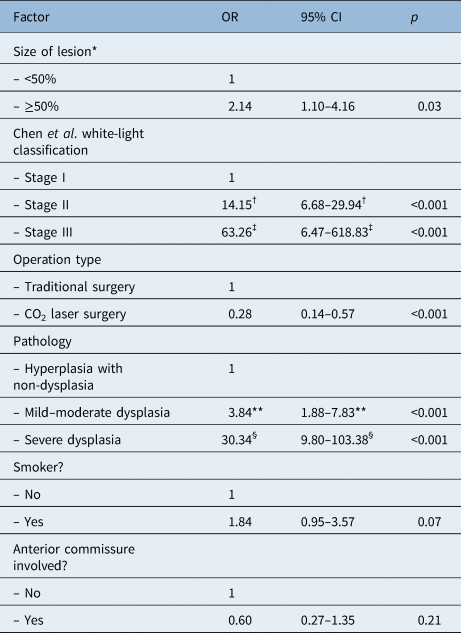
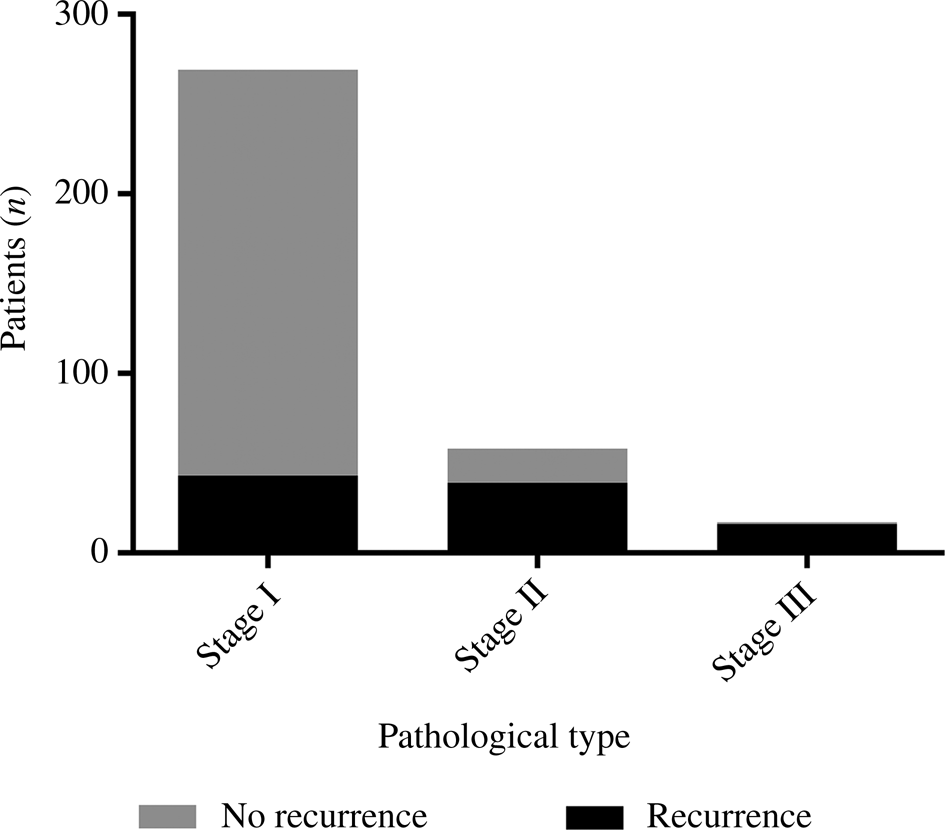
The multivariate analysis showed that lesion size was an independent prognostic factor for vocal fold leukoplakia (p = 0.03, odds ratio = 2.14, 95 per cent confidence interval (CI) = 1.10–4.16; Table 2). Regarding Chen and colleagues’ white-light classification, of the 344 patients, 269 were stage I, with 43 having recurrence, 58 were stage II, with 39 having recurrence (compared to stage I, p < 0.001, odds ratio = 14.15, 95 per cent CI = 6.68–29.94; Table 2), and 17 were stage III, with 16 having recurrence (compared to stage I, p < 0.001, odds ratio = 63.26, 95 per cent CI = 6.47–618.83; Table 2). Figure 2 shows Chen and colleagues’ white-light classification system grading according to recurrence.
Multivariate analysis of factors for recurrence of vocal fold leukoplakia

*The size of lesions was graded, according to Young et al.,Reference Young, Lin, Lee, Lee, Hsin and Liao6 as either less than 50 per cent (the sum of all leukoplakia is less than half the length of one entire vocal fold) or 50 per cent or more (the sum of all leukoplakia is half or more than half the length of one entire vocal fold). †Stage II versus stage I. ‡Stage III versus stage I. **Mild–moderate dysplasia versus hyperplasia with non-dysplasia. §Severe dysplasia versus hyperplasia with non-dysplasia. OR = odds ratio; CI = confidence interval; CO2 = carbon dioxide
White-light classification stage according to recurrence.

A total of 251 patients underwent CO2 laser surgery, of whom 62 exhibited recurrence. The other 93 patients underwent traditional surgery with cold instruments, of whom 36 exhibited recurrence. In multivariate analysis, the surgical method was an independent prognostic factor for the recurrence of vocal fold leukoplakia (p < 0.001, odds ratio = 0.28, 95 per cent CI = 0.14–0.57; Table 2).
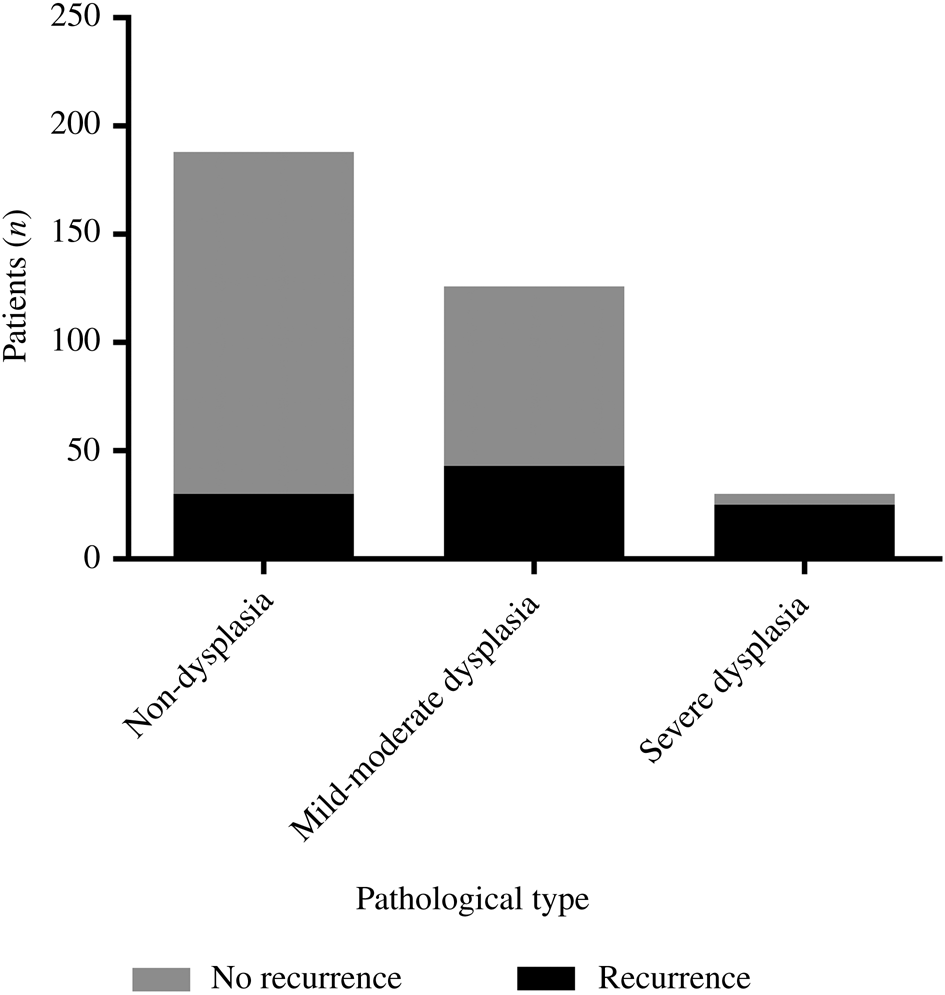
The pathological type was: hyperplasia without dysplasia in 188 patients, and 30 of these patients had recurrence; mild–moderate dysplasia in 126 patients, 43 of whom had recurrence (compared with the hyperplasia without dysplasia group, p < 0.001, odds ratio = 3.84, 95 per cent CI = 1.88–7.83; Table 2); and severe dysplasia in 30 patients, 25 of whom had recurrence (compared with the hyperplasia without dysplasia group, p < 0.001, odds ratio = 30.34, 95 per cent CI = 9.80–103.38; Table 2). The relationship between the pathological type and recurrence is shown in Figure 3. The univariate and multivariate analyses illustrated that pathological type was closely tied to recurrence as an independent risk factor (p < 0.001; Tables 1 and 2).
Pathological type according to recurrence.

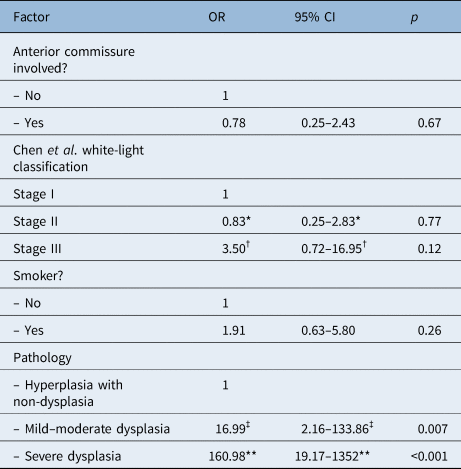
When investigating malignant transformation, 1 patient with hyperplasia without dysplasia, and 12 patients with mild–moderate dysplasia, had malignant transformation (compared with the non-dysplasia group, p = 0.007, odds ratio = 16.99, 95 per cent CI = 2.16–133.86; Table 3), and 25 patients with severe dysplasia had malignant transformation (compared with the non-dysplasia group, p < 0.001, odds ratio = 160.98, 95 per cent CI = 19.17–1352; Table 3). Figure 4 depicts the pathological type according to malignant transformation. The univariate and multivariate analyses revealed that pathological type was the sole independent risk factor (p < 0.001; Tables 1 and 3). Age, sex, disease course, smoking, excessive alcohol consumption, size and location of the lesion, surgical method, white-light classification, anterior commissure involvement, inflammatory markers and fibrinogen level had no statistically significant association with vocal fold leukoplakia malignant transformation.
Multivariate analysis of factors for malignant transformation of vocal fold leukoplakia

*Stage II versus stage I. †Stage III versus stage I. ‡Mild–moderate dysplasia versus hyperplasia with non-dysplasia. **Severe dysplasia versus hyperplasia with non-dysplasia. OR = odds ratio; CI = confidence interval
Pathological type according to malignant transformation.

Discussion
The prognosis of vocal fold leukoplakia after surgery is of great concern. Published studies have focused on the roles of age, sex and lifestyle habits, such as alcohol consumption and smoking, as risk factors for vocal fold leukoplakia recurrence.Reference Hong, Miao, Zhang, Ding, Luo and Guo8–Reference Zhou, Zhang, Zhou, Yang, Liu and Tao10 In our study, sex, age, smoking and alcohol abuse were not associated with recurrence or malignant transformation. The strict control of alcohol and tobacco may have contributed to this result. One article has suggested that anterior commissure involvement increases the possibility of malignant transformation of vocal fold leukoplakia.Reference Klimza, Pietruszewska, Rosiak, Morawska, Nogal and Wierzbicka11 In contrast, our study found no difference, similar to the study by Fang et al.Reference Fang, Yang, Chen, He, Cheng and Chen4 Sufficient exposure and radical resection of the lesion may have contributed to this outcome. An increasing number of reports have indicated that fibrinogen is related to tumour growth and metastasis.Reference Wang, Zhang, Zhang, Cui, Wang and Gao12,Reference Sharma, Mureb, Murab, Rosenfeldt, Francisco and Cantrell13 Vocal fold leukoplakia is considered a pre-cancerous lesion, but in our study there was insufficient evidence to demonstrate this relationship.
Lesion size is a representative clinical characteristic of vocal fold leukoplakia. We found that the size of the lesion correlates with the recurrence of vocal fold leukoplakia. Lesion size graded as 50 per cent or more (whereby the sum of all leukoplakia is half or more than half the length of one entire vocal fold) had a higher recurrence risk than lesions graded as less than 50 per cent (in which the sum of all leukoplakia is less than half the length of one entire vocal fold) (p = 0.03, odds ratio = 2.14), similar to the findings of Lee et al.Reference Lee, Yoon, Lee and Lim14 Consequently, patients with larger lesions should receive greater attention.
Video endoscopy is an essential strategy for diagnosing vocal fold leukoplakia. According to Chen et al.,Reference Chen, Li, Yang, Cheng and Wu7 there are three lesion types (I, smooth and flat; II, smooth and elevated; III, rough) that are related to the post-operative pathological type. Our study demonstrated that lesion form under white light is an independent factor influencing the outcome (p < 0.001). Extended resection may be the key to reducing recurrence, especially for the rough type (type III). Narrow band imaging can also be used to differentiate between benign and malignant lesions.Reference Zhang, Zhu, Zhang, Su, Wang and Ni15 However, we did not have access to the equipment for conducting narrow band imaging inspections of the patients treated early in this cohort. In a future study, we will combine white light with narrow band imaging to assess the lesions.
Surgery is a common treatment for vocal fold leukoplakia. We revealed that, compared with cold instruments, the CO2 laser could effectively control the recurrence of vocal fold leukoplakia, in both the univariate analysis (p < 0.001) and the multivariate analysis (p < 0.001, odds ratio = 0.28). The CO2 laser has various advantages, including high brightness, a high energy conversion rate, less bleeding and greater precision; therefore, CO2 laser surgery is an effective treatment.Reference Yang, Chao, Lee, Chang, Hsieh and Chen9,Reference Zhang, Zhu, Zhang, Su, Wang and Ni15–Reference Galletti, Freni, Cammaroto, Catalano, Gangemi and Galletti18
The pathological type of vocal fold leukoplakia varies from hyperplasia to severe dysplasia. In retrospective research, Dispenza et al.Reference Dispenza, De Stefano, Marchese, Martines and Dispenza19 found that the recurrence rate of mild dysplasia treated using surgery with cold instruments was 13 per cent, and that of moderate dysplasia was 29 per cent. Gallo et al.Reference Gallo, de Vincentiis, Della Rocca, Moi, Simonelli and Minni20 found that the recurrence rate after CO2 surgery increased with increasing pathological heterogeneity, but moderate dysplasia had a higher malignant transformation rate than severe dysplasia (21.42 vs 9.37 per cent). In a meta-analysis, Weller et al.Reference Weller, Nankivell, McConkey, Paleri and Mehanna21 observed that the recurrence and malignant transformation probability increased as the histopathological type increased. Consistent with Weller et al.,Reference Weller, Nankivell, McConkey, Paleri and Mehanna21 our results revealed that a worse histopathological type was associated with a worse prognosis, including recurrence (p < 0.001) and malignant transformation (p < 0.001). In addition to resecting the lesion completely, individuals with worse histopathological types should receive greater attention during follow up.
There is a hypothesis that cancer originates from an inflammatory infection area.Reference Singh, Baby, Rajguru, Patil, Thakkannavar and Pujari22 Fang et al.Reference Fang, Yang, Chen, He, Cheng and Chen4 verified that inflammatory markers (neutrophil-to-lymphocyte ratio, monocyte-to-lymphocyte ratio, platelet-to-lymphocyte ratio), particularly neutrophil-to-lymphocyte ratio, are attributed to the development of vocal fold leukoplakia, which contradicts our findings. Notably, there was no multivariate analysis or other correlating variables in that study, which may have contributed to the disparity.
• Vocal fold leukoplakia may recur or become cancerous, but risk factors are currently unclear
• This study, based on both univariate analysis and multivariate analysis, investigated more factors than previous research
• The results show that lesion size, lesion form under white light, surgical method and pathological type are independent factors for vocal fold leukoplakia recurrence
• Pathological type is the sole independent risk factor for malignant transformation of vocal fold leukoplakia
• High-quality prospective studies with longer follow up are needed to further identify suspicious risk factors
The strength of our study is that we considered more factors than other studies. We used both univariate analysis and multivariate analysis to obtain convincing results. However, our study has some limitations, such as the need for geographical factors and the short follow-up period. We need high-quality prospective studies to identify suspicious risk factors in the future.
Conclusion
This research reveals that the prognosis of vocal fold leukoplakia is closely related to lesion size, operation method, lesion form under white light and pathological type. The severity of the pathology increases the likelihood of recurrence and malignant transformation.
Acknowledgements
The work was supported by grants from the Suzhou Science and Technology Project (grant numbers: SKY2022140 and SYS2020116) and the Suzhou Clinical Medicine Center Project (grant number: Szlcyxzx202102).
Competing interests
None declared.