Introduction
Governments across the political spectrum have long relied on a hybrid of state-funded and state-delivered welfare services as well as charity to meet the needs of people living in poverty (Hogg and Baines, Reference Hogg and Baines2011). The extent and nature of publicly funded services, compared to voluntary resources provided through charity, reflect different ideas about the role of the state, markets, and communities in responding to citizens in need. The provision of voluntary charity versus formalised state-funded welfare is not only a technical policy issue. Rather, it forms an integral part of normative debates about what society ought to look like (Deacon, Reference Deacon2002).
Esping-Andersen (Reference Esping-Andersen1990) theorised these differences in terms of welfare state regimes. Subsequent analyses have developed these typologies, showing how the delivery of services and resources in welfare states varies in ways that cannot be simply understood as ‘liberal’ or ‘neoliberal’ (Deeming, Reference Deeming2017). Further, the mix of universal welfare services and charity in a given society is fluid. In Finland, for example, recent social policy changes led to increasing reliance on charity to address food insecurity (Silvasti, Reference Silvasti2015). Similarly, austerity measures in the UK resulted in increasing use and normalisation of charity (Lambie-Mumford and Dowler, Reference Lambie-Mumford and Dowler2015). For Lambie-Mumford (Reference Lambie-Mumford2019), the growing role of charity in responding to poverty can be understood as a direct response to inadequate state welfare provision, and the abdication of the state from its role in upholding citizens’ social rights.
The critique of charity as a failure to achieve social rights draws on the ideal that the welfare state is an aspiration to break away from the taint of the poor laws (Spicker, Reference Spicker2002). Advocates of the welfare state maintain that it can be a mechanism to create social cohesion (Taylor-Gooby, Reference Taylor-Gooby2016). The ideal of a tax-funded welfare state that provides resources on the basis of social rights sought to address the inadequacy of charity to meet basic need (Salamon, Reference Salamon1987). Charity is not only inadequate to meet need; it is also experienced as shameful (Parsell and Clarke, Reference Parsell and Clarke2020). This proposition resonates with Marshall’s (Reference Marshall1950: 24) classic remark that to access charity was to ‘cross the road that separated the community of citizens from the outcast company of the destitute’. Notwithstanding the limitations of charity, governments in numerous countries with advanced welfare states are increasingly turning to charity and volunteers to meet basic need. As we demonstrate, the move to charity is not solely driven by austerity and economic downturn. Instead, we show that it can be understood as an orchestrated government shift towards celebrating charity and the charitable.
This article examines how Australian social policy propels charities and their volunteers to respond to poverty. We ask, how does Australian policy create the conditions for charities and volunteers to respond to poverty, and how can we understand charity in contemporary society? Australia constitutes an intriguing country to examine social policy and the implications of charity. On the one hand, Australia has a radical interventionist welfare state that does not easily fit Esping-Andersen’s typologies (Deeming, Reference Deeming2017). Although Australia has experienced state-withdrawal from direct welfare provision, this has not occurred alongside crisis-driven austerity programs. Indeed, during the period other developed nations pursued austerity, Australia made progressive social policy investments, including its Paid Parental Leave and National Disability Insurance Schemes (Marston et al., Reference Marston, Cowling and Bielefeld2016; Miller and Hayward, Reference Miller and Hayward2017). On the other hand, Australia is a neoliberal society where microfinance is positioned by government as a preferred solution for individuals in poverty to manage their own economic hardship (Mackenzie and Louth, Reference Mackenzie and Louth2020). Australia’s welfare system can be punitive and provided in conditional ways that exacerbate marginalisation (Marston et al., Reference Marston, Zhang, Peterie, Ramia, Patulny and Cooke2019). Saunders (Reference Saunders2005) goes as far as arguing that Australia can end poverty, but does not do so because of policy and resource decisions. Weeks’ (Reference Weeks2020) recent analysis likewise suggests that in high-income countries key policy decisions, such as welfare to eliminate poverty, are not driven by insufficient wealth in the economy, but rather by politics and the realisation of normative ends.
We illustrate how Australia’s failure to achieve social rights for marginalised individuals is part of a broader shift in governance towards an approach that celebrates the charitable as ‘ethical citizens’ (Rose, Reference Rose2000; Muehlebach, Reference Muehlebach2012), who exercise care and compassion toward the downtrodden. Extending knowledge about the impact of welfare-state retrenchment and conceptual work on ethical citizenship, we show how a decayed welfare state is not only about the outsourcing of welfare provision to charities (McGimpsey, Reference McGimpsey2017; Lambie-Mumford, Reference Lambie-Mumford2019). It is also part of a broader project that aims to cultivate a society in which social problems are responded to through spontaneous, community-led initiatives, powered by the ethical commitments of everyday citizens, with little consideration given to their effectiveness. Through cultivating the ethical citizen to respond to poverty– including with direct funding– the state can sidestep questions about ineffectiveness and point to how it is actively involved in addressing enduring social problems (Seibel, Reference Seibel1996). We show how retrenchment of aspects of the welfare state occurs alongside new investments in bottom-up charity initiatives, coupled with a commitment to grow and normalise charity as an end in itself. We also show that, whilst ideologies that blame the poor for their poverty and practices that seek to activate them into productivity persist, the valorisation of charity and ethical citizenship increasingly positions the poor as ‘vulnerable’ subjects who require compassionate care – that is, as the object of charity. Here, the experiences of the poor are largely incidental, as they are treated more as the grist for ethical citizenship than as an end in themselves.
The article develops over five sections. Next, we briefly overview arguments for and against charity as a response to social problems. Second, we outline changing conceptions of the state, society, and the citizen that we argue underpin charity’s resurgence in poverty responses. Third, we present Australian data that shows that reduced spending on traditional welfare-state initiatives, such as social housing and income support, has occurred alongside increased rates of poverty, on the one hand, and, on the other, increased government funding to charities, and increased use of charities by people who are poor. Fourth, we introduce and analyse two case studies to demonstrate how the ethical citizen is created. Fifth, we bring together the data and case studies presented to reflect upon the wider societal and policy implications of the cultivated ethical citizen.
The contested meaning of charity
The meaning of charity as a response to poverty is contested, with some highlighting its superiority to state-driven welfare (McKnight, Reference McKnight1995; Smith and Lipsky, Reference Smith and Lipsky1993), and others its role in facilitating welfare-state withdrawal (Cloke et al., Reference Cloke, May and Williams2017). There are multiple arguments used to advocate charity and ground-up initiatives, rather than the state, as the primary provider of welfare to people in poverty. Third Way politics – with a lineage that can be traced back to communitarianism – reimaged the relationship between the state and the citizen, and what welfare meant. Rather than social rights, Tony Blair’s New Labour Government in the UK restructured the welfare state to activate citizens to take greater responsibilities over themselves, their families, and their communities (Lister, Reference Lister1998). Under Third Way politics, restructuring welfare was couched as a progressive means to realise people’s opportunities, which includes the active participation of citizens themselves and other non-state actors in welfare provision. Giddens (Reference Giddens1998) described the traditional welfare state as the top-down dispensation of benefits, which should be replaced with localised systems that foster the development of civil society. Under Labour, Conservative, and Liberal Democratic parties, different forms of localism have been idealised (Fitzpatrick et al., Reference Fitzpatrick, Pawson and Watts2020). This includes emphasis on communities responding to social problems with less oversight from central government (Fitzpatrick et al., Reference Fitzpatrick, Pawson and Watts2020).
Third Way discourse has also featured in Australia, although often in a more ‘nebulous’ way than in the UK (Reddel, Reference Reddel2004). Former Labor leader Mark Latham was a strident advocate for de-centering the state and promoting community-based responses to social policy problems (e.g. Latham, Reference Latham1998); and the Rudd Labor Government’s (2007-2010) approach to social policy focused on ‘social inclusion’ and building social capital amongst disadvantaged communities (Deeming and Smyth, Reference Deeming and Smyth2015).
The emphasis on community and volunteers rather than state provision aligns with long-standing belief that ground-up responses to people in need are positive markers of civic society. Writing about the US, Smith and Lipsky (Reference Smith and Lipsky1993) applauded community initiatives, or as they refer to them ‘mediating institutions’, to people experiencing poverty. The asserted desirable properties of such initiatives included their superior effectiveness over state welfare and the vitality and character of the citizens their presence represents. Smith and Lipsky (Reference Smith and Lipsky1993) describe mediating institutions as more legitimate than government because they are better attuned to community need. This view is advanced by McKnight (Reference McKnight1995), who sees scientific problem-solving as cold and undermining community, and builds on the Catholic principle of subsidiarity to argue that families, communities and volunteers should be providing welfare. Indeed, Pope John Paul II (Reference Paul1991) wrote that the welfare state globally subverted community’s function to provide ‘genuine fraternal support’, and that charity and volunteers were needed to overcome ‘today’s widespread individualistic mentality’.
Contrary to the belief that individuals and communities are best placed to respond to their own needs, others see reliance on charity to address poverty as a direct challenge to social rights as a principle of the welfare state. The centrality of ground-up responses to meet local need resonates with neoliberal forces that hinge upon rhetoric of low taxes, minimal central government, and prioritising the economy over social policy (Clarke, Reference Clarke2007). Charity and volunteering facilitate state withdrawal by providing care and resources at minimal cost to government. Likewise, their association with an idealised ‘civil society’ helps legitimise state withdrawal by placing key poverty governance functions outside the purview of democratic accountability (McGimpsey, Reference McGimpsey2017; Lambie-Mumford, Reference Lambie-Mumford2019).
Existing work shows the limitations of the shifting balance from state-led welfare provision to a charity model premised on subsidiarity and spontaneous compassion (Lambie-Mumford, Reference Lambie-Mumford2019). Cloke et al. (Reference Cloke, May and Williams2017) build on a developed literature that identifies four critiques: charity to people in poverty is premised on and exacerbates asymmetric power relationships; receiving charity is stigmatised; charity constructs poverty as a personal rather than a social problem; and charity obscures economic, social, and policy institutions where poverty is embedded (see also Smith-Carrier, Reference Smith-Carrier2020). Nuances within the arguments in support of or against charity illustrate how the debate can transcend binary political ideologies. Writing about Italy, Muehlebach (Reference Muehlebach2012) demonstrates how left-wing volunteers providing care because of state withdrawal understood their actions to re-signify neoliberal reform and represent an opportunity to pursue collective and rights-based solidarity.
Charity as a response to poverty provokes either celebration or concern. Charity’s presence is cited as evidence of either flourishing community and civil society or neoliberalism undermining social rights. Its presence or absence says much about prevailing views about how societies ought to be organised to respond to people in need, and what role the state ought to play in meeting these needs. It is to these changing conceptions that we now turn.
Changing conceptions of the state, society, and the citizen
The proliferation of discourses and programs aimed at increasing community-led responses to social problems constitutes a change in how the ideal citizen is imagined, shifting from social citizenship to ethical citizenship (Rose, Reference Rose2000). The ethical citizen acts on the basis of spontaneous attachments to, and concern for, their community. They are motivated by compassion, care and a sense of connectedness and obligation to others (Muehlebach, Reference Muehlebach2012). In a political context where welfare states are problematised as pacifying and unresponsive, ethical citizens are valorised as active subjects who are attuned to the diverse needs of their communities (Rose, Reference Rose2000). However, the ethical citizen is also valued for its capacity to overcome the atomised individualism that comes with neoliberalism’s marketised social imaginary. For Muehlebach (Reference Muehlebach2012), the ethical citizen adds a moral dimension to the neoliberal project; it recuperates a sense of solidarity and mutual obligation that is otherwise lost in the privatisation and marketization of welfare provision and care.
Whilst ethical citizenship is imagined as separate from the state and the political sphere, operating instead in the pure and dynamic world of ‘the community’, it is something that the state actively cultivates. For Rose (Reference Rose2000), the ethical citizen is cultivated through strategies for ‘governing through community’: efforts by governments to foster connections and mutual obligations amongst members of specific social or geographic groups. This is achieved through the authorisation, solicitation and celebration of bottom-up/community-led initiatives, and the ethical values that underpin these, in official political and policy discourse, often with the support of sympathetic voices in the media and academia (Muehlebach, Reference Muehlebach2012; Rose, Reference Rose1996). It is also achieved through state efforts to instil communities with the capacity for ethical self-governance, which include education and training initiatives for community groups and volunteers, funding and resources for community capacity building, and the reworking of legal and regulatory infrastructures to facilitate and guide community initiatives (Muehlebach, Reference Muehlebach2012; Rose, Reference Rose1996). By operating in this indirect and facilitative way, rather than through direct intervention, the state endeavours to foster and mobilise communities of ethical citizens whilst preserving their ostensible autonomy from the political sphere. This also constitutes a change in the role of the state: it is now oriented to creating the conditions for self-governing communities rather than intervening directly in their affairs (Rose, Reference Rose1996).
Adopting the perspective of changing forms of citizenship allows us to build upon previous work on the growth of charity and volunteerism in welfare provision. On the one hand, it enables us to show how bottom-up initiatives that derive their value from being separate from the state and close to the community (Smith and Lipsky, Reference Smith and Lipsky1993) are rather cultivated by the state as part of broader efforts to realise a specific vision of the ideal citizen. On the other hand, it enables us to reveal how efforts to cultivate and enrol charity in addressing poverty are more than a political-economic and ideological tactic to facilitate austerity and state withdrawal (cf. Lambie-Mumford, Reference Lambie-Mumford2019). Whilst welfare state retrenchment and burgeoning charity are related, we contend that both are underpinned by a desire to cultivate ethical citizenship and to construct a society that is spontaneously compassionate and self-regulating.
Welfare state, poverty, and state funding for charity in Australia
In this section, we present data on reduced state spending towards different facets of the welfare state – such that the hollowing welfare state creates a need for charity. We then analyse the growth in state funding to charities. We argue that increasing amounts of government funding to charity constitutes one of the practical ways through which the state cultivates the ethical citizen.
Retrenched welfare state and rising poverty: Creating a need for the ethical citizen
Australia is experiencing rising rates of poverty and homelessness as a direct result of retrenchment of key welfare-state functions over the past thirty years. In 2018, 13.6 per cent of Australians lived in poverty, which is a 2.1 percentage point increase since 2003 (Davidson et al., Reference Davidson, Saunders, Bradbury and Wong2020). The depth of poverty is increasing more than the growth in the proportion of people who are poor. The gap between the poverty line and people’s average income was 36.3 per cent in 2007, but had risen to 44.2 per cent by 2017 (Davidson et al., Reference Davidson, Saunders, Bradbury and Wong2020: 29).
Poverty in Australia is reinforced by state cash transfers that are below the poverty line. For example, for the past twenty-five years unemployment benefits have been indexed to inflation, which means that they have essentially been frozen (Parliament of Australia, n.d.). In 2019, the maximum rate of unemployment benefits was $278 per week, whereas the national minimum wage was $719 per week (Parliament of Australia, n.d.). On recognition that the rate of cash transfer forces people to live in poverty, there has been a long-term campaign, supported by Australia’s peak welfare lobby and the Business Council, to increase the magnitude of cash transfers (Business Council of Australia, 2019; Raise the Rate, 2019).
Despite widespread support to increase the rate of unemployment benefits, successive Prime Ministers have refused. In August 2019, Prime Minister Scott Morrison said that ‘you ask me “are we increasing [unemployment benefit]?” Well the answer is “no, we are not’”’ (Seven News, Reference Seven2019a). Rejecting questions in parliament about increasing unemployment benefits above the poverty line, the Prime Minister stated that ‘the best form of welfare is a job’, and unlike the Labor opposition, his government ‘will not engage in unfunded empathy’ (Hansard, 2019: 1175-6).
This position extends to Australia’s left-of-centre mainstream Labor party. In Government (2007-2013), the Labor party did not increase the unemployment benefit. Employment Minister at the time, Bill Shorten, acknowledged that the level of unemployment benefit was low, but said that government had no plans to increase it (Akerman, Reference Akerman2012). On several occasions The Greens party tabled legislation to the Parliament to increase the unemployment benefit, but the legislation has not been supported by the Labor or Conservative parties (Hondros, Reference Hondros2019).
The widely endorsed refusal to increase the unemployment benefit to enable recipients to escape poverty compounds with other policies that minimise citizens’ rights to access welfare. These include welfare compliance and conditionality measures that The Senate (2019) deemed punitive and unfair. The right to welfare is likewise undermined by paternalistic policy that has moved from cash transfers to quarantined allocation of funds that restrict what recipients can purchase (Parsell et al., Reference Parsell, Vincent, Klein, Clarke and Walsh2020).
Policy that has prevented the rate of unemployment benefit increasing with the cost of living and minimised the number of people who can access welfare coincides with reduced government expenditure on social housing. Pawson et al. (Reference Pawson, Milligan and Yates2020: 94) show that Australia’s post WWII social-housing construction was halted in the 1996/1997 budget, when the Australian Government reduced spending on social housing by 24 per cent. Since this time, government funding for social housing has declined a further 7 per cent, from $1.42 billion in 2011 to $1.32 billion in 2016 (Pawson et al., Reference Pawson, Parsell, Saunders, Hill and Liu2018). Reduced government funding for social housing has seen the ‘number of social housing dwellings per 100 households decline from 6.2 in 1991 to 4.2 in 2018’ (Pawson et al., Reference Pawson, Milligan and Yates2020: 340). As of June 2018, 140,600 people were on the official waitlist for social housing (Australian Institute of Health and Welfare, 2019). The vast majority of this group are solely reliant on welfare for their income, yet less than 3 per cent of properties in the private rental market meet affordability criteria for most people waiting for social housing (Anglicare, 2019). In an environment where the supply of social housing is decreasing and the waitlists increasing, the rate of homelessness increased by 29.8 per cent between 2006 and 2016 (Pawson et al., Reference Pawson, Parsell, Saunders, Hill and Liu2018).
Increased funding for charity: Practically enabling the ethical citizen
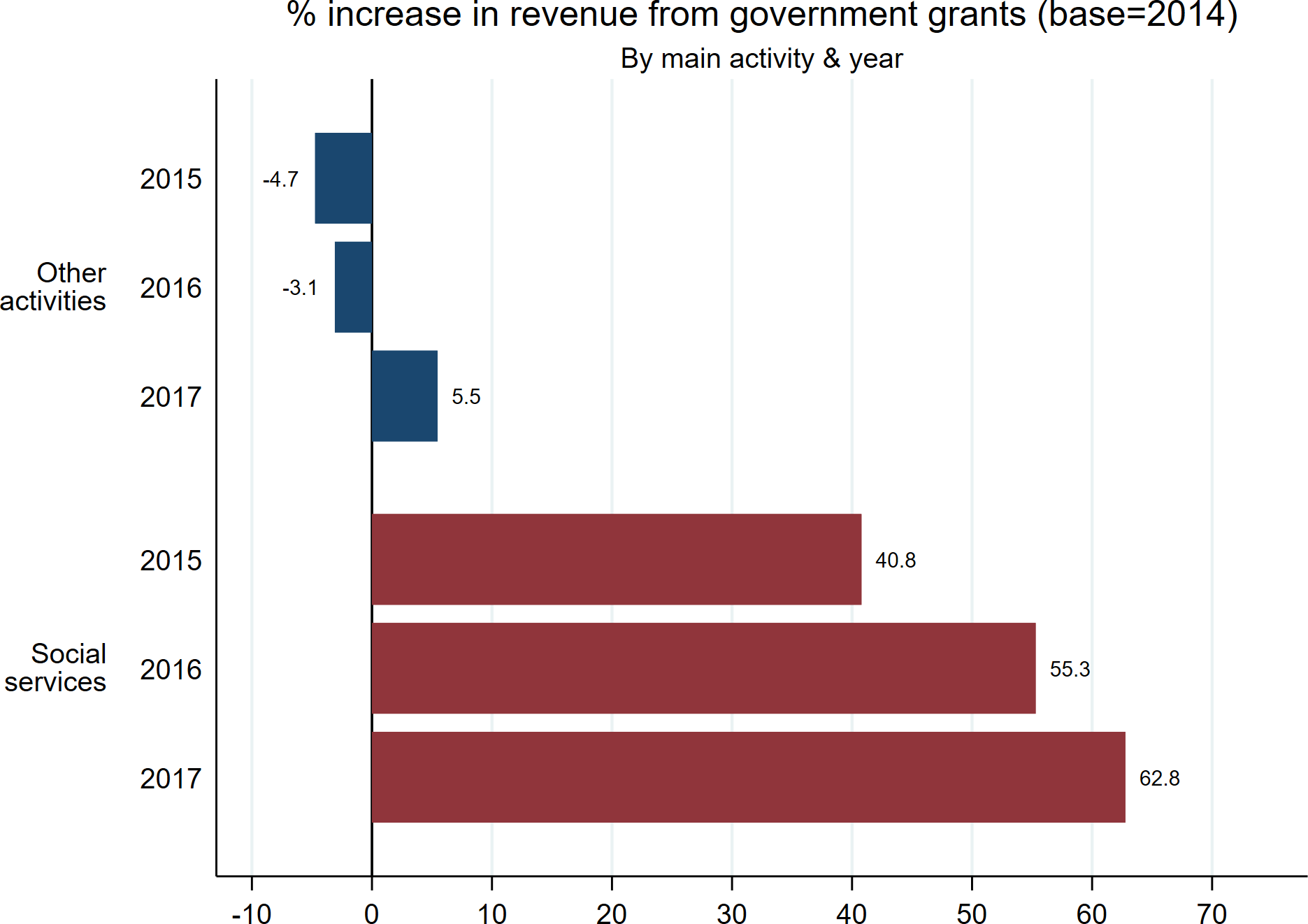
The retrenchment of Australia’s welfare state and the subsequent rise in poverty/homelessness coincided with increased government funding for charity. To establish trends over time in government funding, we examined data from four instalments of the Australian Charities and Not-for-profits Commission (ACNC, 2019) Annual Information Statement Data, covering the 2014/2017 period. These administrative datasets contain annual information on charities’ characteristics, size, finances, main activity, and beneficiaries. The ACNC data reveals that the Australian charity sector is expanding. Between 2014 and 2017, the number of charities grew by approximately 3.2 per cent, from 47,005 to 48,517. There were also substantial increases in Government funding (expressed in Australian dollars adjusted to 2017 prices) to charities over this period, from ∼$55.25 billion in 2014 to ∼$60.52 billion in 2017, or a 9.5 per cent increase. Critically, the data allow us to isolate charities that listed ‘social services’ as their main activity. The number of such charities grew at a much faster rate than the sector: from 1,632 in 2014 to 3,508 in 2017, or a 115 per cent increase. While social service charities comprised 3.65 per cent of all charities in 2014, their share had increased to 7.43 per cent in 2017. In turn, government funding to charities providing social services as their main activity over the 2014/2017 period (expressed in $2017) increased more rapidly than the sector rate; from $4.49 billion in 2014 to $7.30 billion in 2017. Figure 1 presents a comparison of time trends in government funding to charities providing social services as their main activity and all other charities. This indicates that revenue from government grants for social service charities increased by 62.8 per cent between 2014 and 2017, while the analogous figure for other charities was a much smaller 5.5 per cent.
Trends in government revenue, by year and charity’s main activity
Notes. Data from the Australian Charities and Non-for-profits Commission (ACNC) Annual Information Statement Data, 2014/2017. All figures adjusted for inflation using the Consumer Price Index and expressed in expressed in Australian dollars adjusted to 2017 prices.

Reliance on charity by people in poverty
Alongside increased government funding to charities to provide social services (as shown in Figure 1 and above), here we demonstrate that increasing numbers of people use charity to survive. The Australian Government (2021) is the major funder of charities to provide emergency relief, which is targeted to ‘vulnerable people’. Emergency relief assumes the form of ‘immediate financial and/or material support to people in financial crisis e.g. supermarket, utilities, petrol vouchers’ (Department of Social Services, 2017: 4). Despite the name ‘emergency relief’, charity is an enduring feature in the lives of people who are poor. Seventeen per cent of emergency relief recipients accessed it ‘five or more times in a six month period’; almost half of those who accessed emergency relief had accessed it three or more times in six months (Department of Social Services, 2017: 14). Emergency relief is used to subsidise inadequate government benefits.
In addition to significant numbers of people relying on emergency relief, which includes food hampers and supermarket vouchers to purchase food, people in poverty are increasingly relying on food banks. Food Bank Australia reports assisting 815,000 people per month in 2019, and that the number of people seeking food relief increased by 22 per cent on the previous year (Food Bank Australia, n.d.). Far from localised, small-scale, ground-up endeavours, food banks represent a dominant response to food poverty in Australia (Booth, Reference Booth, Riches and Silvasti2014).
Innovative charity to the materially deprived: Two case studies
Growing poverty and homelessness, together with increased government funding for and use of charities, motivate the development of new charity and ground-up models, such as last-resort accommodation, sleep buses, and homeless villages. Here, we discuss two recently established charities: Orange Sky and Beddown. The existence of these charities illustrates acute material need that is produced by decaying social protection. Furthermore, given increasing poverty, homelessness, and state funding to charities, these case studies illustrate how the state cultivates the ethical citizens (Muehlebach, Reference Muehlebach2012; Rose, Reference Rose1996) to pioneer ground-up responses to people represented as vulnerable.
Orange Sky was established in 2014 to provide mobile clothes washing facilities to homeless people. Orange Sky pursues this through fitting washing machines and clothes dryers to vehicles, and driving into public spaces to wash homeless people’s clothes. The charity has progressively expanded the size, scope, and geographical coverage of its operations. After commencing with one vehicle in one city, Orange Sky now operates twenty-seven vehicles in twenty-three cities across all Australian states/territories, with 1,795 registered volunteers (Orange Sky, n.d.). The laundry idea was so popular that the charity expanded to include mobile shower facilities. Similar to the mobile washing machines and dryers, this involves vehicles with attached showers travelling into public spaces so that homeless people can wash themselves. In 2018 Orange Sky expanded to New Zealand, and is pursuing expansion opportunities in the US (Calhoun, Reference Calhoun2016; Orange Sky, n.d.). The expansion gained momentum when the Obama Foundation visited Orange Sky in December 2019 and invited its creators to its Leaders Program.
Beddown, an Australian charity established in 2019, provides inflatable mattresses in car parks to people sleeping rough. After a trial in Australia’s third largest city (Brisbane), Beddown aspires to provide inflatable mattresses in sixty carparks across Australia to assist over 3,000 people per night (Silva, Reference Silva2019). The charity has partnered with a corporation that owns and manages central business district car parks. Access to the car park is provided by the corporate sponsor, and volunteers help set up the inflatable mattresses. Volunteers also conduct overnight shifts, which includes escorting homeless people from mattresses to the toilet. By enabling homeless people to sleep in a car park, Beddown (n.d.) claims that it helps to restore ‘health, dignity, and respect for our guests’.
Whilst Orange Sky and Beddown are both bottom-up initiatives instigated by concerned members of the community, their activities are facilitated and cultivated in important ways by the state and other actors, and are leveraged to cultivate ethical citizenship in the wider community. The ways in which these processes operate are summarised in the three points that follow.
First, these charities respond to manifest poverty that is created by state welfare policy (see above). Amenity for personal hygiene and beds to sleep in are necessities. Failure of the state to ensure everyone has access to these necessities creates a raison d’etre for charities like Orange Sky and Beddown, who are motivated to provide an immediate response to an overt manifestation of deprivation. They rely upon responding to a problem that volunteers observe in front of them. There is intuitive appeal. People who experience deep poverty do not have access to these essential resources, so volunteers meet a basic need.
Second, the work done by Orange Sky and Beddown is naturalised and valorised by the state and sympathetic voices in the media, business and other sectors of society. The two creators of Orange Sky were awarded the prestigious Young Australians of the Year accolade in 2016, the $1 million People’s Choice Award in the Google Impact Challenge, and Order of Australia Medals in 2020. The media likewise offer unmitigated praise, proclaiming them as ‘amazing’ and ‘ambitious’ (Silva, Reference Silva2019; Quaggin and Edwards, Reference Quaggin and Edwards2019). Referring to inflatable mattresses in car parks, the media wondered ‘why no one’s done it before?’ (Seven News, Reference Seven2019b). In 2016, then Prime Minister Malcolm Turnbull (Turnbull, Reference Turnbull2016) described Orange Sky as a practical and innovative idea that ‘would go a long way to raising health standards and restoring dignity to homeless people’. Orange Sky has also enjoyed celebrity endorsements. When Prince Charles and the Duchess of Cornwall toured Australia, the latter visited Orange Sky and ‘put her hand up to be the first volunteer… if it starts in the UK’ (9News, 2018).
The representations of these charities thus celebrate the creators and volunteers with an assumption that their work is unambiguously positive for recipients (Smith-Carrier, Reference Smith-Carrier2020). When there is evidence that the charities are increasing in size, the media cheers them for their ‘empire’ status (news.com.au, 2020). There is no commentary that the increasing size of charities that shower homeless people in the street or enable them to sleep in car parks signifies social policy failure. Instead, the motivations and efforts of the charities’ founders and volunteers are celebrated. It is unsurprising, then, that the creator of Beddown reported a waitlist for people who wanted to volunteer (Quaggin and Edwards, Reference Quaggin and Edwards2019).
Third, the celebration of these charities is coupled with material support from the state and other actors to build their capacity and expand their role in responding to poverty. In the financial year ending 30 June 2019, Orange Sky had a revenue of $6,077,462, of which $3,697,689 came from donations and $1,291,350 from government grants (Orange Sky, 2020). In the state of Queensland, the government created a new funding scheme titled Dignity First to enable a continuous stream of funding to grow charity. Launching the scheme and announcing Orange Sky as the first recipient, the Minister remarked:
This government is committed to a human approach to homelessness supports, from the top down. That is why the government set up the Dignity First Fund to encourage services that promote the immediate dignity of people doing it rough on our streets (de Brenni, Reference de Brenni2016: 4828).
The State of Western Australia also provided financial support to Orange Sky, whereupon the Minister announcing the decision stated that it is great ‘to be involved in an initiative that offers a simple but practical service to some of the most vulnerable people’ (Kelly, Reference Kelly2018).
Charity, policy, and poverty governance
The foregoing analyses reveal intersections between welfare-state retrenchment, increased poverty/homelessness, and burgeoning charity. In this section, we argue that a desire to cultivate ethical citizenship underpins these developments and articulates them into a broader political project. To do this, we make several key points.
First, we posit that people experiencing poverty are destitute ‘by design’: growing rates of poverty and homelessness are a consequence of policy decisions (Saunders, Reference Saunders2005). These decisions are intrinsically related to the forces that propel charity to respond. The rate of the unemployment benefit means that recipients live below the poverty line. Similarly, defunding social housing creates a homeless population. This point is further supported by economic conditions that illustrate Australia could act differently. The Australian Government proclaims that the nation’s twenty-eight years of uninterrupted economic growth is a record among developed economies (Australian Trade and Investment Commission, 2019). Credit Suisse (2019) says Australians are the fourth wealthiest in the world.
Second, policy decisions that create the destitute-by-design population are, at least in part, about advancing the significance of charity and volunteers within society. We cannot see charities that respond to poverty, such as Orange Sky, Beddown, and the more established charities that provide food to the hungry poor, as ground-up initiatives that spontaneously develop distinct from the centralised state (cf. Smith and Lipsky, Reference Smith and Lipsky1993). Nor is their work simply a consequence of the state reducing funding so that unemployed people have insufficient money to eat or homeless people have no amenity to wash (cf. Lambie-Mumford, Reference Lambie-Mumford2019). Rather, charity is directly funded and symbolically valorised by the state as part of a broader movement away from its commitment to social rights, and towards a model of ethical citizenship.
Increasing state funding to charities to try and meet the basic needs of people in poverty, alongside reduced funding for unemployment benefits and social housing, reflects changing societal dynamics and changing values about government and individual responsibility (Lambie-Mumford, Reference Lambie-Mumford2019). These changes, premised on an anti-welfare ideology, assume that the welfare state undermines the economy and represents a disincentive to paid employment (Jones et al., Reference Jones, Lowe and West2020). Under these conditions, the Minister for Housing can fund a charity and celebrate its volunteers for responding to the vulnerable, when the charity is washing the clothes and showering people that are vulnerable because they lack affordable housing: their vulnerability is created by what society has not provided.
Building on the ethical citizenship literature (Rose, Reference Rose2000; Muehlebach, Reference Muehlebach2012), we propose that a decayed welfare state, worsening poverty/homelessness, and increased funding to and valorisation of charity, represent a direct facilitation of the citizen to take on a caring and compassionate role. The caring citizen does not just exist, rather it is cultivated. As we showed above, charity is cultivated by increasing government funding to charities for citizens to volunteer by alleviating the suffering of people in need. It is not as simple as governments providing additional funding for charities so that they can respond to an immediate need created by the decayed welfare state, however. Governments fund charities to normalise their function in society. When announcing funding to Orange Sky, a Minister emphasised that the funding:
Provides significant support to Orange Sky Laundry co-founders… helping to deliver their vision of expanding nationally as quickly as possible (New South Wales Government, 2015a).
Governments actively grow charity through public money; charity, and the ethical citizenship it represents, is an end in itself. Growth is not an inevitable product of ground-up agitation. Governments purposefully seek out charities. The New South Wales Minister for Family and Community Services said that ‘we approached Orange Sky and they were keen to get involved in Sydney’ (New South Wales Government, 2015b). As noted above, the Queensland Government created a new funding scheme (Dignity First) specifically to enable a continuous stream of funding to grow charitable responses to homelessness (de Brenni, Reference de Brenni2016).
Actively promoting charities to respond to people who are excluded from basic resources represents a rejection of the welfare state as an instrument of social rights. Social rights are conceived as passé. Minister de Brenni (Reference de Brenni2016: 4828) said that the Queensland Government wanted to ‘encourage fresh approaches to the challenges people face’, with the assumption that providing social housing or an income to make private housing affordable is stale.
The fresh approaches, although funded from the top by governments, encourage ethical citizens to make spontaneous and effective connections with charity recipients. Politicians mimic the rhetoric that the key value charities offer is the personal connection and conversation between the volunteer and recipient (de Brenni, Reference de Brenni2016). In fact, often the focus is not precisely the interaction, but the opportunity for volunteering and the exercise of compassion that charity represent for the volunteers. Addressing the Australian Senate to offer congratulations to the creators of Orange Sky, Labor Senator Moore (Reference Moore2016) stated that all Australians should be ‘building community on every corner of every street’ and having a chat to homeless people ‘while their laundry is being done by Orange Sky’. Having a conversation with the homeless, or designing charitable endeavour that facilitate conversations, are held up as paradigms of ethical citizenship. The Queensland Labor Premier states that the creators of Orange Sky have demonstrated
Determination to go above and beyond to make a difference, reminding us all of what it truly means to be a Queenslander (Palaszczuk, Reference Palaszczuk2016).
By referring to a ‘Queenslander’, the Premier evokes the good citizen as one who acts to help others. The Premier’s comments, along with other Government Ministers across Australia, provide a template for the normative behaviours that are expected of the ideal ethical citizen (de Koning et al., Reference de Koning, Jaffe and Koster2015). Citizenship and society are not a given, but positive states that are produced step-by-step by morally prescribed actions (Rose, Reference Rose1996).
Third, the idealised identity is constructed in the absence of challenging questions about whether charities have a meaningful impact upon recipients. Compassionate actions are decoupled from consideration of achieving justice through the re-allocation of resources to prevent material deprivation. One of the Orange Sky creators said that they will not solve homelessness, and he doubts whether homelessness can ever be solved (Edmistone, Reference Edmistone2020). Morality is determined by immediate actions, not their consequences (Bloom, Reference Bloom2016). Politicians celebrate this understanding of morality and cultivate these charitable actions as evidence of the ideal citizen. The Labor Chief Minister of the Australian Capital Territory described the creators of Orange Sky as ‘inspiring’, emphasising how they encourage compassionate citizenship to be adopted by the next generation:
I commend Nic and Lucas for their work and for being such amazing role models for our young people (Australian Capital Territory Government, 2016).
Finally, our fourth point is that the manner in which Australia’s approach to charity recasts the ideal citizen as compassionate and caring does not rely on further stigmatising people by blaming them for their poverty (Slater, Reference Slater2018) or activating and responsibilising them into employment (Kirwan et al., Reference Kirwan, McDermont and Clarke2016). Poverty is created through policy decisions: instead of focusing on those in poverty themselves, policy and state officials focus on citizens acting charitably. Charities and the volunteers within them are the primary focus. The charitable are positioned as not only compassionate through their actions toward the poor, but also as distinct from the poor. The poor are positioned in policy as the vulnerable that the compassionate pity.
The poor are significant in this recasting of the ideal citizen, but not for their own sake. The poor’s presence is required for the ideal citizen to be achieved. As Arendt (Reference Arendt2006: 79) observed, when pity motivates charity it leads to the glorification of its cause: ‘pity is not invested in the overcoming of suffering or the production of equality. It revels in the status quo.’ In Australia, the poor are the unfortunate means for the compassionate citizen and caring society to be illustrated. Policy and formal statements from politicians encourage charitable giving, not through a universal collective sense of equals helping each other, but through ethical citizens exercising their compassion toward the downtrodden.
Conclusion
An established literature has demonstrated that states have long drawn on charity and voluntary resources to meet the needs of people in poverty. Adding to this body of work, our analysis of Australia demonstrates that governments’ increasing reliance on charity constitutes part of a movement to foster the conditions for ethical citizenship. We have argued that the assumed ground-up charitable responses to people in poverty are cultivated by the state as part of broader efforts to realise a specific vision of the ideal citizen. Although welfare-state retrenchment and burgeoning charity are related, both are underpinned by a desire to cultivate ethical citizenship and to construct a society that is spontaneously compassionate and self-regulating.
The ethical citizen is materially cultivated through increased funding to charity vis-a-vis reduced funding for income support and social housing, and symbolically cultivated through the esteemed status that they are ascribed by political leaders through explicit praise and prestigious awards. This cultivation of the ethical citizen is similar yet distinct from policy efforts to compel individuals to take on volunteering – see Warburton and Smith (Reference Warburton and Smith2013) in Australia, and Dean (Reference Dean2013) in the UK. The citizen is a willing agent in providing charitable care and, indeed, the government resources that cultivate the ethical citizen create an environment where charity is brought into the government narrative and criticism of government policy stifled (Smith, Reference Smith2017). The citizen providing charity can thus assume a vexed position: their individual actions can benefit the recipients of their care, but the collective activities of the charitable can inadvertently serve to perpetuate the structural problems and policy failures that create the need for charity in the first place (Eliasoph, Reference Eliasoph2013).
We are optimistic about what citizens’ desire to offer time and resources to care for people in need represent. The dominant model of charity presented in this article, however, can promote passivity among the recipient and reinforce structural inequalities (Raventós and Wark, Reference Raventós and Wark2018), and generates incongruence between what volunteers can give and what recipients need (Eliasoph, Reference Eliasoph2011). Rather than rejecting charity and the commitment among citizens that growing charity demonstrates, we argue for the focus to be directed toward the recipients of charitable care, not the charitable and the positive society that they are portrayed to embody. Charity should not only focus on what it means to recipients and how they experience charitable care. Instead, it should engage with the extent to which charitable actions contribute to a more just society – one where some citizens are not systematically excluded from the basic resources that charity seeks to provide. We suggest a research agenda that examines how, if at all, ground-up and charitable acts can be re-imagined to play a role in countries with advanced welfare states where resources are provided based on social rights.