Introduction
During the night of February 27 and the early morning of February 28, 2010, 15 coastal municipalities situated in two French departments, Vendée and Charente-Maritime, were violently stricken by a severe wind storm named “Xynthia”. This extreme meteorological event was accompanied by flooding due to the arrival of Xynthia at high tide during a period of very elevated tidal ranges.
This storm caused the death of 12 individuals in Charente-Maritime and 29 in Vendée. Houses, agricultural fields, and shellfish companies were severely flooded. Several thousand people had to leave their homes temporarily. Emergency psychological support units carried out about 1,000 consultations in each area during the first month after Xynthia.Reference Ollivier, Loury and Hubert1, Reference Raguenaud, Germonneau, Pirard and Motreff2 As a result of the extreme damage, the French government defined solidarity zones in 15 municipalities in order to determine the future of the houses. In these zones, more than 1,500 houses were declared too dangerous for people to continue to occupy. Since the storm, the French government has been buying these houses at their value before the storm.
Epidemiological studies carried out after floods have stressed the short-, mid- and long-term impact of such disasters on mental health.Reference Ahern, Kovats, Wilkinson, Few and Matthies3, Reference Du, FitzGerald, Clark and Hou4 Mental health effects include common mental disorders such as depression, anxiety, irritability and sleeplessness, acute stress disorder, and post-traumatic stress disorders. These effects are due to acute exposure to death risk (fear of dying, witnessing others die, loss of relatives or friends) as well as short-, mid- and longer-term exposure to the consequences (physical injuries, house loss, material and financial issues, work loss).
The mental health impact of floods has been assessed by studies on the activity of psychosocial support servicesReference Raguenaud, Germonneau and Leseigneur5 or by epidemiological studies based either on individual data, such as cross-sectional studiesReference Ligier, Ganiayre and Zielinski6-Reference Verger, Rotily, Hunault, Brenot, Baruffol and Bard11 and cohort studies,Reference Abramson, Stehling-Ariza, Garfield and Redlener12 or on ecological analyses of administrative health databases.Reference Six, Mantey, Franke, Pascal and Malfait13
Psychotropic drug delivery records obtained through health insurance databases have been analyzed following various natural disasters such as earthquakes,Reference Rossi, Maggio, Riccardi, Allegrini and Stratta14 wildfires,Reference Caamano-Isorna, Figueiras, Sastre, Montes-Martinez, Taracido and Pineiro-Lamas15 cyclones,Reference Usher, Brown and Buettner16 the 9/11 terrorist attacks,Reference DiMaggio, Galea and Madrid17-Reference Kettl and Bixler19 and industrial accidentsReference Roussel20, Reference Schwoebel, Cassadou, Roussel, Guinard, Lapierre and Lang21 and have shown increases in psychotropic drug deliveries in the aftermath of the event. Only one study analyzed drug deliveries using administrative health databases to assess the psychological impact of flooding.Reference Six, Mantey, Franke, Pascal and Malfait13
The objective of the study described here was to estimate the short-term mental health impact of Xynthia, in terms of psychotropic drug delivery, on the resident population of the 15 coastal municipalities severely hit by the flooding. The study period ran from September 2008 through December 2010.
Materials and Methods
Drug Sales Data
Health data were obtained from the French National Health Insurance Inter-regime Information System (SNIIR-AM).Reference Tuppin, de Roquefeuil, Weill, Ricordeau and Merliere22 In France, in the early 2000s, the National Health Insurance regime developed an inter-regime information system aimed at better understanding and evaluating beneficiaries’ health care consumption and associated expenditures. Beneficiaries’ health care consumption leading to reimbursement is registered for two years plus the current year, with a specific SNIIR-AM number. Health care delivery can be linked with the city of each insured person's principal residence. In France, 99% of the French resident population benefit from health insurance. Moreover, drug deliveries prescribed by private medical practitioners are precisely registered in the SNIIR-AM.
Daily data on psychotropic drug delivery were therefore extracted for the period 2008-2010 for each selected municipality of the Vendée and Charente-Maritime departments.
The daily number of new psychotropic treatments of the following European Pharmaceutical Marketing Research Association (EphMRA) classes was studied: N05B, N05C, and N06A. A new treatment was defined as a patient having a psychotropic drug delivery on a given day and for whom no delivery of a psychotropic drug of the same EphMRA class was found in the six preceding months. Thus, four indicators were defined:
1. Daily number of any new psychotropic treatments (EphMRA classes: N05B, N05C, N06A);
2. Daily number of new tranquilizer treatments (EphMRA class: N05C);
3. Daily number of new antidepressant treatments (EphMRA class: N06A); and
4. Daily number of new hypnotic treatments (EphMRA class: N05B).
According to guidelines from the French National Authority for Health23 and from the French National Agency for Medicines and Health Products Safety,24 tranquilizers are used to treat anxiety disorders in their various forms and can be prescribed in association with antidepressants during the initiation of a depressive episode with anxiety. Antidepressants are recommended to treat depressive episodes and anxiety disorders as well. Hypnotics are recommended for sleeping troubles.
Exposure Definition
The violent wind of Xynthia hit a large part of the west of France. Fifteen coastal municipalities were particularly stricken by the storm due to flooding, forcing some people to relocate and the French Government to define solidarity zones where 1,500 houses were finally declared uninhabitable. The researchers chose to study these 15 municipalities (Figure 1) because data on residencies of the patients for whom drug deliveries had been registered could not be obtained with better precision. According to the National Institute for Statistics and Economic Studies (Insee) 48,842 people were living in these 15 municipalities in 2009.
Zone Exposed to the Xynthia Storm, France, February 27-28, 2010

In conformity with previous studies,Reference Six, Mantey, Franke, Pascal and Malfait13, Reference Roussel20 a period of three weeks following the storm was defined as the period when acute health impact was expected. An exposure variable to estimate the effect on psychotropic drug treatments was therefore defined according to this period, with “Xynthia” days or “non-Xynthia” days.
Statistical Analysis
A generalized additive model (GAM) with a Poisson distribution that allows for over-dispersion was used to analyze the correlation between the Xynthia variable and the number of new psychotropic treatments.Reference Hastie and Tibshirani25 To control for possible confounders, long-term and seasonal time trends, days of the week, and bank holidays were included in the model. Long-term and seasonal time trends were modelled by a thin plate regression spline.Reference Wood26 The degree of smoothing of the spline was chosen to minimize the autocorrelation in the residuals. To capture the effect of Xynthia, a thin plate regression spline function of time for the 21-day period after Xynthia was defined. This regression spline captured the specific effect of the storm, excluding longer-term temporal trends. The daily relative risk (RR) of the effect of Xynthia was computed as the number of expected new treatments estimated by the Xynthia spline divided by the number of expected new treatments estimated in the absence of the storm. The difference between the number of expected new treatments estimated by the Xynthia spline function and the number of expected new treatments estimated in the absence of the storm represented the number of excess new treatments.Reference Le Tertre, Lefranc and Eilstein27
Data were analyzed using the “mgcv”Reference Wood28 package in the R software (version 2.14.1, R Foundation for Statistical Computing, Vienna, Austria).29
Ethical Considerations
Because sensitive individual data (date of drug delivery, municipality of residency) was extracted from the SNIIR-AM, this study requested and received authorization from the French regulatory authority (Commission nationale de l'informatique et des libertés, decision DE2010-084, authorisation request no. 1469316).
Results
From September 1, 2008 through December 24, 2010, 20,982 new psychotropic treatments were delivered (7,566 for men and 13,416 for women) among the residents of the 15 targeted cities. The daily average number of new psychotropic treatments was 25.
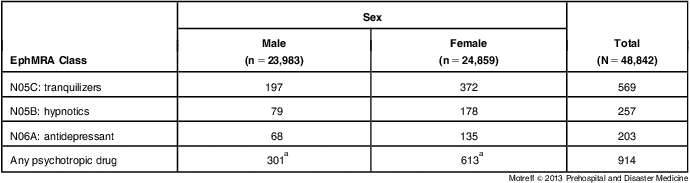
During the 21 days following Xynthia, 914 new psychotropic treatments were delivered (Table 1) for a daily average of 43 new deliveries.
Number of New Psychotropic Drug Deliveries by EphMRA Class and by Sex, March 1-21, 2010 (the 21-day Period Following Xynthia)
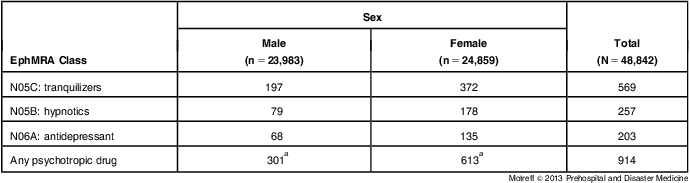
Abbreviation: EphMRA, European Pharmaceutical Marketing Research Association
aSome individuals received more than one drug
New psychotropic treatments among women were twice as high as among men (613 for females vs 301 for males, Table 1) whereas the sex ratio (female/male) for the residential population is 1.04 (24,859 women and 23,983 men).
An important increase in the daily number of new psychotropic treatments after Xynthia was observed (Figure 2).
Daily Number of New Psychotropic Deliveries from September 1, 2008 through December 24, 2010 in the 15 Municipalities Exposed to Xynthia
On the basis of the fitted model, by subtracting the number of expected new treatments estimated in the absence of the storm from the number of expected new treatments estimated by the Xynthia spline (ie, in the presence of the storm), an excess of 409 psychotropic treatments was estimated between March 1 and 21, 2010. Fifty-five treatments in excess were estimated for antidepressants, 118 for hypnotics, and 287 for tranquilizers.
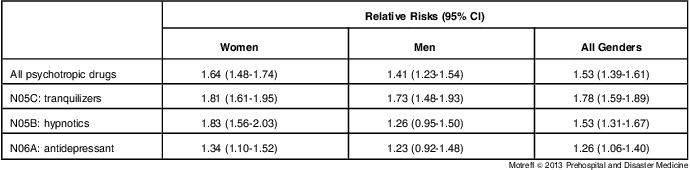
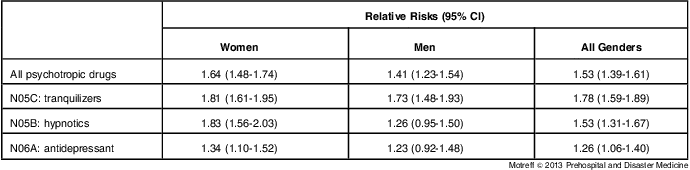
The RR of new psychotropic drug treatments for all genders during the three weeks following Xynthia was 1.53 (95% CI, 1.39-1.61). When looking selectively at the EphMRA classes, the RR for all genders ranged from 1.26 (1.06-1.40) for antidepressants; to 1.53 (1.31-1.67) for hypnotics; and 1.78 (1.59-1.89) for tranquilizers (Table 2). An increase in psychotropic drug deliveries is observed whatever the gender and the EphMRA class, and all the RRs were higher for women than for men (Table 2). However, the 95% CI of the RR for hypnotics and for antidepressants in men includes 1.
Estimated Relative Risks of Psychotropic Drug Prescriptions during the Three Weeks Following Xynthia (“Solidarity Zones”)
Discussion
The results show an increase in psychotropic drug deliveries among the residents of the 15 municipalities during three weeks after the Xynthia storm. With a RR of 1.53 (1.39-1.61) corresponding to an estimate of 409 new deliveries of psychotropic drugs, this study confirms the importance of the psychological impact of the Xynthia storm as observed clinically by health workers who intervened in the field during the aftermath of Xynthia.Reference Ollivier, Loury and Hubert1, Reference Raguenaud, Germonneau, Pirard and Motreff2, Reference Raguenaud, Germonneau and Leseigneur5 This short-term increase in psychotropic deliveries seems consistent with others studies carried out after natural disasters,Reference Six, Mantey, Franke, Pascal and Malfait13-Reference Usher, Brown and Buettner16 industrial disastersReference Roussel20, Reference Fassaert, Dorn, Spreeuwenberg, van Dongen, van Gool and Yzermans30 and terrorist attacks.Reference DiMaggio, Galea and Madrid18
An effect on the level of usage of three classes of psychotropic drugs studied was observed. In the acute phase of trauma, tranquilizers were the most-delivered drugs. The RR was higher for tranquilizers (RR = 1.78; 95% CI, 1.59-1.89). This is consistent with French medical practice and the recommendations of the French National Authority for Health for acute anxiety disorders.23 Antidepressants are recommended when an anxiety disorder, a depressive episode, or a posttraumatic disorder is diagnosed.
Consistent with the literature on psychological trauma where women were found to be at higher risk than men for mental disorders such as anxiety disorders and depression after a traumatic event,Reference Verger, Rotily, Hunault, Brenot, Baruffol and Bard11, Reference North, Nixon and Shariat31-Reference Tolin and Foa34 relative risks in this study were higher for females.
A three-week period to assess the short-term mental health impact of the disaster was selected for this study. Such a period was based on former epidemiological studies on post-disaster drug consumption conducted in France.Reference Six, Mantey, Franke, Pascal and Malfait13, Reference Roussel20 The exact definition of this period can be discussed, but it can be considered that after three weeks without symptoms, the acute stress health effects are over.
French administrations are now preparing easier access to the health insurance database. The simple indicators constructed in this study allow information and comparison before and after the event. As a result, in the near future it will be possible to monitor the indicator as soon as the data collection is consolidated. Indeed, the production of such specific information after an event will allow local public health planners to stay aware of the event's mental health impact and help guide the local public heath response.Reference DiMaggio, Galea and Abramson35
The short-term impact of an event such as the Xynthia storm can represent either the first step of a chronic mental disorder or a transient reaction to the storm. To answer such a question, monitoring drug deliveries alone may not be the best indicator, and this kind of study should be linked to follow-up studies directly interviewing persons on their exposures and their symptoms. On the other hand, the use of health insurance data in follow-up studies will give actual information regarding visits to a health practitioner and drug deliveries as well as sick leave used. Other sources can help to get a better understanding of the health situation. For example, the epidemiological surveillance linked to an outreach psychological support program set up six weeks after Xynthia showed that people were still suffering during the six months following the storm.Reference Raguenaud, Germonneau and Leseigneur5
Limitations
The number of psychotropic treatments may have been underestimated for three main reasons. First, in this coastal area of France, there are many second homes. As health data are attached to the principal residence, it was not possible to take into account people residing outside the exposed zone but being present during the flood or having a second home violently hit by the storm. Second, the treatments administrated by hospitals were not taken into account. Third, the use of new deliveries of psychotropic drugs was chosen because previous studies found that only new prescriptions were sensitive enough to show an increase after a disaster.Reference Six, Mantey, Franke, Pascal and Malfait13, Reference Roussel20 Even though the individuals’ history of psychopathology is unknown, it can be assumed that people who receive a new treatment are developing new psychological disorders (or a relapse). Those people already treated with psychotropic drugs but for whom the disaster emphasized the disorder or provoked a new onset of mental disorder treated with the same class of psychotropics were not taken into account in the study.
The population presenting a mental disorder following the Xynthia storm is larger than the one having received psychotropic drug prescriptions. Indeed, psychotropic drug treatments are just one way of treating affected persons. Psychotherapeutic care is also recommended during the acute phase of a trauma.23 Moreover, there are individuals who do not initiate a treatment, even if they present mental disorders, and these may represent a large population, as demonstrated in a study carried out after Hurricane Katrina where among people with new onset psychological disorders, only one-fifth initiated post-hurricane treatments.Reference Wang, Gruber and Powers36
In addition, as health data were available only on a city scale, it was not possible to distinguish people who were actually living in the solidarity zones from the others. If the analyses had been done only for people living in the solidarity zone, RR might have been higher because exposure intensity to the floods was higher within these areas. Furthermore, it might have been possible to show a geographical gradient in the excesses.
This kind of assessment based on psychotropic deliveries cannot describe precisely the clinical picture and severity of the affected people's pathologies. For example, antidepressant drugs cover not only depression but also most of the different anxiety disorders, and tranquilizers are widely prescribed for treating anxiety in its various forms.23, 24 Therefore, the relevance of such studies will increase in the framework of a more global use of different sources of data.
Conclusion
This study, based on routinely collected data, highlighted a short-term impact of Xynthia on mental health based on an indicator that integrated all the new deliveries of psychotropic drugs for the 15 communities most stricken by the floods. The impact was greater for tranquilizers and females were at higher risk than men. This study confirms that administrative databases can be used to show a health impact of a disaster even at a local level. This is one more step in the direction of a comprehensive strategy of collecting information, allowing the assessment of the health impact of an extreme event, the detection of vulnerable populations, and the orientation of the short-, mid- and long-term public health response.
Acknowledgements
The authors thank the Caisse nationale d'assurance maladie des travailleurs salariés for providing the data. They also would like to thank Marie-Eve Raguenaud and Philippe Germonneau from the Poitier regional office of the InVS and Ronan Ollivier, Pascaline Loury and Bruno Hubert from the Nantes regional office of the InVS for their useful information on the local situation in the aftermath of the storm. The authors also thank Pascal Empereur-Bissonnet for read-through.