INTRODUCTION
Parasites with complex life cycles can be useful tools for the study of biotic communities. They can be used as biological indicators, given their susceptibility to different types of impact (which act directly and/or indirectly on the population of their hosts) (Huspeni and Lafferty, Reference Huspeni and Lafferty2004; Hechinger and Lafferty, Reference Hechinger and Lafferty2005; Huspeni et al. Reference Huspeni, Hechinger, Lafferty and Bortone2005; Fredensborg et al. Reference Fredensborg, Mouritsen and Poulin2006; Smith, Reference Smith2007; Hechinger et al. Reference Hechinger, Lafferty, Huspeni, Brooks and Kuris2007; Vidal-Martínez et al. Reference Vidal-Martínez, Pech, Sures, Purucker and Poulin2010). A taxon of parasites that are promising as biological indicators are the digeneans (Trematoda: Digenea) (Kuris and Lafferty, Reference Kuris and Lafferty1994; Huspeni and Lafferty, Reference Huspeni and Lafferty2004; Huspeni et al. Reference Huspeni, Hechinger, Lafferty and Bortone2005).
The digeneans typically have complex life cycles with different larval stages that parasitize intermediate hosts to finally mature as adults in the definitive hosts. Given that food webs are used by digeneans to complete their life cycles, their larval stages in intermediate hosts are positive indicators of trophic relationships in an ecosystem. In addition, the composition of a larval digenean community is a result of the presence and distribution of definitive hosts in the area. Thus, a diverse and abundant fauna of definitive hosts should result in a diverse and abundant community of larval digeneans in a molluscan host (Lafferty, Reference Lafferty1997; Huspeni and Lafferty, Reference Huspeni and Lafferty2004; Huspeni et al. Reference Huspeni, Hechinger, Lafferty and Bortone2005; Marcogliese, Reference Marcogliese2005; Lafferty et al. Reference Lafferty, Hechinger, Shaw, Whitney, Kuris, Collinge and Ray2006a).
A general feature of larval digenean communities is their spatial and temporal variability in species composition (e.g. Curtis and Hurd, Reference Curtis and Hurd1983; Sousa, Reference Sousa, Esch, Bush and Aho1991; Esch and Fernández, Reference Esch and Fernández1994; Jokela and Lively, Reference Jokela and Lively1995; Curtis, Reference Curtis1997; Kube et al. Reference Kube, Kube and Dierschke2002). This variation has been related to the biology of definitive hosts (density, intensity of infection and behaviour) (Curtis and Hurd, Reference Curtis and Hurd1983; Fernandez and Esch, Reference Fernández and Esch1991a,Reference Fernández and Eschb; Sousa, Reference Sousa1993; Jokela and Lively, Reference Jokela and Lively1995; Granovitch et al. Reference Granovitch, Sergievsky and Sokolova2000; Skirnisson et al. Reference Skirnisson, Galaktionov and Kozminsky2004), to the biology of the snail hosts (habitat preference, vagility and life-history dynamics) (Rohde, Reference Rohde1981; Fernandez and Esch, Reference Fernández and Esch1991b; Sousa, Reference Sousa1993; Sapp and Esch, Reference Sapp and Esch1994; Jokela and Lively, Reference Jokela and Lively1995; Kube et al. Reference Kube, Kube and Dierschke2002; Faltýnkova et al. Reference Faltýnková, Valtonen and Karvonen2008), to abiotic environmental factors (temperature, salinity, pH, water level, etc) (Pietrock and Marcogliese, Reference Pietrock and Marcogliese2003; Fingerut et al. Reference Fingerut, Zimmer and Zimmer2003; Poulin, Reference Poulin2006; Poulin and Mouritsen, Reference Poulin and Mouritsen2006; Byers et al. Reference Byers, Blakeslee, Linder, Cooper and Maguire2008), and to interspecific interactions among parasite species (Kuris, Reference Kuris, Esch, Bush and Aho1991; Lafferty et al. Reference Lafferty, Sammond and Kuris1994; Esch et al. Reference Esch, Curtis and Barger2001). However, these factors do not act independently. They operate interdependently (Faltýnkova et al. Reference Faltýnková, Valtonen and Karvonen2008).
The Mar Chiquita coastal lagoon (Buenos Aires province, Argentina) is designated a Man and the Biosphere Reserve by UNESCO. It is divided into a freshwater zone, influenced by continental water discharge, and an estuarine zone. Air temperature, rainfall, tides, water temperature, salinity and depth are subject to daily, seasonal, and annual variation (Reta et al. Reference Reta, Martos, Perillo, Piccolo, Ferrante and Iribarne2001). The lagoon is characterized by the presence of the exotic polychaete Ficopomatus enigmaticus (Fauvel, 1923) (Serpulidae). This species builds calcareous reef-like aggregates that increase the topographic complexity and benthic diversity in the Mar Chiquita lagoon (Schwindt et al. Reference Schwindt, Bortolus and Iribarne2001). Similar to other structuring polychaete species, the colonies of F. enigmaticus serve as a refuge and as a preferred habitat for other species of invertebrates. In fact, the abundances of some invertebrates are higher among F. enigmaticus tubes than in the surrounding habitats. These organisms include crabs (Luppi and Bas, Reference Luppi and Bas2002), amphipods (Obenat et al. Reference Obenat, Spivak and Garrido2006; Schwindt et al. Reference Schwindt, Bortolus and Iribarne2001; Bruschetti et al. Reference Bruschetti, Bazterrica, Luppi and Iribarne2009) and molluscs (Bruschetti et al. Reference Bruschetti, Bazterrica, Luppi and Iribarne2009).
The reef-like aggregates of F. enigmaticus serve as resting and feeding areas for shorebirds. The lagoon is an important stopover site for migratory birds and for local breeding species (Botto et al. Reference Botto, Iribarne and Martínez1998; Ferrero, Reference Ferrero and Iribarne2001), and the existence of such areas could be considered the main factor determining the distribution and habitat use by shorebirds in the environment (Bruschetti et al. Reference Bruschetti, Bazterrica, Luppi and Iribarne2009). Because these F. enigmaticus areas increase the probabilities of contact between invertebrate intermediate hosts and vertebrate definitive hosts, they may serve as foci of parasite transmission.
The gastropod Heleobia conexa (Gaillard, 1974) (Cochliopidae), one of the invertebrate intermediate hosts associated with F. enigmaticus, is usually found in the middle part of the lagoon, where water and air temperatures fluctuate widely and tides are negligible. The snail lives only in the colonies of F. enigmaticus (De Francesco and Isla, Reference De Francesco and Isla2003; Bruschetti et al. Reference Bruschetti, Bazterrica, Luppi and Iribarne2009). The population density of H. conexa can attain 11 individuals/cm3 on hard substrate (De Francesco and Isla, Reference De Francesco and Isla2003), and its breeding periods have been recorded in spring (September–November) and in autumn (April–May) (De Francesco and Isla, Reference De Francesco and Isla2004). The life cycle of H. conexa is annual (De Francesco and Isla, Reference De Francesco and Isla2004) and the snails can reach a maximum total length of approximately 7 mm (Etchegoin, Reference Etchegoin1997).
Heleobia conexa serves as first intermediate host in the cycles of at least 22 species of digeneans (Etchegoin, Reference Etchegoin1997, Reference Etchegoin and Iribarne2001). The larval digeneans found in H. conexa were identified and described in detail by Martorelli (Reference Martorelli1986, Reference Martorelli1988, Reference Martorelli1989, Reference Martorelli1990, Reference Martorelli1991), Martorelli and Etchegoin (Reference Martorelli and Etchegoin1996), Etchegoin and Martorelli (Reference Etchegoin and Martorelli1997 and Reference Etchegoin and Martorelli1998) and Etchegoin (Reference Etchegoin1997), which makes it possible to recognize and monitor the same species in further studies into the lagoon. Only 4 cercariae were identified at the specific level, the rest were identified at the family level (Etchegoin, Reference Etchegoin1997). This level is sufficient to identify the group of vertebrates acting as definitive host (fish, amphibians, reptiles, birds or mammals) (Etchegoin, Reference Etchegoin1997; Huspeni et al. Reference Huspeni, Hechinger, Lafferty and Bortone2005).
As a continuation of studies initiated by Etchegoin (Reference Etchegoin1997, Reference Etchegoin and Iribarne2001), the main objective of this study was to analyse the temporal stability of the component community of larval digeneans in the H. conexa population during 4 years (1996, 1999, 2004 and 2005) to evaluate its response to environmental changes and its potential use as an indicator of environmental fluctuations in the area.
MATERIALS AND METHODS
In total, 2219 specimens of H. conexa were collected seasonally from 2004 to 2005 in Juan y Juan, an open sport fishing area inside the freshwater zone of Mar Chiquita coastal lagoon (37º 40′S, 57º20′W). The numbers of snails collected seasonally in 2004 were 305, 310, 310 and 256 during the summer, autumn, winter and spring, respectively. In 2005, the numbers of hosts examined were 309, 305, 204 and 220 during the summer, autumn, winter and spring, respectively. Snails were collected from the reef-like aggregates of the serpulid F. enigmaticus, a tube-building polychaete that has invaded 80% of the main body of the lagoon (Shwindt and Iribarne, Reference Schwindt and Iribarne2000). Reefs of F. enigmaticus can measure up to 4 m diameter and 0·5 m height (Obenat and Pezzani, Reference Obenat and Pezzani1994). In the study site, random cores (15 cm diameter×15 cm deep) were taken and placed into plastic cups filled with water from the lagoon for transportation. In the laboratory, snails were removed from reefs and measured with a Vernier caliper (precision: 0·1 mm). Each snail was isolated in 45 ml vol. plastic cups and exposed to a 100 W incandescent lamp for 48 h to stimulate shedding of cercariae (patent infections). Finally, all gastropods were dissected under a stereomicroscope in order to detect the presence of sporocysts, rediae and immature cercariae (pre-patent infections) (Curtis and Hubbard, Reference Curtis and Hubbard1990). Shed cercariae, sporocysts, rediae and immature cercariae were identified according to Martorelli, (Reference Martorelli1986, Reference Martorelli1988, Reference Martorelli1989, Reference Martorelli1990 and Reference Martorelli1991), Martorelli and Etchegoin (Reference Martorelli and Etchegoin1996) and Etchegoin and Martorelli (Reference Etchegoin and Martorelli1997 and Reference Etchegoin and Martorelli1998).
For comparative analysis of component community structure of larval digeneans in H. conexa over time, data from previous studies in Juan y Juan were used. These data used the same seasonal pattern of snail collection followed in the present study and come from samples of 1430 and 930 specimens of H. conexa collected in 1996 and 1999, respectively (Etchegoin, Reference Etchegoin1997 and Etchegoin unpublished data). The numbers of snails collected seasonally in 1996 were 346, 375, 328 and 381 during the summer, autumn, winter and spring, respectively. In 1999, the numbers of hosts examined were 310, 200, 120 and 300 during the summer, autumn, winter and spring, respectively.
To analyse and compare the composition of the community of larval digeneans in H. conexa over time, the following indices were used: (a) Species richness (S) which represents the total number of species in a sample (Magurran, Reference Magurran1988; Ludwig and Reynolds, Reference Ludwig and Reynolds1988); (b) Overall prevalence=the number of parasitized snails/the number of collected snails×100 (Lafferty et al. Reference Lafferty, Sammond and Kuris1994); (c) Prevalence of a species=the number of snails parasitized by that species/the number of collected snails×100; (d) Sørensen similarity index (number of species common to both communities/number of species in sample A + number of species in sample B) and Morisita-Horn index (probability that an individual drawn from sample j and one drawn from sample k will belong to the same species/ probability that 2 individuals drawn from either j or k will belong to the same species) (Krebs, Reference Krebs1999). Proportions of infected snails were compared between years and seasons within years with χ 2-test goodness-of-fit (Zar, Reference Zar2009). Tukey test (Zar, Reference Zar2009) was used for post-hoc comparisons.
RESULTS
Characterization of larval digenean communities in Heleobia conexa
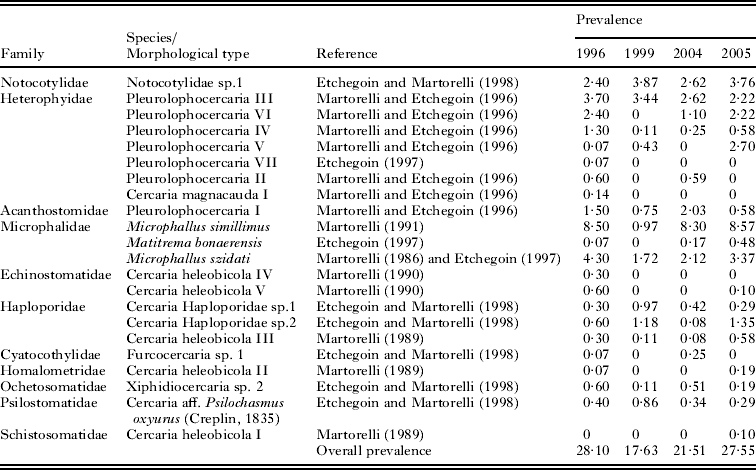
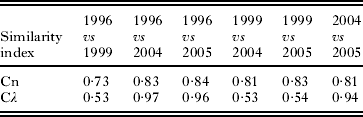
Twenty-two digenean species, belonging to 11 families, were observed (Table 1). The greatest species richness was found in 1996 (S=21), and the lowest species richness was found in 1999 (S=12). Species richness values in 2004 and 2005 were 15 and 17 respectively. Furthermore, only 11 species of digeneans were observed in all sampling periods. The remaining species were recorded in 1, 2 or 3 periods. Pleurolophocercaria VII, Cercaria magnacauda I, Cercaria heleobicola IV and Cercaria heleobicola I were recorded only in 1 period; Pleurolophocercaria II, Cercaria heleobicola V, Furcocercaria sp. 1 and Cercaria heleobicola II were present in two periods and, finally, Pleurolophocercaria VI, Pleurolophocercaria V and Maritrema bonaerensis Etchegoin and Martorelli, Reference Etchegoin and Martorelli1997, were registered in 3 sampling periods. With regard to similarity between these years, the Sørensen index showed the highest values of similarity for the years 1996–2005 (Cn=0·84) and the lowest values for the years 1996–1999 (Cn=0·73) (Table 2). The Morisita-Horn index matches with the Sørensen index in determining that the years 1996–1999 and 1999–2004 were those with lower values of similarity (Cλ=0·53). On the other hand, the Morisita-Horn index showed the highest values of similarity for the years 1996–2004 (Cλ=0·97). The observed differences could be attributable to the way the Sørensen index and Morisita-Horn index calculate the similarity. The Sørensen index uses presence/absence of species while the Morisita-Horn index uses prevalence data.
Annual values of prevalence and detailed list of species or morphological types of larval digeneans parasitizing Heleobia conexa in Mar Chiquita coastal lagoon, during 4 years (1996, 1999, 2004 and 2005)

Larval digeneans parasitizing Heleobia conexa in Mar Chiquita coastal lagoon: interannual comparisons of the parasite community similarity, using Sørensen index (Cn) and Morisita-Horn index (Cλ)

The prevalence of most larval digeneans was low (Table 1). In all sample periods only 3 species exceeded 1% (Cercaria Notocotylidae sp.1, Pleurolophocercaria III and Microphallus szidati Martorelli, Reference Martorelli1986). The most prevalent species in 1996, 2004 and 2005 was Microphallus simillimus (Travassos, 1920), while Notocotylidae sp.1 showed the highest values of prevalence in 1999. The annual overall prevalence never exceeded 30%, and the lowest value (17·63%) was registered in 1999 (Table 1). In χ 2 tests, proportions of infected snails were significantly different between 1996–1999 (χ 2(1)=8·50; P<0·01), 1999–2004 (χ 2(1)=6·58; P<0·01), and 1999–2005 (χ 2(1)= 8·88; P<0·01).
Dynamics of larval digenean communities in Heleobia conexa
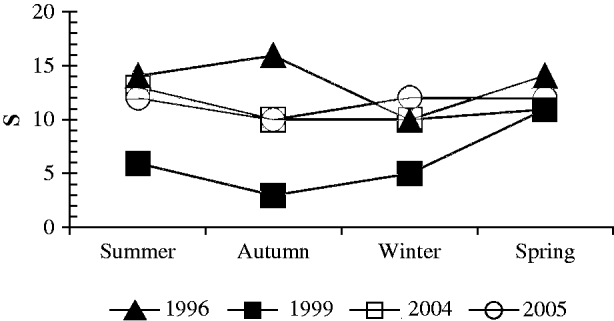
The species richness showed different seasonal patterns (Fig. 1). In 1996 it presented a decrease towards winter, and an increase towards the autumn, while 1999 showed a decrease in the autumn and an increase towards the spring. The years 2004 and 2005 showed, as in 1999, a decline towards autumn. The year 2004 presented an increase towards the summer, and in 2005 species richness remained constant through the seasons.
Seasonal variation of species richness (S) in the larval digenean community of Heleobia conexa in Mar Chiquita coastal lagoon during 4 years (1996, 1999, 2004 and 2005).

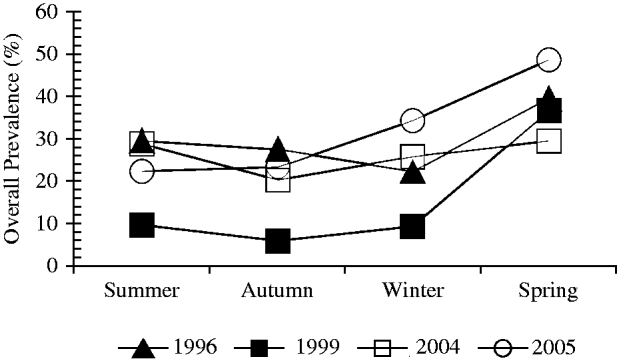
Overall prevalence usually peaked in spring and declined towards autumn-winter (Fig. 2). In 1996, 1999 and 2004 the proportions of infected snails were significantly different between summer-spring (1996: χ 2(1)=5·04; 1999: χ 2(1)=5·82; 2004: χ 2(1)=4·50; P<0·001 in all cases), autumn-spring (1996: χ 2(1)= 7·14; 1999: χ 2(1)=7·23; 2004: χ 2(1)=8·03; P<0·001 in all cases) and winter-spring (1996: χ 2(1)=4·64; 1999: χ 2(1)=4·50; 2004: χ 2(1)=4·62; P<0·001 in all cases). In 2005 (as in 1996, 1999 and 2004) the proportions of infected snails were significantly different between summer-spring (χ 2(1)=9·95; P<0·001), autumn-spring (χ 2(1)=8·55; P<0·001) and winter-spring (χ 2(1)=4·50; P<0·001) and also between summer-winter (χ 2(1)=5·19; P<0·001) and autumn-winter (χ 2(1)=4·53; P<0·001). The most prevalent species of digenean in all seasons in the years 1996, 2004, 2005 was M. simillimus. In the autumn, winter and summer of 1996, Notocotylidae sp.1 was the most prevalent species, whereas in spring Pleurolophocercaria III showed the highest values of prevalence.
Seasonal variation in the overall prevalence of larval digeneans parasitizing Heleobia conexa in Mar Chiquita coastal lagoon during 4 years (1996, 1999, 2004 and 2005). Values of overall prevalence: 1996 (S: 29·50, A: 27·50, W: 22·30, Sp: 39·40); 1999 (S: 9·68, A: 6·00, W: 9·17, Sp: 36·67; 2004 (S: 28·76, A: 20·32, W: 25·72, Sp:29·39); 2005 (S: 22·32, A: 23·28, W: 34·30, Sp: 48·64). S, Summer; A, Autumn; W, Winter; Sp, Spring.

DISCUSSION
The component community of larval digeneans in H. conexa presented a high diversity and low-medium prevalence, both features with annual and seasonal variations.
The diversity of larval digeneans in H. conexa varied seasonally in each year, decreasing towards autumn, except in 1996, and increasing towards the spring and summer. According to Etchegoin (Reference Etchegoin1997, Reference Etchegoin and Iribarne2001), the diversity of this community is strongly influenced by the presence of bird definitive hosts. In the study area, 62 species of birds have been registered. From the total number of bird species censored, 28% includes only migratory birds, with migratory stopovers mainly in spring and summer (Ferrero, Reference Ferrero and Iribarne2001). As the diversity of larval digeneans in the first intermediate host is directly dependent on the presence of definitive hosts (Kuris and Lafferty, Reference Kuris and Lafferty1994; Huspeni et al. Reference Huspeni, Hechinger, Lafferty and Bortone2005; Hechinger et al. Reference Hechinger and Lafferty2005, Reference Hechinger, Lafferty, Mancini, Warner and Kuris2008), increased seasonal diversity in larval digeneans of H. conexa should be correlated with seasonal changes in the composition of the vertebrate definitive host community.
The prevalence in each year showed 1 peak in spring, as seen in all sampling periods. According to De Francesco and Isla (Reference De Francesco and Isla2004), recruitment of juveniles to the adult population of H. conexa occurs in late spring. These juveniles will mature and grow in size over the year to produce new susceptible hosts for infection by digeneans. For this reason, seasonal variation in prevalence throughout the year should be, in part, associated with the population dynamics of the snail host, as was indicated by Kube et al. (Reference Kube, Kube and Dierschke2002) for Hydrobia ventrosa and Faltýnková et al. (Reference Faltýnková, Valtonen and Karvonen2008) for Valvata macrostoma.
The component community in H. conexa showed a difference in the abundance and diversity of morphological types of cercariae between 1999 and the other sampling periods. These annual differences could be due to indirect and/or direct anthropogenic effects. Since 1999, ‘Juan y Juan’ has become an open fishing area with an increasing number of visitors who use propeller and rowing boats for recreational fishing. To facilitate movement of boats in this area, the reef-like aggregates of the polychaete F. enigmaticus were extensively eliminated (approximately 80% of the reefs) (Etchegoin, personal communications). Extraction of reef-like aggregates could have altered the population dynamics of H. conexa because it lives only in the colonies of the polychaete (De Francesco and Isla, Reference De Francesco and Isla2003; Bruschetti et al. Reference Bruschetti, Bazterrica, Luppi and Iribarne2009). In addition, some bird species utilize areas with reefs of F. enigmaticus as a surface for foraging and resting (Bruschetti et al. Reference Bruschetti, Bazterrica, Luppi and Iribarne2009). As a consequence of the extraction of reef-like aggregates, a displacement to other parts of the lagoon of the bird hosts associated with the reefs may have caused an interruption of digenean life cycles in the area. Human activities can change behaviour and/or alter the distribution of birds (definitive host) (Burger, Reference Burger1986; Lafferty, Reference Lafferty2001; Burger et al. Reference Burger, Jettner, Clark and Niles2004; Lafferty et al. Reference Lafferty, Goodman and Sandoval2006b), and can affect directly or indirectly the distribution and abundance of larval digenean communities (Lafferty, Reference Lafferty1997; Bustnes and Galaktionov, Reference Bustnes and Galaktionov1999; Lafferty and Kuris, Reference Lafferty, Kuris, Thomas, Renaud and Guégan2004; Loot et al. Reference Loot, Aldana and Navarrete2005, Reference Loot, Blanchet, Aldana and Navarrete2008).
In the years 2004 and 2005 a gradual restoration of larval digenean diversity has been observed. As pointed out by Pezzani and Obenat (Reference Pezzani and Obenat1988) and by Obenat and Pezzani (Reference Obenat and Pezzani1989, Reference Obenat and Pezzani1994), physical and human erosion produces the detachment of parts of the aggregates of F. enigmaticus and provides new areas for larval recruitment and growth. The dispersion of these aggregates can provide new substratum, food, and shelter for invertebrates (including H. conexa) which are part of the diets of birds. Probably, the formation of new colonies of the polychaete could restore some links between intermediate and definitive hosts and, in consequence, produce a gradual yearly increase in the diversity of larval digeneans in the area.
Using larval digeneans as a bio-indicators of environmental disturbances is useful for detecting general changes over time but not for determining specific causes (Keas and Blankespoor, Reference Keas and Blankespoor1997). Nevertheless, the use of digeneans as bio-indicators of species diversity, abundance, and trophic functions can be applied in a monitoring project with limited financial resources because they provide a high information yield at low cost (Huspeni et al. Reference Huspeni, Hechinger, Lafferty and Bortone2005; Hechinger and Lafferty, Reference Hechinger and Lafferty2005; Hechinger et al. Reference Hechinger, Lafferty, Huspeni, Brooks and Kuris2007).
If we compare the richness observed in the larval digenean community of H. conexa with the richness of the 24 species of snails listed by Huspeni et al. (Reference Huspeni, Hechinger, Lafferty and Bortone2005), only Hydrobia ulvae exceeds the number of trematode species (22 vs 32). Even when the environment was altered by human activity, the number of species of larval digeneans observed was 12 (year 1999). This number exceeds the minimum number of larval digeneans (3) suggested by Huspeni et al. (Reference Huspeni, Hechinger, Lafferty and Bortone2005) to consider larval digeneans in the first intermediate host as bio-indicators of indirect information about vertebrate and invertebrate communities as well as trophic links between second intermediate and final hosts. On the other hand, the larval digenean community of H. conexa showed a year to year re-establishment following the annual cycle of H. conexa (De Francesco and Isla, Reference De Francesco, Isla and Iribarne2001, Reference De Francesco and Isla2004) and the presence of definitive hosts. A similar pattern was observed by Esch et al. (Reference Esch, Barger and Fellis2002) in the snail Helisoma anceps. The annual restructuring of this snail-digenean system could allow inferences about environmental changes in the lagoon within a short period of time, including disturbances due to human activities and fluctuations in the diversity and in the abundance of vertebrate definitive hosts (mainly birds).
According to our results, the larval digenean community of H. conexa could be considered as a good bio-indicator with quick response to environmental disturbances. Future studies (at micro- and macro-scales) in the lagoon will shed light on the relationships between the abundance and diversity of larval digeneans in H. conexa and the distribution and abundance of definitive hosts as well as human activities in the reserve. These studies will also include the analysis of the importance of the aggregates of F. enigmaticus as preferred habitat of H. conexa and its role in facilitating the transmission of digeneans in the area.
ACKNOWLEDGMENTS
The authors gratefully thank Dr Robert Poulin (University of Otago, New Zealand) for his critical comments on an earlier version of the manuscript, and Dr Lawrence Curtis (University of Delaware, USA) for English revision and valuable suggestions.
FINANCIAL SUPPORT
This work was supported by the Consejo Nacional de Investigaciones Científicas y Técnicas (CONICET) (J.A.E., grant number PIP 114-200801-00001); and Universidad Nacional de Mar del Plata (J.A.E., grant number EXA 411/08 15/E359).