In April 2011, all pediatric inpatients at our hospital were moved to a newly built children’s hospital building across the Mississippi River from the old hospital building (built in 1986).Reference Murray, Streifel, O’Dea and Rhame 1 During construction of the new hospital, the infection risk mitigation process included consideration of pipe material, flushing of water distribution systems, and disinfection to minimize the presence of microorganisms in the water. In 1998, an outbreak of bacteremia resulting from rapidly growing mycobacteria (RGM) occurred among hematopoietic stem cell transplant (HSCT) patients in the old hospital, and we traced the cause to water contamination of central venous lines during showering.Reference Kline, Cameron, Streifel, Yakrus, Peacock, Besser and Cooksey 2 Because RGM were present in the city water, we regularly flushed the new hospital water system during preoccupancy to bring fresh chloramine-treated water through the plumbing. Water was sampled. Plumbing fixtures were functional 1 year prior to patient occupancy. Drinking water and ice machines (DWIMs) were installed in the new hospital 2 weeks prior to patient occupancy. Despite these efforts, pediatric HSCT patients became colonized with RGM at an increased incidence soon after the new hospital opened.Reference IrohTam, Kline and Wagner 3 These clinical cases of these 15 patients have been described in a separate report.Reference IrohTam, Kline and Wagner 3
We sought to determine the cause of the outbreak and to eradicate the source of infection. Nontuberculous mycobacteria (NTM) are relatively resistant to chloramine and are present in many municipal water supplies; a US Environmental Protection Agency (EPA) survey found mycobacteria in 61% of hospital water samples.Reference Covert, Rodgers, Reyes and Stelema 4 – Reference duMoulin and Stottmeier 6 NTM cause nosocomial outbreaks and pseudo-outbreaks.Reference Wallace, Brown and Griffith 7 In contrast to the RGM bacteremia outbreak in our old hospital, this recent outbreak resulted primarily in positive RGM cultures from sputum, throat, or gastrointestinal sites.Reference Kline, Cameron, Streifel, Yakrus, Peacock, Besser and Cooksey 2 , Reference IrohTam, Kline and Wagner 3 Therefore, we investigated potential ingested water sources. Water and ice from DWIMs quickly became the focus of our investigation in the new hospital, and we compared these results with results from the DWIMs in the old building.
METHODS
From April 2012 to December 2014,>5,000 water samples were collected from the city water supply entering the new hospital. We tested drinking water from the hospital domestic water system (ie, shower, hand-wash sink, and patient sink) and surge tanks, water hammer arrestors, and points leading to and inside the 4 DWIMs that served the pediatric HSCT patients: 2 from the blood and marrow transplant (BMT) ward and 2 from the pediatric intensive care unit.
On an approximately weekly basis, we tested 3 types of water samples from the 4 DWIMs: (1) the first water from the machine (ie, first-drop water), (2) water collected after the line was allowed to flushed for 30 seconds (ie, 30-second water), and (3) water collected from melted ice that was collected from the ice machine dispenser (ie, ice). Standard methods were used for the evaluation of water.Reference Eaton, Clesceri and Greenberg 8 Samples were collected in sterile cups containing sodium thiosulfate to neutralize chlorine at time of collection. Serial dilutions were run through a 0.45-μm membrane filter placed on Reasoner’s 2 agar and incubated at 35°C for 7 days before colony-forming units (CFU/mL) were counted. The 7-day incubation was chosen because RGM colonies are not visible after 48 hours of incubation.
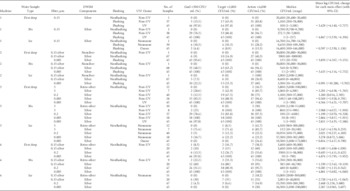
To identify a strategy for ameliorating bacterial burden and escalation in the 4 DWIMs, a number of strategies were tested: (1) flushing ice and water frequently, (2) using 0.005-, 0.15-, and 0.20-µm water filters, (2) cleaning and disinfecting DWIMs, (3) changing piping to copper, (4) installing silver-impregnated machine components and silver filters, and (5) ultraviolet germicidal irradiation and ozone disinfection (UV/ozone). Water and ice samples were collected before and after these interventions, samples were cultured, and HPCs were determined and compared (Table 1).
Interventions to Reduce Rapidly Growing Mycobacteria in 4 Drinking Water and Ice Machines (DWIM) From a Children’s Hospital

NOTE. DWIM, drinking water and ice machine; CFU, colony-forming units; UV, ultraviolet germicidal irradiation; ozone, disinfection; silver, silver-impregnated machine components, retrofitted and commercially available.
Thresholds for these interventions were chosen based on the water and ice HPCs from DWIMs in the old building because those levels had been safe for ingestion by the HSCT patients, and neither RGM bacteremia nor increased amounts of RGM in sputum or gastrointestinal tract cultures had been observed. At first, the target thresholds for total HPC were 500 CFU/mL at 48 hours of incubation (ie, the EPA drinking water standard). 9 We changed the thresholds (after 7 days incubation) to <500 CFU/mL as the goal, with 1,000 CFU/mL as the target and 4,000 CFU/mL as the action point.
Statistical Methods
For first-drop, 30-second, and ice water samples from each DWIM, the log-CFU was used due to the large positive skew for the distribution of CFU. For each DWIM, we recorded sample type, intervention, HPC, and percentage by which the sample exceeded the threshold (Table 1).
To estimate changes in the mean log-CFU by intervention type, a first-order, autoregressive, segmented regression model was used to estimate the mean level of change for each intervention type separately for each DWIM and location (Table 1). The segmented interventions were included as binary indicators. Interventions were believed to be immediate and relatively constant due to the recurring filter replacement schedule; therefore, slope changes were not parameterized and estimated. Seasonality was not believed to affect drinking water; this hypothesis was corroborated by comparing the Akaike Information Criterion (AIC) when fitting a model with and without a seasonal component. The mean change for each main effect and a 95% confidence interval (CI) were calculated. The models assumed an autoregressive-1 (AR1) correlation over time. Descriptive scatter plots were used to assess the impact of each intervention on log-CFU from each sample; Friedman’s smooth lines were created to examine trends in the log-CFU over time.
We analyzed the main effects of the following interventions: (1) UV and ozone disinfection on machine 1, (2) a 0.005-µm filter combined with flushing for machine 2, (3) 3 filter sizes, silver-impregnated components and silver filter, and UV and ozone disinfection for machine 3, and (4) 3 filter sizes and silver-impregnated components and silver filter for machine 4. For machine 1, the single observation labeled “nonflushing” was removed because it was the sole observation of this type. Similarly, a single observation labeled “nonsilver” was removed from machine 2 analysis.
RESULTS
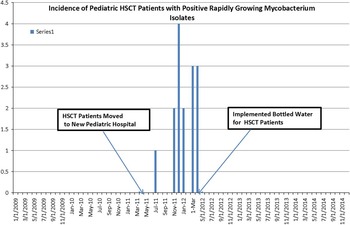
Between July 2011 and April 2012, 15 patients developed RGM colonization (n = 10) and/or infection (n = 6) (Figure 1).Reference IrohTam, Kline and Wagner 3 A 2-year retrospective revealed (1) no positive RGM cultures in this patient population and (2) a significant rate difference in these 2 periods, that is, 0 cases per 11,468 inpatient days (January 2009 to March 2011) compared with 15 cases per 6,920 inpatient days (April 2011 to April 2012). Using an exact-rate ratio test (assuming a Poisson distribution is appropriate), rate ratio is estimated as 0.00 (95% CI, 0–0.168; P<.001). Finally, consumption of hospital DWIM water and ice was prohibited for pediatric HSCT patients, and commercial bottled water was thereafter provided to these patients. Bottled water from multiple distributors was tested for bacterial colony counts. The brand with the least colony formation (ie, mean <1 CFU/mL) was used thereafter for HSCT patients. Since the bottled water intervention began in the pediatric HSCT population 4 years ago, RGM has not been detected in this patient population in our hospital.
Epidemiological Curve showing onset of outbreak of pediatric hematopoietic stem cell transplant (HSCT) patients with positive rapidly growing mycobacteria (RGM) isolates starting shortly after the move to a new children’s hospital building.

Prior to patient occupancy in the new hospital, bacterial HPC levels in first-drop water ranged from 350 to 3,400 CFU/mL. Disinfection of the domestic water system was performed twice using premixed chorine (50 ppm) that was allowed to dwell for 12 hours, followed by flushing. Initial disinfection 14 weeks prior to occupancy reduced bacterial HPC, from 1,980 CFU/mL to 47 CFU/mL, but higher bacterial counts returned within 2 weeks. Repeating disinfection 4 days prior to occupancy reduced colony counts from 1,720 CFU/mL to 47 CFU/mL.
After the new hospital had been occupied for 6 months, an increase in RGM isolates (Mycobacterium chelonae, M. abscessus, and M. immunogenum) in the clinical cultures of pediatric HSCT patients was observed, and water testing began.Reference IrohTam, Kline and Wagner 3 Water cultures with the highest bacterial HPCs (ie,>100,000 CFU/mL) were identified in the drinking water and ice from the DWIMs. Isolates from DWIM cultures were identified as M. chelonae or M. abscessus and M. mucogenicum or M. phocaicum.Reference IrohTam, Kline and Wagner 3 Samples revealed acceptable colony counts (1–2,610 CFU/mL) at the point of water entry into the new hospital; most HPCs were <500 CFU/mL, suggesting escalation within the hospital water distribution system. Sampling of water at multiple points within the hospital showed acceptable HPCs up to the entry point of water into the DWIMs.
When HPCs from drinking water and ice from the DWIMs in the new and the old hospitals were compared, significant differences were observed. The new hospital’s DWIMs were similarly designed and were from the same manufacturer, but they held twice the volume. The old hospital unit had a single 12-pound ice machine serving 25 patients. The new hospital had four 25-pound ice machines serving 24 patients and, thus, an 8-fold increase in the volume of DWIM. The old hospital’s DWIM had counts consistently between 0 and 5,000 CFU/mL in the water and between 0 and 4,000 CFU/mL in the ice. The new hospital’s HSCT unit DWIM at baseline had HPCs as high as 300,000 CFU/mL in water and 780,000 CFU/mL in ice.
Interventions
All four 25-pound ice machines were replaced with 2 smaller 12-pound ice machines per hospital floor. The manufacturer retrofitted these newly purchased 12-pound ice machines with silver-impregnated components. These field-tested machines performed better than expected (Table 1). Ice machines with silver-impregnated components then became commercially available, and 2 new silver-impregnated 12-pound ice machines were purchased for the HSCT unit. To minimize bacterial growth in the water pipes, polycarbonate tubing was replaced with copper tubing in the DWIMs and their connection tubing wherever possible. Copper-tubing supply connections to the DWIMs alone did not have a large impact, and high HPCs were observed.
In total, 5 DWIMs were flushed to run more water through the HSCT unit plumbing. A continuous flow drain was installed for flushing the water lines feeding DWIMs 1 and 2 on the BMT unit at 5.7 L (1.5 gallons) per minute. Because drinking water and ice from the DWIM were not being used by patients, simulations of ice machine usage on the unit via flushing was initiated to produce a more accurate result from the water tests related to our trial interventions.
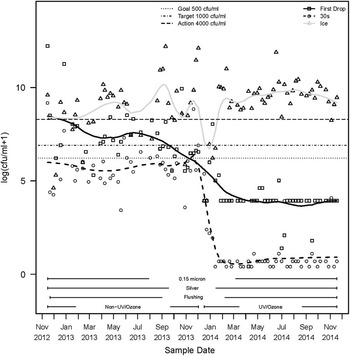
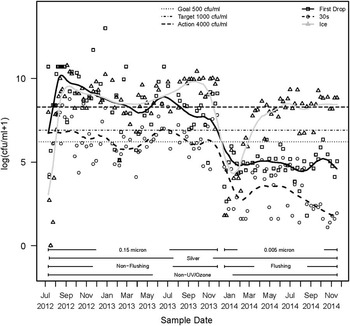
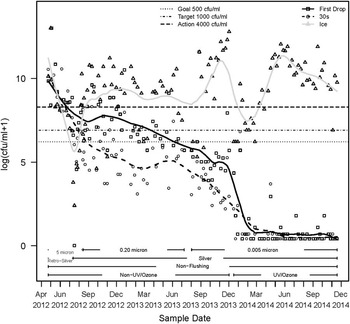
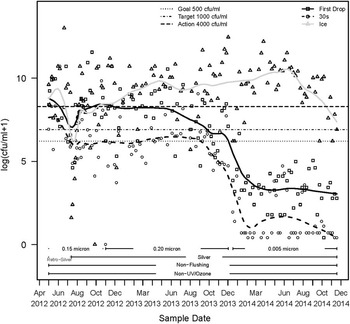
In addition to the continuous flow drain, engineering staff flushed the ice and water from the DWIM twice per day, which entailed dumping the ice bin and flushing the drinking water for 3 minutes. Water was cultured before and after water filtration using different water filters. Pre- and postfilter ports were used to collect samples to determine filter performance. The greatest reduction in HPC was observed with the 0.005-µm filter (Table 1). An additional combination intervention included UV germicidal irradiation and ozone disinfection. The UV treatment occurred at the point of use, and the ozone device was added to treat the ice in the ice bin. Results are shown in Table 1 and Figures 2–5.
Drinking water and ice machine (DWIM) 1 water and ice. Heterotrophic plate counts (HPCs; CFU/mL) and effects from interventions.

Drinking water and ice machine (DWIM) 2 water and ice. Heterotrophic plate counts (HPCs; CFU/mL) and effects from interventions.

Drinking water and ice machine (DWIM) 3 water and ice. Heterotrophic plate counts (HPCs; CFU/mL) and effects from interventions.

Drinking water and ice machine (DWIM) 4 water and ice. Heterotrophic plate counts (HPCs; CFU/mL) and effects from interventions.

DWIM cleaning and sanitizing procedures were audited by an outside vendor. We learned that our DWIM cleaning was excellent. Cleaning was performed every 6 months following the manufacturer’s instructions with the exception of installing new 0.005-µm filters every 6 months. Culturing of the DWIM prior to the manufacturer’s recommended cleaning schedule showed high HPCs in the ice machine bin and reservoir, suggesting that routine cleaning practices may not reduce the HPC in the DWIM to acceptable levels for safe consumption of ice by HSCT patients.
For machine 1, the UV/ozone disinfection intervention reduced 30-second water HPCs to very low levels. This intervention also brought reduced the HPCs of first-drop water below goal levels; however, HPCs were higher in first-drop water than in 30-second water. This machine had been fitted with a 0.15-µm filter and silver-impregnated internal components. However, a very significant reduction remained in the mean log-CFU of first-drop and 30-second water pre- and postinstallation of the UV/ozone devices in the DWIMs.
For machine 2, a significant sustained reduction in the first-drop and 30-second water to below goal levels when the means of the pre- and postinstallation samples of the 0.005-µm filter plus programmed automatic intermittent flushing were compared. A significant change in the ice HPC was also noted after the 0.005-µm filter plus flushing intervention, but this effect was not sustained.
Machine 3 showed the most marked reduction in HPCs in first-drop and 30-second water using a combination of 0.005-µm filter plus UV/ozone disinfection. HPCs of first-drop and 30-second water were consistently below goal levels; however, ice never met goal levels. This machine had silver-impregnated components, and the flushing procedure was not performed. First-drop water met acceptable HPC levels with the 0.005-µm filter alone. When combined with UV/ozone disinfection, the first-drop water had a much lower HPC, which approached the HPC levels of the 30-second water.
Machine 4 was not fitted with UV/ozone disinfection devices, and the 0.005-µm filter alone did reduce first-drop and 30-second water HPCs to levels consistently below the goal. Silver-impregnated components did have some effect, but it was confounded by the effect of the 0.005-µm filter.
For all machines, UV/ozone disinfection as a single intervention had the strongest effect on HPCs, even compared with the 0.005-µm filter alone. The 0.005-µm filter alone had a significant effect on HPCs, but not as powerful as UV/ozone disinfection. The combination of the 0.005-µm filter plus UV/ozone disinfection was very effective in reducing HPCs in both first-drop and 30-second water to levels consistently below the goal.
Silver impregnating of DWIM components appeared to be beneficial, but alone it was not powerful enough to bring water HPCs to goal levels. Cleaning the machines had a somewhat limited short-term effect. Temporary dips were seen in the ice HPCs, but they quickly rebounded. All of the interventions, alone or in combination, were unable to achieve ice HPCs consistently below goal levels.
DISCUSSION
Infection prevention specifications for plumbing are often not considered during design and construction of hospitals. We were surprised by the difficulty in maintaining microbial control in the new hospital plumbing system. During our investigations of floor plumbing diagrams, we discovered that patient floor plumbing was designed to mitigate low-water-pressure problems. Cross connections formed a loop to alleviate pressure issues. Cross-connected sections can remain stagnant or neutral, making disinfection more difficult.
Hospital designers installed larger-capacity DWIMs so that nurses would have access to ice and water close to patients. The unintended consequence was decreased water and ice usage per machine. Stagnant water and ice promoted RGM growth greater than that observed in the old hospital, thus putting pediatric HSCT patients at risk. Our goal was to achieve a safe bacterial level (<500 CFU/mL) in water and ice to allow our HSCT patients to use the DWIMs again.
Several variables likely affected the ice HPCs: water source, volume used, plumbing design, and materials. Because more ice was produced and held in the ice machine, we postulated that water and ice were held for longer periods, thereby promoting increased growth of RGM. A temperature tracking device placed inside the DWIM showed temperatures from 21.1°C to 33.3°C (70°F to 92°F) inside the DWIM, surrounding the area where water is held prior to making ice, and this is an optimal growth temperature for RGM.Reference Mayhall 10
The current HPC for US water was established using 48-hour incubation. RGM grow more slowly than gram-negative bacteria, requiring longer incubation times to become visible. The HPCs were the same at 48 hours as at 5 days, but stereoscopic efforts were required because they cannot be seen with the naked eye. We noted that RGM appeared on culture plates after 5 days of incubation.
A collaborative effort is needed to determine the level of sanitization for DWIM production of ice and water required to meet the safety needs of severely immunocompromised patients. The focus needs to extend beyond Legionella as a waterborne pathogen and needs encompass all waterborne pathogens, such as RGM. 11 Also, water treatment with chloramination while decreasing Legionella, may increase RGMs in potable water and may change the microflora and biofilms of water distribution systems. 11 , Reference Pryor, Springthorpe and Riffard 12 The American National Standards Institute/American Society of Heating, Refrigerating and Air-Conditioning Engineers (ANSI/ASHREA) Standard 188, initially established to regulate minimum legionellosis risk management requirements for building water systems, has changed the emphasis for hospital administrators, who should now be concerned about all microbial content (ie, all genus/species) in water used in health care. 11
In summary, HSCT patients were vulnerable to acquiring RGM colonization and infection from ingesting water and ice with high HPCs from the potable water system. We succeeded in reducing water HPCs to acceptable levels. Despite our interventions, however, we could not consistently achieve goal levels in ice. Further research is needed in this area to get DWIMs to make ice with consistently low HPCs.
The HPCs in our children’s hospital DWIMs have consistently met goal levels for 4 years; thus, we are recommending that HSCT patients be allowed to drink water directly from the DWIMs. We have added the 0.005-µm filter and silver-impregnated components as well as and copper tubing to all DWIMs in the new hospital, and we plan to add UV disinfection devices to all machines used by HSCT patients.
Because the ice HPCs have not met goal levels, HSCT patients are not allowed to ingest the ice. To replace the previously used ice chips, nurses currently freeze the unopened bottles of water and allow patients to drink that ice water as it melts.
We plan to closely monitor the DWIMs in the new hospital and to continue water and ice cultures monthly. We will take action to decrease levels if they increase. We continue to watch for any RGM isolates in HSCT patient cultures, and we plan to reinstitute the bottled water policy if any RGM isolates are detected while we investigate the causes further.
ACKNOWLEDGMENTS
Financial support: No financial support was provided relevant to this article.
Potential conflicts of interest: All authors report no conflicts of interest relevant to this article.