1. Introduction
As is widely known, the term ‘semantic pole’, coined by cognitive grammar (and especially by Langacker), designates the semantic structure codified by a linguistic element, or, to be more precise, by its phonological structure (cf. Langacker, Reference Langacker1987, pp. 76−81, 2008, pp. 15−18). In the case of grammatical constructions, Huelva Unternbäumen (Reference Huelva Unternbäumen2010a) argued that the semantic pole is formed by a complex domain matrix, in the sense that it brings together and integrates elements belonging to different conceptual domains, thereby creating conceptual structures of a considerable complexity. The central aim of the present investigation is to more deeply explore this complexity. Concretely, we intend to demonstrate that, together with conceptual complexity in this sense, we may also identify the effects of a cognitive complexity resulting from the joint intervention of two general cognitive mechanisms in the construction of the semantic pole of grammatical structures, namely the conceptual metaphor and the mechanism of blending.
From the analytical perspective we propose, the semantic pole of grammatical constructions manifests itself as a multidomain matrix, consisting basically of a set (or network) of conceptual metaphors integrated through the mechanism of blending (Fauconnier & Turner, Reference Fauconnier and Turner1998, Reference Fauconnier and Turner2002). As we shall see, the metaphors that participate in these multidomain matrices are, in principle, metaphors that already exist in our conceptual structure, regardless of whether or not they are used as integral elements of the semantic pole of grammatical constructions. As we shall demonstrate in the course of the analysis in Section 2, these often involve primary metaphors (Gibbs, Reference Gibbs2005, pp. 116−118; Grady Reference Grady1997, Reference Grady2005; Lakoff & Johnson, Reference Lakoff and Johnson1999, pp. 45−59), conceived of as metaphors that have a direct, independent, experiential base. Such primary metaphors may be integrated through the blending mechanism, thus creating compound (or complex) metaphors (Grady, Reference Grady2005). In other cases, the starting point for the construction of such multidomain matrices is complex metaphors already existing in our conceptual structure, understood as an autonomous conceptual complex of a metaphorical nature, created through the integration of various primary metaphors (Gibbs, Reference Gibbs2005, p. 117). Nevertheless, regardless of the type of metaphor involved, the multidomain matrices that act as semantic poles of grammatical constructions are always complex metaphorical networks, in the sense described above.
In Section 2, we provide an analysis of the construction of complex metaphors, taking as a starting point the integration of primary metaphors and of other complex metaphors. Our concrete object of analysis consists of the semantic pole of different types of ditransitive constructions. A ditransitive construction is defined here as a construction consisting of a predicate and three arguments (typically labeled in the literature as ‘agent’, ‘recipient’, and ‘theme’). The ditransitive construction is associated with a network of complex metaphors integrated with the mechanism of blending. This network of metaphors includes, among others, OBJECT TRANSFER, CONTROL TRANSFER, ACTION TRANSFER, etc. Each of these metaphors determines in its own way the meaning of the construction.
A number of theoretical−methodological consequences may be derived from the proposed analysis. The first of these consequences has to do with the nature of the semantic categories codified by grammatical constructions. Our analysis shows that these categories are formed by a set of metaphors connected by the blending mechanism. These metaphorical networks serve as conceptual domains that specify individual concepts such as agent, recipient, object, etc. In the second place, we shall argue that our findings can help us to formulate a more accurate definition of the concepts of semantic map and conceptual adjacency. Concretely, we shall propose that the semantic map of a determined grammatical construction is formed by a set of metaphors linked to one another through blending. Finally, we shall show that the blending mechanism and conceptual metaphor seem to be essential elements for explaining the equipotentiality of human language, i.e., the capacity to use existing conceptual structures to codify new situations and experiences.
2. The construction of the category OBJECT TRANSFER
The first semantic category to be analyzed is known as OBJECT TRANSFER. Basically, this category refers to an act through which a person, with his own hands, transfers an object to another person, who also receives it with his own hands (cf. Newman, Reference Newman1996, p. 1). For many authors, this category constitutes the prototypical semantic pole of ditransitive constructions (cf. Delbecque &Lamiroy, Reference Delbecque, Lamiroy, Van Belle and Van Langendonck1996, pp. 90−92; Goldberg, Reference Goldberg1992, p. 51; Huelva Unternbäumen, 2010b, pp.119−123; Hollmann, Reference Hollmann2007, p. 64; Newman, Reference Newman1996, pp. 1−21, 2005, p. 160).
The prototypical nature of the act denoted by this category is well established. For example, Newman (1996, pp. 1−4, 37−38) points out that the act of transferring an object represents a basic frame which acts as a constituent part of a wide range of other frames of a more elaborate nature. These more complex frames, each in its own way, elaborate and specify the act of transfer of an object, situating it within a context of particular socio-cultural interactions, which in many cases are highly ritualized. One aspect which stands out among Newman’s observations is that, independently of the complex frames into which the act of OBJECT TRANSFER may be inserted, and regardless of any additional semantic specifications, the basic constituent elements of this act remain essentially the same: an agent who, with his own hands, transfers an object to a recipient, who also receives it with his own hands. The high frequency of OBJECT TRANSFER and of the elements which comprise it in different contexts constitutes a clear indication of the basic and prototypical nature of this form of transfer.
In Huelva Unternbäumen (2010a, pp. 5−8), we can find another argument to reinforce this view. The basic and prototypical nature of OBJECT TRANSFER may be confirmed by an important observation: the conceptual domains we employ to specify the constituent elements of this type of transfer are often also used to specify other types of transfer; the opposite does not occur. Let us examine a few examples:
(1) a. Paga oitenta e três reais para o pião (Portuguese)
Pays eighty and three reals to the day laborer
‘He pays eighty-three reals to the day laborer’
b. Eu dou esta garrafa para o Senhor João (Portuguese)
I give this bottle to the Mr Juan
‘I give this bottle to Mr Juan’
c. O vizinho deu o lote para o filho dele (Portuguese)
The neighbor gave the lot to the son of him
‘The neighbor gave the lot to his son’
(Examples from Huelva Unternbäumen, 2010a)
(2) a. Vou mostrar para a imprensa os relatórios de maio (Portuguese)
Go show to the press the reports of May
‘I’m going to show the May reports to the press’
b. Mostrar para quem quer que seja qual é a nossa realidade (Portuguese)
To show to who anyone what is our reality
‘To show other people, without distinction, how we live’
(Examples from Huelva Unternbäumen, 2010a)
Examples (1a) and (1b) show that in many cases (but not all, as may be seen in (1c)), the TRANSFER OF CONTROL over an object implies its physical transfer from the spatial−temporal domain of the agent to that of the recipient. Thus, the configuration of the set of conceptual domains required for the semantic specification of the participating elements in these two cases of TRANSFER OF CONTROL must take into account the typical conceptual domains of OBJECT TRANSFER, such as the conceptual domains of SPACE, TIME, and FORCE. Similarly, the TRANSFER OF PERCEPTION is often accompanied by a transfer of the perceived physical object, as in the case of (2a) (but not (2b)). Where this is the case, the specification of the semantics of the elements that comprise this type of transfer will likely draw on OBJECT TRANSFER’s own conceptual domains. In contrast, to specify a ‘simple’ object transfer it is not necessary to fall back on conceptual domains such as those of CONTROL or PERCEPTION. This asymmetry is also an important bit of evidence corroborating the basic and prototypical nature of OBJECT TRANSFER.
The frequent insertion and recurrence of the act of object transfer and the complex and varied set of functions it performs in different situations of interaction confer upon this act a central role in human experience. This observation is corroborated by the fact that practically all the languages in the world have some means of expressing this act.Footnote 1 From a cognitive perspective, this state of affairs leads us to conclude that the act of object transfer corresponds to a basic category of human conceptualization. Newman (1996, pp. 3−4) suggests that the act of object transfer and its corresponding conceptual category can be considered a ‘basic level category’, in the sense proposed by authors such as Brown (Reference Brown1965) and Rosch (Reference Rosch1973), and subsequently systematized by Lakoff (1987, pp. 31−38, 46−54). According to this last author, the basic level categories characteristically have the following properties: (i) they belong at the level of distinctive actions; (ii) this is the level that is learned first; (iii) the categories at this level are those of greatest cultural relevance; and (iv) the entities at this level (objects, actions, etc.) are perceived in a holistic way, as unitary gestalts (pp. 32−33).
More recently, authors such as Lakoff and Johnson (Reference Lakoff and Johnson1999), Grady (Reference Grady2005), and Gibbs (Reference Gibbs2005) have postulated a metaphorical origin of the basic level categories. From this viewpoint, the categories at this level emerge, to a large degree, as primary metaphors (or, to be more precise, as a set of primary metaphors joined together by the blending mechanism).
Within the frame of reference of this new theoretical proposal, and assuming the basic and prototypical nature of this category, it stands to reason that OBJECT TRANSFER is created out of the conceptual integration of primary metaphors. Concretely, we propose that the conceptual structure of OBJECT TRANSFER comprises the following primary metaphors: Persons are locations; Changes are movements; Causes are forces; Causation is forced movement; To control is to have in one’s hands; Loss and acquisition of control is changing hands.
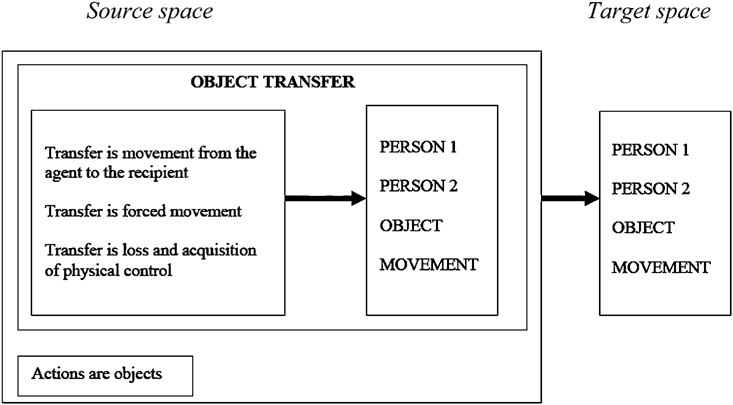
These primary metaphors undergo a complex process of integration, which is divided into two phases. In the first, an integration of pairs of primary metaphors is produced. This results in the creation of the complex metaphors TRANSFER IS MOVEMENT FROM THE AGENT TO THE RECIPIENT, TRANSFER IS FORCED MOVEMENT, and TRANSFER IS LOSS AND ACQUISITION OF PHYSICAL CONTROL. In the second, these complex metaphors are integrated among themselves, forming the total conceptual structure of the OBJECT TRANSFER concept.
The metaphorical network resulting from this process of integration is:
OBJECT TRANSFER
TRANSFER IS MOVEMENT FROM THE AGENT TO THE RECIPIENT
• Persons are locations
• Changes are movements
TRANSFER IS FORCED MOVEMENT
• Causes are forces
• Causation is forced movement
TRANSFER IS LOSS AND ACQUISITION OF PHYSICAL CONTROL
• To control is to have in one’s hands
• Loss and acquisition of control is changing hands
In the next four sections, we shall analyze the construction of this complex metaphor.
2.1. transfer is movement from agent to recipient
The source domain of this metaphor is motion in space, and as target domain the specific action of object transfer. It comprises two primary (sub)metaphors: (i) Persons are locations and (ii) Changes are movements.
As primary metaphors, both constitute basic elements of our conceptual structure, which contribute to a considerable number of concepts. That is to say, the use we make of these primary metaphors is not limited to their participation in the construction of the concept of OBJECT TRANSFER; quite the contrary. Thus, it is not hard to find examples that show their potential for conceptualization.
2.1.1. Persons are locations
One quite well-documented case is the use of the metaphor Persons are locations in the construction of the concept of POSSESSION (cf. Heine, Reference Heine1997; Heine & Kuteva, Reference Heine and Kuteva2002, pp. 34−35, 2007, pp. 280−283). Thus, Heine and Kuteva (2007, pp. 280−281) point out that of the five conceptual schemes at the root of the expression of attributive possession in the languages of the world, three are of a clearly spatial nature. They are as follows: Y at X (localization), Y from X (origin), Y for/to X (direction). The common denominator among the three is that the possessor, element X, is conceptualized as a locus in the respective spatial relationship: a locus, next to which there is an object (in the case of Y at X), from which proceeds an object (in Y from X) or to which an object directs itself (in Y for/to X). It seems, therefore, that the primary metaphor Persons are locations has significant participation in the construction of our (abstract) concept of POSSESSION.
The conceptual structure of this metaphor is characterized by two essential aspects. In the first place, its use permits us to conceive of a person as a position, i.e., as a point in space which can be related to other points. This structural aspect is of great importance, constituting, as it does, a prerequisite for the formation of other basic concepts, such as MOVEMENT (between two points) and TRAJECTORY (from one point to another). The second aspect helps us to conceptualize the person as a circumscribed space (the personal space), separated from the remainder of physical space. This circumscribed space consists of one’s own body and its radius of action or dominion, i.e., by the space that immediately surrounds the body, and within which the person can exercise influence (control) over other bodies and objects. This is a fundamental aspect, considering that the possibility of forming other concepts (like CONTROL or POSSESSION) depends on it.
The structural aspects that we have just described are general components of the primary metaphor Persons are locations. Their utilization in the particular case of construction of the concept OBJECT TRANSFER calls for certain important adjustments of these general structural aspects. In the first place, a transfer situation requires a duplication of these aspects. There must be two persons, conceptualized simultaneously as a position and a circumscribed space. Furthermore, these two persons must be aligned; i.e., they may not occupy non-associated points in space. Rather, they must be conceived of as inter-related points. Finally, the same physical object must occupy first the circumscribed space (domain) of one of the two persons, and then that of the other. In this paper, we will call ‘particularizations’ the adjustments that must be made in the conceptual structure of a primary metaphor for it to be able to be utilized in the construction of a complex metaphor. A ‘process of particularization’ is the cognitive process responsible for such adjustments.
As we shall see, the particularization process acquires new dimensions when the primary metaphor Persons are locations is integrated with the metaphor Changes are movements, to construct the complex metaphor TRANSFER IS MOVEMENT FROM THE AGENT TO THE RECIPIENT.
2.1.2. Changes are movements
There is a great deal of evidence in the literature regarding the primary character of this metaphor, and consequently its great potential for conceptualization. Let us examine a few examples. Lakoff and Johnson (1999, pp. 183−184, 194−196) point out that changes in psychological state are generally conceptualized as movements. This explains the use of verbs and prepositions that originally denote physical motion in expressions of change of state, such as “I came out of my depression”, “She entered a state of euphoria”, “He fell into a depression”, etc.
In fact, the case referred to by these authors may be considered a particular manifestation of a more general phenomenon characterized by the systematic use in very many languages of verbs of motion to form expressions of change (cf. Heine & Kuteva, Reference Heine and Kuteva2002, p. 156). Let us examine a few examples:
(3) a. He went home
a´. He went mad (English)
(From Heine & Kuteva, Reference Heine and Kuteva2002, p. 156)
b. Il va a la village (French)
He goes to the village
‘He goes to the village’
b´. madâm- lâ va- rich (Haitian)
Lady- the go rich
‘The lady will be rich’
(From Heine & Kuteva, Reference Heine and Kuteva2002, p. 156)
c. Va tornar d’Anglaterra (Catalan)
Go to return from England
‘He returned from England’
c´. El gos s’ha tornat dòcil (Catalan)
The dog refl became docile
‘The dog became docile’
In (3), the first sentence in each pair presents the verb of motion that is used in the second sentence as a verb expressing a change of state.
The basic structure of the primary metaphor Changes are movements permits us to conceptualize change as a movement produced between two (or more, for complex activities) points in space. The point at which the movement originates corresponds to the initial state, before the change, while the destination point represents the end state, after the change. In many cases, the initial and final points, the origin and destiny of the movement or change, are conceptualized as circumscribed spaces, out of the first of which a subject or object departs, and into the second of which it enters. It is this which permits us, for example, to use expressions such as To come out of and To go into when speaking of changes in psychological state: “He came out of a state of euphoria and went into a deep depression.”
The basic structure of this metaphor also undergoes a process of particularization when used to construct the concept of OBJECT TRANSFER. To a large degree, the particularization is conditioned by the need to join the structure of this metaphor with that of Persons are locations. It is because of the integration between the two and the adjustments required in order to complete it that we conceptualize the initial and final points (the origin and the destination) as being formed by persons who are in a relationship with one another (in the space−time domain). For its part, change of state is conceived of as the movement of an object that departs the circumscribed space of one of the persons (origin) and enters the circumscribed space of the other (destination).
Furthermore, the need for integration has unleashed an additional particularization in the metaphor Persons are locations. Through its integration with the metaphor Changes are movements, this metaphor enters into contact with two new domains: that of dynamics and, consequently, also that of time. With this, the persons become locations related to each other by the movement (of an object) which occurs in a determined period of time. Other particularizations emerge out of the contact between these two metaphors and the metaphor TRANSFER IS FORCED MOVEMENT, which we examine below.
2.2. transfer is forced movement
The source domain of this metaphor is the dynamics of forces in general; the target domain is the specific action of object transfer. It consists of two inter-related primary (sub)metaphors: (i) Causes are forces, and consequently (ii) Causation is forced movement.
Both represent elements that are absolutely essential to our conceptual structure, in that they help us to construct the general concepts of CAUSE and CAUSATION, along with the numerous specific variations in the same (cf. Johnson, Reference Johnson1987, pp. 41−64; Lakoff & Johnson, Reference Lakoff and Johnson1999, pp. 170−243; Talmy, Reference Talmy2000, pp. 409−549, for example). Their great potential for conceptualization manifests itself, for example, in the use we make of verbs expressing forced movement to refer to situations of abstract causation (cf. Lakoff & Johnson, Reference Lakoff and Johnson1999, pp. 184−185), as may be seen in the following utterances:
(4) a. (Él) me llevó a Madrid (Spanish)
He me drove to Madrid
‘He drove me to Madrid’
a´. Tus actitudes me llevan a la locura (Spanish)
Your attitudes me drive to the craziness
‘Your attitudes drive me crazy’
b. Er brachte Obst, Nüsse und Blumen aus dem eigenen Garten (German)
He brought fruit, nuts and flowers from his own garden
‘He brought fruit, nuts and flowers from his own garden’
b´. Sein Bruder brachte ihn dazu, das Haus erneut zu verlassen (German)
His brother brought him to the point the home again to left
‘His brother brought him to the point where he left home again’
In (4), the verb in the first utterances of each pair denotes forced movement, while in the second it acts as a causal predicate.
The conceptual structure of these two metaphors is quite complex. In the first place, it is important to observe that every force presupposes interaction between two or more entities. In the simplest and most prototypical case, one of them exercises force over another entity, which resists, employing counterforce, thus attempting to maintain its intrinsic tendency of repose or movement (depending on the state in which it found itself prior to the intervention of the former entity). Talmy (2000, pp. 413−414) calls the former the ‘antagonist’ and the latter the ‘agonist’. Obviously, more complex constellations, involving the interaction of various agonists and antagonists, are easy to imagine.
In the second place, it should be pointed out that every force has a vector; that is, the exercise of force necessarily implies an entity’s movement in one direction in space (Johnson, Reference Johnson1987, p. 43). Consequently, the interaction of forces originated by the encounter between the agonist and the antagonist creates two opposite vectors. The force and the counterforce manifest co-linear movements in opposite directions. Furthermore, in manifesting itself as movement directed in space, a force has a starting point and an end point. If the force is intentionally executed by agents endowed with volition, the starting point becomes the origin, and the end, the destiny of the force exercised (Johnson, Reference Johnson1987, p. 43).
Finally, another noteworthy aspect is that forces have degrees or intensities. In the encounter of concurrent forces (agonist and antagonist), the one with the greater intensity will predominate over the other. If it is the agonist, it will maintain its intrinsic tendency (of repose or movement); if not, the antagonist will change the state of the agonist (Talmy, Reference Talmy2000, pp. 413−417).
When the metaphors Causes are forces and Causation is forced movement are employed to construct the concept of OBJECT TRANSFER, the structural aspects we have just described go through a process of particularization which is mainly conditioned by two principal factors: (i) the need to conceptualize a situation with more than one pair of forces (force−counterforce, antagonist−agonist); and (ii) the integration of these primary metaphors with those previously described.
The primary characteristic of a transfer situation is the force exercised by an agent on the transferred object. So far, we have a particular case of the prototypical constellation, formed, as we have seen, by the interaction of force and counterforce: the agent (antagonist) exercises a force on an object (agonist), which, in turn, responds with a counterforce, in an attempt to maintain its intrinsic tendency to repose. The result of this interaction of forces, in turn, is the predominance of the force exercised by the antagonist, considering that, were this not the case, the transfer process could not even have been initiated. The additional element that differentiates a transfer situation from the prototypical constellation is the intervention of the recipient of the transferred object. We have in it the executor of a second force, of a magnitude inferior to that exercised by the initiating agent of the process, but which shares with the latter the same pathway and the same direction (co-linear forces going in the same direction), and which is applied to the same object. The two forces complement one another: the first, exercised by the agent, is responsible for the initial displacement of the object and for most of its progress along the way; while the second, exercised by the recipient, goes into action toward the end of the process (cf. Newman, Reference Newman1996, pp. 48−51).
The construction of the concept of TRANSFER presupposes an integration of the metaphors, Causes are forces and Causation is forced movement, on the one hand, with the metaphors Persons are locations and Changes are movements, on the other. The need for integration has unleashed a process of particularization that affects all the metaphors involved. Let us examine the principal effects of this process in each case.
The first important adjustment is imposed by the structure of the metaphor Persons are locations. This metaphor determines the vector of the force exercised, i.e., its extension, pathway, and direction. The vector has its origin at the position occupied by the agent transmitting the object and extends toward the position of the receptor agent (recipient), a position which, in turn, establishes the end point of the vector. Nevertheless, it is still the force applied that is the key element establishing the link between the persons in the metaphor Persons are locations. Without the existence of the force and the vector it has created, the persons would remain unrelated points in space.
Another significant consequence of the process of particularization resides in the specification of the type of motion involved in an act of object transfer. As we know (and have known at least since Galileo), when there is friction, which is almost always the case, force is needed to maintain an object in movement. The need imposed by this law of physics is basically conceptualized in two different ways: the force that causes the movement may be generated by the very object that moves (the object is an ‘auto-mobile’, so to speak), or the movement may be generated by the force applied by a second entity – which is what we have called ‘forced movement’. With regard to transfer, the metaphor Causation is forced movement portrays a situation in which the movement of the object, which starts within the circumscribed space of the transmitter agent and winds up in the circumscribed space of the receptor agent, is forced movement, resulting from the intervention of these two agents and not the object’s own autopropulsion. Consequently, when employed to construct the concept of OBJECT TRANSFER, the metaphor Changes are movement is particularized and transformed into Changes are forced movement.
2.3. transfer is loss and acquisition of physical control
Every act of transfer presupposes a change of control: a loss of control by the transmitter agent and an acquisition of control for the receptor. In the prototypical case, of transfer of a material object, it leaves the sphere of control of the transmitter agent and enters that of the receptor agent. In this prototypical case, the sphere of control is defined by the circumscribed space of the participating agents. This circumscribed space consists of the body itself and its sphere of action or domination, i.e., the space immediately surrounding the body, within which the person can exercise influence (control) over other bodies or objects. In situations of abstract transfer, when what is transferred is not a concrete material object, the circumscribed space (sphere of control) of the agents manifests a different, and frequently more complex, materiality. Let us examine a few examples from Spanish:
(5) a. Durante la fiesta, su tío le dio un collar de perlas como regalo de cumpleaños (Spanish)
During the party, her uncle her gave a necklace from pearl as present from birthday
‘During the party, her uncle gave her a pearl necklace as a birthday present’
b. Al comenzar las clases, el profesor dio un ordenador a cada alumno (Spanish)
To the begin the classes, the teacher gave a computer to each student
‘The first day of class, the teacher gave a computer to each student’
c. Papá dijo que me iba a dejar la casa, y me la dio en vida (Spanish)
Dad said that me was going to leave the house, and me it gave in live
‘Dad had said he was going to leave me the house, and he gave it to me while he was still alive’
In (5a) we have a prototypical case of object transfer. During the party, the necklace passes from the circumscribed space of the agent (uncle) to that of the receptor (niece). However, it must be borne in mind that as it is a birthday present, it is not only the control over the physical object that is affected by the transfer, but also its possession. In this case, therefore, the circumscribed space or sphere of control has a double materiality: one purely physical, as described above, and the other a metaphorical extension of this, within the conceptual domain of POSSESSION. Also, in (5b), the circumscribed space manifests a quite complex materiality, even though, in this case, there is no transfer of possession, assuming that in fact the computers are not the personal property of the teacher, but rather of the institution. What is happening in this case, together with a material transfer of objects (computers), is a transfer of responsibility and right of use (usufruct). Consequently, the circumscribed space exhibits a physical materiality and, at the same time, has a metaphorical extension in the conceptual domain of RESPONSIBILITY. Finally, the example in (5c) shows us that the circumscribed space may totally dispense with its original constitution of a spatial−temporal nature and be defined exclusively with regard to abstract conceptual domains. The object ‘house’ is not transferable in space; it does not move from one place to another. What is transferred, passing from father to son, is the (legal) possession of the object. Consequently, the circumscribed space takes shape exclusively within the conceptual domain of (legal) POSSESSION.
2.3.1. To control is to have in one’s hands; (consequently), to lose or acquire control is to change hands
The hands play an important role in the conceptualization of control and transfer (Newman, Reference Newman1996, pp. 37−51). It is this part of the body that permits us to grasp and manipulate objects, i.e., to physically control them, applying force. Without a doubt, this act represents one of the most basic and recurrent acts performed by the human being. As such, it is inevitably a candidate for conceptualization through a primary metaphor of great conceptual potential. The metaphor we propose is To control is to have in one’s hands. This primary metaphor combines the concrete physiomotor experience of grasping and manipulating an object (in the broad sense of the word) with our hands with the subjective experience of exercising control over the same.
There is a great deal of supporting evidence for the existence of this primary metaphor. For example, many languages offer an extensive repertoire of expressions which denote control, and the kernel of which is the word for ‘hand’:
(6) a. El futuro está en tus manos (Spanish)
The future is in your hands
‘The future is in your hands’
b. Tener las manos atadas (Spanish)
To have the hands tied
‘One’s hands are tied’
c. Vai ficar na mão dos credores (Portuguese)
Will be in the hands of the creditors
‘It will be in the hands of the creditors’
d. Não ter mão de si (Portuguese)
Not having hand from themselves
‘To be unable to contain oneself’
e. Get one’s hands on somebody
f. Get out of hand
g. Jemanden in der Hand haben (German)
Somebody in the hand have
‘To have somebody over a barrel’
h. Der Streit wurde unhandlich (German)
The quarrel got out-of-hand
‘The quarrel got out of hand’
Furthermore, the actual experience of control and manipulation of objects acts as a source domain for conceptualization of the experiential field of comprehension and thinking. Thus, to conceive of the mental activity of incorporating new knowledge into one’s own mind, we mainly have recourse to the metaphor UNDERSTANDING IS GRASPING (Lakoff & Johnson, Reference Lakoff and Johnson1999, pp. 124−125). The effect of this metaphor explains the generalized use we make of verbs that originally exclusively denotated the action of grasping an object, such as (Sp.) comprender, (Ger.) begreifen, (Eng.) grasp, (Ita.) capire, to refer to the mental process of acquiring knowledge. Likewise, this applies even to the very activity of thinking, which we conceive of with the help of a metaphor whose source domain is directly rooted in the control of objects: THINKING IS OBJECT MANIPULATION (pp. 240−241). In this metaphor, ideas are objects that one has (“I have an idea”), which one may give (“You gave me an idea”) or exchange with others (“Let’s have an exchange of ideas”), etc.
The basic structure of the primary metaphor To control is to have in one’s hands consists of an agent who holds an object in his hands and manipulates it by applying force. In the specific case of object transfer, this basic structure has one peculiarity: the transmitter agent controls and manipulates the object in order to make it exit his circumscribed space; while the receptor, in contrast, manipulates it to make it enter his. In other words, control over the object is, on the one hand, exercised with a view to discarding it, and on the other, in order to acquire and maintain it. Consequently, the more specific metaphor Loss and acquisition of control is changing hands, which applies to object transfer, is derived from the general primary metaphor To control is to have in one’s hands.
Likewise, the process of particularization is conditioned by the need to integrate this metaphor with the others that intervene in the construction of the concept of TRANSFER. One of the most notable effects of this process is that the type of control and manipulation exercised is determined by the structure of the primary metaphors Changes are movement and Causation is forced movement. The object is to be manipulated in such a manner that it is transported from the agent to the recipient. On the other hand, the metaphor To control is to have in one’s hands, and the more specific Loss and acquisition of control is changing hands, contribute in turn to the particularization of other metaphors. The fact that without the conceptual input of these primary metaphors it would be impossible to establish the limits and nature of the circumscribed space (sphere of control) in its prototypical manifestation, which emerges from the use of the hands to apply force to an object, deserves special mention.
2.4. metaphoric integration
In the preceding sections, we have been mainly concerned with breaking down the concept of OBJECT TRANSFER into its constitutive elements, i.e., the set of primary metaphors participating in its construction. In this section, we shift our focus from deconstructive analysis to the question: How is this complex concept constructed through the integration of the conceptual structure of the different primary metaphors described?
As we had anticipated in Section 1, the cognitive mechanism responsible for metaphoric integration, that is the juncture and amalgamation of the conceptual structures of two or more metaphors, is the so-called ‘blending mechanism’ (Grady, Reference Grady2005; Lakoff & Johnson, Reference Lakoff and Johnson1999, p. 47). As is well known, blending is a general cognitive mechanism that operates simultaneously in two or more mental spaces and which, out of the integration of elements of these spaces, forms a third space, the ‘blend’ (Fauconnier, Reference Fauconnier1997, p. 149; Fauconnier & Turner, Reference Fauconnier and Turner1998, p. 133, 2002, p. 39). The peculiarity of the cases analyzed in this paper resides in the fact that all the spaces involved are metaphorically structured. That is to say, it may be assumed that the blending mechanism operates on structures created by the other central cognitive mechanism, the conceptual metaphor.
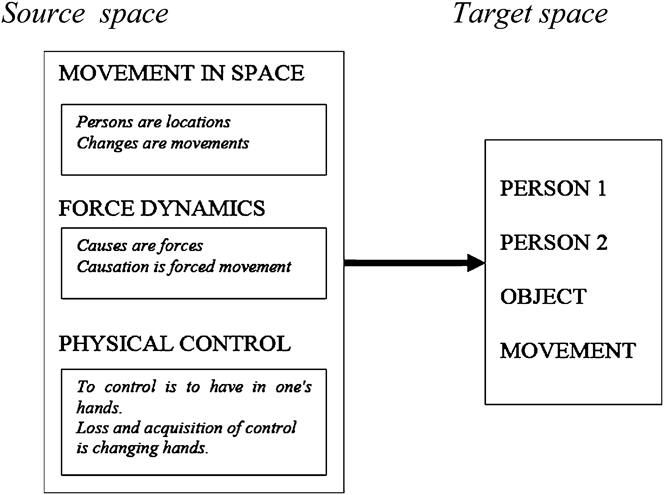
In our case, the first mental space, the so-called ‘source space’, consists of six primary metaphors belonging to three distinct conceptual domains. From this space, material is extracted to configure the conceptual structure of the second space, the so-called ‘target space’. Before this occurs, the target space contains only what Fauconnier and Turner (2002, p. 370) call a ‘diffuse scene’, the concrete conceptual structure of which remains to be constructed. In such a diffuse scene we have the two persons, an object, a series of actions, the displacement of the object, etc. However, we still lack the more detailed semantic specifications to tell us, for example, what aspects of the concept of PERSON are relevant to the conceptualization of the act of transfer (the conceptualization of the person as position, as circumscribed space, etc.), or to determine what type of movement is responsible for the dislocation of the object. These specifications are accomplished via the projection upon the target space of conceptual material proceeding from the source space. Nevertheless, it is also necessary to bear in mind that this scene, although diffuse in the sense we have just described, is perceived as one unit, as a complex but unitary activity, and not as a variety of isolated actors and acts. This fact is of great importance, for it implies a need for the primary metaphors, once projected into the target space, to be submitted to a process of mutual integration. In Figure 1, we schematically present the source and target spaces.
Source space and target space in the construction of the concept of OBJECT TRANSFER.

Going from the projection of the conceptual material of the source space to the conceptualization of the target space is a complex process, which occurs via the execution of a series of cognitive operations. The final outcome is the creation of a new space, ‘the blend’.
The first step in this process is the projection of the material from the source space to the target space. The most notable aspect of this projection is that it always occurs in a selective fashion. That is, it does not affect all those aspects which constitute the primary metaphors, but only those of relevance to the conceptualization of the target space. As an example, let us examine the effects of selective projection in the case of the metaphor Causes are forces. This metaphor incorporates different concrete types of causation.
(7) a. Event X causes event Y. (The explosion made the jet fly.)
b. Event X made person B do Y. (The explosion made me fall to the floor.)
c. Person A causes event Y. (The excursionist provoked the forest fire.)
d. Person A makes object B change. (The children made the flowerpot fall.)
e. Person A causes person B to do Y. (Pedro made the children run.)
(…)
Of these different types of causation, only the one described in (7c) is relevant to a situation of object transfer; therefore, it is the only one projected upon the target space. Similar restrictions would be noticeable in the projection of other primary metaphors. In general, we may say that the target space has a limiting effect on the source space, in that it restricts its potentiality for projection to those aspects that are compatible with the specificities of those particular processes of object transfer. Thus, the target space plays a predominant role in the determination of the conceptual material that will wind up forming a part of the blend.
The subsequent stages in the conceptualization of the target space occur in the blend. The primary metaphors, already purged of the elements that are incompatible with a situation of object transfer, are projected upon the blend. After the projection, the true process of metaphoric integration begins, a process that occurs through the execution of four distinct (but related) cognitive operations: (i) composition; (ii) particularization; (iii) completion; and (iv) elaboration. Although each of these operations does generate a specific outcome, it is important to stress that they share an overall goal: the construction in the blend of a new and autonomous conceptual structure, in the sense discussed in Section 1. Let us examine the contribution of each of these operations.
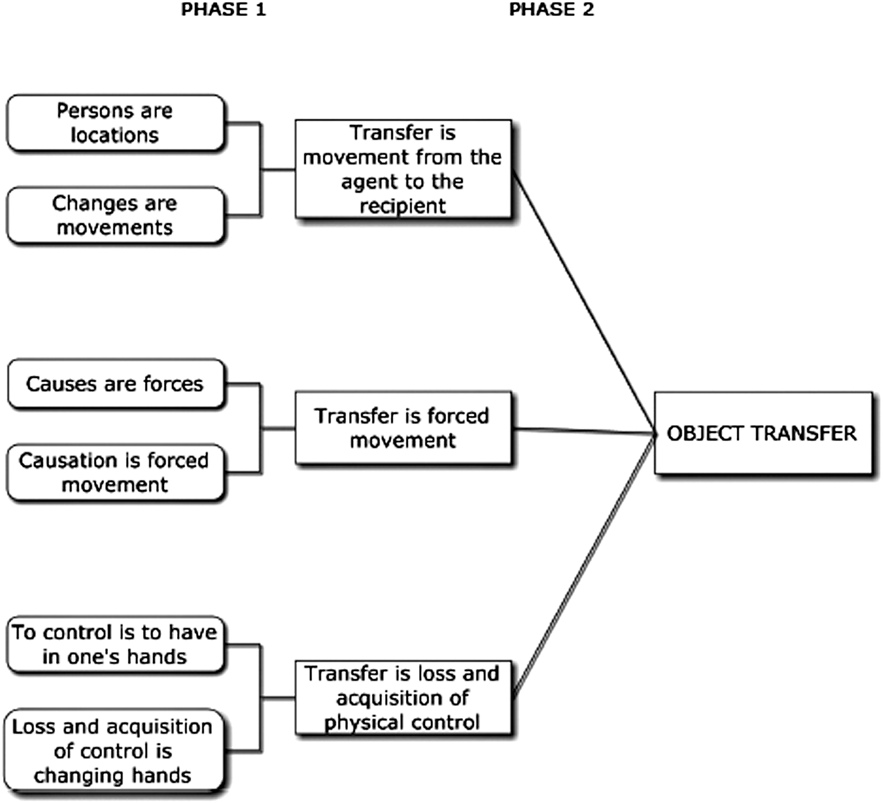
In the first place, metaphoric integration presupposes an ‘operation of composition’ that has the effect of creation of relationships among elements which were previously unrelated, in both the source space and the target space (cf. Fauconnier, Reference Fauconnier1997, p. 150; Fauconier & Turner, Reference Fauconnier and Turner2002, pp. 42−43). In our concrete case, the composition occurs in consecutive phases, which we illustrate in Figure 2.
Metaphoric composition in the construction of the concept of OBJECT TRANSFER.
In the first phase, a composition of pairs of primary metaphors is produced. This results in the creation of the complex metaphors TRANSFER IS MOVEMENT FROM THE AGENT TO THE RECIPIENT, TRANSFER IS FORCED MOVEMENT, and TRANSFER IS LOSS AND ACQUISITION OF PHYSICAL CONTROL. Here, the following observation deserves special attention: while the primary metaphors represent general conceptual structures, the process of composition to which they are submitted, and the complex metaphors that result, are specific aspects of the construction of the concept of OBJECT TRANSFER. This assumes that the primary metaphors in question only form a part of the blend (and consequently of the concept of OBJECT TRANSFER) after the execution of the process of composition, i.e., as constitutive elements of the complex metaphor of which they are now a part.
Metaphoric composition is always accompanied by an ‘operation of particularization’. The concrete effect generated by this operation in each case was fully described in Sections 2.1, 2.2, and 2.3, so here we shall only make a brief analysis of its overall characteristics.
The process of particularization that accompanies and conditions metaphoric composition consists essentially of reciprocal elaboration of schematic elements (of low semantic determination) contained in the structure of the metaphors involved. According to the definition given in Cognitive Grammar (Langacker, Reference Langacker1987, pp. 66−71, 2008, pp. 17−18, 55−56), in order for structures A and B to meet in a relationship of specification, it is necessary (i) for A and B to share the same semantic aspect S, and (ii) for A and B to differ with regard to the degree of specificity with which each represents S, in such a way that S in A is represented schematically, while in B its representation manifests conceptual completeness. The specific relationship between A and B thus implies that B conceptually concretizes A in relation to S.
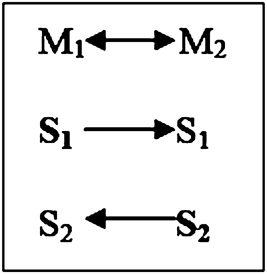
One particularity of metaphoric composition lies in the fact that the relation of specification is reciprocal. This reciprocity assumes that a metaphor M1 specifies a second metaphor M2 in relation to semantic aspect S1, but that at the same time it receives semantic specifications from M2 with regard to another semantic aspect, S2. For example, let us examine the composition of the metaphors Changes are movements and Persons are locations (from which results the complex metaphor TRANSFER IS MOVEMENT FROM AGENT TO RECEPTOR). The metaphor Changes are movements includes, as part of its conceptual structure, a reference to the starting point and end point between which the movement takes place. This reference is absolutely schematic, of low semantic determination. Its elaboration depends on the conceptual contribution of the metaphor Persons are locations, which specifies that the starting point and end point are constituted by persons and their respective circumscribed spaces. For its part, in the metaphor Persons are locations, the type of relationship existing between the persons in question is not specified. Therefore, within the conceptual structure of this metaphor this relationship constitutes an aspect of low conceptual determination; and it is elaborated via the conceptual contribution of the metaphor Changes are movements, which specifies that persons are locations related among themselves by the movement of an object, the starting point of which is one of them, and the end point, the other. This reciprocity of the process of specification may be represented as in Figure 3, following the conventions established by Cognitive Grammar.
Reciprocity of the process of specification in metaphoric composition.
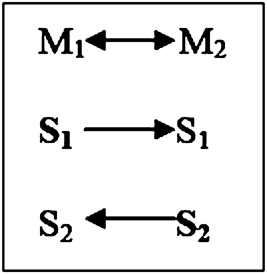
In Figure 3, the arrows indicate the direction of conceptual dependency. Among metaphors in general, the conceptual dependency is reciprocal: each needs to receive a certain specification from the other, in order for metaphoric composition to occur. If, in contrast, we focus on the concrete conceptual aspects (S1, S2), the conceptual dependency is unidirectional: both metaphors have the same conceptual element, but they represent it to different degrees of semantic determination. The metaphor that has the greater degree of determination specifies the other with regard to this aspect.
Likewise, second phase composition, between complex metaphors, occurs through reciprocal elaboration of elements of low semantic determination. Let us examine the case of composition between the metaphors TRANSFER IS MOVEMENT FROM THE AGENT TO THE RECIPIENT and TRANSFER IS FORCED MOVEMENT. The former does not specify what type of movement is involved. This aspect is concretized by the second, which establishes that we are faced with a forced movement. Nonetheless, the direction of movement is an aspect of low conceptual determination in the metaphor TRANSFER IS FORCED MOVEMENT; it needs to be elaborated by the metaphor TRANSFER IS MOVEMENT FROM THE AGENT TO THE RECIPIENT, which indicates that the forced movement starts with the agent and finishes when it reaches the recipient.
The construction of the basic conceptual structure of the concept of OBJECT TRANSFER is the final result of the operation of composition. This basic conceptual structure, formed by a network of metaphors, is processed, in the blend, by two additional cognitive operations: completion and elaboration. The operation of ‘completion’ gives rise to the insertion of the basic structure of the concept of OBJECT TRANSFER into more complex conceptual structures (Fauconnier, Reference Fauconnier1997, pp. 150−151; Fauconnier & Turner, Reference Fauconnier and Turner2002, pp. 43−44). With this, the concept of OBJECT TRANSFER becomes a part of more extensive frames, such as the frame of giving a present to someone on certain occasions (birthdays, weddings, etc.), which occur within a specific socio-cultural situation. It is to be assumed that with the insertion, the concept will be situated within real situations of use. Once this has been accomplished, the blend will make available a consolidated conceptual structure that can begin to be used dynamically in the perception and conceptualization of concrete situations. Fauconnier and Turner call this ‘dynamization of the blend’ ‘operation of elaboration’ (Fauconnier, Reference Fauconnier1997, pp. 151−152; Fauconnier & Turner, Reference Fauconnier and Turner2002, p. 44).
The final result of the operations conducted in the blend is the creation of an autonomous conceptual structure with emergent characteristics. Its emergent nature resides in the fact that the conceptual structure generated in the blend is not entirely present either in the source space or in the target space, nor can it be analyzed as a simple addition of conceptual material proceeding from these two spaces. In the first place, this structure is the output of a complex cognitive process carried out through a set of interlinked operations which select, integrate, modify, and complement the conceptual material from the original spaces. Once created, the conceptual structure of the blend can attain cognitive autonomy. This depends particularly on one factor: frequency of use. Blending theory concerns itself both with innovative blends (on-line blends), which, as such, have a low degree of cognitive fixation, and with routine, conventional blends (entrenched blends), which are characterized by a high degree of fixation (Fauconnier, Reference Fauconnier1997, p. 9; Fauconnier & Turner, Reference Fauconnier and Turner1998, p. 161). Formally, these are not differentiated from one another (“entrenched projections are on-line projections that are becoming entrenched” (Fauconnier & Turner, Reference Fauconnier and Turner1998, p. 161), save in one aspect: blends with a high degree of fixation have become opaque (Fauconnier, Reference Fauconnier1997, p. 9). This opaqueness may refer to two phenomena. On the one hand, the high degree of fixation of the blend, derived from a high frequency of use, permits us to use its content directly, with no need to (re)construct it on the basis of the contents of other spaces. Over time, the blend turns into an autonomous conceptual unit, becoming independent of the source structure and the target structure from which it originated (Fauconnier, Reference Fauconnier1997, pp. 21−25). On the other hand, when it reaches this point, the blend is available to cognition, to serve as a source space for new processes of conceptual integration. This is what happens with the concept OBJECT TRANSFER, as we shall see in greater detail in the next section.
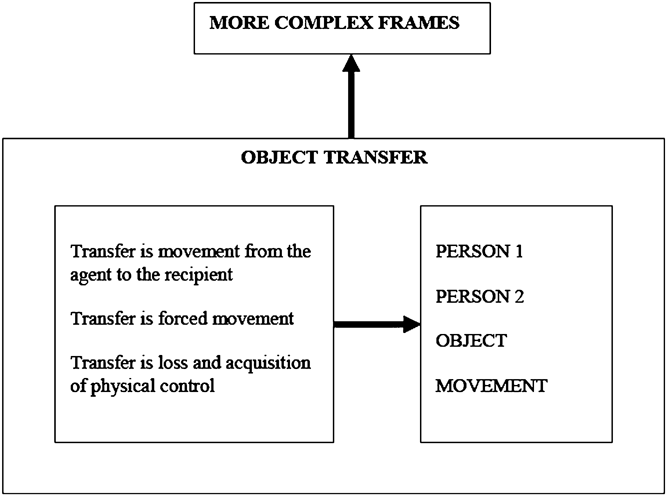
Figure 4 illustrates the conceptual structure created in the ‘blend’. Figure 4 shows that the notion of OBJECT TRANSFER consists of an internal conceptual structure which is quite complex, and which brings together and integrates a set of metaphors and concepts belonging to different conceptual domains. This structure, complex in itself, is integrated in turn into still larger conceptual units (frames of various types). Based on the data discussed, this complex conceptual network can be considered the prototypical semantic pole of ditransitive constructions.
The conceptual structure of OBJECT TRANSFER.
Finally, it is important to note that this conceptual complexity is the result of extensive cognitive processing, carried out through the mechanism of blending with the set of specific operations of which it is comprised (selective projection, composition, complementation, and elaboration). Also deserving of special attention is the fact that the blending mechanism operates on conceptual metaphors, i.e., on structures already created by another central cognitive mechanism.
In short, therefore, we may conclude that alongside conceptual complexity, there also exists a cognitive complexity that must be taken into account if we want to adequately understand the nature of the semantic pole of grammatical constructions.
3. The construction of the category ACTION TRANSFER
Our object of concrete analysis in this section is the concept of ACTION TRANSFER expressed through speech, as in (8):
(8) a. Sie gab mir einen Kuss (German)
She gave me a kiss
‘She gave me a kiss’
b. Ela deu um sorriso para o peão (Portuguese)
She gave a smile to the worker
‘She gave a smile to the worker’
c. I gave the ball a kick
d. He was given a warning for bad behavior
e. Et donaré un consell: les roses de Sant Jordi, compra-les el dia abans (Catalan)
I’ll give you some advice: the roses of Saint George, buy it the day advance
‘I’ll give you some advice: buy roses of Saint George a day in advance’
The sentences in (8) express a situation of interaction involving two people and a third entity. Although we do not yet have a comprehensive typological study of the codification of this situation, existing research shows that many languages encode it through utilization of a ditransitive construction identical to that which is used to encode situations of object transfer (cf., for example, Huelva Unternbäumen, 2010b, pp. 127−128; Newman, Reference Newman1996, pp. 201−210; Palancar, Reference Palancar1999). This formal identity is clear evidence that there is a semantic link between the two concepts, OBJECT TRANSFER and ACTION TRANSFER (Palancar, Reference Palancar1999, pp. 68−72). Specifically, in this paper we defend the thesis that we conceptualize the (more abstract) situation of action transfer through our knowledge of the (more concrete) situation of object transfer. Huelva Unternbäumen (2010a, p. 8) argued that this thesis is based on an important observation: the concept of ACTION TRANSFER has elements that are also part of the conceptual structure of OBJECT TRANSFER, while the reverse cannot be verified. This makes plausible the evolution OBJECT TRANSFER > ACTION TRANSFER.
The structure of OBJECT TRANSFER alone is, however, insufficient to give rise to the concept of ACTION TRANSFER. For this to emerge in a process of ‘blending’, it is necessary to supply a second source space, namely the primary metaphor Actions are Objects. This metaphor is essential to a proper conceptualization of one key aspect of the action transfer situation: the fact that what is transferred is not a specific material object, but rather the result of a physical action (examples (9a), (9b), and (9c)) or of a verbal action (such as (9d) and (9e)) (cf. Huelva Unternbäumen, 2010b, pp. 127−128; Palancar, Reference Palancar1999).
Actions are Objects is a primary metaphor of vast potential for conceptualization (Lakoff & Johnson, Reference Lakoff and Johnson1999, pp. 203−204). Its great importance is clearly manifested, for example, in the conceptualization of the domain of the mind and mental activity. Its use in this domain requires that ideas and thoughts be conceptualized as manipulable objects, which can be acquired, stored, analyzed into their constituent parts, traded, etc. (Lakoff & Johnson, Reference Lakoff and Johnson1999, pp. 240−241, 248−249). Consequently, the mental activity of thinking is conceived of as the manipulation of objects.
The main effect caused by the use of the primary metaphor Actions are Objects is an objectification of the actions.Footnote 2 Once objectified, actions can be cognitively manipulated as if they were objects. And one of the most basic capabilities of this manipulation is, as we have seen, its transfer from one person to another. That is, the effect of this primary metaphor is a condition for the possibility of incorporating actions into the complex structure of the concept of TRANSFER. In this complex structure, the concept of ACTION (metaphorically modified) takes the place of the concept of OBJECT.
It is important to note, however, that the process of objectification of actions is not only metaphorical in nature, but also metonymic. If we look at the examples in (8), we find that what we actually transfer is the result or effect of the action and not the action itself, in its entirety: we transfer the kiss and not the action of kissing, the smile and not the action of smiling, the kick and not the action of kicking the ball, the warning and not the action of giving a warning, the advice and not the action of advising. We see here, therefore, the results of the use of the metonymy result for action, in which the effect of an action represents the action in its entirety (Panther & Thornburg, 2003, pp. 216−224).
Let us now analyze the target space. As in the case of object transfer, we have in it, prototypically, two people who are related by the execution of an action. Another element in common between the two scenes is the directionality of the action performed, its allative character. In both cases, the action is initiated by one person (the agent) and is directed to another (the recipient). Palancar (1999, pp. 70−72) even thinks that the fact that we use the concept of OBJECT TRANSFER to conceptualize other situations that present a similar directionality (even if they do not produce the transfer of a material object, as in the case of action transfer) is mainly due to the directionality inherent in the concept of OBJECT TRANSFER.
Of no less importance, we find another analogy between the situations of object transfer and action transfer: in both cases, the result or effect of the actions executed occurs within the sphere of the recipient. This is obvious in the case of actions of object transfer: the one who receives it is the recipient. It is also quite clear in cases of transfer of physical actions: he who receives the kiss, punch, push, etc. is also the recipient. However, with regard to the transfer of verbal actions, i.e., speech acts, greater subtlety is involved. This type of transfer thus requires special attention.
To understand the conceptual parallels between the situations of object transfer and of verbal action, it is important to note that there is a significant difference between different types of speech act with regard to the possibility of expressing them through ditransitive constructions. Directive speech acts may, in most cases, be expressed by means of a prototypical ditransitive construction with the verb to give at its core:
(9) (Directives)
Give someone notice, give advice to someone, give an order to someone, give someone an admonition, give someone a warning, give instructions to someone, give someone a job, give a suggestion to someone, give someone a recommendation, …
In contrast, speech acts of other types in many cases do not support this construction:
(10) (Assertive)
a. To verify something
*To give someone a verification
b. To affirm something
*To give an affirmation to someone
(11) (Commisive)
a. To promise
*To give someone an oath
(12) (Declarative)
a. To open a session
*To give the opening of a session to someone
b. To detain someone
*To give detention to someone
(13) (Expressive)
a. To lament
*To give someone a lament
b. To protest
*To give someone a protest
Why should there be this difference in behavior? The answer lies in the structure of the illocutionary force of the directive acts. In the first place, the illocutionary force of such speech acts consists of a specific propositional content: the representation of a future action of the hearer. In effect, the speaker advises, suggests, orders, etc., the hearer to do (or not to do) such and such. Furthermore, it is a preparatory condition for directive acts that the hearer be able to perform the future action represented in the propositional content. Third, the degree of strength of the sincerity condition in the illocutionary force of the directive act indicates that the speaker wants the listener to perform this future act (Searle & Vanderveken, Reference Searle and Vanderveken1985, p. 61). Finally, all directive speech acts are characterized by a special kind of accomplishment, situated between two extremes: the speaker, who is trying to persuade the hearer to act in certain ways, may allow rejection (asking, requesting) or exclude this possibility (ordering, commanding) (Searle & Vanderveken, Reference Searle and Vanderveken1985, p. 198). In sum, the result or effect of the implementation of a directive action occurs within the sphere of the hearer (recipient), since it is to him or her that the obligation (or at least the expectation) of a certain action (to do something, to respond, etc.) is transferred. The hearer takes responsibility for compliance (or liability for the consequences of non-compliance) with the proposed action.
This is a feature that differentiates directive acts from other speech acts and, at the same time, establishes a conceptual analogy between the situations of object transfer and those of transfer of action: in both cases, the outcome or impact of the actions occurs within the sphere of the recipient. This conceptual parallel explains the possibility of the use of ditransitive constructions to express directive speech acts.
In short, the situations of object transfer and action transfer share a set of important features: a situation comprising the interaction between two people; the directionality of the action taken; and the effect of the action located within the sphere of the hearer (recipient). These similarities motivate us to use the concept of OBJECT TRANSFER as the main source space (but not the only one, as mentioned above) of the blending process responsible for our concept of ACTION TRANSFER.
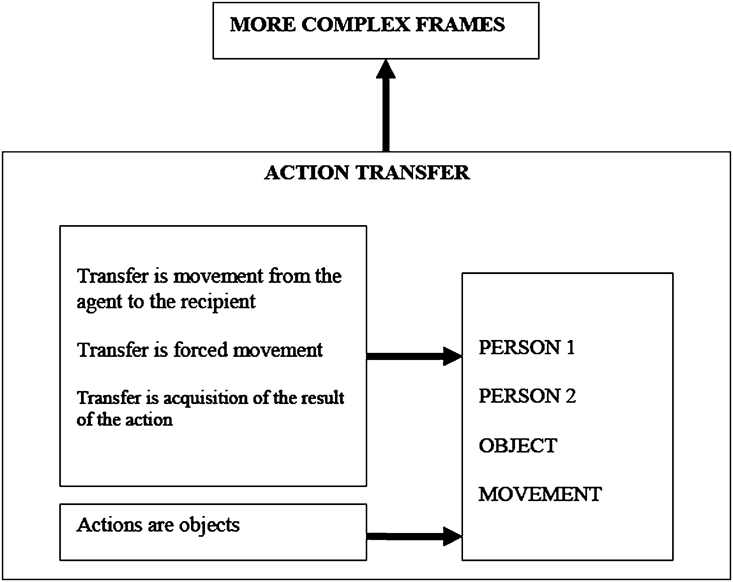
In Figure 5 we represent the source and target spaces involved in this process of blending. As may be seen, the source space consists of two elements: the concept of OBJECT TRANSFER and the primary metaphor Actions are Objects. For its part, the target space is formed by the constituent elements of a situation typical of action transfer.
Source space and target space in the construction of the concept of ACTION TRANSFER.
Of essential importance in the blending process from which the concept of ACTION TRANSFER is derived is the conceptual integration between the constituent elements of the source space. As we saw in Section 2.4, metaphorical integration is a complex process that begins with a composition operation, which has as its main effect the creation of relationships between previously unrelated elements. In the case analyzed here, the composition provokes a substitution: the concept of an object (as a material entity) is replaced by the primary metaphor Actions are Objects. This replacement triggers a process of particularization that affects the whole structure of the concept of OBJECT TRANSFER. Let us examine the concrete effects: (i) the transfer is still a directed movement which begins with the agent and ends with the recipient, but no concrete material object is transferred; (ii) the transfer still involves the implementation of a force, i.e., is configured as forced movement, but the force no longer applies to a concrete material object; (iii) the transfer no longer presupposes the acquisition of physical control over an object, but rather the ‘acquisition’ of the effect of a physical or verbal action on the part of the recipient; and (iv) nor does the transfer presuppose the loss of something. If I give you a kiss or an order, it does not mean I lose the kiss or the order. However, the action of giving someone an order or a kiss does cause the recipient to acquire something I do not have: the effects of my actions manifest themselves only in the sphere of the recipient. In this sense, we have an analogy between OBJECT TRANSFER and ACTION TRANSFER. Both cause the recipient to acquire something I do not possess.
Together, these changes represent a significant extension of our concept of transfer: transfer is no longer tied to concrete material objects, but now also includes objects that are metaphorical, as are the results of actions.
The end result of the operation of composition is the construction of the basic conceptual structure of the concept of ACTION TRANSFER. Once constructed, the operation of completion integrates this basic structure in complex frames. It is important to point out that these frames differ substantially from those we have seen in relation to the concept of OBJECT TRANSFER. Here, the relevant frames are those that correspond to different types of speech acts, especially those of a directive nature (ordering, warning, admonishing, suggesting, etc.), and the communication situations in which they can be produced, as do the frames that conceptualize people’s physical behavior in the context of specific social interactions. Thus, for example, giving somebody a kiss is an appropriate act in some types of social interaction, but inappropriate in others. Inserted in these more complex frames, the concept of ACTION TRANSFER may be dynamized, i.e., may be used to perceive and conceptualize concrete situations (‘the operation of elaboration’).
Figure 6 shows the conceptual structure that emerges in the blend. As may be seen in Figure 6, the concept of ACTION TRANSFER consists of one complex metaphor and one primary metaphor. These metaphors act as conceptual domains that semantically specify the concepts PERSON, OBJECT, and MOVEMENT.
The conceptual structure of the concept of ACTION TRANSFER.
4. Conclusions
Fauconnier and Turner (2002, pp. 182−183) note that one of the great virtues of human language lies in the possibility of taking the conceptual structure encoded by a particular grammatical construction as a starting point for conceptualizing new experiences. In this sense, human language is equipotential: its coding capacity is not confined to already codified situations; rather, the existing conceptual structures should permit the encoding of new situations and experiences. However, for this to be possible, the intervention of a blending process linking new situations and experiences with the already codified conceptual structures is needed. “But the only way it can be equipotential is for the human mind to be able to blend those new situations with what we already know to give us intelligible blends with attached grammatical patterns so those existing grammatical patterns can express the new situations” (Fauconnier & Turner, Reference Fauconnier and Turner2002, p. 182). In this paper we have attempted to show how language expresses this equipotentiality in the particular case of codification of situations of object transfer and action transfer.
We believe that our analysis can complement earlier studies of ditransitive constructions, especially those that employ the key concept of ‘semantic extension’ in their theoretical underpinning. This concept is used by Goldberg in her seminal work on ditransitive constructions in English (1995, 2006, pp. 26−37); subsequently, it was implicitly or explicitly adopted by other authors, such as Delbecque and Lamiroy (Reference Delbecque, Lamiroy, Van Belle and Van Langendonck1996) and Newman (Reference Newman2005). These authors propose that the semantic pole of ditransitive constructions consists of a semantic network (or radial set) which includes a prototypical literal meaning, generally called MATERIAL TRANSFER or OBJECT TRANSFER, and a set of additional meanings (VERBAL TRANSFER, ACTION TRANSFER, etc.), which are related to the prototypical meaning via semantic extensions. More recently, several papers have detailed this general idea of a semantic network. For authors such as Geeraerts (Reference Geeraerts, Van Langendonck and Van Belle1998) or Colleman (Reference Colleman2009), the semantic extension generally does not act upon the construction as a whole, but rather individually, on its constitutive elements. Thus each element is associated with a particular dimension of variation. Let us examine an example from Geeraerts (1998, pp. 193−194).
(14) I give (as a present) you my kingdom
According to Geeraerts, we have here a case of variation along the material entity dimension. The transferred entity is not a material object, but rather control or possession of something (kingdom). If we take as our starting point the prototypical case, we will therefore have a semantic extension of the type, MATERIAL OBJECT > CONTROL/POSSESSION.
The problem that affects these more detailed papers, as well as those more directly inspired by the seminal work of Goldberg, is that none of them provides a uniform and well-grounded explanation of the key concept of semantic extension. Goldberg (Reference Goldberg1992, Reference Goldberg1995) limits herself to affirming that conceptual extension results from a quite heterogeneous set of mechanisms (negation, pragmatic conditions of satisfaction, metaphor, etc.). She does not analyze the processes they cause or their concrete effects. That is to say, they do not explain what the conceptual linkage existing among the different semantic values attributed to the ditransitive construction is, nor do they demonstrate that a determined cognitive mechanism can really be responsible for constructing these links.
In this paper, we have attempted to fill this gap, analyzing the conceptual linkage among the different senses of the ditransitive construction. In our model, the semantic pole of this construction is formed by a metaphorical network consisting of a set of complex metaphors. Each metaphor corresponds to one sense of the construction. Likewise, underlying the basic sense of OBJECT TRANSFER there is a complex metaphor. That is to say, there does not exist a ‘literal’ sense of transfer, on the one hand, and a set of metaphorical extensions of this sense, on the other, as Goldberg’s (Reference Goldberg1992, Reference Goldberg1995) model would have it. The difference is to be found on another plane: the basic sense comprises primary metaphors, while the other senses consist of non-primary metaphors.
Our model has one single mechanism of integration, the blending mechanism. This mechanism is responsible for both internal conceptual integration (among the different metaphors that express the different senses of the construction) and external conceptual integration (among the different meanings that jointly constitute the overall semantic pole of the ditransitive construction). It is therefore necessary to have recourse to a heterogeneous set of integration mechanisms to justify and explain the conceptual links that create and maintain the complex semantic pole of the ditransitive construction.
The semantic pole of ditransitive constructions is a multidomain matrix consisting of a network of conceptual metaphors, integrated via the mechanism of blending. Thus, behind the conceptual complexity, there exists a cognitive complexity that creates and sustains it.