Introduction
Neuropsychiatric symptoms are present in more than 80% of people with dementia (Lyketsos et al., Reference Lyketsos, Lopez, Jones, Fitzpatrick, Breitner and DeKosky2002). They are associated with more hospitalizations (Wancata et al., Reference Wancata, Windhaber, Krautgartner and Alexandrowicz2003), nursing home placement (Steele et al., Reference Steele, Rovner, Chase and Folstein1990), caregiver burden (Coen et al., Reference Coen, Swanwick, O'Boyle and Coakley1997), and economic cost (O'Brien et al., Reference O'Brien, Shomphe and Caro2000). Among many neuropsychiatric symptoms in dementia, wandering and fecal smearing (scatolia) are both troublesome behaviors and seem to be closely related with insomnia. Moreover, both are among the least understood bahaviors (Algase, Reference Algase1999; Nagaratnam et al., Reference Nagaratnam, Lim and Hutyn2001).
Wandering is relatively common among people with dementia (Algase, Reference Algase1999; Burns et al., Reference Burns, Jacoby and Levy1990), and it is one of the most intriguing, hazardous, and least understood behaviors (Algase, Reference Algase1999). Wandering is poorly tolerated by carers (Rabins et al., Reference Rabins, Mace and Lucas1982) and is a prominent cause of hospital admission among dementia sufferers (Begg and McDonald, Reference Begg and McDonald1989). Over the years, the term “wandering” has been used to describe a multitude of behaviors exhibited by individuals with cognitive impairment. According to Hope and Fairburn (Reference Hope and Fairburn1990), the term “wandering” covers different types of behaviors, namely, aimless walking, night walking, pottering, and trailing. Only two features among various definitions of wandering seem to be common to all: those of an individual moving through space and of being cognitively impaired (Algase and Struble, Reference Algase, Struble and Buckwalter1992). Further, many authors do not regard purposeful movement as wandering (Algase, Reference Algase1999; Lai and Arthur, Reference Lai and Arthur2003). Therefore, for this study, wandering is defined as aimless movement without a discernible purpose (Kiely et al., Reference Kiely, Morris and Algase2000).
Scatolia can be defined as the presence of feces on the hands or any part of the body and/or furniture or walls (Begg and McDonald, Reference Begg and McDonald1989), and it is a severe burden for caregivers. Recently, the behavioral and psychological symptoms of dementia (BPSD), as well as cognitive deficits, have received much attention but little research has been conducted to clarify the characteristics of behavioral symptoms like scatolia in people with dementia (Nagaratnam et al., Reference Nagaratnam, Lim and Hutyn2001). Scatolia is among the least understood behaviors (Nagaratnam et al., Reference Nagaratnam, Lim and Hutyn2001). In this study, we conducted a survey in Japan of the clinical characteristics of those people with dementia who show wandering or scatolia behaviors.
Methods
Field survey – patient selection
Representative facilities from each of the six major types of institutions dealing with elderly people with dementia in Okayama Prefectures, Japan, were asked to participate in the study. In total, two psychiatric facilities, one hospital for the elderly with dementia, one nursing home, three geriatric health service facilities (GHSF), one group home, and two adult day-care centers agreed to take part. The survey was performed in June 1999. The patients with dementia were evaluated once. All persons in these facilities with a diagnosis of dementia over a month, except for the bedridden, were included in this study. None of the patients included had psychotic illnesses pre-existing their dementia.
Field survey – evaluation of behavioral symptoms
Behavioral symptoms such as wandering and scatolia were evaluated using a four-point multi-response scale ranging from “none” to “frequent” for the previous month. The frequencies were: none, less than once a month; rare, once a month to once a week; sometimes, several times a week; and frequent, almost every day. The evaluated items were wandering and scatolia.
Field survey – questionnaires
The profiles of elderly patients with dementia and the respondents to the questionnaires were investigated. The questionnaire items included the age, sex, living environment, and diagnosis of the patient with dementia, and the age, sex, and occupation of the respondents. The scores on the Nishimura Mental State scale (NM scale), Nishimura activities of daily living scale (N-ADL scale), and a quality of life questionnaire for dementia (QOL-D) were evaluated (Nishimura et al., Reference Nishimura1993; Terada et al., Reference Terada2002). The frequency of insomnia was also investigated.
The patients with Alzheimer's disease (AD) met the American Psychiatric Association's revised DSM-IV criteria for primary degenerative dementia of Alzheimer type (American Psychiatric Association, 1994) as well as the NINCDS-ADRDA criteria for probable and possible Alzheimer's disease without cerebrovascular events (McKhann et al., Reference McKhann, Drachman, Folstein, Katzman, Price and Stadlan1984). The patients with vascular dementia (VaD) met the NINDS-AIREN criteria for probable vascular dementia (Román et al., Reference Román1993). Mixed dementia cases consisted mostly of possible AD with cerebrovascular events.
Cognitive impairment in dementia patients was assessed using the NM scale, which is a popular bedside screening measure of the cognitive components of mental status in Japan. The ADL measurements were evaluated using the N-ADL scale, which is one of the most utilized scales for the evaluation of ADL in Japan (Nishimura et al., Reference Nishimura1993). In both scales, the maximum score is 50, and the lowest possible score is zero. The NM scores are: normal, 48–50; borderline, 43–47; mild dementia, 31–42; moderate dementia, 17–30; severe dementia, 0–16. In the N-ADL scale, five items are evaluated: walking/sitting, range of activities, dressing/bathing, eating, and excretion. Each item is given 0 to 10 points, and the total is regarded as the N-ADL scale score. The reliability of both scales when completed by nurses or nursing staffs has been reported to be good (Nishimura et al., Reference Nishimura1993).
The QOL-D consists of 31 items grouped into six response sets, each with its own scale. Each item is rated using a four-point multi-response scale ranging from “none” (1 point) to “frequent” (4 points). The six domains are: (1) positive affect, (2) ability to communicate, (3) negative affect and actions, (4) spontaneity and activity, (5) restlessness, and (6) attachment to others. In four domains of the QOL-D (positive affect, ability to communicate, spontaneity and activity, and attachment to others), a high score means a higher QOL, whereas in two domains of the QOL-D (negative affect and actions and restlessness), a high score means a lower QOL. The reliability of QOL-D when completed by nursing staff or family members has been reported to be good to excellent, and the validity is, to some extent, established (Terada et al., Reference Terada2002; Reference Terada2005).
The frequency of insomnia in dementia patients was also evaluated using a four-point multi-response scale in the same way as the frequency of wandering and scatolia.
Field survey – respondents
Questionnaires were completed for all subjects by members of the nursing staff or family members who were well acquainted with the patients being rated. The nursing staff completed the questionnaire if the subject was an inpatient, and the family member completed it if the subject was an outpatient. All raters had daily contact over more than a month with the individuals being studied. No attempt was made to select raters.
Statistical analyses
Statistical analyses were performed using SPSS (Statistical Package for Social Science) software v.14.0J. Comparison between two groups was performed using the Mann-Whitney U test. Comparison among three or more groups was performed using the Kruskal-Wallis H test. To identify which variables were significantly correlated with wandering or smearing feces, we used ordinal regression analysis. Wandering and smearing feces were treated as dependent variables. Covariates were age, NM scores, N-ADL scores, six subscores of QOL-D and insomnia. Factors were gender, diagnosis and living situation. A p level <0.05 was considered significant.
Results
Sample description
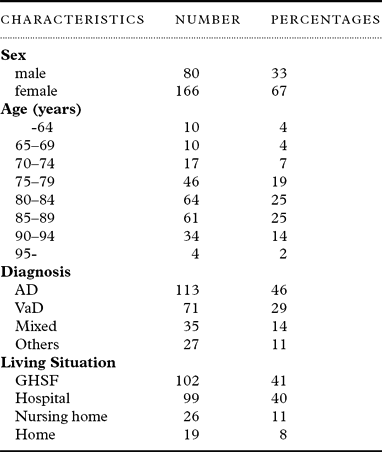
A total of 300 questionnaires were distributed, and 246 individuals with dementia were rated (collection rate 82%). The average age of those rated was 81.6 years (SD = 8.0). Of the subjects, 67% were female. The demographic and clinical characteristics of the subjects are shown in Table 1. The proportion of patients with Alzheimer's disease was 46%, with vascular dementia 29%, with mixed dementia 14%, and with other forms of dementia 11%. Living situations were mostly GHSF (41%) and hospital (40%).
Demographic characteristics of patients (N = 246)

AD = Alzheimer's disease; VaD = Vascular dementia.
Mixed = mixed dementia.
GHSF = geriatric health services facility.
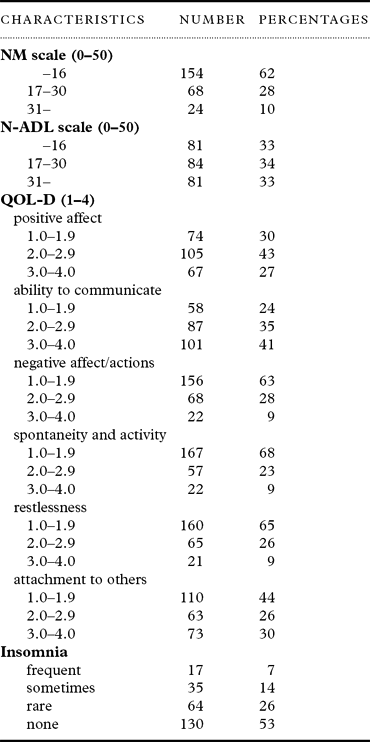
Evaluation using the NM scale as a parameter of the severity of dementia showed most patients as having moderate to severe dementia (mean ± SD: 14.6 ± 10.8) (Table 2). Evaluation using the N-ADL scale showed an even distribution of mild to severe impairment (mean ± SD: 23.3 ± 13.2). The distribution of scores in six domains of QOL-D is shown in Table 2. The frequencies of insomnia in all cases were: frequent, 7%; sometimes, 14%; rare, 26%; none, 53%.
Scale scores and insomnia of patients (N = 246)

NM scale = Nishimura mental state scale.
N-ADL scale = Nishimura activities of daily living scale.
QOL-D = quality of life questionnaire for dementia.
The mean age of the staff and family members who replied to the questionnaire was 36.5 ± 12.0 years. The majority of raters were female (80%), and their occupations were registered nurse (48.0%), nursing assistant (41.1%), and other (10.9%).
Wandering or scatolia – frequency
The frequencies of wandering in all cases were: frequent, 23%; sometimes, 12%; rare, 14%; none, 51% (Table 3). There was no meaningful difference between male and female subjects (Mann-Whitney: U = 6403.5, Z = −0.490, p = 0.624). There were no meaningful differences among the various diseases (Kruskal-Wallis: C2 = 2.578, F = 3, p = 0.461), and living situation (Kruskal-Wallis: C2 = 4.080, F = 3, p = 0.253).
Frequency of wandering and scatolia (N = 246)

AD = Alzheimer disease; VaD = vascular dementia; Mixed = mixed dementia; GHSF = geriatric health services facility.
Frequencies of scatolia in all cases were: frequent, 2%; sometimes, 8%; rare, 15%; none, 75% (Table 3). Males tend to show scatolia more frequently than females (Mann-Whitney: U = 5901.5, Z = −1.870, P = 0.061). There were no meaningful differences among the various diseases (Kruskal-Wallis: C2 = 3.893, F = 3, p = 0.243), and living situation (Kruskal-Wallis: C2 = 2.282, F = 3, p = 0.516).
Wandering – relationship with age, insomnia, NM scale, N-ADL scale and QOL-D
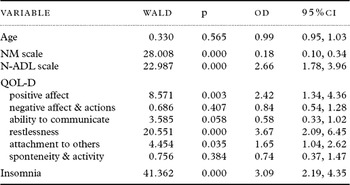
Table 4 displays the results of the ordinal regression analysis for wandering. Six variables were significantly associated with wandering: lower NM scale scores (OR = 0.18), higher N-ADL scale scores (OR = 2.66), insomnia (OR = 3.09), and higher scores of restlessness (OR = 3.67), positive affect (OR = 2.42), and attachment to others (OR = 1.65) in QOL-D. Using a Nagelkerke R2 estimate (as ordinal regression does not contain a direct R2 equivalent), this model explained a significant 53.4% of the variance in wandering (χ2 = 433.456, p <0.001).
Summary of regression analysis of wandering (N = 246)

NM scale = Nishimura mental state scale.
N-ADL scale = Nishimura activities of daily living scale.
QOL-D = quality of life questionnaire for dementia.
Wandering prevalence rates (percentage of “frequent” and “sometimes” groups) by level of cognitive impairment on the NM scale were 16.6% (4/24) for mild, 28.0% (19/68) for moderate, and 40.9% (63/154) for severe dementia. Wandering prevalence rates by level of insomnia were 21.5% (28/130) for patients without insomnia, 39.1% (25/64) for patients with rare insomnia, 57.1% (20/35) for patients with occasional insomnia, and 76.5% (13/17) for patients with frequent insomnia.
Scatolia – relationship with age, insomnia, NM scale, N-ADL scale, and QOL-D
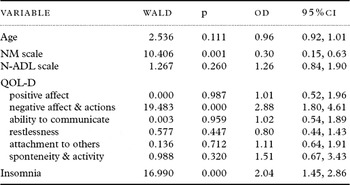
Table 5 displays the results of the ordinal regression analysis for scatolia. Three variables were significantly associated with wandering: lower NM scale scores (OR = 0.30), insomnia (OR = 2.04), and higher scores of negative affect & actions (OR = 3.67) in QOL-D. Using a Nagelkerke R2 estimate, this model explained a significant 32.0% of the variance in scatolia (χ2 = 306.516, p <0.001).
Summary of regression analysis of smearing feces (N = 246)

NM scale = Nishimura mental state scale.
N-ADL scale = Nishimura activities of daily living scale.
QOL-D = quality of life questionnaire for dementia.
Prevalence rates of scatolia (percentage of “frequent” and “sometimes” groups) by level of cognitive impairment on the NM scale were 4.2% (1/24) for mild, 4.4% (3/68) for moderate, and 12.3% (19/154) for severe dementia. Prevalence rates of scatolia by level of insomnia were 5.4% (7/130) for patients without insomnia, 6.3% (4/64) for patients with rare insomnia, 17.1% (6/35) for patients with occasional insomnia, and 35.1% (6/17) for patients with frequent insomnia.
Discussion
Wandering – frequency, disease difference, sex difference, cognitive function, ADL, and other clinical features
In nursing homes in the U.S.A., wanderers constituted 11% of over 8,000 residents (Kiely et al., Reference Kiely, Morris and Algase2000) or 23% of over 6,000 residents (Riter and Fries, Reference Riter and Fries1992). In a review article, Algase argued that wanderers constituted 31% (unweighted mean) of the population in institutionalized samples encompassing over 7,000 residents, most of whom had dementia (Algase, Reference Algase1999). Aimless walking in patients with dementia was found in 21% in the U.K. (Hope et al., Reference Hope, Keene, Gedling, Cooper, Fairburn and Jacoby1997) and 16% in Japan (Karasawa et al., Reference Karasawa, Kashara and Kato1988). Among patients with AD, the frequencies of wanderers were reported to be 19% in the U.K. (Burns et al., Reference Burns, Jacoby and Levy1990) and 34% in Taiwan (Hwang et al., Reference Hwang, Yang, Tsai and Liu1997). In our study, if we regard the “frequent” and “sometimes” groups as wanderers, the positive rate was 35% (frequent, 23% and sometimes, 12%).
Data from a sample of 1312 patients revealed that wanderers constituted 26% of AD patients and 18% of those with vascular dementia (Cooper and Mungas, Reference Cooper and Mungas1993). For both diagnoses, rates were low (12% and 9%) in the early stages and higher (37% and 28%) as each disease progressed to the later stages. In this study, there were no statistically significant differences among the different dementia types in the frequencies of wandering. We suppose that not a few patients with VaD, as well as patients with AD, suffer from wandering in geropsychiatric wards and care units in Japan. In previous reports, wanderers and non-wanderers did not differ by gender or age (Algase, Reference Algase1999). In this study also, we did not find any significant sex and age differences in the frequency of wandering.
Wanderers’ scores on global measures of cognitive performance have been reported to be significantly lower than scores of non-wanderers (Algase, Reference Algase1992; Reference Algase1999; Burns et al., Reference Burns, Jacoby and Levy1990; Logsdon et al., Reference Logsdon, Teri, McCurry, Gibbons, Kukull and Larson1998). Studies reveal increasing proportions of wanderers among subjects at each level of dementia ranging from 0 to 18% (mean = 8.0%) among mild dementia, 3–26% (mean = 13.6%) among moderate dementia, and 0–67% (mean = 29.5%) among severe dementia (Ballard et al., Reference Ballard, Mohan, Bannister, Handy and Patel1991; Cooper and Mungus, Reference Cooper and Mungas1993; Reisberg et al., Reference Reisberg, Auer, Monteiro, Boksay and Sclan1996; Algase, Reference Algase1999). In this study, wandering prevalence rates by level of cognitive impairment were 16.6% for mild, 28.0% for moderate, and 40.9% for severe dementia. Moreover, ordinal regression analysis revealed that cognitive impairment was significantly associated with wandering. Our data are consistent with previous findings and suggest that the close relationship between wandering and severe cognitive dysfunction is transcultural.
Preserved ADL was reported to be a positive predictor for some kinds of wandering (Song et al., Reference Song, Lim and Hong2008). Ability to wander was important resident characteristics associated with development of wandering (Kiely et al., Reference Kiely, Morris and Algase2000). Our results are consistent with previous findings, and suggest that relatively preserved ADL was closely associated with wandering behavior.
QOL has recently been recognized as the central purpose of health care. However, a relationship between wandering and QOL has not been reported. In this study, we found a close relationship of wandering to restlessness, positive affect and attachment to others. From a psychosocial perspective, wandering behavior is conceptualized as the expression of needs (Algase, Reference Algase1999; Lai and Arthur, Reference Lai and Arthur2003), and supposed to be a means of alleviating loneliness and separation (Rader et al., Reference Rader, Doan and Schwab1985). As patients become increasingly confused about their environment, they seek something or someone that is familiar (Rader et al., Reference Rader, Doan and Schwab1985; Lai and Arthur, Reference Lai and Arthur2003). Wandering is, therefore, seen as a natural outcome of this searching process for a place of safety and familiarity. A psychological state seeking to alleviate loneliness and separation might be associated with high scores of restlessness, positive affect and attachment to others in QOL-D.
Circadian rhythm disturbances, particularly sleep disturbances, have also been investigated as a basis for wandering (Algase, Reference Algase1999; Klein et al., Reference Klein1999; Yang et al., Reference Yang, Hwang, Tsai and Liu1999). In our study, insomnia had an intimate relationship with wandering.
Scatolia – frequency, disease difference, sex difference, cognitive function, ADL, and other clinical features
Compared to wandering behavior, scatolia has not received much attention, and there is little published information on this behavior in adults. Of 94 patients with Alzheimer's disease in one study, only one patient showed scatolia (Nagaratnam et al., Reference Nagaratnam, Lim and Hutyn2001). In our study, the prevalence rate of scatolia was 10%. Our data are based not on a community-wide sample but consist mainly of inpatients on geropsychiatric wards or care units. Therefore, the prevalence of scatolia was more frequent than previously reported.
Constipation is said to be the major cause of scatolia in dementia, and this ceased when the constipation was relieved (Begg and McDonald, Reference Begg and McDonald1989). We did not investigate the frequency of constipation, so we cannot discuss the validity of the theory, but we did observe that severe cognitive dysfunction and negative affect and actions were intimately related to the occurrence of scatolia. Mason argued that when a patient was angry, hostile and belligerent, the smearing of feces might be an act of passive retribution (Mason, Reference Mason1996). Negative affect in patients with dementia might contribute to scatolia. From clinical observation, scatolia often occurs when people with dementia are trying to clean themselves up after an accident, and the feces get everywhere. This is not inconsistent with constipation.
It is reported that the frequency of smearing feces was higher at night than during the day (Begg and McDonald, Reference Begg and McDonald1989). In our report, insomnia was intimately related to scatolia, suggesting that disturbance of circadian rhythm might contribute to the occurrence of scatolia. Fewer staff on duty to supervise at night, however, might affect the relationship between scatolia and insomnia.
Limitations of this study
The main methodological problem in this study is the sample selection. Our data are based not on a community-wide sample but mainly of inpatients on geropsychiatric wards or in care units. This might elevate the percentage of problematic behaviors in this study. Secondly, in many cases, the cause of dementia was diagnosed on the basis of clinical symptoms, simple psychometric tests, and computed tomography without SPECT or PET. Therefore, the accuracy of the clinical diagnoses may be somewhat limited. Thirdly, the reliability of the NM scale and N-ADL scale when completed by family members was unknown. Moreover, recall bias for a previous month was no doubt high. These factors might affect the results.
Conflict of interest
None.
Description of authors’ roles
Toshie Ata was involved in data analysis and wrote the paper. Seishi Terada designed the study, analyzed the data and wrote the paper with Toshie Ata. Osamu Yokota, Yoshikatsu Fujisawa and Ken Sasaki collected data. Takeshi Ishihara helped with data analysis. Shigetoshi Kuroda supervised the study design, participated in data analysis and assisted with writing the paper.
Acknowledgments
This work was supported by grants from the Japanese Ministry of Education, Culture, Sports, Science and Technology, and the Zikei Institute of Psychiatry.