Introduction
A common response by the governments of industrialised countries to the challenges of population ageing has been to introduce policies that aim to mobilise all available labour, thereby to build the tax base and to increase productive capacity. Such ‘labour supply’ responses have included measures to raise the employment rate of people in the customary working ages, and others to extend working lives beyond the conventional retirement age (Organisation for Economic Co-operation and Development (OECD) Reference Arulampalam, Booth and Taylor2006: 9). A sizable group that is important to any labour supply response are ‘mid-life’ women; that is, women who in the main have completed intensive child-rearing. In the United Kingdom and other OECD countries, this group comprises a large share of unemployed people of working age and so is the target of policies to raise employment rates. For example, in Australia in 2006, women aged 40–64 years accounted for over 40 per cent of the population aged 25–64 years that was not involved in paid work, while by contrast men aged 40–64 years accounted for only 25.1 per cent of the non-employed ‘pool’ (Australian Bureau of Statistics 2006).Footnote 1
To date, however, the employment experiences and choices of mid-life women have been poorly represented in the research and policy literatures on appropriate responses to population ageing. As Hanks (Reference Hanks2004: 190) commented, ‘we know only relatively little about the work and retirement patterns of mothers in their later years’. Currie and Madrian (Reference Currie, Madrian, Ashenfelter and Card1999:3353) made a similar observation when they noted that ‘a glaring limitation of the existing literature is the intense focus on elderly white men, to the virtual exclusion of most other groups’. One reason for the scant evidence about the employment experiences of mid-life women is the lack of the necessary data. Many important surveys of employment experiences either do not include mid-life women, or they are so poorly represented that small cell sizes quickly become a problem in analyses.Footnote 2 Incredibly, a major United States survey of older workers did not actually survey women but instead asked husbands to describe their wives' work patterns.Footnote 3
Moreover, when mid-life women have been included in studies of the labour supply, most often they have not been the focus of the inquiry. In some instances, the age group has been identified in a more general study of women's labour-market experiences (seeBirch Reference Birch2005 for an overview of the extensive literature); in other instances, mid-life women have been included in a general study of older worker's employment (e.g. Berger and Messer Pelkowski Reference Berger and Messer Pelkowski2004; Cai and Kalb Reference Cai and Kalb2004, Reference Cai and Kalb2006; Campolieti Reference Campolieti2001; Chan and Huff Stevens Reference Chan and Huff Stevens2001; Clark, York and Anker Reference Clark, York and Anker1999; Peracchi and Welch Reference Peracchi and Welch1994). Only a few empirical studies have made mid-life women and their particular circumstances the focus of modelling and analysis. Cross-sectional studies specifically of the group include Evans and Kelley (Reference Evans and Kelley2002), Hill (Reference Hill2002) and the NEXT study of the early exit or retirement of European nurses, which included a specific component on ageing in the nursing profession (Hasselhorn et al. Reference Hasselhorn, Müller and Tackenberg2005). Longitudinal findings are more relevant to the current paper but have been limited to those from Pavalko and Artis's (Reference Pavalko and Artis1997) study of the employment transitions of United States women in late mid-life, Henz's (Reference Henz2004) examination of the effects of informal care obligations on labour-force participation; Hanks's (Reference Hanks2004) study of the links between German women's reproductive histories and their late-life labour-market behaviour; and Spiess and Schneider's (Reference Spiess and Schneider2003) study of the effects of care roles on hours of paid work among mid-life women.
This paper aims to provide four types of information on the employment experiences of mid-life women. First, we present new data on the determinants of women's mid-life transitions into and out of paid employment. By making use of longitudinal data from the Household, Income and Labour Dynamics in Australia survey (HILDA), we overcome some of the data limitations that have affected previous studies.Footnote 4 Second, we provide separate information on the determinants of women's mid-life transitions into and out of employment, thereby greatly improving on most evidence from cross-sectional studies, which typically are incapable of differentiating the two transitions. Third, the paper presents detailed information on the effect of changes in health status during mid-life on women's ability to stay in paid work, and on the impact on their employment chances of their (often large) care roles. Many empirical studies have touched on the consequences of motherhood's unpaid care roles with women's employment and earnings (e.g. Baxter Reference Baxter2005; Joshi Reference Joshi1990),Footnote 5 but only a few studies have focused on the relationships for mid-life women (seeEvandrou and Glaser Reference Evandrou and Glaser2003). Similarly, many studies have explored the effects of deteriorating health on the labour-market participation of older men, but the comparable effects among mid-life women are poorly documented and understood. The paper also examines the role of job characteristics – such as full-time or part-time work and access to sick, recreational and other leave benefits – in determining women's ability to remain employed through mid-life. Finally, an analysis of the effect of the employment transitions of mid-life women's partners on their own employment trajectories is reported. The organisation of the remainder of the paper is straightforward. The next section describes the HILDA data and the analyses, after which the results are presented and their policy and other implications discussed.
Data and methods
This paper draws on data from the first five waves of the HILDA survey. The survey began in 2001 with a probability-based sample of Australian households: 15,127 individuals aged 15 or more years from 7,682 households were interviewed at Wave 1.Footnote 6 Among them were 2,051 women aged 40–64 years, the age range that we classify as mid-life. The survey was repeated annually, so Wave 5 was in 2005. HILDA provides comprehensive information on the respondents' economic-activity attributes, such as their status (employed, unemployed, marginally attached to the labour force, unattached to the labour force), working hours, permanency of employment contracts, occupation, and occupational history. These variables are also available for the respondent's partner, if any. Socio-demographic and family characteristics are also comprehensively measured, with for example data on the age of the respondent and each of her children, and the respondent's educational attainment, marital status and proficiency in the English language.
Information on the health of the individual is derived from the responses to a self-completion questionnaire. One question asked: ‘In general, would you say your health is excellent, very good, good, fair, poor or very poor?’ The responses give a Short Form 36 score of current health and wellbeing (Ware, Snow and Kosinski Reference Ware, Snow and Kosinski2000). Another question asked whether a health condition had developed in the last year, or if the respondent's health was worse than a year ago.Footnote 7 Care roles, other than those associated with child care, were determined by the responses to a question on how much time the respondent spent caring for a disabled spouse, a disabled adult relative, or elderly parents or parents-in-law. Collected as hours-of-care per week, the measure can be used to indicate changing care responsibilities.Footnote 8 The analysis focuses on two transitions over 12 months, from paid employment to non-employment, and from non-employment to paid employment.Footnote 9 These transitions were measured by comparing the respondent's labour-force status (employed or not employed) at Wave t with her status at Wave t-1. Including no change, up to four separate employment transitions for each respondent were possible.Footnote 10
Standard economic approaches to understanding the determinants of employment transitions were adopted. For example, we assumed that, all other things held constant, paid employment is more likely to occur for (and be sustained by) individuals who have greater labour-market opportunities by virtue of their education, occupational experience, language skills, location and physical capabilities. It was also assumed that paid employment is less likely to occur for (or be sustained by) those individuals for whom the opportunity costs of engaging in paid work are relatively high, as with care obligations. Job attributes and labour-market conditions were also assumed to affect employment opportunities and outcomes. Positive job characteristics, such as job security, are likely to increase the attractiveness of paid work. Business cycle changes generally affect the ability of individuals to gain or retain employment.
This approach guided our selection of independent variables in the models. We calibrated probit regression models of the impact of the measured characteristics of a mid-life woman at Wave t on the probability of an employment transition by Wave t+1.Footnote 11 The longitudinal data enabled analysis of the influences on an employment transition during not only the interval t to t+1 but also during the preceding year, t-1 to t, as for example a change in health status during the 12 months prior to Wave t. This helped address the important problem of endogeneity, or of alternative possible causal relationships between key variables, that commonly affect cross-sectional analyses (seeEvandrou and Glaser Reference Evandrou and Glaser2003: 586). Some findings are vulnerable to attrition bias, as from selective refusals or deaths. We had to exclude mid-life women who were not interviewed at succeeding waves, which resulted in an unbalanced analysis sample so it was not appropriate to apply the population weights calibrated for the entire HILDA sample (Melbourne Institute of Applied Economic and Social Research 2008). The concern about selective attrition was mitigated, however, by the relatively low rates for mid-life women (7.6, 6.8, 6.0 and 4.4 per cent for Waves 2, 3, 4 and 5, respectively). For comparison, the attrition rates from the entire HILDA sample at the same waves were 13.2, 9.6, 8.4 and 6.0 per cent.Footnote 12
An important first step in the modelling was to ensure that the estimates were not affected by selection bias. This study exemplifies the problem well. The analysis sample for the transition from paid employment in mid-life comprised only the women who were employed in at least one of four years between 2001 and 2004, but these women were likely to have characteristics that distinguished them from other mid-life women. For example, as they were employed, they were likely to be relatively well educated and to have had fewer children than other women. It would be wrong to infer that their responses to a change in health would be the same as those of other women (if they had been employed). To correct for this problem we used a method pioneered by Heckman (Reference Heckman2000) that is now widely used.Footnote 13 It is implemented using a two-stage procedure suggested by Orme (Reference Orme1997), and involves analysis of the probability that a woman with particular characteristics is represented in the sample prior to analysis of the employment transitions. The initial probit model was calibrated and from this a generalised residual estimated and included as a term in the employment transition regressions, effectively correcting for sample bias.
The results
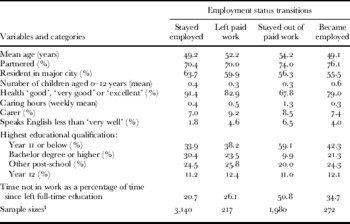
Table 1 profiles the analysis sample. Of the 2,573 mid-life women in the study, 60.9 per cent were employed at their first occurrence in any wave (so including entrants to the HILDA survey at Waves 2–4). Those engaged in paid work and not in paid work at each wave were then counted. This provided 3,357 person-year observations of women in paid employment during the study period. Of these observations of women in paid work, there were 217 cases where a woman had made a out of paid employment 12 months earlier, 6.5 per cent of the total employed sample. There were 2,252 person-year observations of women not in paid work in our sample, and of these observations there were 272 cases where a woman had made a transition into paid work to a not-employed state in the preceding 12 months, 12.1 per cent of the total. The descriptive statistics shown in Table 1 provide a summary overview of the associations between a woman's age, health, care roles, education and labour-market experiences and the most likely employment transitions (including none). For example, 82.9 per cent of the women who left paid work in the study period assessed their health as ‘good’, ‘very good’ or ‘excellent’, but 91.4 per cent of the women who remained in paid work had this health status.Footnote 14 Among the women who left paid work, 9.2 per cent reported spending time caring for a disabled or elderly relative, whilst among those who stayed in paid work, 7.0 per cent spent time on these roles. These results raise the question of whether the apparent relationship between health and employment persists once age and other factors are controlled, which is now addressed.
Characteristics of the analysis sample by employment transitions from 2001 to 2005: Australian women aged 40–64 years

Notes: Partnered women are women who are legally married or in a de facto relationship. Year 12 is the highest school-based level of educational attainment. 1. The unit of analysis is ‘women at survey waves’, or person-years over five years, and the data are from the five annual waves, 2001–2005.
Data source: HILDA survey (for details see text and Acknowledgements).
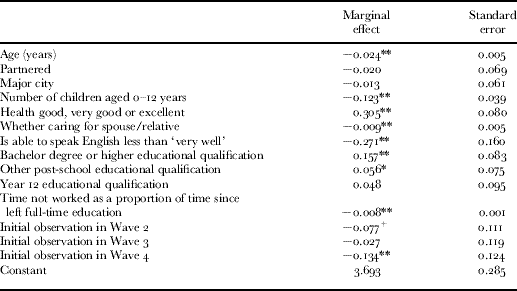
We first report the regressions of the probability of a mid-life woman being employed in the year that she was first observed in the HILDA data using the independent variables displayed in Table 1. These analyses were primarily to help control for selection bias and to address the possibility of endogeneity in the measure of health status.Footnote 15 They are reported in Table 2, however, because they provide useful evidence about the influential factors. The importance of health and care roles in determining these chances is clear: women with ‘good, very good or excellent’ health were 30.7 percentage points more likely to be in paid employment than women with ‘fair, poor or very poor’ health. These results are consistent with the report from Cai and Kalb's (Reference Cai and Kalb2006) detailed study of the effects on labour-force participation that the probability of labour-force participation for a 50–60-year-old Australian woman was 25.3 per cent less if she had ‘poor’ as opposed to ‘excellent’ health. The results are consistent with Hasselhorn, Müller and Tackenberg's (Reference Hasselhorn, Müller and Tackenberg2005) emphasis of the importance of the ‘healthy worker effect’ in determining the pattern of employment transitions by older nurses.
Estimated marginal effects on initial employment probability: Australian women aged 40–64 years, 2001–05
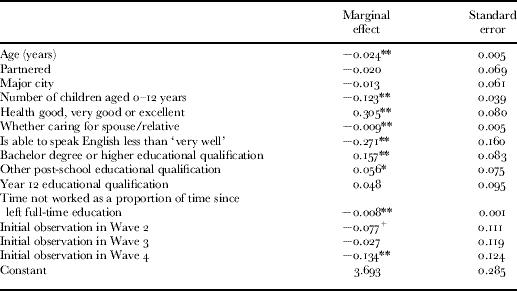
Notes: The default or reference categories are: Wave 1; not partnered; living in a non-metropolitan area; health very poor, poor or fair; zero care hours; speaks English ‘very well’; educational qualification is Year 11 or below. Marginal effects measure the extent to which changes in the value of each explanatory variable affected the probability that a woman was employed at the first wave at which she is observed. Marginal effects are calculated at the sample means. Sample size: 2,573. Likelihood ratio chi-squared statistic (14 degrees of freedom)=1,003**.
Data source: HILDA survey (for details see text and Acknowledgements).
Significance levels: +p<0.1, * p<0.05, ** p<0.01.
Each additional hour per week engaged in caring for a dependant reduced the probability of employment by 0.9 percentage points. If this relationship is linear, 30 additional hours of this type of care would reduce the employment probability by 27 percentage points. Several other studies have produced similar results: McLanahan and Monson (Reference McLanahan and Monson1990) found that care-giving lowered married women's chances of being employed, and Wakabayashi and Donato (Reference Wakabayashi and Donato2005) found that the paid work hours of women aged 46 or more years were substantially lower (by approximately 10 hours per week) when they had a caring role. Evandrou and Glaser (Reference Evandrou and Glaser2003) reported British survey evidence that approximately one-third of mid-life women reduced their engagement in paid work (either through leaving paid work or by working fewer hours) as a result of taking on caring responsibilities. It is important to note, however, that other studies have reported converse findings, e.g. Wolf and Soldo (Reference Wolf and Soldo1994) reported that the provision of care to elderly parents did not affect the paid working hours of married daughters.
Some further important determinants of the employment chances of mid-life women are also apparent from the figures in Table 2. As women age, the likelihood that they will be employed falls – on average by 2.4 percentage points each year. Poor proficiency in English strongly reduces the employment likelihood. Women with an ability to speak English ‘less than very well’ had a 27.1 percentage points lower chance of being employed than their English-proficient counterparts. Education also played a crucial role in determining whether women were employed in mid-life. Degree holders in the HILDA sample were 15.7 percentage points more likely to be employed than those who did not complete high school. Finally, prior experience in the labour market was an important predictor of mid-life employment. The results shown here indicate that with each percentage point increase in the time not in paid work since the completion of full-time education, the probability of being employed during mid-life decreased by 0.8 percentage points. Assuming a linear trend, a reduction in the proportion of time not in paid work from 32.5 per cent (the sample mean) to 16 per cent reduced the employment probability by 12.8 percentage points.
These results raise important questions about the direction of causation in the relationships, as between health and employment. It is likely that poor health reduces employment chances, but it is also possible that women's employment status affects their health status. Tables 3 and 4 present results from the regression models of the employment transitions, which help address the uncertainty about the causal direction. They show, for example, the effect of a measured change in health status since the previous wave on the probability of an employment transition during the following 12 months. The regression models used in this part of the study also take into account the characteristics of the samples of employed and non-employed mid-life women, and thus provide unbiased estimates of the effects of changing health, care roles and various other factors on the likelihood of an employment transition. Separate models were run for all women and for partnered women. Several other factors, including those relating to changes in the spouse's employment, influence a partnered woman's employment incentives and opportunities.
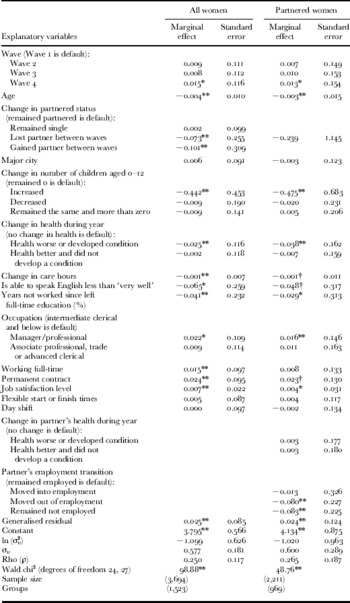
Estimated marginal effects on the probability of retaining employment: Australian women aged 40–64 years, 2001–05

Notes: ln (συ2) is the log variance or the panel-level variance component. συ is the standard deviation. Rho (ρ) is the proportion of the total variance contributed by the panel-level variance component; that is, ρ=συ2/(συ2+1).
Data source: HILDA survey (for details see text and Acknowledgements).
Significance levels: † p<0.1, * p<0.05, ** p<0.01.
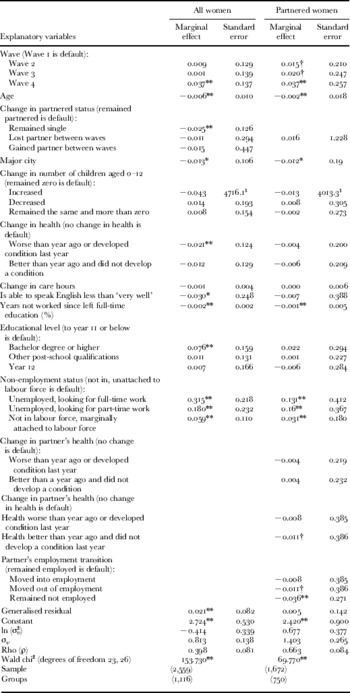
Estimated marginal effects on the probability of gaining employment: Australian women aged 40–64 years, 2001–05

Notes: 1. The exceptionally high standard errors on this variable (denoting increase in number of children aged 0–12) is due to the very small number of cases in the relevant population sub-groups. The variable is highly insignificant and is only included in this model in order achieve consistency with the model on the probability of retaining employment (Table 3). Ln (συ2) is the log variance or the panel-level variance component. συ is the standard deviation. Rho (ρ) is the proportion of the total variance contributed by the panel-level variance component, that is, ρ=συ2/(συ2+1).
Data source: HILDA survey (for details see text and Acknowledgements).
Significance levels: † p<0.1, * p<0.05, ** p<0.01.
A decline in health is shown to have detrimental effects on a mid-life woman's chances of retaining employment, and on her ability to return to paid work during mid-life (Table 3). Women who developed a health condition were 2.5 percentage points less likely to remain in paid employment during the following year than other women: holding all other variables constant at the means, the probability of retaining employment fell from 93.5 to 91.0 per cent. In the sample of partnered women this effect was larger, indicating that having a partner made it a little easier to leave paid work after becoming ill. Among all women, a decline in health was also associated with a 2.1 percentage point reduction in the chances of becoming employed in mid-life, though these effects were smaller and not significant for partnered women (Table 4). These findings are consistent with Cai and Kalb's (Reference Cai and Kalb2006) observation that women with poor health had substantially lower chances of employment than those with excellent health. The effects of changes in health status were not symmetrical; that is, whilst deteriorating health harmed women's employment chances in mid-life, health improvements did not significantly influence these chances.
Increasing care obligations created similar effects on women's employment chances. Among all women, when the hours in a week spent caring for a sick spouse or elderly parent increased by 30, the probability of retaining employment in the same year fell by approximately three percentage points (Table 3). This effect was similar among partnered women (seeHenz Reference Henz2004 for an international review of comparable results, and Taskforce on Care Costs 2005 for Australian evidence). These results are in accord with those of Pavaloko and Artis (Reference Pavalko and Artis1997) and Evandrou and Glaser (Reference Evandrou and Glaser2003), but it should be noted that the measured relationship between change in care hours and change in employment may also indicate that women who leave employment in mid-life are more likely to extend their care hours. Table 4 presents the findings on the long-term impacts of care roles, and show that a reduction in care hours did not have an observable impact on women's chances of returning to work in mid-life, which is in line with findings from Pavaloko and Artis (Reference Pavalko and Artis1997), Spiess and Schneider (Reference Spiess and Schneider2003) and Evandrou and Glaser (Reference Evandrou and Glaser2003). Importantly, this implies that women who have previously had high care responsibilities do not find that their chances of returning to paid work rise when these obligations fall.
The results presented in Tables 3 and 4 also show that mid-life women have substantial care obligations associated with their own children, and that these roles have a strong effect on their employment chances in mid-life. Having a child reduced the probability of remaining in paid employment by around 44 percentage points (47.5 percentage points for partnered women), but as children grow older, mid-life mothers do not promptly return to work. Non-employed women with a reduced number of children aged less than 12 years of age were no more or less likely to move into paid employment than other women. It appears, therefore, that whilst becoming a mother tips many women out of paid work, later in mid-life a reduction in the maternal care role has little effect on the probability of returning to paid work.
The importance of women's family context to her employment opportunities and choices is also reflected in other results reported in Tables 3 and 4. First, the data show the important way in which the employment actions of many mid-life women are affected by their partner's employment. Among partnered women, the likelihood of remaining in a job was eight percentage points lower for women whose partner left employment (or had not worked) than for women whose partner remained employed across the 12 months. Women with partners who either left employment or remained out of work for the entire year were also less likely (by approximately 1.1 and 3.6 percentage points, respectively) to gain employment than women with partners who remained in paid employment. This result is consistent with those from the studies that have found that couples co-ordinate retirement decisions (cf. Blau Reference Blau1998). The results also indicate that changes to women's partner status impact on their employment chances. Losing a partner reduced the chances that a woman would be in paid work over the next 12 months by 7.3 percentage points, and, interestingly, gaining a partner also reduced these chances – by 10.1 percentage points. One possible explanation is that many women's employment decisions are influenced by their partner's employment and income. It follows that a change in a woman's partner status may require a re-evaluation of her involvement in paid work.
The measured effects of changes in women's care roles and health on their employment transitions are of a comparable magnitude to the effects of other, more commonly recognised determinants of employment in mid-life. For example, the results in column 2 of Table 3 show that, with each additional year of age above 40 years, the chance that a woman will leave paid work increased by 0.4 percentage points (the effect was 0.3 percentage points for partnered women). As Table 3 shows, an additional year of age reduced the probability that a woman would re-enter paid employment by 0.6 percentage points (the effect for partnered women was 0.2 percentage points). These results are both intuitively persuasive and consistent with the findings of several studies on women's labour-force participation rates and retirement patterns as they age (seeWarren Reference Warren2006 for an overview).
Job characteristics also play a role in determining the likelihood that mid-life women will remain employed. In Australia, workers employed under what are known as permanent – as opposed to casual – employment contracts have statutory rights to sick leave and recreational leave benefits. The standard recreational-leave benefit for full-time workers on a permanent contract is four weeks with pay per annum. Sick-leave benefits vary between contracts but most Australian workers can take up to five single days paid sick-leave each year without presenting a medical certificate to their employer. Sick-leave is often used by parents to enable them to care for a sick child (see Australian Bureau of Statistics 1996). Column 2 of Table 3 shows that women with access to these benefits were 2.4 percentage points less likely to leave paid employment than women employed on casual contracts – where paid sick and recreational leave is typically not available. The measured effect was virtually the same in the sample of partnered women – at 2.3 percentage points.
Flexible working hours, i.e. the ability to vary start and finish times, are often cited as enabling women to fulfil their paid and unpaid roles (seeLewis Reference Lewis1997), but our analysis of the HILDA data did not find the attribute to be a statistically significant influence on the probability that a mid-life woman remained in employment; nor was working days as opposed to at night a significant determinant. This finding is consistent with Scharlach, Sobel and Roberts's (Reference Scharlach, Sobel and Roberts1991) findings that the personal circumstances of care-givers are more important determinants of continued employment than their work arrangements. Job satisfaction, which is likely to reflect the convenience of the person's working times, was however significant. As shown in Table 3 (column 2), when a mid-life woman's ranking of her job satisfaction increased by one (on the scale from ‘0’ to ‘10’), the probability that she would remain in paid work increased by 0.7 percentage points.
Education, language proficiency and labour-market experience could all be expected to play a role in determining the likelihood of employment transitions mid-life. Standard models of employment and earnings all emphasise these factors in the composition of human capital (Becker Reference Becker1964), and the results in Tables 3 and 4 accord. In brief, they show that women in managerial and professional posts (most likely requiring high educational qualifications) were more likely to remain engaged in paid work than women in intermediate or elementary clerical and other roles (most often requiring lesser qualifications). Women with a first degree or higher qualification were also more likely to return to work in mid-life than women who did not complete high school. An important implication of these results is that, as successive generations of women with higher educational qualifications move into mid-life, this age-gender group's employment rates are likely to rise. Women who could not speak English very well were less likely to remain in paid work in mid-life than others, and they were also less likely to return to paid work (although this effect was slight and not statistically significant for partnered women). Time spent out of paid work diminished the likelihood of remaining in paid work and reduced the probability of returning to work. Furthermore, women who identified themselves as marginally attached to the labour force were more likely than those who saw themselves as unattached to re-enter paid work. Not surprisingly, women who were actively looking for paid work were the most likely to return to paid work.
To complete this commentary on the findings displayed in Tables 3 and 4, it can be noted that the general availability of economic opportunities influence employment probabilities. The years 2001–2005 were characterised in Australia by strong economic and employment growth. The influence of this on the likelihood of mid-life women remaining in or re-entering paid work is apparent in the marginal effects of the ‘wave’ variables. Women employed in 2004 (Wave 4), when economic conditions were most favourable, were more likely to remain in paid work than their counterparts in 2001 (Wave 1). Likewise, women who were not engaged in paid work in 2004 (Wave 4) were more likely to move into paid employment than their non-employed counterparts in 2001. Although economic opportunities vary among Australia's metropolitan and rural areas, the employment transitions of mid-life women living in cities (where job prospects are typically better) were little different from their counterparts in rural areas.Footnote 16
Discussion
This article has investigated the factors that influence the labour supply of mid-life women in Australia. Many of the reported patterns are not surprising: for example, that age and education strongly influenced employment retention and re-entry, and that poor health and/or substantial care roles had a negative impact on employment chances. The analysis provided new information, however, on the effects of changing health and care roles on the likelihood of mid-life women being in employment. For example, we have shown that women with ‘excellent, very good or good’ health were approximately 30 percentage points more likely to be employed than those with ‘poor’ health, and that if a woman experienced a worsening of health in mid-life, her chance of remaining in paid work over 12 months fell by approximately three percentage points. Women who reported that they spent time caring for an elderly parent or disabled family member had a substantially lower chance of being in paid work than other women. When care hours increased in mid-life, the probability of retaining paid work also fell, by about 0.1 percentage points for each additional hour of care each week. Women who had a dependent child in mid-life experienced a substantial reduction – approximately 44 percentage points – in their chances of retaining employment. These findings contribute new information on the immediate economic costs that women face when their health deteriorates and when they undertake caring roles for disabled and elderly people.
A more surprising result is the asymmetry of these health and care effects. Although both deteriorating health and/or larger care roles reduced the likelihood that a woman remained in paid work, improvements in health and/or reductions in care roles did not increase the chances of returning to paid work. This is an important result because it points to substantial long-term employment and earnings consequences for mid-life women if they experience poor health and/or undertake large care roles. The asymmetry has important implications for the design of programmes that target employment rates. For one, they suggest that interventions to address the effects of poor health are likely to be most effective when directed towards women when they first encounter health problems, and that programmes should address both the health problems and the organisational and institutional barriers to remaining in paid work. The findings also indicate the need for programmes that reduce the work–life conflict associated with caring, and that support women's chances of re-entering paid work when their caring roles reduce.
A related finding is that the provision of sick and recreational-leave benefits had significant positive effects on employment retention. Women with access to these benefits were 2.4 percentage points less likely to leave paid employment over 12 months than women employed under alternative arrangements. Job satisfaction ratings were also an important predictor of the likelihood that a mid-life woman remained in paid employment. Both results indicate that a woman's ability to remain in paid work – especially when she has a substantial care role – is affected by her entitlement to have her family needs considered in her employment relationship. As additional waves of HILDA data become available (and the sample of mid-life women increases), it should be possible to ascertain if these effects are important when interacting with women's changing care roles and/or changing health circumstances. Ideally, as more data become available it will also be possible to obtain more precise measures of the effects of a range of leave provisions on women's chances of remaining employed in mid-life.
Policy makers and employers with an interest in maximising the labour supply have a strong incentive to respond to this paper's findings. Population ageing provides an excellent reason for addressing the employment and other factors that could contribute to a woman remaining in paid work following a negative health event or more demanding care role. Similarly, there is now a compelling business and economic case for addressing the reasons why many women find it difficult to return to work when their care roles ease and/or their health improves. To develop a policy response to population ageing that is sensitive to the needs and circumstances of mid-life women requires a willingness to consider the positive role of mandated sick and recreational-leave benefits. Although this will challenge the ethos of some neo-liberal policy regimes, such responses can address some of the economic dilemmas associated with demographic ageing.
Acknowledgements
The data for this paper were drawn from the Household, Income and Labour Dynamics in Australia (HILDA) Survey, which was initiated and funded by the Australian Government Department of Families, Community Services, Housing and Indigenous Affairs (FaCHSIA), and is managed by the Melbourne Institute of Applied Economic and Social Research (MIAESR). The findings and views reported in this paper are those of the authors and should not be attributed to FaCHSIA or MIAESR.