Introduction
Suicide is a major cause of premature mortality worldwide and its prevention is a clinical and policy priority. Individuals with bipolar disorder (BD) are thought to be at particularly high risk and it has been suggested that between 12% and 19% of people diagnosed with BD die by suicide (Guze & Robins, Reference Guze and Robins1970; Goodwin & Jamison, Reference Goodwin and Jamison1990; Harris & Barraclough, Reference Harris and Barraclough1997). However, data from more recent studies have cast some doubt on the validity of these figures. Estimates of suicide incidence have tended to be lower (Tondo et al. Reference Tondo, Isacsson and Baldessarini2003; Rihmer, Reference Rihmer2005), possibly as a consequence of changes in diagnostic criteria over time, the inclusion of bipolar subtypes and less focus on in-patient populations. In a study of absolute risk of suicide after hospital contact for mental disorder, Nordentoft et al. (Reference Nordentoft, Mortensen and Pedersen2011) followed up individuals over 36 years and found that the highest risk was among men with BD: 8% died by suicide during the follow-up period. For women with BD the risk was 5% and was the second highest risk group behind only schizophrenia. These figures are similar to those presented by Angst et al. (Reference Angst, Stassen, Clayton and Angst2002), who found that 8% of people with BD died by suicide over a follow-up period of more than 40 years. In a review of studies of suicide by individuals with a current major depressive episode, Rihmer (Reference Rihmer2005) reported that 44% may have had a diagnosis of bipolar II disorder (BD II). In two prospective studies, Tondo et al. (Reference Tondo, Isacsson and Baldessarini2003, Reference Tondo, Lepri and Baldessarini2007) found that the rate of suicide in BD was 0.25%/year and 0.4%/year respectively. The lack of consensus is likely to be a consequence of the different methodologies used in these studies. Accurately estimating the rate of suicide in BD is further complicated by the continuing opacity of the prevalence of BD itself, with estimates ranging from 0.5% to 2.4% in studies of the general population (Mitchell et al. Reference Mitchell, Slade and Andrews2004; Merikangas et al. Reference Merikangas, Akiskal, Angst, Greenberg, Hirschfeld, Petukhova and Kessler2007, Reference Merikangas, Jin, He, Kessler, Lee, Sampson, Viana, Andrade, Hu, Karam, Ladea, Medina-Mora, Ono, Posada-Villa, Sagar, Wells and Zarkov2011; Lee et al. Reference Lee, Ng and Tsang2009), and could be as high as 3–4% for BD II (Merikangas & Lamers, Reference Merikangas and Lamers2012). Perhaps unsurprisingly, given this context, few studies have examined temporal trends in BD suicides.
Several studies have sought to identify which bipolar patients are most at risk of suicide but results have proved limited and contradictory. Marangell et al. (Reference Marangell, Bauer, Dennehy, Wisniewski, Allen, Miklowitz, Oquendo, Frank, Perlis, Martinez, Fagiolini, Otto, Chessick, Zboyan, Miyahara, Sachs and Thase2006) carried out a prospective study of bipolar patients in the USA and found that history of suicide attempt and percentage days depressed in the previous year were related to subsequent suicidal behaviour. Other studies have also identified history of suicide attempt as a risk factor for suicide in BD (Rihmer, Reference Rihmer2007), along with male gender (Hawton et al. Reference Hawton, Sutton, Haw, Sinclair and Harris2005) and expressed hopelessness (Tondo et al. Reference Tondo, Isacsson and Baldessarini2003). However, these characteristics are also common in general population suicides and are therefore unlikely to be related specifically to a diagnosis of BD.
Previous work has been subject to several methodological limitations; studies have typically recruited small samples, included few events, or have been carried out within a single treatment centre or geographical area (Tondo et al. Reference Tondo, Isacsson and Baldessarini2003; Hawton et al. Reference Hawton, Sutton, Haw, Sinclair and Harris2005). Research on incidence and rates of suicide in BD has often been restricted to a specific bipolar subtype or more seriously ill hospitalized patients (Baldessarini & Jamison, Reference Baldessarini and Jamison1999; Fagiolini et al. Reference Fagiolini, Kupfer, Rucci, Scott, Novick and Frank2004). Follow-up periods are often short and might distort the risk of suicide in BD as risk may be increased in the early stages of BD and diagnoses may change over time (for example, bipolar is often misdiagnosed initially as unipolar depression) (Goodwin & Jamison, Reference Goodwin and Jamison1990).
The prevention of suicide, particularly among high-risk groups such as those with mental illness, is an important public health aim in many countries (US Public Health Service, 1999; Department of Health, 2002). Reliable baseline statistics are essential in tracking progress but the comparative lack of good quality international data on suicide in BD makes it difficult to assess the impact of suicide prevention strategies in this group. More reliable estimates of the frequency of suicide in BD and further clarification of the key characteristics associated with suicide in BD would be of use to clinicians, service providers and policy makers.
Aims
The aim of this study was to describe the frequency, trends over time, and characteristics of those with BD who died by suicide in England, using data from a large national database. The specific objectives were to: (1) describe the frequency of suicide in BD in a clinical population; (2) identify any trends over time in the number of bipolar suicide deaths; and (3) describe the demographic, clinical and management characteristics of people with a primary diagnosis of BD who died by suicide, and to compare them to suicides by people with other primary diagnoses.
Method
The National Confidential Inquiry into Suicide and Homicide by People with Mental Illness (NCI)
Our analyses used data from the suicide database of the NCI (Appleby et al. Reference Appleby, Shaw, Kapur, Windfuhr, Ashton, Swinson, While, Lowe, Bickley, Flynn, Hunt, McDonnell, Pearson, Da Cruz, Rodway, Roscoe, Saini, Turnbull, Burns, Hadfield and Stones2006; Hunt et al. Reference Hunt, Kapur, Robinson, Shaw, Flynn, Bailey, Meehan, Bickley, Parsons, Burns, Amos and Appleby2006). Data collection by the NCI involves three stages. In stage 1 the NCI collects basic information on a complete national sample of suicide deaths and deaths that have received an open verdict at coroner's inquest for all individuals aged ⩾10 years, from the Office for National Statistics (ONS) for England and Wales. It is convention in the UK to include open verdicts in official statistics and research studies, as the majority of these are suicide deaths (O‘Donnell & Farmer, Reference O'Donnell and Farmer1995), and excluding cases given open verdicts may result in a 50% underestimate in the incidence of suicide (Linsley et al. Reference Linsley, Schapira and Kelly2001). All open verdicts are included unless there is a clear record that suicide was not considered as a cause of death at inquest. In stage 2 the NCI identifies suicides that were in contact with mental health services in the 12 months prior to death by contacting hospitals and community trusts providing these services in the deceased's district of residence. If records show the deceased was in contact with services, they become an ‘inquiry case’. In stage 3, for all ‘inquiry cases’, the consultant psychiatrist responsible for the care of the patient is identified and sent a copy of the NCI suicide questionnaire to complete. The suicide questionnaire collects information on social/demographic characteristics, clinical history, details of the suicide, details of care and final contact with services, and the respondents' views on prevention.
Data from returned suicide questionnaires are entered onto the NCI suicide database, which includes data on inquiry cases from 1996 onwards. The NCI suicide questionnaire has a response rate of more than 97% (Appleby et al. Reference Appleby, Shaw, Kapur, Windfuhr, Williams, Swinson, Hunt, Flynn, Bickley, Rodway, Roscoe, Turnbull, Saini, Da Cruz, Pearson, While, Lowe, Burns, Hadfield, Stones and Clarke2012) and has been shown to be a reliable data collection tool (Windfuhr et al. Reference Windfuhr, While, Hunt, Turnbull, Lowe, Burns, Swinson, Shaw, Appleby and Kapur2008).
NCI BD sample
Unless stated otherwise, the BD suicide sample used in the analyses includes all cases on the NCI suicide database with a primary diagnosis of BD from England. Primary and secondary diagnoses are collected routinely as part of the NCI suicide questionnaire. Primary diagnosis is considered to be the ‘main’ psychiatric diagnosis and is determined by the responding clinician. Diagnostic categories are concordant with ICD-10 classifications. Therefore, the diagnostic group ‘bipolar disorder’ on the NCI suicide database encompasses the same groups as the ICD-10 BD category (F31) and includes BD I, BD II, and BD not otherwise specified (NOS). Respondents may use a combination of case-note review, consultation with other members of the mental health team and clinical judgement based on their own knowledge of the patient in reporting primary and secondary diagnoses.
Analysis
All statistical analyses were conducted using SPSS 15.0 for Windows (SPSS Inc., USA), apart from trend tests, which were carried out using Stata/IC 11.0 for windows (StataCorp LP, USA).
Trends
Poisson regression was used to carry out trend tests for significant increases or decreases in BD suicides over time. Tests were run for the whole NCI bipolar sample and separately for males, females and age groups (the four age groups were those commonly used in the work of the NCI: ⩽24, 25–44, 45–64 and ⩾65 years). We also formally tested for interaction between bipolar and general population suicide deaths, and between different age groups for the bipolar sample.
Characteristics of suicide in BD
Simple descriptive statistics were used to describe the demographic, treatment and clinical characteristics of the bipolar suicides. Items were compared between BD suicides and other primary diagnosis suicides. Any cases with unknown items were removed from the analysis of that item; therefore, the denominator in each analysis is the number of valid cases for each item. The number of valid responses included for each item are displayed as a percentage of the total number of cases. Where possible, variables were combined to create more comprehensive categories and to reduce the proportion of missing data (e.g. individual antidepressant categories were combined to create a single antidepressant variable). Pearson's χ 2 tests of association were used, for two by two tables the continuity correction is given, odds ratios (ORs) and associated 95% confidence intervals (CIs) are also presented. Because multiple testing was used, a p value of 0.01 was selected to assess statistical significance. Age and gender were regarded as possible explanatory variables rather than confounders and so were not adjusted for in the primary analyses; however, secondary analyses adjusting all ORs for age and gender were carried out.
Results
There were 1489 BD suicides in our sample. This represented just less than 10% of all suicide deaths on the NCI database for the study period (9.6% of 15 465 valid cases). The average number of BD suicides per year between 1997 and 2007 (when data were most complete) was 116. The average frequency of BD suicide per year was 65 for males and 52 for females.
Trends over time
There were no significant trends in the frequency of BD suicides over time [incidence rate ratio (IRR) 0.99, 95% CI 0.97–1.00, p = 0.15] whereas general population suicides over the same time period decreased significantly (IRR 0.98, 95% CI 0.98–0.98, p < 0.01). There was no significant increase or decrease in frequency of BD suicides for females (IRR 1, 95% CI 0.97–1.02, p = 0.79) or males (IRR 0.98, 95% CI 0.96–1.00, p = 0.08). A test of interaction between BD suicides and all other suicides in the general population was not significant (χ 2 = 0.13, df = 1, p = 0.72), suggesting that the failure to detect significant falls in suicide in the bipolar sample could have been due to smaller numbers. With respect to age, trend tests showed significant downward trends in the frequency of suicide for the under-24 age group (IRR 0.84, 95% CI 0.77–0.93, p < 0.001) and the 25–44 age group (IRR 0.97, 95% CI 0.94–0.99, p = 0.015). There were no significant trends in the older age groups. A test of interaction confirmed that the decline in suicides over time was significantly different between age groups (χ 2 = 18.3, df = 3, p < 0.001).
Characteristics of the sample
Demographics and secondary diagnoses
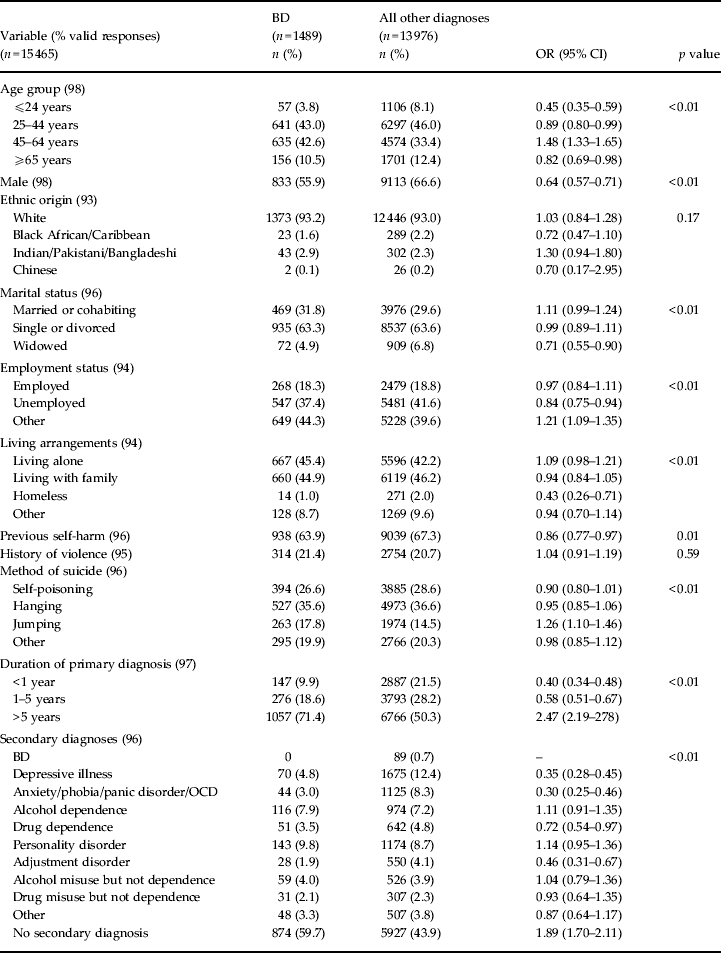
Table 1 shows the demographic and diagnostic characteristics of BD suicides compared to other primary diagnosis suicides. BD suicides were older and less likely to be male. BD suicides were less likely than other primary diagnosis suicides to have several characteristics that are known risk factors for suicide (e.g. homelessness and a history of previous suicidal behaviour). BD suicides were more likely to have had their primary diagnosis for more than 5 years. Overall, those with BD were less likely than other patients to have a formal secondary diagnosis (particularly those related to depression or anxiety). The most common secondary diagnoses in those with BD who died by suicide were personality disorder and alcohol dependence, together accounting for nearly one-fifth of cases.
Demographic and clinical characteristics for suicides with a primary diagnosis of bipolar disorder (BD) compared to suicides with any other primary diagnosis

OCD, Obsessive–compulsive disorder; OR, odds ratio; CI, confidence interval.
Care and management characteristics (Table 2)
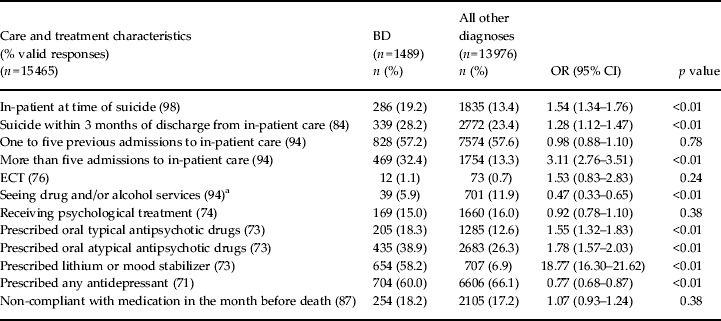
Compared to other primary diagnosis suicides, BD suicides were more likely to have been current or recent in-patients and to have had more than five previous admissions to in-patient care. BD suicides were less likely than other primary diagnosis suicides to be in contact with drug and alcohol services. BD suicides were slightly more likely to be prescribed typical or atypical antipsychotic drugs than the comparison group, and much more likely to have been prescribed lithium or other mood stabilizers. Overall, just over half of BD suicides had been prescribed mood stabilizers. Of those prescribed mood stabilizers who died by self-poisoning (179, 27.4%), the overdose included these drugs in only 25 (14.0%) cases.
Treatment characteristics for suicides with a primary diagnosis of bipolar disorder (BD) compared to suicides with any other primary diagnosis
ECT, Electro-convulsive therapy; OR, odds ratio; CI, confidence interval.
a Question added to National Confidential Inquiry into Suicide and Homicide by People with Mental Illness (NCI) questionnaire in 2003; only cases where year of death was 2003 or later were included in the analysis (sample comprised 660 BD diagnosis, n = 5896 all other diagnosis).
Clinical characteristics at last contact before suicide (Table 3)
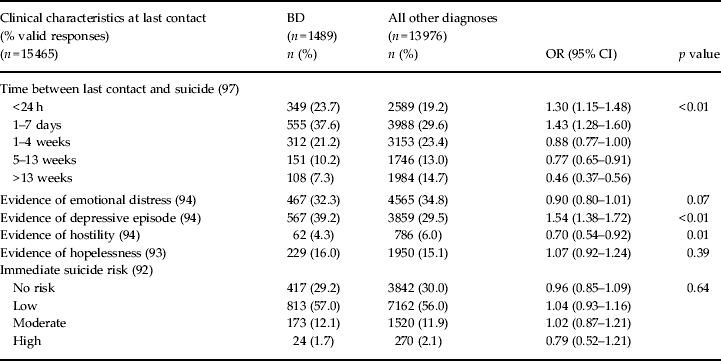
BD suicides were more likely to have been seen by mental health services in the 7 days prior to suicide than those with other primary diagnoses. BD suicides were also more likely to have evidence of depressive symptoms at last contact, but less likely than those with other primary diagnosis to have evidence of hostility at last contact. The majority of cases across both groups were considered to be at low or no immediate risk of suicide.
Clinical characteristics at last contact with mental health services for suicides with a primary diagnosis of bipolar disorder (BD) compared to suicides with any other primary diagnosis
When we adjusted the ORs in Tables 1–3 for age and gender, there was little impact on our findings (data available from authors).
Discussion
Main findings
This study describes the largest detailed sample of suicide deaths by individuals with BD in the international literature to date. In our sample nearly 10% of current psychiatric patients who died by suicide had a primary diagnosis of BD. Trend tests suggest that the decline in BD suicide deaths was not statistically significant but this could have been due to small numbers. There was some evidence of a decrease in the number of BD suicide deaths by younger patients.
There was a higher proportion of females among BD suicides than among other primary diagnosis suicides. BD suicides were more than twice as likely as those with other primary diagnoses to have been diagnosed more than 5 years prior to the suicide. Demographic and social factors among those with BD showed little difference compared with those with other primary diagnoses. Personality disorder and alcohol dependence were the most common secondary diagnoses in the BD group. BD suicides had a distinct pattern in relation to accessing in-patient care and just less than half were current or recent in-patients at the time of the suicide. Most had previously been admitted to in-patient care and were three times more likely than those with other primary diagnosis to have had more than five previous in-patient admissions. Mood stabilizers were the most commonly prescribed pharmacological treatment for those with BD; however, given the possible anti-suicidal properties of lithium (Baldessarini et al. Reference Baldessarini, Tondo, Davis, Pompili, Goodwin and Hennen2006), an important finding was that more than 40% of cases were not prescribed mood stabilizers. Data for this variable were not complete (73% complete). This finding should therefore be interpreted cautiously, although we suspect that those not prescribed mood stabilizers would be over-represented in the missing data group. In this case the proportion of individuals not prescribed appropriate medication might be even higher. Just over 60% of patients with BD had been in contact with mental health services in the 7 days prior to the suicide, and just under half of these were seen within 24 hours of the suicide. Almost 90% of BD suicides were assessed as being at no or low immediate risk of suicide when they were seen (although this was not dissimilar to those with other primary diagnoses).
Findings in relation to previous research
The results of this study are consistent with previous research on factors found to be associated with completed suicide in BD (Dalton et al. Reference Dalton, Cate-Carter, Mundo, Parikh and Kennedy2003; Leverich et al. Reference Leverich, Altshuler, Frye, Suppes, Keck, McElroy, Denicoff, Obrocea, Nolen, Kupka, Walden, Grunze, Perez, Luckenbaugh and Post2003; Tondo et al. Reference Tondo, Isacsson and Baldessarini2003; Rihmer, Reference Rihmer, Zarate and Manji2009). Our data confirm that suicide in BD is associated with a high number of previous admissions to in-patient care (Leverich et al. Reference Leverich, Altshuler, Frye, Suppes, Keck, McElroy, Denicoff, Obrocea, Nolen, Kupka, Walden, Grunze, Perez, Luckenbaugh and Post2003), although the reasons for admission were not available. The number of bipolar cases with substance misuse (Lopez et al. Reference López, Mosquera, de León, Gutiérrez, Ezcurra, Ramírez and González-Pinto2001; Tondo et al. Reference Tondo, Isacsson and Baldessarini2003; Oquendo & Mann, Reference Oquendo and Mann2006) and/or anxiety disorder (Angst et al. Reference Angst, Stassen, Clayton and Angst2002; Leverich et al. Reference Leverich, Altshuler, Frye, Suppes, Keck, McElroy, Denicoff, Obrocea, Nolen, Kupka, Walden, Grunze, Perez, Luckenbaugh and Post2003; Simon et al. Reference Simon, Hunkler, Fireman, Lee and Savarino2007) was lower than might have been expected given the prevalence of co-morbid substance and anxiety disorders typically found in BD populations (Goodwin & Jamison, Reference Goodwin and Jamison1990). It is possible that this was a recording bias. However, our study was restricted to a clinical subgroup of people with BD who died by suicide and previous work has suggested that substance/alcohol use is not strongly related to suicide in these individuals (Hawton et al. Reference Hawton, Sutton, Haw, Sinclair and Harris2005). We should also bear in mind that the data in Table 1 refer to formal secondary diagnoses made by the treating clinical team. Although lower than expected, alcohol use/dependence was one of the most common secondary diagnoses in BD suicides and therefore may have been an important contributory factor. Less than 40% of BD suicides had evidence of depressive symptoms at their last contact with services before the suicide. This is in contrast to many studies of suicide attempt in BD, where structured psychiatric assessments have found that depressive symptoms and depressive episode are prominent. The lower than expected proportion of cases with depression in our results could be due to the particular characteristics of our clinical sample, a reflection of the time interval between being seen and death, or it could be an indication of a crucial under-recognition of depression among this group. Risk of suicide is thought to be higher at younger ages and earlier in the course of BD (Goodwin & Jamison, Reference Goodwin and Jamison1990). However, our results show that BD suicides commonly took place more than 5 years post-diagnosis and most frequently by people in the 25–64-year age groups, and suicides by people aged between 45 and 64 years were much more common in the BD group than in the other primary diagnosis group. We found that the majority of cases included were considered to be at ‘low risk’ for suicide at last contact with services. This is consistent with the results of psychological autopsy studies, which have shown that suicidal intent is rarely communicated when the individual is seen by a health-care professional shortly before the suicidal act, although it may be communicated earlier to friends or family members (Isometsä et al. Reference Isometsä, Henriksson, Aro, Heikkinen, Kuoppasalmi and Lonnqvist1994, Reference Isometsä, Heikkinen, Marttunen, Aro and Lonnqvist1995).
Methodological issues
Not all those with BD who die by suicide will be in contact with services in the 12 months before death (Merikangas & Pato, Reference Merikangas and Pato2009), and not all those in contact with services will be appropriately diagnosed with BD (Dunner, Reference Dunner2003; Benazzi, Reference Benazzi2006). The characteristics of our sample may not reflect the characteristics of those with BD with no service contact prior to death. A study from The Netherlands by ten Have et al. (Reference ten Have, Vollebergh Bijl and Nolen2002) found that the most common reason for a lack of contact with mental health services was lower severity of BD symptoms; therefore our sample may be biased towards the more seriously ill. It would have not been feasible as part of this national study to collect detailed data on all individuals with BD who had not been in contact with mental health services.
Data used in the analyses were collected from clinicians after the suicide had occurred. Completion of the NCI suicide questionnaire relies on the accuracy of case-notes and the clinicians' knowledge of the patient. The clinicians were therefore not blind to patient outcome when completing the questionnaire and it is possible that this could influence results, particularly those relating to care or treatment before death.
Allocation to the BD suicide group was dependent on the recording of primary diagnosis by responding clinicians and it is possible that, where there were multiple co-morbidities, primacy may have been attributed incorrectly. There were 89 cases with a secondary diagnosis of BD, all of which had a primary diagnosis of schizophrenia; we adopted a conservative approach and included these in the other primary diagnosis group, which may have reduced between-group differences. We also carried out a post-hoc sensitivity analysis including these 89 individuals in our BD suicide group. There was little effect overall on the results.
It is possible that the clinician completing the questionnaire was not the professional with whom the last contact was made and consequently variables relating to clinical state might have been under-reported and found less frequently than expected (e.g. evidence of depressive symptoms). However, clinicians generally use patient records along with their personal knowledge and recollection of the patient when filling in the NCI questionnaire, and it would be unusual for significant changes in mood state not to be recorded as part of the clinical record.
There are some potential issues with missing data on the NCI database and therefore the results presented should be interpreted with caution. The majority of variables were more than 90% complete. Patient treatment variables had greater levels of missing data. In most cases this was because the clinician completing the questionnaire left some fields blank, but some cases were historical artefacts due to the evolving nature of the suicide questionnaire and the addition of new questions over time that could not be back-coded for older cases (these have been adjusted where possible; for example, access to drug and alcohol services was added in 2003).
This study was descriptive in nature. Although it was possible to identify characteristics that are common in suicide in BD, it was not possible to comment on the aetiology of these factors, or inter-relationships that may exist between them. As some of these risk factors may have been consequences of care and not true risk factors, we did not undertake a multivariate analysis.
Clinical and research implications
Frequency and characteristics of suicide in BD
Suicide prevention is a priority for services (Appleby et al. Reference Appleby, Shaw, Kapur, Windfuhr, Williams, Swinson, Hunt, Flynn, Bickley, Rodway, Roscoe, Turnbull, Saini, Da Cruz, Pearson, While, Lowe, Burns, Hadfield, Stones and Clarke2012). The results of this study show that those with BD frequently die by suicide, and our findings are likely to have underestimated the magnitude of this risk. Overall, the frequency of bipolar suicide seems to have remained relatively stable over time, which is in contrast to falling rates of suicide in the English general population. It may be that some of the societal determinants of suicide have less of an impact in this clinical population, where illness-related factors may be more relevant. The possibility that individual clinical groups are not benefiting from an overall decline in suicide raises issues of equity and this warrants specific exploration in future studies. Nevertheless, the lack of a significant decrease in suicide rates by those with BD could be a power issue reflecting the comparatively small numbers of deaths in this group. The evident stability of BD suicide deaths could also be a consequence of the improved diagnosis of BD and perhaps of BD II in particular. This might have caused an increase in BD suicides as people who would previously have been diagnosed with unipolar depressive disorder are moved into the BD category.
Although several demographic and social characteristics in our BD sample were similar to those in suicides in general and psychiatric populations, we did find that women were over-represented. There is little consensus on the role of gender in relation to suicide in BD, and this might reflect a greater long-term suicide risk in women than in men (Pompili et al. Reference Pompili, Rihmer, Innamorati, Lester, Giradi and Tatarelli2009; Gonda et al. Reference Gonda, Pompili, Serafini, Montebovi, Campi, Dome, Duleba, Girardi and Rihmer2012). Cohort studies of those with mental illness often describe the risk of suicide as highest at the time of diagnosis, with the risk subsequently diminishing over time (Goodwin & Jamison, Reference Goodwin and Jamison1990; ten Have et al. Reference ten Have, Vollebergh Bijl and Nolen2002). We found that the majority of BD suicides in fact took place at least 5 years after diagnosis. In addition, those with BD were more likely to die by suicide in middle-age than those with other primary diagnoses. These findings suggest that risk of suicide in BD may be relatively persistent.
Implications for services and treatment
Although there were similar levels of co-morbid alcohol dependence in the BD group and in those with other primary diagnoses, the BD group were less likely to be in contact with alcohol services, highlighting a possible deficiency in the provision of dual diagnosis services. However, policy changes have sought to address this (Department of Health, 2001; CSIP, 2008). Over a third of BD suicides in this study were not prescribed lithium or another mood stabilizer, although there were some missing data for this variable. Given the increased risk of suicide that seems to accompany a diagnosis of BD and the strong evidence for the protective effect of lithium (Tondo et al. Reference Tondo, Isacsson and Baldessarini2003; Angst et al. Reference Angst, Angst, Gerber-Werder and Gamma2005; Rihmer, Reference Rihmer2005), this might be considered a key treatment in long-term management.
Risk assessment
A clinically important result was that the majority of patients with BD were seen by mental health services during the week before the suicide, and nearly a quarter within the 24 hours immediately preceding it, providing a potential opportunity for services to intervene. However, nine out of 10 BD suicides were assessed as being at no or low risk at last contact. These data suggest that clinical assessment of suicide risk may not be accurately identifying at-risk BD patients, or that patients with BD are subject to rapid changes in mental state consistent with the hypothesis that suicidal behaviour in BD is associated with impulsivity (Rihmer, Reference Rihmer2007). However, assessment of suicide risk reported on the NCI questionnaire may also be influenced by other considerations such as recall bias, defensiveness in the reporting of this item, or the result of adaptation to risk by clinical staff through continued exposure to high-risk patients. It is also possible that recognition of high risk could trigger the implementation of interventions to lessen that risk and thereby prevent suicide, and so by default the majority of completed suicides by psychiatric patients in contact with services would be from individuals not identified as being at risk. Although this explanation is heuristically appealing, questions remain regarding why these cases of completed suicide were not assessed as ‘at risk’, and whether there are indicators of risk that are being missed in current assessments.
It is important that health professionals are able to accurately identify those patients who might be most at risk. Factors such as alcohol dependence/misuse, personality disorder, depressive episode, multiple psychiatric admissions and current or recent admission could characterize such a high-risk group. In our sample of BD suicide deaths, 75% had one or more of these factors, 34% had two or more, 8% had three or more, and less than 1% had four. In terms of risk management, a reduction in the emphasis placed on traditional indicators of risk, such as social circumstances and recent diagnosis, and an increase in the emphasis on diagnosis-specific factors may increase the utility of assessments. Ideally, clinically useful indicators of suicide risk that can be operationalized need to be identified in future studies. However, the identification of a high-risk group with BD on the basis of factors associated with suicide in this sample would be premature as two-thirds of completed suicide had less than two of these risk factors. More work is required to determine the causes of suicide in BD and to explore how risk factors interact to precipitate suicidal behaviour.
Acknowledgements
We acknowledge the help of the NCI. This article presents independent research commissioned by the National Institute for Health Research (NIHR) under its Programme Grants for Applied Research funding scheme (RP-PG-0407-10389). The views expressed in this article are those of the authors and not necessarily those of the National Health Service (NHS), the NIHR or the Department of Health.
Declaration of Interest
None.