1. Introduction
Eastern China is an ideal region for the study of lithospheric mantle evolution, because of considerable loss of the Archaean keels beneath the North China Craton during Phanerozoic times (Griffin et al. Reference Griffin, Zhang, O'Reilly, Ryan, Flower, Chung, Lo and Lee1998; Menzies, Fan & Zhang, Reference Menzies, Fan, Zhang, Prichard, Alabaster, Harris and Neary1993). This region also contains the world's largest ultrahigh-pressure (UHP) metamorphic belt in the Dabie–Sulu orogen, which resulted from the collision of the North China and Yangtze cratons during the Late Triassic (c. 230 Ma: Li et al. Reference Li, Xiao, Liou, Chen, Ge, Zhang and Sun1993). Discovery of coesite (Wang, Liou & Mao, Reference Wang, Liou and Mao1989; Okay, Xu & Şengör, Reference Okay, Xu and Şengör1989; Hirajima et al. Reference Hirajima, Ishiwatari, Cong, Zhang, Banno and Nozaka1990) and diamond (Xu et al. Reference Xu, Okay, Ji, Şengör, Su, Liu and Jiang1992) in eclogites suggests that the continental crust was once subducted to mantle depth, possibly greater than 200 km (Ye, Cong & Ye, Reference Ye, Cong and Ye2000).
Mantle-derived xenoliths and xenocrysts in Palaeozoic diamondiferous kimberlites from Mengyin and Fuxian document the presence of a cold, thick lithospheric mantle at least as late as the middle Ordovician beneath the North China Craton (Lu et al. Reference Lu, Han, Zheng and Ren1991). However, studies on peridotite xenoliths from Neogene and Quaternary basalts revealed the existence of a thin, hot and fertile lithospheric mantle underneath this region, indicating a dramatic change from cratonic mantle to oceanic mantle during Mesozoic–Cenozoic times (Griffin et al. Reference Griffin, Zhang, O'Reilly, Ryan, Flower, Chung, Lo and Lee1998; Menzies, Fan & Zhang, Reference Menzies, Fan, Zhang, Prichard, Alabaster, Harris and Neary1993; Menzies & Xu, Reference Menzies, Xu, Flower, Chung, Lo and Lee1998; Zheng et al. Reference Zheng, O'Reilly, Griffin, Lu and Zhang1998; Fan et al. Reference Fan, Zhang, Baker, Jarvis, Mason and Menzies2000). The mechanism for such change still remains hotly debated.
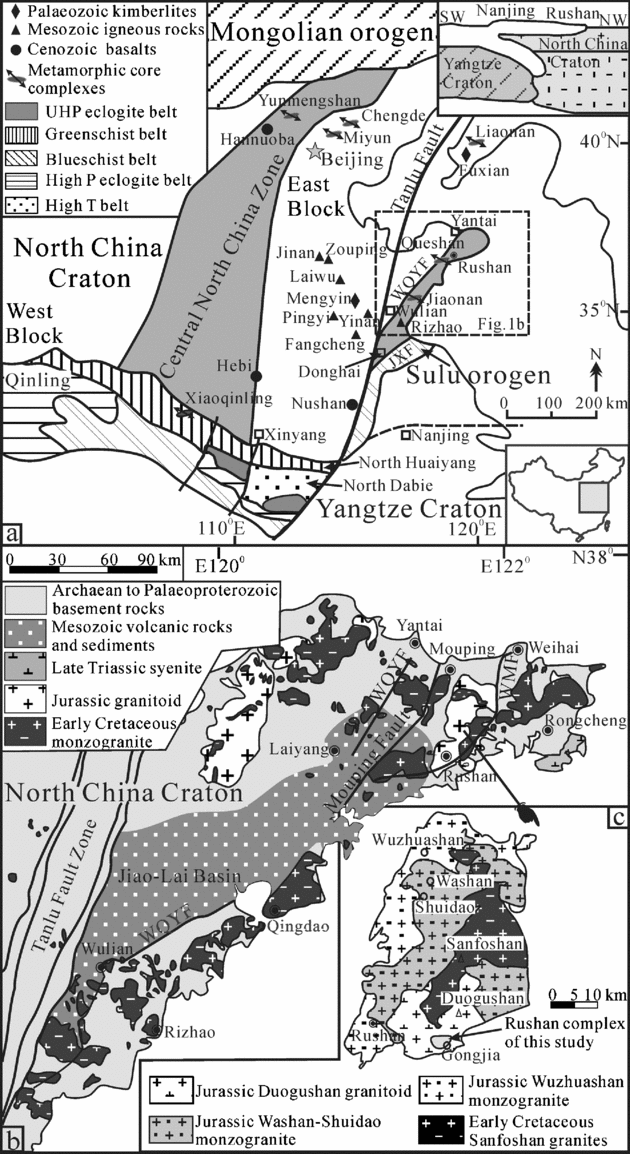
Recently, studies on mantle xenoliths (Zheng et al. Reference Zheng, Sun, Zhou and Robinson2005b) and Mesozoic intermediate–mafic igneous rocks from both the inner and southern margin (Fig. 1a) of the North China Craton revealed the existence of a highly enriched lithospheric mantle, metasomatized and modified by subduction processes during the Triassic collision between the North China and Yangtze cratons (Ying, Zhou & Zhang, Reference Ying, Zhou and Zhang2006; Zhang et al. Reference Zhang, Sun, Zhou, Fan, Zhai and Ying2002, Reference Zhang, Ying, Shimoda, Kita, Morishita, Shao and Tang2007; Zheng et al. Reference Zheng, Sun, Zhou and Robinson2005b). Subduction-related modification of the North China lithospheric mantle was especially significant at its southern edge, close to the Dabie–Sulu area (Zhang et al. Reference Zhang, Sun, Zhou, Zhou, Fan and Zheng2003; Ying, Zhou & Zhang, Reference Ying, Zhou and Zhang2006; Zheng et al. Reference Zheng, Sun, Zhou and Robinson2005b). In addition, some of the cratonic mantle could have been split apart from the North China lithosphere and incorporated into the subducted Yangtze crust in the Sulu UHP belt (Zheng et al. Reference Zheng, Griffin, O'Reilly, Yang and Zhang2006b).
(a) Simplified geological map (modified from Fan et al. Reference Fan, Guo, Wang and Zhang2004) showing major tectonic units and Mesozoic igneous rocks in eastern China. The tectonic subdivisions are based on Zhao et al. (Reference Zhao, Wilde, Cawood and Sun2001). The dashed line refers to the sub-surface suture between the North China and Yangtze cratons (Li, Reference Li1994). The inset cartoon in the top right shows the crustal detachment model for the collision of the North China and Yangtze cratons. (b) Map showing distribution of the Mesozoic volcanic rocks and intrusions in the Jiaodong Peninsula (modified after Yang et al. Reference Yang, Wu, Chung, Wilde, Chu, Ching and Song2005b). (c) Detailed geological map of the studied Rushan complex and the relative Kunyushan granites (from Guo et al. Reference Guo, Chen, Zhang, Siebel and Zhai2005). WQYF – Wulian–Qingdao–Yantai Fault, JXF – Jiashan–Xiangshui Fault, WMF – Wulian–Mishan Fault.

Mesozoic igneous rocks from the Dabie–Sulu orogen are considered to be the products of subduction-related to post-collisional extension-related magmatism and can provide constraints on the processes involved in the evolution of the lithosphere (Fan et al. Reference Fan, Guo, Wang, Lin and Zhang2001; Yang et al. Reference Yang, Wu, Chung, Wilde, Chu, Ching and Song2005b). Abundant information is available on Mesozoic mafic-intermediate igneous rocks from the Dabie orogen (Jahn et al. Reference Jahn, Wu, Ching and Chin1999; Fan et al. Reference Fan, Guo, Wang and Zhang2004; Wang et al. Reference Wang, Fan, Peng, Zhang and Guo2005). Studies conducted in the Sulu orogen have been mostly confined to volcanic rocks (Fan et al. Reference Fan, Guo, Wang, Lin and Zhang2001), lamprophyres (Guo et al. Reference Guo, Fan, Wang and Zhang2004), granitic rocks (Chen et al. Reference Chen, Xie, Li, Zhang, Zhou, Park, Ahn, Chen and Zhang2003; Guo, Fan & Li, Reference Guo, Fan and Li2006; Yang et al. Reference Yang, Chung, Wilde, Wu, Chu, Ching and Fan2005a, Reference Wu, Yang, Wilde and Zhangb) and a few mafic dykes (Yang et al. Reference Yang, Chung, Zhai and Zhou2004). Geochemical investigations of the Mesozoic mafic-intermediate intrusions in the Sulu orogen are still rare; the nature and evolution of the lithospheric mantle beneath the Sulu area are particularly less well constrained.
Here, we present geochronological and geochemical investigations for the Rushan complex with the aim of constraining the petrogenesis and origin of the Rushan complex and mantle processes involved in its generation, and will further discuss the crust–mantle interaction that occurred beneath the collisional zone, and its implication for the evolution of the lithosphere.
2. Geological background
The North China Craton, one of the oldest cratons in the world, is bounded by the Qinling–Dabie–Sulu orogenic belt to the south and the Central Asia orogenic belt to the north, and has a Precambrian basement consisting mainly of gneiss, migmatite and high-pressure granulite-facies rocks (Zhao et al. Reference Zhao, Cawood, Wilde, Sun and Liu2000, Reference Zhao, Wilde, Cawood and Sun2001; Zhai, Guo & Liu, Reference Zhai, Guo and Liu2001), with some ancient remnants as old as 3600 Ma (Liu, Nutman & Compston, Reference Liu, Nutman and Compston1992; Zheng et al. Reference Zheng, Griffin, O'Reilly, Lu, Wang, Zhang, Wang and Li2004). This craton is composed of two Archaean nuclei, the Western and Eastern blocks, separated by the Palaeoproterozoic Central Orogenic Zone (Fig. 1a). The Eastern Block is considered to have encountered tectonothermal remobilization during the Phanerozoic, and was marked by considerable lithospheric thinning (Griffin et al. Reference Griffin, Zhang, O'Reilly, Ryan, Flower, Chung, Lo and Lee1998; Menzies, Fan & Zhang, Reference Menzies, Fan, Zhang, Prichard, Alabaster, Harris and Neary1993; Menzies & Xu, Reference Menzies, Xu, Flower, Chung, Lo and Lee1998; Fan et al. Reference Fan, Zhang, Baker, Jarvis, Mason and Menzies2000), crustal extension and widely developed metamorphic core complexes across the North China Craton. These metamorphic core complexes were mainly distributed along the northern edge of the Craton, such as at Miyun, Chengde, Yunmengshan and Liaonan, and at Xiaoqinling, Jiaonan and Queshan within the Dabie–Sulu orogenic belt (Wu et al. Reference Yang, Chung, Zhai and Zhou2005a; Yang et al. Reference Yang, Wu, Chung, Lo, Wilde and Davis2007) (Fig. 1a). Development of these metamorphic core complexes was almost contemporaneous with the Early Cretaceous giant igneous activities in eastern North China (Wu et al. Reference Wu, Lin, Wilde, Zhang and Yang2005a).
The Sulu orogen is the eastern part of the Qinling–Dabie–Sulu UHP metamorphic belt and has become one of the most significant regions for the study of continental subduction (Ye et al. Reference Ye, Yao, Katayama, Cong, Wang and Maruyama2000), crust–mantle interaction and crustal recycling processes (Guo, Fan & Li, Reference Guo, Fan and Li2006). It is separated from the North China Craton to the NW by the Wulian–Qingdao–Yantai Fault and the Yangtze Craton to the SE by the Jiashan–Xiangshui Fault (Fig. 1a). Metamorphic rocks in the Sulu orogen are predominantly amphibolite-facies granitic gneisses, with subordinate amounts of coesite-bearing eclogites (Hirajima et al. Reference Hirajima, Ishiwatari, Cong, Zhang, Banno and Nozaka1990), marbles (Kato, Enami & Zhai, Reference Kato, Enami and Zhai1997), pelitic schists (Zhang et al. Reference Zhang, Hirajima, Banno, Cong and Liou1995), meta-granitoids (Hirajima et al. Reference Hirajima, Zhang, Li and Cong1992) and tectonically emplaced ultramafic bodies (Zhang et al. Reference Zhang, Liou, Zheng, Griffin, Yui and O'Reilly2005). These metamorphic rocks are widely distributed, such as at Donghai, Rizhao, Qingdao, Rongcheng and Weihai (Fig. 1). Geochronological data revealed that the protoliths of these orthometamorphites were emplaced in Neoproterozoic times (800–700 Ma: Hacker et al. Reference Hacker, Ratschbacher, Webb, Ireland, Walker and Dong1998; Liu, Xu & Xue, Reference Liu, Xu and Xue2004).
The studied area is located in the Jiaodong peninsula, south of the Wulian–Qingdao–Yantai Fault. The Jiaodong peninsula, which is separated from the west Shandong Province by the Tanlu wrench fault, is composed of two different parts, called the Jiaobei block and the Sulu orogen, respectively (Zhai et al. Reference Zhai, Cong, Guo, Liu, Li and Wang2000). The oldest exposed metamorphic rocks in the Jiaobei block are a sequence of amphibolite- to granulite-facies volcanic and sedimentary rocks of the Late Archaean to Early Proterozoic Jiaodong Group, which displays North China Craton affinities. In contrast, the outcropping rocks in the Sulu orogen are composed of the Proterozoic Jiaonan and Fenzishan groups with Triassic interbedded UHP rocks displaying Yangtze continental affinities.
Mesozoic igneous rocks, which were mainly emplaced in the Late Triassic (215–200 Ma), Late Jurassic (160–150 Ma) and Early Cretaceous (135–113 Ma) (Yang et al. Reference Yang, Chung, Wilde, Wu, Chu, Ching and Fan2005a) are widely distributed in the Sulu orogen and characterized by voluminous high-K calc-alkaline granitic rocks and minor but widespread mafic bodies. The Early Cretaceous magmatism along the Sulu orogen is considered to be the largest tectono-thermal event of that orogen (Yang et al. Reference Yang, Chung, Wilde, Wu, Chu, Ching and Fan2005a). The most representative Mesozoic pluton in the Sulu orogen is the Kunyushan suite, which is composed of four parts, including the Duogushan granodiorite (161 ± 1 Ma), the Wuzhuashan and Washan–Shuidao biotite-bearing monzogranite (146–138 Ma) and the Sanfoshan granite (113 ± 1 Ma) (Guo et al. Reference Guo, Chen, Zhang, Siebel and Zhai2005) (Fig. 1c). Yang (Reference Yang2000) proposed that the Washan–Shuidao biotite-bearing monzogranite originated from the anatexis of crust materials during post-collisional extension, whereas Zhang et al. (Reference Zhang, Zhai, He, Peng and Xu2004a) considered the Duogushan and Washan–Shuidao granites to have been generated by dehydrational melting of the underplated mafic lower crust in the Yangtze Craton.
The Rushan complex, which intruded into the Duogushan granitoids (Fig. 1c), is located on the southeast of Rushan city (36°51′24.9″N; 121°42′37.0″E), with total outcrop surface of about 2 km2. Samples studied were collected from a quarry northwest of Gongjia village.
3. Petrography
The Rushan intrusive complex exhibits an ellipse shape and is comprised of at least four phases: (1) medium- to fine-grained biotite gabbro; (2) medium-grained biotite gabbro; (3) medium- to coarse-grained biotite gabbro; (4) fine-grained pyroxene-bearing diorite. The pyroxene-bearing diorite predominates in the outermost part of the complex. Late-stage syenite dykes are seldom observed in the pyroxene-bearing diorite.
The gabbro is composed mainly of plagioclase (35–50%), alkaline feldspar (10–15%), clinopyroxene (20–35%) and biotite (10–15%) with minor orthopyroxene (~5%), whereas the pyroxene-bearing diorite consists mainly of plagioclase (40–50%), hornblende (10–15%), biotite (~10%), pyroxene (5–10%), with rare alkaline feldspar and quartz. Accessory phases include zircon and Fe–Ti oxides such as magnetite. Plagioclase is widely developed with polysynthetic twinning and zoned texture. They are euhedral–subhedral in shape and 0.5–2.5 mm in size. Unlike typical cumulate gabbros, the gabbroic rocks of the Rushan complex contain 10–15% alkaline feldspar, including orthoclase, perthite and minor microcline. The alkaline feldspar is mainly subhedral–anhedral with a width of 1–3 mm. In some cases, alkaline feldspar shows complex zoned texture and is weakly sericitized. Clinopyroxene is subhedral–anhedral and 0.3–0.8 mm in size, and some have developed with narrow hornblende reaction rims. Some clinopyroxenes occur as anhedral fine grains interstitial to feldspars or as inclusions in biotite. Large flakes of foxy-red biotite are present in the gabbroic rocks. The biotites mainly range from 1 to 4 mm in length, with the largest grains up to 8 mm. They usually contain Fe–Ti oxides, feldspars and minor pyroxene inclusions. In some cases, biotite occurs interstitially to other mafic minerals and feldspars and shows simple reverse zoning with a narrow hornblende rim. Orthopyroxenes with euhedral–subhedral shapes are always developed with two groups of good cleavage and range from 0.2 to 0.6 mm long.
4. Analytical procedures
All measurements were completed at the State Key Laboratory of Geological Processes and Mineral Resources, China University of Geosciences (Wuhan), except for the whole-rock major oxide contents analysis carried out at Hubei Institute of Geology and Mineral Resource, the Chinese Ministry of Land and Resources. Zircons were separated using conventional heavy liquid and magnetic techniques and purified by hand-picking under a binocular microscope. The internal structures of zircons were obtained by using the cathodoluminescence (CL) images conducted on a MonoCL3 system with a voltage of 10 kV on the JXA-8100 Electronic Probe. Based on CL images, the zircons were analysed for U–Pb isotopes and U, Th and Pb concentrations using an Agilent 7500a inductively coupled plasma-mass spectrometer (ICP-MS). The GeoLas 200 M, which is equipped with a 193 nm ArF-excimer laser with a homogenizing, imaging optical system, was used for laser-ablation experiments with a 32 μm laser beam diameter. All U–Th–Pb isotope measurements were performed using zircon 91500 as an external calibration, and NIST610 as an internal standardization. The reference zircons were analysed every tenth analysis. The common Pb was estimated from 204Pb counts. Age calculations were carried out using ISOPLOT (Ludwig, Reference Ludwig2003) and presented as weighted means with 2σ errors. The analytical results are tabled in the Appendix (available online as supplementary material at http://multimediafluids.uam.elogim.com/journals/geo).
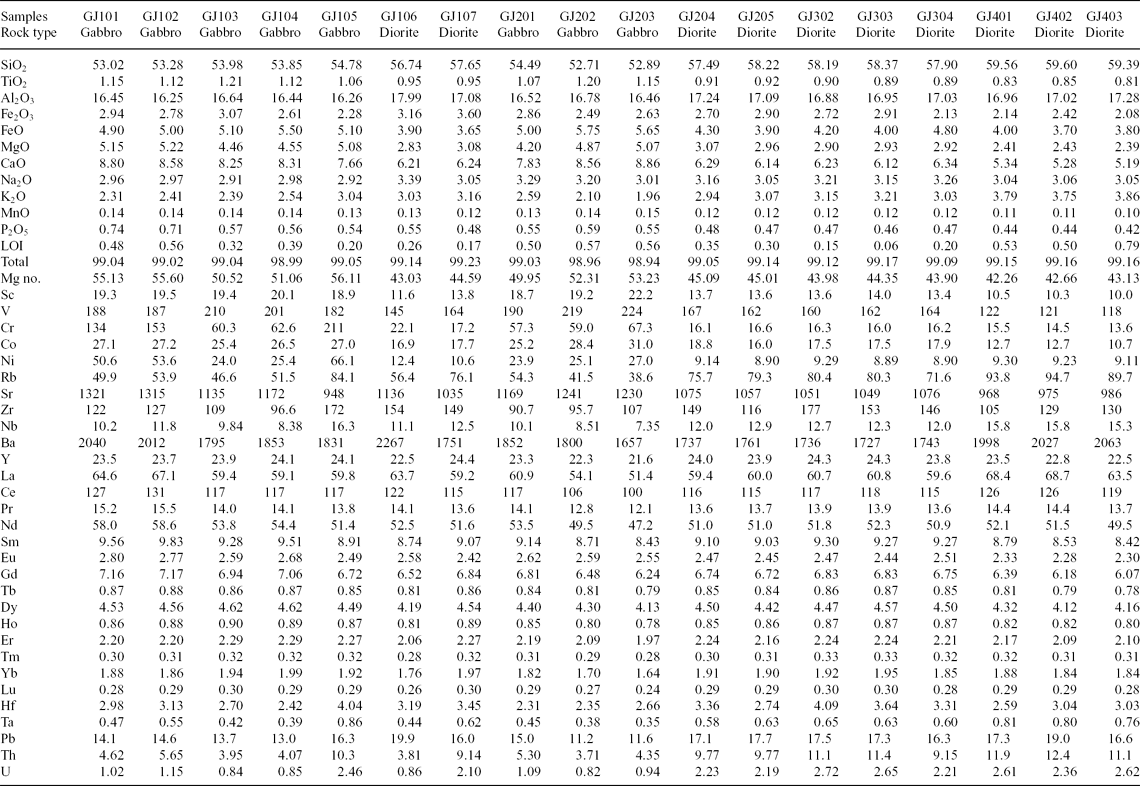
All samples selected for whole rock major, trace element and isotopic analyses were first trimmed to remove altered surfaces and then crushed by using a ceramic jaw crusher and powdered to about 200 mesh in an agate mill. Major oxide contents were analysed by wavelength X-ray fluorescence spectrometry with the relative standard deviations (RSD) of <5%. FeO content was analysed solely using a wet chemical method. Trace element analysis was performed on an Agilent 7500a ICP-MS. About 50 mg of each sample powder were weighed into a Teflon® bomb, and then moistened with a few drops of ultra-pure water before addition of 1 ml HNO3 and 1 ml HF. The sealed bomb was heated at 190°C in an oven for more than 48 hours. After cooling, the bomb was opened and evaporated at 115°C to incipient dryness, then 1 ml HNO3 was added and the sample dried again. The resultant salt was re-dissolved with 3 ml 30% HNO3 before it was again sealed and heated in the bomb at 190°C for 12 hours. The final solution was transferred to a polyethylene bottle and diluted in 2% HNO3 to about 80 ml for ICP-MS analysis. Analysis of the international rock standards BHVO-2 and BCR-2 indicated that the analytical precision is mostly better than 5%, according to the RSD. The major and trace element analytical results are listed in Table 1.
Major oxide (wt %), trace element (ppm) compositions of the Early Cretaceous Rushan complex in the Sulu orogen, eastern China

FeOt = FeO + 0.9*Fe2O3; LOI – Loss on ignition; Mg no. = Mg2+/(Mg2+ + Fe2+ + Fe3+).
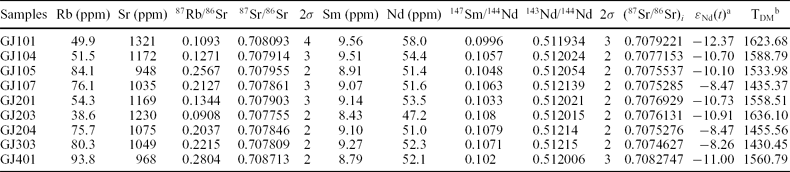
About 50 mg of each sample powder were dissolved in Teflon® bombs with a mixture of 1 ml ultra-pure water, 1 ml HNO3 and 1 ml HF for Sr–Nd isotopic analysis. The sealed bombs were kept in an oven at 190°C for 48 hours; the decomposed samples were then dried on a hotplate. This was followed by adding 1 ml HNO3 and the samples were dried on the hotplate again. The re-dried salts of the samples were dissolved again in 1 ml HNO3 and then loaded onto columns of resins sequentially for separation and purification of Rb, Sr, Sm and Nd by HCl eluant. The Rb and Sr of each sample were purified by second exchange procedures. The Sr and Nd isotopic compositions were measured on a thermal ionization mass spectrometer. The Sr and Nd isotopic ratios were normalized to 86Sr/88Sr=0.1194 and 146Nd/144Nd=0.7219, respectively. The measured 87Sr/86Sr ratio of NBS 987 standard and 143Nd/144Nd of the La Jolla standard are 0.710331±5 (2σ) and 0.511844±1 (2σ), respectively. The 87Rb/86Sr and 147Sm/144Nd ratios were calculated using Rb, Sr, Sm and Nd concentrations by ICP-MS analysis. 143Nd/144Nd and 147Sm/144Nd ratios of CHUR at the present time used for calculating ɛNd(t) value are 0.512638 and 0.1967, respectively. The present-day 143Nd/144Nd and 147Sm/144Nd ratios of the depleted mantle used for calculating TDM value are 0.51315 and 0.2136, respectively. The results are presented in Table 2.
Sr and Nd isotopic compositions of the Early Cretaceous Rushan complex in the Sulu orogen, eastern China
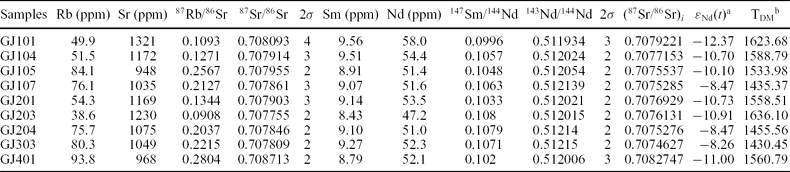
The Rb, Sr, Sm and Nd abundances were measured by ICP-MS.
a, b: 143Nd/144Nd and 147Sm/144Nd of the chondrite and depleted mantle at present day are 0.512638 and 0.1967, 0.513151 and 0.2136, respectively.
λRb = 1.42×10⁻¹¹ yr−1Steiger & Jäger, Reference Steiger and Jäger1977), λSm = 6.54×10⁻¹² yr−1(Lugmair & Harti, Reference Lugmair and Marti1978). (87Sr/86Sr)i and ɛNd(t) were calculated at 111 Ma.
5. Results
5.a. Zircon U–Pb geochronology
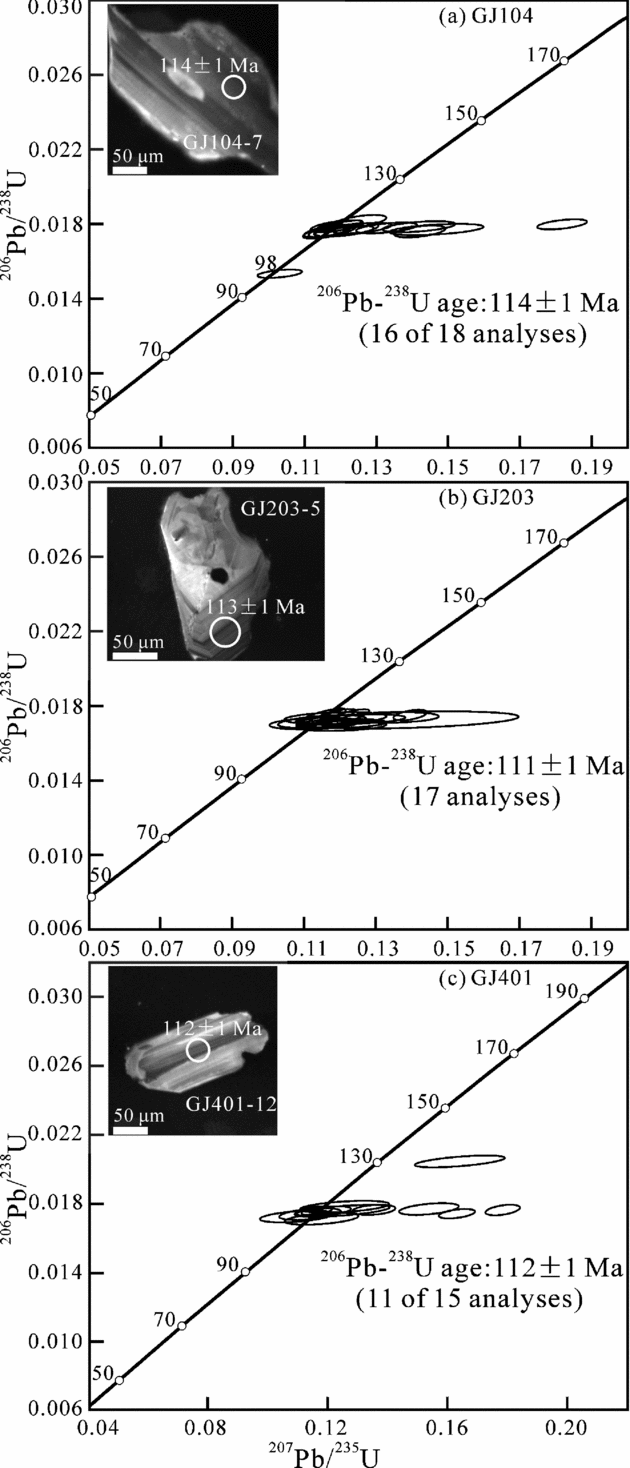
Zircons in GJ104, a coarse-grained biotite-bearing gabbro, are colourless with aspect ratios ranging between 1:3 and 1:1, and with well-developed tetragonal dipyramids. The CL images show that the zircons have well-developed oscillatory zoning. No inherited cores were observed in more than 60 grains. Eighteen point analyses on 18 selected grains gave a relatively wide range in U (60.3–392.8 ppm) and Th (58.9–772 ppm) concentrations with relatively constant Th/U ratios of 0.85–1.36, except for three grains greater than 1.8 (Appendix Table A1). Sixteen concordia or near-concordia analyses give a weighted mean 206Pb–238U age of 114 ± 1 Ma (MSWD=1.3; Fig. 2a).
Zircon U–Pb concordia diagrams for samples GJ104, GJ203 and GJ401. Insets in (a), (b) and (c) show the CL images of representative zircons; scale bar = 50 μm.

Most zircons from GJ203, a medium-grained biotite-bearing gabbro, are enhedral with pyramidal and prismatic crystal forms. They are about 150 to 300 μm in length with aspect ratios of 1:4 to 1:2.5. Some of them have subtle magmatic oscillatory zoning in CL images. Seventeen observed zircon grains from this sample have rather wide ranges of U (72.49–1036.01 ppm) and Th (65.53–1843 ppm) concentrations with Th/U ratios of 0.9–2.33 (Appendix Table A1). Seventeen spot analyses form a tight cluster on the concordia plot with a weighted mean 206Pb–238U age of 111 ± 1 Ma (MSWD=1.4; Fig. 2b).
Most zircons from GJ401, a fine-grained pyroxene-bearing diorite, are well crystallized, euhedral–subhedral in shape, and have perfect long prismatic crystal forms. They range up to about 100 to 400 μm in length with aspect ratios between approximately 1:5 and 1:2. According to the CL images, there are two kinds of zircons, one with banded texture and the other with good magmatic oscillatory zoning. A total of 15 zircons from these two kinds were selected for dating. One grain, with relatively low Th/U (0.59), yields an older disconcordant 206Pb–238U age of 131 ± 1 Ma. Of the other 14 analyses, 11 spots form a tight cluster on the concordia plot and give a weighted mean 206Pb–238U age of 112 ± 1 Ma (MSWD=1.5), whereas three analyses are shifted to the right of the concordia line, probably due to the analytical uncertainty of the 207Pb (Fig. 2c).
Based on the uniform ages of the different samples, we interpret the youngest weighted mean 206Pb–238U age of 111 ± 1 Ma as the emplacement age of the Rushan intrusion.
5.b. Major elements
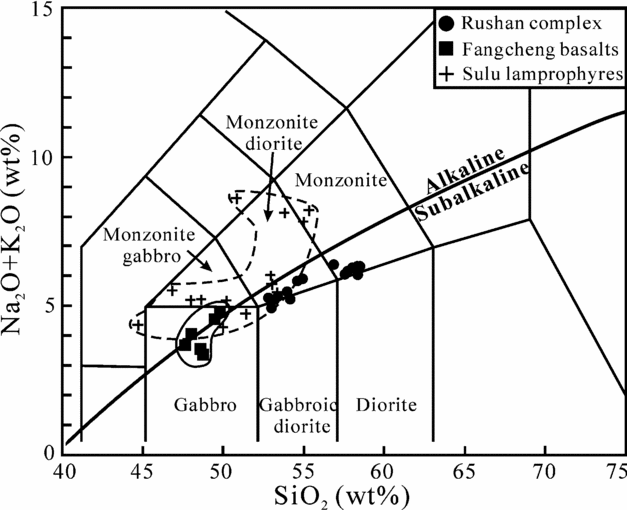
The Rushan complex is predominantly composed of monzonite diorite to monzonite, with SiO2 ranging from 52.7 to 59.6 wt% (Fig. 3). They are high-potassium calc-alkaline, with total alkalis (K2O+Na2O) of 4.97–6.91 wt% and K2O/Na2O of 0.65–1.27, and they are characterized by low MgO (2.39–5.22 wt%), CaO (5.19–8.86 wt%), Na2O (2.91–3.39 wt%) with magnesium numbers (Mg no.) of 42.3–56.1, coupled with high Al2O3 (16.3–18.0 wt%) and P2O5 (0.42–0.74 wt%), as well as moderate TiO2 (0.81–1.21 wt%) (Table 1).
Plots of total alkali versus SiO2 for the Rushan complex from the northern Sulu orogen and comparison with the Fangcheng basalts (Zhang et al. Reference Zhang, Sun, Zhou, Fan, Zhai and Ying2002) and Sulu lamprophyres (Guo et al. Reference Guo, Fan, Wang and Zhang2004).

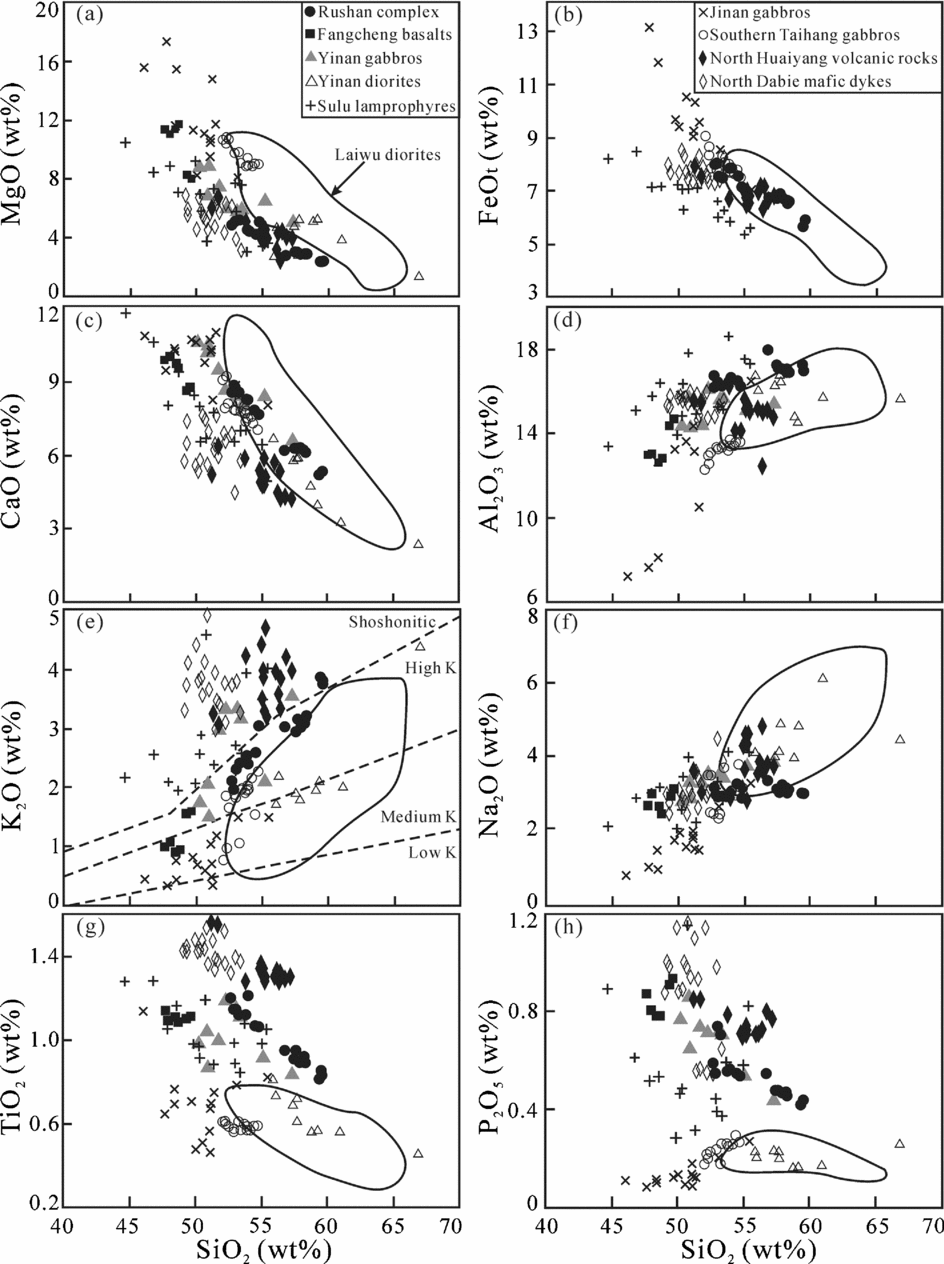
The Rushan complex has similar major element compositions to that of the Early Cretaceous North Huaiyang volcanic rocks, but exhibits generally higher SiO2, Al2O3 than the North Dabie mafic dykes and Sulu lamprophyres. The complex also has higher SiO2, Al2O3 and Na2O, K2O, TiO2, P2O5, but lower MgO, FeOt than that of the Fangcheng basalts, Jinan and southern Taihang gabbros. In Figure 4a–c, the Rushan complex displays coherent variation trends. MgO, FeOt, and CaO negatively correlate with SiO2, whereas Al2O3, Na2O and K2O positively correlate with SiO2 (Fig. 4d–f).
Plots of SiO2 versus other major elements of the Rushan complex from the northern Sulu orogen and comparison with other igneous rocks from the Dabie–Sulu belt and the North China Craton. Data sources: Fangcheng basalts (Zhang et al. Reference Zhang, Sun, Zhou, Fan, Zhai and Ying2002), Yinan gabbros (Xu et al. Reference Xu, Ma, Huang, Yoshiyuki, Chung, Wang and Wu2004b) and diorites (Xu et al. Reference Xu, Huang, MA, Wang, Yoshiyuki, Xu, Wang and Wu2004a), Sulu lamprophyres (Guo et al. Reference Guo, Fan, Wang and Zhang2004), Laiwu diorites (Chen, Reference Chen2001, pp. 24–7; Xu et al. Reference Xu, Huang, MA, Wang, Yoshiyuki, Xu, Wang and Wu2004a), Jinan gabbros (Guo et al. Reference Guo, Fan, Wang and Lin2001), southern Taihang gabbros (Wang et al. Reference Wang, Fan, Zhang and Peng2006), North Huaiyang volcanic rocks (Fan et al. Reference Fan, Guo, Wang and Zhang2004) and North Dabie mafic dykes (Wang et al. Reference Wang, Fan, Peng, Zhang and Guo2005).

5.c. Trace elements
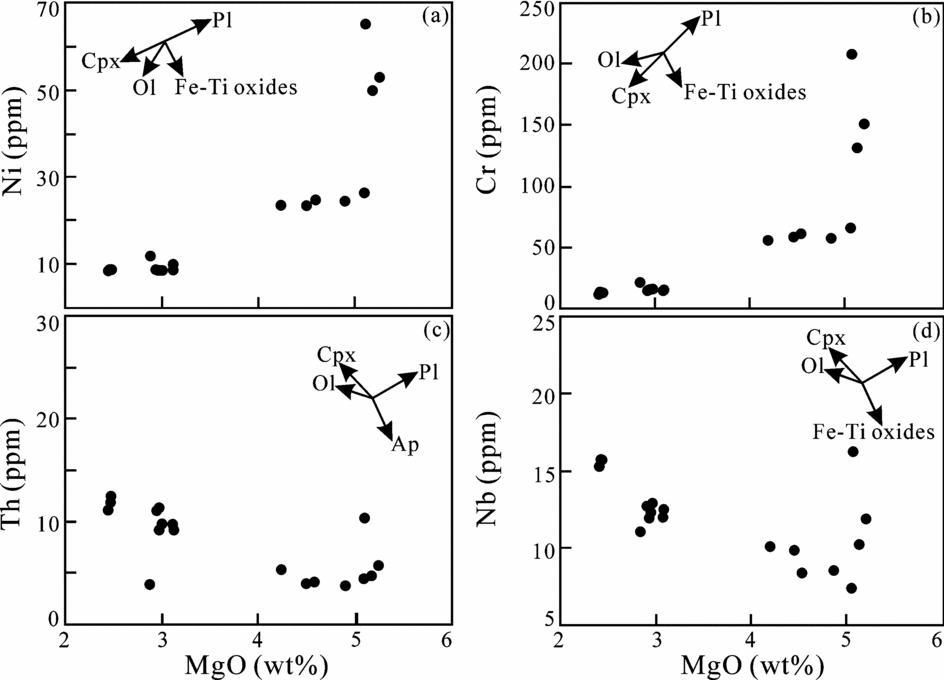
The Rushan complex exhibits a relatively restricted compositional range, with Co of 10.7–31.0 ppm and a slightly wider range of Cr (13.6–211 ppm) and Ni (8.89–66.1 ppm). They have high Sr (948–1321 ppm) and Ba (1657–2267 ppm), and a narrow range of Rb content (38.6–94.7 ppm), combined with Ba/Nb and La/Nb ratios of 112.54–225.57 and 3.67–7.06, respectively. Zr and Nb contents are 90.7–177 ppm and 7.35–16.3 ppm with superchondritic Zr/Hf (39.2–48.3) and Nb/Ta (18.9–25.0) values. Positive correlations between MgO and compatible elements like Cr and Ni can be observed (Fig. 5a, b). The LILE such as Th, and HFSE like Nb, increase moderately as MgO decreases (Fig. 5c, d).
Plots of MgO versus trace elements for the Rushan complex.

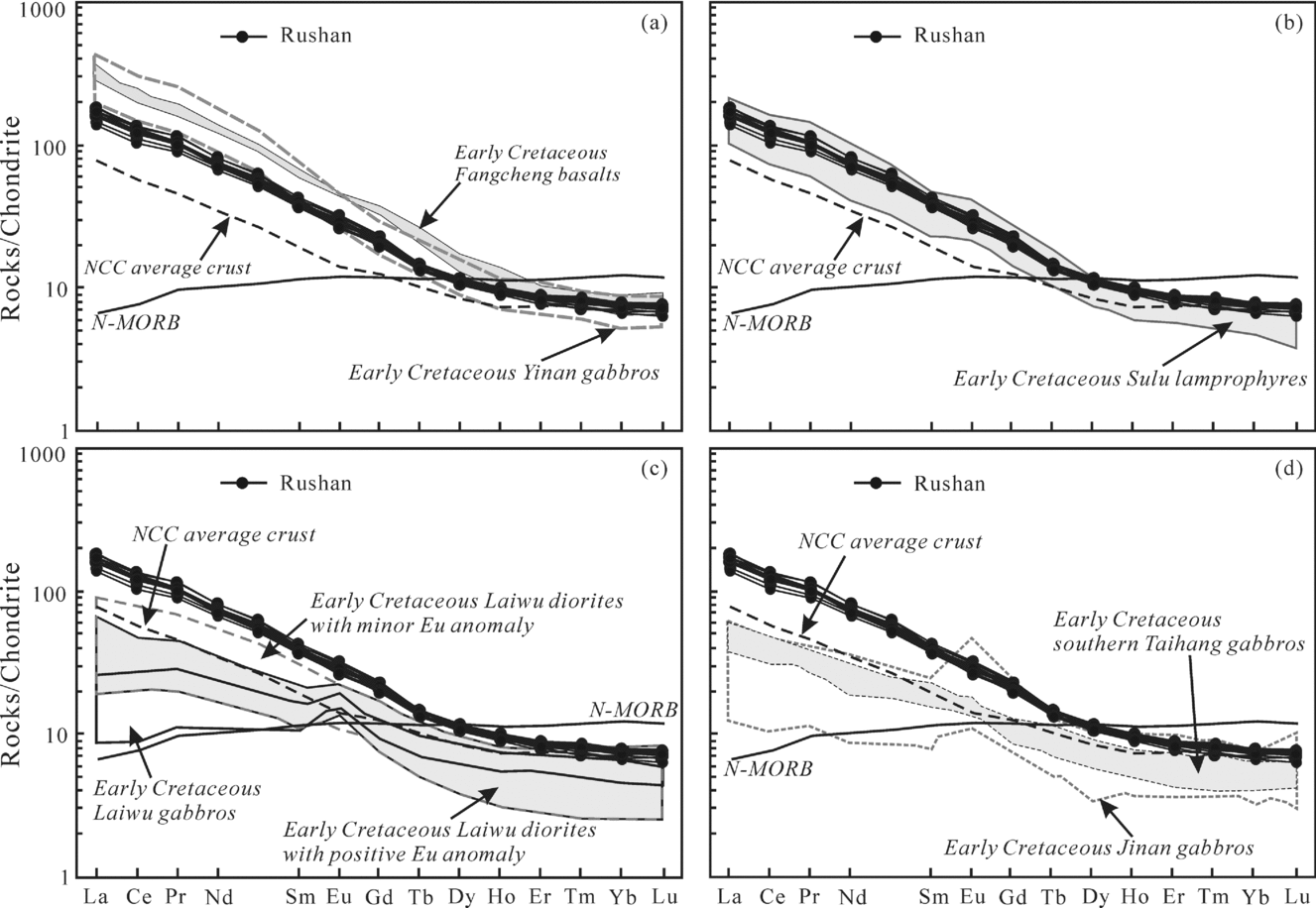
The Rushan rocks exhibit subparallel chondrite-normalized rare earth element (REE) patterns with total REE abundances of 238–303 ppm and display pronounced enrichment of LREE (Fig. 6) with (La/Yb)cn ratios (‘cn’ denotes the values normalized to chondrite) spanning a range of 19.6–24.6. They are completely different from those of ocean floor basalts (N-MORB) and the average crustal composition of the North China Craton (Yan & Chi, Reference Yan and Chi1997). Other features of the REE patterns for the Rushan rocks are marked by (1) less variation in the heavy rare earth elements (HREE) and (2) minor positive or small negative Eu anomalies. The REE pattern of the Rushan complex is distinctive from the igneous rocks of the North China Craton in terms of total REE and LREE/HREE differentiation, but comparable with that of the Sulu lamprophyres (Fig. 6).
Chondrite-normalized REE patterns for the Rushan rocks. Normalization values and N-MORB are from Sun & McDonough (Reference Sun, McDonough, Saunders and Norry1989); average crustal composition of the North China Craton is compiled from Yan & Chi (Reference Yan and Chi1997). For other data sources, see Figure 4.

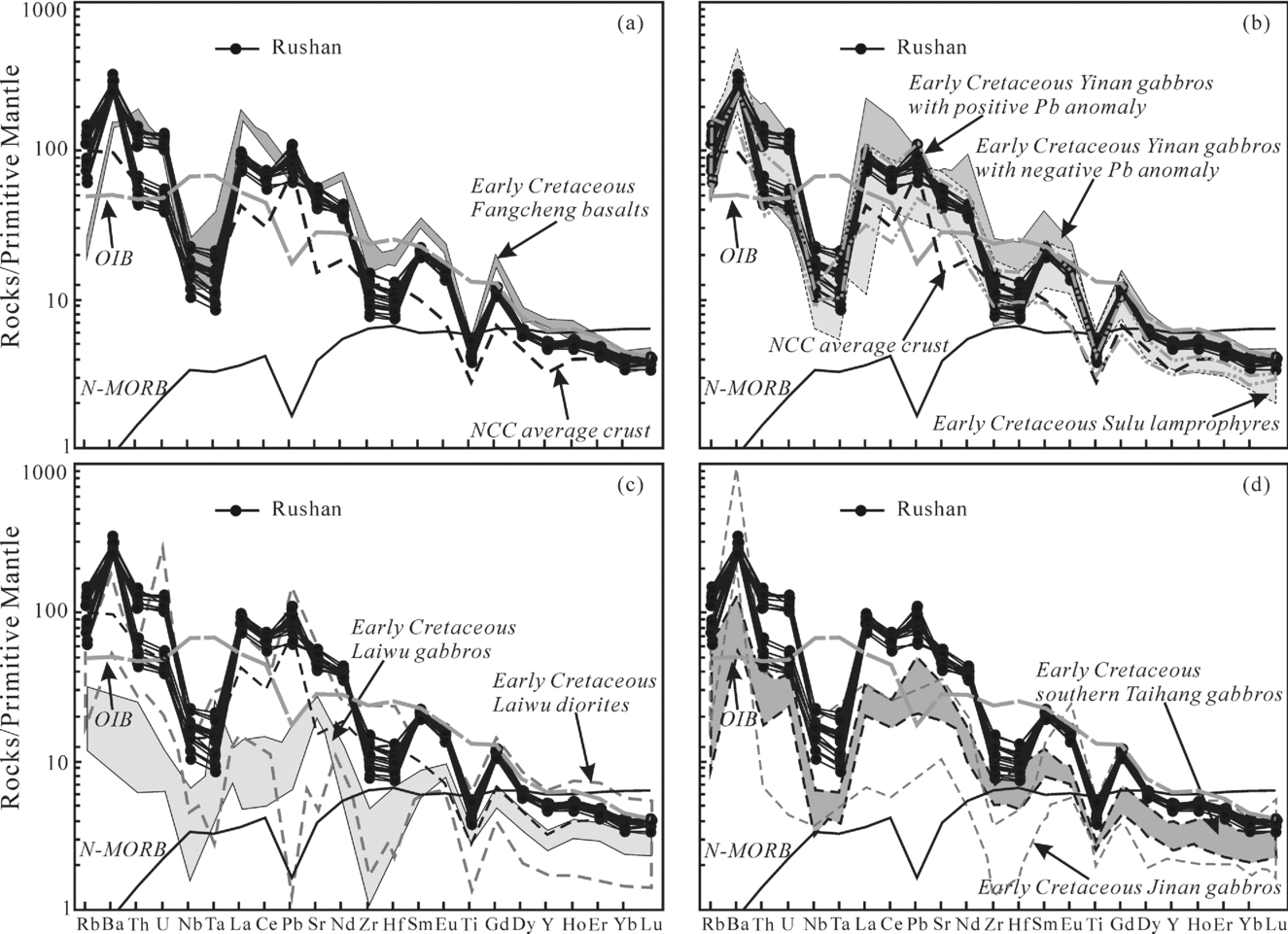
The Rushan rocks show significant negative anomalies in HFSE, coupled with positive Pb and Ba anomalies. U and Th display moderate depletion with regard to Rb, Ba and La (Fig. 7). The pronounced enrichment in LILE and REE relative to HFSE, strongly depleted HFSE and positive Pb anomalies make the Rushan rocks remarkably different from the Oceanic-Island-Basalts (OIB) and N-MORB. The spidergrams of the Rushan rocks not only fall into the distribution range of the Sulu lamprophyres (Fig. 7b), but are also roughly coincident with those of the Fangcheng basalts (Fig. 7a) and Yinan gabbros (Fig. 7b), except for the stronger positive Pb anomalies in the Rushan samples and the generally higher LILE, especially REE in the Fangcheng and Yinan rocks. The Rushan rocks are apparently more enriched in LILE and REE compared to the Laiwu complexes (Fig. 7c), Jinan and southern Taihang gabbros (Fig. 7d).
Primitive mantle-normalized spidergrams for the Rushan rocks. Normalization values, N-MORB, and OIB are from Sun & McDonough (Reference Sun, McDonough, Saunders and Norry1989). For other data sources, see Figure 4.

5.d. Sr–Nd isotopes
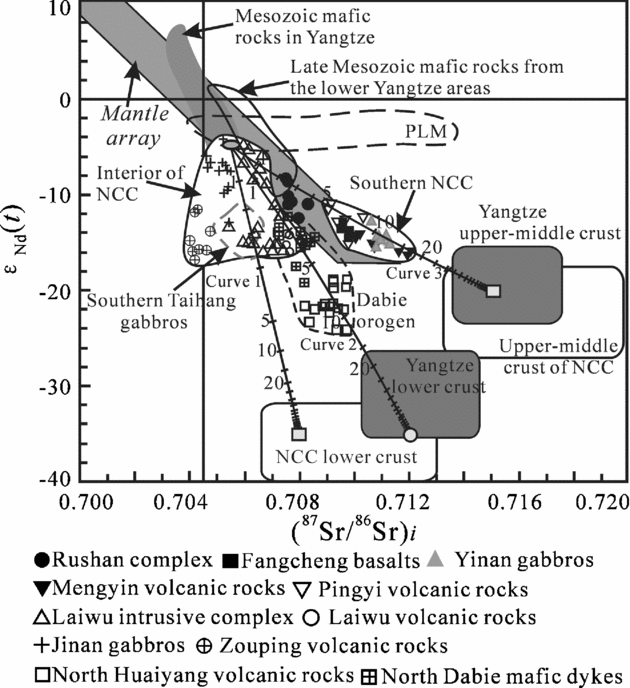
The Rushan rocks span an 87Sr/86Sr range of 0.7078–0.7087 and 143Nd/144Nd a range of 0.5119–0.5122. They have moderately radiogenic (87Sr/86Sr)111 Ma ranging from 0.70746 to 0.70827 and ɛNd(111 Ma) values of −12.4 to −8.3 (Table 2), and display an affinity to an enriched mantle II (EMII)-like source (Fig. 8). The Sr and Nd isotopes of the Rushan complex contrast remarkably with those of the Cenozoic basalts (Zou et al. Reference Zou, Zindler, Xu and Qi2000 and references therein).
Initial 87Sr/86Sr versus ɛNd(t) (t=111 Ma) diagram and the possible mixing models for the generation of the Rushan rocks. Data sources: Mengyin, Pingyi, Laiwu and Zouping volcanic rocks (Ying, Zhou & Zhang, Reference Ying, Zhou and Zhang2006), mafic rocks from the Yangtze Craton (Wang et al. Reference Wang, Fan, Guo and Peng2003) and the lower Yangtze areas (Chen et al. Reference Chen, Yan, Xie, Xu and Xing2001a; Yan et al. Reference Yan, Chen, Xie, Yang, Yu and Qian2005), the Palaeozoic lithospheric mantle (PLM) of the North China Craton (Zheng & Lu, Reference Zheng and Lu1999), the lower and upper–middle crust of the North China Craton and the upper–middle crust of the Yangtze continent are from Jahn et al. (Reference Jahn, Wu, Ching and Chin1999), the Yangtze lower crust is complied from Gao et al. (Reference Gao, Ling, Qiu, Zhou, Hartmann and Simon1999). For other data sources, see Figure 4. Curve 1 refers to the mixing between the PLM and the lower crust of the North China Craton. Curve 2 is the mixing trend of the PLM with the lower crust of the Yangtze continent. Curve 3 notes the trend of source mixing between the PLM and the upper–middle crust of the Yangtze continent. The numbers indicate the percentages of participation of crustal components. The mixing modelling parameters used for the lower crustal composition of the North China Craton are Sr=290 ppm, 87Sr/86Sr=0.70800, Nd=21 ppm, ɛNd(t)=−35; Sr=320 ppm, 87Sr/86Sr=0.71200, Nd=20 ppm, ɛNd(t)=−35 for the Yangtze lower crust, Sr=220 ppm, 87Sr/86Sr=0.71500, Nd=20 ppm, ɛNd(t)=−20 for the upper–middle crust of the Yangtze continent, and Sr=20 ppm, 87Sr/86Sr=0.70550, Nd=1.5 ppm, ɛNd(t)=−5 for the PLM of the North China Craton.

6. Discussion
6.a. Petrogenesis of the Rushan complex
6.a.1. Crustal contamination?
The HFSE depletion, LILE and REE enrichments, and highly enriched Sr–Nd isotopic signatures imply that crustal materials, which occurred either in the source and/or through assimilation en route, may have been involved in the petrogenesis of the Rushan complex.
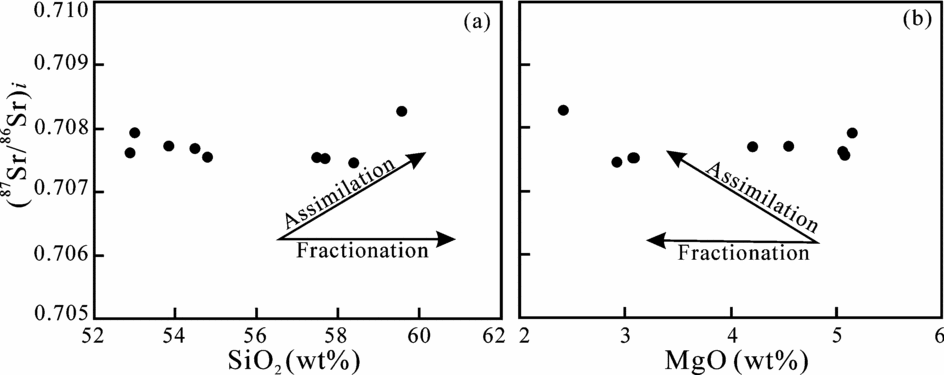
The Jurassic Duogushan granodiorites, as the direct wall-rock of the Rushan complex (Fig. 1c), are the most possible contamination source of the latter. However, the higher abundances of LILE and REE in the Rushan rocks than in the Duogushan granodiorites (Zhang et al. Reference Zhang, Zhai, He, Peng and Xu2004a) suggest that contamination from the Duogushan granodiorites should be unimportant in their petrogenesis. Moreover, the rather uniform Sr isotopic compositions of the Rushan complex (Fig. 9) also indicate that it is impossible for the Duogushan granodiorites contamination to have played an important role in their petrogenesis. Since the Duogushan granodiorites were generated by dehydrational melting of the mafic Yangtze lower crust (Zhang et al. Reference Zhang, Zhai, He, Peng and Xu2004a), the lower crustal contamination may have a significant influence in the magma evolution. Figure 8 shows that all of the Rushan rocks plot far away from the range between mantle reservoirs and the North China Craton lower crust, precluding the North China Craton lower crust contamination. The Yangtze lower crust could be considered a candidate contamination source that is consistent with the observed geochemical characteristics, because the Rushan data point towards that field (Fig. 8). However, the Rushan rocks have extremely high Ba (1657–2267 ppm) and Sr (948–1321 ppm), which are much higher than the continental crust values (390 ppm Ba and 325 ppm Sr: Rudnick & Fountain, Reference Rudnick and Fountain1995), hence the Ba and Sr concentrations exclude the Yangtze lower crustal contamination from having played a significant role in the formation of the Rushan complex.
Diagrams of (87Sr/86Sr)i versus SiO2 (a) and MgO (b) for the Rushan complex.

More complex processes involving crustal assimilation coupled with fractional crystallization (AFC) are expected to result in progressive decreases in Ni, Cr and Mg no., concomitant increase in SiO2 and (87Sr/86Sr)i and negative correlation between MgO and (87Sr/86Sr)i. However, these features are not observed in the Rushan samples (Fig. 9a). The possibility of magma mixing between mantle and crustal-derived magmas is also not favoured, because this process should generate mixing curves in the isotopic correlation diagrams and in plots between isotopic ratios with parameters such as SiO2 or MgO; these mixing curves are also not observed (Fig. 9).
The intermediate composition (SiO2 up to 59.60 wt%) and ‘crust-like’ signatures give cause to speculate about a pure crustal origin for the Rushan complex. The North China Craton has an Archaean lower crust predominantly composed of mafic to felsic garnet granulites (Jahn & Zhang, Reference Jahn and Zhang1984; Chen et al. Reference Chen, O'Reilly, Zhou, Griffin, Zhang, Sun, Feng and Zhang2001b; Zhou et al. Reference Zhou, Sun, Zhang and Chen2002; Huang, Xu & Liu, Reference Huang, Xu and Liu2004), which is a possible source for the Rushan complex. However, the lower crust of the North China Craton as represented by the Hannuoba and Nushan granulites is usually characterized by low Rb contents (mostly <11.2 ppm), very strong Th–U depletion and Zr, Hf enrichment (Huang, Xu & Liu, Reference Huang, Xu and Liu2004 and references therein), features that are different from those in the Rushan rocks. Consequently, the Rushan complex could not be directly derived from the melting of the aged North China lower crust. The lower crust of the Yangtze continent, represented by the Kongling Tonalite–Trondhjemite–Granodiorite (TTG) rocks, has (87Sr/86Sr)111 Ma=0.70674–0.71850, ɛNd(111 Ma)=−48.3 to −15.1(Gao et al. Reference Gao, Ling, Qiu, Zhou, Hartmann and Simon1999; Ma et al. Reference Ma, Ehlers, Xu, Li and Yang2000). Such high initial 87Sr/86Sr ratios and low ɛNd(t) are obviously different from that of the Rushan rocks. The Sr–Nd isotopes rule out the possibility that the Rushan rocks were derived from the partial melting of the Yangtze lower crust. Therefore, we consider the ‘crust-like’ elemental and isotopic signatures of the Rushan rocks to be inherited mainly from their source.
6.a.2. Enriched lithospheric mantle origin
The compositional characteristics of the Rushan rocks are consistent with a fractional mineral assemblage of olivine, clinopyroxene, apatite and Fe–Ti oxides during magma evolution. However, the lowest silica content (52.7 wt%), highest Mg no. (up to 56.1) and relatively high concentrations of Cr (up to 211 ppm) and Ni (up to 66.1 ppm), suggest that the Rushan complex may be derived from a mantle source. Comparison of the N-MORB and OIB, the different REE and trace element compositions, superchondritic Zr/Hf and Nb/Ta, significantly low Nb/U (4.65–12.85) and Ce/Pb (6.11–9.51), and highly enriched Sr–Nd isotopes in the most mafic rocks of the Rushan complex favour an enriched lithospheric mantle origin.
Geochemical and Sr–Nd isotopic data of the Mesozoic igneous rocks (e.g. Guo et al. Reference Guo, Fan, Wang and Lin2001; Xu et al. Reference Xu, Huang, MA, Wang, Yoshiyuki, Xu, Wang and Wu2004a, Reference Xu, Ma, Huang, Yoshiyuki, Chung, Wang and Wub; Fan et al. Reference Fan, Guo, Wang, Lin and Zhang2001; Zhang et al. Reference Zhang, Sun, Zhou, Fan, Zhai and Ying2002; Fan et al. Reference Fan, Guo, Wang and Zhang2004; Wang et al. Reference Wang, Fan, Peng, Zhang and Guo2005; Ying, Zhou & Zhang, Reference Ying, Zhou and Zhang2006) and lamprophyres (Guo et al. Reference Guo, Fan, Wang and Zhang2004), which were negligibly contaminated by crustal components, revealed the existence of an enriched lithospheric mantle beneath the North China Craton and the Sulu–North Dabie orogen. Compared with these rocks from the southern margin of the North China Craton, the source of the Rushan complex only displays slightly lower Sr isotopic ratios and insignificantly higher Nd isotopes (Fig. 8), and the trace element patterns of the Rushan rocks are roughly coincident with the mafic rocks from the southern margin of the North China Craton (Fig. 7a, b). When compared with the Mesozoic igneous rocks from the interior of the North China Craton, the Rushan complex exhibits rather similar ɛNd(t) (Fig. 8). In comparison with the Mesozoic North Huaiyang volcanic rocks and North Dabie mafic dykes that originated from a North China Craton-like lithospheric mantle (Fan et al. Reference Fan, Guo, Wang and Zhang2004; Wang et al. Reference Wang, Fan, Peng, Zhang and Guo2005), the Rushan complex shows just slightly higher ɛNd(t) values and roughly similar initial 87Sr/86Sr. Sr–Nd isotopes of the Rushan complex, however, are much more distinctive from those for the Mesozoic mafic rocks from the Yangtze interior (Wang et al. Reference Wang, Fan, Guo and Peng2003) and lower Yangtze region (Chen et al. Reference Chen, Yan, Xie, Xu and Xing2001a; Yan et al. Reference Yan, Chen, Xie, Yang, Yu and Qian2005). These indicate that the source of the Rushan complex was similar to that within the eastern North China Craton.
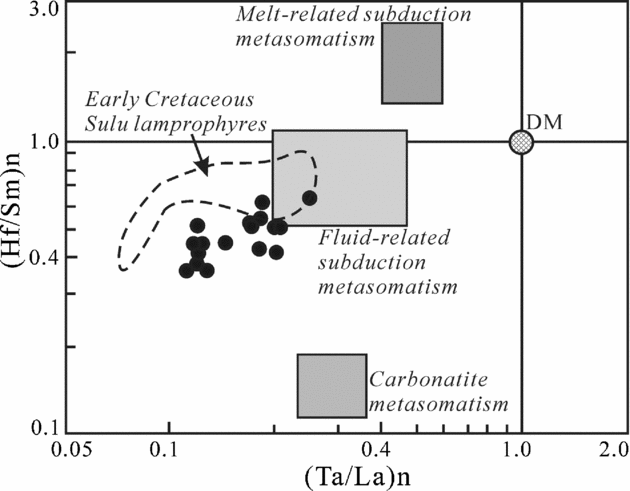
Both Guo et al. (Reference Guo, Fan, Wang and Lin2001) and Ying, Zhou & Zhang (Reference Ying, Zhou and Zhang2006) suggested that carbonatitic melt metasomatism should be prevalent within the interior of the North China Craton lithosphere. Melts derived from a carbonatitically metasomatized source are highly enriched in K2O, Na2O, CaO and FeO, and depleted in Al2O3 and SiO2. These features are inconsistent with the Rushan complex. Instead, the Rushan rocks have high (Hf/Sm)n and low (Ta/La)n ratios that plot far away from the field of carbonatite metasomatism, but close to the field of fluid-related subduction metasomatism (Fig. 10). Moreover, the Rushan complex has sufficient enriched LREE, LILE and higher Sr isotopes compared to the coeval igneous rocks from the interior of the North China Craton (Figs 6c, d, 7c, d, 8), suggesting that the lithospheric mantle for the Rushan complex had undergone stronger metasomatism compared to the interior of the North China Craton lithosphere. Therefore, according to the similar tectonic evolution at both the northern Sulu orogen and the southern North China Craton, it is reasonable to consider that the Rushan complex favours an enriched lithospheric mantle that is tectonically and geochemically affiliated to the southern wedge of the North China Craton.
Diagram of (Ta/La)n versus (Hf/Sm)n for the Rushan complex. ‘n’ denotes the values normalized to the primitive mantle. Sulu lamprophyres are from Guo et al. (Reference Guo, Fan, Wang and Zhang2004). The fields of the subduction and carbonatite-related metasomatism are from La Flèche, Camiré & Jenner (Reference La Flèche, Camiré and Jenner1998).

Metasomatism within the lithospheric mantle as reflected by the Rushan complex could be associated with the subduction/collision processes (Fig. 10). The superchondritic Zr/Hf and Nb/Ta ratios in the Rushan complex cannot be simply explained by analytical errors, but probably imply unusual metasomatic agents. It is accepted that if rutile is a metasomatic mineral extracted from the UHP rocks, the resulting metasomatized mantle will have superchondritic Nb/Ta values (Guo et al. Reference Guo, Fan, Wang and Zhang2004). Therefore, the observed Nb/Ta fractionation in the Rushan complex favours a rutile-rich metasomatic agent, in agreement with the rutile exsolution in garnet from the adjacent UHP rocks (Ye, Cong & Ye, Reference Ye, Cong and Ye2000), and we infer that the mantle of the Rushan complex was also metasomatized by rutile-bearing melts released from the subducted Yangtze crust. Zhang et al. (Reference Zhang, Sun, Zhou, Fan, Zhai and Ying2002) proposed that the enriched Mesozoic lithospheric mantle beneath the southern wedge of the North China Craton may have evolved from that in the early Palaeozoic through extensive interaction with the melts derived from the subducted Yangtze lower crust (Zhang et al. Reference Zhang, Ying, Shimoda, Kita, Morishita, Shao and Tang2007). A simple Sr–Nd isotopic modelling also shows that the involvement of 2–4% Yangtze upper–middle crust and 1.5–3% Yangtze lower crust into the Palaeozoic lithospheric mantle (Fig. 8) could account for the observed Sr–Nd isotopic features of the Rushan complex.
6.b. Nature of the enriched lithospheric mantle
Occurrence of a significant amount of biotite, and the relatively high K2O contents (1.96–3.86 wt%) of the Rushan complex, indicate the existence of a hydrous and potassic phase in the source region. Phlogopite and potassium-rich amphibole may be the candidates. Melts in equilibrium with phlogopite are expected to have higher Rb/Sr (>0.1) and lower Ba/Rb (<20) ratios (Furman & Graham, Reference Furman and Graham1999). However, the Rushan rocks have lower Rb/Sr (0.03–0.1) and higher Ba/Rb (21.30–43.4) ratios, suggesting an amphibole-bearing source.
Significant Sr and Ba enrichment in the Rushan samples could be regarded as evidence for the presence of plagioclase in the source region. This coincides with the lack of a significant Eu anomaly and plagioclase fractionation for the Rushan rocks. Garnet is refractory during mantle partial melting and is usually retained in the melting source as a major residual mineral (Guo et al. Reference Guo, Fan, Wang and Lin2001) to host HREE. However, the relatively high HREE abundances (Y>21.6 ppm, Yb>1.64 ppm) of the Rushan rocks indicate that the residual garnet is not evident in the mantle source. Such geochemical features are different from those of the Archaean TTG rocks and adakites (Defant & Drummond, Reference Defant and Drummond1990). Garnet is usually believed to be stable at depths more than 80 km in the lithospheric mantle (McKenzie & O'Nions, Reference McKenzie and O'Nions1991). Therefore, the lithospheric mantle of the Rushan complex was spinel facies with a depth of possibly less than 80 km.
The Rushan rocks generally show higher Al2O3 contents compared to the Mesozoic igneous rocks in the North China Craton and the Dabie–Sulu orogen (Fig. 4d). Al2O3 is an incompatible constituent and would first be melted during partial melting in the mantle environment, so the melting source should have had a relatively high content of Al2O3. Minerals that host Al2O3 in the lithospheric mantle include garnet, spinel and clinopyroxene. Since garnet is not evident in the melting source and spinel is usually considered to be an accessory mineral constituting a low proportion of the lithospheric mantle, the high Al2O3 contents in the Rushan rocks require the mantle source to have contained a relatively higher proportion of clinopyroxene.
In summary, the source of the Rushan complex was a clinopyroxene-rich spinel-facies mantle. Such a mantle is not only different from the Palaeozoic refractory lithosphere, but also contrasts with the fertile one in the Cenozoic, and records the metasomatism by the melts/fluids derived from the subducted Yangtze crust.
6.c. Implications for lithospheric mantle thinning and evolution
It is difficult to associate the Rushan intrusion with the Triassic subduction/collision, because the formation of the Rushan complex took place at 111 Ma, which significantly post-dates the Triassic subduction/collision between the North China and Yangtze cratons at c. 230 Ma (Li et al. Reference Li, Xiao, Liou, Chen, Ge, Zhang and Sun1993). Moreover, the Early Cretaceous magmatism is widespread over the eastern North China Craton. Therefore, we propose that the intrusion of the Rushan complex is related to the post-orogenic extensional regime caused by asthenospheric upwelling. The slab-derived fluids and melts released during the amphibolite-facies retrogressive processes related to the exhumation of the pre-subducted slab would progressively migrate up, perturb and metasomatize the overlying lithospheric mantle. The generation of the Rushan intrusion may have proceeded in two steps: (1) the early-stage metasomatism of the northern Sulu lithospheric mantle caused by fluids and melts released from the exhumed Yangtze slab; (2) a post-orogenic extension (c. 111 Ma) corresponding to the widespread removal of the North China cratonic keels due to asthenosphere upwelling, subsequently triggering the melting of the pre-existing metasomatized enriched lithospheric mantle.
Various models have been proposed to interpret the considerable Phanerozoic lithospheric thinning and evolution beneath the eastern North China Craton. Zheng et al. (Reference Zheng, O'Reilly, Griffin, Lu, Zhang and Pearson2001, Reference Zheng, Griffin, O'Reilly, Yang and Zhang2006b) considered that the lithospheric destruction was accompanied by the collision between the North China and Yangtze cratons in Early Mesozoic times and suggested the replacement of old refractory lithospheric mantle by young oceanic lithosphere to account for the removal of the Archaean keels in Late Mesozoic times. Zhang et al. (Reference Zhang, Sun, Zhou, Fan, Zhai and Ying2002, Reference Zhang, Sun, Zhou, Zhou, Fan and Zheng2003) proposed that this modification was triggered by the addition of melts from the subducted Yangtze continental lithosphere. Subsequent melt–peridotite interaction efficiently transformed the Palaeozoic cratonic lithospheric mantle into enriched Mesozoic lithospheric mantle (Zhang, Reference Zhang2005). Xu (Reference Xu2001) advocated the importance of thermo-mechanical erosion (Menzies & Xu, Reference Menzies, Xu, Flower, Chung, Lo and Lee1998; Xu et al. Reference Xu, Huang, MA, Wang, Yoshiyuki, Xu, Wang and Wu2004a) from the base of the lithosphere and subsequent chemical erosion caused by asthenospheric upwelling. Wang et al. (Reference Wang, Zhao, Zou, Li, Liu, Wu, Xu and Zhang2007) put forward the importance of the magmatic underplating and subsequent crust–mantle interaction accompanied by asthenospheric upwelling.
A ‘continental roots–plume tectonics’ model has been adopted to describe the configuration and dynamic evolution of the subcontinental lithosphere beneath Eastern China by Deng et al. (Reference Deng, Mo, Zhao, Wu, Luo and Su2004, Reference Deng, Su, Niu, Liu, Zhao, Zhao, Zhou and Wu2007), who proposed a plume-like asthenospheric upwelling beneath Eastern China to account for the dramatic lithospheric thinning. However, there is no direct evidence for the existence of mantle plume activities during Mesozoic times. Helium isotopic data from the Tertiary igneous rocks of the Shandong peninsula are all lower than MORB, suggesting that there is no significant contribution from a high 3He/4He primordial component that is required in plume-related reservoirs (Tang et al. Reference Tang, Zheng and Yu2007). Therefore, it is not convincing to correlate the lithospheric thinning with the arrival of a large mantle plume during the Phanerozoic. Delamination is usually triggered by lower crustal thickening, accompanied by the lowermost crust sinking into the underlying asthenosphere. If this is the case, involvement of such large amounts of lower crustal materials should be recorded in the upwelling asthenosphere, which gradually cooled and descended to form the Cenozoic oceanic depleted mantle (Zheng et al. Reference Zheng, Griffin, O'Reilly, Liou, Zhang and Lu2005a, Reference Zheng, Griffin, O'Reilly, Yang, Li, Zhang, Zhang and Liou2006a). As indirect evidence, noble gas and mantle fluid compositions of the peridotitic olivines from the Cenozoic basalts revealed the existence of oceanic depleted mantle with the involvement of recycled young oceanic crust materials beneath the eastern North China Craton (Tang, Zheng & Yu, Reference Tang, Zheng, Chen and Ye2007). In other words, the present noble gas and mantle fluid results also do not favour the delamination model. Zhai et al. (Reference Zhai, Fan, Zhang, Sui and Shao2007) and Wang et al. (Reference Wang, Zhao, Zou, Li, Liu, Wu, Xu and Zhang2007) are also in agreement, both arguing that it would be difficult for the delamination process to act on the whole eastern North China Craton and remove 80–120 km of the lithospheric mantle. The lithospheric mantle thinning might not have completely finished, since the mantle source reflected by the Rushan complex still preserves a cratonic mantle signature rather than asthenospheric features; this indicates that the lithospheric thinning was a successive process rather than a sudden delamination (Gao et al. Reference Gao, Rudnick, Yuan, Liu, Liu, Xu, Ling, Ayers, Wang and Wang2004; Wu et al. Reference Wu, Yang, Wilde and Zhang2005b).
Comprehensive geochemical investigations of the igneous rocks demonstrated that the Mesozoic lithospheric mantle was laterally heterogeneous beneath the North China Craton (Zhang et al. Reference Zhang, Sun, Zhou, Fan, Zhou and Zhai2004b). The Rushan complex has LREE and LILE that are less enriched (Figs 6, 7) compared to the Fangcheng basalts and Yinan gabbros. These indicate that the Rushan complex was derived from a shallower mantle source that experienced a lower degree of modification and metasomatism, while the Fangcheng and Yinan rocks were from a deeper mantle source with a higher degree of modification. This is consistent with the Sr and Nd isotopic model, in which the involvement of 2–4% Yangtze upper–middle crust and 1.5–3% Yangtze lower crust into the Palaeozoic lithospheric mantle could reasonably account for the observed Sr–Nd isotopic features of the Rushan rocks, while mixing of the Palaeozoic mantle with nearly 7–8% Yangtze upper–middle crust could have produced the Fangcheng basalts, and 9–12% Yangtze upper–middle crust in the Palaeozoic lithospheric mantle could account for the Yinan gabbros (Fig. 8). Such differences indicate that the southern margin of the North China Craton was also vertically heterogeneously modified by fluids/melts released from the subducted Yangtze crust. At the southern wedge of the North China Craton, the Yangtze block was subducted beneath the base of the overriding lithospheric mantle due to its buoyancy relative to the surrounding mantle. Subsequently, the fluids and melts released from the subducted crustal materials would progressively infiltrate and metasomatize the overriding lithospheric mantle. The shallow lithospheric mantle would undergo relatively weaker metasomatism and modification compared to the deeper source, such as is the case for the Rushan complex and rocks from the southern North China Craton.
Vast Early Cretaceous magmatism and occurrences of metamorphic core complexes (Wu et al. Reference Wu, Lin, Wilde, Zhang and Yang2005a; Yang et al. Reference Yang, Wu, Chung, Lo, Wilde and Davis2007) indicated the extensional tectonic regime in the eastern North China Craton during Late Mesozoic times, corresponding to the extensive asthenospheric upwelling. This triggered the decompressional melting of the pre-modified lithospheric mantle. The deeper lithospheric mantle with a relatively higher degree of modification and metasomatism would melt earlier, resulting in the formation of Fangcheng basalts and Yinan gabbros. As the progressive asthenospheric upwelling and accompanying lithospheric thinning occurred, the less modified shallow lithospheric mantle would begin to melt, producing magmas such as the Rushan complex. This means that the enriched Mesozoic lithospheric mantle beneath the southern North China Craton evolved from its Palaeozoic refractory counterpart through different degrees of interaction with the subducted Yangtze crust-derived melts/fluids, further suggesting a vast secular evolution of the lithospheric mantle. This Mesozoic enriched lithospheric mantle was then successively thinned by partial melting or erosion and finally replaced by the Cenozoic fertile mantle (Fan et al. Reference Fan, Zhang, Baker, Jarvis, Mason and Menzies2000) through descent and accretion of the upwelling asthenospheric materials (Zheng et al. Reference Zheng, Griffin, O'Reilly, Liou, Zhang and Lu2005a, Reference Zheng, Griffin, O'Reilly, Yang, Li, Zhang, Zhang and Liou2006a).
7. Conclusions
The Early Cretaceous (c. 111 Ma) Rushan complex in the northern Sulu orogen consists of biotite-bearing gabbro and pyroxene-bearing diorite. The rocks have low MgO, high Al2O3 and moderate TiO2, and show high-K calc-alkaline affinities. The significant enrichment in LILE and LREE, pronounced depletion in HFSE and EMII-like Sr–Nd isotopic composition suggest that they were derived from a spinel-facies cratonic mantle. The lithospheric mantle source of the Rushan complex is tectonically affiliated to the southern wedge of the North China Craton and was previously metasomatized by fluids/melts released from the subducted Yangtze continent. Melting of the mantle resulted from an extensional regime corresponding to the asthenospheric upwelling during gradual erosion and replacement of the cratonic lithosphere by the fertile materials.
Acknowledgements
The authors would like to thank Mr S. Zheng for his help in the CL image photos, Professors Y. S. Liu and W. L. Ling for their help in zircon dating and geochemical analysis, and Dr J. F. Ying for the isotopic mixing calculation. We express our gratitude to Drs David Pyle, Neng Jiang and an anonymous reviewer for their thoughtful suggestions and constructive comments. Mrs J. Holland is also thanked for her helpful editorial efforts. This work was support by the Chinese National Science Foundation (90714002, 40425002 and 40602009) and the Open Research Program of the State Key Laboratory of Geological Processes and Mineral Resources (GPMR200611).