Introduction
As a result of global population aging, dementia has emerged as an important public health problem. In 2005, it was estimated that there were 24.3 million people with dementia worldwide, with 4.6 million new cases annually (one new case every seven seconds). The number of people affected is likely to double every 20 years to reach 81.1 million by 2040 (Ferri et al., Reference Ferri2005). In recent years, early detection and intervention have been emphasized – efforts to reduce the risk or delay the onset of dementia are likely to be most effective in the early stages (Weuve et al., Reference Weuve, Kang, Manson, Breteler, Ware and Grodstein2004; Verghese et al., Reference Verghese2006). Research into the preservation of cognitive function in the elderly is of increasing public health importance.
In late life, leisure activities constitute a major part of daily life and assume the roles of providing the cognitive stimulation, social engagement and physical exercise that were earlier offered by school or employment. A mounting body of literature has addressed the beneficial effects of leisure activity participation on cognitive function. Data from both animal and human studies have suggested various mechanistic pathways, ranging from changes at the molecular or cellular level to a general impact on health. The three main hypotheses relating cognitive function to leisure activities are the reserve hypothesis, the vascular hypothesis and the stress hypothesis (Fratiglioni et al., Reference Fratiglioni, Paillard-Borg and Winbald2004). Although the evidence from the rich neurobiological literature seems promising, the interpretation of available clinical data is hampered by marked conceptual discrepancies and methodological variations, as has been highlighted in a previous review (Leung and Lam, Reference Leung and Lam2007). For instance, the concept of leisure activities is intuitively accessible, but in practice is difficult to standardize, classify and measure. Various theoretical definitions and operationalizations of activity engagement have been used, and activities have been categorized in several ways. Most activities involve varying degrees of intellectual, physical and social components, but it is unclear how these components should be quantified or prioritized, particularly across diverse cultural and socioeconomic contexts. Leisure activities may be geographically or culturally specific, and thus any classification will need to be tailor-made for different regions and ethnicity. In addition, a wide range of cognitive assessments has been employed in previous studies, from very short global tests to tests of multiple cognitive domains. It remains to be determined whether general cognitive status or only specific cognitive domains are modulated by different leisure activities. Control for relevant variables is another crucial issue, as many factors may influence, or relate to, a person's lifestyle; such factors may also be associated with cognitive function. The objective of this study was to examine the association of late-life leisure activity participation with cognitive function in community-dwelling elderly Chinese in Hong Kong, and to address some of these methodological issues.
Methods
Study design and participants
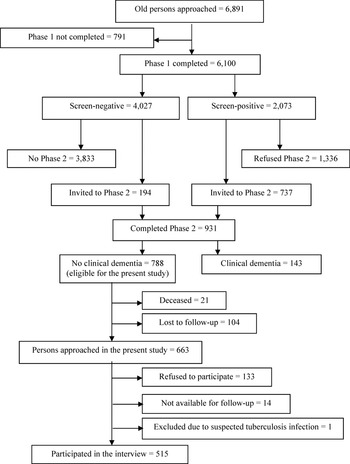
This study constituted part of the follow-up study of a population-based community survey of the prevalence of cognitive impairment in Hong Kong elderly Chinese (Lam et al., Reference Lam2008). The survey was conducted from October 2005 to July 2006 (see Lam et al., Reference Lam2008 for full details). In short, a total of 6,891 people aged 60 years and over were randomly sampled from the non-institutionalized population in Hong Kong. Subsequently, 6,100 persons were successfully screened using the Cantonese version of the Mini-mental State Examination (CMMSE) (Chiu et al., Reference Chiu, Lee, Chung and Kwong1994) and the Abbreviated Memory Inventory for the Chinese (AMIC) (Lam et al., Reference Lam, Lui, Tam and Chiu2005). Those who were screen-positive and 5% of the randomly recruited screen-negative elderly were invited to be examined for dementia following a standardized protocol. Clinical dementia was defined according to the criteria of the Diagnostic and Statistical Manual of Mental Disorders, 4th edition (DSM-IV) (American Psychiatric Association, 1994) and the severity was determined by the global Clinical Dementia Rating (CDR) (Hughes et al., Reference Hughes, Berg, Danziger, Coben and Martin1982; Morris, Reference Morris1993). Eventually, 931 people completed the assessment, 143 of whom had a diagnosis of clinical dementia (CDR ≥ 1). The remaining 788 persons not suffering from clinical dementia constituted the sample for the present study (Figure 1).
Flow chart of the study (adopted and simplified from Lam et al., Reference Lam2008)

The 788 persons of the present study met the following eligibility criteria: (1) they were aged 60 years and over and living in the community at baseline, and (2) they had no diagnostic criteria for clinical dementia at baseline. The present study was conducted between August 2007 and June 2008. Eligible participants were contacted either by phone or by post. Participants who agreed to a follow-up assessment were invited for an interview either at a regional social centre or in their own home. Information was collected by trained research assistants and psychiatrists through face-to-face interviews using standardized questionnaires and a battery of cognitive assessment tools. The interviewers were blind to all of the previously collected data. Written informed consent was obtained from each participant, or a relative where the participant was not fit to give consent. To enhance the accuracy of the data collection, additional information was obtained from relatives or through the inspection of prescribed medications and medical records kept by the participants. The whole assessment took approximately an hour to complete. The study was approved by the ethics committees of the Chinese University of Hong Kong and the Department of Health of the Government of the Hong Kong Special Administrative Region.
Variables
Predictor variable
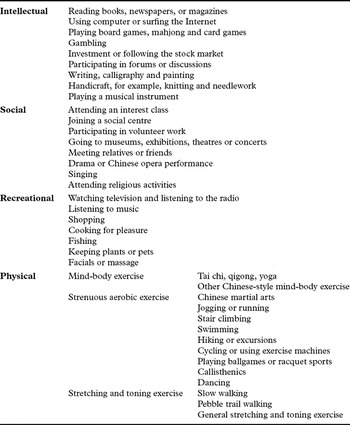
Leisure activities were defined as activities in which individuals engage for enjoyment or well-being and which are independent of work or the activities of daily living (Verghese et al., Reference Verghese2006). To enable a valid categorization, the leisure activities in which local elderly people commonly engaged had been identified and classified into physical, intellectual, social and recreational categories with the help of a focus group comprising elderly care professionals, an independent panel of occupational therapists in the field of geriatrics and psychiatry, and a convenience sample of community elderly (Table 1). The participants were asked whether they engaged in any leisure activities using the leisure activity checklist. They were asked to specify the types of activities and the extent of engagement by reporting the frequency and duration of their participation in each activity. To capture the activities in which the participants engaged regularly and constantly, activities performed at frequencies of less than monthly were excluded, as in another recent study (Niti et al., Reference Niti, Yap, Kua, Tan and Ng2008). Adopted and modified from previous studies (Verghese et al., Reference Verghese2003; Reference Verghese2006; Podewils et al., Reference Podewils2005; Sturman et al., Reference Sturman, Morris, Mendes de Leon, Bienias, Wilson and Evans2005; Wang et al., Reference Wang2006), the level of participation in each activity category was measured in three ways: total hours per week, total frequency and total number of subtypes. The frequency of participation was coded to generate a scale on which one point corresponds to participation in one activity for one day per week. For each activity, the participants received 7 points for daily participation, 4 points for participating several days per week, 1 point for weekly participation, 0.5 point for biweekly participation, 0.25 for monthly participation and 0 for participating less than monthly or never.
Classification of leisure activities

Outcome variables
For the interviews conducted in social centers, a more extensive cognitive assessment was performed. This included the administration of the Chinese version of the Alzheimer's Disease Assessment Scale – Cognitive Subscale (ADAS-Cog) (Chu et al., Reference Chu, Chiu, Hui, Yu, Tsui and Lee2000), the CMMSE, 10-minute delayed recall, digit span test and the category verbal fluency test (CVFT) (Chiu et al., Reference Chiu1997). For the in-home interviews, the Chinese ADAS-Cog was replaced by word list learning and 10-minute delayed recall due to limitations of time and the physical environment. These tests are briefly described here:
1. The Chinese ADAS-Cog is an 11-item scale with scores ranging from 0 to 70, with higher scores indicating greater severity. It includes components of memory, language and praxis, and is considered a sensitive test to monitor changes in cognitive function. It has been shown to be reliable and valid among the elderly Chinese in Hong Kong (Chu et al., Reference Chu, Chiu, Hui, Yu, Tsui and Lee2000).
2. The CMMSE is a standard clinical test for global cognitive function. The maximum score is 30 points, with higher scores indicating better cognitive performance. It assesses various domains, including orientation, registration, attention and calculation, recall, language and visual construction. It has been validated locally with satisfactory reliability and validity (Chiu et al., Reference Chiu, Lee, Chung and Kwong1994).
3. Digit span assesses auditory verbal short-term (working) memory, attention and concentration. In the test, subjects are required to repeat strings of digits of increasing length in forward and reverse order. The version used in this study was adopted from the Wechsler Memory Scale, and both the forward and backward measures were recorded.
4. The CVFT is a test of language, semantic memory and executive function (initiation). Subjects are asked to generate as many exemplars as possible from semantic categories, including animals, fruits and vegetables, in one minute. The total number of correct items was obtained.
5. Word list learning provides a measure of immediate recall. Subjects are required to learn a list of ten common words over three successive trials. The mean error score was recorded, and the higher the score, the poorer the performance. For delayed recall, subjects are asked to recall as many words as possible after ten minutes. The number of correct answers was counted.
Other variables
Sociodemographic data and lifestyle characteristics, including age, sex, marital status, education, longest occupation in life, residential arrangements, household composition, and drinking and smoking habits, were obtained. Depressive symptoms were assessed using the Cornell Scale for Depression in Dementia (CSDD) (Alexopoulos et al., Reference Alexopoulos, Abrams, Young and Shamoian1988). Feelings of loneliness were rated using the Chinese version of the six-item De Jong Gierveld Loneliness Scale (Leung et al., Reference Leung, Gierveld and Lam2008). Both scales have been shown to be valid measures among elderly Chinese (Lam et al., Reference Lam, Lim, Low, Ng, Chiam and Sahadevan2004; Leung et al., Reference Leung, Gierveld and Lam2008). Self-reported medical history and sensory impairment were scored using the Cumulative Illness Risk Scale (CIRS) (Conwell et al., Reference Conwell, Forbes, Cox and Caine1993). Diagnoses related to cerebrovascular risk factors (CVRF) (Goldstein et al., Reference Goldstein2006), including cardiovascular diseases (coronary heart disease, heart failure, peripheral arterial disease), hypertension, diabetes mellitus, arrhythmia and dyslipidemia, were counted. Self-rated health and physical mobility were also recorded.
Statistical methods
The sample size estimation was performed using Power and Precision software version 3.0 (Biostat, Englewood, NJ, U.S.A.). The sample size was estimated based on the incidence of cognitive impairment from a previous study in Hong Kong (Ho et al., Reference Ho, Woo, Sham, Chan and Yu2001). In that study, the estimated three-year incidence of cognitive impairment in a non-demented population was 14.1%. Elderly who did not participate in any physical activity (30.2%) were reported to have an odds ratio (OR) of 2.1 (95% confidence interval 1.1–3.3) of increased risk of cognitive impairment. Based on this information, it was estimated that a sample of 500 subjects would be able to detect a significant difference with a power of 78% and α of 0.05.
Multivariate linear regression analyses were performed to examine the association between leisure activity participation and cognitive function. The dependent variables were the scores of the various cognitive tests. The independent variables included the total frequency, total hours per week and total number of subtypes for each activity category and for all of the categories. The statistical models examined the independent association between each activity category and cognitive function, whilst controlling for the other three categories, and also the association between overall activity participation and cognitive function. The models were adjusted for covariates significantly associated with cognitive function.
The correlation between cognitive performance and potential confounding factors was examined using the Pearson correlation coefficient for normally distributed variables and the Spearman rank correlation coefficient for non-parametric variables. The factors considered were age, sex, education, longest occupation in life, the baseline CMMSE score, the subscores and overall score of the Chinese six-item De Jong Gierveld Loneliness Scale, the CIRS score, number of CVRF diagnoses, the CSDD score, self-rated health, sensory impairment, mobility, presence of cerebrovascular accident (CVA), transient ischemic attack (TIA), Parkinson's disease and schizophrenia, and drinking and smoking status. Factors found to be significantly associated with the dependent variables were entered as covariates.
All analyses were performed using the Statistical Package for Social Sciences (SPSS) software version 15.0 (SPSS, Chicago, IL, U.S.A.). The level of statistical significance was set at p < 0.05 with a two-tailed distribution.
Results
Characteristics of the sample
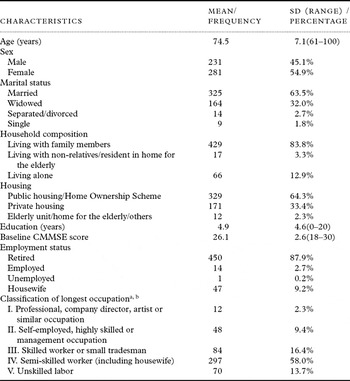
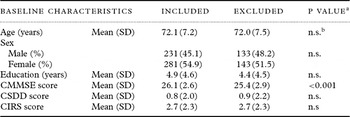
Of the 788 people in the sample, 21 (2.7%) died and 104 (13.2%) were lost to follow-up. Of the remaining 663 people, 133 (16.9%) declined participation, one person was excluded because of suspected active tuberculosis infection, and 14 (1.8%) were not available for follow-up because of hospitalization or being away from Hong Kong. Thus, 515 elderly people (65.4%) participated in the interviews, with a mean follow-up interval of 22.3 months (SD 3.5) (see Figure 1). Three of the participants were excluded from the analyses due to incomplete data, leaving 512 participants in the final analyses. The characteristics of the 512 participants are shown in Table 2. The sample had a mean age of 74.5 years (SD 7.1; range 61–100) and 45.1% were male. The mean education in years was 4.9 (SD 4.6; range 0–20) and the baseline mean CMMSE score was 26.1 (SD 2.6). The differences in baseline characteristics between those included in the analyses (N = 512) and those not included (N = 276) were evaluated. The included participants had a higher CMMSE score (p < 0.001), but no significant differences were found in the age, sex, education, and CSDD and CIRS scores of the two groups (Table 3). About 84% of the participants reported that they did some exercise. Those who did not engage in exercise gave reasons such as engagement in other activities, poor health and lack of interest. Almost all participants (99%) were involved in some intellectual, social and recreational activities.
Characteristics of the participants included in the analyses

aThe classification was adopted and modified from Schmand et al., Reference Schmand, Smit, Geerlings and Lindeboom1997.
bData from one participant are missing.
CMMSE = Cantonese version of the Mini-mental State Examination
Comparison of the baseline characteristics of the included and excluded participants

ap value: χ2 tests for comparison of categorical data, independent samples t tests for normally distributed data and the Mann-Whitney U test for non-parametric data.
bn.s.: non-significant, p > 0.05.
CMMSE = Cantonese version of the Mini-mental State Examination; CSDD = Cornell Scale for Depression in Dementia; CIRS = Cumulative Illness Risk Scale
Leisure activity participation and cognitive function
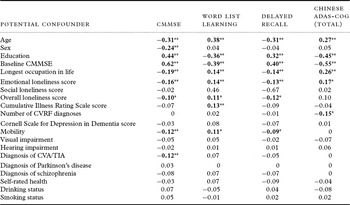
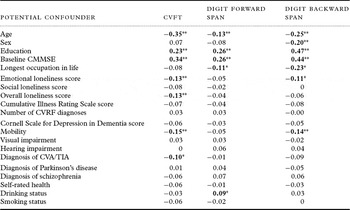
Correlation analyses of the scores of the different cognitive tests and potential confounders showed that there was a consistent, statistically significant correlation between the scores and age, education and the baseline CMMSE score. Other important confounders included the longest occupation in life, the loneliness score and mobility (Tables 4 and 5). Potential confounders that were significantly associated with the scores were included in the multivariate linear regression models.
Correlation between potential confounders and the CMMSE, word list learning, delayed recall and the Chinese ADAS-Cog (total) scoresa

**Correlation significant at the 0.01 level (two-tailed).
*Correlation significant at the 0.05 level (two-tailed).
a p value calculated using the Pearson correlation coefficient for normally distributed continuous variables and the Spearman rank correlation coefficient for non-parametric variables.
Note: Statistically significant coefficients are set in bold type.
CMMSE = Cantonese version of the Mini-mental State Examination; CVRF = cerebrovascular risk factors; CVA/TIA = cerebrovascular accident/transient ischemic attack
Correlation between potential confounders and the category verbal fluency test and digit span scoresa

**Correlation significant at the 0.01 level (two-tailed).
*Correlation significant at the 0.05 level (two-tailed).
a p value calculated using the Pearson correlation coefficient for normally distributed continuous variables and the Spearman rank correlation coefficient for non-parametrically distributed variables.
Note: Statistically significant coefficients are set in bold type.
CMMSE = Cantonese version of the Mini-mental State Examination; CVFT = category verbal fluency test; CVRF = cerebrovascular risk factors; CVA/TIA = cerebrovascular accident/transient ischemic attack
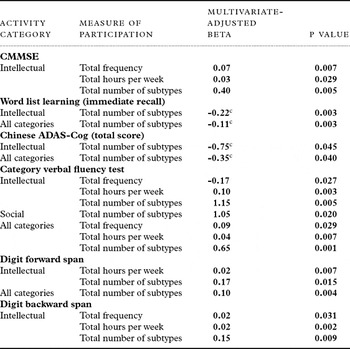
Multivariate linear regression was performed to demonstrate the association between leisure activity participation and performance in the cognitive tests. Only statistically significant findings were shown (Table 6). There were no significant findings on delayed recall, hence the results are not shown.
Multivariate linear regression of leisure activity participation on the performance of the CMMSE, word list learning, the Chinese ADAS-Cog (total score), the category verbal fluency test and digit spana,b

aOnly the statistically significant results are shown.
bAll of the models included the following covariates entered simultaneously: age, education and baseline CMMSE score. Other covariates were entered when found to be significantly associated with the corresponding scores. The independent association of each activity category was studied while controlling for participation in the other three categories.
cA negative sign indicates a negative association. For word list learning (immediate recall) and the Chinese ADAS-Cog, a higher score denotes greater severity.
CMMSE = Cantonese version of the Mini-mental State Examination
A higher level of participation in intellectual activities had a significant and positive association with performance in various cognitive tests, including the CVFT (p = 0.027, 0.003 and 0.005), the CMMSE (p = 0.007, 0.029 and 0.005) and digit backward span (p = 0.031, 0.002 and 0.009) as measured by the total frequency, total hours per week and total number of subtypes, respectively. For digit forward span, the association was significant (p = 0.007 and 0.015) as measured by the total hours per week and total number of subtypes respectively. For word list learning (p = 0.003) and the Chinese ADAS-Cog (p = 0.045), the association was significant as measured by the total number of subtypes.
The number of social activities had a significant association with the CVFT. Overall activity participation had a significant association with word list learning, the Chinese ADAS-Cog and digit forward span as measured by the total number of subtypes, and with the CVFT as measured by all three measures of participation.
Discussion
In this study, a higher level of late-life leisure activity participation, especially participation in intellectual activities, was associated with better cognitive function. These findings remained robust after controlling for a large number of confounders, including age, education and baseline CMMSE score and participation in activities in other categories.
Several possible reasons explain the association between late-life intellectual activity participation and cognitive performance. First, infrequent cognitive activity may predict dementia because it is a prodromal sign of the disease. However, one clinicopathological study shows that the level of cognitive activity participation is not correlated with the severity of neuropathology of dementia (Wilson et al., Reference Wilson, Scherr, Schneider, Tang and Bennett2007a). Another study reports a significant association between cognitive activity participation and the development of dementia after two decades (Crowe et al., Reference Crowe, Andel, Pederson, Johansson and Gatz2003). These observations suggest that reduced cognitive activity participation is not simply a prodromal sign. The second possible reason is that older people who remain active may always have been more mentally active and socioeconomically advantaged, and it may be these earlier enriched experiences that are critical, rather than activity in late life. However, one study shows that the association between late-life cognitive activity and Alzheimer's disease (AD) remains robust even after controlling for early-life cognitive activity and socioeconomic status across the course of life (Wilson et al., Reference Wilson, Scherr, Schneider, Tang and Bennett2007a). In the present study, the associations between intellectual activity participation and cognitive function remained significant after adjustment for age, education, baseline CMMSE score and participation in activities in other categories. These results imply that the cognitive nature of the activities undertaken in late life is crucial. The last suggested reason is that intellectual activities may enhance cognitive reserve. The cognitive reserve model suggests that the brain actively attempts to cope with damage by using existing cognitive processing approaches (neural reserve) or by enlisting compensatory approaches (neural compensation). It posits that there are individual differences in the ability to cope with brain damage, and that individuals with greater reserve will be more successful at coping with the damage and will remain clinically more intact for longer periods (Stern, Reference Stern2006). Being mentally active may help to build a reserve against cognitive decline by these mechanisms.
The total number of subtypes was often significantly associated with cognitive performance. This is consistent with other studies reporting a reduced risk of cognitive impairment or dementia in those who engage in more activities (Podewils et al., Reference Podewils2005; Niti et al., Reference Niti, Yap, Kua, Tan and Ng2008). Participation in different activities may be equally as important as, or even more important than, the frequency and duration of activities in terms of cognitive performance. Involvement in a number of different activities requires the organization and memory skills necessary to schedule, attend and shift flexibly between activities. Engaging in a variety of lifestyle activities is found to be positively associated with indices of cognition among non-demented older women, particularly in the domain of memory (Podewils et al., Reference Podewils2005). Alternatively, recall of the number of activities may be less susceptible to recall biases than specifics about frequency and duration. Understanding which components of leisure activities are important clearly deserves further attention.
In contrast to some other studies (Lytle et al., Reference Lytle, Bilt, Pandav, Dodge and Ganguli2004; van Gelder et al., Reference van Gelder, Tijhuis, Kalmijn, Giampaoli, Nissinen and Kromhout2004; Weuve et al., Reference Weuve, Kang, Manson, Breteler, Ware and Grodstein2004; Larson et al., Reference Larson2006), there was no significant positive association between physical activity participation and cognitive performance. A plausible explanation for this finding is the confounding effect of participation in intellectual activities. Participants who engage in intellectual activities may have been more likely also to participate in physical activities. Furthermore, there may be components that overlap between physical activities and other activities, as physical activities often occur in conjunction with social and mental stimulation, and it may be that mental stimulation is the common factor underlying the beneficial effects of these activities. These reasons may confound any protective association observed with physical activities. For example, one study (Sturman et al., Reference Sturman, Morris, Mendes de Leon, Bienias, Wilson and Evans2005) showed that the association between physical activities and cognitive decline becomes insignificant after adjustment for participation in cognitively stimulating activities. It is also possible that the weak association between physical activities and cognitive performance observed in this study is explained by the low level of physical activities reported in the cohort overall. The beneficial effects of physical activities may depend on a threshold effect. Inadequate compliance with regular exercise may also be an important factor.
In contrast to studies using a volunteer cohort, the sample in this study came from a large population-based cohort of community-dwelling Chinese older adults. Compared with those who were excluded from the analyses, the remaining participants had higher baseline CMMSE scores. However, as noted from Table 3, the absolute difference was small. Comprehensive information was obtained by standardized questionnaires, validated scales and cognitive assessment tools. This increased the ability to measure and adjust for a large number of potential confounders. Some of these confounders, such as loneliness and sensory impairment, have rarely been considered in previous studies, but they have been observed to be related to cognitive performance (Newson and Kemps, Reference Newson and Kemps2005; Wilson et al., Reference Wilson2007b). Both global cognitive tests and tests of specific cognitive domains were administered in order to capture the modulating effects of leisure activity participation on both general cognitive status and different cognitive domains.
A new leisure activity classification and checklist that suits the local socio-cultural context for elderly people was developed expressly for this study. This improved the quality of the data collection, facilitated subsequent analysis and enhanced the accuracy of the interpretation. Whereas most previous studies examine only a restricted list of specific activities of less than 20 types, more than 30 types in four categories were examined in this study. In this way it can reflect a wide range of activities in different domains, which should allow the findings to be generalized to the majority of older adults. However, the over-inclusion of activities in an overall measure may have masked the effect of a few activities that actually improve cognition. We used three types of previously established measures (hours per week, frequency, and number of subtypes) to capture the dimensions of duration, frequency and diversity of leisure activities. Nevertheless, further studies are required to determine the optimal way to evaluate the impact of leisure activities on cognition. The classification was not without its limitations. It was difficult to assign weights to the cognitive, physical or social demand of the leisure activities, as it varied among activities and among the people engaged in each activity. Although the classification of leisure activities was developed with the help of experts and a sample of elderly people, no classification can ever be exhaustive or perfectly mutually exclusive. The categorization aimed to prioritize the different domains for each activity, and to facilitate the design of further studies and intervention programs.
As activities were assessed in categories or in terms of overall participation, the effects of individual subtypes were not examined. Only leisure activities were measured, hence the effects of work and non-leisure activities were not taken into account. The major limitation of this study is that the interpretation of the association between leisure activity participation and cognitive function was constrained by the cross-sectional design of the study.
The study findings have some important public health implications. Greater participation in intellectual activities is found to be associated with better cognitive function. There is increasing interest in targeting interventions in early cognitive decline, as interventions may be most effective at this point and even small effects may translate into major public health gains (Weuve et al., Reference Weuve, Kang, Manson, Breteler, Ware and Grodstein2004; Verghese et al., Reference Verghese2006). Intervention programs that capitalize on beneficial intellectual activities may reduce cognitive decline or dementia. Intellectual activities are low cost, low risk and can be promoted in the community. The study results also suggest that the variety of activities may be important; making different types of activities more accessible to the elderly may thus be another recommendation. To our knowledge, this study is one of only a few to have examined the effects of late-life leisure activities among elderly Chinese (Ho et al., Reference Ho, Woo, Sham, Chan and Yu2001; Wang et al., Reference Wang2006; Niti et al., Reference Niti, Yap, Kua, Tan and Ng2008). Although the results need to be confirmed by further studies before definitive conclusions and recommendations can be made, the study provides evidence of the beneficial role of intellectual activities in elderly Chinese populations.
Many questions remain to be answered by future research. To elucidate the distinct effects of different activities on cognitive performance, future research would benefit from the analyses of specific activities, the assessment of performance in a wider range of cognitive domains and the careful consideration of information that may potentially confound the results. It is also important to determine the period of life during which activity engagement is most effective in preserving cognition and reducing cognitive decline or dementia. Further studies, such as clinicopathological and genetic research, are needed to evaluate the underlying mechanisms of dementia. Longer-term clinical trials are needed to define the causal role of leisure activity participation, to establish the specific nature of the cerebral responses to leisure activities and to demonstrate the relative benefits of different types of leisure activities. As a next step, the generalizability of the benefits of leisure activities to different socio-cultural environments, in particular in the developing world, has to be evaluated. Answers to these questions will help us better define the target populations for future specific interventions among people of different ethnicity and background.
The possibility that exposure to different life experiences, such as late-life leisure activities, may help to build a reserve against cognitive decline may lead to the devising of interventions to reduce the risk of cognitive impairment and dementia. This study, which targeted a cohort of elderly Chinese and produced a tailor-made classification of leisure activities, adds further data to the existing literature on this research area. Most of the risk factors for cognitive decline and dementia, such as advanced age and genetic predisposition, are not modifiable. However, elderly people can readily modify their lifestyles. Encouraging the elderly to lead an active lifestyle, especially to engage in intellectual activities, thus offers a practical means of improving cognitive function and enabling continued independent living.
Conflict of interest
None.
Description of authors’ roles
Grace T. Y. Leung designed the study, undertook the interviews and statistical analyses, and wrote the paper. Ada W. T. Fung undertook the interviews and statistical analyses. Cindy W. C. Tam helped with the interviews and the revision of the paper. Victor W. C. Lui, Helen F. K. Chiu and Chan W. M. helped revise the paper. Linda C. W. Lam helped with the design of the study, the interviews, statistical analyses and writing the paper.
Acknowledgments
The study is supported in part by the Mr Lai Sheung Hung and Mrs Lai Chan Pui Ngong Dementia in Hong Kong Research Fund.