



Introduction
The COVID-19 pandemic, as a major public health emergency with the fast transmission speed, the wide scope of infection, and the great difficulty in prevention and control (The State Council Information Office, 2020), exacerbated economic hardship, societal dysfunction, and health challenges for a vast majority of individuals and their families in China. The economic downturn and high unemployment rate brought financial burdens for families; home schooling and remote learning intensified difficulties in students’ academic studies; and home isolation amplified emotional problems and family conflicts (Lian & Yoon, Reference Lian and Yoon2020). What’s more, the maladaptation in families resulted from the COVID-19 pandemic caused long-term sequelae among family members and triggered various mental health issues, such as anxiety, sleep disorders, loneliness, depression, and so on (Bartek et al., Reference Bartek, Peck, Garzon and VanCleve2021).
Anxiety is one of the most common sufferings during the pandemic. A recent systematic review published in The Lancet found that after the outbreak of the COVID-19 pandemic, the global prevalence of anxiety disorders in 2020 was 3,824.9 per 100,000 population (i.e. 298 million people) and 4,802.4 (i.e. 374 million people) after adjustment (Santomauro et al., Reference Santomauro, Mantilla Herrera, Shadid, Zheng, Ashbaugh, Pigott, Abbafati, Adolph, Amlag, Aravkin, Bang-Jensen, Bertolacci, Bloom, Castro, Chakrabati, Chattopadhyay, Cogen, Collins, Dai and Ferrari2021). Severe anxiety symptoms disrupt individual’s daily functionality consequently not only were one’s physical and mental health struggling but also their financial burden increased. At the same time, people may struggle with interpersonal relationships as well as lack of adaptation while facing adversity. Considering the high prevalence of anxiety during the COVID-19 pandemic and its significant and negative impacts on people’s lives in every aspects, it’s more important to explore what may buffer the negative effects caused by anxiety compared to identifying what caused anxiety. Examining the protective factors of anxiety will help to identify key elements clinicians should work onto implement more effective interventions under the COVID-19 pandemic. Previous studies focusing on the internal coping resources of individuals, examined how individuals’ resilience and positive coping strategies acted on the outcomes of mental health (i.e. anxiety and depression) after experiencing adverse events (Hu et al., Reference Hu, Zhang and Wang2015; Kurimay et al., Reference Kurimay, Pope-Rhodius and Kondric2017; Rourke et al., Reference Rourke, E., Halpern and Vaysman2020). Previous studies focusing on the external coping resources of individuals found that these type of resources were more helpful for individuals and families to cope with dilemmas. However, social support, as the vital external resources, was found to be more beneficial and effective in promoting adaptation and relieving anxiety problems in a study on college students during COVID-19 (Szkody et al., Reference Szkody, Stearns, Stanhope and McKinney2021).
Anxiety in families
Both internal and external dyadic interactions may trigger the occurrence of anxiety and its maintenance, but little is known about the dyadic and reciprocal transmission of anxiety between parents and adolescents (Black et al., Reference Black, Evans, Aaron, Brabham and Kaplan2021; Hanetz Gamliel et al., Reference Hanetz Gamliel, Dollberg and Levy2018). Several studies have shown that in a closed relationship, it is common to see the dyadic phenomenon in which one person’s mindset increases or reduces distress or has positive effects in another person (Rusbult & Van Lange, Reference Rusbult and Van Lange2003). For the dyadic relationship like parent–adolescent, family process in particular provides an important context for understanding the effective factors of decreasing anxiety (Kaye et al., Reference Kaye, Frith and Vosloo2015). A number of investigations have examined the role of broad risk factors in parent–adolescent dyads. Research supports that both emerging adult children and their parents who perceived higher parent–child relationship satisfaction had partners with lower levels of depressive and anxiety symptoms (Hong et al., Reference Hong, Cui, Ledermann and Love2021). Moreover, findings from a study using the dyadic modeling suggested the intra-individual and inter-individual associations between displays of negative facial affect and social anxiety symptoms among parent–adolescent dyads (Woody et al., Reference Woody, Kaurin, McKone, Ladouceur and Silk2022).However, few studies have explored the protective factors such as resilience and social support, and how they play a role on decreasing anxiety in parent–adolescent dyads. Therefore, based on the positive outlook (Obeldobel & Kerns, Reference Obeldobel and Kerns2021) and the family systems perspective (Hughes & Gullone, Reference Hughes and Gullone2008), the current study explored the protective factors influencing anxiety and its possible mechanisms at both individual and dyadic levels.
The relationship between social support and anxiety
Supportive relationships were widely recognized as an essential element to mental health. Evidence from a 75-year follow-up study titled the Harvard Study of Adult Development found that individuals who had more social connections with family, friends, and community were more likely to have happier and healthier lives (Waldinger, Reference Waldinger2015). The stress-buffering model of social support (Cohen & Wills, Reference Cohen and Wills1985) suggested that the support from significant others could buffer the negative effects of stressful events on individual’s physical and mental health (e.g. anxiety) and helped to maintain a positive state of physical and mental health of an individual. The latest theory of the conceptual framework for thriving through relationships stated that supportive relationships promoted recipients’ long-term psychological well-being by influencing their emotions, self-evaluations, appraisals, and motivations (Brewer et al., Reference Brewer, Cantor and Kerr2015). As broadly defined, social support was referred to the emotional and material support from others (i.e. family members, friends,v and health care workers), and with the support, people feel being cared for, loved, respected, and valued (Ao et al., Reference Ao, Zhu, Meng, Wang, Ye, Yang, Dong and Martek2020). Furthermore, supportive relationships may promote awareness disclosure, and emotional sharing, and lead to an overall decrease in the intensity, persistence, and frequency of emotional arousal caused by adversities (Weinberg et al., Reference Weinberg, Besser, Zeigler-Hill and Neria2016; Ye et al., Reference Ye, Zheng, Sun, Zhou and Deng2016). Several studies reported that social support could relieve people’s (e.g., doctors, patients) anxiety level and was positively associated with their mental health during stressful life events (Ratajska et al., Reference Ratajska, Glanz, Chitnis, Weiner and Healy2020; Xiao et al., Reference Xiao, Zhang, Kong, Li and Yang2020), correspondingly affected people’s psychological condition and led to psychological recovery after disasters (Ao et al., Reference Ao, Zhu, Meng, Wang, Ye, Yang, Dong and Martek2020). An empirical study of 736 Chinese people during the early stage of the COVID-19 pandemic showed that individuals with higher levels of social support were able to better withstand the negative effects of psychological stimuli, and the social support facilitated psychological recovery after disasters, such as reducing people’s anxiety levels under the COVID-19 pandemic (Ao et al., Reference Ao, Zhu, Meng, Wang, Ye, Yang, Dong and Martek2020).
Therefore, social support may be an effective factor to promote psychological health and to decrease anxiety symptoms. However, only a few cross-sectional studies have been conducted directly on the relationship between social support and anxiety during the pandemic, and the mediating process between social support and anxiety symptoms remains unclear. Considering that the prevention measures taken during the pandemic like home isolation, which results in adults and adolescents spending more time with their family members, family members are more likely to use their own social support resources within the family system to enhance their family’s overall strengths and to cope with the adversities due to the pandemic, such as decreasing the individual’s maladaptation like anxiety.
Social support, perceived family resilience, and anxiety at the individual level
Family resilience refers to the ongoing capacity of the family, as a functional system, to withstand and rebound from stressful life challenges and emerging strengthened and more resourceful (Walsh, Reference Walsh2003, Reference Walsh2016), and perceived family resilience was defined as one’s perception of this capacity (Ungar, Reference Ungar2011; Walsh, Reference Walsh2015; Yang et al., Reference Yang, Feldman and Li2021). One study of 89 dyads (parents and adolescents) who were exposed to rocket attacks found that youth who believed their family to be resilient suffered less anxiety in the face of security tensions (Finklestein et al., Reference Finklestein, Pagorek-Eshel and Laufer2020). Several empirical studies also proved the significant association between family resilience and mental health during the COVID-19 pandemic (Eales et al., Reference Eales, Ferguson, Gillespie, Smoyer and Carlson2021; Zhuo et al., Reference Zhuo, Yu and Shi2022). In the key processes in family resilience framework, Walsh (Reference Walsh2016) identified three dimensions that facilitate family resilience included belief systems, organizational processes, and communication/problem-solving processes (Walsh, Reference Walsh2016), which indicated that, the family and social network, played a buffer role during adversities, and family must be able to mobilize and organize the resources (i.e. social connectedness, economic resources) of family member to cope with stress, and reorganize the organization according to some specific situation to effectively deal with crises or adversities. Consistent with this framework, research supported a positive association between social support and family resilience among foster parents (Piel et al., Reference Piel, Geiger, Julien-Chinn and Lietz2017) and patients in the intensive care unit (Wong et al., Reference Wong, Liamputtong, Koch and Rawson2019). According to these findings, we think that family resilience may serve as a potential mediator to explain the association between social support and anxiety among family members.
Social support, perceived family resilience, and anxiety at the dyadic level
It is unknown, however, at the dyadic level, how social support as a resource of multiple systems acts on family members’ perceived family resilience and consequently affects their psychological health. Both the ecological theory (Bronfenbrenner, Reference Bronfenbrenner1979) and family systems theory (Broderick, Reference Broderick1993) emphasized that individuals were interdependent in any environments. Therefore, individuals in each family environment actually had their own unique sources and social support, and the situation was very likely to affect the family microenvironment and the mental health of the members while facing difficult circumstances. A longitudinal study of 687 two-parent households also showed that family processes had a large impact on children’s social anxiety through economically or socially disadvantaged conditions, and the supportive family relationships may buffer the effects of environmental stress on children (Mak et al., Reference Mak, Fosco and Feinberg2018). A few previous studies demonstrated that parents’ social support had influence on adolescents’ anxiety, but failed to see the influence of adolescents on their parents as it is also an important part of the family systems (Skinner et al., Reference Skinner, Godwin, Alampay, Lansford, Bacchini, Bornstein, Deater-Deckard, Di Giunta, Dodge, Gurdal, Pastorelli, Sorbring, Steinberg, Tapanya and Yotanyamaneewong2021; Withers et al., Reference Withers, Cooper, Rayburn and McWey2016). Therefore, the current study hypothesized that not only parents’ social support could be beneficial to relieve adolescents’ anxiety but also adolescents’ social support could be conducive to alleviating parents’ anxiety.
In addition, family resilience as a potential mechanism through which social support predicts anxiety at the individual level, could also be a dyadic mediator at the interpersonal level. That is, family resilience may serve as a potential pathway for parents and adolescents to influence each other, thereby ultimately generating a positive cycle through which they adapt together successfully during adversity. For example, a supportive and intimate dyadic relationship provides a positive environment for adolescents to learn coping skills to deal with stressful life events (West et al., Reference West, Buettner, Stewart, Foster and Usher2012). Additionally, family members with high level of social support may reinforce each other’s feelings of competence and family resilience, thus encouraging each other to cope with challenges and relieve anxiety effectively. Therefore, family resilience may be a potential mechanism through which the dyadic effects of social support on anxiety are transmitted in parent-adolescent dyads.
Dyadic analysis in parent–adolescent dyads
Therefore, data collection from parent–adolescent dyads and the analyses of dyadic data could help with examining whether individuals are influenced by others and themselves, which could provide a more comprehensive picture for the health interventions. The actor–partner interdependence model (APIM; Cook & Kenny, Reference Cook and Kenny2005) was an ideal method to analyze dyadic data from family. To further explore the mechanism, the actor–partner interdependence mediation model or APIMeM (Ledermann & Bodenmann, Reference Ledermann and Bodenmann2006) was also adopted. Both APIM and APIMeM have been widely used in family research on intimate and parent–adolescent relationship in recent years (Harvey et al., Reference Harvey, Crowley and Woszidlo2019; Pagorek-Eshel & Finklestein, Reference Pagorek-Eshel and Finklestein2019; Qu et al., Reference Qu, Huang, Kouros and Yu2021). In the current study, APIMeM was used to test associations between parents’ and adolescents’ social support via family resilience on their own anxiety (actor effects), as well as on each other’s anxiety (partner effects) (i.e., family resilience as a mediator). Because trauma exposure and media exposure during the pandemic were likely confounded with outcomes among parents and adolescents, we controlled for them in models, providing a more robust test of the extent to which social support predicts anxiety.
The current study
The purpose of the current study was to investigate whether and how parents’ and adolescents’ social support was associated with their own and each other’s anxiety through the mediation of their family resilience during COVID-19 by adopting a dyadic approach using APIMeM. In all models, we expected that higher levels of social support would be associated with greater family resilience, which would be associated with lower levels of anxiety at the individual and the dyadic level.
Method
Participants and procedure
Participants in this study were 2512 adolescents and their parents, and they were recruited from Nanjing, Jiangsu province, China. On average, adolescents were 13.85 years old (SD = 2.56; N = 2398; range: 8–21 years), and 72.1% were the only-child in their family. Of these 2398 adolescents who report their age, 2.25% (N = 54) were 8–9 years old, 23.73% (N = 569) were 10–11 years old, 39.20% (N = 940) were 12–15 years old, 34.57% (N = 829) were 16–18 years old, and 0.25% (N = 6) were over 18 years old. Thirty percent (N = 841) of adolescents were in upper grades of primary school, 32% (N = 806) were in secondary school, and 34% (N = 865) were in high school. Only one parent from each adolescent was asked to complete the questionnaire. And parents, on average, were 41.91 years old (SD = 4.64; N = 2169; range: 27-65 years). Approximately 75.8% were mothers. Data collection occurred on July 31 and August 1, 2021. From July 20 to August 2, 2021, the COVID-19 outbreak rebound in Nanjing, and the local government had implemented quarantine measures to protect the public health so that adolescents and their parents in this study were quarantined at home when they were completing the questionnaire, which was a self-administered questionnaire on an online survey platform. Both the adolescent and parent questionnaires were filled by themselves independently. If there were questions in the questionnaire that the younger adolescent could not understand, the parents helped to ensure they understood before the adolescent filled that question out. As a fair compensation for the time spent in this study, a free lecture of mental health was provided to each participant who completed the questionnaire. Ethics approval of this study was granted by the Ethics Committees of the authors’ institution and before investigation we obtained the informed consents from both parents and their children.
Measures
The self-rating anxiety scale (SAS)
Adolescent’s and their parent’s anxiety symptoms were measured using the Chinese version of Zung Self-rating Anxiety Scale (SAS; Zung, Reference Zung1971). The scale consisted of 20 self-report items assessing both psychological and somatic symptoms of anxiety. Participants rated each item based on their experiences within the past week using a 4-point Likert scales ranging from 1 (“none or a little of the time”) to 4 (“most or all of the time”). Total raw scores range from 20 to 80. The standard score was the integer part after the raw score multiplying by 1.25, and higher standard scores indicated higher levels of anxiety. According to the results of the Chinese norm, the cut-offs score of anxiety is 50, 50–59 suggested mild anxiety, 60–69 suggested moderate anxiety, and 69 and above suggested severe anxiety. In the present study, the Cronbach’s α of the scale was 0.846 for adolescents and 0.82 for their parents.
Social support rating scale (SSRS)
Social support was assessed using a revised scale based on Furman & Buhrmester’s (Reference Furman and Buhrmester1992) Network of Relationships Inventory. This scale included five factors: emotional support, instrumental support, companionship, intimacy, and enhancement of worth. There were 20 items which rated on a 5-point Likert scale ranging from 0 (not at all) to 4 (always). This scale demonstrated good psychometric properties among Chinese people. In the present study, the Cronbach’s α of the scale was 0.975 for adolescents and 0.971 for their parents.
The Chinese version of the family resilience assessment scale (FRAS-CR)
Family resilience was measured with the Chinese version of the Family Resilience Assessment Scale (FRAS-CR) compiled by Sixbey (Reference Sixbey2005) and revised by An et al. (Reference An, Cheng, Yue and Yuan2022). There were 40 items in this scale, including four dimensions: family communication and problem solving (FCPS); maintaining a positive outlook (MPO); family connectedness (FC); utilizing social and economic resources (UESR). Items were rated on a 4-point Likert scale, ranging from 1 (strongly disagree) to 4(strongly agree). Higher scores indicated higher levels of family resilience. This scale demonstrated good psychometric properties among Chinese people. In this study, Cronbach’s α between parents and adolescents was 0.987 and 0.988, respectively.
Media exposure
Media exposure related to pandemic was measured with the questionnaire designed by He et al. (Reference He, Li, Zhao and An2021). Four items were used to assess severity of exposure to the COVID-19 pandemic in parents and adolescents respectively. The first two questions asked adolescents and parents how much attention and time they spent on media reports during the COVID-19 pandemic, where 1 indicating the lowest level and 5 indicating the highest. The last two focus on the individual’s perception of the extent and amount of the media report about the COVID-19 pandemic, with 1 indicating very insufficient and 5 indicating too much. Higher score indicated higher level of media exposure related to COVID-19.
Trauma exposure
Trauma exposure related to pandemic was revised from Wu et al. (Reference Wu, Zhang, Lin and Zang2013) trauma exposure questionnaire which was originally measure the severity of the survivors’ exposure to traumatic events. To measure trauma exposure of the COVID-19 pandemic, the questionnaire consisted of 18 items, included objective trauma exposure (asked participants to indicate whether they had someone working on the front line/gotten infected of the pandemic of themselves, family members, households and friends, teachers and classmates/co-workers, neighborhoods, and others) and subjective trauma exposure (asked participants whether worried about getting infected since the outbreak of themselves, family members, households, and friends, teachers and classmates/co-workers, neighborhoods, and others). Each item was rated on a two-point scale, where 1 represented “yes” and 0 represented “no”. Higher score indicated higher level of trauma exposure of the COVID-19 pandemic.
Demographic information
Demographic information collected among adolescents included age, phase of education, whether only child or not, and subjective socioeconomic status. For parents it included their age, gender, and subjective socioeconomic status.
Analysis plan
Analyses were performed using SPSS version 25 and Mplus 7.0. Path analyses with maximum likelihood estimation were conducted. Person correlations were used to examine the extent to which adolescents’ and their parents’ social support, as well as whether their anxiety and perceived family resilience were congruent. As a preliminary analysis, an omnibus test of indistinguishability was conducted to determine whether empirical differences existed between adolescents and their parents. A nonsignificant chi-square value provided evidence of indistinguishability, whereas a significant chi-square value provided evidence for distinguishable dyads.
Next, actor and partner effects of social support on anxiety were tested using an actor-partner interdependence model (Cook & Kenny, Reference Cook and Kenny2005; Kenny et al., Reference Kenny, Kashy and Cook2006). The proposed dyadic indirect effect of perceived family resilience was examined using the actor-partner interdependence mediation model (Ledermann et al., Reference Ledermann, Macho and Kenny2011). The significance of the mediation effect was tested by bootstrapping the 95% confidence interval of the indirect effect with 5,000 repetitions. Because the APIM and APIMeM for distinguishable dyad members were recursive and fully saturated models, therefore, no model fit statistics are presented (Cook & Kenny, Reference Cook and Kenny2005; Ledermann & Bodenmann, Reference Ledermann, Macho and Kenny2011; Qu et al., Reference Qu, Huang, Kouros and Yu2021). A 95% confidence interval without zero provided evidence for a significant indirect effect.
Results
Except adolescents’ educational stages did differ significantly in scores for anxiety [F (2509) = 32.47, p < 001], social support [F (2509) = 39.75, p < 001] and perceived family resilience [F (2509) = 43.62, p < 001], there were no significance in other demographic factors. The post hoc test results showed that adolescents in high school had significantly lower social support scores and perceived family resilience scores, and higher anxiety scores compared to the adolescents in primary and secondary school; adolescents of the secondary school had significantly lower social support scores than that of primary school. Bivariate correlations among the variables are presented in Table 1. The adolescents’ social support was negatively associated with their own anxiety (r = −0.42, p < 0.01) and parents’ anxiety (r = −0.27, p < 0.001). There was also a significant correlation between the parents’ social support and their own anxiety (r = −0.26, p < 0.01) and adolescents’ anxiety (r = −0.15, p < 0.01).
Descriptive statistics and bivariate correlations in variables: adolescents and parents (N = 2512)

*p < 0.05, **p < 0.01, ***p < 0.001.
The omnibus test of distinguishability was significant, x 2 (12) = 70.581, p < 0.001, providing evidence that the parent–adolescent dyads were empirically distinguishable, and supported testing separate actor and partner effects for each dyad member. Next, we controlled for trauma exposure related to the pandemic in the models for the APIM and APIMeM, because they might reflect the level of anxiety symptoms.
Table 2 and Figure 1 present the path estimates of the APIM. There was a significant negative actor effect at the individual level, which parents’ and adolescents’ social support significantly affected their own anxiety (for parents: β = −0.18, p < 0.001; for adolescents: β = −0.42, p < 0.001). At the dyadic level, there was only negative and significant partner effect of adolescents’ social support on parents’ anxiety (β = −0.20, p < 0.001). To further examine whether there were significant differences among the adolescents’ actor effect, adolescents’ partner effect and parent’s actor effect, each two standardized coefficients constrained equal and compared using chi-square test for the constrained and unconstrained models. There were significant differences between adolescents’ actor effect and parent’s actor effect (x 2 = 64.03, p < 0.001), adolescents’ actor effect and adolescents’ partner effect (x 2 = 170.92, p < 0.001), and adolescents’ partner effect and parent’s actor effect (x 2 = 68.58, p < 0.001).
APIM testing dyadic associations between adolescents’ and parents’ social support and anxiety. Note. Unstandardized coefficients are presented. Solid lines represent significant pathways, and dashed lines represented nonsignificant pathways. Model controlled for trauma exposure of adolescents and parents. ***p < 0.001.

Total, direct, and indirect effects in the actor–partner interdependence mediation model
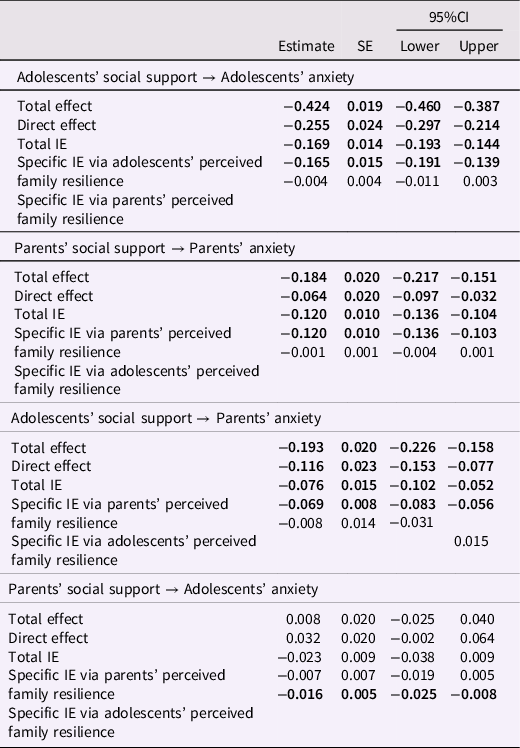
Note. Values of indirect effect estimates presented in bold are significant at p < 0.05. IE = indirect effect; SE = standard error; CI = confidence interval. Model controlled for trauma exposure of adolescents and parents.
Regarding the indirect effects of the APIMeM, as reported in Table 2 and Figure 2, the perceived family resilience of adolescents and parents significantly mediated the actor effect between social support and anxiety (for adolescents: β = −0.165, SE = 0.015, 95% CI = −0.191, −0.139; for parents: β = −0.120, SE = 0.010, 95% CI = −0.136, −0.103). And at the dyadic level, the adolescents’ social support was associated with their parents’ anxiety through the partial mediating effect of the parents’ perceived family resilience (β = −0.069, SE = 0.008, 95% CI = −0.083, −0.056).
The actor–partner interdependence mediation model results for social support, perceived family resilience, and anxiety. Note. Unstandardized parameter estimates are presented. Solid lines represent significant pathways, and dashed lines represented nonsignificant pathways. Model controlled for trauma exposure of children and parents. *p < 0.05, **p < 0.01, ***p < 0.001.

Discussion
The current study adopted the APIM and APIMeM to investigate dyadic effects of social support on anxiety and the potential mediating mechanism of perceived family resilience within adolescents and parents during the COVID-19 pandemic. And the findings showed that adolescents’ social support had significant actor effect and partner effect on their own and their parents’ anxiety, whereas parents’ social support only had a significant actor effect on their own anxiety. What’s more, the findings indicated mediating actor effects of social support on anxiety via one’s own perceived family resilience in both adolescents and parents and a significant partner mediating effect of adolescents’ social support on parents’ anxiety through parents’ perceived family resilience. Notably, these findings remain significant when controlling for trauma exposure during the COVID-19 pandemic.
Plenty studies had confirmed the significant association between social support and mental health, while this study further verified that perceived social support acted as a buffer for anxiety both for adolescents and parents. Our findings were in line with several previous studies that found social support had a strong influence on anxiety in adults (Khoury et al., Reference Khoury, Atkinson, Bennett, Jack and Gonzalez2021; Lebel et al., Reference Lebel, MacKinnon, Bagshawe, Tomfohr-Madsen and Giesbrecht2020; Nie et al., Reference Nie, Su, Zhang, Guan and Li2020). A study investigating 7143 college students in China during the COVID-19 outbreak by using structured questionnaires found that social support was negatively correlated with anxiety, which suggesting that effective and robust social support is necessary during public health emergencies (Cao et al., Reference Cao, Fang, Hou, Han, Xu, Dong and Zheng2020). Prior research on the linkage between social support and anxiety had rarely focused on children or adolescents during the COVID-19 pandemic (Magson et al., Reference Magson, Freeman, Rapee, Richardson, Oar and Fardouly2021; Qi et al., Reference Qi, Zhou, Guo, Zhang, Min, Li and Chen2020). To extending the work in this field, this study found that adolescents’ perceived social support was negatively and significantly associated with their anxiety, even higher than that of their parents. Adolescents were also facing many unprecedented uncertainties and stressful events during the pandemic, and they urgently needed to mobilize positive resources to deal with such a dilemma. Adolescents could perceive social support, especially from their parents, and had the ability to use these support resources to cope with anxiety. Moreover, because adolescents were not mature enough in their thinking or emotion regulations which relied more on important others, social support had a greater impact on psychological distress for adolescents.
In addition to the actor effect of social support on anxiety at the individual level, there was a significant negative correlation between adolescents’ social support level and parents’ anxiety level; in contrast, parents’ social support showed no prime partner effect on their adolescents’ anxiety. Remarkably, the lack of partner effects from parents to adolescents was not in accordance with our hypothesis. This finding could be well explained from the perspective of child effect that most family lived around with the center of their children (Fu, Reference Fu2015), that is the social adaptation and development of children always be one of the greatest factors affecting parents’ stress and anxiety. The child effect was even more pronounced during COVID-19, when parents spent more time with their children, communicated more with them, and paid more attention to their children’s health (Nicolì et al., Reference Nicolì, Spinelli, Lionetti, Logrieco and Fasolo2022). A study of parent–child dynamics during initial COVID-19 related school closures by using cross-sectional analyses of a survey that utilized a convenience sampling approach found that more than one-third (34.7%) of parents said their child’s behavior had changed since the pandemic, including being sad, depressed, and lonely, and most parents were spending more time involved in daily caregiving of their children since the COVID-19 (Lee et al., Reference Lee, Ward, Chang and Downing2021). Further, when adolescents perceived the high level of company and social support, it often signified a more positive psychological developmental competence and quality, at least in the eyes of their parents, which could greatly reduce worried and anxiety about their adolescents.
However, the relationship did not apply to parents’ social support to their adolescents’ anxiety. This could be explained that most of the children in this study were adolescents, and at this stage of their life their anxiety could come from other aspects besides from their parents, such as academic performance and peer interaction. Thus, the social support of parents didn’t make such enormous influence on their adolescents’ anxiety. This finding was consistent with findings from the study of Browne et al. (Reference Browne, Wade, May, Jenkins and Prime2021). They evaluated multilevel, longitudinal associations between the COVID-19 disruption, family relationships, and caregiver/child mental health using a parent–adolescent comparison and observed evidence of child effects at the between-family level, but could not observe caregiver-driven pathways (i.e., effects linking earlier caregiver distress to later child psychopathology) (Browne et al., Reference Browne, Wade, May, Jenkins and Prime2021).
What’s more, the current study also shed light on a possible mechanism linking social support to anxiety for both parents and adolescents during the pandemic outbreak. That is the remarkable mediating effects via perceived family resilience in the association between social support and anxiety at the individual levels which were found in both adolescents and parents, and these effects were after controlling for trauma and media exposure related to the COVID-19 pandemic. Adolescents’ and parents’ perceived social support from peers, friends, or communities, which would increase the resilience of the whole family and thus help reduce individual anxiety. For example, maintaining a positive outlook could alleviate anxiety. Sharing positive emotions and perspectives could support family members to temporarily withdraw from the numbness and emotional indifference of the epidemic, re-examine family and relationships, and gain spiritual vitality. This perspective was also in conjunction with a previous study that had found higher family-level positive outlook magnified the negative relationship between pandemic-related stressors and anxiety symptoms in Hong Kong (Chan et al., Reference Chan, Piehler and Ho2021). Moreover, utilizing social connectedness and community resources make a vital importance to individual anxiety. Especially for these families who experienced many complex and traumatic losses caused by the COVID-19 pandemic, mobilizing relational resources could challenge the social distancing restrictions and this was crucial to build family and community resource teams, which could be better ways to understand grief, loss, and resilience (Walsh, Reference Walsh2020). From this study, the results confirmed that during the pandemic outbreak the social support accelerated one’s strength and resources to positive coping with adversities that boosted family adaptation and improved their perceived family resilience, consequently resulted in relieving their levels of anxiety.
The partner mediating effect indicated that adolescents’ social support was positively associated with their parents’ perceived family resilience, which also alleviated parents’ anxiety. This partner mediating effect showed that adolescents’ social support had a significant correlation with parental anxiety. Family is the system that provides highly supportive relationships. In the face of adversity, family members would influence each other, and the relationships among individual family members are the most important part of the family’s function. Especially during the pandemic, the whole family was under pressure from many aspects, and parents, as the backbone of the family, had a more realistic, comprehensive and sensitive perception of all aspects of the family and their changes. Due to the limitation of adolescents’ physical, cognitive, and emotional development stage, coupled with their natural disadvantaged position in the family, adolescents’ perception of family was relatively simple, more concerned with themselves and easy to ignore their parents. In other words, parents were more acutely aware of changes in the other person’s perceived level of social support than adolescents. Therefore, in response to the enormous pressures of the pandemic, the sources of perceived family resilience in parents included both parents’ own social support and the perceived social support of their adolescents, further alleviated parents’ anxiety.
Strengths and limitations
This study had notable strengths. First, the self-reported data were from both the parent and the adolescents which could effectively reduce information bias. Second, the current study was the first study which adopted a large sample to examine the bidirectional relationships between parents’ and adolescents’ social support on their anxiety and the potential effects of perceived family resilience among them. Thirdly, this study focused on family-level coping resources and implications under the context of the COVID-19 pandemic.
It should be noted that our study has some limitations. First, this study was correlational and cross-sectional thus may not draw any causal conclusions, and the lack of pre-pandemic data further limited the persuasiveness of the results. Future studies should adopt longitudinal design between variables to test the mediating role of perceived family resilience over time. Second, this study investigated perceived social support of parents and adolescents that may decrease their levels of anxiety; however, others within the family (e.g., life events or number of family members) may also affect perceived family resilience and anxiety during the pandemic.
Implications
These findings had implications for improving existing interventions, especially current programs targeting positive adaptation of families during the COVID-19 pandemic. Our findings indicated that whether parents or adolescents, their perceived social support can alleviate anxiety via perceived family resilience, while adolescents’ perceived social support can alleviate parents’ anxiety through parents’ perceived family resilience. Therefore, in terms of improving social support, we suggest that the government and community institutions should provide effective materials, medical and psychological counseling services for each family during the pandemic to enhance the social support perceived by family members. School departments should also organize online mutual aid activities to improve adolescents’ sense of social support through teacher–student and peer interaction. In terms of improving perceived family resilience, we suggest parents to actively communicate with their children, cultivate positive beliefs, enhance the overall sense of family connection, and teach adolescents to solve problems with social resources to enhance the adolescents’ perceived family resilience, especially their own.
Acknowledgements
All the authors are grateful to the 2512 families for their cooperation, as well as the assistants who helped promote and recruit participants during the study.
Funding statement
This research was supported by The National Social Science Fund of China under Grant (grant number 20CSH068) and Postgraduate Research & Practice Innovation Program of Jiangsu Province (grant number 1812000024866).
Conflicts of interest
None.



