Introduction
The fall webworm, Hyphantria cunea Drury (Lepidoptera: Erebidae), is a serious invasive foliar pest in China that infests many deciduous trees (Schowalter and Ring, Reference Schowalter and Ring2017; Edosa et al., Reference Edosa, Jo, Keshavarz, Anh, Noh and Han2019). It originated in North America and has now expanded to over 20 countries worldwide (Wu et al., Reference Wu, Zhang, Li, Cao, Liu, Wang, Liu, Liu, Hu, Zhou, James, Zhang, Huang and Zhan2019). Currently, the distribution of H. cunea ranges from 19° to 55° north latitude and is listed as an international quarantine pest due to its numerous host plants, high fertility, and strong adaptability (Tang et al., Reference Tang, Yuan, Liu and Zhang2021). It expanded to Asia in 1945, spreading from Japan to South Korea (1958), North Korea (1961), and China (1979) (Ge et al., Reference Ge, He, Zhu, Wang, Xu and Zong2019; Dai et al., Reference Dai, Cao, Chen, Yang, Shen, Ma, Hoffmann, Chen and Wei2024). Since it was first discovered in Dandong City, Liaoning Province, it has been distributed throughout 14 provinces in China (Zhao et al., Reference Zhao, Geng, Hao, Dai and Sun2022; Zhou et al., Reference Zhou, Gong, Li, Wang and Yan2024). This pest has caused substantial economic losses to forests, fruit trees, and even field crops, posing a severe threat to ecological security. In the original regions, the population remains below the threshold due to the presence of several natural enemies (Schowalter and Ring, Reference Schowalter and Ring2017; Tao et al., Reference Tao, Ma, Meng and Yan2023). In newly invaded areas, this pest has caused considerable loss of forest trees (Schowalter and Ring, Reference Schowalter and Ring2017; Zhao et al., Reference Zhao, Geng, Hao, Dai and Sun2022). In 2021, the cumulative occurrence area of H. cunea in China was 731,400 hectares, and the control area was 5.4641 million hectares. The national disaster losses from H. cunea totalled 21.298 billion yuan, averaging 29,100 yuan/hectare, of which the economic loss was 1.396 billion yuan and the non-economic loss was 19.902 billion yuan (Liu et al., Reference Liu, Su, Liu, Ding and Fang2023).
The first step in managing an infestation is to inspect the trees for the detection of H. cunea (Schowalter and Ring, Reference Schowalter and Ring2017). The application of appropriate management measures should commence at an early stage of larval development, since older larvae will form larger colonies, making it more difficult to penetrate with the pesticide (Tao et al., Reference Tao, Ma, Meng and Yan2023). In recent years, the indiscriminate application of pesticides has had adverse effects on beneficial organisms and the environment, particularly during forest spraying, which is the primary habitat for these organisms. Additionally, the phenomenon of increasing pest resistance has become more severe (Pu and Chung, Reference Pu and Chung2024). Pesticides failed to achieve a sustained reduction in pest populations. Conversely, a common observation among those utilising pheromone-based pest management is that continuous long-term use of pheromone does decrease the population of the target pest (Witzgall et al., Reference Witzgall, Kirsch and Cork2010; Malinga and Laing, Reference Malinga and Laing2024).
Sex pheromones are widely used in pest monitoring and management for their high accuracy, specificity, non-pollution, and safety to natural enemies (Rizvi et al., Reference Rizvi, George, Reddy, Zeng and Guerrero2021). In most Lepidoptera, sex pheromones are synthesised in the pheromone glands (PG) and actively released by female adults to attract conspecific males for mating (Matsumoto, Reference Matsumoto2010; Yew and Chung, Reference Yew and Chung2015). Since the first structural elucidation of bombykol in Bombyx mori in 1959 (Butenandt, Reference Butenandt1959; Butenandt and Hecker, Reference Butenandt and Hecker1961), the chemistry of sex pheromones has been extensively studied, and more than 700 lepidopteran species have had their sex pheromones identified to date (Ando and Yamamoto, Reference Ando and Yamamoto2020). Sex pheromones can serve as effective tools for managing insect pests, assessing pest populations, identifying the appearance and spread of invasive species, and protecting endangered species (Alam et al., Reference Alam, Abbas, Abbas, Abbas, Hafeez, Shakeel, Xiao and Zhao2023; Shang et al., Reference Shang, He, Li, Chen, Luo and Li2024). Recently, the most effective practical applications of sex pheromones in integrated pest management (IPM) included pest population monitoring, mass trapping, mating disruption, and push–pull strategies (Benelli et al., Reference Benelli, Lucchi, Thomson and Ioriatti2019; Ricciardi et al., Reference Ricciardi, Di Giovanni, Cosci, Ladurner, Savino, Iodice, Benelli and Lucchi2021). The studies of H. cunea sex pheromone was begun in 1970s and the first characterisation was achieved by extracting the pheromone gland of female adults, and then three components ((Z,Z)-9,12-octadecadienal (C18:2Ald), (Z,Z,Z)-9,12,15-octadecatrienal (C18:3Ald), and (3Z,6Z)-3,6-9,10-epoxyheneicosadiene (C21-2Epo)) were identified (Hill et al., Reference Hill, Kovalev, Nikolaeva and Roelofs1982). Despite the accurate identification of these three components, no males were captured in the field with any blend of these chemicals. In Hungary, two trienic epoxide components ((3Z,6Z)-1,3,6-9,10-epoxycosatriene and (3Z,6Z)-1,3,6-9,10-epoxyhenicosatriene (C20-3Epo)) were identified lately (Tóth et al., Reference Tóth, Buser, Pena, Arn, Mori, Takeuchi, Nikolaeva and Kovalev1989), and field trials using an equal ternary mixture of C18:3Ald, C21-2Epo, and C21-3Epo were shown to be attractive to H. cunea males (Trematerra et al., Reference Trematerra, Ferrario and Binda1993; Zhang et al., Reference Zhang, Schlyter, Chu, Ma and Ninomiya1996). Moreover, the quaternary blend of C18:2Ald, C18:3Ald, C21-2Epo, and C21-3Epo proved effective for monitoring H. cunea populations in China (Su et al., Reference Su, Fang, Tao, Yan, Ma and Zhang2008). The synthesis of the critical components of the H. cunea sex pheromone involves multiple technically demanding steps. Despite reports on their laboratory synthesis, no domestically produced commercial pheromone products have been developed in China (Zhao et al., Reference Zhao, Geng, Hao, Dai and Sun2022). On the other hand, the commercially available synthetic lure, Nitolure, produced by Nitto Denko, showed contradictory reports regarding the efficacy (Yamanaka et al., Reference Yamanaka, Seta and Yasuda1986; Rezaei et al., Reference Rezaei, Moharramipour, Fathipour and Talebi2006). Currently, the sex pheromone products used for monitoring and controlling H. cunea are almost entirely imported from abroad, which are expensive and contribute to increasing the cost of pest management. Meanwhile, the electrophysiological activity and field trapping activity of synthetic sex pheromone in H. cunea have not been systematically studied yet (Zhao et al., Reference Zhao, Geng, Hao, Dai and Sun2022).
In this study, based on the synthesis of sex pheromone components of H. cunea, their bioactivity was evaluated using electrophysiological responses and field trapping tests to assess their effectiveness in trapping and population monitoring of H. cunea. Through field trials, investigate the application technology of the synthesised sex pheromone in the field to improve the monitoring capability and accuracy of the H. cunea, and lay the foundation for the promotion and application of the synthesised sex pheromone products for monitoring the H. cunea populations in China.
Materials and methods
Insects culture
The H. cunea larvae were collected from Populus × canadensis ‘I-214’ at Huaian county of Jiangsu Province (33.62°N, 119.02°E) in May 2022. The laboratory population of H. cunea was fed artificial diets in a light incubator at 25 ± 1 °C with a 16-h light/8-h dark cycle and 60 ± 5% humidity. Fresh artificial diets (consisting of wheat germ (12%), casein (4.5%), Wesson’s salt (1.0%), ascorbic acid (0.5%), sugar (2%), agar (1.5%), choline chloride (0.05%), sorbic acid (0.4%), methyl p-hydroxybenzoate (0.25%), cholesterol (0.1%), Vanderzant’s vitamin mix (0.003%), and inositol (0.035%)) (Cao et al., Reference Cao, Yang, Tang and Chen2014) were supplemented every day until the larvae pupated. Pupae were sexed based on the morphology of a few terminal abdominal segments and maintained under the same conditions as larval rearing (Zhao et al., Reference Zhao, Geng, Hu, Li, Liang and Hao2023). Newly emerged adults were placed at a ratio of 1:2 (female: male, totalling 80 adults) in screen cages (40 × 50 × 30 cm) at room temperature for mating and oviposition.
Chemicals
The Z9, Z12, Z15-18Ald (C18:Ald), Z3, Z6-9S,10 R-epoxy-21Hy (C21-2Epo), and 1, Z3, Z6-9S,10 R-epoxy-21Hy (C21-3Epo) were synthesised independently by our research group (unpublished data). The purity of all these synthetic compounds was >98% by GC (Gas Chromatography) analysis, and they were stored at −80 ℃ until use.
Electroantennographic responses of male adults to synthetic sex pheromone components
The chemoreceptivity of adult male H. cunea antenna to the synthetic sex pheromone components was examined using the electroantennographic (EAG) method. Each antenna of a 2-day-old male adult was prepared by cutting off at the base, and the terminal distal segments were excised under a binocular microscope by a sterilised scalpel and tweezers (Pistillo et al., Reference Pistillo, D’Isita, Di Palma and Germinara2024). The separated antennae were rapidly positioned between two Ag/AgCl electrodes with Kaissling saline solution (Tang et al., Reference Tang, Zhang and Zhang2012). Before starting the experiment, air bubbles in the electrode buffer solution were carefully removed to prevent interference with the electrical signals. The electrode at the distal portion of the antenna was connected via an interface device to a signal-collection input board (Syntech, Kirchzarten, Germany), which was then coupled to a computer. EAG signals were captured by a computer utilising AutoSpike software (Syntech, Kirchzarten, Germany). A gas-controlling unit (Syntech CS-05) provides an airflow of 60 mL/s, with the gas outlet directed towards the antenna at a distance of 1 cm. A volume of 10 µL was applied to a 0.5 × 5 cm filter paper using a Pasteur pipette (10 mm × 20 mm × 20 mm) for each solution. The Pasteur tube was positioned between the gas-controlling unit and the gas outlet. The antennae of H. cunea males were stimulated for 0.1 s with a spacing of 30 s. The tests were conducted in the subsequent order: control-sample-control-sample-control (Chen et al., Reference Chen, Xu, Li, Xue, Deng, Fan, Yang and Hao2024). Electroantennogram records have been adjusted to eliminate the impacts of solvent and environmental factors utilising a procedure:
The relative electroantennogram value = E S − (E S−1 − E S+1)/2, where E C is the raw electroantennogram value of the sample, E S−1 is the value of the control before the sample, and R S+1 is the value of the control after the sample.
Evaluation of optimal solvent of synthetic sex pheromone components
Several commonly used organic solvents for pheromone preparation were screened in advance by recording male antennal responses to each solvent to minimise potential solvent interference in the EAG assays. The male EAG responses to different solvents (dichloromethane, n-hexane, isopropanol, and ethanol) were measured. 10 μL of each solvent was dropped onto a 0.5 × 5 cm filter paper using a Pasteur pipette, and air stimulation was set as the control. The antennae of male adults were stimulated for 0.1 s with an interval of 1 min to allow recovery and prevent adaptation, and six antennae were tested for each solvent.
Dosage responses of males to synthetic sex pheromone components
Each single-component and ternary mixtures (C18:3Ald, C21-2Epo, and C21-3Epo in an 8:1:1 ratio) were diluted by dichloromethane (determined by Section Evaluation of optimal solvent of synthetic sex pheromone components) into four solutions, of which the concentration was 0.1, 1, 10, and 100 ng/μL. After fixation on the electrodes, the antennae were stimulated with the solutions in the following sequence: 10 µL of dichloromethane (treated as a control), 10 µL of each concentration of single components, and 10 µL of the ternary mixture in dichloromethane. The test and data analysis methods were the same as those above, and six antennae were tested for each dosage of each chemical compound.
Ages of male sensitivity to synthetic sex pheromone components
The antennae of virgin males at different ages (1–6 days after emergence) were collected and stimulated by synthetic single-component and ternary mixtures of 100 ng (determined by Section Dosage responses of males to synthetic sex pheromone components). Dichloromethane was used as a control. The test and data analysis methods were the same as those above, and six antennae from different day-old males were tested for each chemical compound.
Mating status of male response to synthetic sex pheromone components
The antennae of virgin males and mated males at the same periods (1, 2, and 3 days post mating) were collected and stimulated by synthetic sex pheromone components and ternary mixtures of 100 ng. The test and data analysis methods were the same as those above, and six antennae from different day-old males were tested for each chemical compound.
The male sensitivity to different mixtures of the sex pheromone components
According to Zhang et al. (Reference Zhang, Schlyter, Chu, Ma and Ninomiya1996), synthetic baits of C18:3Ald, C21-2Epo, and C21-3Epo blend at the ratio of 8:1:1 exhibited a significant trapping effect. Single component of C18:3Ald, C21-2Epo, and C21-3Epo, mixture of C18:3Ald:C21-2Epo at ratio of 8:1, C18:3Ald:C21-2Epo at 8:1, C21-2Epo:C21-3Epo at 1:1 and blend of C18:3Ald, C21-2Epo, C21-3Epo at 8:1:1 was selected to evaluate male sensitivity. Test and data analysis methods were the same as above, and six antennae from 2 day-old males were tested for each chemical compound.
Field trapping
Efficacy of different dispenser materials
After the laboratory evaluation, synthetic sex pheromone components were selected as candidates to determine the field attractivity of H. cunea male adults. Green rubber septa (8 mm diameter, Pherobio Technology Co. Ltd., China) and cotton wick (self-made) were selected as candidate dispensers of sex pheromone baited with 8:1:1 (Zhang et al., Reference Zhang, Schlyter, Chu, Ma and Ninomiya1996) ratios of C18:3Ald, C21-2Epo, C21-3Epo for loading with 200 µL dichloromethane solutions in the field trials, a chip of thin black plastic laminate (Nitolure, Nitto Denko, Japan) was set as positive control. The dispensers baited with distilled dichloromethane were used as a negative control. All lures were stored at −20 °C until field use. Trapping tests were conducted in Populus deltoides wood at Xuzhou City, Jiangsu Province, from 30 June to 17 July 2022, using Unitraps. Traps were arranged in a randomised complete block design with five replicates. The distances between traps within a block were at least 50 m, and the distances between blocks were at least 400 m. Traps were hung on branches of P. deltoides at 2–3 m height above ground level, and the trap positions were changed randomly to minimise the effects of habitat heterogeneity. Trap captures were recorded every 2 days; on each observation date, traps were emptied, the number of captured males was recorded, and traps were rotated within blocks.
Efficacy of different mixtures of synthetic sex pheromone components
As mentioned above, single-component, binary, and ternary mixtures were loaded at 10 mg in 200 µL of dichloromethane solution using suitable dispensers (determined by Section Efficacy of different dispenser materials) in the field trials. The dispensers loaded with distilled dichloromethane were used as a control. Field trial methods were the same as above.
Efficacy of synthetic sex pheromone in H. Cunea population monitoring compared with commercial sex pheromone products
The field trapping experiments were conducted in Huaian City, Jiangsu Province, from 1 May to 1 October 2022, with Unitrap and blank dispensers (green rubber septa, 8 mm diameter, Pherobio Technology Co. Ltd., China) to evaluate the activity of synthesised sex pheromone components. The rubber was loaded with 10 mg of synthetic sex pheromone dissolved in 200 μL of distilled dichloromethane, and the mixture was pipetted into the grooves of the empty dispensers. The synthetic commercial lure, Nitolure, produced by Nitto Denko (Osaka, Japan), served as the control group. Traps were arranged in a randomised complete block design with three replicates and three blocks. The distances between traps within a block were at least 50 m, and the distances between blocks were at least 400 m. Throughout the monitoring period, all traps were inspected once per day, and the number of H. cunea male adults captured in each trap was recorded during each inspection. Field trial methods were the same as above.
Statistical analysis
For the statistical analysis of the EAG experiments, electrophysiological response values of H. cunea males to different solvents, different doses, different ratios of synthetic sex pheromone components, and periods of males to compounds to synthetic compounds used One-Way ANOVA followed by Tukey test. Student’ t-test was utilised to compare the significance between mated and virgin males sensitivity to synthetic compounds. In the field experiments, the number of moths captured was prior to entry as the dependent variable in a general linear model (GLM), periods of trapping, and types of dispensers were the response variables and tested separately for each dispenser and week. Moreover, further analysis was performed to calculate the interaction between dispensers and weeks. As the data distributions of a moth caught by different mixtures of synthetic compounds did not fulfil the assumption of homoscedasticity, the non-parametric Kruskal–Wallis multiple comparison tests with Bonferroni correction were used. All analyses were performed using SPSS 22.0 (IBM Inc., New York, USA). The plots were conducted by Origin 2023 (OriginLab Inc., Northampton, UK).
Results
EAG responses of male adults against synthetic sex pheromone compounds at different concentrations
Based on optimal solvent screening, dichloromethane was selected as a candidate solution for diluting C18:3Ald, C21-2Epo, C21-3Epo, and ternary mixtures at different concentrations (Figure S1). The EAG responses against synthesised compounds were measured at the dosages of 1, 10, 100, and 1000 ng. In the range of concentrations, the antennae of males showed a dose-dependent response to C18:3Ald, C21-2Epo, C21-3Epo, and ternary mixtures, respectively (Tukey test, C18:3Ald: F = 146.5, P < 0.01; C21-2Epo: F = 231.3, P < 0.01; C21-3Epo: F = 130.8, P < 0.01; ternary mixtures: F = 62.3, P < 0.01). EAG responses of H. cunea males to three single-component and ternary mixtures were increased from a dose of 1 to 100 ng, and there was no further increase at a dose of 1000 ng. The EAG responses to the sex pheromone concentration were flat at 100 and 1000 ng (fig. 1), and the activation threshold was 100 ng. The male antennae responded strongly to any dose of C21-3Epo compared to the other two components, which indicated that C21-3Epo might be a major component of H. cunea sex pheromone (fig. 1).
EAG responses of H. Cunea males to different doses of the sex pheromone components and ternary mixture.

EAG responses of different ages of H. Cunea males against synthetic compounds
Male adults of different day ages showed remarkable electrophysiological responses to three individually synthesised components and ternary mixtures (Tukey test, C18:3Ald: F = 68.5, P < 0.01; C21-2Epo: F = 141.1, P < 0.01; C21-3Epo: F = 84.1, P < 0.01; ternary mixtures: F = 34.5, P < 0.01). The responses of male antennae to C18:3Ald, C21-2Epo, and C21-3Epo were measured from the 1st to 6th day post emergence. The mean EAG responses of moths to C18:3Ald, C21-2Epo, and C21-3Epo increased significantly and peaked on the 2nd day after male adult eclosion (Tukey test, P < 0.05), then gradually decreased (fig. 2). Male moths within 3 days of eclosion exhibit greater sensitivity to synthetic compounds than those that are older (fig. 2). There were no significant differences in EAG responses were observed in male moths at 4–6 days after emergence among the tested solutions, except for C18:3Ald. Moreover, the male antennae responded with significantly higher amplitudes to C21-3Epo and ternary mixtures of any day-old males than to the other two components (fig. 2).
EAG response of different day-old H. Cunea males to synthetic sex pheromone components and ternary mixtures.

Sensitivity of different mating status males against synthetic sex pheromone components
The virgin male moths exhibit higher electrophysiological responses to the synthetic compounds than mated males according to EAG analyses (fig. 3). The sensitivity of male moths 1 day post mating to C18:3Ald was significantly higher than that of unmated male moths (fig. 3A, t = 3.1, P < 0.05), and the sensitivity of mated males to C18:3Ald decreased significantly after 2 day post mating (fig. 3A, t = 7.1, P < 0.05). While the mating status did not affect the sensitivity of males 3 day post-mating to C18:3Ald (fig. 3A, t = 0.7, P < 0.05). Electrophysiological responses of male adults at 1,2 day post mating to C21-2Epo showed a tendency to decrease compared to unmated males, but there was no significant difference (figs. 3B, 1 day post mating: t = 2.3, P > 0.05; 2 day post mating: t = 1.0, P > 0.05), and males at 3 days after mating showed a significant decrease in sensitivity to C21-2Epo (fig. 3B, t = 3.8, P < 0.01). Furthermore, male moths of different days after mating were significantly reduced in sensitivity to both C21-3Epo and the ternary mixtures (figs. 3C and 3D).
EAG response of different mating status of H. Cunea males to synthetic sex pheromone components and ternary mixtures.

Sensitivity of males to different ratios of the sex pheromone components
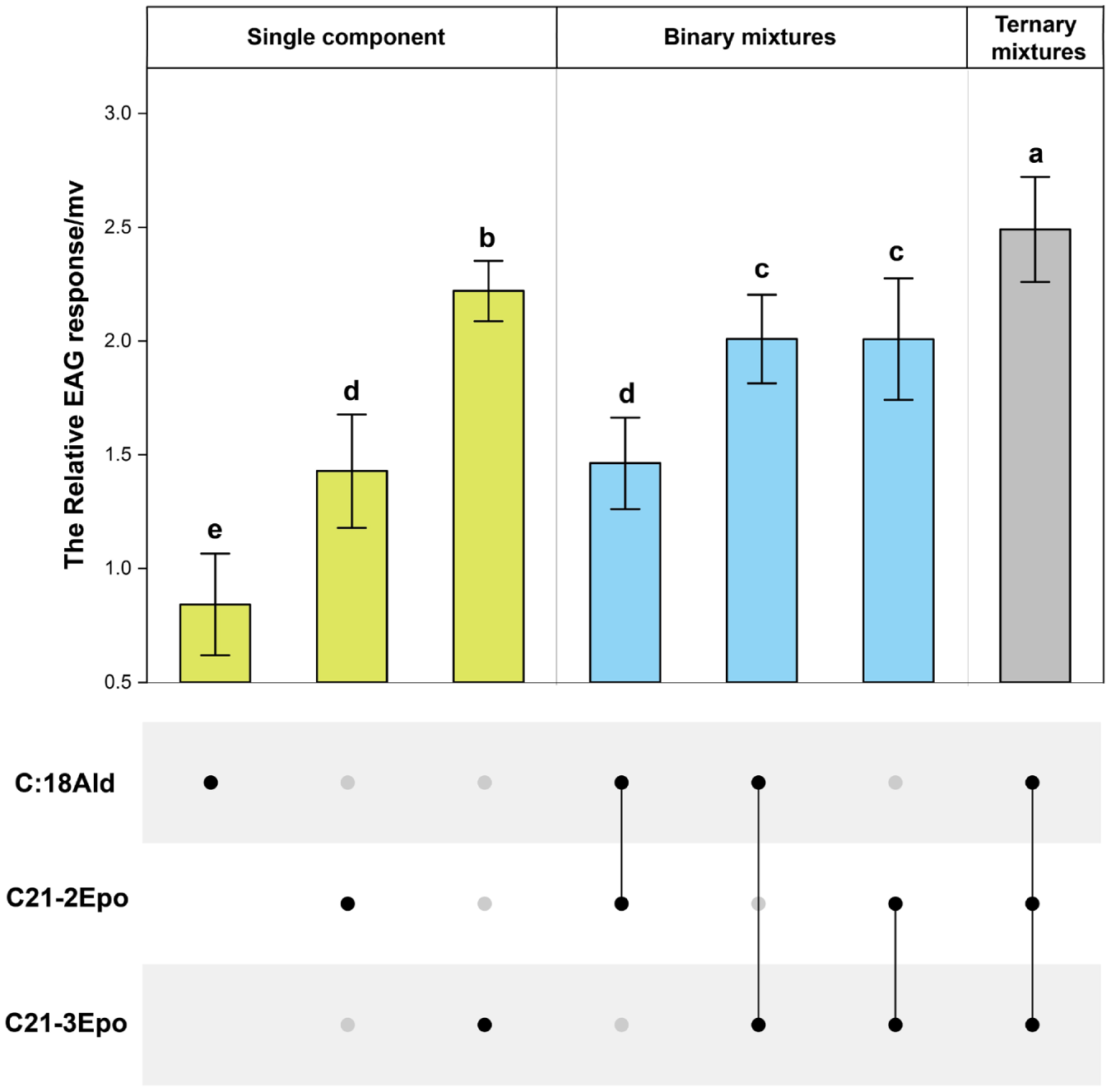
The male adult exhibited a notable electrophysiological response to different components and mixtures of components. When C18:3Ald was mixed with C21-2Epo in an 8:1 ratio, the males were significantly more sensitive to the mixture than C18:3Ald (Tukey test, P < 0.05), but not significantly different from C21-2Epo (Tukey test, P > 0.05). Moreover, when C18:3Ald and C21-2Epo were mixed with C21-3Epo at 8:1 and 1:1 ratios, respectively, males showed stronger electrophysiological responses to the mixtures, significantly higher than either single component, but lower than C21-3Epo (fig. 4). Surprisingly, when C18:3Ald, C21-2Epo, and C21-3Epo were mixed 8:1:1 to form a ternary mixtures, it elicited the strongest EAG responses to male adults and was significantly higher than those of single components and binary mixtures (fig. 4).
EAG responses of males to a single synthetic component, binary mixtures, and ternary mixtures.

Field trapping
The field test was conducted in Xuzhou, Jiangsu, from June to July 2022 to evaluate the biological activity of the field trap for H. cunea and to select suitable dispensers for the synthetic sex pheromone. The results showed that the Unitraps baited with a green rubber septum loaded with 100 uL of a dichloromethane solution of the synthetic sex pheromone showed strong trapping activity in the field test (Table 1). In a 3-week field trial, the green rubber septum trapped 58.6 ± 20.0 and 61 ± 20.8 males per trap in the first 2 weeks, respectively, and the black plastic laminate loaded with commercial lure-Nitolure trapped 45 ± 30.5 and 34 ± 7.5 moths per trap in the first two weeks. The generalised linear model results showed that the number of moths trapped did not differ significantly between Nitolure and the control (GLM, P > 0.05). However, the synthetic sex pheromone did not exert a favourable trapping activity when the cotton wick was used as a dispenser. At the peak of adult occurrence, only 2.3 ± 0.6, 3 ± 0.5, and 0.6 ± 0.6 moths per Unitrap were caught each week, numbers significantly lower than those caught with a green rubber septum and black plastic laminate (Table 1).
Captures of H. Cunea male moths by different types of dispensers loaded with sex pheromone in fields

Different uppercase letters indicate significant differences in trap catches among the different dispensers by GLM, P<0.05.
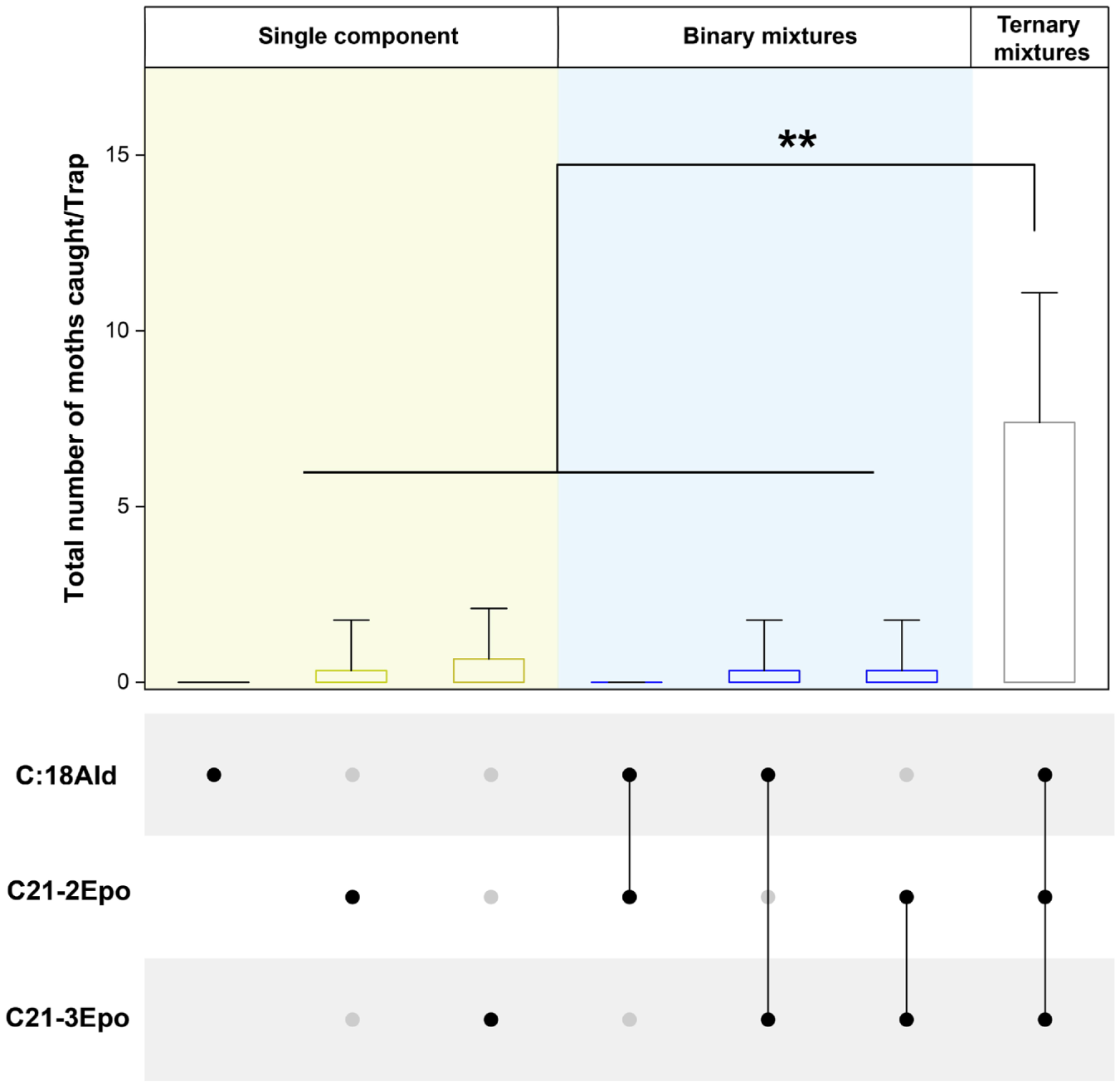
Subsequently, we examined the trapping activity of different ratios of the synthetic sex pheromone components. Although single-component and binary mixtures exhibited obvious electrophysiological activity under laboratory conditions (fig. 4), the field test showed that neither single-component nor binary mixtures showed significant trapping activity, whereas the ternary mixtures showed strong monitoring and trapping effects (fig. 5).
Field catches of male H. Cunea in traps baited with synthetic single-component, binary mixtures, and ternary mixtures.

In the final field trial, we monitored the dynamics of H. cunea occurrence using synthetic sex pheromone components and the commercial Nitolure in Huaian, Jiangsu Province, with trapping periods from 26 April to 10 September in 2022. The moths in each Unitrap were counted and cleaned up daily. The results indicated that synthetic sex pheromones effectively monitored the population dynamics of H. cunea (fig. 6). Both the synthetic sex pheromone and Nitolure monitored three emergence peaks during the occurrence of H. cunea, and the monitored emergence periods basically overlapped (fig. 6). The monitoring data matched with the official report that there were three generations per year of H. cunea occurring in the Jiangsu area.
Emergence dynamics of H. Cunea males monitored with self-synthetic sex pheromone and Nitolure.

Discussion
In recent decades, the pest control concept has deliberately transitioned from calendar-based, broad-spectrum pesticide applications to more comprehensive, incorporated, and high-efficacy strategies (Shaw et al., Reference Shaw, Asmus, Schroeder and Ervin2023). Food security, environmental conservation, rising input costs, and resistance management are crucial factors influencing contemporary pest management policies and techniques in commercial agriculture (Dara, Reference Dara2019). Consequently, the incorporation of traditional, behaviourally oriented, biological, and cultural pest management techniques into IPM systems has gained enormous significance in the twenty-first century (W Zhou et al., Reference Zhou, Arcot, Medina, Bernal, Cisneros-Zevallos and Akbulut2024). Currently, pesticide management strategies might easily result in environmental pollution, and these pesticides are broad-spectrum, killing the beneficial organisms as well as the targeted pests (Choi and Park, Reference Choi and Park2012; Edosa et al., Reference Edosa, Jo, Keshavarz, Anh, Noh and Han2019). Sex pheromone and lure application technology, as an effective tool, has been extensively utilised for the monitoring and control of insect pests because of its high efficiency, non-polluting nature, non-toxicity, and selectivity to target species (Rizvi et al., Reference Rizvi, George, Reddy, Zeng and Guerrero2021; Alam et al., Reference Alam, Abbas, Abbas, Abbas, Hafeez, Shakeel, Xiao and Zhao2023; Shang et al., Reference Shang, He, Li, Chen, Luo and Li2024). Insect sex pheromones are chemicals that females produce to attract males for mating (Tewari et al., Reference Tewari, Leskey, Nielsen, Piñero, Rodriguez-Saona and Abrol2014). The capacity of insect sex pheromones to manipulate sexual communication species-specifically and regulate insect populations without negatively impacting other beneficial organisms is fascinating. In contrast to conventional chemical pesticides, sex pheromone trapping offers the benefits of selectivity, high efficacy, and resistance-free pest control. Sex pheromone trapping has gained prominence in IPM, with sex pheromones being utilised in agricultural, forestry, and urban pest control through monitoring, mating disruption, ‘lure and kill’ strategies, mass trapping, and other manipulations (Reddy and Guerrero, Reference Reddy and Guerrero2010; Larsson, Reference Larsson2016; Franco et al., Reference Franco, Cocco, Lucchi, Mendel, Suma, Vacas, Mansour and Navarro-Llopis2022; Alam et al., Reference Alam, Abbas, Abbas, Abbas, Hafeez, Shakeel, Xiao and Zhao2023).
H. cunea is a polyphagous and severe pest of forest, urban, and agricultural ecosystems worldwide, and various control methods have been independently evaluated in invaded areas to manage this insect pest (Edosa et al., Reference Edosa, Jo, Keshavarz, Anh, Noh and Han2019; Lv et al., Reference Lv, Meng, Deng, Zhang, Tao and Yan2024). Nevertheless, some control methods were limited to the laboratory and needed further study to verify their effectiveness in the field (Tao et al., Reference Tao, Ma, Meng and Yan2023). The H. cunea spreads in various ways and can be spread over long distances with seedlings, shipments, and transportation (Ge et al., Reference Ge, He, Zhu, Wang, Xu and Zong2019). In recent years, the distribution range of H. cunea in China has been expanding, and the number of invaded areas has been increasing year by year (Zhao et al., Reference Zhao, Geng, Hao, Dai and Sun2022). Therefore, the use of sex pheromones for monitoring H. cunea populations could prevent dispersal and spread of H. cunea, as well as provide a basis for its quarantine and integrated management (Schowalter and Ring, Reference Schowalter and Ring2017). Particularly, multiple subjects regarding H. cunea sex pheromones have been investigated in North America, Europe, New Zealand, and China. Nonetheless, its assessment and field application still need to be explored.
The current study used synthetic sex pheromone components of H. cunea to investigate the bioactivity in laboratory and field tests. In the lab, the synthetic sex pheromone components elicited the strongest electroantennogram activity in male adults. All components exhibited dose-dependent antennal responses, as indicated by EAG measurements. EAG responses of H. cunea males to three individual components and a ternary mixture were increased from a dose of 1 to 1000 ng, and there was no significant difference in male sensitivity to 100 and 1000 ng, and the activation threshold was 100 ng. It indicated that the dose exceeded 100 ng, and the olfactory receptors were saturated, which was also found in other moth species. Moreover, various chemicals elicited both significant and diminished responses at identical dosages. In other lepidopteran species, the predominant pheromone component elicited a more dramatic overall antennal response (Malo et al., Reference Malo, Renou and Guerrero2000; Karpati et al., Reference Karpati, Olsson, Hansson and Dekker2010), potentially attributable to the greater quantity of olfactory sensory neurons attuned to the primary component on the antennae (Yuvaraj et al., Reference Yuvaraj, Andersson, Anderbrant and Lofstedt2018). In several moth species, including Plutella xylostella (Zhang et al., Reference Zhang, Wang and Zhang2009), Agrotis ipsilon, Heliothis virescens, and Heliothis subflexa (Soques et al., Reference Soques, Vásquez, Grozinger and Gould2010), it has been shown that age and mating status could influence olfactory reception and the processing of sexual pheromones in males. In H. cunea, the younger and virgin male moths exhibited greater electrophysiological activity in response to synthetic compounds in this research. The mean EAG responses of males to C18:3Ald, C21-2Epo, and C21-3Epo increased significantly following emergence and peaked at 2 days (P < 0.05), and males at age 1–3 days showed high sensitivity to sex pheromone. Moreover, the sensitivity of male moth antennae to sex pheromones drastically diminished post-mating. It seems that young and virgin H. cunea males (2–3 days old) had sufficient sexual maturity to respond to the sex pheromone, which was consistent with the findings of Zhang (Zhang et al., Reference Zhang, Schlyter, Chu, Ma and Ninomiya1998). In Copitarsia decolora, the wind tunnel bioassays demonstrated that virgin males exhibited greater attraction (both long flight and landing) compared to males assessed 24 and 48 h post-mating (Vázquez-Covarrubias et al., Reference Vázquez-Covarrubias, Jiménez-Pérez, Castrejón-Ayala, Figueroa-Brito and Belmont2015). In Spodoptera frugiperda, the optimal age of mating is 2 days (Rogers and Marti, Reference Rogers and Marti1994), while for Spodoptera exigua, the peak mating rate is reached at 1–2 days (Rogers and Marti, Reference Rogers and Marti1996). In A. ipsilon, mating induces the secretion of neuromodulators that can influence antennal lobe neurons in sensitivity to female sex pheromones and impact the maturation of the sexual accessory glands, but antennal sensitivity remains unaffected (Duportets et al., Reference Duportets, Dufour, Couillaud and Gadenne1998; Gadenne et al., Reference Gadenne, Dufour and Anton2001). In contrast, the antennal sensitivity of males to sex pheromones is significantly impacted by mating in H. cunea. The decrease in pheromone response could be related to the fact that H. cunea males do not mate more than once during the lifecycle (Zhang et al., Reference Zhang, Schlyter, Chu, Ma and Ninomiya1996), and the use of sex pheromone traps could catch more virgin moths than mated ones.
Components and ratios are the two most important factors for a pheromone (Kaissling, Reference Kaissling and Mucignat-Caretta2014). They determine whether the pheromone affects an insect. Even though the component and ratio are accurate, this does not necessarily indicate that the pheromone has excellent trapping efficacy in field applications (Yan et al., Reference Yan, Zhang, Ali, Du, Mei and Gao2022; Saveer et al., Reference Saveer, Hatano, Wada‐Katsumata, Meagher and Schal2023). The efficacy of field trapping may be influenced by pheromone dosage, application method, insect population density, meteorological conditions, and other factors (Ricciardi et al., Reference Ricciardi, Di Giovanni, Cosci, Ladurner, Savino, Iodice, Benelli and Lucchi2021; Rizvi et al., Reference Rizvi, George, Reddy, Zeng and Guerrero2021). Therefore, the most straightforward and efficient method to assess pheromone effectiveness is through field application. In this study, C21-3Epo could elicit strong EAG responses in male antennae at tested conditions compared to C18:3Ald and C21-2Epo. It indicated that C21-3Epo might be the core component of H. cunea sex pheromone. Although single-component and binary mixtures exhibited apparent electrophysiological activity under laboratory conditions, the field test revealed that neither showed significant trapping activity (fig. 5). Instead, the highest number of conspecific males was caught in traps baited with a ternary blend of C18:3Ald, C21-2Epo, and C21-3Epo, indicating that the three components were essential and indispensable for male attractiveness. In Diaphania angustalis, the blend of E10,E12-16: Ald and E10,E12-16: OH in a ratio of 9:1 elicited a stronger EAG response than other treatments or a single component under laboratory conditions (Ma et al., Reference Ma, Liu, Wang, Zhang, Shi, Sun, Chen, Jia, Wang, He and Wen2017). Moreover, in the field, the blend of E10,E2-16:Ald and E10, E2-16:OH, baited with a 9:1 ratio, was more attractive to males than other treatments, and the male moths were still captured baited with 8:1 and 10:1, while the other ratios of sex pheromone components could not attract males (Ma et al., Reference Ma, Liu, Wang, Zhang, Shi, Sun, Chen, Jia, Wang, He and Wen2017).
Furthermore, the effect of dispenser type on male captures based on sex pheromone has been well studied in the field. The rubber septa have been used as pheromone dispensers to attract moths since the 1970s (Zhang et al., Reference Zhang, Leskey, Bergh and Walgenbach2013). In this study, the field test demonstrated that Unitraps baited with green rubber septum exhibited great trapping activity. In a three-week field trial, the green rubber septum trapped 58.6 ± 20.0, 61 ± 20.8, and 16.3 ± 2.9 males per trap, with no significant difference compared with Nitolure. However, the cotton wick did not exhibit satisfactory trapping activity as a dispenser. This difference may be due to pheromone release rates from different dispenser types, with the pheromone being released faster from cotton wicks than from rubber septa (Klassen et al., Reference Klassen, Lennox, Dumont, Chouinard and Tavares2023; Hellmann et al., Reference Hellmann, Greiner and Vilcinskas2024). The trapping efficacy of pheromone-baited systems is strongly influenced not only by the chemical composition and dose of the lure but also by the physical characteristics of the dispenser, particularly its release kinetics (Klassen et al., Reference Klassen, Lennox, Dumont, Chouinard and Tavares2023). Different dispenser matrices, such as rubber septa and cotton wicks, differ substantially in their porosity, surface-air interface, and physicochemical stability, which collectively determine the evaporation dynamics and temporal emission profile of pheromone components (Klassen et al., Reference Klassen, Lennox, Dumont, Chouinard and Tavares2023). This variability can lead to differences in both the absolute release rate and the stability of component ratios over time, thereby affecting male attraction in the field (Rizvi et al., Reference Rizvi, George, Reddy, Zeng and Guerrero2021). In the current study, the green rubber septum loaded with the ternary blend exhibited excellent monitoring performance. In Lasioderma serricorne, dispenser-specific release patterns can markedly alter trap performance, the enhanced catches of L. serricorne adults when β-ionone was combined with pheromone lures, an effect closely associated with the release characteristics of the delivery system (Guarino et al., Reference Guarino, Basile, Ranno, Suma and Peri2022). In Helicoverpa zea, variations in the emission rates of different dispensers result in marked differences in the trapping efficiency of lures (Huseth et al., Reference Huseth, Duplais, Panta, Jakhmola, Seybert and Nault2025). Moreover, in Lepidoptera, the rubber septum used as a pheromone dispenser has been effective at catching moths (Magsi et al., Reference Magsi, Li, Cai, Yamamoto, Bian, Zhao, Zhou, Xiu, Fu and Ando2022; Mayo et al., Reference Mayo, Abeysekera, Silk, MaGee, Leclair, Sweeney and Ogden2023; Sadique et al., Reference Sadique, Ishtiaq, Qayyum, Alkherb, Abbasi, Arshad, Ullah, Faried, Akram and Rebouh2025). For example, traps baited with (Z, E)-9,11-tetradecadienyl acetate on two types of rubber septa were superior to traps baited with the same compound in closed polyethylene vials for attracting Spodoptera littoralis and S. litura males in cotton and alfalfa fields (Neumark et al., Reference Neumark, Waters and Jacobson1975). In Synanthedon scitula, traps baited with rubber septum dispensers captured S. scitula males for at least 6 months; over the last 4 months of the flight season, catches in traps baited with a rubber septum were greater than those in traps baited with a vial dispenser (Zhang et al., Reference Zhang, Leskey, Bergh and Walgenbach2013).
Finally, field trapping was conducted during the flight period of H. cunea in 2022 to investigate the population dynamics of this pest. The results demonstrated that both the green rubber septum baited with the ternary blend and Nitolure effectively monitored three peak emergence periods of H. cunea, with the emergence patterns largely overlapping. These findings confirm the potential of synthetic sex pheromone components for accurate and efficient monitoring of H. cunea populations in the field. Notably, the green rubber septum baited with the ternary blend was particularly effective in providing a consistent and reliable tool for large-scale population monitoring. This advancement is crucial for early detection and timely intervention, both of which are essential for the development of sustainable pest management strategies. Furthermore, the incorporation of these pheromone-based monitoring techniques into IPM programmes offers significant potential for targeted pest control, minimising the reliance on chemical pesticides and reducing environmental impact.
Supplementary material
The supplementary material for this article can be found at https://doi.org/10.1017/S0007485325100709.
Acknowledgements
This research was supported by the National Key R&D Programme of China (2021YFD1400300).
Authors’ contributions
Xudong Zhao: Writing – original draft, Visualisation, Methodology, Data curation. Siqi Tang: Investigation, Validation; Zhuang Zuo: Investigation, Formal analysis. Yishu Geng: Data curation, Resources. Wenxuan Xu: Data curation. Tian Xu: Software, Writing – review & editing; Dejun Hao: Project administration, Conceptualisation, Funding acquisition, Writing – review & editing.
Competing interests
The authors declare that the research has no competing interests.