Millions of radiological examinations with intravascular contrast media (CM) are conducted each year in North America and in Europe. Various forms of CM have been used to improve medical imaging and are routinely used in imaging departments worldwide. Like all pharmaceuticals, however, these agents are not completely devoid of risk (1). Nephrotoxicity is attributed to radiologic iodinated CM if there has been a sudden deterioration in renal status following their administration. If no other etiology appears from the clinical records, the syndrome is called contrast induced—acute kidney injury (CI-AKI) (1). Acute kidney injury (AKI) is a syndrome characterized by an injury to the kidney often resulting in a sudden reduced glomerular filtration (Reference Kellum, Bellomo and Ronco2). The spectrum of AKI ranges from subclinical forms (Reference Haase, Kellum and Ronco3) and absent or minimal elevations in serum creatinine (sCr) to oliguria and dramatic rise in sCr in cases of more severe forms and complete kidney failure (Reference Wang, Muntner, Chertow and Warnock4). AKI frequently occurs during hospitalization and is associated with a more than fourfold increased likelihood of death. These observations highlight the importance of AKI recognition as well as the association of AKI with mortality in hospitalized patients (Reference Wang, Muntner, Chertow and Warnock4). AKI is associated with significantly increased mortality, length of hospital stay (LOS), and costs across a broad spectrum of conditions. Moreover, outcomes are related directly to the severity of AKI, whether characterized by nominal or percentage changes in serum creatinine (Reference Chertow, Burdick and Honour5) (Reference Ricci, Cruz and Ronco6). High-osmolar CM are associated with more adverse events overall (including AKI), than low-osmolar (LOCM) and iso-osmolar. Therefore, the evidence clearly shows that high-osmolar CM should be avoided in general and, today, their use is rare (7). The High-Risk Patients Undergoing Angiography (NEPHRIC) study showed that the use of the iso-osmolar agent iodixanol (Visipaque®) reduced the incidence of CI-AKI in high-risk diabetic patients when compared with low-osmolar CM such as iohexol (Reference Aspelin, Aubry, Fransson, Strasser, Willenbrock and Berg8). This difference in nephrotoxicity was confirmed in other studies, even if in some cases only a trend without statistically significance was evidenced (Reference McCullough and Brown9). Even though some debate still exists, a possible explanation to the lower nephrotoxicity associated to iodixanol may be found in the evidence showing that CI-AKI risk is associated to the osmolality rather than the viscosity characteristic of the CM (Reference Davidson, Stacul and McCullough10), thus favoring equal (iso-) osmolar to low- and hig-hosmolar CM.
Currently, two main economic evaluations comparing IA administration of iodixanol and LOCM were found in the published literature, which focused on CI-AKI short-term adverse outcomes (Reference Aspelin, Aubry and Fransson11;Reference Colombo, Lundkvist, Caruggi, Serra and Vinci12). However, the contrast agents were compared in terms of incremental cost per adverse events avoided, rather than life-years (LYs) gained. Moreover, no economic evaluation was found that focused on the long-term consequences of CI-AKI and that evaluated CM post IV administration.
Thus, given the lack of peer reviewed economic evaluations, a cost-effectiveness analysis was performed to compare iodixanol with a mix of LOCM in IV administration in Italy. The analysis focused on the incidence and long-term outcomes of CI-AKI with different CM. The study aimed at obtaining adequate information for the different stake-holders, concerning the clinical outcomes of CM-enhanced computed tomography (CMCT) and the resulting economic value of the decision-making process in the selection of CM.
METHODS
Study Design
A cohort simulation Markov model was developed using MS Excel. A Markov model is defined by a set of mutually exclusive health states which allow a fair approximation of disease progression. CI-AKI free, CI-AKI, myocardial infarction (MI), and death were the four health states included in the model and patients transited across them based on the recursive probabilities of health events (Supplementary Figure 1, which can be viewed online at http://dx.doi.org/10.1017/S0266462313000706).
The simulation began after a CM-enhanced diagnostic radiology, with patients who did not develop CI-AKI located in the CI-AKI free state and patients who did develop it in the CI-AKI state. If an MI occurred, patients moved to the MI state, based on the associated transition probability. The simulated cohort could leave the MI state only in the event of death, referred to as the absorbing state, and patients in all modeled states were faced with a probability of fatal event. In addition to cardiovascular conditions, adverse drug reactions (ADRs) of allergic nature represent a potential health consequence of CM administration. However, ADRs were not modeled in base-case analysis due to the relatively low clinical relevance and our choice to focus on long-term, CI-AKI related, adverse health outcomes. Both clinical inputs and results of the simulation including ADRs can be found in Supplementary Table 1, which can be viewed online at http://dx.doi.org/10.1017/S0266462313000706.
The simulation was run with monthly cycles over the life-time of patients, that is until all cohort has been absorbed into the death state. All costs and outcomes in the model were discounted at an annual rate of 3.5 percent.
The population simulated in the model was defined to represent Italian patients undergoing IV CMCT. Baseline cohort characteristics (initial age of 68.1 years, 57 percent males) were based on the observational, multi-center study by Lencioni and colleagues (Reference Lencioni, Fattori, Morana and Stacul13), which included an Italian population of 493 patients. Similar population characteristics were encountered in an important randomized clinical trial (RCT) which investigated the incidence of CI-AKI post IV iodixanol administration (Reference Nguyen, Suranyi and Ravenel14).
In addition to base-case population, four high-risk sub-populations, defined by the presence of specific risk factors for CI-AKI were also considered for the analysis. These were diabetic condition, history of congestive heart failure (CHF), renal impairment (RI), and age of 75 or more years.
Model Inputs
Incidence of CI-AKI
In the model, patients who were diagnosed with CI-AKI within 72 hours from IV CMCT moved to the CI-AKI health state. The transition probability was obtained from the meta-analysis by McCullough and Brown (Reference McCullough and Brown9), which reported the incidence of CI-AKI. The meta-analysis provided four sets of incidence results, having stratified literature data according to the definition of CI-AKI and the timing of SCr measurements. Consequently, four possible CI-AKI incidence rates were considered in the analysis, based on CI-AKI definition as an increase in the SCr from baseline of ≥0.5 mg/dL or an increase in SCr from baseline of ≥25 percent and allowing for standardized SCr determinations only or also for nonstandardized measurements
Base-case analysis was performed given CI-AKI defined as a 0.5 mg/dL SCr increase above baseline and measured at fixed points in time, which is likely to yield more accurate incidence rates. However, analysis was then conducted on each of the four possible combinations to capture any potential significant variation in the incremental cost-effectiveness ratio (ICER).
A further variation to base-case analysis was obtained by assuming four high-risk subpopulations, namely diabetic, CHF, RI, and over 75. The respective CI-AKI probabilities were obtained factoring the base-line incidence, as reported above, by odds ratios (OR) derived from Mehran observational study (Reference Mehran, Aymong and Nikolsky15). Detailed input data for the four sub-populations simulation as well as results are reported in Supplementary Table 2, which can be viewed online at http://dx.doi.org/10.1017/S0266462313000706.
Myocardial Infarction
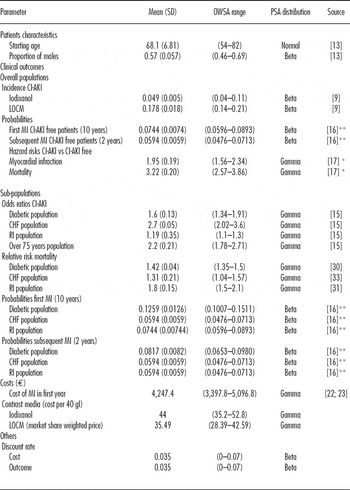
Patients in both CI-AKI free and CI-AKI state were at risk of MI, and the respective probabilities can be found in Table 1. CI-AKI free population was assumed to have a baseline MI risk obtained from the Coronary Heart Disease 10 years risk outcome of the Framingham project (16). The hazard risk ratio (HRR) of MI for patients who experienced CI-AKI compared with the CI-AKI free group was used to account for the greater MI risk of the former. MI rates for both groups were obtained from the prospective analysis by Rihal and colleagues (Reference Rihal, Textor and Grill17) and an exponential regression model was used to estimate the HRR of interest, which was subsequently factored to the baseline MI risk.
Summary of Base-Case Parameters: Central Tendency and Dispersion Measures

* HR was derived applying an exponential regression model to mortality rates in the study.
** Changing underlying risk factors in Framingham algorithm
OWSA, One-way sensitivity analysis; PSA, probabilistic sensitivity analysis; LOCM, low-osmolar contrast media; CI-AKI, Contrast-induced acute kidney injury; MI, myocardial infarction; CHF, congestive heart failure; RI, renal impairment.
Mortality
The probability of death in the CI-AKI free population was obtained from national mortality data for Italy reported by the National Institute of Statistics (18). That is, the estimated mortality for the general Italian population, without specific risk factors. Higher mortality seems to be one of the long-term adverse events of CI-AKI. Hence, patients who have experienced CI-AKI are at higher risk of death and this is captured in the model factoring the baseline mortality by the HRR of death for CI-AKI compared with CI-AKI free patients. The HRR was estimated applying an exponential regression model to the respective mortality rates again obtained from the study by Rihal et al. (Reference Rihal, Textor and Grill17).
In the MI state, the same mortality of the CI-AKI free state or CI-AKI state is applied, depending on the history of simulated patients. The reason behind such an assumption was that both the general population mortality and the excess mortality reflected in the HRR of death from Rihal already captured the increased mortality due to CV events. Hence double counting was avoided.
Costs
The analysis was pursued from a third-party payer perspective, in this case the Italian National Health System (SSN). Costs included in the analysis can be divided into costs related to the administered contrast medium and healthcare costs associated to adverse health events occurred. As a first option, the cost of purchasing CM was calculated with products’ ex-manufacturing prices in terms of Euro per gram of Iodium (gI) and assuming an average dose of 40 gI. The cost per gI of iodixanol and of the first four LOCM more used in Italy, namely iomeprol, iopromide, iobitridol, and iopamidol, was calculated based on current ex-manufacturing prices (19). Given current market shares in Italy, 45 percent, 32 percent, 15 percent, 8 percent (20) for the four agents, respectively, a weighted average was estimated to obtain the LOCM cost per patient treated (Table 1).
As a second option, CM prices were obtained from 2011 hospital tenders in the Lombardy region, so to obtain an approximation of hospitals’ discount strength in a real-world scenario (21). Given these CM bid prices, the cost of iodixanol and of LOCM per 40 gI dose resulted lower than ex-manufacturing price by €5.6 and €9.95, respectively.
The cost of one episode of MI was obtained from the Italian DRG tariffs associated to codes 121 and 122 (22), weighted by the relative frequencies, which are reported by the national hospital discharge database system (23).
Model Analysis
Base-case analysis was conducted on baseline parameters to estimate the ICER, in terms of cost (€) per life-year, of iodixanol compared with LOCM. In so far as parameters in the model were estimated given limited available information, both deterministic and probabilistic sensitivity analysis were performed to control for variability and uncertainty around the ICER, respectively.
One-way sensitivity analysis was conducted varying each of the base-case parameter independently over its range (Table 1). The upper and lower range values were obtained by respectively decreasing and increasing the base-line value by 20 percent, for all parameters with the exception of the discount rate, which was assigned a 0–7 percent range, and the HRRs, ORs, and mortality RRs, for which the confidence interval available from their original papers was used.
Probabilistic sensitivity analysis was conducted fitting distributions to all parameters in the model and running 1,000 Monte Carlo simulations, which were then visualized as cost-effective acceptability curve and as joint incremental costs and effects cloud on the cost-effectiveness plane. The distribution and standard deviation (SD) corresponding to each of the model parameters can be found in Table 1. When the SD was not available in the literature for a given parameter, a 10 percent of its mean value was assumed. The gamma distribution typically provides a good fit to cost data, is skewed, and is constrained to be positive
In addition to base-case results, the results of the present study were analyzed from an alternative perspective, following the schema of the cost-benefit analysis. In this type of pharmacoeconomic analysis, the differential outcomes and costs associated with the two compared strategies can be interpreted by evaluating the Net Monetary Benefit (NMB), which is given by: NMB = Δb * WTP – Δc, where Δb is the incremental outcome, WTP is the willingness to pay threshold (or acceptable ICER threshold), and Δc is the incremental cost. Various willingness to pay thresholds are reported in the literature for different countries. A formal willingness to pay per unit of effectiveness does not appear to exist in the Italian context. However, an Italian study by Messori et al. (Reference Messori, Santarlasci, Trippoli and Vaiani24) suggests a threshold range between €1,000 and €5,000 per month of survival and this has often been used as willingness to pay reference in the Italian literature.
RESULTS
Base-Case Analysis
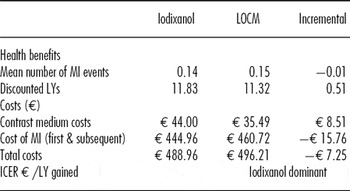
Base-case results showed a greater discounted life expectancy of around 6 months associated with iodixanol with respect to LOCM (11.83 and 11.32 LYs with iodixanol and LOCM, respectively) (Table 2). The lower discounted cost associated to iodixanol compared with LOCM resulted in a negative incremental cost ratio of −€7.25, with the former being mildly cost saving. Thus, in terms of cost-effectiveness analysis the joint incremental cost and effect was located in the south-east quadrant of the cost-effectiveness plane, suggesting that iodixanol was dominant with respect to LOCM.
Base-Case Analysis Results

LOCM, low-osmolar contrast media; MI, myocardial infarction; LYs, life-years; ICER, incremental cost-effectiveness ratio
Incremental costs and life-years were calculated using different CI-AKI incidence rates based on definitions of CI-AKI and SCr measurement timing as reported in McCullough and Brown (Reference McCullough and Brown9). Iodixanol was associated with gains in survival for all four combinations and it appeared also cost saving, hence dominant, when CI-AKI incidence data were based on standardized measurements. A positive ICER was obtained for CI-AKI incidence definition based on both standardized and nonstandardized SCr determination. Although positive, the ICER was relatively low, corresponding to €133.21 and €21.91 per life-year when CI-AKI incidence was defined by a SCr increase of ≥0.5 mg/dL and by a SCr increase of ≥25 percent, respectively.
Results obtained using the base-case definition of CI-AKI and SCr measurement timing and substituting the overall population with the diabetic, CHF, RI, and age ≥75 sub-populations more strongly supported the cost-effectiveness of iodixanol compared with LOCM. Iodixanol was dominant in all groups except the over 75 years of age population, for which an ICER of €19.27/LY was estimated. The largest benefits in terms of costs and life-years were observed for the CHF and diabetic patient groups, with incremental survival of 0.79 LYs and 0.67 LYs and savings of €52.12 and €17.53, respectively (see Supplementary Table 2 for the complete set of results in sub-populations).
Finally, re-performing the analysis using hospital bid prices in the Lombardy region to calculate the prices of iodixanol and LOCM, results confirmed iodixanol as the dominant strategy compared with LOCM, even though savings were reduced to €2.89.
Sensitivity Analysis
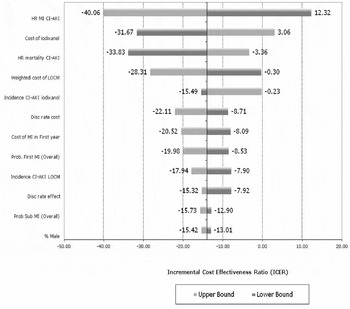
One-way sensitivity analysis was performed on all base-case variables in the model and the results were visualized as tornado diagram (Figure 1). The analysis suggested that the ICER was most sensitive to variations in the HR for CI-AKI related MI, the cost of iodixanol, the HR for CI-AKI related mortality and the weighted cost of LOCM. Furthermore, it can be observed that the ICER almost never turned positive, ranging from −€41/LY to €12/LY and thus indicating that iodixanol predominantly remained the dominant strategy even after controlling for first-order uncertainty.
One-way sensitivity analysis results depicted as tornado diagram. The first 12 parameters in order of influence on the base-case ICER are reported. HR, hazard ratio; CI-AKI, contrast induced - acute kidney injury; MI, myocardial infarction; LOCM, low osmolar contrast media; Disc, discount rate; Sub, subsequent event.

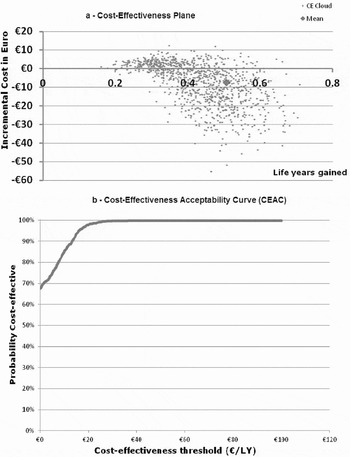
Results of probabilistic sensitivity analysis were depicted in the cost-effectiveness plane and the cost-effectiveness acceptability curve (CEAC) (Reference Briggs, Drummond and McGuire25) (Figure 2). The dots located on the cost-effectiveness plane in Figure 2 are the outcome of 1,000 iteration from the probabilistic outputs of iodixanol compared with LOCM treatment strategy. The cost-effectiveness cloud was situated around the origin between the north-east and south-east quadrant. This again suggested the cost neutrality and positive incremental survival of iodixanol compared with LOCM. The bigger dot represents the joint incremental cost and effect of base-case analysis and therefore allows visualizing the respective position compared with the cloud.
Results of the probabilistic sensitivity analysis depicted (a) in the cost-effectiveness plane and (b) as cost-effectiveness acceptability curve (CEAC). In the cost-effectiveness plane, each one of the 1,000 iterations is represented by a blue dot. In the base case the incremental outcome was 0.51 LYs and the incremental cost -€7.25 (red dot). LY, life-years.

The CEAC shows the probability that iodixanol is accepted as cost-effective strategy at varying willingness to pay threshold within a range of €0/LY and €100/LY. As expected, the proportion of iterations which supported the cost-effectiveness of iodixanol compared with LOCM increased as the threshold became larger. Given that iodixanol appeared to be on average cost neutral and more effective, the probability of cost-effectiveness equaled 100 percent. Results continued to support the cost-effectiveness of iodixanol compared with LOCM, even after controlling for second-order uncertainty.
Cost-Benefit Analysis
Cost benefit analysis results show that, given base-case incremental effectiveness of 0.5 LYs and savings of €7.25 associated to iodixanol compared with LOCM, and assuming a WTP range between € 1,000 and € 5,000, as reported by Messori et al. (Reference Messori, Santarlasci, Trippoli and Vaiani24), iodixanol yields an estimated net monetary benefit ranging between €6,007.25 and €30,007.25.
DISCUSSION
This analysis, aimed at filling the gap of economic evaluations assessing CM in the IV setting, supports the cost-effectiveness of iodixanol compared with LOCM, given the positive increment in life-years and the associated cost savings. Such results were preserved when real-world prices were used, indicating that the differential in price between iodixanol and average LOCM was completely absorbed by the healthcare costs associated with the higher incidence of CI-AKI for IV LOCM patients group. At varying definitions of CI-AKI and SCr measurement timing, results continued to support the cost-effectiveness of iodixanol, although its dominant position over LOCM was lost when both standardized and nonstandardized measurements were allowed. However, given the importance of fixed and frequent measurements to obtain accurate SCr records, standardized methods seem to be preferable and this appears to be in support of our initial finding. A variation to base-case analysis was obtained including ADRs in the model to account for nonrenal adverse events post-CM administration. The inclusion of ADRs did not appear to change the cost-effectiveness conclusion in favor of iodixanol, given the relatively low associated incremental cost of €13.65 per life-year (Supplementary Table 1).
A few published economic studies are currently available that studied the pharmacoeconomic profile of CM-enhanced diagnostics. The study by Arana and Catalá-López (Reference Arana and Catalá-López26), is the only one in the literature that compares the economics and effectiveness of iodixanol and LOCM in IV setting. However, they concentrate merely on the ADRs of allergic nature and results cannot therefore be used for comparison with our findings. Previous economic evaluations by Aspelin et al. (Reference Aspelin, Aubry and Fransson11) and Colombo et al. (Reference Colombo, Lundkvist, Caruggi, Serra and Vinci12) assessed the cost-effectiveness of iodixanol compared with LOCM in IA setting. Fundamental differences from our analysis exist, in terms of time frame, choice of adverse health events, and intended outcome of the model. Despite such disparities, our conclusions appear to be in line with their findings, which support the cost-effectiveness of iodixanol in IV administration as well.
Some limitations to the model exist, particularly concerning lack of primary source and generalizable data. The clinical data used to populate the model were extrapolated from heterogeneous sources available through published clinical studies. Although the uncertainty surrounding model estimates was tested, some degree of caution should be maintained. One main limitation refers to the many and contradictory systematic reviews of CI-AKI incidence presented in the literature. That is, there exists substantial disagreement about a statistically significant difference of CI-AKI incidence between iodixanol and LOCM. Most analysis in the literature aggregated studies which are very diverse in methodology (Reference Heinrich, Häberle, Müller, Bautz and Uder27;Reference From, Al Badarin and McDonald28). However, McCullough and Brown could conduct a meta-analysis which accounted for the heterogeneity of prospective, randomized comparisons of iodixanol and LOCM, and pooled the relative risks (RRs) for CI-AKI based on route of administration, definition of CI-AKI, and timing of sCr measurement. Moreover, all clinical trials collected were assessed for quality and consistency and only those with a Jadad score ≥2, were included in the analysis. As a result, the authors showed a sharp trend toward the reduced incidence of CI-AKI associated with iodixanol, which was statistically significant in specific subsetting. Although the study by McCullough and Brown appears sufficiently robust in its methods, the absence of greater agreement among studies in the literature remains a limitations.
The results of the analysis were presented as cost per life-year and utility values to account for the quality of life were not taken into account. Such a limitation was mainly due to the absence of relevant quality of life data in the literature.
Another important limitation relates to the inclusion of nonrenal long-term effect of CI-AKI only, whereas it might have been relevant to model the effect of CI-AKI on the development of renal failure, need for renal replacement therapy, and related mortality. This could not be pursued due to lack of available information. Given the potential relevance to the analysis, this should be considered a first gap to address when clinical evidence becomes available. Due to the same data limitation issue, MI was the only cardiovascular event modeled in the analysis. Finally, the risk of MI for overall and sub-populations was obtained from the Framingham risk algorithm, which reflects the cardiovascular risk of the U.S. population. Given the differing epidemiological profile of the Italian population, this is likely to result in an overestimation of the MI risk.
Sensitivity analysis results appeared to support the robustness of the model and confirmed the cost-effectiveness of iodixanol as compared to LOCM. More specifically in one-way sensitivity analysis a relatively high sensitivity to variations in the HR for CI-AKI related MI, was found, confirming that this parameter played a crucial role in the analysis. However the absolute values of ICER produced in this analysis were always largely confined in a range of acceptability, touching a maximum of €12/LY.
CONCLUSIONS
Recognizing methodological limitations and on the basis of the available economic evaluations to date, the cost-effectiveness model presented here shows that IV administration of iodixanol compared with LOCM is associated with better clinical outcomes along with average savings in direct healthcare costs. A positive net monetary benefit resulted from factoring in published Italian data regarding WTP thresholds. Overall, the findings of this analysis support the cost-effectiveness of the iodixanol IV use in the Italian clinical setting of hospital CT radiology practice.
SUPPLEMENTARY MATERIAL
Supplementary Figure 1 and Supplementary Tables 1 and 2: http://dx.doi.org/10.1017/S0266462313000706
CONTACT INFORMATION
Sergio Iannazzo MBA, M.Eng. (sergio.iannazzo@icloud.com), SIHS Health Economics Consulting, Torino, Italy
Stijn Vandekerckhove MSc, IMS Health, Vilvoorde, Belgium
Maria De Francesco MSc, IMS Health, Milano, Italia
Akash Nayak MSc, San Bortolo Hospital, Vicenza, Italy
Giovanni Morana MD, Diagnostic Radiology Unit, Ca' Foncello Hospital, Treviso, Italy
Massimo Valentino MD, Diagnostic Radiology Department, S. Antonio Abate Hospital, Tolmezzo (UD), Italy
Claudio Ronco MD, Department of Nephrology Dialysis & Transplantation & International Renal Research Institute (IRRIV), San Bortolo Hospital, Vicenza, Italy
CONFLICTS OF INTEREST
Sergio Iannazzo, Stijn Vandekerckhove, Maria De Francesco, Giovanni Morana, Massimo Valentino and Claudio Ronco have received consulting fees and payment for writing the manuscript to their institute from IMS Health from GE Health Care to conduct a health economic study. Claudio Ronco also reports receiving a fee for expert testimony from GE Healthcare, ABBOT Gambro, Braun and Fresenius. Akash Nayak reports having no conflicts of Interest.