Introduction
Like adults, children use narratives to share their experiences and make sense of the world around them (Bruner, Reference Bruner1990). Sharing stories helps children to connect with family, friends, and peers and, in the process, to shape and consolidate their sense of reality and identity (Nicolopoulou, Reference Nicolopoulou, Cox and Lightfoot1997; Nicolopoulou, Cates Brockmeyer, de Sá & Ilgaz, Reference Nicolopoulou, Cates Brockmeyer, de Sá, Ilgaz, Cakaite, Blum-Kulka, Aukrust and Teubal2014). Along the way, children develop strong language skills (lexical and morphosyntactic) necessary to further support and enhance their narrative abilities (Dickinson, Hoffer & Rivera, Reference Dickinson, Hoffer, Rivera, Veneziano and Nicolopoulou2019; Sénéchal & Lever, Reference Sénéchal, Lever, Robson and Quinn2014). In turn, the acquisition of narrative and other oral language skills during the preschool and kindergarten years plays a critical role in children's academic performance (Catts, Fey, Zhang & Tomblin, Reference Catts, Fey, Zhang and Tomblin1999; Dickinson & Porche, Reference Dickinson and Porche2011; Dickinson & Tabors, Reference Dickinson and Tabors2001; Griffin, Hemphill, Camp & Wolf, Reference Griffin, Hemphill, Camp and Wolf2004; Reese, Suggate, Lang & Shaughency, Reference Reese, Suggate, Lang and Shaughency2010; Snow, Porche, Tabors & Harris, Reference Snow, Porche, Tabors and Harris2007).
Narrative discourse has been characterized as having two essential functions (Labov & Waletzky, Reference Labov, Waletzky and Helm1967/1997; Labov, Reference Labov and Labov1972). The more self-evident function involves what we standardly think of as narration, recounting events in sequential and temporal order. In contrast to this so-called ‘referential’ function, narrative discourse is also fundamentally ‘evaluative.’ There is no one true sequence of events, but rather an interpretation of and attitude toward the narrated events. This latter evaluative function of narratives is what sets them apart as a socially and culturally embedded practice. Specifically, evaluation has been conceptualized as operating in two interrelated ways: (a) as part and parcel of the action sequence and thus embedded within referential clauses (internal evaluation); and (b) the narrator suspends relating the narrative and expresses the “point” of the story and also whether the events in the story are funny, scary, amazing, and so on (external evaluation) (Labov, Reference Labov and Labov1972; Özyürek & Trabasso, Reference Özyürek and Trabasso1997). Therefore, evaluation not only expresses the narrator's stance on the narrated events by indicating what is significant and why it is worth recounting them, but it also organizes the discourse and maintains a relationship with the audience (see also Thompson & Hunston, Reference Thompson, Hunston, Hunston and Thompson2000). Effectively, it is evaluation that enables the monologic narrative to be interactive and fulfill a communicative function. Thus, tracing the evaluative language in children's stories and how it is integrated with stories' referential function can illuminate a crucial aspect of narrative development.
A considerable body of research addresses how narrative competence develops during childhood (for a recent review, see Aksu-Koç & Erciyes, Reference Aksu-Koç, Erciyes, Bar-On and Ravid2018). There is more work focusing on the development of the referential function, such as narrative structure and the linguistic devices that support it, and less on how the evaluative function develops, especially during the preschool years (see also Glenn-Applegate, Breit-Smith, Justice & Piasta, Reference Glenn-Applegate, Breit-Smith, Justice and Piasta2010). The current study contributes to this line of research by focusing on the development of evaluative language among 3-, 4-, and 5-year-olds telling fictional stories to and for their peers in a preschool context.
Not only is the development of evaluative language important in the context of narrative competence in particular, but it also plays a role in the development of other academically critical skills. To wit, various aspects of evaluative language have been found to predict children's later reading comprehension. Griffin et al. (Reference Griffin, Hemphill, Camp and Wolf2004) found that 5-year-olds' quality of play narratives (evaluative expressions, including characters' mental states) uniquely predicted reading abilities three years later. Suggate, Schaughency, McAnnaly and Reese (Reference Suggate, Schaughency, McAnnaly and Reese2018) found that the quality of children's storytelling at 4 years of age (where “quality” was measured through evaluative expressions along with orientations) predicted their early literacy skills a year later, as well as their reading comprehension at ages 12 and 16. O'Neill, Pearce and Pick (Reference O'Neill, Pearce and Pick2004) reported that character perspective shifts and evaluative expressions of mental state references in 3- and 4-year-olds' narratives predicted math scores two years later. These intriguing results bolster the idea that evaluative language in narrative development constitutes an essential contributor to later learning across subject areas. They also raise the question of the developmental trajectory of evaluative language during the preschool years – a period we contend has not been adequately studied.
The developmental trajectory of evaluative language
Taking Labov's ideas as a starting point, researchers have devised various coding schemes for analyzing evaluative language using different age ranges and methods of eliciting narratives (Bamberg & Damrad-Frye, Reference Bamberg and Damrad-Frye1991; Peterson & McCabe, Reference Peterson and McCabe1983; Shiro, Reference Shiro2003; Ukrainetz, Justice, Kaderavek, Eisenberg, Gillam & Harm, Reference Ukrainetz, Justice, Kaderavek, Eisenberg, Gillam and Harm2005). While some developmental patterns have emerged, the picture is somewhat problematic because studies often use different coding schemes. Anticipating our conclusions, evaluative expressions' developmental progression is slow and gradual, and it is influenced by socio-economic status (SES) and culture. Also, the pattern of development during the preschool years is not well delineated. We turn to explain these issues by highlighting some key studies.
Evaluative language development in fictional narratives
A slow but reliable developmental progression has been found when examining children's fictional narratives – that is, stories based on imagined events as one finds in many children's books or TV shows (in contrast to narratives of personal experience, where children ranging from age 4 to 10 produce few discernable developmental differences, Peterson & McCabe, Reference Peterson and McCabe1983; Shiro, Reference Shiro2003). Bamberg and Damrad-Frye (Reference Bamberg and Damrad-Frye1991) were among the first to examine evaluation in fictional narrations of English-speaking 5-, 9-year-olds, and adults of the wordless picture book, Frog, where are you? Building on Labov's categories (intensifiers, comparators, correlatives, and explicatives), the narratives were coded using five categories of evaluations: frames of mind (affective and cognitive states), character speech, hedges, negative quantifiers, and causal connectors. Using a composite score of all evaluation categories, the authors found an increase in the percentage of evaluations (in relation to the total number of clauses) for 5- and 9-year-olds (14% and 17%, respectively) and adults (44%). There was no apparent difference between 5-year-olds and 9-year-olds, whose use of specific categories did not go beyond 4% and 7%, respectively. Five-year-olds did not prefer any particular expression, while 9-year-olds and adults favored the frames of mind over any other. Frames of mind was also the only category showing a clear developmental progression across the three age groups (4%, 17%, and 20%, for 5-year-olds, 9-year-olds, and adults, respectively).
Shiro (Reference Shiro2003) found a similar developmental progression for the frequency of cognitive expressions (similar to frames of mind) in 7- and 10-year-olds' fictional stories. Still, this development was observed only for children from upper-middle-class and not from low-income backgrounds. No developmental increase was found for the frequency of any of the other categories. However, this picture of mental states' developmental growth was not corroborated by Küntay and Nakamura (Reference Küntay, Nakamura, Strömqvist and Verhoeven2004). They tested Turkish and Japanese children (4-, 5-, 7-, 9-year-olds) and adults using narrations of the same frog storybook and coding categories as Bamberg and Damrad-Frye. Comparing their results to those from Bamberg and Damrad-Frye, the authors reported that English-speaking children exhibited a stronger developmental trend for the percentage of use for frames of mind, hedges, and causal connectives relative to both their Turkish and Japanese counterparts. Also, English-speaking children used more character speech than Japanese children. Thus, the results of these studies indicate that (a) expressions of mental states increase with age for school-age children, and (b) SES and culture can influence the development of evaluative language.
The emerging picture is that the acquisition of evaluative language is a slow and late development in children. Aksu-Koç and Erciyes (Reference Aksu-Koç, Erciyes, Bar-On and Ravid2018) summarized the widely accepted view and stated that 3-year-olds scarcely make any evaluations while 4- and 5-year-olds use them occasionally. It is not until 7–9 years of age that reference to emotional and mental state words becomes somewhat prevalent, with enhancers and hedges increasing in frequency. This development continues with adolescents and adults who can use a great variety of evaluative lexical and syntactic devices (Berman, Reference Berman1997; Labov, Reference Labov and Labov1972).
Ukrainetz et al. (Reference Ukrainetz, Justice, Kaderavek, Eisenberg, Gillam and Harm2005) objected to this developmental picture, arguing it is misleading because school-age children were tested with a particularly challenging elicitation method. Several previous studies have used the 24-page wordless picture frog book (Bamberg & Damrad-Frye, Reference Bamberg and Damrad-Frye1991; Küntay & Nakamura, Reference Küntay, Nakamura, Strömqvist and Verhoeven2004) or a 10-minute video (Shiro, Reference Shiro2003). In contrast, Ukrainetz and colleagues used a simple 5-picture sequence depicting everyday obstacles that prevent a boy from getting to school on time (a task included in the Test of Narrative Language, Gillam & Pearson, Reference Gillam and Pearson2004). Using this stimulus, they elicited narrations from 5- to 12-year-olds and coded them using five categories only somewhat related to those previously used: modifiers (adjectives & adverbs), multi-word expressions, repetition, internal states, and dialogue.
It is challenging to compare Ukrainetz and colleagues' results directly to previous studies because these researchers only reported the presence (just one instance) or absence of a category. But despite the objections raised by Ukrainetz and colleagues, their results largely corroborate the developmental picture about internal states we have seen so far. They also found that the use of internal state talk increased across development: 20% of 5–6-year-olds used at least one instance, 50% of 7–9-year-olds, and 72% of 10–12-year-olds. Furthermore, they found that the children most frequently used the modifiers category (adjectives and adverbs) they introduced: 60% of 5–6-year-olds used it at least once, 90% of 7-9-year-olds, and 95% of 10-12-year-olds.
Early emergence of evaluative language
Even though a developmental picture in broad strokes emerges for fictional stories told by English-speaking school-age children, it is less clear when preschoolers begin to use evaluative language and what categories they may favor. Most studies have used 5-year-olds as their youngest age group (Bamberg & Damrad-Frye, Reference Bamberg and Damrad-Frye1991; Shiro, Reference Shiro2003; Ukrainetz et al., Reference Ukrainetz, Justice, Kaderavek, Eisenberg, Gillam and Harm2005); and when 4-year-olds have been included, they tend to be combined with 5-year-olds (Peterson & McCabe, Reference Peterson and McCabe1983). Only Glenn-Applegate et al. (Reference Glenn-Applegate, Breit-Smith, Justice and Piasta2010) included 3-year-olds, but they combined them with 4-year-olds. Glenn-Applegate and colleagues analyzed narrations elicited by the frog storybook, which constitutes a demanding task for preschoolers, and the categories used were more similar to the Ukrainetz et al. (Reference Ukrainetz, Justice, Kaderavek, Eisenberg, Gillam and Harm2005) than to those from previous studies (i.e., adjectives, adverbs, interjections, repetitions, internal states, dialogue, humor, stress). Also, the picture of development presented by Glenn-Applegate and colleagues is limited because they calculated only the percentage of children who used at least one instance (presence or absence) of a category.
In contrast, the current study focused on spontaneously produced narratives by 3-, 4-, and 5-year-olds in a social context that was meaningful to children – a storytelling context that has been shown to produce richer and more sophisticated narratives than those generated in less naturalistic contexts (Brockmeyer, Nicolopoulou, Sá & Ilgaz, Reference Brockmeyer, Nicolopoulou, Sá and Ilgaz2009; Spinillo & Pinto, Reference Spinillo and Pinto1994; Wellhousen, Reference Wellhousen1993). But before we introduce our study, we discuss one important way we expanded the notion of evaluative language.
Evidentiality as an aspect of evaluative language
Based on Chafe's (Reference Chafe, Chafe and Nichols1986, Reference Chafe1994) insightful analysis of subjectivity in language, a handful of studies have expanded the study of evaluative language in children's narratives. Specifically, Shiro (Reference Shiro2004) attempted to capture different types of subjectivity in personal and fictional stories in 7- and 10-year-old Venezuelan children. Shiro, Diez-Itza and Fernández-Urquiza (Reference Shiro, Diez-Itza, Fernández-Urquiza, Aguilar-Mediavilla, Buil-Legaz, López-Penadés, Sanchez-Azanza and Adrover-Roig2019) extended a similar analysis to narratives of 9-year-olds with Williams syndrome. They coded children's narratives using evaluative expressions (cognition, emotion, intention, physical, and reported speech) and evidential expressions following Chafe's model of epistemic modality (1986), thus coding modes of knowing, sources of knowledge, and enhancers.
Evidentiality is the speakers’ reference as to how they acquired a piece of information expressing whether this is direct evidence (perception), indirect evidence (hearsay/report), or inference (Aksu-Koç, Reference Aksu-Koç, Güven, Akar, Öztürk and Kelepir2016; Ünal & Papafragou, Reference Ünal, Papafragou and Aikhenvald2018). Closely related to evidentiality is epistemic modality, which indicates the degree of certainty or uncertainty of the speaker towards the information presented since such epistemic notions vary depending on the nature of the source (Matsui, Reference Matsui and Matthews2014). Certainty/uncertainty are often captured through modal auxiliaries, mood inflections, modal adverbs, and other epistemic markers (Hickmann & Bassano, Reference Hickmann, Bassano, Nuyts and van der Auwera2016; Matsui, Reference Matsui and Matthews2014). To the best of our knowledge, no study has looked at the development of evidentiality and expressions of certainty/uncertainty in young children's narratives, even though there is accumulating research on young children's acquisition of these notions in naturalistic and experimental settings (Aksu-Koç, Reference Aksu-Koç, Güven, Akar, Öztürk and Kelepir2016; Choi, Reference Choi and Frawley2006; Hickmann & Bassano, Reference Hickmann, Bassano, Nuyts and van der Auwera2016; Matsui, Reference Matsui and Matthews2014; Ünal & Papafragou, Reference Ünal, Papafragou and Aikhenvald2018).
These lines of research indicate that, from around 2-3 years of age, young children produce some evidential and certainty/uncertainty expressions, but this development is piecemeal and gradual, and full-blown mastery takes time (Aksu-Koç, Reference Aksu-Koç, Güven, Akar, Öztürk and Kelepir2016; Choi, Reference Choi and Frawley2006; Hickmann & Bassano, Reference Hickmann, Bassano, Nuyts and van der Auwera2016; Matsui, Reference Matsui and Matthews2014). We expect, however, that it takes longer for preschoolers to use these markers appropriately in their narratives. This stems from narratives' nature of embodying a double displacement: a spatio-temporal removal, as the narrative world, is not about the “here and now,” but about the “there and then”; and a displacement of consciousness, as opinions, attitudes, and voices attributed to the story's narrator or characters (Chafe, Reference Chafe1994). Also, children's “perspective-taking” and “theory of mind” abilities, which partially underlie the categories of evaluative and evidential expressions, emerge gradually starting as early as around 2–3 years and become more frequent and stable around 4–5 years of age (Allen, Skarabella & Hughes, Reference Allen, Skarabella, Hughes and Behrens2008; Carpendale & Lewis, Reference Carpendale, Lewis, Liben, Ulrich and Lerner2015; Graf & Davies, Reference Graf, Davies and Matthews2014; Hickmann & Bassano, Reference Hickmann, Bassano, Nuyts and van der Auwera2016). Thus, one expects that some of these expressions should be incorporated in children's narratives earlier than others, especially for narratives elicited in a meaningful social context (Nicolopoulou, Reference Nicolopoulou and Richner2007). In short, adding evidentiality and certainty/uncertainty in evaluative language allows us to capture better the subjective perspective of the narrator or a specific character.
The current study
This study investigated cross-sectional differences across three preschool ages and longitudinal changes within each age group concerning evaluative and evidential expressions. Our analysis focused on stories generated by 3-, 4-, and 5-year-olds because children of these ages have not been adequately studied. To the best of our knowledge, no study has considered developmental differences among these three age groups. We also focused on children's spontaneous stories because this is a favorite childhood activity, so we expect them to reflect children's narrative abilities best. Previous research had shown that children who composed their own stories produce richer and more linguistically sophisticated narratives than when they created them with the help of pictures or other props (Brockmeyer et al., Reference Brockmeyer, Nicolopoulou, Sá and Ilgaz2009; Spinillo & Pinto, Reference Spinillo and Pinto1994; Wellhousen, Reference Wellhousen1993).
Furthermore, because these children narrated stories in their preschool classroom during the entire school year, we examined changes from their first to their last story. By incorporating a longitudinal element in our study, analyzing two stories per child, one at the beginning (first story) and the other at the end of the school year (last story), we were able to study within-subject change, a feature absent from all the studies reviewed so far. We were also interested in analyzing children's stories regarding their use of evaluative expressions – as most previous studies have done – but also of evidential expressions. By doing so, we aimed to obtain a more detailed picture of young children's developing abilities to express subjectivity in their narratives.
We hypothesized that the context of narrative elicitation used in this study, a storytelling/story-acting (STSA) classroom practice, might attune children to the audience in a manner often tricky to achieve when eliciting stories from individual children in traditional experimental settings. In this respect, we expected that the STSA context might be closer to Labov's ingenious method (1972) of eliciting narratives of near-death experiences from urban adolescents that produced a rich set of evaluations. We also expected that evaluative language would be prevalent in these stories, especially as the practice continued over the school year.
Narratives in social context
To flesh out our hypotheses and expectations regarding the STSA, it is worth highlighting several of its features. The stories were generated as part of the STSA that was a standard component of the curriculum in the preschool classrooms we studied. Children had the opportunity to dictate stories to their teacher during daily free-play activities. These stories were acted out the same day by the child-author and peers during a group-time activity that involved the entire classroom (for further details, see method).
The stories were neither solicited by adults nor scaffolded by a story template or adult-suggested topics or story props. Children volunteered for this activity and were free to choose their characters, themes, and plots – thus, creating their own spontaneous stories. One result of having their stories read to and dramatized for the entire class at group-time is that children tell their stories not only to the adults who write them down but also to their peers. This practice allows children to use their stories for socio-relational concerns, such as enticing other children to act in their stories by telling appealing stories they want to enact. The children often used their stories to seek or express friendship, group affiliation, or prestige, attuning the storyteller to the audience's concerns. In composing stories, children may be inclined to include specific characters or themes that their friends favor acting out, or that mark the clique to which they belong, and so on (for further details, see Nicolopoulou, Reference Nicolopoulou, Slobin, Gerhardt, Guo and Kyratzis1996, Reference Nicolopoulou, Cox and Lightfoot1997; Nicolopoulou et al., Reference Nicolopoulou, Cates Brockmeyer, de Sá, Ilgaz, Cakaite, Blum-Kulka, Aukrust and Teubal2014). Thus, we anticipated that stories generated through this practice would offer a vibrant body of materials to capture evaluative language's developmental origins.
Evaluative language coding
To capture a wide range of the developing subjectivity in young children's narratives, we coded evaluative language in terms of two dimensions: (a) evaluative expressions, understood as referring to the teller's opinions and interpretation of the story's characters or events (e.g., modifiers, affective and mental states, character speech, enhancers, causal explanations, and negative qualifiers); and (b) evidential expressions, understood as furthering the teller's subjectivity by referring to the source of information expressed in the utterance (e.g., perception, language, belief, and inference) along with the speaker's certainty or uncertainty towards the truth value of the proposition (captured by the use of modal verbs and modal adverbs, which we refer to as modulation of assertion).
The choice for our coding categories was rooted in previous studies and our desire to compare our results to them. For evaluative expressions, we included all the categories used by Bamberg and Damrad-Frye (Reference Bamberg and Damrad-Frye1991), which were also used by Küntay and Nakamura (Reference Küntay, Nakamura, Strömqvist and Verhoeven2004), and we added the category of “modifiers” used by Ukrainetz et al. (Reference Ukrainetz, Justice, Kaderavek, Eisenberg, Gillam and Harm2005) and Glenn-Applegate et al. (Reference Glenn-Applegate, Breit-Smith, Justice and Piasta2010). For evidential expressions, we included a range of information sources: direct perception, language report, belief based on previous knowledge, and inference from observable but incomplete evidence (Aksu-Koç, Reference Aksu-Koç, Güven, Akar, Öztürk and Kelepir2016; Choi, Reference Choi and Frawley2006; Matsui, Reference Matsui and Matthews2014; Ünal & Papafragou, Reference Ünal, Papafragou and Aikhenvald2018). For capturing the degree of certainty or uncertainty (closely linked to evidentiality), we cast a broad net and focused on how children modulate their assertions through the use of auxiliary modals and modal adverbs since our interest was in capturing young children's development. This aspect of certainty or uncertainty has been included in some previous evaluative coding schemes for older children as “hedges” (Bamberg & Damrad-Frye, Reference Bamberg and Damrad-Frye1991; Küntay & Nakamura, Reference Küntay, Nakamura, Strömqvist and Verhoeven2004; Labov, Reference Labov and Labov1972). Because of the close conceptual affinity between evidential expressions (understood as a source of knowledge) and hedges (degree of certainty/uncertainty), we believe the category modulation of assertion fits better with our notion of evidential expressions.
Research questions
Specifically, we asked two pairs of research questions. First, do preschool children include evaluative language – evaluative and evidential expressions – in their spontaneous stories generated through the STSA? If so, does the frequency and length adjusted frequency of evaluative and evidential expressions increase with age from 3- to 5-years? Second, are there changes in children's use of such expressions over the school year (from the first to last story)? If so, is the end of the year increase in evaluative language explained by the frequency of the storytelling activity in which the children participated (e.g., the number of stories told)?
Method
Participants
We analyzed the first and last stories composed by 30 children who attended five different mixed-age classes across several years in a private half-day preschool in a college town in the northeastern United States. Children were randomly selected from the five preschool classes to create three age groups of equal size and gender distribution: 5 boys and 5 girls each at early 3′s, early 4′s, and late 4′s at the beginning of the school year. Children in the oldest group started as late 4′s, and most turned 5 during the fall semester, but for simplicity's sake, we refer to them as 5-year-olds. Some children attended the class for a second year, but we included only their stories from the first year when we included these children in our sample. We only had two children (a boy and a girl) in the older group whose stories came from the second year. But a preliminary analysis suggested that these stories were not different in length, linguistic, and narrative complexity from those in the same age group that had attended the classroom for only one year.
Children's ages at the beginning of the school year were as follows: 3-year-olds: M = 40.40 (SD = 2.80; Range: 36 to 47); 4-year-olds: M = 49.50 (SD = .97; Range: 48 to 54); 5-year-olds: M = 57.30 (SD = 1.95; Range: 55 to 61). The children were from middle- to upper-middle-class families and their parents were mostly professionals or academics. All but two children were white European American, and all spoke English as their first language. As the teachers reported to us, all the children were typically developing, and we confirmed through the first author's extensive observations in the classrooms.
Classroom data collection: child-produced, teacher-transcribed narratives
The children told the stories analyzed in this study as part of the STSA that was a regular part of the curriculum for the entire school year in all the five preschool classes studied (for further details, see Nicolopoulou, Reference Nicolopoulou, Slobin, Gerhardt, Guo and Kyratzis1996, Reference Nicolopoulou, Cox and Lightfoot1997). The basic STSA structure involves the following three steps: the teacher invites students to dictate stories to her one at a time; the teacher transcribes each story as it is being dictated; and, later in the day, each student who has dictated a story (and has had it transcribed) directs herself and her classmates in a dramatization of the story, rooted in the transcription. The first two steps comprise the storytelling (“ST”) part of the STSA, while the final step comprises the story-acting (“SA”) part.
Regarding the classrooms included in the present study, the lead teachers cultivated the STSA activity well before the first author started observing the classrooms. The impetus and guidelines for this activity came from the teacher/scholar Vivian Paley (Reference Paley1986, Reference Paley1990), as it dovetailed nicely with the Froebel play philosophy operating in these classrooms. The teachers' goal in using this activity daily in their classrooms was to provide an opportunity for the children to tell their own stories that they were going to dramatize later that day with their friends. For this reason, the teachers did not guide or correct the child's language, grammar, narrative structure, or content during the activity. They believed that such development would gradually occur as the children listened to each other's stories and dramatized them together.
Procedure
Storytelling
The storytelling part of the activity took place every day during morning “choice time,” when children were free to participate in different activities available to them. During a portion of this period, the lead teacherFootnote 1 was available to write down stories from any child who wanted to tell a story. There were always children who volunteered to tell stories, and each teacher usually took down stories from 2–4 children per day – as many as they had time to dramatize that day. If more children wanted to tell a story, the teacher established a waiting list so the children could go on with other activities. The teacher consulted this list the next day if all the children did not have a chance to tell their story the previous day. All the children in the classroom readily told stories as this was a favorite activity; also, no child was required to tell a story, although the teachers encouraged some of the more reticent ones, especially towards the beginning of the school year (see Nicolopoulou, Reference Nicolopoulou and Richner2007).
In telling their stories, the child sat next to the teacher or across from the teacher at a classroom table. The teacher invited the child to tell any story they wanted (“Do you have a story to tell? Tell me about it”), and she wrote down the child's story verbatim in a class story notebook. Thus, the teacher did not provide the children with a narrative template or any other guidance in telling these stories (neither content, nor structure, nor grammar). The children were given full freedom to develop their stories in any way they wished.Footnote 2 The teachers also provided minimal prompts during the story dictation, and they only inquired, if the child stopped, whether they had something more to add to their story (“Anything else?”) or whether they were finished (“Is there more to your story?”).
The stories analyzed here were not audiotaped, but the children had learned to dictate their stories to the teacher, stopping as the teacher wrote down what they had just said and continued to dictate after she stopped writing. The teacher also occasionally controlled the children if they were going too fast, and she could not take the story down. In establishing this rhythm, the teacher read aloud each sentence as she was writing it down for the child to approve it or make any change deemed necessary. As soon as the dictation was complete, the teacher often read the entire story back to the child, ensuring that she had heard everything correctly. She also reread the story during the dramatization part, as explained below. In any of these times, the teacher readily accepted any changes the child made – and a few children took the opportunity to do so.
Story-acting
The story-acting portion of the activity took place during “group time,” with the entire class assembled. All the stories dictated during that day were acted out in the order dictated. The teacher first read the story aloud to the whole class, and then the author of the story chose children in the classroom (including himself or herself) to act out the characters in the story. As the teacher read the story a second time, the child-actors acted out the story while the rest watched attentively. This process was repeated until all the stories dictated during that day were acted out. The stories in each class were written in a single “class storybook,” which the first author obtained for analysis at the end of the school year. All parents had signed consent forms, approved by the college's Institutional Review Board, to make the stories of their children available to us.
Analytic plan: selecting the analytic sample and coding the stories
The 30 children told a total of 762 stories, but our analysis here focused only on 60 stories: the first and last story told by each child during the academic year. In all cases, there were at least 6 months between the first and the last story: the first stories were told during the first and second months of the activity (September-October) and the last stories during the last two months of the activity (April and May). Children told significantly different numbers of stories across the three ages, F(2,27) = 5.08, p = .013. Three- and 4-year-olds told a similar number of stories (M = 25.10, SD = 6.13 and M = 21.30, SD = 7.34, respectively), while 5-year-olds told significantly more stories (M = 35.40, SD = 14.61) than both the 3-year-olds (p = .03) and the 4-year-olds (p = .005).
The narratives were transcribed and coded using the CHAT transcription format provided by the CHILDES Project (MacWhinney, Reference MacWhinney2000). They were parsed into clauses, where a clause is defined as a unified predicate that expresses a single activity, event, or state (see Berman & Slobin, Reference Berman and Slobin1994). Each clause was then coded for the use of categories for evaluative and evidential expressions.
Evaluative expressions
As discussed in the Introduction, evaluative expressions refer to the speaker's opinions, attitudes, and expectations towards the story's characters, actions, and events. To ensure that we could compare our results with previous studies, we used their evaluative categories (cf. Bamberg & Damrad-Frye, Reference Bamberg and Damrad-Frye1991; Ukrainetz et al., Reference Ukrainetz, Justice, Kaderavek, Eisenberg, Gillam and Harm2005).
Modifiers
Adjectives and adverbs that change, clarify, qualify/quantify, or limit a character, object, or action in some way to add emphasis, explanation, or detail (e.g., a beautiful little princess; a warm and snug house; he came in very slowly, three power ranges, a lot of alligators).
Mental states
Expressions that refer to the cognitive and affective states of characters serving to qualify the nature of links between events. They function to encourage interest and empathy in the audience and include a reference to emotional states (e.g., happy, sad, scary); verbs that evoke a clear emotional response (e.g., he screamed when he saw the monster); expressions of volition, wish, desire (e.g., would like; wants; prefers) or intention (e.g., she went to get her coat; they went to show grandma their new puppy); and reference to perceptual processes (e.g., see, hear), or mental states (e.g., know, think, remember, plan).
Character speech
Attributes of speech that express an alternative perspective to that of the narrator, thus bringing immediacy and vividness to the narrative. We included two types: the character is speaking directly (e.g., The door said, “window, why don't we go to the park?”) or indirectly (e.g., The door said to the window that they go to the park).
Enhancers
Expressions that stress, intensify, and provide emphasis through repetition (e.g., they had a big, big dinner); enhancing adverbial phrases or adjectives (e.g., again, suddenly, humongous monster, very long fight); phrases indicating unexpected or contrasting nature of things (but, instead), or mitigating the action or activity (e.g., would you be so kind as to give me some food?).
Causal explanations
Pointers to the motivation for an action, providing the causal framework relating events that often remain implicit. This category included inter-clausal connectors such as because, so, so that, as, since, in order to, to, and so on.
Negative qualifiers
They highlight underlying expectations regarding norms or events, and at times they indicate surprise. This category included direct negation, not (e.g., he did not come; he did not know; nobody came) or un (e.g., he undid everything).
Evidential expressions
These refer to the speaker's attitude towards the information contained in the utterance concerning the nature of the source of information and the degree of certainty or uncertainty towards the information.
Source of information
Expressions indicating the nature of the source through which the speaker obtained the information expressed in the utterance: perception such as see, hear, smell, taste, or touch (e.g., he heard a crushing sound), language (the King said, “You must be bored”), belief (e.g., he thought the bear was nice), or inference (e.g., it must be raining).
Modulation of assertion
Expressions informing the listener of the narrator's degree of certainty for proposition's truth value expressed in the utterance. This category included modal auxiliaries (e.g., must, can, should) and modal adverbs (e.g., perhaps, maybe, possibly).
Coding reliability
An independent examiner coded 40 percent of the sample (both stories of 2 boys and 2 girls at each age group) and these scores were compared to the coding by the first author who coded all the data three times. The reliabilities calculated separately for each category as Cohen's kappa showed very high agreement (clauses = .99; modifiers = .98; mental states = .95; character speech = 1; enhancers = .83; causal = 1; negative qualifiers = 1; sources of knowledge = .93; and modulation of assertion = 1).
Results
To address our research questions, we conducted multiple univariateFootnote 3 3 (Age: 3-, 4-, 5-year-olds) x 2 (Story Order: first, last) mixed repeated measures ANOVAs on evaluative and evidential expressions used in children's stories with Age as the between- and Story Order as the within-subjects variable. The analyses were performed separately for each specific category and on the composite scores of evaluative and evidential expressions for raw frequencies as distinct from story-length adjusted percentages (i.e., frequency of a specific category divided by the total number of clauses per story multiplied by 100).
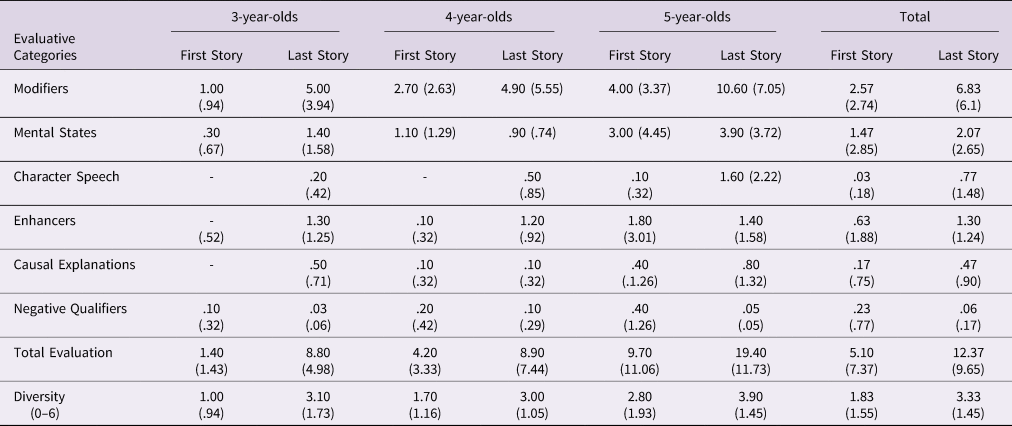
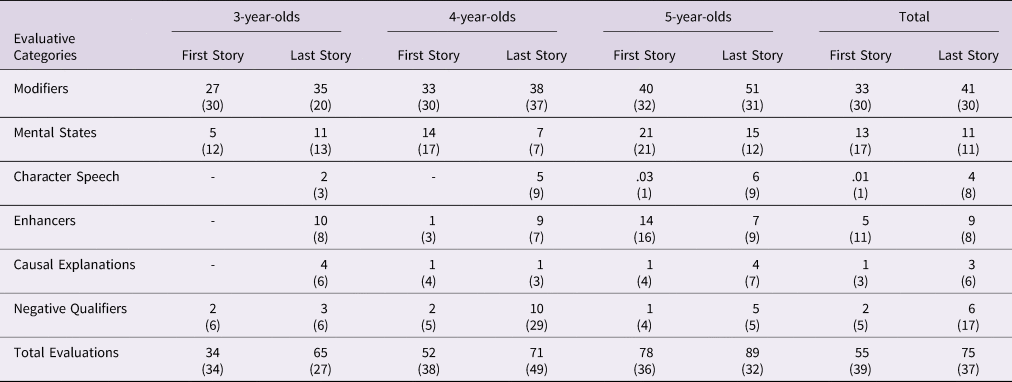
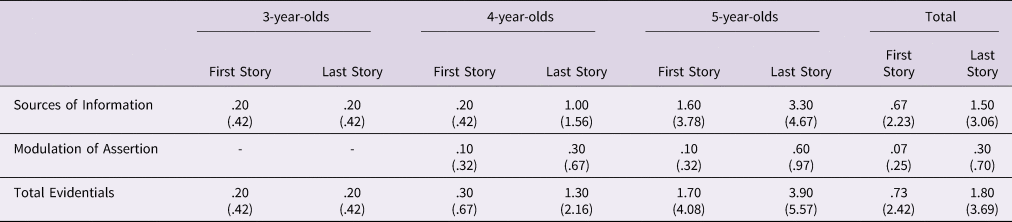
Because both mean frequencies and mean percentages were negatively skewed, they were logged linearly transformed (logs to the base 10; Field, Reference Field2016). The statistical results (F values) reported here are based on the logarithmically transformed data, but we report the untransformed means for ease of interpretation. The descriptive statistics for the untransformed frequencies of evaluative and evidential expressions are shown in Tables 2 and 4a, respectively. The untransformed mean percentages of evaluative and evidential expressions are shown in Tables 3 and 4b, respectively. Post hoc analyses (adjusted for multiple comparisons by using Bonferroni corrections) tested the hypotheses concerning age. We also conducted a 3 (Age) x 2 (Story Order) ANOVA on the number of different evaluative expressions (irrespective of frequency) children used in their stories. We called this the diversity measure (see Table 2 for descriptive statistics).
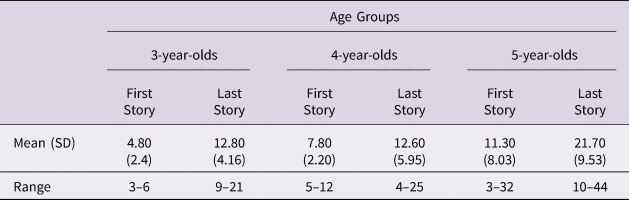
Mean Number of Clauses (Standard Deviations) and Range for First and Last story by Age

Mean Frequencies (and Standard Deviations) of Evaluative Expressions for First and Last Story by Age

Mean Percentages (and Standard Deviations) of Evaluative Expressions for First and Last Story by Age

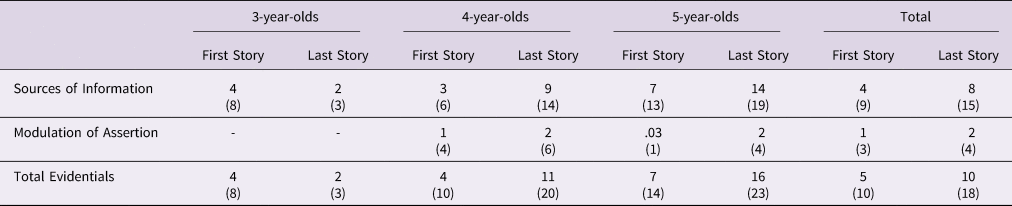
Evidential Expressions' Mean Frequencies (and Standard Deviations) for First and Last Story by Age

Evidential Expressions' Mean Frequencies (and Standard Deviations) for First and Last Story by Age

The decision to conduct the analyses on both frequencies and percentages was influenced by the fact that children's stories increased in length by Age, F(2, 27) = 6.45, p = .01, η p2 = .32, reflecting that 5-year-olds told significantly longer stories (M = 16.5) than did 3-year-olds (M = 8.80, p = .01) and 4-year-olds (M = 10.20, p = .03) (see Table 1). In addition, children's last story (MLastStory = 15.70) was significantly longer than their first story (MFirstStory = 7.97, F (2, 27) = 44.44, p <.001, η p2 = .65). Mean frequencies also present useful information in that children's greater use of evaluative and evidential expressions indicates mastery of storytelling abilities, although these seem to covary with increases in story length. Also, in this study, using percentages is an especially conservative measure, and probably misleading, because for older children, their clauses often contained more than one evaluative expression, especially in their later stories. For several of the categories used here (e.g., causal explanations, negations, and modulation of assertion), it is unreasonable to expect more than a few instances in each story. For these reasons, we believe the results should be evaluated mainly in terms of frequencies, using percentages as a backdrop while keeping in mind the caveats mentioned here.
Children's use of evaluative expressions
Frequency
Using a composite frequency score for evaluative expressions (aggregating across the different categories used), we found a significant main effect of Age, F(2, 27) = 10.64, p <.0001, η p2 = .44, reflecting that 5-year-olds used more total evaluative expressions (M = 14.55) than did 4-year-olds (M = 6.55, p =.012) and 3-year-olds (M = 5.1, p <.0001). Specifically, while 3-year-olds on average used 5 evaluative expressions and 4-year-olds 6 ½ in their stories, 5-year-olds used 14 ½. There was also a significant main effect of Story Order, F(1, 27) = 38.87, p <.0001, η p2 = .59, reflecting that children used more total evaluative expressions in their last stories (M = 12.37) than in their first stories (M = 5.1).
Focusing on the frequency of each specific evaluative category (i.e., Modifiers, Mental States, Character Speech, Enhancers, Causal Explanations, and Negative Qualifiers), we observed that the categories used most frequently across all age groups were Modifiers followed by Mental States then Enhancers and Character Speech. In contrast, Causal Explanations and Negative Qualifiers were less frequently used (see Table 2). In fact, there was a main effect of Age for children's use of Modifiers, F(2, 27) = 6.75, p = .004, η p2 = .33, with 5-year-olds using more Modifiers (M = 7.30) than did 4-year-olds (M = 3.80, p = .03) and 3-year-olds (M = .30, p <.01). There was also a main effect of Age on Mental States, F(2, 27) = 3.71, p < .04, η p2 = .22, with 5-year-old using more mental states (M = 3.45) than 3-year-olds (M = .85, p = .047) and 4-year-olds (M = 1). Thus, 5-year-olds used more evaluative expressions than 3- and 4-year-olds who did not differ significantly from each other.
There was a main effect of Story Order for children's use of Modifiers, F(1, 27) = 16.62, p < .0001, η p2 = .38, Character Speech, F(1, 27) = 12.21, p = .002, η p2 = .31, Enhancers, F(1, 27) = 17.61, p < .0001, η p2 = .39, and Negative Qualifiers, F(1, 27) = 4.83, p = .04, η p2 = .15, while Mental States (p = .09) and Causal Explanations (p = .09) were only trends (see Table 2). Overall, children used more of each of these specific categories in their last story than in their first story with Modifiers having the greatest increase over time (MFirst = 2.57; MLast = 6.83), followed by Mental States (MFirs t = 1.47; MLast = 2.07), and Enhancers (MFirs t = .63; MLast = 1.30). There was also a significant Age x Story Order interaction for Enhancers, F(1, 27) = 4.85, p = .02, η p2 = .26. Simple main effects indicated that 3- and 4-year-olds used more Enhancers in the last story than in their first story, while 5-year-olds used the same number of Enhancers in both stories (see Figure 1).
Frequency of Enhancers by Age and Story Order

Percentages
The results using percentages – frequencies adjusted for differences in story length – yielded only a subset of the observed results with frequencies. Specifically, only the evaluative composite mean percentage scores showed a significant Age effect, F(2, 27) = 5.13, p = .01, η p2 = .275, with 83% of 5-year-olds’ clauses containing evaluative expressions while only 63% of 4-year-olds and 49% of 3-year-olds did. The 5-year-olds were significantly different from the 3-year-olds (p = .01) but not from the 4-year-olds. None of the specific evaluative subcategories showed Age effects.
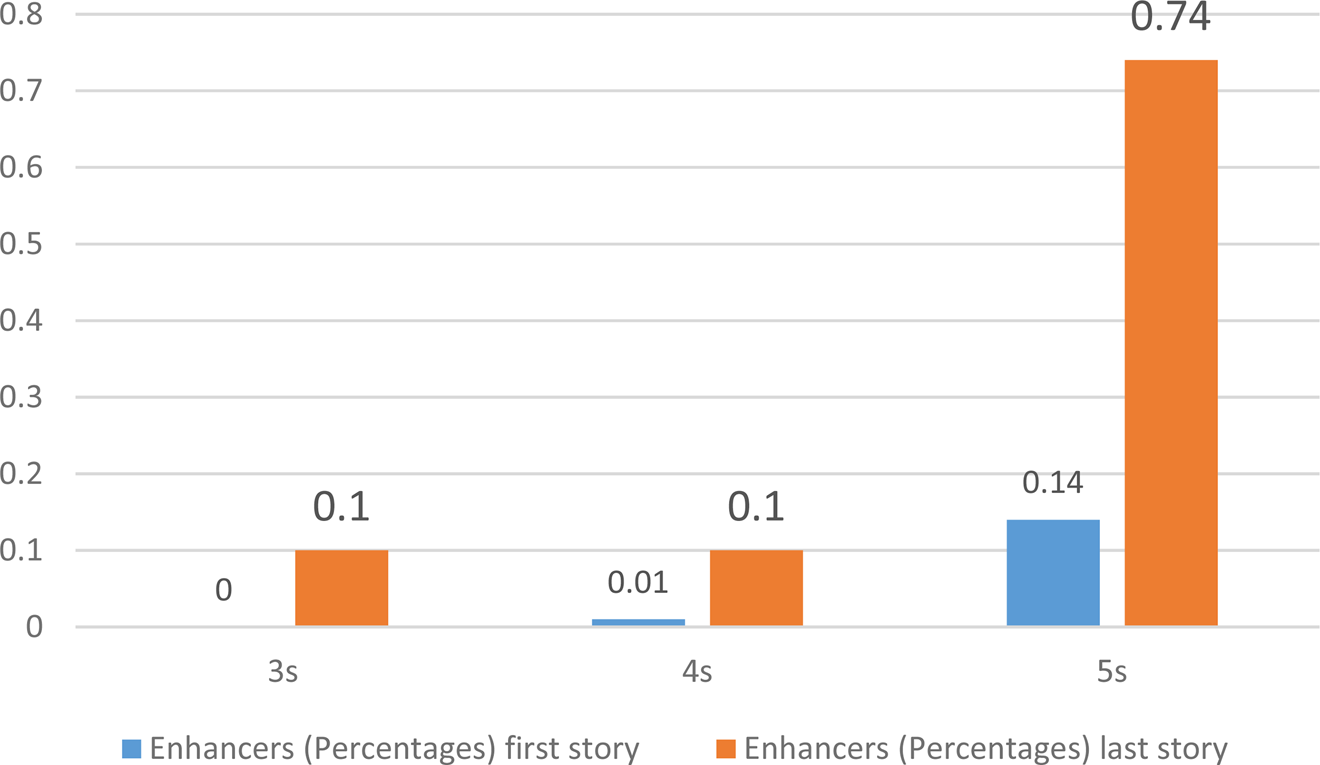
There was also a main effect of Story Order for evaluative composite mean percentage scores, F(2, 27) = 5.35, p = .03, η p2 = .165, reflecting the fact that 55% of clauses in the first story contained evaluative expressions versus 75% in the last story. With respect to specific categories, this Story Order difference was borne out in Character Speech (F(2, 27) = 9.41, p = .01, η p2 = .259; MFirst = 1%, MLast = 4%) and Enhancers (F(2, 27) = 4.58, p = .04, η p2 = .145; MFirst = 5%, MLast = 9%). In addition, the Age x Story interaction for Enhancers was significant, F(2, 27) = 6.43, p = .01, η p2 = .323, indicating that percentage of clauses with Enhancers increased significantly from the first to last story only for the 5-year-olds. This pattern of interaction is different from that observed for raw frequencies (see Figure 2).
Percentage of Enhancers by Age and Story Order

Diversity of evaluative expressions
We also examined whether children employed a greater diversity of evaluative expressions (types of evaluative categories used, regardless of their frequency of use) by age and from first to the last story. Children received a score of 1 for each of the evaluative subcategories they used with a possible range from 0–6 points (see lower panel of Table 2).
There was a main effect of Age, F(2, 27) = 3.70, p = .04, η p2 = .215, reflecting that 3-year-olds used on average 2 different types of evaluative expressions (M = 2.05), 4-year-olds slightly over 2 (M = 2.35), and 5-year-olds slightly over 3 (M = 3.35), but only the difference between 5- and 3-year-olds was significant (p = .045). There was also a main effect of Story Order, F(1, 27) = 21.72, p < .0001, η p2 = .45), reflecting that children used a wider range of diverse expressions in their last stories (M = 3.33) than in their first stories (M = 1.83).
Children's use of evidential markers
Frequency
Using a composite frequency score of evidential markers (aggregating across Source of Information and Modulation of Assertion), we found a main effect of Age, F(2, 27) = 3.60, p =.04, η p2 = .21, reflecting that 5-year-olds used more evidential markers (M = 2.8) than 3-year-olds (M = .20, p = .046), while 4-year-olds were not different from either the 3-year-olds or the 5-year-olds. There was also a significant main effect of Story Order, F(1, 27) = 4.28, p =. 048, η p2 = .137, reflecting that children used more evidential markers in their last story (M = 1.80) than in their first story (M = .73).
The frequency of each specific category for evidential markers revealed only a main effect of Age for Source of Information, F(2, 27) = 3.71, p = .04, η p2 = .215, reflecting that 5-year-olds (M = 2.45) signaled the Source of Information more often than the 3-year-olds (M =. 20) (see Table 3). No significant differences were found for Modulation of Assertion either by Age or Story Order.
Percentages
There were no significant results for mean percentages for evidential expressions whether we examined the composite percentage scores or mean percentages for each of these categories separately (see Table 4b). The use of each of these categories, when measured in percentages, was systematically low across the sample.
Predicting evaluative language in the last story
While the previous analyses indicated significant increases for evaluative and evidential expressions from the first to the last story, this analysis explicitly tested whether the frequency of engagement in the STSA was associated with these increases. As a proxy for the frequency of engagement, we used the number of stories told (NOST) by each child to see whether it predicted the total number of evaluative language expressions used in their last story. Strictly speaking, focusing on NOST captures only one aspect of engagement in the STSA since children also participated as actors in the activity's story-acting portion. However, our data do not allow us to quantify the story-acting aspect of children's participation.
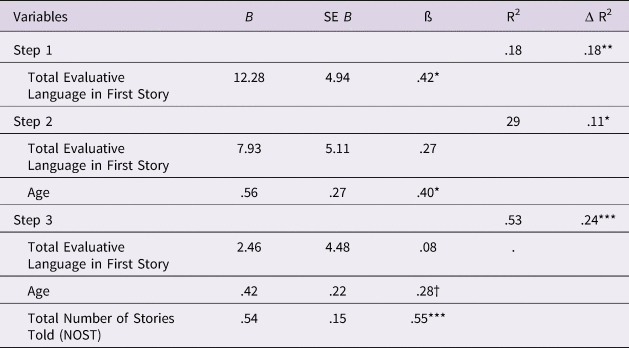
A three-step hierarchical regression was conducted with total evaluative language (evaluative and evidential expressions) in the last story as the dependent variable. The first story's total evaluative language was entered at step one to control for children's evaluative language for the first story. Age was entered at step two, and NOST was entered at step three. After controlling for autoregression (total evaluative language score in the first story), we found that Age was a significant predictor (ß = .40, p = .047) only in step 2. When NOST was entered in step 3, only NOST was significant (ß = .55, p = .001). This step explained 53% of the data variance, an increase of 24% relative to step 2 that did not include NOST as a predictor (see Table 5).
Summary of Hierarchical Regression Analysis for Variables Predicting Total Evaluative Language for the Last Story

Note. †p <.10, *p <.05, **p <.01, ***p <.001
Discussion
This study examined preschoolers' evaluative language using spontaneous stories generated by 10 children each at 3, 4, and 5 years of age to provide a detailed picture of children's developing narrative abilities during these early years. It also analyzed children's first and last story told approximately at the beginning and end of the school year – thus, adding a unique longitudinal dimension to this study. The stories analyzed here were generated through the STSA that was a regular activity of the preschool classrooms the children attended. Because these stories were dramatized by the child-author and their peers in the classroom, it helped to bring out the social aspect of telling and sharing stories with others. For this reason, we expected that the children would be more likely to express their subjective stance (or that of the characters) in their stories. And to capture children's narrative subjectivity comprehensively, the stories were analyzed for both evaluative and evidential expressions.
The authentic classroom STSA context of story elicitation succeeded in drawing out a substantial number of evaluations in children's stories. This rich evaluative language – especially evaluative expressions – was evident across ages and from the first to the last story. We found that 3- and 4-year-olds did not differ significantly from each other, while 5-year-olds often differed from 3-year-olds and, at times, from 4-year-olds. In this section, we take up some of the main findings of this study, and we offer some illustrations of the evaluative language children used.
A closer look at evaluative language in light of previous studies
One of the most frequent evaluative categories in our data was Modifiers. They increased in frequency from the first story to the last, in line with the findings of Glenn-Applegate et al. (Reference Glenn-Applegate, Breit-Smith, Justice and Piasta2010) and Ukrainetz et al. (Reference Ukrainetz, Justice, Kaderavek, Eisenberg, Gillam and Harm2005), showing early and growing use of items from this category. Preschool children appear to start by elaborating their characters in describing and specifying them in greater detail before elaborating other aspects of the story.
The next most frequent evaluative category in our data was Mental States, and this also showed cross-sectional differences and longitudinal increases. This result accords with previous studies showing that Mental States was the second most commonly used category by preschoolers (Glenn-Applegate et al., Reference Glenn-Applegate, Breit-Smith, Justice and Piasta2010) as well as those that found a clear developmental progression for this category for older children (Bamberg & Damrad-Frye, Reference Bamberg and Damrad-Frye1991; Shiro, Reference Shiro2003; Ukrainetz et al., Reference Ukrainetz, Justice, Kaderavek, Eisenberg, Gillam and Harm2005). This result further supports the idea that children's first forays into evaluative language involved elaborating their characters' features – and, in this case, their internal mental states.
However, this category's presence in children's narratives may not indicate true metacognitive abilities but their origins. In this study, we followed the standard practice in defining the category of mental states in children's narratives rather broadly to include emotion, intention, volition, and perceptual and cognitive processes. But as Malle (Reference Malle, Gilead and Ochsner2020) cogently argues, social cognition is hierarchically organized, ranging from lower-order capacities (e.g., social referencing, detecting intentional actions, and inferring desires) to higher-order abilities (e.g., inferring knowledge and making mental state ascriptions). Thus, metacognition emerges gradually over time. Using data from the same children as the current study, but analyzing all their stories throughout the school year, Nicolopoulou and Richner (Reference Nicolopoulou and Richner2007) found a gradual development of children's conception of characters as portrayed in their stories that accords with Malle's hierarchical organization of social cognition. Specifically, 3-year-olds' characters were portrayed mainly as Actors (only just actions), 4-year-olds mainly as Agents (including volition, emotion, and intentionality), and 5-year-olds mainly as Persons (including representational abilities with thoughts and beliefs and contrasting representations, including false beliefs).
Somewhat less frequent were the categories of Sources of Knowledge and Enhancers, although these too increased in use with age and from the first to the last story. In addition to the increase of frequency of use over time, how children expressed these categories changed with age. In Sources of Knowledge, children continued by elaborating aspects of their characters by indicating perception as the source of knowledge by 3 and 4 years, adding language by 4 years, and adding beliefs and a few inferences by 5 years. A similar progression of children's understanding of source monitoring from perception to language to belief and inference was reported in a comprehensive review by Ünal and Papafragou (Reference Ünal, Papafragou and Aikhenvald2018). They argue that this progression is gradual and lengthy, starting with perception at 3 years, adding verbal communication to learn about invisible properties by 4–6 years. Still, the causal link between inferential access and knowledge does not develop until age 6. It is interesting to note that in children's spontaneously produced stories, they added these sources of information in a similar order but in a more condensed period. This may be the case because of the favorable social context of narrative elicitation in our study and because these children told stories throughout the school year, giving them continuous opportunities to practice and hone these skills.
In the case of Enhancers, 3- and 4-year-olds used repetition more often while older children used lexical items such as so big, humongous, as well as contrastive such as but. The fact that 5-year-olds used a wider range of Enhancers, including some that serve canonical discourse functions (e.g., but), suggests they may have been more successful in taking the perspective of others. Consequently, they can elaborate their stories to help their audience see the story events from their or their characters' point of view (for a review see Graf & Davies, Reference Graf, Davies and Matthews2014). The repetition used by the younger children, on the other hand, has a more straightforwardly rhetorical function and so evinces less narrative sophistication. In the context of these within-category differences, it is interesting that an Age x Story Order interaction emerged, showing that both 3- and 4-year-olds increased their use of enhancing devices over time, while 5-year-olds used them in equal frequencies in their first and last story (see Figure 1). This result suggests that, among the 3-year-olds and 4-year-olds, the STSA may have attuned children to their peers as an audience.
Character Speech, Causal Explanations, Negatives Qualifiers, and Modulation of Assertion were the least frequently used categories. On average, they increased from less than one instance in the first story to a bit over one instance by the last story (see Table 2 & 4a). We also saw similar age trends. While children can use several of these linguistic elements in their communicative interactions with others (Choi, Reference Choi and Frawley2006; O'Neill, Reference O'Neill2007), in our case, the children needed to incorporate them in stand-alone narratives, which requires advanced language and cognitive abilities. While we did not separate agent-oriented modality (can/can't) from epistemic modality (may/might, possible/probable) in our category of Modulation of Assertion, neither of these linguistic forms was very frequent in the 5-year-olds' stories. However, research has found that agent-oriented modality, which is oriented towards actions, develops as early as 2 to 3 years, while epistemic modality, which concerns knowledge, develops later (Choi, Reference Choi and Frawley2006; Hickmann & Bassano, Reference Hickmann, Bassano, Nuyts and van der Auwera2016; Matsui, Reference Matsui and Matthews2014). Two factors can explain the scarcity of these forms in our stories. We restricted our coding of Modulation of Assertion to modals and modal auxiliaries. Simultaneously, some of the ways agent-oriented modality (desire, volition) are expressed were included in our mental state category, so our coding disadvantaged the Modulation of Assertion category. Besides, we believe that the modulation aspects (expressed through modals) related to characters' actions and knowledge require more elaborated storylines that only some of our 5-year-olds started producing.
In closing, two main findings emerge from our more detailed analysis. First, the developmental picture observed in this study provides evidence of an earlier emergence of evaluative language skills than has been found in previous research – starting as early as 3 and 4 years. The relative frequencies of many of the categories were similar, albeit in some cases somewhat lower than those of studies with school-age children. Second, our analysis of evaluative language helps us grasp how preschoolers elaborate their spontaneous narratives with more detail and specificity. They start by first specifying, defining, and clarifying their characters through modifiers, and soon add some simple mental states, including desires, wants, and emotions. Only beginning at age 4 and more so at age 5 do children incorporate more sophisticated cognitions (know, think, remember) that include some higher-order capacities (e.g., false beliefs or inferences). Another aspect of characters that is elaborated early on is the nature of the source of information through which characters acquire knowledge – even though this category was not very frequently used. As children progress in portraying their characters, they begin to elaborate the storyline by including causal explanations, negative qualifiers, and enhancers. However, modulation of assertion, which focuses on certainty or uncertainty for the information conveyed, was rarely observed in these stories. It may well be that this category requires the further elaboration of both characters' perspectives and storyline before it can appear with some frequency. Next, we turn to illustrate this developmental progression by using some stories from our sample.
Illustrating the developmental picture
Age differences
We illustrate these results by quoting the first stories from three children, one from each of the three age groups. We selected these children because they told stories about a similar theme, making it easier to draw comparisons. These stories demonstrate age-related differences in length and evaluative language.
The first story by a 3-year-old girl (Daphne, 3;4)Footnote 4:
Once upon a time, there was a house. There was two [EVA] orange [EVA] kitties. A raccoon came and ate the peels. And a person came and fed the cats.
The first story by a 4-year-old girl (Nora, 4;1):
Once upon a time, there was a beautiful [EVA] little [EVA] princess. Then a prince came. The princess girl [EVA] grew up and they married, and they had two babies [EVA] – a boy and a girl [EVA]. Another prince [EVA] came and married the other girl [EVA]. They had a puppy and a little [EVA] cat.
The first story by a 5-year-old girl (Margo, 4;9):
Once there was mom and dad, and a sister. And they lived in a house far out [EVA] in the country. They had a brother and a little [EVA] baby. They went out in the woods and saw [EVA; EVI] a cave. And they looked in [EVA]: and saw [EVA; EVI] glowing [EVA] eyes. They saw [EVA; EVI] a bad [EVA] bat and a bad [EVA] bear. They rushed into the house and they forgot [EVA] to lock [EVA] the door. Then they locked the door. The end.
These examples illustrate how the older children used both more evaluative and evidential expressions than did the younger children, and how their stories included a more significant number of categories. The 3-year-old used only a few modifiers, specifying the number (two) and color (orange) of the characters (the kitties). In contrast, the 4-year-old used numerous modifiers to specify, clarify, and differentiate the various characters in the story. But only the 5-year-old went beyond the external elaboration of characters and attributed mental states to the character and added identifying information sources such as perception, purposeful intentionality to motivate actions, and cognitive processes such as forgetting. Furthermore, while both the 3- and the 4-year-olds related their story from the narrator's perspective, the 5-year-olds related their story from the character's perspective. In the 5-year-old's story, we are told that the character saw a cave, and then he saw glowing eyes, a bad bat, and a bad bear. In this respect, the subjectivity of the character is further elaborated as well as aspects of the setting the incident takes place, filling in the scene for the audience in a way that the younger children's stories do not.
From first to the last story
The next two stories illustrate changes from the first to the last story for a 5-year-old boy. Again, we observe substantial increases in narrative length and also striking increases in evaluative language for both evaluative and evidential expressions.
The first story of a 5-year-old boy, Ellis (5;1):
Once there was Superman. The Spiderman came and spun a web and swung to a building. It was the root of the building [EVA]. And then Rocksteady and Bebop, and Shredder came and they had a big, big [EVA], very long [EVA] fight. Then they had pizza and that's the end.
The last story of Ellis (5;8) and 16 stories in between:
Once there was Robin Hood. Then a bear came. But the bear was nice [EVA]. And Robin Hood thought [EVA] that [EVI] the bear was evil [EVA] so [EVA] he shot an arrow at the bear. But [EVA] the bear knocked the arrow out of the way. The bear did not [EVA] fight Robin Hood so [EVA] he shot another arrow [EVA] at the bear. But the bear again [EVA] knocked the arrow out of the way, after that [EVA] the bear didn't [EVA] run at Robin Hood. The bear was a nice [EVA] bear. So [EVA] then that told [EVA; EVI] Robin Hood that the bear was a nice [EVA] bear. So [EVA] they were friends. Then a bad guy [EVA] came. The bear and Robin Hood fighted the bad guy [EVA]. And the bad guy [EVA] died. And Robin Hood and the bear won the fight. The end.
These two stories illustrate the narrative growth this child made over the school year. The child used only a limited number of evaluative expressions in his first story, while he used many evaluative and evidential expressions in his last story. It is also clear how the character's perspective is brought out in the last story. We follow Robin's Hood reasoning in evaluating and reevaluating the evidence as to whether the bear is evil or not based on the bear's reactions to Robin Hood's aggressive actions. This child also includes mental states and the sequential contrasting reasoning that shapes the story character's judgment, which reflect theory-of-mind abilities. This story illustrates well the critical role that evaluative language plays in bringing out the subjectivity of the characters and further elaborating plot organization.
Do the STSA support and foster children's evaluative language?
The remarkable growth observed in Ellis' stories is not an isolated instance, as our quantitative analysis also attests. It seems that the context of our story elicitation – where children told stories not mainly to the teacher but also to their friends through story dramatization – fostered the use of evaluative language along similar lines as those found in studies with older children – and at times in a richer way. The question arises, though, whether the changes observed are primarily the result of the STSA or whether they reflect development that would have occurred in any preschooler over 5–6 months. While we could not test this causal hypothesis explicitly due to the lack of control data, our regression models did reveal that children's total number of stories told (NOST) significantly predicted their growth in evaluative language scores over and above age. Indeed, some underlying factors that predisposed children to employ more evaluative language over time may have prompted them to tell more stories. But the relationship between NOST and evaluative language scores, over and above children's age, suggests that the active engagement of the children in the STSA (as reflected by NOST) is one of the mechanisms of children's enhanced narrative sophistication.
Another informative comparison further recommends the STSA as a plausible cause of these increases. Children's frequencies of use for many of the specific subcategories for their last story (when the children were now older and thus closer to the next age group) were often higher than the scores children in the following age group received at the start of the school year. That is, the scores 3-year-olds received in the spring (who are now older by 5/6 months) were higher than the scores the 4-year-old group received in the fall; similarly, the scores 4-year-olds received in the spring were higher than the scores the 5-year-old group received in the fall. This indicates that the opportunity of using language again and again – in this case, the experience of telling stories – may create a powerful self-sustaining system that strengthens and reinforces language (Dickinson, Griffin, Golinkoff & Hirsh-Pasek, Reference Dickinson, Griffin, Golinkoff and Hirsh-Pasek2012) and especially narratives (Hoff, Reference Hoff2006). This may be especially likely in the context of the STSA because children are not only storytellers but also story listeners. They are exposed to their peers' linguistic input and the interpretive pressures operating in tracking orally presented stories. Thus, the activity seems to impact the development of the cognitive and linguistic aspects that underlie evaluative language.
The final outstanding question these results raise is whether preschool children can take others' perspectives as the development of evaluative and evidential expressions requires – since, as we have seen, several of these expressions are directed towards the audience. There is considerable experimental research in recent years, indicating that even 2-year-olds can take others' perspectives (for an overview, see Allen et al., Reference Allen, Skarabella, Hughes and Behrens2008). But other studies suggest that 3-year-olds encountered some difficulties in perspective-taking tasks, while 4- and 5-year-olds were better able to take others' perspectives (Graf & Davies, Reference Graf, Davies and Matthews2014). The variability in children's performance observed in various studies seems to stem from task demands or task complexity, including how researchers ask their questions. It appears then that the younger the children, the more likely the results reflect task demands and variability in methodology (Graf & Davies, Reference Graf, Davies and Matthews2014). Indeed, our results relating NOST to children's growth in evaluative language support these contentions and underline Nilsen and Fecica's (Reference Nilsen and Fecica2011) argument that successful communicative perspective-taking depends on social experience.
Limitations, future directions, and conclusions
This study shows that stories elicited in a genuine peer group context display remarkable evaluative language skills that also developed over the school year. However, our ability to draw stronger conclusions from this work is limited by several study features, which we discuss here. First, because we were interested in capturing stories told spontaneously in a classroom peer-context in the iterative story-generation of the STSA, it was impossible to audio-record these stories. Instead, we relied on the teachers to take them down. However, the teachers were careful in writing down the stories as the children were dictating and did so with minimal intervention as the STSA aligned well with the general school pedagogical philosophy. Because of this, the teachers embraced the rules of the STSA that encouraged minimal intervention and guidance of children's stories. The children had the opportunity to correct what the teacher had written down – and some did so, as the story was read back to the children more than once. Thus, we do not view the lack of audio-recording of the stories as quite as problematic a limitation as it may initially sound. We also made sure that our coding categories fitted well with the type of transcription used (as opposed to some evaluative paralinguistic elements, such as intonation, vowel elongation, or gestures, which were not captured in the transcription nor were a focus of this study).
Second, including more children and a larger number of stories would have given us a richer and more stable picture. It would have also allowed us to test various other hypotheses – such as whether the observed increase in evaluative language may have been affected by children's initial language abilities or by the number of times they acted in stories. However, to compare an equal number of children across ages, we restricted the number of children per age group. We also analyzed only two stories per child rather than all the stories the children told. It would be useful if future research of this kind could be carried out with larger samples of children and stories. It bears acknowledging, though, that this type of story elicitation and subsequent sampling is incredibly resource-intensive. To get a large number of children across the three age groups studied here and produce stories as volunteers in a meaningful social context, one would need to draw from many classrooms that regularly and consistently practice the STSA. Also, the researcher would need to monitor the classrooms and the activity regularly. All of this would likely be more feasible in an experimental evaluation where some of these features could be controlled. Still, in the authentic context of classrooms that voluntarily adopted and sustained the STSA, these conditions are difficult to be realized.
A third limitation stems from the fact that the children in these classrooms came from a homogeneous group of middle-class to upper-middle-class professional and academic families; and the classroom curriculum fostered a rich language environment. This limitation may be tempered, however, in the context of the STSA. The first author and colleagues have shown that the STSA fosters narrative development and other language skills (Nicolopoulou, Reference Nicolopoulou, Blum-Kulka and Snow2002, Reference Nicolopoulou, Cremin, Flewitt, Mardell and Swann2017, Reference Nicolopoulou, Veneziano and Nicolopoulou2019), including self-regulation and social competence (Nicolopoulou, Cortina, Ilgaz, Cates Brockmeyer & de Sá, Reference Nicolopoulou, Cortina, Ilgaz, Cates Brockmeyer and de Sá2015; Nicolopoulou, Sá, Ilgaz & Brockmeyer, Reference Nicolopoulou, Sá, Ilgaz and Brockmeyer2010) for children from language-underprivileged backgrounds. However, an analysis of evaluative language has not been carried out with the stories of children from language-underprivileged backgrounds; and we also found differences in the narrative competence of these two populations (Nicolopoulou, Reference Nicolopoulou, Blum-Kulka and Snow2002, Reference Nicolopoulou, Cremin, Flewitt, Mardell and Swann2017, Reference Nicolopoulou, Veneziano and Nicolopoulou2019). Still, we believe the differences observed in these populations are mainly due to these children's initial language capacity when starting preschool and to how often they had the opportunity to tell stories in their classroom. Concerning cultural variations, the picture is more complex since it is not only the opportunity and frequency of storytelling that makes a difference. Rather a host of cultural factors such as the type of narratives the culture demands, what is considered important or worth telling to focus on or omit, and overall, the types of adult narratives the children encounter in their culture. These reasons suggest that our results may not generalize to all children, but they indicate what is possible given rich social language experiences and a genuinely meaningful communicative context to tell stories.
Despite these limitations, the genuine social context of the STSA in which these stories were generated provides a unique context to elicit evaluative language. On the one hand, it can be likened to the narratives about near-death experiences Labov elicited from African American adolescents who were guided into the rhetorical position of persuading the listener that these were emotionally significant experiences. The structure of the STSA also made it clear to the children that they needed to tell stories that appealed to the audience so that their friends would be willing to dramatize their stories and continue to play with them in the classroom. At the same time, this study found that having children tell stories repeatedly appeared to support and enhance their evaluative language. On the other hand, this context of story elicitation also has some limitations since the classroom's life imbues children with diverse social and cognitive concerns (Nicolopoulou, Reference Nicolopoulou, Slobin, Gerhardt, Guo and Kyratzis1996). For example, children may not have the same socio-relational concerns over time since group dynamics may shift. And the children may want to incorporate new themes or appeal to different groups of children, and so on. Simultaneously, the children may also develop cognitive concerns that direct them more to narrative content issues than social context. These factors may affect children's storytelling in unpredictable ways so that there may not always be an easily observable unidirectional development. On the whole, however, analyzing stories collected in this peer-group context constitutes a powerful way to glimpse preschoolers' potential for narrative development.
Acknowledgements
After the first author, the rest of the authors are listed in random order since they all contributed equally and in significant ways to this study. The authors would like to thank the children who participated in this project, their parents, and the teachers whose classrooms we studied and whose cooperation was essential for the research presented here. Sincere appreciation is extended to Ayhan Aksu-Koç for invaluable discussions, guidance, and support in finalizing this paper.