Introduction
The northern Moluccas (Maluku Utara) Islands in Eastern Indonesia (Figure 1) are located at the geographic interface of Island Southeast Asia and Oceania. Various archaeological studies have helped to reconstruct the migration of Homo sapiens throughout Island Southeast Asia and especially the islands in Wallacea, including the Moluccas (Bellwood et al. 1993, Reference Bellwood, Nitihaminoto, Irwin, Waluyo and Tanudirjo1998; Spriggs 1998; Irwin et al. Reference Irwin, Bellwood, Nitihaminoto, Tanudirjo and Siswanto1999; Bellwood 2017). Early major human migration can be divided into two periods: the Late Pleistocene to Middle Holocene, or around 50 000 BP and 4000 BP, and the Neolithic to Metal Age around 4000–1000 BP. This second period saw the first human migration into Remote Oceania, including Polynesia, Micronesia and the eastern Melanesian islands. In the Moluccas case, the previous studies have shown that the islands played a significant role as stepping stones in the human dispersal into Oceania from at least 35 000 BP (Bellwood et al. Reference Bellwood, Nitihaminoto, Irwin, Waluyo and Tanudirjo1998; Szabo et al. Reference Szabo, Brumm and Bellwood2007). In this paper we focus on new evidence from the second migration period, from a newly investigated cave site called Aru Manara on Morotai Island that has produced modelled and decorated pottery associated with jar burials, and radiocarbon dates in the first millennium BC.
Locations of Aru Manara and other sites discussed in the northern Moluccas.

The Neolithic site of Uattamdi, on Kayoa Island (3400–3000 BP), has produced plain red-slipped sherds related to similar Neolithic pottery found at sites in eastern Borneo, Sulawesi, the Talaud Islands and the Philippines. The Uattamdi potsherds were also associated with a variety of shell artefacts and marine and terrestrial animal remains (Ono Reference Ono2016; Bellwood 2017). The Uattamdi assemblage was contemporaneous with Lapita sites in Near and Remote Oceania, although, so far, it has not produced any dentate-stamped sherds in the style typical of the Lapita culture. This absence means that the relationship between the Neolithic archaeology of the northern Moluccas and the Lapita assemblages of Melanesia remains unclear.
The period discussed in this paper spans between 2700 and 2000 BP, slightly later than the Lapita period and the commencement of occupation at Uattamdi when the number of sites in the northern Moluccas with pottery and jar burials increased dramatically (Ono et al. Reference Ono, Oktaviana, Aziz, Prastiningtyas, Iriyanto, Ririmasse, Zesse and Hisa2017). Aru Manara, the focus of this article, was a major burial site on Morotai Island at the northern tip of the Moluccas, active at this time of overlap between the Late Neolithic and the Early Metal Age, and following the initial Austronesian migration to Taiwan, Island Southeast Asia and Oceania around 3500 BP, making it a significant period in the proto-history of eastern Indonesia. Historical evidence for the ancient spice (cloves) trade from the northern Moluccas dates back to at least the Early Han dynasty (206 BC–AD 9) and indicates the development of maritime networks and human migration in and around the islands (Miller Reference Miller1969; Hung & Chao Reference Hung and Chao2016). The distributions of Austronesian and Papuan languages in the northern Moluccas also suggest complex population movements within the past 3000 years. The arrival of bronze, iron and glass artefacts during the mid to late first millennium BC possibly encouraged further developments in human migration and trading networks both in the Moluccas and more widely across Island Southeast Asia.
The recovery of anthropomorphic and zoomorphic appliqué pottery from Aru Manara suggests similar evidence to that found at other sites, including jar burials and a megalithic grave tradition comprising menhirs, dolmens, mortars and stone statues, and hence perhaps similar beliefs. We suggest that these practices originated as part of a wider ‘Neolithic package’ (Spriggs 2011). In addition to presenting the evidence from this site for the first time, we also review its implications for a broader understanding of contact between Island Southeast Asia and Oceania through similar decorative pottery motifs after 2700 BP (Garanger Reference Garanger1971; Galipaud et al. Reference Galipaud, Kinaston, Halcrow, Foster, Harris, Simanjuntak, Javellel and Buckley2016).
Aru Manara and its burials
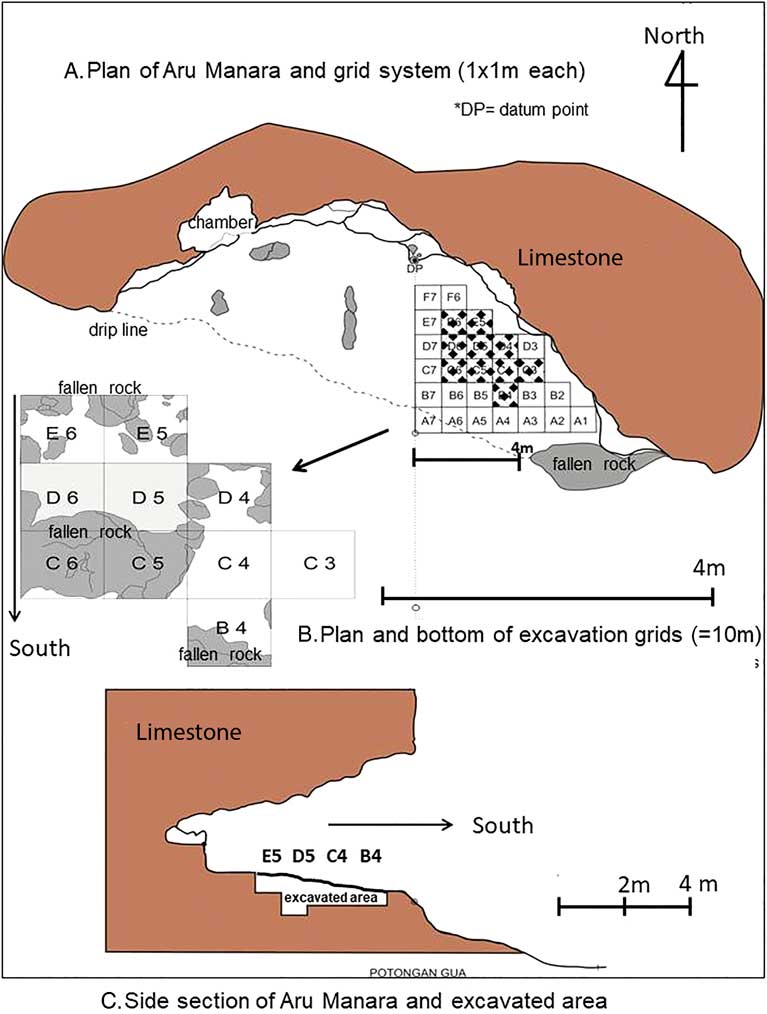
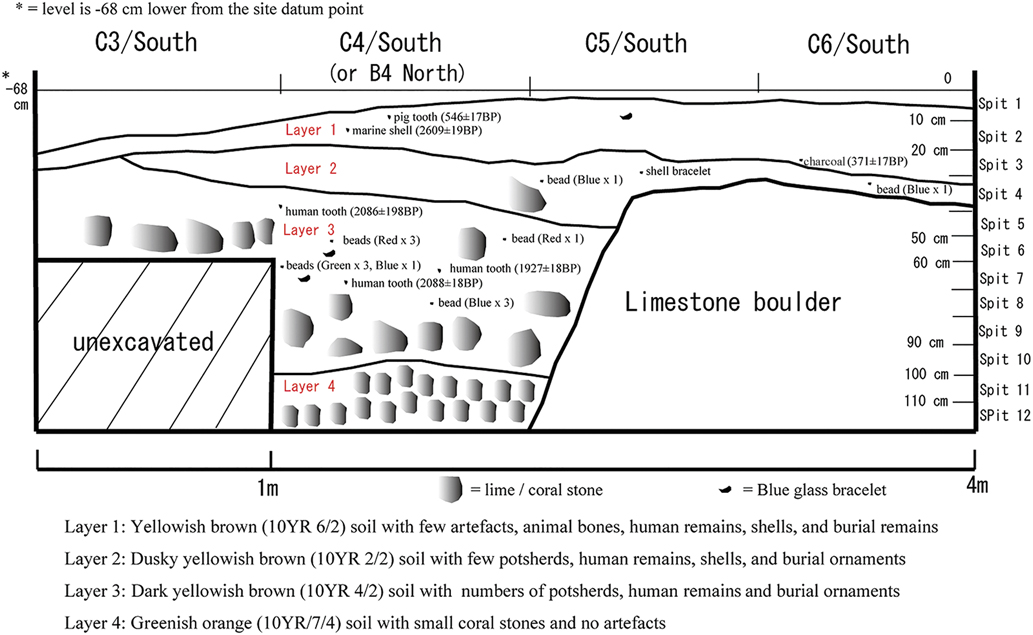
Aru Manara is a limestone cave located about 275m inland from the south-eastern coast of Morotai (Figure 1). The cave floor lies about 5m above current high tide; the mouth is 16m wide and 6m high, and the cave extends back over 7m deep, covering 80m2. We used a 1×1m grid and a 0.1m spit digging system, then selected to excavate an area of 10m2 in total (Figures 2–3). The excavation confirmed four layers with 2m of deposits down to bedrock. Cultural materials were identified in layers 1–3. Among them, layer 3 yielded the largest volume of human remains, burial ornaments and pottery, while the much younger layers 1–2 yielded fewer such finds, and were deemed partly disturbed, based on the 14C dates (Figure 3). Among the 10 square-metre grids, bedrock was only reached in squares D5 and D6 (Figure 2) in order to confirm that layer 4 comprised culturally sterile roof-fall. In other squares, excavation did not extend beyond the estimated middle of layer 4, which was devoid of cultural materials.
A) Plan of the excavation at Aru Manara and grid-reference system used; B) bottom plan of the excavated squares; and C) the south-facing section (simplified) of squares E5, D4, C4 and B4.

The wall section showing the location of some of the recovered ornaments and samples used for dating samples.

The large number of teeth (NISP, number of identified specimens=1550 in total) and fragmented human bones (NISP=57 273 in total) recovered suggest secondary burial. Approximately half of this material is a dark black or grey-white in colour as a result of heating; the rest, mixed with the burnt material, shows no signs of burning. The existence of many well-burnt bones indicates that some bodies were cremated, after which the remains were collected and buried in the shelter (Shipman et al. Reference Shipman, Foster and Schoeninger1984). Based on the total number of canines (n=200), which are the best-represented element, the minimum number of individuals is 50. Our analysis confirms that those buried include adults (ages >20), adolescents (ages 15–19), children (ages 1–14) and infants (age <1). The remains are too fragmentary for sex determination.
The site also produced charcoal, shells and animal bones including pig, rat and fish, mainly from the upper layers. Three small bronze ornament fragments were also excavated from the topsoil. Other finds, mainly excavated from the middle to lower layers, include possible baked clay ear ornaments (n=2); Trochus, Tridacna and Conus sp. shell ornaments (n=10); glass beads (n=23); fragments of glass rings (n=4); a bone ornament (possibly made from a dugong rib); and an obsidian flake from an unknown source (Ono et al. Reference Ono, Oktaviana, Aziz, Prastiningtyas, Iriyanto, Ririmasse, Zesse and Hisa2017). The sherds included part of a pedestal with appliqué lizards and box-type pottery, some of which bear decorations of human figures, found mainly in the lower to middle layers in square B4 located close to the shelter mouth (Figure 2), amongst the highest density of human bones (NISP=18 985).
Thirteen AMS samples were obtained from charcoal, human teeth, shell ornaments and a pig bone, and analysed at Tokyo University (Table 1). These dates were calibrated using OxCal 4.2.3 (Ramsey Reference Ramsey2009), with results based on the IntCal 2013 and Marine 09 calibration curves. These dates clearly show that the human remains and associated shell ornaments (potentially burial goods), date to between 2700 and 2000 cal BP. The dated charcoal samples and pig bone post-date 1000 cal BP, and thus do not correspond with the burials. The older dates for the human teeth from the upper layer in squares D6 and E6 probably reflect disturbance and indicate poor stratigraphic integrity. All the human remains and a single shell ornament from square B4 dated to between 2200 and 2000 cal BP, forming the basis for the assumption that the associated burial goods from B4, including many of the anthropomorphic and zoomorphic pots excavated from layer 3 in B4, also date to this period.
AMS dates and calibrated dates of excavated samples from Aru Manara.

Anthropomorphic and zoomorphic burial pottery
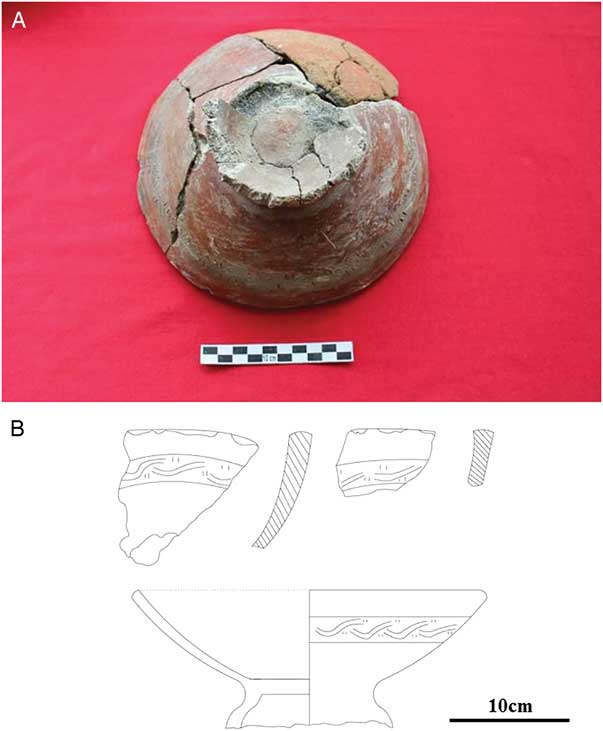
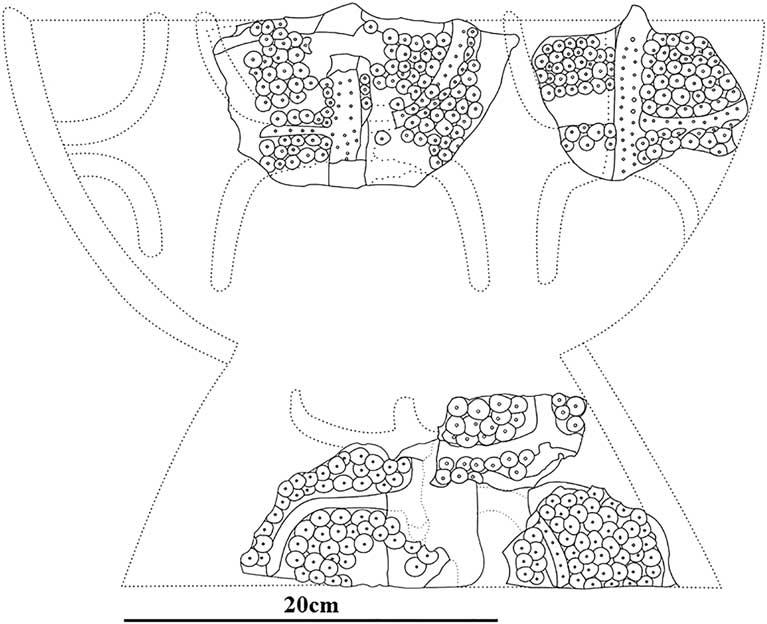
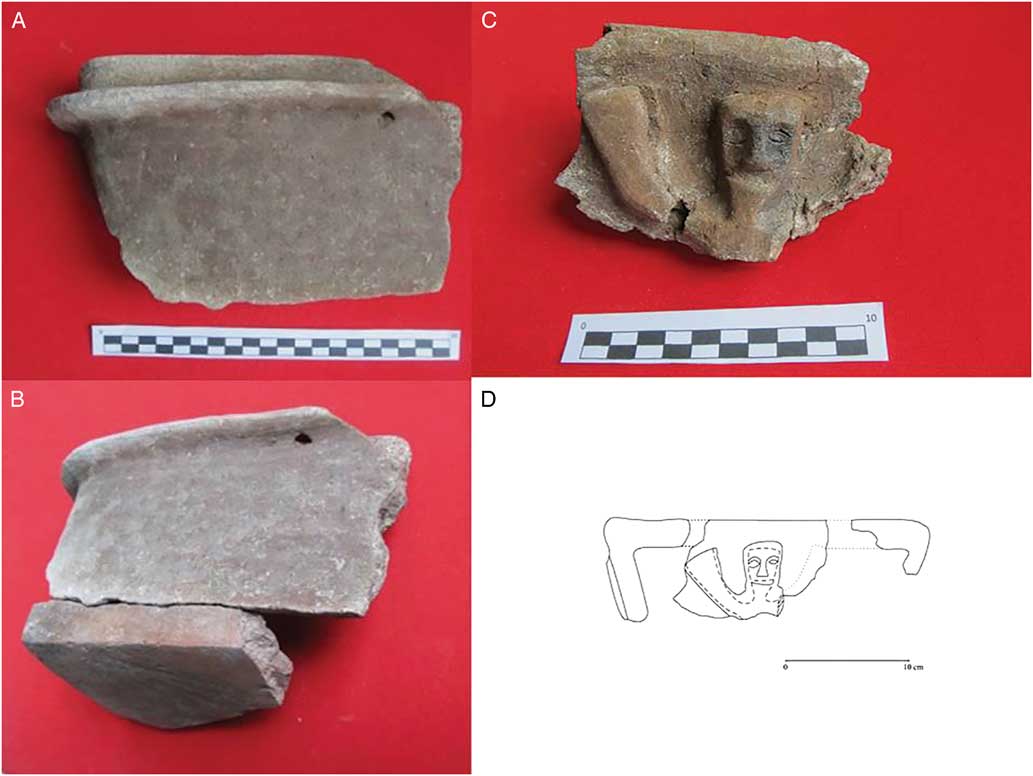
Diagnostic Aru Manara sherds mostly belong to pedestals, restricted and everted rims (some carinated), and direct rims from bowls. An almost complete red-slipped vessel with a foot-ring and incised decoration was unearthed from squares E6 and C5 (Figure 4). This was found alongside a large red-slipped open bowl with a ring-foot, decorated with appliqué lizards and stamped circles with tiny centralised perforations (Figures 5–6). Also found were sherds of square, box-like vessels, one of which was decorated with appliqué anthropomorphic figures (Figure 7). The other sherds found in the site (N=504) included 32 red-slipped and 79 decorated pieces. The latter comprised: 1) linear and curvilinear motifs created from pairs of incised lines, or horizontal straight and curvilinear incisions interspersed with typical ‘inverted comma’ markings; 2) circle-stamped motifs; 3) triangular incisions; and 4) pedestals with triangular or round cut-outs (Ono et al. Reference Ono, Oktaviana, Aziz, Prastiningtyas, Iriyanto, Ririmasse, Zesse and Hisa2017). The incised motifs listed under 1) are similar to those recorded in contemporaneous Moluccan assemblages at Tanjung Pinang on Morotai, Buwawansi 3 and Um Kapat Papo on Gebe Island, all dating to c. 2500–2000 BP (Bellwood et al. Reference Bellwood, Waluyo, Nitihaminoto and Irwin1993).
Pedestal vessel with red-slipped and incised motifs: A) reconstructed vessel showing red-slip except for a fragment where the surface was worn; B) an illustration of the reconstructed vessel (photograph and drawing by Ono).

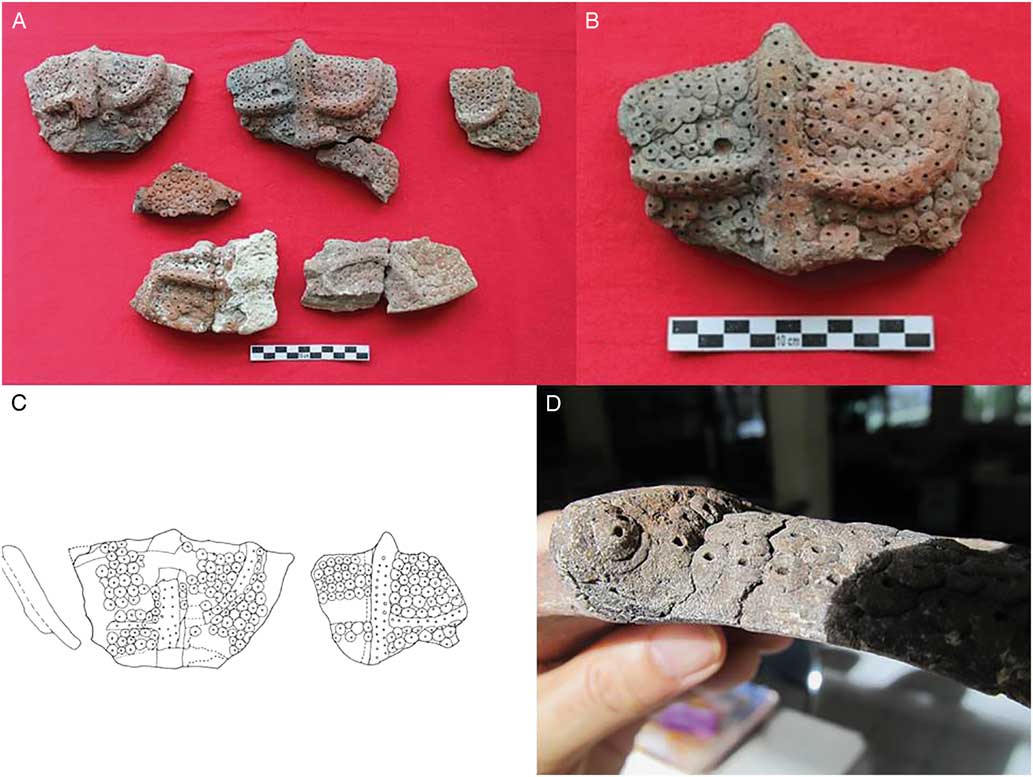
Sherds from a vessel with lizard appliqué and stamped circle/punctate decoration: A) all of the larger-sized appliqué sherds; B) a rim sherd with appliqué lizard; C) drawing of sherds with appliqué lizard; D) a lizard head with raised eyes (photographs and drawing by Ono).

A reconstruction of the vessel shown in Figure 5 (drawing by Ono).

Sherds from a box-type vessel with no decoration (A–B), and the cover of a box-type vessel with anthropomorphic decoration (C–D) (photographs and drawing by Ono).

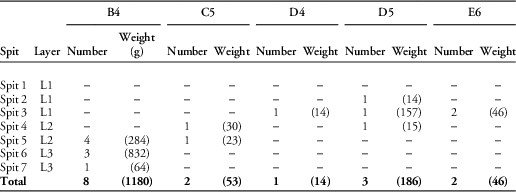
As shown in Table 2, half of the sherds with lizard appliqué came from the lower deposits of square B4. In total, the 16 pieces found were scattered across squares B4, C4, D4, D5 and E6 (Figure 2). Our reconstruction of these sherds confirms that they belonged to a single vessel, of which both the upper bowl (400mm diameter) and the lower foot ring (300mm diameter) had appliqué lizards with stamped circle and central punctate decoration (Figure 6). There appear to be 12 lizards (8 on the bowl, and 4 on the foot) in total. Each has a face with two eyes and a mouth (Figure 5D). The stamped circles with central perforations (Figure 5A–C) were applied over the whole body of the pot and on the sides of the lizard bodies, while the forepart of each lizard body is decorated with numerous impressed dots (Figure 5B).
Distribution of lizard appliqué sherds in Aru Manara.

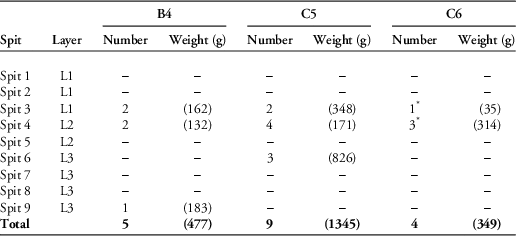
As well as representations of animals, the square vessel from Aru Manara features an appliqué anthropomorphic figure with a human face with two eyes and a pointed nose (although no mouth) and raised arms (Figure 7C–D). Sherds of this vessel were recovered from squares B4, C5 and C6, with most pieces coming from the middle layer of C5 (Table 3). A lid sherd with a similar appliqué anthropomorphic figure was found in the middle layer of C6. Reconstruction of the sizes of these square vessels is difficult as they have no diameters. It is unclear if they were used for burial or for other purposes. Similar square vessels have been excavated from the Metal Age jar burial site of Leang Buidane on Salibabu Island (Talaud), about 250km from Morotai (Bellwood Reference Bellwood1980), and they feature at contemporaneous sites on Palawan island in the southern Philippines (Fox Reference Fox1970).
Distribution of sherds from square box-like vessels in Aru Manara (*=with appliqué human figure).

Discussion
Jar burial in Southeast Asia and Oceania
In Taiwan, Southeast Asia and Oceania, the jar burial tradition commenced during the Neolithic, with the earliest occurrences in southern Taiwan dating to about 4000 BP (Tsang et al. Reference Tsang, Li and Chu2006; Tsang & Li Reference Tsang and Li2015). The distribution includes many coastal sites in central Vietnam (Yamagata Reference Yamagata2012), Taiwan (Hung & Ho Reference Hung and Ho2006; Hung et al. Reference Hung, Dung Nguyen, Bellwood and Carson2013), the Philippines (Fox Reference Fox1970; Bellwood & Dizon Reference Bellwood and Dizon2013) and Borneo (Lloyd-Smith Reference Lloyd-Smith2009; Lloyd-Smith & Cole Reference Lloyd-Smith and Cole2010), dating mostly to between 3500 and 2700 BP. Jar burials in Indonesia are thought to have been slightly later, mainly during the Metal Age (Ardika & Bellwood Reference Ardika and Bellwood1991; Santoso Reference Santoso1995; Bellwood 2007; Calo et al. Reference Calo, Prasetyo, Bellwood, Lankton, Gratuze, Pryce, Reinecke, Leusch, Schenk, Wood, Bawono, Gede, Yuliati, Fenner, Reepmeyer, Castillo and Carter2015). New evidence for a jar burial at Pain Haka, on Flores, however, dates to between 3000 and 2200 BP, overlapping with the Late Neolithic (Galipaud et al. Reference Galipaud, Kinaston, Halcrow, Foster, Harris, Simanjuntak, Javellel and Buckley2016). Although it is unknown whether jar burials were indigenous or introduced to the region (Beyer Reference Beyer1979; Bellwood 2007), it is now clear that the tradition was brought by early Austronesian-speaking populations into Island Southeast Asia and Oceania. In Remote Oceania, the Teouma burial site on Efate Island in Vanuatu produced a number of Lapita jar burials dated between 3000 and 2800 BP (Bedford et al. Reference Bedford, Spriggs and Regenvanu2006; Bedford & Spriggs Reference Bedford and Spriggs2007; Valentine et al. Reference Valentine, Choi, Lin, Bedford and Spriggs2015).
Jar burials encompass several variations across Southeast Asia and Oceania, including primary and secondary interment within the jars, head removal and other kinds of body manipulation. In the West Mouth cemetery in the Niah Caves (N=170 burials) in Sarawak and at Pain Haka on Flores (N=48 burials), primary and secondary burials occurred in varying bodily positions (Lloyd-Smith Reference Lloyd-Smith2009; Galipaud et al. Reference Galipaud, Kinaston, Halcrow, Foster, Harris, Simanjuntak, Javellel and Buckley2016). For primary burials, flexed or extended positions seem to have been the most popular during the Neolithic, whereas fragmentary or secondary burials in shallow or surface deposits in caves and rockshelters increased in number during the Metal Age, especially in eastern Indonesia. The burial culture of the Early Metal Age in Island Southeast Asia is evidently linked with the Late Neolithic tradition, and now we have many secure dates for this development, starting at least at 2400 BP in Taiwan (Hung & Chao Reference Hung and Chao2016), and by 2200 cal BP at Aru Manara with glass beads and bracelets (Ono et al. Reference Ono, Oktaviana, Aziz, Prastiningtyas, Iriyanto, Ririmasse, Zesse and Hisa2017). Recent excavations at Gua Harimau on Sumatra have unearthed bronze artefacts in primary extended burials (N=78 burials) dated to 2400–2600 cal BP (Simanjuntak Reference Simanjuntak2016), and show that the beginning of metal use in west Indonesia might correspond to their appearance in Taiwan.
Anthropomorphic/zoomorphic pottery and the jar burial tradition
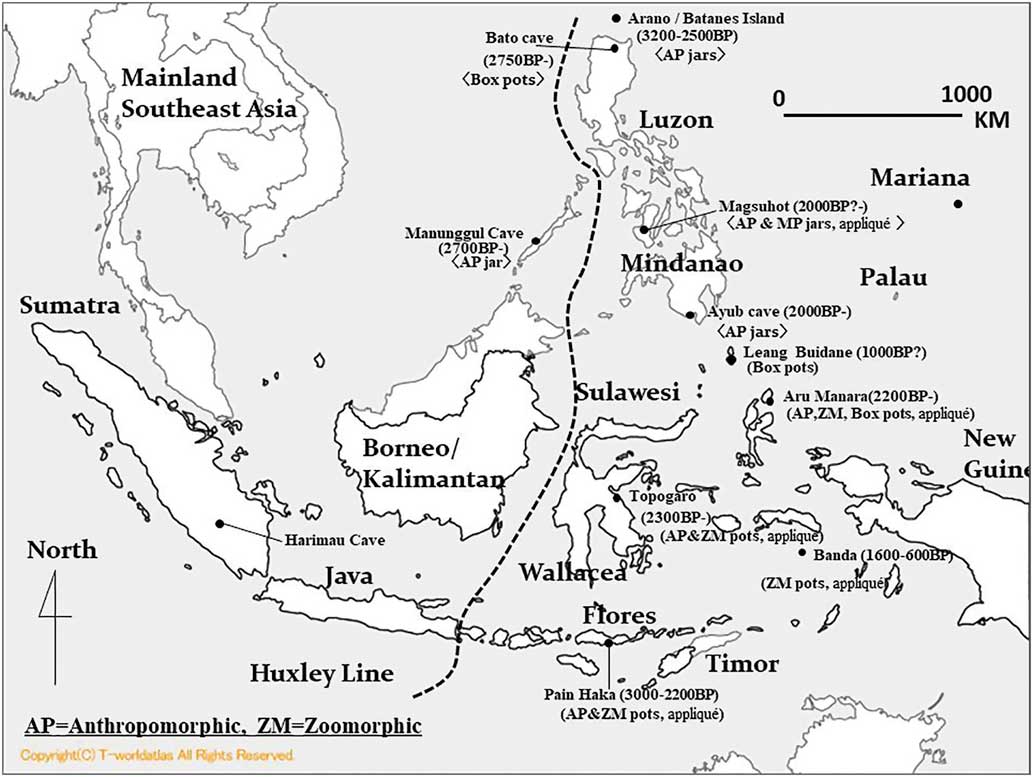
The use of anthropomorphic and zoomorphic figures to decorate burial vessels became more popular and widespread in Island Southeast Asia (Figure 8) and Oceania after the Late Neolithic. In the northern Moluccas, a fragment of bird-head pottery is reported from Sabatai Tua on Morotai (Bellwood et al. Reference Bellwood, Waluyo, Nitihaminoto and Irwin1993: 28–29). As a surface find associated with Chinese blue-and-white ceramics, however, it might be much younger than the Aru Manara zoomorphic pottery, and no lizard decoration is present. The undated turtle heads were also found applied to the rim of an excavated vessel from Kumo Island, off Tobelo in northern Halmahera and facing towards Morotai (Solheim 1998). Such pottery was also produced on the Banda Islands in the central Moluccas dated between 500 and 1400 BP (Lape Reference Lape2000: 143). These bird-head fragments have a single stamped circle with impressed decoration, possibly representing a bird’s eye, in a style resembling the appliqué lizards from Aru Manara.
Locations of archaeological sites with zoomorphic/anthropomorphic pots in Island Southeast Asia discussed in this article (© T-worldatlas).

In other eastern Indonesian islands, a small carinated pot with incised and appliqué human faces, and a pedestalled bowl with a bright red slip and appliqué lizards, both possibly dating after 2500 BP, have been found at Pain Haka on Flores (Galipaud et al. Reference Galipaud, Kinaston, Halcrow, Foster, Harris, Simanjuntak, Javellel and Buckley2016). In the Goa Topogaro cave complex in central Sulawesi, in 2016, our team excavated secondary burials dated to between 2300 and 1800 BP (Ono et al. in press). One of the pots from here has a bright red slip with human face appliqué motifs, and incised and dentate-stamped designs, with lime infill. A number of animal- and bird-head-like pottery lids and handles were also produced.
Meanwhile, a number of sites in the Philippines have produced comparable material. Modelled ceramic human figurines, decorated with rows of stamped circles, are reported from Anaro on Itbayat Island, Batanes, dating to between 3200 and 2500 BP (Bellwood & Dizon Reference Bellwood and Dizon2013: fig. 6.9), together with ceramic knobs and projections that frequently resemble phalluses. Manunggul Cave on Palawan has yielded a famous jar with a lid that supports two humans sitting in a canoe, while a lidded ceramic box containing human teeth also comes from Palawan (Fox Reference Fox1970). In Mindanao, the remarkable anthropomorphic burial jars from Ayub Cave are thought to be from the Metal Age around 2000 years ago (Dizon & Santiago Reference Dizon and Santiago1996). The Magsuhot site on Negros has also produced a Metal Age zoomorphic jar with appliqué lizard figures (Tenazas Reference Tenazas1974; Cuevas et al. Reference Cuevas, Jago-On, Torre, Delon, Jacar, Penalosa, Bautista and Dizon2012), together with flat-bottomed cylindrical jars and a rectangular ceramic coffin with an appliqué foliated flange, possibly representing a human figure. Other associated lids also feature this appliqué foliated flange. One of these lids is roof-shaped with appliqué M-shaped motifs and anthropomorphic figures (Cuevas et al. Reference Cuevas, Jago-On, Torre, Delon, Jacar, Penalosa, Bautista and Dizon2012). The material at Magsuhot was found in association with glass beads, a glass bracelet triangular in cross-section and an iron blade (Vitales Reference Vitales2010).
Pottery with anthropo- and zoomorphic figures has also been found in association with Lapita burials in Oceania (Spriggs Reference Spriggs1990), although appliqué human figures on Lapita pots are very rare. A modelled bird’s head, perhaps once attached to an early Lapita pot with dentate-stamped human figures around its lip, was excavated from the Teouma site on Efate, Vanuatu (Bedford & Spriggs Reference Bedford and Spriggs2007: 13). A similar bird’s head was found from excavations at Lapita site SZ–8 on the Reef-Santa Cruz islands of the south-east Solomon Islands (Green Reference Green1979). Incised figures of possible sea turtles with what appear to be human faces are also found on these sherds.
During the post-Lapita period in Oceania, clay modelled faces or figures of any form were rare (Bedford & Spriggs Reference Bedford and Spriggs2007), except for a few cases such as the animal-like handles and animal head from the Mangaasi site on Efate, Vanuatu, dated to around 2600–2000 BP (Garanger Reference Garanger1971: figs 2 & 9). Mangaasi-style pottery, widely distributed in Melanesia, has incised and appliqué decoration, including a sherd from Watom Island with stamped circles with punctate central holes (Specht Reference Specht1968; Garanger Reference Garanger1971), similar to the lizard pottery in Aru Manara as well as the more recent bird’s head pottery from Morotai and from the Banda Islands (Bellwood et al. Reference Bellwood, Waluyo, Nitihaminoto and Irwin1993; Lape Reference Lape2000). In terms of pottery production, the appliqué technique recorded for Mangaasi pottery may represent a potential precedent for the same technique recorded for Moluccan zoomorphic pottery after 2200 BP.
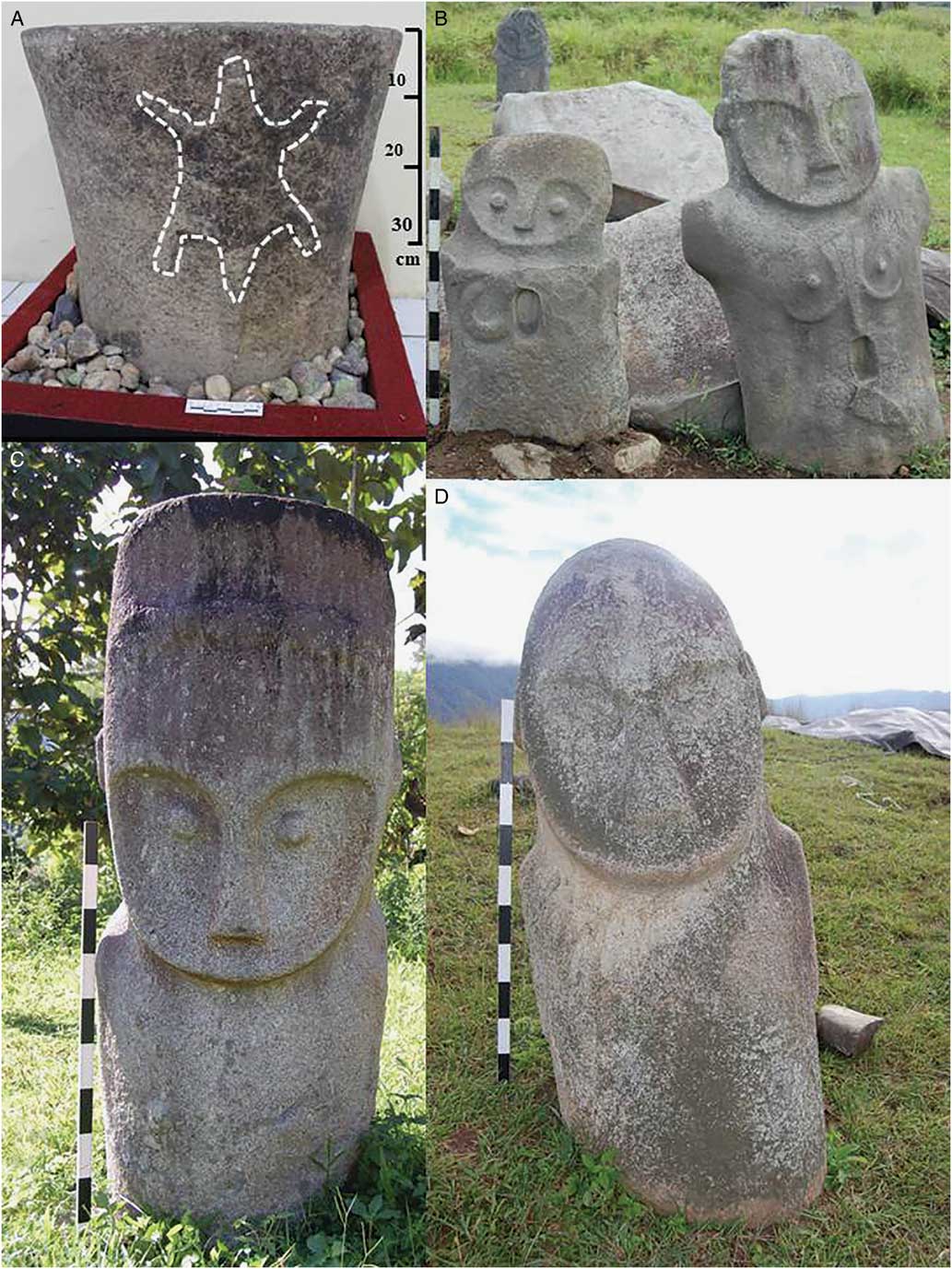
Zoomorphic and anthropomorphic figures on stone carvings in central Sulawesi: A) an undated stone mortar showing one of three lizard figures, found in Minahasa, north Sulawesi; B) two undated stone statues in Pada Pokekea, central Sulawesi; C) a female stone statue, with a string of large beads around her head in Bada, central Sulawesi (see Kaudren 1938: 96–99); and D) a stone statue in Besoa, central Sulawesi (photograph A by Ono by permission of the north Sulawesi Province Museum, and photographs B–D by Balai Arkeologi Manado).

Symbolic representation and human dispersal
The anthropomorphic and zoomorphic appliqué pottery from Aru Manara is associated with secondary human burials dated to around 2200 BP. The dates, and the coexistence of burial goods, including glass and shell ornaments, suggest that the burials belong to the Early Metal Age. Some specific types of decoration, including the circle-stamping and the triangular or round cut-outs through the pedestals, are similar to the Kalanay assemblage from the central Philippines (Solheim Reference Solheim1964). Perforated pedestals are also common during this period elsewhere in the northern Moluccas (Bellwood 2017). The box-type vessels also indicate a possible connection between the northern Moluccas, the Talaud Islands (Bellwood Reference Bellwood1980) and Palawan in the Philippines (Fox Reference Fox1970). This connection appears to have been especially strong during the Late Neolithic and Early Metal Age.
In terms of similar zoomorphic figures, the existence of appliqué lizard decorations on burial pottery can now be confirmed between 2500 and 2200 BP for Flores and Morotai, and around 2000 BP for Negros. Lizard figures have not yet been confirmed at contemporaneous sites in Oceania, although modelled or dentate-stamped zoomorphic figures do occur in Lapita contexts. Such zoomorphic representation was also popular in the ‘megalithic tradition’ of later prehistoric Indonesia (van Heekeren 1958). For instance, an undated stone mortar from Minahasa (Figure 9A), at the North Sulawesi Province Museum has three lizard figures around its body, while a stone jar from the Besoa Valley in central Sulawesi has three lizard figures and a number of human faces carved on its exterior (Kaudern Reference Kaudern1938: fig. 23).
Anthropomorphic figures in pottery or stone occur more widely than lizards in famous stone carvings in central Sulawesi (Bada, Besoa, Pada Pokekea) and Kalimantan/Borneo, as well as in Palau and on Rapanui/Easter Island. The emphasis on eyebrows and noses, with almond-shaped or rounded eyes, links both the anthropomorphic pottery and the stone carvings (Figure 9B–D). The Aru Manara find shows clear similarities here. Perhaps these symbols represented aspects of ritual belief and the afterlife that were shared widely during the Neolithic (Bellwood 2017) and even more widely during and after the Metal Age in Southeast Asia and Oceania. The general ceramic-forming techniques suggest that these examples were not part of a continuous distribution, but rather they appear as an intermittent, localised archaeological expression.
The strong similarities in the anthropomorphic and zoomorphic motifs used to decorate pottery associated with human burials and megalithic grave monuments in Island Southeast Asia, particularly in the Philippines and eastern Indonesia, indicate a very widespread sharing of style, presumably as a reflection of maritime trade and periodic migration. On the other hand, the existence of a common technique of using appliqué decoration on pottery in the Moluccas and Island Melanesia may indicate similar levels of human interaction between the Moluccas and regions to the east. It is as yet unclear, however, whether trade-based interactions or local human migrations between eastern Island Southeast Asia and western Melanesia were involved. Indeed, similarities in material culture may not necessarily reflect past human migrations, but instead may indicate local developments based on a wider underlying cultural matrix (Lloyd-Smith & Cole Reference Lloyd-Smith and Cole2010). Future morphometric and genetic studies of the human remains excavated at Aru Manara may provide valuable insights into human migrations within the region and provide clues regarding their impact upon north Moluccan prehistory.
When considering maritime trade networks in the northern Moluccas, we should also remember the maritime spice trade that commenced around 2200 BP, involving India, China and Southeast Asia. As the home of the clove (Syzygium aromaticum), the northern Moluccas were probably an integral part of these trade networks. Evidence for such ancient trade into Aru Manara includes the glass beads and bracelets found there. X-ray fluorescence analysis of the beads confirms that some are of potash glass, possibly of Chinese or Vietnamese origin (Glover & Henderson Reference Glover and Henderson1995; Calo et al. Reference Calo, Prasetyo, Bellwood, Lankton, Gratuze, Pryce, Reinecke, Leusch, Schenk, Wood, Bawono, Gede, Yuliati, Fenner, Reepmeyer, Castillo and Carter2015), whereas others are of the high-alumina soda-glass type, known as ‘Indo-Pacific’ beads, possibly from India or Southeast Asia (Ono et al. Reference Ono, Oktaviana, Aziz, Prastiningtyas, Iriyanto, Ririmasse, Zesse and Hisa2017). Thus, the Late Neolithic to Metal Age transition in Island Southeast Asia may have seen the development of mortuary traditions derived genealogically from earlier Austronesian beliefs, in the context of frequent contact and trade, with repercussions extending as far as India, China, Island Melanesia and beyond.
Acknowledgements
We would like to acknowledge the Kementerian Riset dan Teknologi Indonesia (Indonesian Ministry of Research and Technology) and Pusat Penelitian Arkeologi Nasional Indonesia (National Research Centre for Archaeology, Indonesia) for the considerable support that they provided. Many thanks go to P. Bellwood, D. Bulbeck, J. Specht and M. Spriggs for their useful comments and discussion. The excavation and analysis of excavated materials was funded by Grants-in-Aid from the Japan Society for the Promotion of Science to Rintaro Ono in 2011 (grant number: 23720385) and during 2012–2016 (grant numbers: 24101702 & 26300028).