Despite vast evidence and public information concerning its consequences, and the proliferation of policies limiting access, cigarette smoking remains the leading preventable cause of death and disease in the United States (Danaei et al., Reference Danaei, Ding, Mozaffarian, Taylor, Rehm and Murray2009; Grunberg & Barry, Reference Grunberg, Barry and Whitbourne2015; Islami, Ward et al., Reference Islami, Ward, Jacobs, Ma, Goding Sauer and Lortet-Tieulent2015). Indeed, smoking prevalence is 15% among U.S. adults, and as high as 26% among adults living below the poverty line (CDC, 2015). Each year about two thirds of U.S. smokers make a quit attempt (Agaku, King, Dube, Control, & Prevention, Reference Agaku, King and Dube2014; Lavinghouze & Malarcher, Reference Lavinghouze and Malarcher2016; Rafful et al., Reference Rafful, García-Rodríguez, Wang, Secades-Villa, Martínez-Ortega and Blanco2013). Of those, less than 5% remain abstinent three-months post quit (Rafful et al., Reference Rafful, García-Rodríguez, Wang, Secades-Villa, Martínez-Ortega and Blanco2013; Zhu, Lee, Zhuang, Gamst, & Wolfson, Reference Zhu, Lee, Zhuang, Gamst and Wolfson2012; Zhuang, Gamst, Cummins, Wolfson, & Zhu, Reference Zhuang, Gamst, Cummins, Wolfson and Zhu2015).
Factors associated with unsuccessful quitting include nicotine dependence, poor mental health, low social support for quitting, stress and lower self-efficacy beliefs about quitting (Cobb et al., Reference Cobb, McAdams-DeMarco, Huxley, Woodward, Koton and Coresh2014; Hiscock, Bauld, Amos, Fidler, & Munafo, Reference Hiscock, Bauld, Amos, Fidler and Munafo2012; Lukowski, Morris, Young, & Tinkelman, Reference Lukowski, Morris, Young and Tinkelman2015; Raupach, Brown, Herbec, Brose, & West, Reference Raupach, Brown, Herbec, Brose and West2014; Smit, Hoving, Schelleman-Offermans, West, & de Vries, Reference Smit, Hoving, Schelleman-Offermans, West and de Vries2014). Another factor that may influence abstinence is the subjective importance of cigarettes and cigarette smoking to a smoker's conception of self (self-concept). If cigarette smoking is experienced as an essential characteristic of the self-concept, this belief may affect readiness to quit, quit attempts and successful quitting, as quitting smoking would be akin to losing a significant facet of who one conceives the self to be as a person. The results of research suggest that smokers’ self-conceptions of cigarettes and smoking affect success in quitting, and abstinence (Berg et al., Reference Berg, Parelkar, Lessard, Escoffery, Kegler and Sterling2010; Gibbons & Gerrard, Reference Gibbons and Gerrard1995; Lindgren, Neighbors, Gasser, Ramirez, & Cvencek, Reference Lindgren, Neighbors, Gasser, Ramirez and Cvencek2016; Pulvers et al., Reference Pulvers, Scheuermann, Romero, Basora, Luo and Ahluwalia2013; Shadel & Mermelstein, Reference Shadel and Mermelstein1996; van den Putte, Yzer, Willemsen, & de Bruijn, Reference van den Putte, Yzer, Willemsen and de Bruijn2009). Indeed, findings of such research suggest that becoming a non-smoker involves adopting a non-smoker identity (Lindgren et al., Reference Lindgren, Neighbors, Gasser, Ramirez and Cvencek2016; Tombor, Shahab, Brown, & West, Reference Tombor, Shahab, Brown and West2013; Tombor et al., Reference Tombor, Shahab, Herbec, Neale, Michie and West2015; Vangeli & West, Reference Vangeli and West2012). This task is especially salient given the increased prevalence of smoking bans (Meijer, Gebhardt, Dijkstra, Willemsen, & Van Laar, Reference Meijer, Gebhardt, Dijkstra, Willemsen and Van Laar2015). Thus, given the public health burden (Jha & Peto, Reference Jha and Peto2014) and the high rate of relapse, along with the relation of self-concept to behaviour change (Dudovitz, Li, & Chung, Reference Dudovitz, Li and Chung2013; Frazier et al., Reference Frazier, Vaccaro, Garcia, Fallahazad, Rathi and Shrestha2015; Hensel, Fortenberry, O'Sullivan, & Orr, Reference Hensel, Fortenberry, O'Sullivan and Orr2011; Stephens, Markus, & Fryberg, Reference Stephens, Markus and Fryberg2012; Thomas, Reference Thomas2007), we sought to better understand how smokers’ conceptions of cigarettes and cigarette smoking, in relation to self-concept, affect abstinence in a cohort of smokers participating in a smoking cessation study.
Variable selection was guided by theory proposing that a key function of the self is to adapt self-conceptions and behaviour to the social rules (constraints) of one's contexts in order to minimize psychological distress (Rodriguez, Reference Rodriguez2000). Motivated by the work of Piaget (Piaget, Reference Piaget and Rapaport1951) and Epstein (Epstein, Reference Epstein1973), Rodriguez proposed that when behaviour and self-concept fit contextual constraints, the individual experiences equilibrium and change is perceived as unnecessary, such as when a smoker who attributes great importance to smoking is in a smoking-friendly setting. Conversely, when fit is poor, it is proposed that the individual experiences psychological distress (disequilibrium), such as when the contradiction between a high subjective importance of smoking (SIMS) and the health and social consequences of smoking is made salient. It is the experience of disequilibrium that is proposed to be a key motivator for change, and it is the ability to tolerate disequilibrium that is proposed to be responsible for the maintenance of behaviour change, a process termed psychoadaptation.
Consistent with the role of disequilibrium in psychoadaptation, the purpose of this study was to assess whether disequilibrium moderates the relation between the SIMS to a cigarette smoker's self-concept and smoking abstinence at 24 weeks post quit. We proposed that for smokers experiencing higher versus lower disequilibrium at baseline (greater understanding of the contradiction between high SIMS and smoking's health and social consequences), SIMS would be associated with higher abstinence 24 weeks post quit.
Methods
Participants
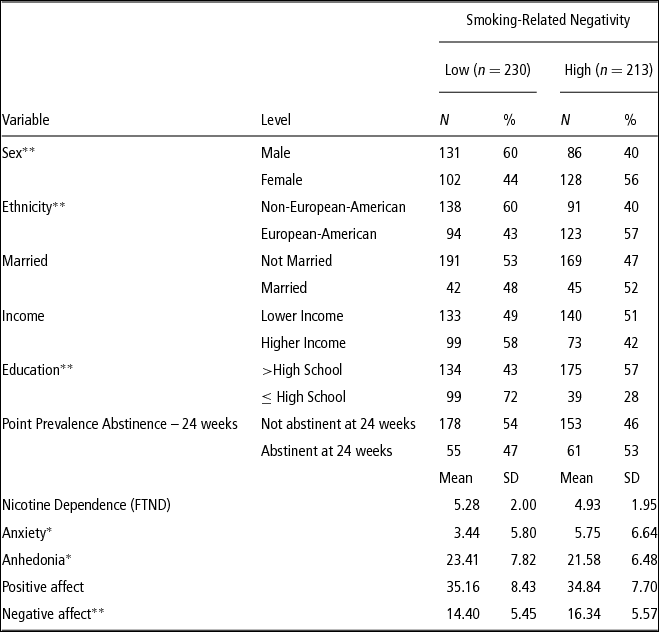
Participants were 447 adult smokers (Mean age = 47 years, SD = 11.92; 51% Female; 44% White), smoking on average 17 cigarettes/day (SD = 8.36) pre quit, taking part in a randomized controlled trial evaluating the efficacy of long- versus short-term nicotine replacement therapy (NRT) using nicotine patches (Schnoll et al., Reference Schnoll, Goelz, Veluz-Wilkins, Blazekovic, Powers and Leone2015). Sample demographics for the n = 440 participants with complete data on all predictor variables are presented in (Table 1).
Descriptive statistics

*p < 0.05.
**p < 0.01.
Procedures
At baseline (prior to randomisation to one of three NRT durations) (see main study for details, Schnoll et al., Reference Schnoll, Goelz, Veluz-Wilkins, Blazekovic, Powers and Leone2015), all participants completed a battery of measures assessing demographics, smoking and nicotine dependence, prior quit attempts and psychological traits and states (anhedonia, anxiety and positive and negative affect), along with the SIMS measure.
Instrumentation
The subjective importance of smoking (SIMS)
The SIMS is a 14-item measure developed to assess the psychological importance of cigarettes and cigarette smoking to a smoker. Its development followed from prior research demonstrating relations between smoking uptake and specific facets of self-concept (Rodriguez & Audrain-McGovern, Reference Rodriguez and Audrain-McGovern2005; Rodriguez, Dunton, Tscherne, & Sass, Reference Rodriguez, Dunton, Tscherne and Sass2008), and theory suggesting the role of self-concept in the regulation of behaviour and affect (Epstein, Reference Epstein1973; Masterson, Reference Masterson1985; Piaget, Reference Piaget and Rapaport1951; Rodriguez, Reference Rodriguez2000).
Development of the SIMS took place in three phases. In the first, 17 items were generated based on unstructured interviews with adults smoking ≥ 20 cigarettes/day, and in consultation with other University of Pennsylvania tobacco researchers. The SIMS was then administered to a convenience sample of 94 young adult smokers in Quebec, Canada (50% female; 83% White; mean age 21, SD = 0.45; cigarettes/week = 57, SD = 34.83; age first smoked = 14, SD = 2.04) (O'Loughlin et al., Reference O'Loughlin, Dugas, Brunet, DiFranza, Engert and Gervais2015). Results suggested that the SIMS is poorly suited for smokers smoking < 10 cigarettes/day.
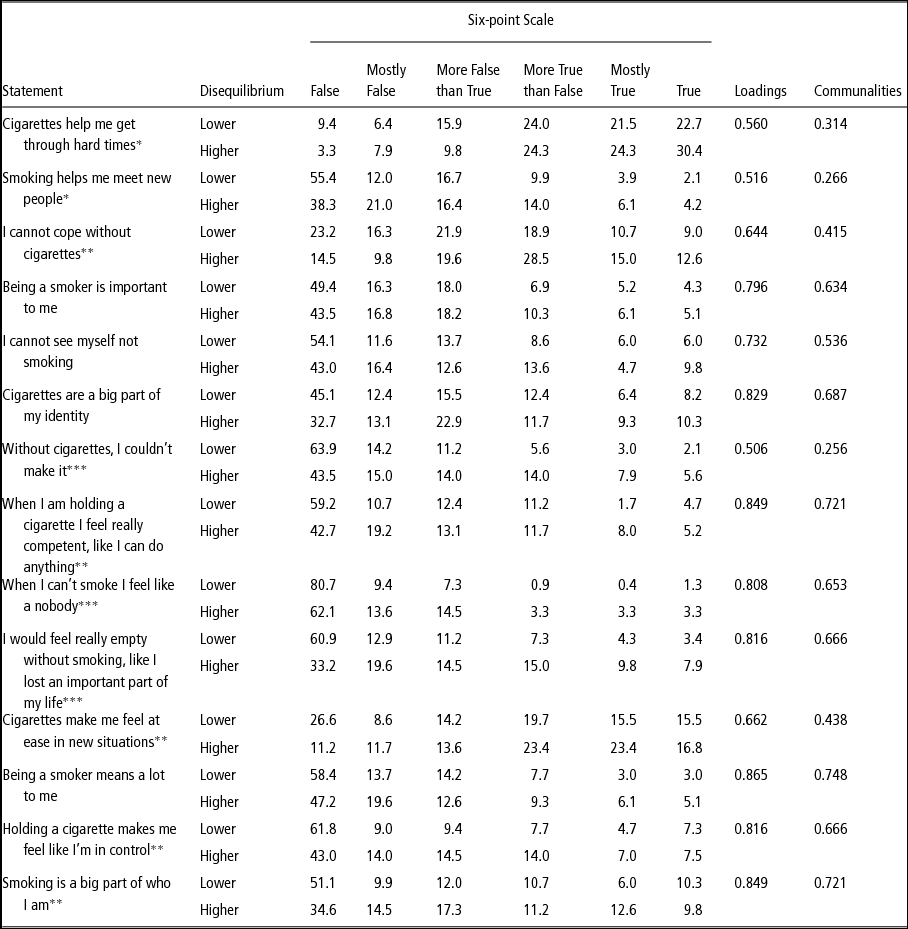
The SIMS was next administered to a sample of 202 Southeastern Pennsylvania adult daily cigarette smokers with no intention to quit (Mean age 31 years, SD = 8.07) taking part in a study to better understand their opinions on tobacco product advertising (Strasser et al., Reference Strasser, Orom, Tang, Dumont, Cappella and Kozlowski2011). The SIMS was administered once as part of a baseline smoking history battery. The aim of this phase was to assess the distribution of the SIMS in a sample of smokers smoking more cigarettes per day and for longer than the Quebec sample (cigarettes/day =17, SD = 5.72; years smoked 13, SD = 6.81). Although there was greater variability than the Quebec sample, the response probabilities for several items were highly skewed to ‘False’ (six-point False–True scale). Discussion with two co-authors (AS & RS) resulted in revising or removing several items. The present study represents the third phase of testing, and includes 14 of the 17 original items, and revisions. See (Tables 3 and 4) for the items.
Nicotine dependence
Nicotine Dependence was assessed with the 7 – item Fagerstrom Test for Nicotine Dependence (Heatherton, Kozlowski, Frecker, & FAGERSTROM, Reference Heatherton, Kozlowski, Frecker and FAGERSTROM1991); Cronbach's Coefficient Alpha (Alpha) = 0.540. We assessed nicotine dependence as it should be positively and strongly correlated with SIMS given cigarettes are nicotine delivery devices.
Psychological correlates
The Positive and Negative Affect Scale (20 items) was used to assess positive and negative affect (Watson, Clark, & Tellegen, Reference Watson, Clark and Tellegen1988), Alpha = 0.823; the Snaith–Hamilton Pleasure Scale (14 items) was used to assess anhedonia (inability to experience pleasure) (Snaith et al., Reference Snaith, Hamilton, Morley, Humayan, Hargreaves and Trigwell1995), Alpha = 0.933; The 21-item Beck Anxiety Inventory was used to assess Anxiety symptoms (Beck, Epstein, Brown, & Steer, Reference Beck, Epstein, Brown and Steer1988), Alpha = 0.885. These variables were selected for their possible positive and negative relations to SIMS, and for assessment of construct validity.
Demographic variables
We controlled for the demographic variables sex, race, education, marital status and income.
Point prevalence abstinence
Our outcome variable was carbon monoxide (CO) verified 7-day point prevalence abstinence (PPA) at 24 weeks (Schnoll et al., Reference Schnoll, Goelz, Veluz-Wilkins, Blazekovic, Powers and Leone2015). We used this PPA measure as it was the more proximal (to quit date) of two measures taken (24 weeks and 52 weeks). Given that the SIMS was only measured at baseline, and the SIMS would likely change over time, it would be more likely to represent how the smoker feels about smoking (with respect to the Self) at a 24 than 52 weeks.
Disequilibrium
We employed the single item ‘Smoking makes me feel bad about myself’ as an indicator of disequilibrium. We used a single indicator for purposes of parsimony. Further, it allowed us to efficiently divide our sample into higher and lower levels of disequilibrium, permitting for the assessment of moderation; does the effect of the SIMS on PPA differ by disequilibrium? As this item had a six-point rating scale (False, Mostly False, More False than True, More True than False, Mostly True, True), we considered participants selecting a ‘False’ option to have low disequilibrium, whereas participants selecting a True option to have high disequilibrium. To assess the item's validity as a measure of disequilibrium, we conducted bivariate correlation analysis between disequilibrium and nicotine dependence and positive affect (discriminant validity) and negative affect and anxiety (convergent validity). As expected, disequilibrium was significantly and positively associated with negative affect (r = 0.185, p > 0.0001) and anxiety (r = 0.218, p < 0.0001). By contrast, it was uncorrelated with nicotine dependence (r = −0.055, p = 0.244) and positive affect (r = 0.012, p > 0.807). These findings support the construct validity of our indicator of disequilibrium.
Other covariates
We also controlled for prior quit attempts lasting at least 24 hours (a proxy for motivation to quit smoking; binary 0 = none, 1 = at least one) and treatment assignment (binary 0 = standard, 1 = extended).
Analysis
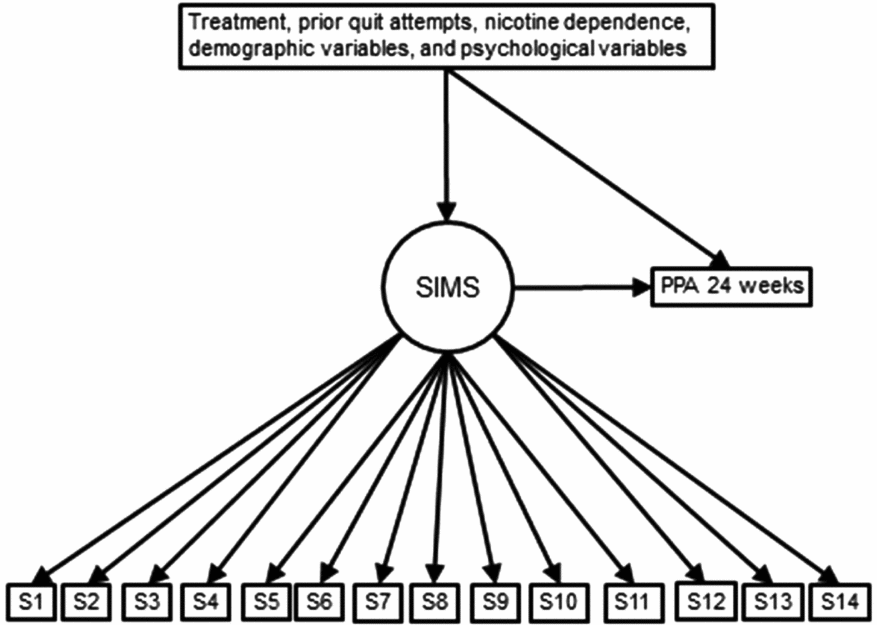
We employed exploratory structural equation modelling (ESEM) to analyse the data. ESEM is a structural equation modelling (SEM) method that allows researchers to combine exploratory factor analysis (EFA) and confirmatory factor analysis (CFA) in a single model (Asparouhov & Muthén, Reference Asparouhov and Muthén2009; Marsh et al., Reference Marsh, Muthén, Asparouhov, Ludtke, Robitzsch and Morin2009). As such, it permits assessment of the internal EFA and cross structure (discriminant and convergent validity) of a measure in a single study. ESEM is a hybrid method that borrows from EFA and CFA, along with SEM (Asparouhov & Muthén, Reference Asparouhov and Muthén2009; Marsh et al., Reference Marsh, Muthén, Asparouhov, Ludtke, Robitzsch and Morin2009). Unlike CFA which restricts items to load on a single factor, ESEM allows items to load on multiple factors, which is a more realistic assumption (Marsh et al., Reference Marsh, Muthén, Asparouhov, Ludtke, Robitzsch and Morin2009). The process involves several steps. In the first, EFA is conducted to identify the number of factors best representing the relations amongst the measured variables. We will consider a factor reliable if it contains ≥ four loadings ≥ 0.60 (Stevens, Reference Stevens2002). In the second step, covariates are added to the model to assess convergent and discriminant validity. In the third, one may assess the association of covariates to the measured variables (i.e., factor indicator variables) using model modification indices. (Figure 1) is a general description of our ESEM. We used SPSS 24 software for descriptive statistics and Mplus 7.0 software for the ESEM analysis.
General ESEM model in this study. Paths from all predictor variables to the latent SIMS variable and the measured point prevalence abstinence (24 weeks) variable are estimated and tested for significance for participants with low and for participants with high disequilibrium. Any differences in effects between the two levels of disequilibrium are tested for significance using a chi-square difference test (applicable to categorical outcome variables).

Given the ordinal nature of the SIMS variables, model parameter estimation employed a weighted least squares estimation technique (WLSMV) with robust standard errors, and a mean and variance adjusted chi-square (χ2) test statistic (Muthén, du Toit, & Spisic, Reference Muthén, du Toit and Spisic1997; Muthén & Muthén, 1998–Reference Muthén and Muthén2004). We evaluated our multivariate models for fit to the observed data using multiple indicators of model performance, including the χ2 test, comparative fit index (CFI), weighted root mean square residual (WRMR), standardized root mean squared residual (SRMR) and root mean squared error of approximation (RMSEA) (Jackson, Gillaspy, & Purc-Stephenson, Reference Jackson, Gillaspy and Purc-Stephenson2009), along with substantive criteria (e.g., interpretability of factors). Heuristics for acceptable fit were: CFI, WRMR, SRMR and RMSEA, > 0.95, < 0.90, < 0.08, and < 0.10, respectively (Kenny, Reference Kenny2015). To account for missing data, Mplus estimates mean, variance and covariance parameters using a full information maximum likelihood (FIML) estimating procedure which employs the expectation maximization (EM) algorithm, assuming data are missing at random (Muthén, 1998–Reference Muthén2004a; 1998–Reference Muthén2004b). This only accounts for missing data on the dependent variables. Thus, cases with missing data on the covariates are not included in the analysis.
Results
Descriptive Statistics
Means and standard deviations for continuous variables, and frequency distributions and proportions for categorical variables are presented in (Table 1). Independent samples t-tests and χ2 analyses were employed to assess differences between participants with high (n = 212) and low (n = 228) disequilibrium. Of note, females reported greater disequilibrium than males, χ2(1, n=440) =12.166, p < 0.0005. Further, those reporting greater disequilibrium scored significantly higher on anxiety (t(421.94), = −3.88, p=0.0001) and negative affect (t(441), = −3.72, p = 0.0002), but lower on anhedonia (t(435.65), = 2.69, p = 0.0074).
Multivariate Modelling
Exploratory factor analysis (EFA)
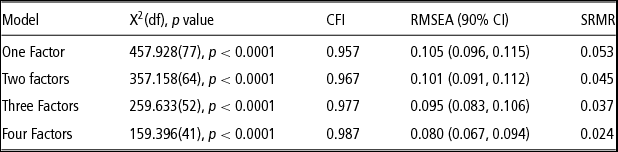
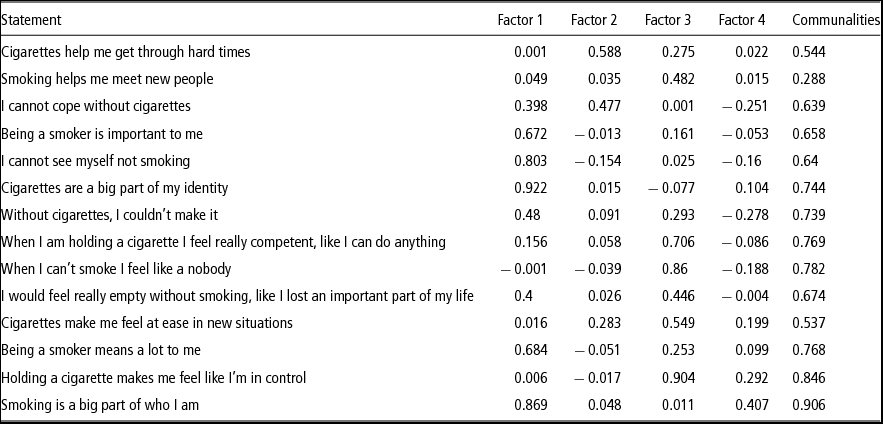
The EFA was assessed using models with one to four factors to represent the 14 ordinal SIMS observed variables, using a Geomin oblique rotation method (Table 2). The χ2 statistic dropped with the addition of each factor to the model, although remaining significant across all models. However, the interpretability of the factor loadings beyond a single factor was difficult as several items loaded high on the multiple factors (See Table 3 for factor loadings, items, and their communalities for the four factor solution). Given only one eigenvalue > 1 (λ1=8.339) accounting for 60% of the variance, along with a scree plot (eigenvalue plot) elbow at 2 (also suggesting one factor), and 12 loadings ≥ 0.60, we selected the single factor solution as the best solution for these data. This model fit the data fairly well, χ2(n=447, df=77) = 457.928, p < 0.0001; CFI = 0.957, RMSEA = 0.105 (95%CI = 0.096, 0.115), SRMR = 0.053, with CFI and SRMR indicating good fit but RMSEA suggesting less than adequate fit (Kenny, Kaniskan, & McCoach, Reference Kenny, Kaniskan and McCoach2015). Assessing the source of model misspecification (separate EFA for levels of disequilibrium) suggests the misfit is due to the item ‘cigarettes help me get through hard times’, which did not load significantly for higher disequilibrium. RMSEA for high disequilibrium was 0.122 (90% CI = 0.087, 0.155), whereas RMSEA for low disequilibrium was 0.069 (90% CI = 0.046, 0.091). Nevertheless, we believe the one factor solution is optimal for these data based on substantive and empirical criteria. The items, factor loadings, and communalities for the single-factor solution are presented in (Table 4).
Model comparisons exploratory factor analysis

Factor loadings and communalities for the four factor solution

Distribution of responses to SIMS items divided by disequilibrium, and factor loadings and eigenvalues

*p ≤ 0.5.
**p ≤ 0.01.
***p ≤ 0.0001.
Exploratory Structural Equation Modelling (ESEM)
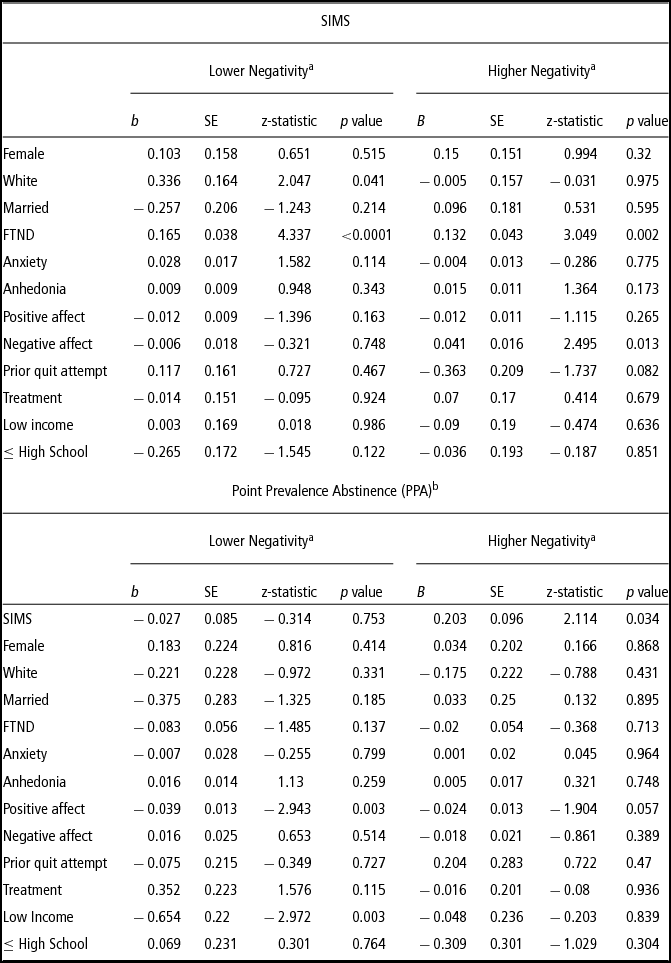
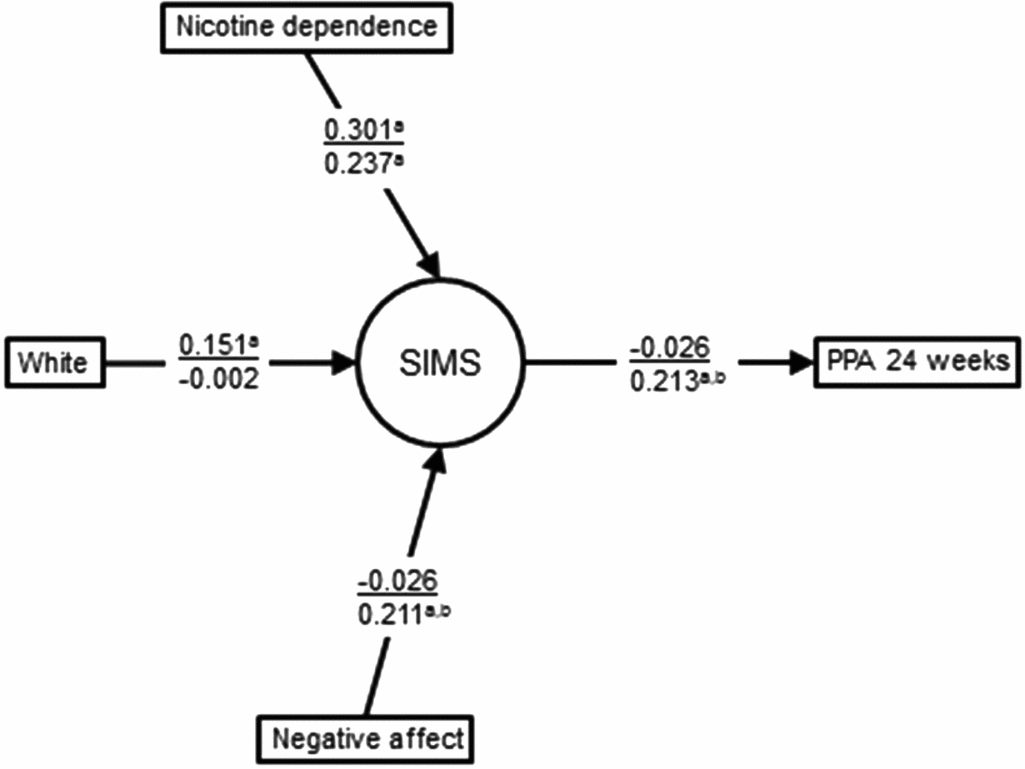
We next added covariates to the multivariate model to assess their relations to SIMS and PPA at 24 weeks, and to test whether relations differ by disequilibrium. This also allowed us to measure the convergent and discriminant validity of the SIMS, a weighted factor score. The two-group model also fit the data fairly well, χ2(n=443, df=560) = 782.243, p < 0.0001; CFI = 0.974, RMSEA = 0.042 (90%CI = 0.035, 0.049; probability RMSEA ≤ 0.05 = 0.965), WRMR = 1.259. The model results with unstandardized path coefficients, standard errors, z-statistics, and p values are presented in (Table 5). Standardized path coefficients for significant model effects are presented graphically in (Figure 2). We present significant effects only for sake of parsimony.
Non-standardized results of exploratory structural equation modelling

a The smoking-related negativity binary variable was generating by cutting the single item ‘Smoking makes me feel bad about myself’ into a lower half and a higher half (responses 1–3 were lower negativity; responses 4–6 were higher negativity).
b The outcome point prevalence abstinance variable (biochemically verified) is binary (1 = abstinant at 24 weeks; 0 = not abstinent at 24 weeks). As such, the b values represent the log odds of change (i.e., logistic regression).
c This difference in the effect of the SIMS factor on PPA at 24 weeks is significant, p = 0.0405.
ESEM with standardized path coefficients for significant model effects. Values above the dividing line represent standardized path coefficients for participants with lower disequilibrium, whereas values below the dividing line are standardized path coefficients for participants with higher disequilibrium.

Subjective Importance of Smoking (SIMS)
Nicotine dependence was associated with an increase in SIMS among smokers reporting both high (b = 0.132, z = 3.049, p = 0.002) and low (b = 0.165, z = 4.337, p < 0.0001) disequilibrium, with no difference in the effect (p > 0.05). However, negative affect was associated with higher SIMS for participants reporting high disequilibrium (b = 0.041, z = 2.495, p = 0.013), and not related to SIMS among participants reporting low disequilibrium (p = 0.748). This between-group difference in effects was significant, χ2(1, N=561) = 5.062, p = 0.0245, suggesting that disequilibrium moderates the relation between negative affect and SIMS. There were no other significant relations between any of the remaining covariates and SIMS, when exploring group differences. Although SIMS is not a specific measure of nicotine dependence, the stronger relation between SIMS and nicotine dependence supports its construct validity as individuals who place a high subjective importance on smoking are likely to have higher nicotine dependence. Further, the significant relation of negative affect with SIMS amongst participants experiencing high versus low disequilibrium supports the construct validity of the proposed role of disequilibrium as a possible mechanism of change in the smoking cessation process, as predicted by psychoadaptation.
Point prevalence abstinence (PPA)
For participants reporting high disequilibrium, SIMS was positively associated with PPA at 24 weeks (b = 0.203, z = 2.114, p = 0.034), whereas the relation was not significant (p = 0.753) for participants reporting low disequilibrium. This difference in the effect of SIMS on PPA was significant, χ2(1, N=440) = 4.416, p = 0.0356, suggesting that disequilibrium moderates the effect of the SIMS on abstinence at 24 weeks; individuals experiencing greater disequilibrium are more likely to have remained abstinent at 24 weeks than individuals with lower disequilibrium. There were no significant between-group differences for the relations of the covariates and PPA at 24-weeks.
Discussion
The purpose of the present study was to assess whether negative feelings about the self, associated with smoking, moderated the effect of the SIMS on PPA at 24 weeks post quit in a sample of participants involved in a NRT treatment study. Guided by theory proposing that behaviour change is motivated by a desire to reduce the psychological distress resulting from experiences contradicting beliefs about the self (Rodriguez, Reference Rodriguez2000), we proposed that when cigarette smokers encounter such information (whether voluntarily or serendipitously), the consequence is a feeling of negativity about the self (disequilibrium in Piagetian vernacular, Piaget, Reference Piaget and Rapaport1951) and motivation to either adapt one's conceptions and behaviour to fit the new information or eschew such disconfirming information and continue smoking.
We conducted the present analysis in two phases. We first assessed the factor structure of the measure we developed to better understand the SIMS, and then assessed whether disequilibrium moderated the relation between smoking's subjective importance and abstinence 24-weeks post quit. The results support the plausibility of the theoretical model tested in relation to smoking and abstinence. Indeed, it appears that although smoking may have a greater subjective importance for smokers higher in nicotine dependence, the experience of disequilibrium could motivate smokers to remain abstinent despite smoking's subjective importance. When coupled with other findings supporting the possible role of self-conceptions and identity in the smoking cessation process (Berg et al., Reference Berg, Parelkar, Lessard, Escoffery, Kegler and Sterling2010; Gibbons & Gerrard, Reference Gibbons and Gerrard1995; Lindgren et al., Reference Lindgren, Neighbors, Gasser, Ramirez and Cvencek2016; Pulvers et al., Reference Pulvers, Scheuermann, Romero, Basora, Luo and Ahluwalia2013; Shadel & Mermelstein, Reference Shadel and Mermelstein1996; Tombor et al., Reference Tombor, Shahab, Brown and West2013; Tombor et al., Reference Tombor, Shahab, Herbec, Neale, Michie and West2015; van den Putte et al., Reference van den Putte, Yzer, Willemsen and de Bruijn2009; Vangeli & West, Reference Vangeli and West2012), this finding supports recommendations for a more comprehensive program of research to identify the role of self-conceptions related to substance use behaviours (Lindgren et al., Reference Lindgren, Neighbors, Gasser, Ramirez and Cvencek2016). Such research may not only validate these findings, but suggest directions for incorporating self-concept into smoking cessation initiatives.
Self-concept formation involves identifying with activities that become important to the individual (Wigfield & Karpathian, Reference Wigfield and Karpathian1991). These activities come to define who one is, not just what one can do. Self-concept formation is a continuing process that is particularly salient during significant life change, such as quitting smoking (Tombor et al., Reference Tombor, Shahab, Brown and West2013; Tombor et al., Reference Tombor, Shahab, Herbec, Neale, Michie and West2015; Vangeli & West, Reference Vangeli and West2012). As smoking cessation involves the loss of a key facet of the smoker's sense of self, identification of alternatively rewarding activities to replace cigarettes and cigarette smoking and to help re-define the self as a non-smoker would be essential to a smoking cessation initiative. Our findings support this supposition, as individuals with high SIMS and who experienced greater disequilibrium were more likely to remain abstinent at 24-weeks post quit. This suggests that efforts to personalize the negative consequences as smoking may trigger disequilibrium and that this may result in the smoker being more likely to remain abstinent post quit. However, without replacing the void left by the absence of cigarettes with alternatively rewarding activities (e.g., exercise and hobbies), relapse is highly likely. Only carefully designed and controlled studies can assess the validity of these speculations. Given the current high relapse rate (Rafful et al., Reference Rafful, García-Rodríguez, Wang, Secades-Villa, Martínez-Ortega and Blanco2013; Zhu et al., Reference Zhu, Lee, Zhuang, Gamst and Wolfson2012; Zhuang et al., Reference Zhuang, Gamst, Cummins, Wolfson and Zhu2015), and smoking-related morbidity and mortality (Danaei et al., Reference Danaei, Ding, Mozaffarian, Taylor, Rehm and Murray2009; Grunberg & Barry, Reference Grunberg, Barry and Whitbourne2015; Islami, Torre, & Jemal, Reference Islami, Torre and Jemal2015; Islami, Ward et al., Reference Islami, Ward, Jacobs, Ma, Goding Sauer and Lortet-Tieulent2015), this research is essential.
Limitations
There are several limitations to the results of this study. First, the SIMS was only measured at baseline, precluding exploration of change with changes in smoking behaviour. Second, the SIMS was added to an existing study designed to assess the effectiveness of prolonged NRT use, and not specifically to assess its validity and reliability. Indeed, in all three studies reported here, the SIMS was added to ongoing smoking cohort studies. Future studies assessing the SIMS and its role in smoking cessation need to be designed and conducted specifically for this purpose. Third, as the SIMS was added to an existing study, we could not include other measures related to cessation success and SIMS, including self-efficacy and motivation to quit. However, we used prior quit attempts as a proxy for motivation to quit. Finally, this study employed weighted not summated SIMS factor scoring, which makes clinical use difficult.
Conclusions
The findings of this study suggest the need for further research to evaluate how the SIMS may impact smoking cessation interventions. Including the SIMS in the battery of tests administered at baseline and follow up may allow for a better understanding of how self-conceptions alter or are altered by changes in smoking status.
Acknowledgements
We would like to thank the staff of the University of Montreal and the University of Pennsylvania who provided time and effort to the studies used in the validation process of the SIMS.
Financial Support
This research was supported by a grant from the National Institute on Drug Abuse to Dr. Schnoll (R01 DA025078).
Conflicts of Interest
Dr. Schnoll is a consultant for the products Buprion (Zyban) and Verenicline (Chantix). Further, he receives supplies of Verenicline/placebo for trials. No other authors in this study have any conflicts of interest to report.
Ethical Standards
The authors assert that all procedures contributing to this work comply with the ethical standards of the relevant national and institutional committees on human experimentation and with the Helsinki Declaration of 1975, as revised in 2008.