Symptoms of anxiety and depression are commonly observed during childhood (Balazs et al., Reference Balazs, Miklosi, Kereszteny, Hoven, Carli, Wasserman, Apter, Bobes, Brunner, Cosman, Cotter, Haring, Iosue, Kaess, Kahn, Keeley, Marusic, Postuvan, Resch and Wasserman2013; Polanczyk et al., Reference Polanczyk, Salum, Sugaya, Caye and Rohde2015). For example, reports are as high as 2% for depressive disorders, and 9% for anxiety disorders (Sterba et al., Reference Sterba, Prinstein and Cox2007; Whelan et al., Reference Whelan, Leibenluft, Stringaris and Barker2015). These internalizing symptoms emerge as early as the preschool/early school age years (Luby, Reference Luby2010; Tandon et al., Reference Tandon, Cardeli and Luby2009), at rates that remain consistent throughout childhood (Beyer & Furniss, Reference Beyer and Furniss2007; Whalen et al., Reference Whalen, Sylvester and Luby2017). Two challenges in understanding the developmental origins of early emerging internalizing disorders were the focus of this paper. One, despite consistent evidence of a relationship between prenatal maternal stress and early childhood symptoms of anxiety and depression (Van den Bergh et al., Reference Van den Bergh, van den Heuvel, Lahti, Braeken, de Rooij, Entringer, Hoyer, Roseboom, Raikkonen, King and Schwab2017), assessing the contribution of prenatal maternal stress has been complicated by the heterogeneous presentation and comorbidity among prenatal maternal affective symptoms (Putnam et al., Reference Putnam, Wilcox, Robertson-Blackmore, Sharkey, Bergink, Munk-Olsen, Deligiannidis, Payne, Altemus, Newport, Apter, Devouche, Viktorin, Magnusson, Penninx, Buist, Bilszta, O’Hara and Stuart2017) and the diversity of measures used to measure prenatal stress (Glover, Reference Glover2014). Two, questions remain about the role of negative emotionality (NE), a temperamental trait consisting of sadness, fear and emotional over-reactivity (Gartstein & Rothbart, Reference Gartstein and Rothbart2003 ), as a susceptibility endophenotype in the pathway between prenatal stress and early childhood internalizing disorders (Dodd et al., Reference Dodd, Hudson and Rapee2017; Erickson et al., Reference Erickson, Gartstein and Dotson2017). Clearer evidence for which prenatal stress symptoms link to internalizing disorders and whether NE mediates that pathway would inform strategies for prevention and early intervention.
Prenatal origins of internalizing disorders
The Fetal Programming Hypothesis and the Developmental Origins of Health and Disease Hypothesis (DOHAD), have guided research in understanding how the development of future disease is rooted in exposure to adversity in utero (Barker, Reference Barker2004; Doyle & Cicchetti, Reference Doyle and Cicchetti2018; Hanson & Gluckman, Reference Hanson and Gluckman2008). This has also been extended to psychopathology, with evidence that an adverse prenatal environment can shape fetal development leading to risks for later mental health (O’Donnell & Meaney, Reference O’Donnell and Meaney2017). In line with Fetal Programming and DOHAD, prenatal maternal affective psychopathology has been found to be a contributor to childhood mental health, including internalizing problems, as prenatal maternal affective psychopathology predicts child symptoms of anxiety and depression (Field, Reference Field2011; O’Connor et al., Reference O’Connor, Monk and Fitelson2014; Szekely et al., Reference Szekely, Neumann, Sallis, Jolicoeur-Martineau, Verhulst, Meaney, Pearson, Levitan, Kennedy, Lydon, Steiner, Greenwood, Tiemeier, Evans and Wazana2021; Van den Bergh et al., Reference Van den Bergh, van den Heuvel, Lahti, Braeken, de Rooij, Entringer, Hoyer, Roseboom, Raikkonen, King and Schwab2017). Results from a recent meta-analysis reported an odds ratio of 1.66 (95% CI = 1.54, 1.79) for the association between prenatal maternal stress and child social emotional development and greater effect sizes with increasing severity of prenatal maternal stress (Madigan et al., Reference Madigan, Oatley, Racine, Fearon, Schumacher, Akbari, Cooke and Tarabulsy2018). This relationship has been reported in early and mid-childhood (Hannigan et al., Reference Hannigan, Eilertsen, Gjerde, Reichborn-Kjennerud, Eley, Rijsdijk, Ystrom and McAdams2018; O’Donnell, Glover, et al., Reference O’Donnell, Gaudreau, Colalillo, Steiner, Atkinson, Moss, Goldberg, Karama, Matthews, Lydon, Silveira, Wazana, Levitan, Sokolowski, Kennedy, Fleming and Meaney2014) as well as in adolescence (Capron et al., Reference Capron, Glover, Pearson, Evans, O’Connor, Stein, Murphy and Ramchandani2015; Pearson et al., Reference Pearson, Evans, Kounali, Lewis, Heron, Ramchandani, O’Connor and Stein2013). These effects seem to be separate from postnatal contributions of maternal mood (Hentges et al., Reference Hentges, Graham, Plamondon, Tough and Madigan2019; Lahti et al., Reference Lahti, Savolainen, Tuovinen, Pesonen, Lahti, Heinonen, Hamalainen, Laivuori, Villa, Reynolds, Kajantie and Raikkonen2017), strengthening the argument for in utero biological changes to fetal development that underlie differences in risk for later disorder.
Specificity of developmental outcomes occurring from exposure to specific trimesters has yet to be established (Madigan et al., Reference Madigan, Oatley, Racine, Fearon, Schumacher, Akbari, Cooke and Tarabulsy2018), however there is some evidence suggesting important influences on child social emotional development from exposure during mid-late pregnancy. Infants of mothers experiencing emotional stress during the second and third trimester of pregnancy are reported to have lower levels of serotonin and dopamine, greater right frontal EEG activity and lower vagal tone (Field et al., Reference Field, Diego, Hernandez-Reif, Schanberg and Kuhn2002), more difficult temperament in toddlerhood (Stroustrup et al., Reference Stroustrup, Hsu, Svensson, Schnaas, Cantoral, Solano González, Torres-Calapiz, Amarasiriwardena, Bellinger, Coull, Téllez-Rojo, Wright and Wright2016), greater emotional problems at 4 years (O’Connor, Heron, Golding, et al., Reference O’Connor, Heron, Golding, Beveridge and Glover2002; O’Connor et al., Reference O’Connor, Heron, Golding, Glover and Team2003), and greater anxiety at 8 and 9 years old (Van den Bergh & Marcoen, Reference Van den Bergh and Marcoen2004). Although there is literature that points to the entirety of the prenatal period as having a potential impact on development (Lahti et al., Reference Lahti, Savolainen, Tuovinen, Pesonen, Lahti, Heinonen, Hamalainen, Laivuori, Villa, Reynolds, Kajantie and Raikkonen2017; Van den Bergh et al., Reference Van den Bergh, van den Heuvel, Lahti, Braeken, de Rooij, Entringer, Hoyer, Roseboom, Raikkonen, King and Schwab2017), mid to late pregnancy remains an important period of consideration in the study of the effect of prenatal stress on child internalizing problems.
In addition to timing of gestational exposure, the definition and operationalization of prenatal stress remain sources of discussion, and both the measurement approaches and the measures themselves vary considerably. Clearly, affective symptoms during pregnancy manifest in different symptom constellations (Ross et al., Reference Ross, Evans, Sellers and Romach2003). Putnam et al. (Reference Putnam, Wilcox, Robertson-Blackmore, Sharkey, Bergink, Munk-Olsen, Deligiannidis, Payne, Altemus, Newport, Apter, Devouche, Viktorin, Magnusson, Penninx, Buist, Bilszta, O’Hara and Stuart2017) has attempted to group affective symptoms into three underlying symptom dimensions across the pre and immediate postnatal periods – depressed mood, anxiety, and anhedonia. Pregnancy-specific anxiety, reflecting fears and worries pertaining to the pregnancy itself (Huizink et al., Reference Huizink, Mulder, Robles de Medina, Visser and Buitelaar2004), is another symptom dimension to consider given its separate prediction of adverse pregnancy and childhood outcomes (Erickson et al., Reference Erickson, Gartstein and Dotson2017). Szekely et al. (Reference Szekely, Neumann, Sallis, Jolicoeur-Martineau, Verhulst, Meaney, Pearson, Levitan, Kennedy, Lydon, Steiner, Greenwood, Tiemeier, Evans and Wazana2021) included pregnancy-specific anxiety in their examination of latent dimensions of prenatal affective symptoms and reported symptom clusters consisting of depressed mood and anhedonia, somatic symptoms, and pregnancy-specific worries. This conceptualization was strengthened by evidence that pregnancy specific worries contributed to children’s psychopathology independently of other prenatal stressors. Findings that pregnancy specific anxiety independently associates with child outcome (Erickson et al., Reference Erickson, Gartstein and Dotson2017) supports the distinction of different types of stress. In order to best understand the relationship between prenatal maternal affective symptoms and child outcomes, both the qualitatively different underlying dimensions of affective symptoms and the high degree of relatedness between the symptoms need to be considered (Reichenheim et al., Reference Reichenheim, Moraes, Oliveira and Lobato2011). The application of this framework to the study of the link between prenatal maternal affective symptoms and child internalizing problems could help clarify whether the negative effects are mainly due to a general vulnerability to experience affective symptoms during pregnancy or to one or more specific symptom clusters such as depressed mood, anhedonia, or pregnancy-specific anxiety.
NE as an endophenotype
The prenatal origins of later developing phenotypes are thought to reflect prenatally induced developmental plasticity (Hartman & Belsky, Reference Hartman and Belsky2018). Exposure to adversities in the prenatal environment program susceptibility characteristics in the child that can result in later problematic outcomes in the face of postnatally adverse environments (Hartman & Belsky, Reference Hartman and Belsky2018). Accordingly, prenatally determined susceptibility endophenotypes may be implicated in the pathway to the development of child internalizing symptoms. NE measured before preschool/early school age, is a well-documented marker of susceptibility (Hartment & Belskey, Reference Hartman and Belsky2018). It is a temperamental trait consisting of sadness, fear and emotional over-reactivity (Gartstein & Rothbart, Reference Gartstein and Rothbart2003), and reflects a generally stable tendency to show increased emotional reactivity towards negative situations (Gartstein & Rothbart, Reference Gartstein and Rothbart2003; Lemery et al., Reference Lemery, Goldsmith, Klinnert and Mrazek1999). NE’s role as an endophenotype in the pathway to internalizing symptoms is supported by evidence of both its prenatal origins (Watson et al., Reference Watson, Gamez and Simms2005) and its reliably consistent association with internalizing psychopathology (Dodd et al., Reference Dodd, Hudson and Rapee2017). Prenatal maternal affective symptoms appear to influence the development of NE, as mothers who report more psychopathology during pregnancy also rate their children higher in NE above the influence of other environmental stresses and postnatal maternal mood (Erickson et al., Reference Erickson, Gartstein and Dotson2017). For example, pregnancy specific anxiety has been reported to be associated with infant fearfulness and falling reactivity (Nolvi et al., Reference Nolvi, Karlsson, Bridgett, Korja, Huizink, Kataja and Karlsson2016), as well as with activity level and sadness at 6 months (Henrichs et al., Reference Henrichs, Schenk, Schmidt, Velders, Hofman, Jaddoe, Verhulst and Tiemeier2009). Similarly, prenatal anxiety and depression is reported to be associated with infant reactivity (Davis et al., Reference Davis, Snidman, Wadhwa, Glynn, Schetter and Sandman2004), fearful behaviors (Davis et al., Reference Davis, Glynn, Schetter, Hobel, Chicz-Demet and Sandman2007), and slow behavior recovery from a stressor shortly after birth (Davis et al., Reference Davis, Glynn, Waffarn and Sandman2011). Even the well replicated large genomic influence on temperament (Saudino, Reference Saudino2009) is reported to be modified by exposure to stress in utero independent of postnatal maternal mood, as evidenced in studies in which significant Gene × Environment (G × E) interactions were reported (Gordon Green et al., Reference Gordon Green, Babineau, Jolicoeur-Martineau, Bouvette-Turcot, Minde, Sassi, St-Andre, Carrey, Atkinson, Kennedy, Steiner, Lydon, Gaudreau, Burack, Levitan, Meaney, Wazana and Maternal Adversity2016; Pluess et al., Reference Pluess, Velders, Belsky, van IJzendoorn, Bakermans-Kranenburg, Jaddoe, Hofman, Arp, Verhulst and Tiemeier2011).
The findings of NE as an endophenotype in the path from maternal affective psychopathology to internalizing symptoms are mixed though. Whelan et al. (Reference Whelan, Leibenluft, Stringaris and Barker2015) reported a significant pathway linking pre- and post-natal maternal depression with child anxiety/depressive symptoms at 7–13 years through negative toddler NE. Similarly, in a study of the influence of prenatal maternal stress, measured as a combination of perceived stress, state anxiety and depression, and NE at 3 years on child internalizing problems at age 5 years, Hentges et al. (Reference Hentges, Graham, Plamondon, Tough and Madigan2019) reported a direct effect of prenatal stress and child NE at 3 years on child internalizing problems at 5 years and an indirect effect for child NE on the relationship between prenatal stress and child internalizing problems (Hentges et al., Reference Hentges, Graham, Plamondon, Tough and Madigan2019). In studying the effects of the Queensland Flood with a more objective measure of prenatal stress (exposure to a natural disaster during pregnancy), McLean et al. (Reference McLean, Cobham, Simcock, Kildea and King2019) also found a mediating effect of NE at 16 months on preschool/early school age internalizing symptoms. In contrast, Glynn et al. (Reference Glynn, Howland, Sandman, Davis, Phelan, Baram and Stern2018) did not detect a mediating effect of NE measured throughout early childhood on the relationship between unpredictability of prenatal maternal mood and anxious and depressive symptoms from 10 to 13 years of age. Their measure of mood was generated from pregnancy-specific anxiety, state anxiety, perceived stress and depression measured repeatedly and combined to reflect patterns of mood predictability across the prenatal period (Glynn et al., Reference Glynn, Howland, Sandman, Davis, Phelan, Baram and Stern2018). The absence of an effect was also reported in a longitudinal study of mothers and children from low income families, as NE measured across the first year of life did not mediate the relationship between prenatal stressful life events and internalizing behaviors rated by mothers at 18 months (Lin et al., Reference Lin, Crnic, Luecken and Gonzales2017).
Differences in findings across these studies may be due to variations in methodology and the operationalization of maternal stress, with no clear factor (including age) explaining the presence or absence of findings. In two studies, measures of objective stress and life events were used rather than of mood (Lin et al., Reference Lin, Crnic, Luecken and Gonzales2017; McLean et al., Reference McLean, Cobham, Simcock, Kildea and King2019); in one study the focus was on prenatal depression (Whelan et al., Reference Whelan, Leibenluft, Stringaris and Barker2015); one study was on maternal mood with perceived stress (Hentges et al., Reference Hentges, Graham, Plamondon, Tough and Madigan2019), and another on a composite of different affective symptoms but with no distinction between them (Glynn et al., Reference Glynn, Howland, Sandman, Davis, Phelan, Baram and Stern2018). As well, the mediating path of NE did not distinguish between certain types of affective symptom or contextual stress. Finally, indirect effects of the mediating variables were not explicitly tested. Examining how the mediation effect of NE may be distinct to different symptom clusters of maternal affective psychopathology will help to clarify its role as an endophenotype in the relationship between prenatal maternal affective psychopathology and child internalizing symptoms.
Measuring internalizing disorders
Issues of diagnosis and symptom differentiation at an early age complicate the understanding of the prenatal origins of childhood internalizing symptoms. Contrary to affective illness in adults, preschool/early school age symptoms are less differentiated (Egger et al., Reference Egger, Erkanli, Keeler, Potts, Walter and Angold2006; Dougherty et al., Reference Dougherty, Leppert, Merwin, Smith, Bufferd and Kushner2015) and include complex presentations of behavior that are unique to early development (Whalen et al., Reference Whalen, Sylvester and Luby2017). Both concurrent and sequential comorbidity are very characteristic of childhood mental disorders (Rutter et al., Reference Rutter, Kim-Cohen and Maughan2006), and externalizing behaviors are often present when evaluating the presence of internalizing psychopathology in preschool/early school age children (Bubier & Drabick, Reference Bubier and Drabick2009). Accordingly, internalizing symptoms among this age group may be harder to capture using specific composites of internalizing measures.
In attempting to better understand internalizing psychopathology and its complex relationship with other mental health disorders, researchers have aimed to consider alternative ways of conceptualizing traditional psychiatric diagnostic nosology. One novel approach has been a latent construct of general psychopathology that includes both a general factor characterized by overlapping symptoms of internalizing and externalizing disorders, and two specific (residual factors) characterized by distinct internalizing and externalizing symptoms (Neumann et al., Reference Neumann, Pappa, Lahey, Verhulst, Medina-Gomez, Jaddoe, Bakermans-Kranenburg, Moffitt, van IJzendoorn and Tiemeier2016; Sallis et al., Reference Sallis, Szekely, Neumann, Jolicoeur-Martineau, van IJzendoorn, Hillegers, Greenwood, Meaney, Steiner, Tiemeier, Wazana, Pearson and Evans2019; Shields et al., Reference Shields, Giljen, Espana and Tackett2021). While the general factor has been reported to be a strong predictor of adult mental health symptoms and impairments (Sallis et al., Reference Sallis, Szekely, Neumann, Jolicoeur-Martineau, van IJzendoorn, Hillegers, Greenwood, Meaney, Steiner, Tiemeier, Wazana, Pearson and Evans2019), the specific internalizing factor is a separate predictor of certain outcomes (Sallis et al., Reference Sallis, Szekely, Neumann, Jolicoeur-Martineau, van IJzendoorn, Hillegers, Greenwood, Meaney, Steiner, Tiemeier, Wazana, Pearson and Evans2019) validating it as a distinct construct from the externalizing factor.
Similarly, the use of a general internalizing factor constructed from multiple informants over multiple timepoints in young children would allow for the integration of information about all internalizing symptoms, at an age when differentiation is less clear and context specific behaviors and emotions are quite prominent. This type of factor would capture a general manifestation of internalizing psychopathology that may be more reflective of actual presentations of internalizing symptoms in preschool/early school age children, without missing the cumulative influence of the various internalizing symptoms. The integration of information from multiple raters addresses concerns about the influence of one rater influences by their own internalizing symptoms (Atella et al., Reference Atella, DiPietro, Smith and St James-Roberts2003), and rater divergences which complicate the construction of a single diagnosis. Such an approach also allows for the harmonization of the internalizing construct across comparable cohorts using different specific measures, a first essential in reproducible research.
Research objectives
The present study was designed to evaluate the role of early childhood NE as a candidate mechanism linking prenatal maternal affective symptoms and offspring internalizing problems during the preschool/early school age period. Three questions were examined.
What dimensions of second trimester prenatal maternal affective symptoms associate with childhood internalizing problems at age 4–6 years?
Does NE measured at 18 and 36 months mediate the association between prenatal maternal affective symptoms and childhood internalizing problems (ages 4–6)?
What are the indirect effects of NE for each separate dimension of prenatal affective symptoms?
The study includes three methodological advances. One, prenatal maternal affective symptoms was captured using a bifactor latent structure, which includes a general maternal affective psychopathology factor and a number of specific factors representing unique variation of specific affective symptom clusters not explained by the general factor (Szekely et al., Reference Szekely, Neumann, Sallis, Jolicoeur-Martineau, Verhulst, Meaney, Pearson, Levitan, Kennedy, Lydon, Steiner, Greenwood, Tiemeier, Evans and Wazana2021). Two, preschool/early school age internalizing problems were modeled with a single internalizing factor that represents children’s general manifestation of internalizing pathologies by capturing the variance shared across the different internalizing symptoms, which were assessed repeatedly at 4–6 years of age using questionnaires from multiple different raters and diagnostic interviews. Three, early NE was assessed at two time points (18 and 36 months) during the first 3 years of life.
Method
Participants
The participants were a community-based sample of mother–infant dyads recruited between 2003 and 2009 from Montreal, Quebec and Hamilton, Ontario as part of the Maternal Adversity, Vulnerability and Neurodevelopment (MAVAN) Project. The mothers were recruited from the general population at 13–20 weeks gestation during their routine ultrasound and were included in the study if they were at least 18 years old, and fluent in either French or English. Participants were excluded if they experienced serious obstetric complications during pregnancy or during the delivery of their child, extremely low birthweight (under 1,000 g), if their child had any congenital diseases or if they delivered prematurely (before 37 weeks’ gestation). Details on the MAVAN cohort are reported elsewhere (O’Donnell, Gaudreau, et al., Reference O’Donnell, Gaudreau, Colalillo, Steiner, Atkinson, Moss, Goldberg, Karama, Matthews, Lydon, Silveira, Wazana, Levitan, Sokolowski, Kennedy, Fleming and Meaney2014).
Retention rates for the MAVAN subjects were 97.4% at 6 months, 84.04% at 18 months, and 80.5% at 36 months, reducing the total sample size from 590 to 464 dyads at 36 months. Compared to mothers who stayed in the study, those who left the study differed significantly on measures of age at birth and education. Mothers who left the study also had significantly higher postnatal depression (t(423) = 2.79, p = .006). Compared to children who remained in the study, those who left the study did not differ significantly on measures of anxiety and NE. However, children who left the sample were more likely to be girls (χ 2 (1, N = 408) = 5.46, p = .02) and had significantly higher anhedonia (t(435) = 2.84, p = .005).
Of the 590 eligible dyads, there were 578 women who had information on prenatal affective symptoms. Standardized latent factor scores representing prenatal affective symptoms were derived previously in our sample from (Szekely et al., Reference Szekely, Neumann, Sallis, Jolicoeur-Martineau, Verhulst, Meaney, Pearson, Levitan, Kennedy, Lydon, Steiner, Greenwood, Tiemeier, Evans and Wazana2021). Of the 590 eligible children, 408 had information on at least one internalizing subscale between the ages of 4 and 6 years. Thus, the analysis deriving the internalizing factor scores of children included 408 participants. Full information maximum likelihood was used to handle missing data. For the path analysis, out of the 408 dyads that had information on internalizing subscales, 337 had information on NE at 18 or 36 months, and 335 had information on the covariates included. Thus, the final path analysis comprised 335 mother-child dyads. Informed consent was obtained at the time of recruitment and at each data collection. Ethics Review Board approval was obtained from the institution of each study site.
Measures
Maternal Prenatal Depression and Pregnancy-Specific Anxiety
The mothers reported on their depressive symptoms at 24–36 weeks of pregnancy using the Centre for Epidemiological Studies Depression Scale (CES-D; Radloff, Reference Radloff1977). The items on the CES-D are designed to measure symptoms of depression in community-based populations, and include 20 questions about mood, appetite, and sleep. Items are rated on a Likert-scale ranging from 0–3. The CES-D has been validated for use in pregnant women (e.g., Field et al., Reference Field, Diego, Hernandez-Reif, Schanberg and Kuhn2002). In the sample used in the present study, internal reliability is good (α = .91).
Pregnancy-specific anxiety was assessed at 24–26 weeks of pregnancy using the Pregnancy-Specific Anxiety scale developed by Roesch et al. (2004). Out of a larger set of questions concerning pregnancy-specific emotional reactions, Roesch et al. (2004) identified four items of pregnancy-related fears and worries using factor analysis. Each question is rated on a 5-point Likert scale ranging from having “never” experienced the anxious symptoms described to having “almost always” experienced the anxious symptoms described in the past 7 days. The four items included in this measure are; (a) How often have you felt anxious about being pregnant? (b) How often have you felt concerned about being pregnant? (c) How often have you felt panicky about being pregnant? (d) How often have you felt afraid of being pregnant? In the sample used in the present study, internal reliability is good (α = .83).
Negative Emotionality
The mothers rated their children’s NE at 18 and 36 months using the Early Child Behavior Questionnaire (ECBQ; Putnam et al., Reference Putnam, Gartstein and Rothbart2006). The ECBQ is a reliable and valid measure of child temperament including 18 subscales. Two factors representing NE at 18 and 36 months were extracted factor analytically using promax with oblique rotation. Internal consistency was 0.79 and 0.75 at 18 and 36 months, respectively. Further information on the construction of these factors is available elsewhere (Gordon Green et al., Reference Gordon Green, Babineau, Jolicoeur-Martineau, Bouvette-Turcot, Minde, Sassi, St-Andre, Carrey, Atkinson, Kennedy, Steiner, Lydon, Gaudreau, Burack, Levitan, Meaney, Wazana and Maternal Adversity2016). Factor scores representing NE are standardized and range from −1.42 to +2.41.
Childhood Internalizing Problems
The children’s internalizing problems were repeatedly assessed between 4 and 6 years of age using the following questionnaires and diagnostic interviews. Reliability information is provided for those measures for which it is available. There is no reliability data for the Strengths and Difficulties Questionnaire (SDQ) and the Pictorial Dominic Questionnaire which were automatically coded from an algorithm using self-report data. Subscales specific to internalizing problems as indicated by the creators of each measure were chosen.
(1) the Child Behavior Checklist (CBCL 11/2–5) (Achenbach et al., Reference Achenbach, Howell, Quay and Conners1991) at 48 and 60 months rated by mothers. At the 48 month assessment, internal consistency was .60 for the anxious depressed scale, .60 for the emotional reactive scale, .60 for the somatic scale, and .64 for the withdrawn scale. At the 60 month assessment, internal consistency was .72 for the anxious depressed scale, .69 for the emotional reactive scale, .65 for the somatic scale, and .58 for the withdrawn scale.
(2) the PAPA. The PAPA is a semistructured researcher-administered diagnostic parent interview feasible and validated for children under 7 (Egger & Angold, Reference Egger and Angold2004). One week test–retest reliability of the PAPA was comparable to interviews for older children and adults, and did not vary significantly by age, sex, or race (Angold & Costello, Reference Angold and Costello2000; Egger et al., Reference Egger, Erkanli, Keeler, Potts, Walter and Angold2006) with, for example, kappa and ICC for depression of 0.72 and 0.71, respectively. The reliability for our sample was more then 95% in a 10% sample recoded from the original audio recordings.
(3) the SDQ (Goodman, Reference Goodman1999) rated by mothers at 60 and 72 months and by fathers at 60 months. The SDQ is a 25-item psychopathology screening questionnaire which has been extensively evaluated and widely applied to assess behavior disorders of children and adolescents around the world (Goodman, Reference Goodman1999; Goodman et al., Reference Goodman, Renfrew and Mullick2000, Reference Goodman, Ford, Simmons, Gatward and Meltzer2003; Shojaei et al., Reference Shojaei, Wazana, Pitrou and Kovess2009). The SDQ inquires about positive and negative attributes and includes a scale for anxious and depressive psychopathology, which consists of five questions with scores ranging from 0 (“not true”) to 2 (“certainly true”). The SDQ emotional symptoms subscales score ranges from 0 to 10.
(4) The Pictorial Dominic Questionnaire (the Dominic) (Valla et al., Reference Valla, Bergeron, Bidaut-Russell, St-Georges and Gaudet1997) completed by the children themselves at 72 months. This measure is a pictorial-based semistructured questionnaire which asks children whether they endorse precise situations representing symptoms for common Diagnostic and Statistical Manual-IV (DSM-IV) childhood psychopathologies. Probability diagnoses are produced for the most prevalent DSM-IV disorders including specific phobia, major depressive disorder, separation anxiety disorder and generalized anxiety disorder. Validated cut-off points are used to determine three diagnostic probability categories: “likely absent,” “possible”, and “likely present.” In this original version, the alphas measuring internal consistency ranged from 0.62 to 0.88. Test–retest interclass correlations ranged from 0.59 to 0.74 (Valla et al., Reference Valla, Bergeron, Berube, Gaudet and St-Georges1994). Criterion validity against clinical judgment yielded kappa values ranging from 0.64 to 0.88 with best kappa values for the anxious and depressive psychopathologies (Bidaut-Russell et al., Reference Bidaut-Russell, Valla, Thomas, Bergeron and Lawson1998; Shojaei et al., Reference Shojaei, Wazana, Pitrou and Kovess2009; Valla et al., Reference Valla, Bergeron, Berube, Gaudet and St-Georges1994).
Covariates
The covariates for the present study were selected by theoretical conception. They were retained for the final analyses if they were significantly associated with any of the predictors or outcome. They included mother’s age at childbirth, education, child gender and study site. Postnatal maternal depression was also included as a covariate, given its strong association with both predictor and outcome. Further, including postnatal maternal depression as a covariate also allowed for the assessment of the unique contribution of maternal affective psychopathology during the prenatal period, above and beyond the contribution of postnatal depressive symptoms. Most of the covariates were obtained from the Health and Well Being of Mothers and their Newborns questionnaire (Kramer et al., Reference Kramer, Wilkins, Gouler, Seguin, Lydon, Kahn, Dassa, Dahhou, Masse, Miner, Asselin, Gauthier, Ghanem, Benjamin and Platt2009) administered prenatally and at 6, 12, 24 and 36 months postnatal. Maternal education was assessed prenatally and was coded as having a “high school degree or less”, “some years of college or vocational training”, “completed college or vocational training”, “university graduate or higher”. In light of the low frequencies, the four categories were collapsed into two for further analyses; “high school degree or less”, “some years of college or vocational training”, and “completed college or vocational training” consisted of one category and “university graduate or higher” consisted of the second category. Maternal postnatal depression was measured using the CES-D at 6 and 12 months postpartum. An aggregate score was created, reflecting the average amount of maternal depressive symptoms across the first postpartum year (i.e. 6 and 12 months assessments combined).
Statistical analysis
Prenatal Maternal Affective Symptoms
Latent factors underlying general and specific prenatal affective symptom factors were previously derived using confirmatory bifactor analysis (FFA) (lavaan R package, version 0.6-1.1133; Rosseel, Reference Rosseel2012) of the same sample (Szekely et al., Reference Szekely, Neumann, Sallis, Jolicoeur-Martineau, Verhulst, Meaney, Pearson, Levitan, Kennedy, Lydon, Steiner, Greenwood, Tiemeier, Evans and Wazana2021). In this type of analysis, each item is simultaneously loaded onto a general factor, representing the variance shared across all prenatal affective items (i.e., CES-D and Pregnancy Anxiety Scale), as well as on their corresponding specific factor, which—for the CES-D—were identified previously (Carleton et al. (Reference Carleton, Thibodeau, Teale, Welch, Abrams, Robinson and Asmundson2013). Based on the solution proposed by Carleton et al. (Reference Carleton, Thibodeau, Teale, Welch, Abrams, Robinson and Asmundson2013), five factor latent dimensions were specified: (a) A general maternal affective psychopathology factor including all CES-D and pregnancy-specific items entered in the analysis. (b) A somatic symptom factor. An example of an item from this factor is “I did not feel like eating, my appetite was poor”. (c) A negative affect factor. An example of an item from this factor is “I felt sad”. (d) An anhedonia factor. An example of an item from this factor is “I felt hopeful about the future”. (e) A pregnancy-specific anxiety factor that included the four questions on the Pregnancy Specific Anxiety scale. An example of the type of questions asked is: “In the past seven days, how panicky have you felt about being pregnant”. Standardized factor scores for each participant were extracted for further analyses. See Appendix A in supplementary material for model fit statistics and factor loadings of the bifactor CFA model.
Negative Emotionality
The stability of NE over 18 and 36 months was examined using paired sample t-tests. No significant differences were found between the average NE score at 18 months (M = −0.3, SD = .64) and 36 months (M = 0.00, SD = .57) (t(311) = −1.052, p = .294) and both scores were positively correlated, r(310) = .619, p <.001, indicating high stability between the factor scores at both time points. Accordingly, the scores at 18 and 36 months were combined into an average NE score for the present analysis. See Appendix B in supplementary material for factor loadings.
Child Internalizing Factor
The mother, father, and child ratings of internalizing subscales of the CBCL, PAPA, SDQ, and Pictorial Dominic were standardized and entered into a CFA (lavaan R package, version 0.6-1.1133; Rosseel, Reference Rosseel2012) using the maximum likelihood robust estimator. All of the items were specified to simultaneously load onto a general internalizing factor, as well as their corresponding measurement/rater factor (i.e., mother, father, child). Rater factors were added to minimize any biases inherent in having the same rater reporting on multiple subscales. Accordingly, the internalizing factor represents a general vulnerability to internalizing psychopathology with variance associated with each informants’ ratings parsed out. Similar methodology has been used elsewhere to examine latent factor structures of child psychopathology (Neumann et al., Reference Neumann, Pappa, Lahey, Verhulst, Medina-Gomez, Jaddoe, Bakermans-Kranenburg, Moffitt, van IJzendoorn and Tiemeier2016).
The bifactor internalizing model described above was compared to (a) a simpler unifactor model that included only a general internalizing factor, (b) a more complex trifactor model that further specified unique symptom factors of anxiety and depression in addition to the general internalizing and rater-specific factors. The model fit was evaluated by the Comparative Fit Index (CFI), the Tucker–Lewis Index (TLI), and the Robust Root Mean Square Error of Approximation (RMSEA), with RMSEA < 0.05 and CFI/TLI > 0.9 indicative of good model fit. Outliers were identified by visual inspection of Cook’s Distance plots. Only one outlier was identified. However, as the results were identical when it was omitted from the analysis, the subject was not removed from further analyses. Standardized internalizing factor scores were extracted for use in further analyses.
Main Associations and Mediation Analyses
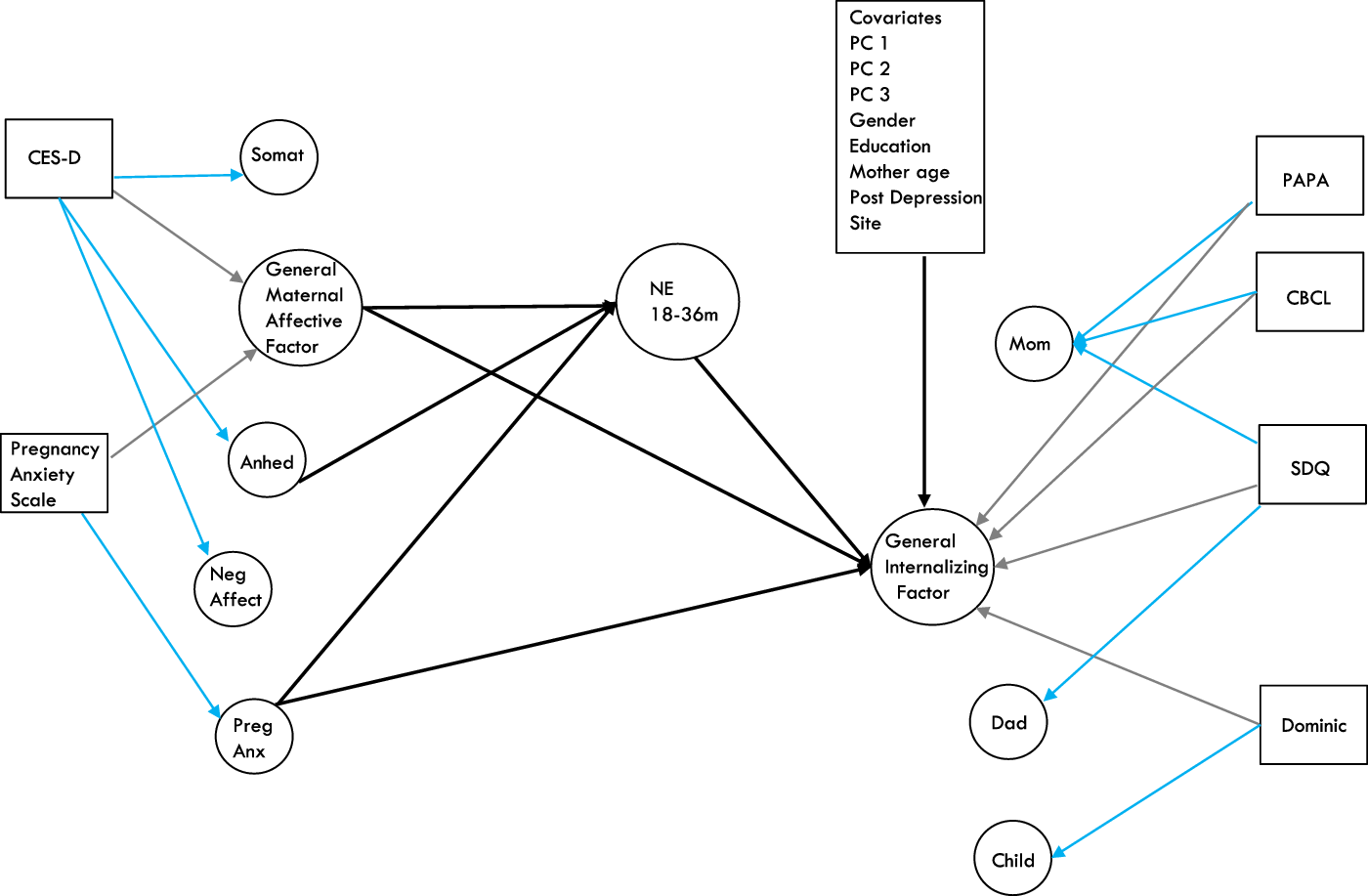
The analyses were conducted in three steps. First, using correlation coefficients, we examined separately the associations between the different factors of prenatal maternal affective psychopathology (i.e., overall affective symptom factor; the negative affect factor, the anhedonia factor, the somatic symptoms factor, and the pregnancy-specific anxiety factor) and NE and the child internalizing psychopathology factor (general internalizing factor of the bifactor model). Second, factors that were significantly associated with NE or child internalizing symptoms were entered in a path model additionally including the factor of NE and the general internalizing factor. Specifically, the factors included were the general maternal psychopathology factor, the prenatal anxiety factor, and the anhedonia factor. Path analyses were conducted using the lavaan R package (version 0.6-1.1133; Rosseel, Reference Rosseel2012). This was to determine significant pathways of prenatal maternal affective psychopathology, NE (aggregate score 18–36 months) and child internalizing symptoms (4–6 years). Third, when a significant pathway included NE, the mediating effect of NE was statistically evaluated by examining the indirect effect of the significant predictor through NE using lavaan (version 0.6-1.1133; Rosseel, Reference Rosseel2012). Refer to Figure 1 for a conceptualization of the entire hypothesized path model.
Path model testing associations between maternal affective factors, NE, and the internalizing factor.

Results
Descriptives
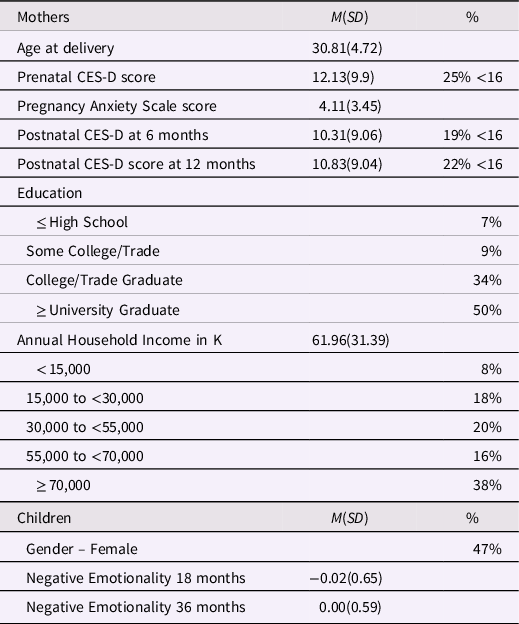
The mean age for mothers at delivery was 30 years (SD = 4.72). Half of the women had a university degree or higher. The average household income was $61,000 (Canadian) per year, with 38% of women reporting an annual family income over $70,000. Unstandardized prenatal depression scores ranged from 0 to 49 (M = 12.13, SD = 9.90), with 25% of the women meeting the threshold for clinically significant symptoms of depression (i.e., score >16) at 24 to 26 weeks of pregnancy. Pregnancy-specific anxiety scores on the Pregnancy-Specific Anxiety scale ranged from 0 to 16 (M = 4.11, SD = 3.45). In terms of postnatal depression, unstandardized scores at 6 months postpartum ranged from 0 to 52 (M = 10.31, SD = 9.06), and 19% of women met the threshold for depression. Characteristics for postnatal depression at 12 months were similar. In terms of child characteristics, there was an almost equal distribution of males and females. Standardized scores ranged from −1.22 to +3.92 for NE at 18 months (M = −0.02, SD = 0.65) and from −1.42 to 2.21 at 36 months (M = 0.00, SD = 0.59). Refer to Table 1 for more detailed information on the sample characteristics.
Descriptive statistics of MAVAN mother and child (N = 408 pairs)

Child internalizing factor
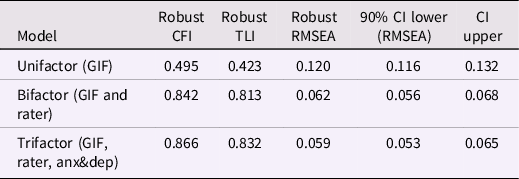
The fit of the bifactor model was compared to a more parsimonious unifactor model (i.e., internalizing factor without the rater factors). Closely approaching our criteria used to evaluate good model fit (RMSEA < 0.05 and CFI/TLI > 0.9), the bifactor model had superior fit indices compared to the unifactor model (Table 2). It was also compared to a more complex trifactor model, which included a general internalizing factor, a rater factor and specific anxiety and depression factors, depending on whether they described anxiety or depressive symptoms. Fit was similar to the bifactor model, however, with only two subscales loading onto the specific depression factor, this model did not satisfy the reliability criteria of a minimum three items (or subscales) per factor (Raubenheimer, Reference Raubenheimer2004). As such, the bifactor model was retained for further analyses. See Table 2 for comparison of model fit statistics.
Confirmatory factor analysis of a general internalising factor (N = 408 pairs) using maximum likelihood estimation procedure

Note. GIF = General Internalizing Factor, CFI = Comparative Fit Index, TLI = Tucker-Lewis Index, RMSEA = Root-Mean-Square Error of Approximation.
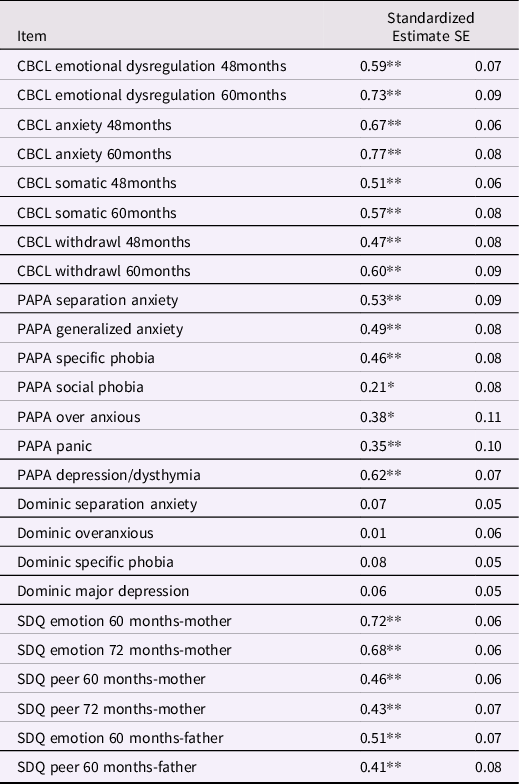
All internalizing psychopathology subscales from the CBCL, PAPA, and SDQ significantly loaded onto the general internalizing factor, independent of the rater variables (Table 3). Subscales from the Dominic did not load significantly onto the general factor, and there was an almost perfect correlation between the general internalizing factor scores when the Dominic Scale was included as part of the factor analysis and when it was not r = 1.00, p = <.0000. However, it was included as the fit statistics improved when it was included in the overall model.
Factor loadings of individual subscales on the General Internalizing Factor (N = 408 pairs)

Note. *p = <.01, **p = <.0001.
Main effect and path analysis
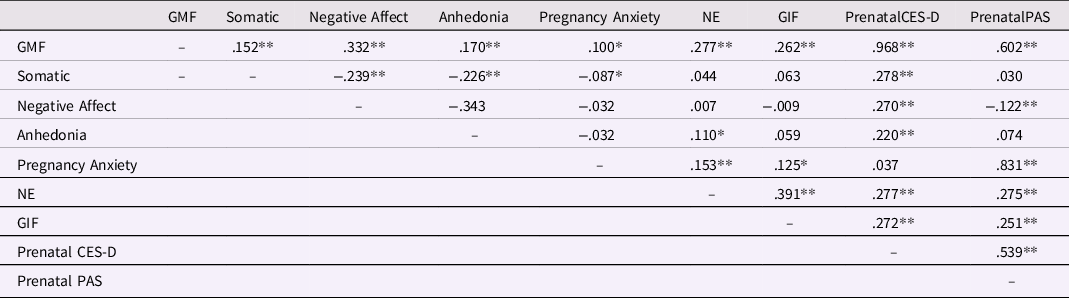
Relationships between the general prenatal maternal affective symptom factors, child temperament and general internalizing factor were examined using Pearson correlation coefficients. The correlation coefficients are shown in Table 4. The general prenatal maternal affective psychopathology factor, and the specific pregnancy-specific anxiety factor were significantly correlated with the general child internalizing factor (r = .26, p < .0001; r = .12, p = .02, respectively). Regarding the associations with NE, the general maternal affective psychopathology factor (r = .27, p < .0005), the pregnancy-specific anxiety factor (r = .15, p = .002) and the anhedonia factor (r = .11, p = .02) were all significantly associated with child NE. Thus, the general prenatal maternal affective psychopathology factor, the pregnancy-specific anxiety and anhedonia factors were taken forward into the path analyses. The somatic symptom factor and the negative affect cluster were not included in the path analysis as they were not correlated with child NE or child internalizing problems.
Pearson Correlation Coefficients between the prenatal maternal symptom factors, measures of prenatal maternal psychopathology, child negative emotionality and internalizing psychopathology

Note. GIF = General Internalizing Factor. GMF = General Maternal Psychopathology factor. PAS = Pregnancy Anxiety Scale. NE = Negative Emotionality*p = <.05, **p = <.01.
Based on the above associations, the hypothesized path model examined both the direct and indirect (i.e., through NE) effects of the general maternal affective psychopathology factor and the pregnancy-specific anxiety factor on children’s internalizing behavior, and the indirect effect (through NE) of the anhedonia factor on children’s internalizing symptoms. The covariates included in the model were maternal education, maternal age at birth, child gender, study site and postnatal maternal depression. The analyses were conducted using the maximum likelihood estimation procedure.
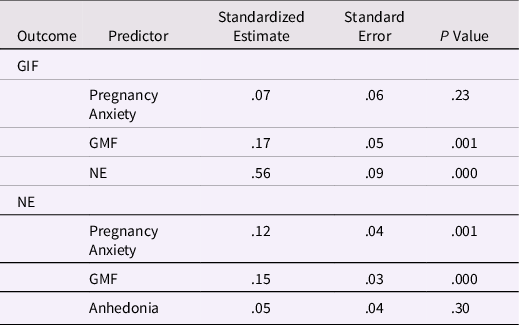
Prior to adjusting for covariates, analyses of direct effects revealed that the general maternal affective psychopathology factor significantly predicted children’s internalizing factor scores (B = .17, p = .001; Table 5), whereas the pregnancy-specific anxiety factor did not (B = .07, p = .23; Table 5). Analyses of effects between the general maternal affective psychopathology factor, temperament, and the internalizing factor indicated that the general maternal affective psychopathology factor (B = .15, p < .001: Table 5) and the pregnancy-specific anxiety factor (B = .12, p = .001; Table 5) significantly predict NE, whereas the anhedonia symptom factor (B = .05, p = .30; Table 5) did not. NE was significantly associated with children’s internalizing factor scores (B = .56, p < .001; Table 5).
Unadjusted path model of effects between the general maternal affective psychopathology, temperament, and the internalizing factor (n = 339 pairs)

Note. GIF = General Internalizing Factor. GMF = General Maternal Psychopathology factor. NE = Negative Emotionality.
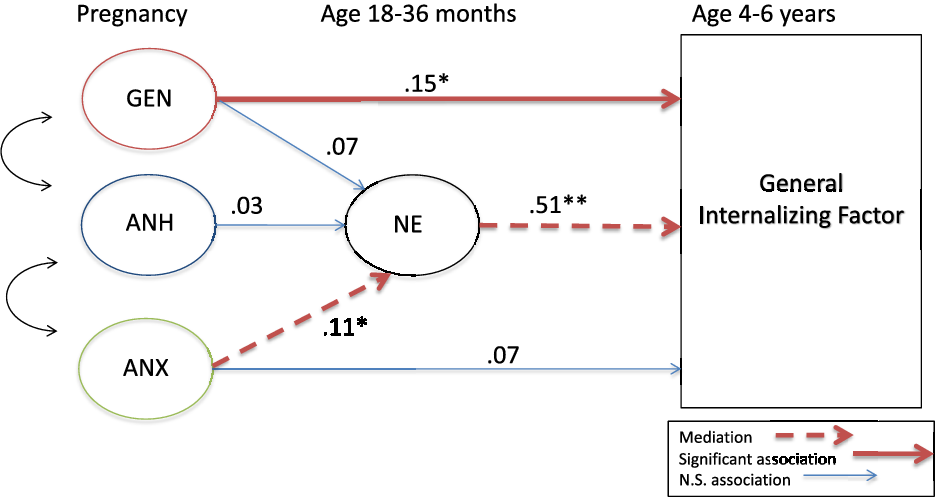
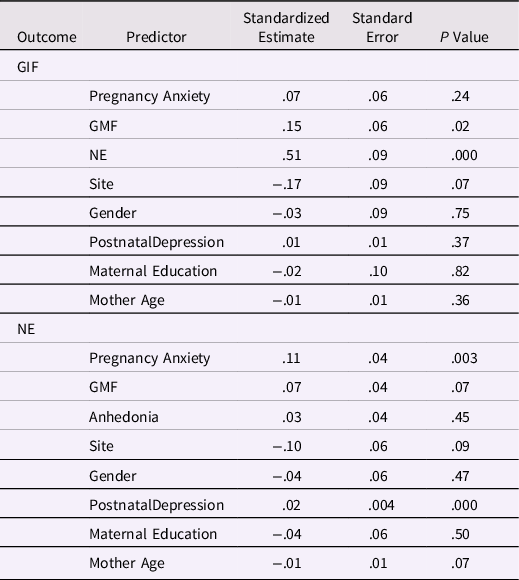
Results were similar in fully adjusted models. The general maternal affective psychopathology factor significantly predicted children’s internalizing factor scores (B = .15, p = .01), whereas the pregnancy-specific anxiety factor did not (B = .07, p = .24; Figure 2). Conversely, analyses of effects between the general maternal affective psychopathology factor, temperament, and the internalizing factor indicated that the general maternal affective psychopathology factor (B = .07, p = .07) and the anhedonia symptom factor (B = .03, p = .45) did not significantly predict NE, whereas the pregnancy-specific anxiety factor did (B = .11, p = .003). NE was significantly associated with children’s internalizing factor scores (B = .51, p < .001; Figure 2). Refer to Table 6 for statistics from the fully adjusted model.
Depicts results of indirect and direct effects examined in path model. Note **p < .001, *p < .01.

Adjusted path model of effects between the general maternal affective psychopathology, temperament, and the internalizing factor (n = 335 pairs)

Note. GIF = General Internalizing Factor. GMF = General Maternal Psychopathology factor. NE = Negative Emotionality.
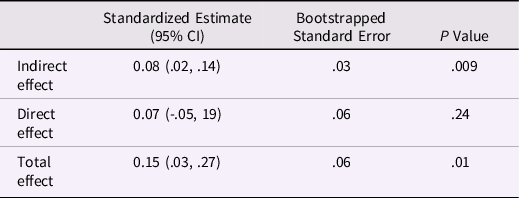
Analyses of the indirect effect using bootstrapping of 1,000 resamples revealed that child NE mediated the effect of maternal pregnancy-specific anxiety on child internalizing problems (B = .08, Bootstrap SE = .03, 95% CI = 0.021, 0.14, p = .009; Table 7). The associations between the general maternal affective psychopathology factor, the anhedonia symptom factor, and the child internalizing factor was not significantly mediated by child NE (Figure 2).
Mediation of the association between pregnancy anxiety and child internalizing problems by negative emotionality (n = 335 pairs)

Discussion
The results of the present longitudinal study revealed significant contributions of second trimester prenatal maternal affective psychopathology on preschool/early school age internalizing symptoms, independent of postnatal maternal depression. Further, distinct pathways for this relationship were identified based on different symptom clusters of maternal affective psychopathology. Importantly, we report on NE between 18 and 36 months as one mechanism underlying this relationship. Findings provide further support for the developmental origins of health and disease (DOHaD) hypothesis emphasizing the importance of antenatal mental health on early child temperament and later preschool/early school age mental health outcomes (Doyle & Cicchetti, Reference Doyle and Cicchetti2018; Hanson & Gluckman, Reference Hanson and Gluckman2008; O’Donnell & Meaney, Reference O’Donnell and Meaney2017).
We addressed previous limitations within the literature by using novel methodologies to study longitudinal associations. Specifically, we used a factor representing overlapping symptoms of maternal affective psychopathology and four additional factors representing different symptom clusters to identify distinct antenatal influences from those with less significant contributions. We also generated an internalizing factor representing a general vulnerability to child internalizing psychopathology with variance associated with maternal, paternal and child’s ratings parsed out to account for rater biases, such as those associated with maternal affective symptoms. Finally, within the longitudinal context of our study, formal mediation tests directly examined the indirect effect of NE, revealing early temperament plays a role in the causal pathway between prenatal affective psychopathology and later preschool/early school age internalizing symptoms.
Certain findings stand out. The primary finding was that only the factors representing general maternal affective psychopathology and pregnancy-specific anxiety significantly contributed to preschool/early school age internalizing problems. Further, the general maternal affective psychopathology factor was the strongest predictor of child internalizing problems and was the only affective predictor to demonstrate a direct effect in the mediation analysis. This indicates that there appears to be an element shared among depression and pregnancy-specific anxiety symptoms that is particularly important in predicting preschool/early school age internalizing symptoms. In addition, after accounting for overlapping symptoms of maternal prenatal psychological distress, depressive symptoms do not appear to have significant unique effects on preschool/early school age internalizing symptoms, whereas symptoms specific to pregnancy-specific anxiety do.
Similar findings were demonstrated for temperament. A significant relationship was initially detected between the anhedonia symptom factor, representing mother’s diminished interest in pleasure, and NE at 18 and 36 months. However, this association was no longer significant once accounting for the other symptoms of prenatal maternal affective psychopathology. Although the general maternal prenatal affective symptom factor significantly contributed to NE in the initial model containing other specific maternal factors, the association was no longer significant after controlling for covariates, including postnatal depression. Conversely, the effect for pregnancy-specific anxiety remained even after accounting for other specific factors and covariates.
These findings are in line with research reporting a particularly robust effect for pregnancy-specific anxiety on child developmental outcomes compared to other prenatal stressors. For example, Erickson et al. (Reference Erickson, Gartstein and Dotson2017), report similar differences in effects on infant temperament for prenatal depression and general anxiety as compared to pregnancy-specific anxiety in their recent review. After examining 34 different studies looking at the effect of different types of prenatal maternal affective psychopathology on the development of temperament, they reported equivocal findings for depression and anxiety. Half of the studies reviewed found significant associations, whereas the other half reported no association. Conversely, support for pregnancy-specific anxiety was robust (Erickson et al., Reference Erickson, Gartstein and Dotson2017).
The significance of pregnancy-specific anxiety may be embedded within the distinct context of pregnancy. As this stressor is characterized by women’s worries about the health of their children and fears related to delivery (Huizink et al., Reference Huizink, Mulder, Robles de Medina, Visser and Buitelaar2004), symptoms are more easily distinguishable from other unmeasured environmental stressors that may also impact maternal psychological state and child development (Huizink & de Rooij, Reference Huizink and de Rooij2018). Conversely, symptoms of more general anxiety or depression are often intimately intertwined with contextual factors such as socio-economic status or level of social support (Mancuso et al., Reference Mancuso, Schetter, Rini, Roesch and Hobel2004).
The effect of the pregnancy-specific anxiety factor compared to the other specific depression factors may be explained in part by the adjustment of our models for symptoms of postnatal depression. Mothers who experience symptoms of prenatal maternal depression often also experience depressive symptoms during the postnatal period (Evans et al., Reference Evans, Heron, Francomb, Oke and Golding2001; Faisal-Cury & Menezes, Reference Faisal-Cury and Menezes2012). Disentangling their separate contributions is often difficult, particularly due high levels of collinearity (Belsley, Reference Belsley2004; van der Wal et al., Reference van der Wal, van Eijsden and Bonsel2007). Although postnatal depression was also covaried in the models examining the effect of pregnancy-specific anxiety, pregnancy-specific symptoms of anxiety could not be covaried. Thus, as the time period when these symptoms occur are contained to pregnancy, it becomes easier to disentangle them from the contribution of other maternal affective symptoms occurring during other developmental windows.
Somatic symptoms did not significantly contribute to NE or childhood internalizing problems. This may be because the questions that comprise this factor measure a different construct in pregnant women than other depressed populations. Specifically, the somatic symptom factor may be tapping into the physiological effects of pregnancy, rather than depressive symptomology. The validity of the somatic factor for specific populations with other medical conditions has been questioned elsewhere (e.g., Cheng et al., Reference Cheng, Chan and Fung2006). Further, although Carleton et al. (Reference Carleton, Thibodeau, Teale, Welch, Abrams, Robinson and Asmundson2013) confirmed the validity of a somatic factor in a three factor structure of the CES-D, they recognized that this may not be optimal in certain populations with health concerns. Our results appear to support this claim.
A second essential finding was that NE mediated the relationship between pregnancy-specific anxiety and preschool/early school age internalizing problems. Few studies have examined NE as a mediating mechanism of prenatal maternal affective psychopathology, with equivocal findings reported (e.g., Glynn et al., Reference Glynn, Howland, Sandman, Davis, Phelan, Baram and Stern2018; Hentges et al., Reference Hentges, Graham, Plamondon, Tough and Madigan2019). Adding to this literature, our study is the first to identify NE from 18 to 36 months as a mediating mechanism linking pregnancy-specific anxiety to child internalizing problems, and the first to demonstrate the joint influence of these effects on internalizing problems as young as preschool/early school age. There is some evidence suggesting pregnancy-specific anxiety is related to maternal cortisol levels (Kane et al., Reference Kane, Dunkel Schetter, Glynn, Hobel and Sandman2014), which have been hypothesized to have programming effects on the child hypothalamic-pituitary-adrenal (HPA) axis (Glover et al., Reference Glover, O’Connor and O’Donnell2010). The HPA axis is one of the most studied biological systems implicated in the development of anxiety and depression. As one of the main outflow systems of the stress response system, the HPA axis acts to mediate and regulate stress and emotion (Jacoby et al., Reference Jacoby, Overfeld, Binder, Heim and Cicchetti2016). Since irregular activation of the HPA axis is implicated in the development of anxiety and depression (Kallen et al., Reference Kallen, Tulen, Utens, Treffers, De Jong and Ferdinand2008; Parker et al., Reference Parker, Schatzberg and Lyons2003) and in children with NE (e.g., Baibazarova et al., Reference Baibazarova, van de Beek, Cohen-Kettenis, Buitelaar, Shelton and van Goozen2013), prenatal programming of this system could be one mechanism which links pregnancy-specific anxiety and the development of internalizing problems in children via infant NE.
Importantly, mediation was specific to pregnancy-specific anxiety. Although the general maternal affective psychopathology factor did significantly predict preschool/early school age internalizing symptoms, no mediation effect was found. The specificity of the mediation effect to the pregnancy-specific anxiety factor suggests that discrepancies reported across previous studies may be due to undifferentiated symptoms of stress and mood.
Differences in mediation by symptom cluster may reflect distinct mechanisms that mediate these two different types of stress. Pregnancy-specific anxiety may operate through NE, whereas the impact of general maternal affective psychopathology may be mediated by other factors. Possibilities include, inflammation markers (Barker et al., Reference Barker, Cecil, Walton, Houtepen, O’Connor, Danese, Jaffee, Jensen, Pariante, McArdle, Gaunt, Relton and Roberts2018), epigenetics (Monk et al., Reference Monk, Spicer and Champagne2012), and brain systems involved in emotional reactivity and emotion regulation (Field et al., Reference Field, Diego, Hernandez-Reif, Schanberg and Kuhn2002; Qiu et al., Reference Qiu, Anh, Li, Chen, Rifkin-Graboi, Broekman, Kwek, Saw, Chong, Gluckman, Fortier and Meaney2015). More studies are needed to confirm the precise underlying mechanisms of this unique stressor that influence child development.
The absence of a mediation effect for the general maternal affective psychopathology factor and other depressive symptom factors, may also be reflective of a moderated-mediation effect, such that only children with certain characteristics or who are living under certain environmental conditions are influenced by prenatal maternal affective psychopathology and go on to develop NE, or internalizing problems. Indeed, in our previous study, a significant association between prenatal maternal depression and NE only existed for children with certain susceptibility genes (Gordon Green et al., Reference Gordon Green, Babineau, Jolicoeur-Martineau, Bouvette-Turcot, Minde, Sassi, St-Andre, Carrey, Atkinson, Kennedy, Steiner, Lydon, Gaudreau, Burack, Levitan, Meaney, Wazana and Maternal Adversity2016). Other studies report postnatal maternal behavior, such as sensitivity and parenting, can modify the effects of prenatal stress. For example Sharp et al. (Reference Sharp, Pickles, Meaney, Marshall, Tibu and Hill2012) reported that maternal stroking over the first weeks postpartum modified the associations of prenatal depression on infant physiological and behavioral outcome. Results from this and other similar studies lead to the question raised by Pluess and Belsky (Reference Pluess and Belsky2011) in their theory Prenatal Programming of Postnatal Plasticity, that perhaps prenatal stress programs the child to develop modifiable susceptibility characteristics that are influenced by the postnatal environment in a for better or for worse manner. As such, according to Pluess and Belsky, the effects of prenatal stress on later developing phenotypes such as internalizing problems would be dependent on postnatal environmental influences that modify prenatally programed endophenotypes (Pluess & Belsky, Reference Pluess and Belsky2011). As NE is considered to be a factor highly susceptible to both positive and challenging environments (Hartman & Belsky, Reference Hartman and Belsky2018), including other postnatal moderating factors in future models may be key in further understanding the variation in mediation of NE observed for different symptom factors in the present study.
These findings have important implications for prevention and intervention programs. Treatments targeting prenatal maternal affective problems have helped to reduce symptoms of maternal psychopathology (Glover, Reference Glover2014; Wakschlag et al., Reference Wakschlag, Roberts, Flynn, Smith, Krogh-Jespersen, Kaat, Gray, Walkup, Marino, Norton and Davis2019), with the field now moving forward with Randomized Control Trials to explicitly ascertain whether this improves child outcome (Brown et al., Reference Brown, Krogh-Jespersen, Tandon, Graham, Mackiewicz Seghete, Wakschlag, Wazana, Székely and Oberlander2021). We identify an early child characteristic that can serve as an additional target for intervention for women with symptoms of pregnancy-specific anxiety to facilitate more optimal outcomes for their children. NE is conceptualized as a susceptibility factor, such that children characterized with this type of temperament are more sensitive to both negative and positive environmental influences (Belsky & Pluess, Reference Belsky and Pluess2009). Indeed, there is evidence that children with more difficult temperament are more vulnerable to negative parenting, but also profit more from positive parenting, specifically at younger ages (Slagt et al., Reference Slagt, Dubas, Dekovic and van Aken2016). As such, working on parenting skills could be one way to help children with NE reduce the negative impact of maternal symptoms of pregnancy-specific anxiety on their level of internalizing symptoms. Importantly, although interventions targeting NE remain valuable in the absence of maternal pregnancy-specific anxiety, they may be less effective in reducing the impact of other types of prenatal stress.
Finally, in this study we were able to identify prenatal maternal affective symptoms and early child NE as predictors of preschool/early school age internalizing problems, which have also been demonstrated to be predictors of symptoms of anxiety and depression throughout development (Dodd et al., Reference Dodd, Hudson and Rapee2017; Nigg, Reference Nigg2006; Van den Bergh et al., Reference Van den Bergh, van den Heuvel, Lahti, Braeken, de Rooij, Entringer, Hoyer, Roseboom, Raikkonen, King and Schwab2017). This supports the characterization of internalizing behaviors emerging as early as age 4–6 years as reflecting persistent symptoms rather than developmentally transient behaviors. Further, the generation of the child internalizing factor yielded a bifactor model that did not differentiate between different symptomatology of anxiety and depression. Developmental differences may make it difficult to differentiate between anxious and depressive symptomology so early on in childhood. This is in line with research demonstrating high levels of comorbidity between internalizing symptoms during the preschool/early school age period (Rutter et al., Reference Rutter, Kim-Cohen and Maughan2006).
Limitations
Our study design does not explicitly test for possible genetic influences. As internalizing problems are heritable, the association between prenatal maternal affective psychopathology and preschool/early school age internalizing problems might not be characterised by influences on the developing fetus (i.e., foetal programming), but by heritability. However, some of our findings were independent of postnatal maternal mood, suggesting effects are not entirely related to genetic transmission of risk. Further, previous studies within our cohort have adjusted for maternal genotype and found the impact of maternal affective psychopathology remained a significant predictor of child temperament (Babineau et al., Reference Babineau, Green, Jolicoeur-Martineau, Bouvette-Turcot, Minde, Sassi, St-Andre, Carrey, Atkinson, Kennedy, Lydon, Steiner, Gaudreau, Levitan, Meaney and Wazana2015; Gordon Green et al., Reference Gordon Green, Babineau, Jolicoeur-Martineau, Bouvette-Turcot, Minde, Sassi, St-Andre, Carrey, Atkinson, Kennedy, Steiner, Lydon, Gaudreau, Burack, Levitan, Meaney, Wazana and Maternal Adversity2016). Future investigations should aim to further disentangle the role of genes underling the relationships between maternal affective psychopathology, child temperament, and preschool/early school age internalizing problems.
Our NE factors and the factors of maternal affective psychopathology were obtained from parent-report measures rated by the mother. As such, parental mood may influence the ratings given to the child (Atella et al., Reference Atella, DiPietro, Smith and St James-Roberts2003), at least for child temperament. However, parent report questionnaires benefit from a longer observation period and the ECBQ specifically inquires about the frequency of observable behaviors (Rothbart, Reference Rothbart1981), minimizing parent-reporting bias. Further, the effect of parental mood on ratings of childhood internalizing problems is limited by the longitudinal design of the study, controlling for postnatal maternal mood, including rater factors in the CFA models to remove any residual variation related to specific raters, by measuring NE at two different time points, and using diagnostic, self-rated, father and mother rated measures of child psychopathology.
Our study does not account for all possible types of prenatal maternal stress. Specifically, mothers who experience depression and pregnancy-specific anxiety may also be vulnerable to adverse environmental factors that could provoke a different type of stress experienced by the foetus, such as more general symptoms of anxiety. However, there is some evidence that pregnancy-specific anxiety may be a more robust contributor of foetal programming than other types of stress including more general symptoms of anxiety (Davis & Sandman, Reference Davis and Sandman2012; Erickson et al., Reference Erickson, Gartstein and Dotson2017).
Including postnatal depression in models examining the effect of prenatal stress can cause collinearity given its strong association with prenatal depression. In our sample, prenatal and postnatal CES-D were strongly correlated (r = .612, p = <.001). Although this did not lead to collinearity in our analyses, the inclusion of both prenatal affective symptoms and postnatal depression in the adjusted path models may have led to over adjustment and a conservative estimation of the associations with the maternal affective psychopathology factor. However, adjusting for postnatal depression is important given the known contribution on child development demonstrated in the literature, and in our analysis an effect of the maternal effective psychopathology factor on child internalizing problems was established even after postnatal depression was included in our model. Application of alternative study designs have demonstrated consistent independent prenatal effects above that of postnatal mood, some on child temperament and internalizing problems (Davis et al., Reference Davis, Glynn, Waffarn and Sandman2011; O’Donnell, Glover, et al., Reference O’Donnell, Gaudreau, Colalillo, Steiner, Atkinson, Moss, Goldberg, Karama, Matthews, Lydon, Silveira, Wazana, Levitan, Sokolowski, Kennedy, Fleming and Meaney2014), and may be considered in future studies invesitagting mediating effects with prenatal affective variables.
In addition, there are other unmeasured confounds that could explain the associations found in our study. However, we are confident that despite these possible confounding factors, the impact on child internalizing symptoms in the present study is at least in part due to maternal affective psychopathology as the relationship between maternal mood and child outcome has been established in several large community studies even after controlling for common confounds and suggest a direct causal pathway (Glover et al., Reference Glover, O’Donnell, O’Connor and Fisher2018).
There is evidence from animal models highlighting sex differences in the relationship between prenatal stress on developmental outcome (Weinstock, Reference Weinstock2007). As such, in the present investigation, post hoc we stratified the path analysis to look at associations for girls and for boys (Appendix C in Supplementary material). Some differences did emerge for pregnancy anxiety, such that the relationship between the pregnancy anxiety factor and NE appears stronger for boys, whereas the relationship between the pregnancy anxiety factor and the child internalizing factor appears stronger for girls. However, stratification does not allow us to determine if these differences are statistically significant and due to the number of parameters in our analysis, we did not have enough power to look at an interaction. Differences on the impact of pregnancy-specific anxiety on development among boys and girls is an important area for future investigations.
Many studies have demonstrated that the association between prenatal environmental exposure and child development is dependent on timing of gestation (e.g., Davis et al., Reference Davis, Glynn, Schetter, Hobel, Chicz-Demet and Sandman2007). As such, another limit of this study is that exposure to maternal affective symptoms was only measured between 24 and 26 weeks of pregnancy. Further examination of exposure to maternal affective psychopathology earlier and later during pregnancy is needed to determine if similar associations may be found during different developmental periods. However, there is some research showing that behavioral and emotional outcomes are associated only with exposure during later gestation (Davis et al., Reference Davis, Glynn, Schetter, Hobel, Chicz-Demet and Sandman2007; O’Connor, Heron, Glover, et al., Reference O’Connor, Heron, Glover and Alspac Study2002). Further, the second trimester appears to be important for neurodevelopment (e.g., Sandman et al., Reference Sandman, Buss, Head and Davis2015), which may be captured in part in this sampling time frame.
Finally, there might be other important mediators that were not tested such as parental sensitivity, family environment, attachment security, some of which are also linked in part with prenatal stress. Biological mediators such as child HPA and autonomic function could also play a role in the development of NE and child internalizing difficulties (Cost et al., Reference Cost, McGowan, Pawluski, Wazana, Székely and Oberlander2021).
Summary and future directions
The results of this study further specify the conditions in which prenatal maternal affective psychopathology predicts child internalizing symptoms emerging early in development. Our results indicate that different types of maternal affective psychopathology may exert influence via distinct mechanistic pathways. There are a number of hypothesized biological mechanisms underlying prenatal stress exposure. Specifically, changes to the fetal HPA axis, differences in brain development based on glucocorticoid exposure, impact on the sympathetic nervous system, and alteration of fetal neurotransmitter systems have all been identified as possible pathways that contribute to child psychopathology (Huizink & Rooij, Reference Huizink and de Rooij2018). However, it is not well understood how these changes may be influenced by different types of stressors (O’Donnell & Meaney, Reference O’Donnell and Meaney2017; Tiemeier, Reference Tiemeier2017). For example, foetal exposure to glucocorticoids is one common investigated biological mechanism, demonstrating effects on child temperament and internalizing symptoms (Buss et al., Reference Buss, Davis, Shahbaba, Pruessner, Head and Sandman2012; de Weerth et al., Reference de Weerth, van Hees and Buitelaar2003). However, it has not been consistently found to mediate the effect of maternal symptoms of prenatal psychopathology (Davis et al., Reference Davis, Glynn, Schetter, Hobel, Chicz-Demet and Sandman2007, Reference Davis, Glynn, Waffarn and Sandman2011). New avenues for further investigation of biological pathways of prenatal stresses include integration of genetic information into DOHaD models (O’Donnell & Meaney, Reference O’Donnell and Meaney2017). Indeed, genetic vulnerability has been implicated in the path from maternal affective psychopathology symptoms to fetal brain development (Qiu et al., Reference Qiu, Shen, Buss, Chong, Kwek, Saw, Gluckman, Wadhwa, Entringer, Styner, Karnani, Heim, O’Donnell, Holbrook, Fortier and Meaney2017), temperament (Babineau et al., Reference Babineau, Green, Jolicoeur-Martineau, Bouvette-Turcot, Minde, Sassi, St-Andre, Carrey, Atkinson, Kennedy, Lydon, Steiner, Gaudreau, Levitan, Meaney and Wazana2015; Gordon Green et al., Reference Gordon Green, Babineau, Jolicoeur-Martineau, Bouvette-Turcot, Minde, Sassi, St-Andre, Carrey, Atkinson, Kennedy, Steiner, Lydon, Gaudreau, Burack, Levitan, Meaney, Wazana and Maternal Adversity2016), and child internalizing symptoms (Velders et al., Reference Velders, Dieleman, Cents, Bakermans-Kranenburg, Jaddoe, Hofman, Van Ijzendoorn, Verhulst and Tiemeier2012). As such, future directions of this study include a continued investigation of how the relationships between pregnancy-specific anxiety, the general maternal psychopathology factor, NE, and child internalizing problems might differ based on child genetic vulnerability. It is expected that such further specification of the present model will continue to help uncover the mechanisms of prenatal maternal affective psychopathology, as well as provide evidence for more tailored prevention and intervention.
Supplementary material
To view supplementary material for this article, please visit https://doi.org/10.1017/S0954579421001747
Acknowledgments
We would like to thank all members and participants of the Maternal Adversity, Vulnerability, and Neurodevelopment (MAVAN) project for their time and commitment to this research.
Funding statement
This research was made possible by grants from the Canadian Institutes of Health Research, the March of Dimes Foundation and the Fonds de Research du Quebec. The MAVAN project has been supported by funding from the McGill Faculty of Medicine, the Blema & Arnold Steinberg Family Foundation, and the Canadian Institutes for Health Research.
Conflicts of interest
None.