





Introduction
Prediabetes, encompassing both impaired fasting glucose and impaired glucose tolerance, is a condition when an individual’s blood glucose levels exceed normal levels but remain below the diabetes threshold (American Diabetes Association Professional Practice Committee, 2023). Individuals with prediabetes have a high risk of developing type-2 Diabetes (T2D), with 10% developing T2D annually and 70% over their lifetime (Tuso, Reference Tuso2014). Globally, there are an estimated 537 million adults with diabetes, a number that is expected to increase significantly. Most of these individuals (81%) reside in low- and middle-income countries (LMICs), including Malaysia (International Diabetes Federation, 2021). Based on the census conducted in 2023, the prevalence of diabetes in Malaysia is estimated to be at 15.6%, far exceeding the global prevalence rate (International Diabetes Federation, 2021). This alarming statistic underscores the urgent need for effective interventions and strategies to prevent diabetes on a large scale.
Studies have shown that lifestyle interventions targeting modifiable risk factors, including sedentary lifestyles and unhealthy eating habits, can effectively prevent diabetes. Evidence from the Diabetes Prevention Program (Knowler et al., Reference Knowler, Barrett-Connor, Fowler, Hamman, Lachin, Walker, Nathan and Diabetes Prevention Program Research2002, Reference Knowler, Fowler, Hamman, Christophi, Hoffman, Brenneman, Brown-Friday, Goldberg, Venditti and Nathan2009), the Da Qing study (Pan et al., Reference Pan, Li, Hu, Wang, Yang, An, Hu, Lin, Xiao, Cao, Liu, Jiang, Jiang, Wang, Zheng, Zhang, Bennett and Howard1997), and the Finnish Diabetes Prevention Study (Tuomilehto et al., Reference Tuomilehto, Lindström, Eriksson, Valle, Hämäläinen, Ilanne-Parikka, Keinänen-Kiukaanniemi, Laakso, Louheranta, Rastas, Salminen and Uusitupa2001) showed that these interventions decreased diabetes risk progression by 58% within three years and provided protection from microvascular and macrovascular complications for up to 30 years (Knowler et al., Reference Knowler, Barrett-Connor, Fowler, Hamman, Lachin, Walker, Nathan and Diabetes Prevention Program Research2002; Gong et al., Reference Gong, Zhang, Wang, Ma, An, Chen, Zhang, Feng, Li, Chen, Cheng, Gregg, Hu, Bennett and Li2019). However, the high resource and labor demands make the implementation of these interventions challenging in low-resource settings such as those in the LMICs.
To address this growing threat, the PRediabetes Intervention, Management and Evaluation (PRIME) program, a community-based lifestyle behavior modification program for individuals with prediabetes in Malaysia, was developed (Teoh et al., Reference Teoh, Ng, Chong, Cheong, Ng, Bell and Lee2024). The effectiveness of the PRIME program was studied in a cluster randomized trial that integrated digital health tools with in-person community pharmacy services to encourage lifestyle behavior changes among participants through the provision of education, self-monitoring, goal-setting, and motivation (Ng et al., Reference Ng, Teoh, Chong, Ng, Bell and Lee2025; Teoh et al., Reference Teoh, Baek, Ademi and Lee2025). At the end of the six-month study, the program received a 90% completion rate with participants from the intervention arm achieving a significantly greater weight loss of 1.26 kg than the control arm (Teoh et al., Reference Teoh, Ng, Chong, Ng, Bell and Lee2026).
While interventions and studies like the PRIME program have demonstrated their effectiveness, it is unclear as to why community pharmacies remained underutilized for providing prediabetes management programs as part of their services outside of clinical trials. It has been suggested, however, that community pharmacies in many LMICs struggle to implement such programs due to resource constraints, technological challenges, and other socio-behavioral factors (Elgeed et al., Reference Elgeed, Navti and Awaisu2020).
Innovative digital health solutions such as mHealth mobile apps, dashboards, and wearable devices are increasingly used to enhance healthcare services, including monitoring of health parameters, patient education, and communication (Hamine et al., Reference Hamine, Gerth-Guyette, Faulx, Green and Ginsburg2015). While digital health interventions have been widely applied in many LMICs for managing non-communicable diseases, perceptions of the implementation of digital health-supported diabetes prevention strategies remain limited (Boima et al., Reference Boima, Doku, Agyekum, Tuglo and Agyemang2024; Stephani et al., Reference Stephani, Opoku and Quentin2016; Van Rhoon et al., Reference Van Rhoon, Byrne, Morrissey, Murphy and Mcsharry2020). In addition, the impact of digital health-supported interventions on healthcare providers is not well understood, as many of these studies focused solely on participant outcomes.
To improve the implementation and scaling up of digital health-supported and community pharmacy-based prediabetes management programs, it is crucial to develop an understanding of the factors affecting program effectiveness, as well as the facilitators and barriers to program implementation from both the participants’ and pharmacists’ perspectives. To do so, this qualitative study was conducted among participants and pharmacists involved in the PRIME program to examine the factors that facilitated or impeded its implementation, adoption, and participation.
Methods
Study design
This qualitative study was part of a larger pragmatic cluster randomized controlled trial, the PRIME program, which evaluated the impact of a digital health-supported and community pharmacies-based prediabetes management program for people with prediabetes. This study was conducted between October 2022 to November 2023 and was approved by the Monash University Human Research Ethics Committee (MUHREC) (Project ID: 36042). This report adhered to the Standards for Reporting Qualitative Research (SRQR) reporting guidelines (Supplementary Material Figure S1). All participants provided informed consent.
PRIME program
The PRIME program was a digital health-supported prediabetes management program conducted in community pharmacies in Selangor and Kuala Lumpur, Malaysia. Participants were adults aged 18 years and above, with a BMI ≥ 23 and had fasting blood glucose between 5.6mmol/L and 6.9mmol/L or HbA1c between 5.7% and 6.4%. All participants received a digital lifestyle intervention with the intervention arm receiving additional support, including tailored education modules, peer support, and guided advice by the health coaches. All the health coaches were pharmacists who received at least 3 hours of training covering topics such as active listening, lifestyle counseling techniques, and navigating and accessing resources provided in PRIME program. Further details on the design of PRIME program have been described previously (Teoh et al., Reference Teoh, Ng, Chong, Cheong, Ng, Bell and Lee2024).
Recruitment and enrollment
All participants were those who completed the PRIME program were invited to participate in this study and were recruited in person during their follow-up visits or by telephone. All pharmacists involved in the program were identified and invited by telephone. Given the limited number of participants (n = 91) available in the PRIME program and the primary aim of understanding lived experiences of individuals involved in the program, convenience sampling was preferred over other purposive sampling methods (Lewis-Beck et al., Reference Lewis-Beck, Bryman and Futing Liao2004; Teoh et al., Reference Teoh, Ng, Chong, Ng, Bell and Lee2026; Zrineh et al., Reference Zrineh, Al-Usta and Alwawi2026). This approach enabled recruitment of participants who could provide important insights from their first-hand experience with the program. Nevertheless, efforts were made to include participants from diverse demographic backgrounds to capture a range of perspectives. The focus group discussions and interviews were conducted online via Zoom video conferencing, and informed consent was obtained before the session began.
Data collection
In-depth, semi-structured interviews and focus group discussions were conducted following a question guide (Supplementary Material Figure S2 and S3). The qualitative inquiry was underpinned by the Theoretical Domains Framework (TDF), which is an integral component of the Behavior Change Wheel (BCW) that informed the development of PRIME program (Michie et al., Reference Michie, Van Stralen and West2011; Atkins et al., Reference Atkins, Francis, Islam, O’connor, Patey, Ivers, Foy, Duncan, Colquhoun, Grimshaw, Lawton and Michie2017). TDF domains previously identified as important to program development were used to structure the interview guide, which were then refined to address the aims of the study. For both focus groups and interviews, participants were asked to discuss their experiences participating in the PRIME program, using digital health tools for self-monitoring, and their thoughts about having the program in a community pharmacy setting. The pharmacist participants were also asked similar questions, with an additional focus on understanding their experience in implementing and delivering the PRIME program as part of their routine community pharmacy service. All interviews were conducted with concurrent data analysis to the point of theoretical saturation, where no new information, codes, or themes emerged.
The study was conducted in Malaysia where multilingual communication and code-switching are common in routine conversations. As the interview guide was developed and administered in English, formal back-translation was not undertaken. Although all participants understood English, they were encouraged to respond in the languages in which they felt most comfortable to enable a more natural and detailed expression of their experiences. All interviews and focus group discussions were responded in either English, Mandarin Chinese, or Bahasa Malaysia. The interviewer (KWT) was a trained researcher and native trilingual speaker in these languages with 12 years of formal education in these languages. All interviews and sessions were audiotaped and lasted between 60 and 90 minutes each.
Data analysis
All the recorded interviews and focus group discussions were transcribed and de-identified. Responses in Mandarin Chinese and Bahasa Malaysia were translated to English by independent research assistants who are native trilingual speakers and also received at least 12 years of formal education in these languages. The transcripts were checked for accuracy by KWT. Any uncertainties regarding the meaning of specific language expressions were checked with participants where necessary and discussed among the research team to ensure conceptual equivalence rather than literal translation.
Data saturation was achieved at the seventh focus group session and the eighteenth interview. Subsequently, two additional interviews were conducted to ensure no new themes were identified. Using thematic analysis approach, the de-identified interview transcripts were analyzed with QSR Nvivo version 12.6.0.959 (QSR International Pty Ltd., Burlington, MA, USA) inductively and deductively by KWT and SWHL. For translated transcripts, coding was conducted alongside the original audio recordings to preserve contextual meaning and reduce risk of translation-related misinterpretation. The transcripts were first read through at the initial data familiarization phase. A deductive approach was used to develop an initial coding framework based on researchers’ analytic pre-conceptions, including concepts explored in the semi-structured interview guide and the research questions. Subsequently, the transcripts were coded inductively based on phrases and concepts that were meaningful to the research questions, allowing the codebook to be refined and expanded. Constant comparisons between transcripts were used to identify similarities and differences throughout the coding process. The codes were reviewed, compared, and modified, with similar codes being compiled into key themes. The themes were refined by removing or recoding redundant and infrequent codes. Any disputes in the coding or the development of themes were discussed among the researchers until consensus was achieved. The themes and subthemes were then mapped to the UK-MRC framework for process evaluation to demonstrate the mechanisms and contextual factors that influenced the implementation of the PRIME program (Moore et al., Reference Moore, Audrey, Barker, Bond, Bonell, Hardeman, Moore, O’cathain, Tinati, Wight and Baird2015; Skivington et al., Reference Skivington, Matthews, Simpson, Craig, Baird, Blazeby, Boyd, Craig, French, Mcintosh, Petticrew, Rycroft-Malone, White and Moore2021).
Reflexivity statement
KWT is a Malaysian registered pharmacist with clinical practice experience in both hospitals and community pharmacies and is also a health services researcher focusing on prediabetes and pharmacy practice. SWHL is a Malaysian senior health systems and services researcher with over 15 years of experience and is also a registered pharmacist with practicing experience in community pharmacy. WLC is a health systems and services researcher focusing on public health and pharmacy practice with over 10 years of qualitative research experience and is also a registered pharmacist with hospital pharmacy practice experience. The involvement of research team members in the coding, analysis, and interpretation of findings, including those without community pharmacy experience and those not involved in the original PRIME RCT study, served as a check against confirmatory bias and mitigates its influence on interpretation.
Results
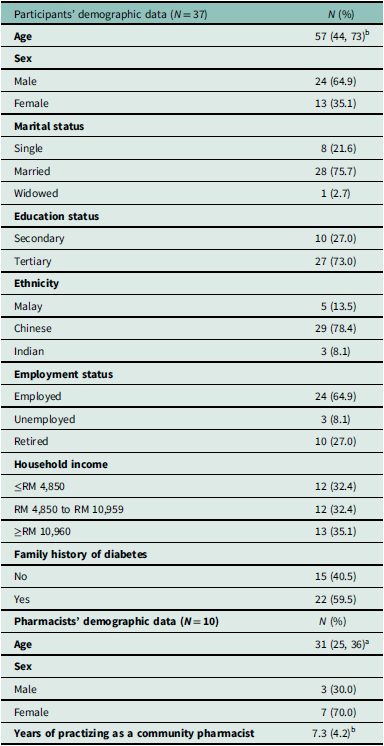
Forty-seven participants were interviewed in seven focus group discussions (each had 3–5 participants) and twenty interview sessions with participants and pharmacists. Table 1 summarized all participants’ demographic data.
Participants’ and pharmacists’ demographic data

Table 1. Long description
A table comparing demographic data of participants and pharmacists. The table has two main sections: Participants’ demographic data and Pharmacists’ demographic data. Participants’ demographic data section includes age, sex, marital status, education status, ethnicity, employment status, household income, and family history of diabetes. Pharmacists’ demographic data section includes age, sex, and years of practicing as a community pharmacist. Participants’ demographic data section has 37 participants with age range 44 to 73, 24 males and 13 females, 8 single, 28 married, 1 widowed, 10 with secondary education, 27 with tertiary education, 5 Malay, 29 Chinese, 3 Indian, 24 employed, 3 unemployed, 10 retired, 12 with household income less than or equal to RM 4,850, 12 with household income between RM 4,850 to RM 10,959, 13 with household income greater than or equal to RM 10,960, 15 with no family history of diabetes, and 22 with family history of diabetes. Pharmacists’ demographic data section has 10 pharmacists with age range 25 to 36, 3 males and 7 females, and an average of 7.3 years of practicing as a community pharmacist.
a Data were presented as: median (interquartile range)
b mean (standard deviation). Household income levels were categorized based on the Malaysian Income Classification.
Five main themes were developed from the study data. Representative quotes related to each theme and their mapping to the UK-MRC framework are described in Table 2.
Identified themes and their associated quotes from participants and pharmacists

Table 2. Long description
The table has five columns: Theme Subthemes, Quotes from participants, Quotes from pharmacists, and UK-MRC mapping. It contains data for four themes with associated subthemes, participant quotes, pharmacist quotes, and UK-MRC mapping. Theme 1: Motivational factors includes codes like Awareness, Confidence, Motivation, and Professional credibility. Theme 2: Influence of rapport includes codes like Rapport building and Building relationships. Theme 3: Improved convenience to healthcare access includes codes like Convenience, Accessibility, and Availability of resources. Theme 4: Resources and support includes subthemes like Ongoing follow-up and support, Clear and concise information, Adapting programs to pharmaceutical management, and Financial viability. Theme 5: Intervention with digital health includes subthemes like Empowering patients, Improving accessibility and convenience, and Patient-centric technological guidance.
UK-MRC: United Kingdom Medical Research Council framework for developing and evaluating complex interventions.
a Mechanism of impact refer to the processes through which the PRIME program produces change in outcomes; context refers to the factors external to the PRIME program that may influence implementation and outcomes.
Theme 1: Intrinsic motivations towards better health
Intrinsic motivations emerged as a key facilitator to participation and implementation of PRIME program among the participants and pharmacists. Participants were aware of the negative impact of diabetes through interactions with individuals who had firsthand experience in their community. As a result, they were driven by a common goal: to live healthier and prevent the consequences of diabetes. Participants also implied that at prediabetes stage, they are not ‘ill’ and can still live a ‘normal life’.
“Those people who got diabetes, they suffer… You got to constrain yourself from doing this and that. And all the symptoms (consequences) of diabetes make you so uncomfortable and obstructing your normal life” SP01
The program acted as a catalyst in helping participants realize the importance of being disciplined and committed to making consistent lifestyle changes to achieve better health. This, in turn, encouraged active participation and adherence to health recommendations.
“I’m back to running… To exercise is really important, and also back to (being) disciplined… It’s about your commitment to yourself. If you really want a healthy body lifestyle, then you have to do it.” LFSB02
Pharmacists’ motivations were primarily rooted in their professional identity as health advocates and an inherent sense of responsibility to enhance the health and well-being of individuals with prediabetes.
“As a community pharmacist, our role is there to pass the message, to give the counselling, to create the awareness.” Pharmacist 10
“As a pharmacist, we have to take the bigger role of being the first line of treatment for any participant coming into the store… (To) advise people not to go down that path of indulging and not controlling their blood sugar because, at the end of the day, that’s diabetes, and it will be the contributor to most of the chronic diseases that we have. Prevention, I’m trying to teach them more on the prevention.” Pharmacist 3
A lack of urgency in managing prediabetes among both individuals with prediabetes and healthcare professionals was a barrier, as it was often perceived as less serious than other diseases like diabetes. This perception hindered individuals from taking timely actions to manage their condition. While the PRIME program provided a platform for lifestyle intervention, a broader shift in mindset is needed to emphasize the importance of early intervention during the prediabetes stage as an effort to prevent diabetes.
“The doctor never really stressed that (prediabetes was serious) … Because although it’s (the blood glucose) a bit high… They (the healthcare professionals) just glossed over it… It’s not like so high that I have to be on medication… (I assumed) it’s because I took too much sugar (before the test), it will just go down by itself.” DMEN10
Theme 2: Influence of rapport building
Rapport building was a key facilitator to participation and implementation of PRIME program; participants valued the pharmacists’ expertise and personal care, while pharmacists viewed it as an opportunity to build customers’ loyalty and the public’s trust in the pharmacy profession.
“It‛s one of the reasons that make this program very attractive… It gives you ‘oomph‘ ‘ (the motivation) that we look forward to meet… (the pharmacists) have personal caring for us.” DMEN02
“(PRIME) has helped to establish a very good relationship with the participant. In the long run… The participant will always come back to the pharmacy to meet (us). And if we are talking in the sense of a business, there’s a really, really good outcome that we definitely want, because we want participant retention.” Pharmacist 2
On the other hand, the main barrier to active participation in peer support chatgroups was unfamiliarity with the other members. Participants felt uncomfortable sharing their thoughts with a group of ‘strangers’, and some found the messages shared were unhelpful.
“We don’t know each other very much in the peer group. I don’t feel comfortable putting in certain information which might affect some people… Because we are not professional.” DMEN01
To ensure meaningful peer support, participants emphasized the importance of building relationships beforehand, whether it is through a virtual meeting or a small group discussion.
Theme 3: Improved convenience to healthcare access
The strategic locations of community pharmacies facilitated implementation, providing participants with convenient access. Pharmacies were favored over health clinics and hospitals, which were deemed better suited for severe illnesses and less conducive for lifestyle management. This finding was similar to theme 1 where participants did not perceive themselves as being ill.
“They are located at the strategic places like you know, shopping complex… It’s more convenient. People with my condition (prediabetes), I don’t think I’ll be going to hospital to inquire more of it unless it’s very severe.” PVBJ07
Additionally, community pharmacies served as a one-stop center for point-of-care testing, offering various tests such as fasting blood glucose and HbA1c. This increased the opportunity for participants to engage in screening, monitoring, and lifestyle interventions.
“Even though we say (to the patients that they have) the risk for prediabetes… The challenge is they…don’t want to go (to the doctor) for further check-up…. (We can) do more tests or screening on their HbA1c or their fasting sugar (at the pharmacy).” Pharmacist 1
Theme 4: Resources and support
Ongoing follow-up and continuous support
The integration of routine monitoring and follow-up visits were important facilitators that kept participants accountable for lifestyle changes. Along with the pharmacist-guided advice, participants could regularly track their health progress and understand the impact of their lifestyle choices, motivating them to maintain their healthy habits.
“You’re answerable to someone, and you know that you have this appointment down the road, then you try your best to make sure that you meet the targets… If you’re not accountable to anyone. And then you tend to be very, like, let things lie…” DMEN10
Similarly, pharmacists’ motivations and confidence in delivering effective prediabetes care grew as they noted improvements in the participants’ health outcomes over time.
“It’s a positive outcome that we hope to see. Definitely it’s an encouragement and an experience that we can share to another person who has similar problems, I can motivate another participant to move forward.” Pharmacist 1
Nonetheless, participants and pharmacists emphasized the need for continuous monitoring beyond the six-month as they were uncertain about their future progress upon program completion.
“I think the six-month program is long enough to make ourselves aware and do some of these things into our routine. I think it’s not easy… I hope that was longer. So at least somebody was (encouraging) me to do better.” PVBJ05
“I don’t know for sure about when the program is already ended, whether are they continuing doing it by themselves… Whether are they going to come back after the program has ended? How do we keep in touch with this kind of participant?” Pharmacist 3
Clear and actionable information
The standardized procedure of PRIME program, along with the instructional materials and trainings for pharmacists facilitated program implementation, as it provided pharmacists with clear guidance and a structured approach to deliver prediabetes care.
“For pharmacists’ side, we won’t be too lost. It’s more systematic, like everyone is more in line, more uniform (in) looking at participants with prediabetes… To help them to improve their health.” Pharmacist 7
However, the absence of established prediabetes-specific guidelines still caused uncertainty among pharmacists in confirming and managing prediabetes.
“We don’t really actually have a specific guideline… Some people enjoyed a little bit too much sugars for the past two months… Their blood sugars actually showed that they are prediabetics, but (the blood glucose is high) only just for a few days… We are not trying to create fear… That’s the toughest point for me to decide whether they are already in that prediabetes stage or they’re just (in) a momentarily kind of phase.” Pharmacist 3
Adapting program to pharmacy operation
Pharmacists often had to multitask as they faced time constraints and pharmacists’ shortages. Relating to theme 1, pharmacists who perceive prediabetes as less urgent may prioritize other cases of acute ailments or chronic diseases over prediabetes management in these situations.
“We don’t just counsel participants, there are a lot of other work tasks that the pharmacist has to handle, in terms of operation matters and also staff matters… It’s like you want to help this participant here, but there are a lot of other patients (customers) waiting for you to help them… It’s always a matter of whether we have enough manpower and time.” Pharmacist 7
“Prediabetes, for me, I think not really worth spending so much time… I would rather spend the time for diabetic patients.” Pharmacist 5
This may also reduce the number of community pharmacies that may be interested in implementing PRIME, especially among the profit-driven entities. To address this, pharmacists suggested solutions such as using an appointment-based system, running the program in a lower-traffic pharmacy, simplifying processes, and task-shifting.
“Not everyone will be willing to do it because some people see it as a non-profitable business strategy.” Pharmacist 8
Financial viability for implementation
When exploring whether the program should be charged, participants were willing to pay an average monthly fee of RM70 (range RM4 to RM 400). However, incurring a fee for this program could be a potential barrier to participation, as some participants felt that paying for prediabetes management was unnecessary.
Some pharmacists believed an incentivization of RM10 per follow-up visit could be a facilitator for boosting motivation among pharmacists, while others considered prediabetes care as part of their professional responsibility. Additionally, pharmacists suggested integrating the program into their key performance index to promote participation, although this should be approached cautiously to avoid overburdening pharmacists.
“Make it as a KPI… But the KPI must be reasonable. If it’s out of our ability, it becomes a burden which we cannot really practice… then it’s not reasonable.” Pharmacist 10
Theme 5: Innovation with digital health
Empowering prediabetes care
The digital health tools in the PRIME program enhanced the abilities of both participants and pharmacists in managing prediabetes. These tools facilitated self-monitoring and ensured proper documentation of health data, enabling users to efficiently retrieve and review their data. Being able to visualize their health data on the PRIME app empowered participants to self-reflect on the relationship between their lifestyle and health status and make informed decisions on their lifestyle actions. Additionally, the in-app prediabetes education modules reinforced participants’ health awareness and provided them with practical solutions for managing their condition.
“We have the opportunity to monitor and, you know, it shows the reading… Even the graph is there… When it’s (blood glucose level) gone up… I tell myself, I need to do something about it… This tool can help me to actually look at my readings, just by opening up the app, which is much easier.” AMSA04
Technology assistance that is convenient and time-saving was the key facilitator to adoption by the pharmacists. The dashboard streamlined history-taking for pharmacists, and provided a comprehensive overview of participants’ health data. This enhanced efficiency in the care process, allowing pharmacists to tailor their advice targeted to participants’ needs.
“When you save people’s time, people will have the willingness to use it, anything (that is) simple and straightforward… The dashboard… On one site, you can see everything about the participant… You don’t need to find (participants’ information) here, find there, piece by piece… Save the time to know them better.” Pharmacist 1
Streamlining technical accessibility and functionality
To ensure continuous engagement, it is important that any healthcare mobile app should have sufficient functionalities. Participants described how their interest waned over time, with 52% discontinuing use by the 9-month follow-up. Importantly, as these digital innovations required user input, it became unhelpful for pharmacists when participants stopped engaging with the mobile app.
“It’s just a recording (mobile) app, to sync data… There’s no drive to keep using the (mobile) app.” SWP02
In addition, while many features of the mobile app were helpful during the initial phase, their usefulness declined over time as users became more familiar with their lifestyle habits and required less frequent monitoring. This observation is supported by the quantitative data, which showed a decline in the use of self-monitoring features over time (Teoh et al., Reference Teoh, Ng, Chong, Ng, Bell and Lee2026).
“For the food diary, initially, it was actually quite good, but (it became) rather cumbersome if you continue… recording it all the time. …After some time, I also stopped doing it because roughly I know what are the food I take and what are the calorie, I just make sure I don’t deviate from that.” PVBJ07
Technical hiccups often left older participants feeling demotivated as they were unsure about the security and reliability of the mobile app. Along with several other technology challenges, including phone compatibility, storage capacity, and internet connectivity, this highlighted the opportunity for personalized support. To assist older participants in overcoming technology apprehension, continuous guidance from pharmacists was seen as a valuable service that ensured they felt secure and confident in navigating the mobile app.
“We are always scared of the unknown. And every time we try, we cannot get it (the mobile app does not work as expected), it causes us (to) feel uncomfortable… IT (Information Technology) these kinds of things, to us older people, I think it’s not that simple as one or two briefings then we can catch it all… I did a lot of trial and error to get used to the (mobile) app… I believe the mobile app has multifunction, it’s just that we don’t know how to explore them.” SP04
Discussion
This study evaluates the experiences of both participants and community pharmacists on the implementation of a digital health-supported and community pharmacy-based prediabetes management program in the LMICs. The study builds on previous findings of a positive attitude and acceptance towards prediabetes interventions, highlighting opportunities for broader implementation of such programs (Adekunle et al., Reference Adekunle, Olson, Schommer and Brown2023; Teoh et al., Reference Teoh, Ng, Chong, Bell, Cheong and Lee2023). The UK-MRC process evaluation framework highlights the need to consider both how an intervention produces change and the context in which it is delivered (Moore et al., Reference Moore, Audrey, Barker, Bond, Bonell, Hardeman, Moore, O’cathain, Tinati, Wight and Baird2015; Skivington et al., Reference Skivington, Matthews, Simpson, Craig, Baird, Blazeby, Boyd, Craig, French, Mcintosh, Petticrew, Rycroft-Malone, White and Moore2021). For the PRIME program, potential mechanisms of impact may include rapport building, information provision, continuous support, and empowerment through digital health. However, its feasibility and sustainability within the pharmacy practice may depend on contextual factors, such as accessibility, adaptability to pharmacy workflows, and financial viability. This reinforces the importance of considering both the intervention components and the real-world delivery context when refining similar programs for future implementation.
The idea of living with diabetes complications strongly motivated participants to take actions. Participants’ hesitancy in accepting the label of being ‘ill’ suggests that the context in which the interventions are implemented can influence their ability to effectively reach the target group (Andersson et al., Reference Andersson, Ekman, Lindblad and Friberg2008). Leveraging these intrinsic motivations along with the reversible potential of prediabetes creates a window of opportunity for program participation (Andersson et al., Reference Andersson, Ekman, Lindblad and Friberg2008; Abel et al., Reference Abel, Whitehead and Coppell2018). Although the role of community pharmacists in health promotion services and facilitation of self-care activities is well-established, some may argue that there is still a reluctance to receive lifestyle interventions from pharmacists as opposed to doctors (Krska and Morecroft, Reference Krska and Morecroft2010; Hindi et al., Reference Hindi, Schafheutle and Jacobs2018; Katangwe et al., Reference Katangwe, Family, Sokhi, Al-Jabr, Kirkdale and Twigg2019; Hirota and Okamura, Reference Hirota and Okamura2020; Katangwe et al., Reference Katangwe, Family, Sokhi, Kirkdale and Twigg2020; Hibino et al., Reference Hibino, Matsumoto, Nagase, Nakamura, Kato, Isomura and Hori2023). In this study, participants preferred having such programs in a community pharmacy setting rather than health clinics or hospitals, as they did not consider prediabetes severe enough to necessitate care from health clinics and hospitals. Community pharmacies were seen as a one-stop health and wellness center, as lifestyle interventions complemented the existing pharmacy services, such as health screenings, self-care services, and health product recommendations (Ooi et al., Reference Ooi, Hassali, Shafie, Kong, Mak and Chua2016; Straw et al., Reference Straw, Mills, Winters, Van De Roovaart and Chen2023). Often situated close to residential areas and essential shops, community pharmacies increased accessibility for healthcare services, as well as convenience for participants to run errands or do leisure shopping at nearby stores after their follow-up visits (Tew et al., Reference Tew, Hatah, Arif, Abdul Wahid, Makmor-Bakry and Abdul Maulad2021). This strategic placement enhanced the overall experience for participants, which integrated pharmacy visits into their daily lifestyle.
However, the same reluctance to self-identify as “ill” may also suggest that individuals with prediabetes are concerned about experiencing diabetes-related stigma, despite not having diabetes. Although research examining prediabetes-related stigma remains limited, studies have shown that four in five individuals with diabetes experience negative social stereotypes or prejudices, including in healthcare settings (Speight et al., Reference Speight, Holmes-Truscott, Garza, Scibilia, Wagner, Kato, Pedrero, Deschênes, Guzman, Joiner, Liu, Willaing, Babbott, Cleal, Dickinson, Halliday, Morrissey, Nefs, O’donnell, Serlachius, Winterdijk, Alzubaidi, Arifin, Cambron-Kopco, Santa Ana, Davidsen, De Groot, De Wit, Deroze, Haack, Holt, Jensen, Khunti, Kragelund Nielsen, Lathia, Lee, Mcnulty, Naranjo, Pearl, Prinjha, Puhl, Sabidi, Selvan, Sethi, Seyam, Sturt, Subramaniam, Terkildsen Maindal, Valentine and Vallis2024). Such stigma may discourage engagement with health services and contribute to avoidance of preventive or management interventions, potentially undermining the aims of diabetes prevention efforts (Speight et al., Reference Speight, Holmes-Truscott, Garza, Scibilia, Wagner, Kato, Pedrero, Deschênes, Guzman, Joiner, Liu, Willaing, Babbott, Cleal, Dickinson, Halliday, Morrissey, Nefs, O’donnell, Serlachius, Winterdijk, Alzubaidi, Arifin, Cambron-Kopco, Santa Ana, Davidsen, De Groot, De Wit, Deroze, Haack, Holt, Jensen, Khunti, Kragelund Nielsen, Lathia, Lee, Mcnulty, Naranjo, Pearl, Prinjha, Puhl, Sabidi, Selvan, Sethi, Seyam, Sturt, Subramaniam, Terkildsen Maindal, Valentine and Vallis2024). Importantly, community pharmacists involved in such programs often have frequent contact with individuals with prediabetes and are therefore well positioned to influence their engagement and behavior. Pharmacists delivering these services may therefore require training in person-centered communication to support attitudes and practices that are trust-building and sensitive to the ambiguity of prediabetes as a condition positioned between health and illness.
Rapport building was highly valued by pharmacists and participants; pharmacists recognized the potential to foster greater public trust in the profession and enhance business loyalty through building relationships with their participants, while participants described their interactions with their pharmacists as experiences of ‘personal care’ and ‘encouragement’. These observations aligned with previous findings that showed the influence of relationship and trust-building on patient satisfaction, loyalty, and acceptance of pharmacist-provided health promotion services (Patterson et al., Reference Patterson, Doucette, Urmie and Mcdonough2013; Melton and Lai, Reference Melton and Lai2017; Roszak and Ferreri, Reference Roszak and Ferreri2020; Adekunle et al., Reference Adekunle, Olson, Schommer and Brown2023). Similarly, the results indicated that peer support chatgroups could be more effective with strong relationships among participants. These findings align with other research emphasizing the importance of relationship building during initial contact to improve engagement and achieve better outcomes (White et al., Reference White, Bhattacharya, Bremner, Faulkner, Foster, Gibson, Goldsmith, Harnett, Lucock, Patel, Priebe, Repper, Rinaldi, Salla, Simpson, Ussher and Gillard2023).
Accountability encouraged participation in this study. Participants found that the regular follow-up structure was not just beneficial in receiving continuous guidance and encouragement but also provided a sense of accountability that motivated them to sustain their lifestyle changes. As such, they were uncertain about future progress after the program had ended. While regular follow-up visits were commonly present in clinical trials, they were less so in clinical practice, which may explain poorer adherence in clinical settings (Van Onzenoort et al., Reference Van Onzenoort, Menger, Neef, Verberk, Kroon, De Leeuw and Van Der Kuy2011). Although long-term follow-up visits may be ideal, their implementation can be challenging due to time constraints and limited manpower. Research have shown that accountability through social interactions between a patient and health provider was key to adherence; however, it does not necessarily require direct human contact (Straw et al., Reference Straw, Mills, Winters, Van De Roovaart and Chen2023). This suggests that in low-resource situations where frequent face-to-face follow-up visits were not plausible, pharmacists could utilize digital interactions including phone calls or online communications, to provide ongoing encouragement and support (Straw et al., Reference Straw, Mills, Winters, Van De Roovaart and Chen2023).
The integration of digital health tools including the mobile app and the pharmacist dashboard complemented well with service delivery and facilitated self-management. The visualization of health metrics on mobile apps has been previously shown to encourage self-reflection on lifestyle choices and reinforce self-monitoring habits, an effect also observed in this study (Du et al., Reference Du, Dennis, Rhodes, Sia, Ko, Jiwani and Wang2020). A common challenge for pharmacists in many LMICs to provide any health prevention services was the lack of access to patient’s medical information, which resulted in reliance on self-reported data (Kandula et al., Reference Kandula, Moran, Tang and Obrien2018; Du et al., Reference Du, Dennis, Rhodes, Sia, Ko, Jiwani and Wang2020). This study addressed this issue by utilizing real-time projection of participants’ self-monitoring data, enabling pharmacists to provide individualized feedback more accurately and confidently. However, limited engaging functionalities impeded long-term engagement with the mobile app, especially with the self-monitoring features. Participants commonly reported that once they understood their lifestyle habits, they no longer felt a need to continue using the app, aligning with previous studies on reasons for discontinuing health app use. Future iterations could sustain engagement by providing ongoing value, such as opportunities to set new achievable goals and receive updated personalized information over time. Nevertheless, the blended approach of the program combining human support with technology-assisted interventions were essential, as pharmacists played crucial roles in building brand trust and continually supporting participants to utilize the mobile app throughout the program (Santos-Vijande et al., Reference Santos-Vijande, Gómez-Rico, Molina-Collado and Davison2022; Chew et al., Reference Chew, Rajasegaran, Chin, Chew and Kim2023; Lakka et al., Reference Lakka, Aittola, Järvelä-Reijonen, Tilles-Tirkkonen, Männikkö, Lintu, Karhunen, Kolehmainen, Harjumaa, Mattila, Järvenpää, Ermes, Mikkonen, Martikainen, Poutanen, Schwab, Absetz, Lindström and Pihlajamäki2023).
Implications for policy and practice
Diabetes prevention is often overlooked by both participants and health professionals, posing barriers to implementation. In a resource-limited setting, managing diabetes often took precedence, and lifestyle interventions were perceived as less urgent (Kandula et al., Reference Kandula, Moran, Tang and Obrien2018; Katangwe et al., Reference Katangwe, Family, Sokhi, Kirkdale and Twigg2020). PRIME could potentially be translated into a practical diabetes prevention model in LMIC contexts, as it builds on existing pharmacy resources for diabetes prevention while using digital health to enhance service delivery, follow-up, and participant engagement. However, PRIME cannot be implemented in silo, and scaling it would require collective change at both policy and practice levels. First, policy priorities should include formally integrating community pharmacies into diabetes prevention pathways, thereby establishing clear referral mechanisms with a multidisciplinary team of general practitioner and allied health professional. Monetary incentives for pharmacists and financial support for participants, such as waived or discounted fees for point-of-care tests and self-monitoring devices, could be introduced into policies. These policy modifications are particularly important in LMICs, where out-of-pocket costs and limited primary care capacity may otherwise restrict access to preventive care (Langlois et al., Reference Langlois, Mckenzie, Schneider and Mecaskey2020). Given the well-established evidence on the effectiveness and cost-effectiveness of lifestyle interventions in diabetes prevention especially in resource-limited settings, policymakers should allocate resources more deliberately towards preventive measures (Ma et al., Reference Ma, Wan and Wu2020).
At the practice level, program features could be made more adaptable to minimize workload burden and support delivery in under-resourced pharmacy settings. This could include scheduling visits during periods of low customer traffic or providing training that allows task-shifting to other pharmacy staff members. Capacity-building could focus on a training framework that equips pharmacists and pharmacy staffs with core competencies in prediabetes screening, management, and person-centered communication. Training could be delivered through low-cost blended formats, combining online modules with interactive workshop components such as case studies, role-play, and counseling demonstration. The information gap identified among pharmacists further supports the need for prediabetes-specific guidelines, as existing guidance remains largely diabetes-focused (World Health Organization, 2006; Ministry of Health, 2020; American Diabetes Association Professional Practice Committee, 2023). Developing prediabetes-specific guidelines is essential to raise awareness and keep health providers informed on its evidence-based management.
Strengths and limitation
This study had several limitations. First, the study might have limited generalizability as it was conducted in the urban areas of Malaysia, considering that the socioeconomic backgrounds of the participants may differ from those in rural areas especially in terms of digital and health literacy. In addition, the pharmacists involved in the PRIME program have received structured training on prediabetes care, which may not reflect the current community pharmacy practice beyond context. This study employed convenience sampling, which may introduce selection bias as completers may be more motivated than dropouts. Despite attempts to contact non-completers, no responses were received. As a result, the findings may be subject to selection bias, as they primarily reflect the perspectives of participants who were more engaged with the program. This may have limited the ability of the study to fully capture barriers experienced by individuals who discontinued participation. Nevertheless, the overall attrition rate of the program was low (<10%), potentially limiting the impact of such bias. As all participants understood English, the interview guide was administered in English without formal back-translation or validation in other languages. Given that most Malaysians are multilingual, participants in the study were encouraged to respond in their preferred local languages, which may have led to language-related variation during data collection and translation. To minimize this, interviews were conducted by a multilingual researcher, translations were checked against the recordings, and uncertainties were discussed with participants or the research team to preserve conceptual equivalence. Furthermore, the interviews were conducted by KWT who was also involved in the RCT on the PRIME program, which might have influenced the objectivity of the analysis. To address this potential source of bias, we included researchers who were not involved in the RCT throughout process of interpretation of codes and themes development to provide independent perspectives and strengthen analytical credibility. Perspectives from physicians and policymakers were not included in this study, as they were not directly involved in the delivery or execution of the program. This may have limited the insights gained regarding system-level contexts. Future research aiming to scale and embed such programs in the existing health system should actively involve system-level stakeholders to co-develop implementation strategies and support policy alignment.
Despite the limitations, this study offered several strengths. A key strength is its inclusion of the lived experiences of both providers and participants involved in the real-world implementation of a diabetes prevention service, providing a more comprehensive understanding of the service from multiple perspectives. This study also revealed an in-depth understanding of the acceptance and feasibility of combining digital health support and community pharmacy services in managing prediabetes in an LMIC region. Importantly, the findings in this study were broadly applicable to other community-based lifestyle interventions and may be extrapolated to address other non-communicable disease states, such as hypertension and dyslipidemia.
Conclusion
This study demonstrated that a digital health-supported, community pharmacy-based prediabetes management program is a feasible, acceptable, and potentially impactful model of care. The PRIME program highlighted how digital health tools, such as a mobile app and a dashboard, can support community pharmacy service in screening, education, monitoring, and follow-up for people with prediabetes. However, its implementation also showed that sustainable delivery requires stronger policy and practice support, including adequate resource allocation, prediabetes-specific guidelines, pharmacist capacity building, and workload management, and ultimately formal inclusion of community pharmacy as a diabetes preventive service in health policy. The use of digital health tools, such as the mobile app and the pharmacist dashboard, was innovative; however, technical difficulties and the lack of engaging functionalities limited their effectiveness. Improvements in these areas could strengthen the integration of community pharmacy and digital health into routine prediabetes care and contribute to improved diabetes prevention outcomes.
Supplementary material
The supplementary material for this article can be found at https://doi.org/10.1017/S1463423626101765.
Data availability statement
The authors confirm that the data supporting the findings of this study are within the article and its supplementary materials.
Acknowledgment
The authors would like to thank the pharmacy students (Lee Shee Nie, Lee Yi Hern and Wong Jia Jun) for their help in transcribing the interviews. The authors would also like to thank all PRIME participants and pharmacists for their participation.
Author contributions
KWT: Conceptualization; Data curation; Formal analysis; Investigation; Methodology; Project administration; Visualization; Writing - original draft. CMN: Investigation; Supervision; Writing - review & editing. CWC: Funding acquisition; Resources; Supervision; Writing - review & editing. WLC: Conceptualization; Formal analysis; Methodology; Writing - review & editing. SWHL: Conceptualization; Formal analysis; Methodology; Resources; Supervision; Visualization; Validation; Writing - review & editing
Funding statement
This work was supported by the Monash University Malaysia Network for Equity through Digital Health (NEED) Grant (Project code: I-M010-MTC-000007).
Competing interests
The authors declare no conflicts of interest relevant to this work.
Ethical standards
Written and verbal informed consent was obtained from all subjects/patients. Verbal consent was witnessed and formally recorded.


 Open access

