Introduction
India is bestowed with an immense genetic diversity of major species of farm animals that have been reared for food to date. At present, India is home to 44 well documented sheep breeds that are an integral part of the rural agrarian economy, especially in hilly and mountainous areas. The total ovine population of India is 74.26 million (Anonymous, 2019). The UT of Jammu & Kashmir/Ladakh has five sheep breeds that are documented and registered with the national nodal agency for animal genetic resources (National Bureau of Animal Genetic Resources, 2020). These breeds include Karnah, Gurez, Bakerwal and Poonchi from the UT of Jammu and Kashmir; and Changthangi from the UT of Ladakh. Karnah sheep are reared mainly in Kupwara and adjoining areas of Kashmir Valley with its breeding tract located between 73°50′E and 74°40′E longitude and 34°15′N to 34°45′N latitude (Khan et al., Reference Khan, Ganai, Ahmad, Alam, Ahmad, Shanaz and Majid2021a). Gurez are raised in Jammu and Kashmir’s Bandipora district, with its breeding tract located between 74°40′E and 74°90′E longitude and 34°15′N and 34°45′N latitude (Khan et al., Reference Khan, Ganai, Ahmad, Alam, Ahmad, Shanaz and Rather2021b). Similarly, Poonchi and Bakerwal breeds are reared mainly in areas of Poonch, Rajouri and adjoining districts of Jammu division of UT of J&K. Their breeding range is located between 32°58′N and 33°35′N latitude and 70°4′E and 74°4′E longitude (Khan et al., Reference Khan, Ganai, Ahmad, Alam, Shanaz, Majid and Ahmad2021c). Changthangi sheep are raised in the valleys of Ladakh, with its breeding tract located between 320°N and 360°N latitude and 750°E and 800°E longitude (Khan et al., Reference Khan, Ganai, Ahmad, Sheikh, Shanaz and Majid2021d).
Most of the sheep breeds of the temperate Himalayas are threatened by different factors that include low economic value, mechanization and indiscriminate crossbreeding. Karnah and Bakerwal sheep breeds have reached endangered status (Khan et al., Reference Khan, Ganai, Ahmad, Alam, Ahmad, Shanaz and Majid2021a,c). Body conformation is a very important trait of meat animals (Yakubu and Mohammed, Reference Yakubu and Mohammed2012). Evaluation of morphometric traits and indices will help to improve the efficiency of selection in mutton and dual-purpose breeds and thereby enhance the profitability of farmers (Valsalan et al., Reference Valsalan, Sadan and Venketachalapathy2020). Similarly, ethnological functional indices are important parameters that help in the determination of breed characteristics and gain valuable insights into the type, purpose and performance aspects of evaluated breeds (Esquivelzeta et al., Reference Esquivelzeta, Fina, Bach, Madruga, Caja, Casellas and Piedrafita2011).
Principal component analysis (PCA) examines the relationships between multiple quantitative variables measured on a single object, reducing the number of variables under consideration to a small number of indices (called principal components) that are linear combinations of the original variables (Morrison, Reference Morrison1976). PCA results can be used to reduce the number of traits to be included in selection indices for improvement in the original traits (Karacaoren and Kadarmideen, Reference Karacaoren and Kadarmideen2008). PCA allows data to be viewed from different dimensions by combining the morphometric variables to produce indices or components that are uncorrelated (Manly, Reference Manly1994). Keeping in view the above points, the present study was carried out to evaluate the linear morphometric traits and indices in five registered breeds of the temperate Himalayan region for selection and breeding purposes of elite animals.
Materials and methods
Data collection
The present study was conducted on 27,000 data points pertaining to nine traits in five indigenous registered breeds of sheep in Jammu and Kashmir and Ladakh. Data were collected on 3000 animals with equal coverage of five breeds, i.e. Karnah (Kupwara, Kashmir), Gurez (Bandipora, Kashmir), Poonchi (Poonch and Rajouri, Jammu), Bakerwal (Jammu) and Changthangi (Ladakh). These populations are reared in different geographic locations and experience different environmental and managemental conditions as follows:
-
Bakerwal Sheep: The breed has no distinct home tract; entirely migratory, winter in the Pir Panjal ranges of the Jammu division, especially in Rajouri and a few in Udhampur, and in the summer they migrate to the Kashmir Valley, crossing the high mountain passes. Bakerwal sheep farmers spend the winter primarily in the Rajouri district and a few in Udhampur district of Jammu province (Table 3). The Bakerwal sheep are maintained by the farmers without any scientific management and breeding practices on depleted pasture. The sheep are mainly reared by the people for mutton and wool production. This sheep population is migratory in nature. Vaccination and dosing are regularly carried out by the Animal and Sheep Husbandry Departments.
-
Changthangi Sheep: This sheep is mainly reared by a nomadic tribe called Changpa along with the pashmina-producing Changthangi goat. The economy of Changpas is largely dependent on animal rearing. It is reared for multiple purposes (mutton, wool, pelt, manure and dung energy). The breed is exclusively maintained through natural grazing during the summer. When the snow melts, nutritious clover sprouts in the pastures, but the sheep eat the dried surface grasses and some undersand herbs and shrubs after removing the top soil with their hooves. Vaccination and dosing are regularly carried out by the Animal and Sheep Husbandry Departments.
-
Gurez Sheep: The sheep are reared by the Dardi Tribe of the Gurez valley of the Bandipora district. The Gurez valley is situated along the almost east-west flowing Kishan-Ganga river and embraces rough terrain of difficult accessibility. The valley encompasses over 57842 hectares of Himalayan mountain ranges. Vaccination and dosing are regularly carried out by the Animal and Sheep Husbandry Departments.
-
Karnah Sheep: The breeding tract of the Karnah sheep breed was earlier in the entire Kupwara district and other adjoining regions of the valley. At present, the Karnah sheep breed is found only in Karnah Tehsil of Kupwara district. The narrow valleys and fine-edged mountains give this region a special ecosystem in the Kashmir Valley, which remains cut off from the major parts of Kashmir for 7–8 months because of snow cover in the long winters, which requires special housing for animals, while in summer, animals are on migration, where permanent houses are not feasible. The animals are flocked in the open, surrounded by logs or temporary stone- walls in grazing camps.
-
Poonchi sheep: This sheep is locally known as Pahari and Desi sheep and is mainly reared by the nomadic communities of Jammu and Kashmir districts, namely Gujjar, Bakerwals and Pahari. Poonchi sheep are maintained by the farmers without any scientific management and breeding practices on depleted pasture. The sheep are mainly reared by the people for mutton and wool production. This sheep population is migratory in nature.
The study included five estimated and four derived traits (indices) on sheep maintained under field conditions. Body indices were calculated to infer the peculiar breed characteristics, body proportions, conformation, type and functional assessment of the studied breeds. Based on phenotypic appearance, the inheritance patterns of these animals varied from near-purebred to different levels of crossbred nature.
Data were recorded under field conditions on body length (BL), height at withers (HW), chest girth (CG), ear length (EL) and tail length (TL). Furthermore, four derived traits (indices) studied in these sheep populations included an index of body frame (IBF) or index of length, index of thorax development (ITD), Baron–Crevat index (BCI) or index of confirmation and index of body weight (IBW). IBF is considered the ethnological index of animals that provides information about the breed characteristics. Other derived traits (ITD, BCI and IBW) are considered functional indices that provide additional information about the type, purpose and performance of animals (Esquivelzeta et al., Reference Esquivelzeta, Fina, Bach, Madruga, Caja, Casellas and Piedrafita2011).
The measurements were taken using flexible measuring tape along with the following points:
-
Body length (BL): Length from the manubrium of the sternum to the pin bone while the animal is properly restrained in a standing position.
-
Height at withers (HW): Height measured from ground level to the top-most point of withers when the animal is standing on a flat levelled surface.
-
Chest girth (CG): CG was taken as the circumference of the chest at the level of the 6th rib.
-
Ear length (EL): Distance between the base of the ear to its tip on the dorsal surface.
-
Tail length (TL): Distance between the base of the tail to its endpoint.
-
Index of body frame (IBF): Calculated as the ratio of BL to wither height that is then multiplied by a factor of 100.
-
Index of thorax development (ITD): ITD was calculated as the ratio of CG to wither height that is then multiplied by a factor of 100.
-
Baron–Crevat index (BCI): Calculated as the ratio of the square of CG to wither height.
-
Index of body weight (IBW): Calculated as the ratio of body weight to wither height that is then multiplied by a factor of 100.
Statistical analysis
Data were analyzed using the General Linear Model (GLM) procedure to elucidate the effect of breed on measured and derived traits among the five breeds under study. The statistical model for fixed-effect analysis of morphometric traits is given below:
Y ij = μ + B i + e ij
where, Y ij is the observation of morphometric traits in jth animals of ith breed (five different populations), μ is the overall mean for the respective traits, B i is the fixed effect of ith breed on morphometric traits and e ij is the error/residual term associated with the measurements and overall analysis.
Pearson’s coefficients of correlation between different traits were estimated to infer from the linear statistical relationship of different morphometric traits. Multivariate PCA with a correlation matrix was undertaken on nine morphometric traits using the SPSS (factor program) statistical package. Principal component analysis is a dimensional reduction technique that deals with correlated data and transforms it into orthogonal components that explain most of the variance in underlying traits. The number of principal components equals the number of traits under analysis. The first few principal components explain the higher variance, followed by subsequent principal components in order. Kaiser’s criterion was used to reduce the number of principal components for further analysis and interpretation (Kaiser, Reference Kaiser1960). Varimax orthogonal rotation procedure of principal components was done to enhance the interpretation process efficiently. Varimax rotation refers to the process of linear orthogonal transformation of factor solutions to simpler components and works on the maximization of column variance of the factor pattern matrix. The adequacy of sampling was evaluated using the Kaiser–Meyer–Olkin (KMO) test, which is considered a measure of sample adequacy during PCA and factor analysis. Bartlett’s test of sphericity was used to test the validity of the dataset for factor analysis with a pre-set 1% level of significance. The communalities between different morphometric traits were also estimated. Eigenvalues and the proportion of variance explained by each principal component were determined.
Results and Discussion
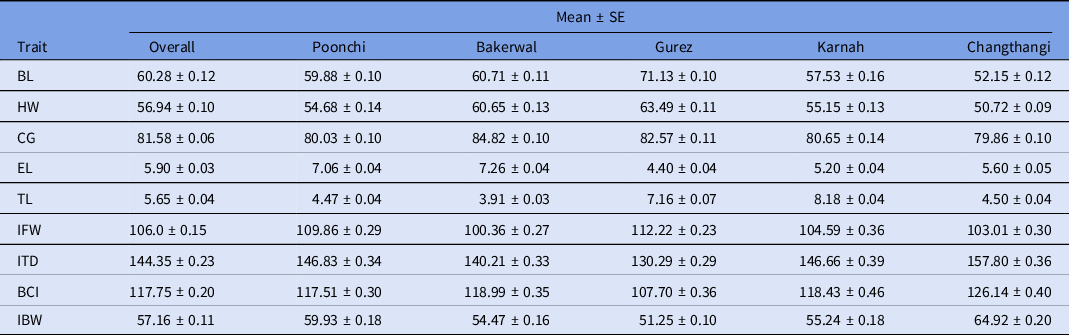
The descriptive statistics (arithmetic mean with standard error and coefficient of variation) pertaining to various morphometric (estimated and calculated) traits are summarized in Table 1. The mean BL ranged from 52.15 (Changthangi) to 71.13 (Gurez). Gurez sheep possessed the longest body among the five breeds under study. The estimates of HW, CG, EL and TL were highest in Gurez (63.49), Bakerwal (84.82), Bakerwal (7.26), and Karnah (8.18) breeds, respectively. HW, CG, EL, and TL estimates were lowest in Changthangi (50.72), Changthangi (79.86), Gurez (4.40), and Bakerwal (3.91), respectively.
Summary of morphometric traits and indices in five evaluated breeds

BCI: Baron–Crevat Index; BL: Body length; CG: Chest girth; EL: Ear length; HW: Height at withers; IBW: Index of body weight;IFW: Index of body frame; ITD: Index of thorax development; TL: Tail length.
Changthangi breed showed the lowest average estimates of BL, HW and CG, which might be the reason for its adaptation to a cold and hypoxic environment. The BL of Karnah (57.53) was similar to that reported for adult Rampur–Bushair sheep by Sankhyan et al., (Reference Sankhyan, Thakur, Katoch, Dogra and Thakur2017) while that of Gurez sheep (71.13) was similar to that reported for Kajali sheep breed of India in an earlier study by Mishra et al. (Reference Mishra, Vohra, Raja, Singh and Singh2017). A higher BL of 77.5 has earlier been reported for Madgyal sheep by Yadav et al. (Reference Yadav, Arora and Jain2016). Similarly, the average HW estimate of Gurez sheep was similar to that reported for Malpura sheep of India by Mehta et al. (Reference Mehta, Vij, Joshi, Sahai and Nivsarkar1995). The average HW estimate of Bakerwal breed was similar to that reported for the adult Rampur–Bushair by Sankhyan et al. (Reference Sankhyan, Thakur, Katoch, Dogra and Thakur2017).
The average CG estimates of Gurez (82.57) and Bakerwal (84.82) were comparable with those of Kajali and Madgyal sheep (Yadav et al., Reference Yadav, Arora and Jain2016; Mishra et al., Reference Mishra, Vohra, Raja, Singh and Singh2017). The average CG estimate of other breeds was higher than that reported for the Rampur–Bushair and Malpura sheep breeds (Mehta et al., Reference Mehta, Vij, Joshi, Sahai and Nivsarkar1995; Sankhyan et al., Reference Sankhyan, Thakur, Katoch, Dogra and Thakur2017). The average EL of five evaluated breeds, ranging from 4.40 to 7.26 was comparable with that reported earlier for Malpura sheep (Mehta et al., Reference Mehta, Vij, Joshi, Sahai and Nivsarkar1995). However, much larger estimates have been reported for other Indian sheep breeds, i.e. Rampur–Bushair, Kajali and Madgyal (Yadav et al., Reference Yadav, Arora and Jain2016; Mishra et al., Reference Mishra, Vohra, Raja, Singh and Singh2017; Sankhyan et al., Reference Sankhyan, Thakur, Katoch, Dogra and Thakur2017). The case was similar with the average TL estimate of five Himalayan breeds.
Among the derived traits, the highest IBF was observed in the Gurez breed with an estimate of 112.22. Morphometric indices are useful to describe the body proportions and conformation of breeds using linear traits. As per the standard classification based on IBF estimates, Poonchi (average IBF = 109.86), Gurez (average IBF = 112.22), Karnah (average IBF = 104.59) and Changthangi (average IBF = 103.01) breeds showed a rectangular body frame (or long line) with an estimate exceeding 103, while the Bakerwal breed (average IBF = 100.36) showed a square body frame (estimate less than 103 but higher than 97).
The overall average IBF estimate was 106.01 covering all breeds. All breeds except Gurez showed excellent development of the thorax with estimates of 146.83, 140.21, 146.66 and 157.80 for Poonchi, Bakerwal, Karnah and Changthangi breeds, respectively. The ITD estimate for Gurez breed was only 130.29. The highest ITD estimate for Changthangi goat was consistent with the needs of this breed to survive cold and hypoxic conditions in its breeding tract (Ladakh). The overall average for five breeds was 144.35. Based on BCI estimates, Changthangi was the strongest breed among the five sheep breeds with an average estimate of 126.14. The BCI estimate was lowest for the Gurez breed showing the lowest strength among studied breeds. The average IBW of different breeds ranged from 51.25 in Gurez to 64.92 in Changthangi sheep, with an overall average of 57.16.
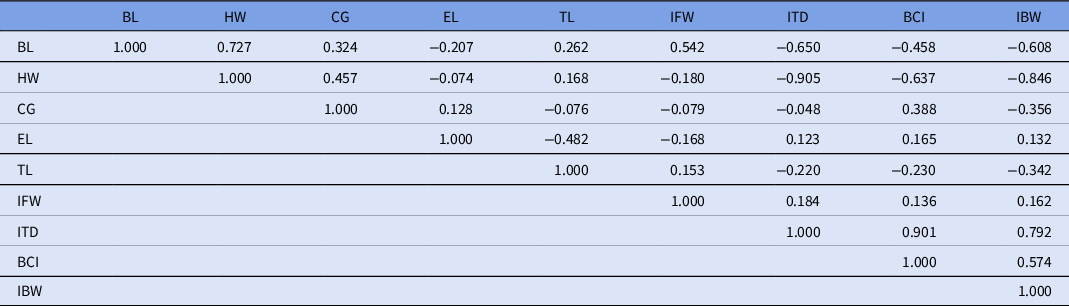
The total phenotypic correlation between different morphometric traits and indices is presented in Table 2. The highest positive correlation was found between ITD and BCI with an estimate of 0.901. Among the linear morphometric traits, the highest correlation was found between BL and height at withers (HW) with an estimate of 0.727. However, for linear morphometric traits, negative correlation estimates were recorded for BL-EL, HW-EL, CG-TL and EL–TL combinations (Table 2). Among positive-correlated linear morphometric traits, a high correlation (r > 0.40) was found for BL-HW and HW-CG combinations while it was moderate (0.20 > r < 0.40) for BL-CG and BL-TL combinations. All other positive-correlated traits had low estimates (0 > r < 0.20). All the correlations were found to be statistically significant (P < 0.01). The significant and moderate to high estimates of the phenotypic correlation between different morphometric traits suggested the need for PCA to reduce the dimensionality and convert the variables into orthogonal components. The traits showing positive correlation implied that these variables may be under similar genetic control, while different genes with probable antagonistic effects formed the basis of traits showing negative correlations (Semakula et al., Reference Semakula, Mutetikka, Kugonza and Mpairwe2010). Positive and negative correlation estimates may be implemented judiciously in indirect selection programmes for these breeds. Similar to our results, Yadav et al. (Reference Yadav, Arora and Jain2016) reported low correlation estimates for different combinations of TL and EL with other morphometric traits in Madgyal sheep. Lower estimates of the correlation of EL and TL with other morphometric traits have also been reported in Zulu sheep (Mavule et al., Reference Mavule, Muchenje, Bezuidenhout and Kunene2013). These traits are reported to be determined mainly by non-additive genetic effects, and any selection based on these traits may not lead to a significant genetic response in traits of economic importance.
Pearson’s correlation coefficient between morphometric traits and indices in evaluated breeds

BCI: Baron–Crevat Index; BL: Body length; CG: Chest girth; EL: Ear length; HW: Height at withers; IBW: Index of body weight; IFW: Index of body frame; ITD: Index of thorax development; TL: Tail length.
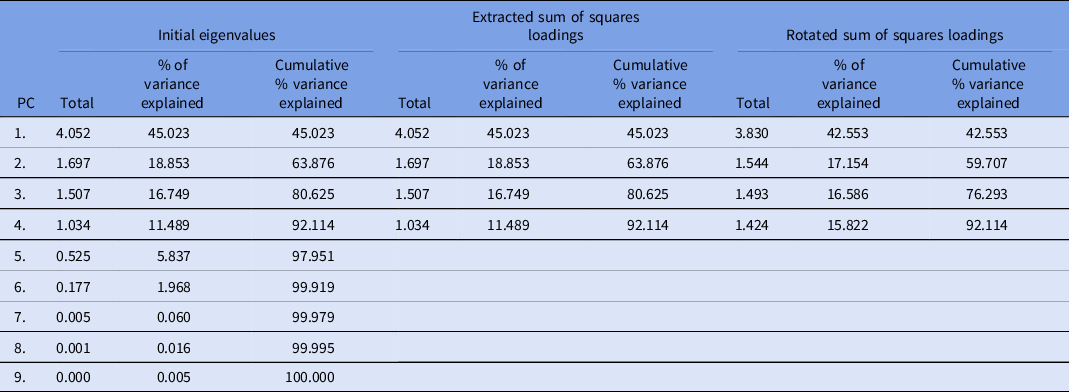
Total variance explained by different principal components, extracted and rotated components

Multivariate PCA-based analysis has been undertaken on morphometric traits in several species to understand the relationship between evaluated variables and principal components (PCs) and evaluate the contribution of each PC in explaining the total variance in original traits (Salako, Reference Salako2006; Yadav et al., Reference Yadav, Arora and Jain2016; Araújo de Melo et al., Reference Araújo de Melo, de Gusmão Couto, de Lima Silva, Hongyu, Teodózio de Araújo, Mesquita da Silva, Santos Rios, dos Santos and Fraga2020; Valsalan et al., Reference Valsalan, Sadan and Venketachalapathy2020). Upon multivariate PCA on the dataset, the first four principal components were able to explain 92.117% of the total phenotypic variance. The individual contributions of the first four PCs were 45.027%, 18.856%, 16.749% and 11.485% with eigenvalues of 4.052, 1.697, 1.507 and 1.034, respectively. The first three components explained 80.632% of the variance, whereas more than 90% of the variance was explained by the first four PCs in the evaluated traits. Only the first four components showed eigenvalues greater than one, indicating their usefulness in explaining the underlying variance in evaluated traits compared with original variances. These components were extracted for further analysis. Table 3 presents the eigenvalues, percentage variance explained and cumulative variances explained by different PCs of linear morphometric traits and indices. The first principal component (PC1) showed large loading of ITD (0.949), HW (0.940), IBW (0.890), BL (0.787) and BCI (0.776). Conversely, EL (0.680), IFW (0.645) and TL (0.604) showed a large contribution/loading to PC2. Similarly, CG (0.750), IFW (0.575) and BCI (0.557) contributed largely to the loading of PC3, while PC4 was largely loaded by IL (0.497), IFW (0.495) and EL (0.463). Bartlett’s test for adequacy of sampling showed a highly significant (chi-squared estimate of 58409.059, P < 0.001). The KMO measure of sampling adequacy was observed to be 0.559. This was concurrent with that of Kaiser (Reference Kaiser1974) who recommended an estimate of 0.5 and above for sample adequacy. Khargharia et al. (Reference Khargharia, Kadirvel, Kumar, Doley, Bharti and Das2015) reported KMO estimates ranging between 0.22 and 0.98 for different morphometric traits of Assam Hill goats. A KMO estimate of greater than 0.5 revealed that considerable variation in underlying traits was caused by PCs. Bartlett’s test revealed that the correlation matrix based on morphometric traits was significantly different from the identity matrix. It also showed the adequacy and suitability of data for factor analysis using PCA.
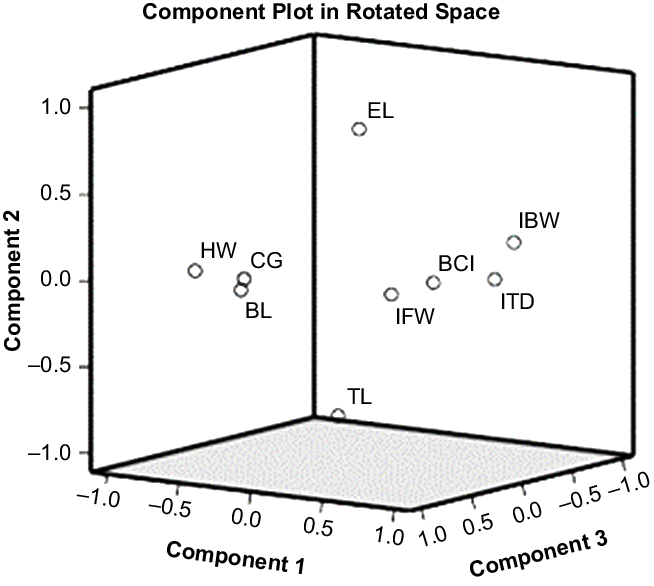
Upon 2D varimax rotation of PCs, the first three factors explained 76.295% of the total variance. When the first three rotated factors were plotted across components, four different clusters were formed, which stratified morphometric indices into one cluster (Fig. 1). Among linear morphometric traits, BL, CG and HW were clustered together. TL and EL traits were plotted separately and distant from each other and other clusters (Fig. 1). Most of the linear morphometric traits and indices showed high communality estimates, which indicated that underlying variance in these traits was shared between various variables. It also further stressed the usefulness of PCA on this dataset. Therefore, in breeding programmes for these sheep breeds, PCs with loadings from different traits can be used instead of using multiple traits individually (Yadav et al., Reference Yadav, Arora and Jain2016).
Component plot showing the distribution and clustering of different traits and indices in different planes.

In conclusion, the PCA technique explored the interdependence of the original morphometric traits and indices simultaneously rather than individually. Morphometric traits were highly correlated, except for EL and TL. The KMO test, Bartlett’s test of sphericity and estimated communalities showed the appropriateness of PCA on the evaluated traits. More than 90% of the total variance in evaluated traits was explained by the top four PCs. Morphometric traits (linear and indices) in the sheep breeds of the temperate Himalayas can be improved by loadings in top PCs. The study will be helpful in the selection of genetically elite animals, in developing sustainable breeding programmes to expedite genetic gains vis-a-viz sheep breeds of the temperate Himalayas.
Acknowledgements
The authors are thankful to sheep farmers for allowing us to measure the different body parameters from Bakerwal, Gurez, Karnah, Poonchi and Changthangi sheep. The authors are highly grateful to the Sheep Husbandry Department, Jammu, Kashmir and Ladakh for providing the help needed for the present study.
Funding
We are thankful to the Department of Biotechnology, Govt of India for providing financial support for the completion of the study under Project ‘Monoculturing of Exotic sheep breed in J&K: Impact Assessment using Molecular Markers for Conservation Genetics’.
Conflict of interest
None declared.