Introduction
Epidemiological studies have documented that the vast majority of community residents have experienced traumatic events but only a small minority of victims have developed post-traumatic stress disorder (PTSD) (Breslau et al. Reference Breslau, Davis, Andreski and Peterson1991, Reference Breslau, Kessler, Chilcoat, Schultz, Davis and Andreski1998, Reference Breslau, Wilcox, Storr, Lucia and Anthony2004; Kessler et al. Reference Kessler, Sonnega, Bromet, Hughes and Nelson1995, Reference Kessler, Berglund, Demler, Jin, Merikangas and Walters2005; Bowman & Yehuda, Reference Bowman, Yehuda and Rosen2004). These observations have highlighted the importance of predispositions: victims vary in their susceptibility to the PTSD response to traumatic experiences. A history of pre-existing disorders is among the most consistently documented predisposing risk factors of PTSD (Bromet et al. Reference Bromet, Sonnega and Kessler1998; Brewin et al. Reference Brewin, Andrews and Valentine2000; Breslau, Reference Breslau2002; Ozer et al. Reference Ozer, Best, Lipsey and Weiss2003; Bowman & Yehuda, Reference Bowman, Yehuda and Rosen2004; Koenen et al. Reference Koenen, Moffitt, Poulton, Martin and Caspi2007). Epidemiological surveys have also found that a considerable proportion of adults who experienced any trauma have experienced multiple traumas, and that adults with PTSD report elevated rates of prior traumas, especially during childhood (Resnick et al. Reference Resnick, Yehuda, Pitman and Foy1995; Breslau et al. Reference Breslau, Chilcoat, Kessler and Davis1999; Galea et al. Reference Galea, Ahem, Resnick, Kilpatrick, Bucuvalas, Gold and Vlahov2002; Berntsen et al. Reference Berntsen, Johannessen, Thomsen, Bertelsen, Hoyle and Rubin2012), compared with adult trauma victims who have not succumbed to PTSD. The finding has been interpreted as supporting a ‘sensitization’ process, in which early stressors produce greater responsiveness to subsequent stressors. An important limitation in this research is that it is based primarily on retrospective accounts by adult victims of trauma. Such retrospective reports could be biased by current PTSD or distress symptoms.
Biological models of ‘sensitization’ that connect childhood trauma, specifically childhood maltreatment, and adult PTSD have been proposed. Childhood maltreatment has been hypothesized to ‘recalibrate stress response systems to facilitate altered responses to subsequent exposure that result in risk for adult PTSD’ (Yehuda et al. Reference Yehuda, Flory, Pratchett, Buxbaum, Ising and Holsboer2010, p. 406). Related biological models, drawing on data from animal models and human correlational studies, have suggested that child abuse during ‘a critical period during which brain exposure to corticosterone affects learning’, when combined with genetic risk, ‘may lead to an amygdala-dependent emotional circuit, which is altered and always primed for stress responsiveness', leaving such persons at higher risk for stress-related psychopathology, such as PTSD or depression (Gillespie et al. Reference Gillespie, Phifer, Bradley and Ressler2009, p. 989). Although data from animal models are suggestive of the sensitization process, human studies lack both the prospective tests and biological data needed to support the proposed sensitization models.
Epidemiological studies have reported associations between childhood maltreatment and PTSD, as well as to other common psychiatric disorders (Bremner et al. Reference Bremner, Southwick, Johnson, Yehuda and Charney1993; McLaughlin et al. Reference McLaughlin, Green, Gruber, Sampson, Zaslavsky and Kessler2010). These studies, by and large, relied on cross-sectional design and retrospective accounts of maltreatment by adults. There are two exceptions. One study used prospectively ascertained records of child protection involvement as a proxy for maltreatment in a New Zealand population survey, and reported a significant effect of childhood maltreatment on adult PTSD (Scott et al. Reference Scott, Smith and Ellis2010). Another study used prospectively documented child abuse cases and reported that the association of abuse with lifetime PTSD was not significant, after it was adjusted for family problems (e.g. parental drug disorder, arrest), childhood behavior problems, and alcohol and drug disorders. Only the adjusted effect on PTSD symptoms was significant (Widom, Reference Widom1999). However, PTSD symptoms in themselves are diagnostically ambiguous and do not signify a distinct disorder; they characterize other anxiety disorders and depression and are used in the definition of these disorders. They are also common symptoms of non-specific distress (Breslau et al. Reference Breslau, Chase and Anthony2002; North et al. Reference North, Suris, Davis and Smith2009). What turns the list of non-specific symptoms into a DSM disorder is the specified configuration of symptoms and their connection with the traumatic event.
Concurrently, studies in developmental psychopathology have demonstrated the essential role of childhood disorders in adult disorders (Kim-Cohen et al. Reference Kim-Cohen, Caspi, Moffitt, Harrington, Milne and Poulton2003). Koenen et al. (Reference Koenen, Moffitt, Caspi, Gregory, Harrington and Poulton2008) traced the development of other mental disorders in adults with PTSD, using 30-year data from the Dunedin Multidisciplinary Health and Development Study (DMHDS) (childhood maltreatment was not examined). Nearly all the young adults with current and lifetime PTSD had met criteria for another mental disorder between the ages of 11 and 21; most disorders had onsets before age 15. In view of these findings, any theory that connects childhood maltreatment to adult PTSD needs to take into account the role of juvenile disorders in the etiology of adult PTSD.
In this study, using the DMHDS, we aimed to address two issues related to early antecedents of adult PTSD. (1) Does childhood maltreatment in the first decade of life predict PTSD following traumatic events occurring in adulthood? (2) Does history of juvenile disorder, independent of early childhood maltreatment, predict PTSD following exposure to trauma in adulthood? The study of Koenen et al. (Reference Koenen, Moffitt, Caspi, Gregory, Harrington and Poulton2008) did not evaluate the role of early childhood maltreatment in the relationship between juvenile disorders (ages 11–15) and adult PTSD. The absence of such an evaluation leaves the door open to the argument that the effects of juvenile disorders on the risk of adult PTSD might have been due, in large part, to earlier traumatic experiences, chiefly maltreatment. In this study, we examined this possibility.
Method
Participants were members of the DMHDS, a longitudinal investigation of the health and behavior of a complete cohort of children born during 1972–1973 in Dunedin, New Zealand. Perinatal data were obtained at delivery. When the children were later traced for follow-up at age 31, 1037 individuals (91% of eligible births) participated in the assessment, forming the base sample for the longitudinal study. Cohort members represent the full range of socio-economic status (SES) in the general population of New Zealand's South Island and are primarily white.
The Dunedin sample was assessed at ages 3, 5, 7, 9, 11, 13, 15, 18, 21, 26, 32 and 38 years, when 964 participants (96% of living cohort members) participated. The analysis reported here is on 928 participants with complete data on all relevant variables. The research procedure involved bringing four study members per day (including emigrants living overseas) to the research unit for a full 8-h day of tightly scheduled individual interviews and tests. Each research topic was presented, in private, as a standardized module by a different trained examiner in counterbalanced order throughout the day. The study protocol was approved by the institutional ethical review boards of the participating universities. After a complete description of the study, written informed consent was obtained.
Measurement of key variables
Childhood maltreatment in the first decade of life was based on assessment of: (1) staff-observed maternal rejection at age 3 years; (2) parent-reported harsh discipline at ages 7 and 9; parents scoring in the top decile of the distribution were classified as unusually harsh; (3) two or more changes in the child's primary caregiver up to age 11; (4) exposure to physical abuse prior to age 11, retrospectively reported by study members at the age-26 assessment; and (5) exposure to sexual abuse prior to age 11, retrospectively reported by study members at the age-26 assessment. The measurement of maltreatment was described previously by Caspi et al. (Reference Caspi, McClay, Moffitt, Mill, Martin, Craig, Taylor and Poulton2002). A cumulative exposure score was calculated for each child by counting the number of maltreatment indicators (from 0 to 5) and children were classified on an ordinal scale: no maltreatment (zero indicators, coded 0), moderate maltreatment (one indicator, coded 1) and severe maltreatment (two to five indicators, coded 2). In the sample analyzed in this study (n = 928), 64.3% experienced no maltreatment, 27.2% experienced one indicator of maltreatment and 8.5% experienced two to five indicators of maltreatment. This distribution reflects closely the distribution of categories of childhood maltreatment reported for the entire sample (Caspi et al. Reference Caspi, McClay, Moffitt, Mill, Martin, Craig, Taylor and Poulton2002).
Juvenile psychiatric disorders were assessed in private standardized interviews, using the Diagnostic Interview Schedule for Children (DISC; Costello et al. Reference Costello, Edelbrock, Kalas, Kessler and Klaric1982) at ages 11, 13 and 15. Interviews were conducted by experienced clinicians who had tertiary degrees in social work, medicine and clinical psychology and were blind to study members' psychiatric history. Modifications, procedures, reliability, validity, prevalence and evidence of impairment have been described in detail at ages 11 (Anderson et al. Reference Anderson, Williams, McGee and Silva1987), 13 (Frost et al. Reference Frost, Moffitt and McGee1989) and 15 (McGee et al. Reference McGee, Feehan, Williams, Partridge, Silva and Kelly1990). Juvenile psychiatric diagnoses using assessments from 11 to 15 years of age include the following four disorder categories: anxiety disorders, depressive disorders, conduct disorders (including oppositional defiant disorder at 11 and 13 years of age), and attention deficit hyperactivity disorder (ADHD). In the current study we defined juvenile disorders as any disorder versus no disorder. In the sample analyzed in this study (n = 928), 35.0% had one or more juvenile disorders between 11 and 15 years of age.
To determine SES, children's social class origins (i.e. their parents' social class) were measured on a scale that places occupations into one of six categories (from 1 = professional to 6 = unskilled laborer), based on education and income associated with that occupation using data from the New Zealand census (Elley & Irving, Reference Elley and Irving1976). The higher of either parent's occupation was averaged across the multiple childhood assessments up to age 15 and standardized to a score with mean = 0 and standard deviation = 1.
PTSD was assessed using a modified version of the Diagnostic Interview Schedule for DSM-IV (DIS-IV; Robins et al. Reference Robins, Cottler, Bucholz and Compton1995). PTSD was assessed for the first time at age 26, when lifetime history was assessed. The lifetime prevalence of PTSD in the cohort at age 26 years was 9.6% (n = 93; 11.8% for women, 7.6% for men), which is very similar to estimates based on epidemiological studies of adults in the USA (Kessler et al. Reference Kessler, Sonnega, Bromet, Hughes and Nelson1995; Breslau et al. Reference Breslau, Kessler, Chilcoat, Schultz, Davis and Andreski1998; Roberts et al. Reference Roberts, Gilman, Breslau, Breslau and Koenen2011). The lifetime PTSD data up to age 26 have been reported previously (Koenen et al. Reference Koenen, Moffitt, Poulton, Martin and Caspi2007, Reference Koenen, Moffitt, Caspi, Gregory, Harrington and Poulton2008) and are not used in this report. To maintain measurement separation between participants' reports of child physical and sexual abuse, given at age 26, and PTSD risk, we used as outcomes only traumatic events and PTSD occurring after age 26.
At age 32, participants were asked whether they had experienced traumatic events since they were aged 26. Recall for the years between ages 26 and 32 was enhanced by using the life history calendar method (Belli et al. Reference Belli, Shay and Stafford2001). Those who endorsed such an experience were then evaluated for PTSD. Participants who had more than one traumatic event since age 26 were asked to designate their worst event (‘the one that affected them the most’), get that experience clear in their minds, and answer PTSD diagnostic questions in relation to that experience. At age 38, the same procedure was repeated, covering the interval period between ages 32 and 38. Data on PTSD from the assessment at age 32 were combined with those from the assessment at age 38 to yield cumulative cases of PTSD during the 12-year interval from age 26 to age 38. The types of worst events experienced by participants from age 26 to age 32 were reported previously (Koenen et al. Reference Koenen, Moffitt, Caspi, Gregory, Harrington and Poulton2008). The same distribution pattern was maintained when events experienced from age 32 to 36 were added. The most frequent ones were unexpected death of a close relative/friend, witnessing/learning about assault/injury to a close friend/relative, assault, life-threatening illness and serious accidents. Participants received a PTSD diagnosis if they met the B, C, D, E and F criteria for PTSD, according to DSM-IV.
Statistical analysis
Analyses were conducted on the subset with complete data on exposure to traumatic events and PTSD for the period from age 26 to age 38 (n = 928). Our interest was in PTSD cases resulting from traumatic events experienced during a defined period in adulthood, uncontaminated by the predictors childhood maltreatment (ages 3–11 years) and juvenile disorders (ages 11–15 years). We include all PTSD cases among participants who experienced traumatic events during the 12-year period from age 26 to 38.
Three sets of logistic regressions were used to test and estimate the effect of childhood maltreatment and juvenile disorders on trauma and PTSD in adulthood. The first model estimated the effect of childhood maltreatment on trauma exposure and, among the trauma exposed, on PTSD. The second model estimated the effect for juvenile disorders. The third model estimated the effects of juvenile disorders and maltreatment simultaneously; it addressed the question of whether the effect of juvenile disorders on adult PTSD was independent of earlier maltreatment. All models adjust statistically for sex and SES. We tested the interaction between childhood maltreatment and any juvenile disorder but did not detect any interaction at α < 0.10.
In the logistic regressions, we used two dummy indicator variables (1 v. 0 and 2 v. 0) to represent the three maltreatment groups: 0 = zero maltreatment indicators; 1 = one maltreatment indicator; 2 = 2–5 maltreatment indicators (Caspi et al. Reference Caspi, McClay, Moffitt, Mill, Martin, Craig, Taylor and Poulton2002). Given the ordinal nature of measurement, we did not deem it appropriate to impose a linearity assumption and treat maltreatment as a continuous, interval variable. Had we done so, it would have been all too easy to extrapolate findings beyond the support of the data. The use of two indicator variables in regressions, as we have done, does not force any particular metric or distance between levels.
Results
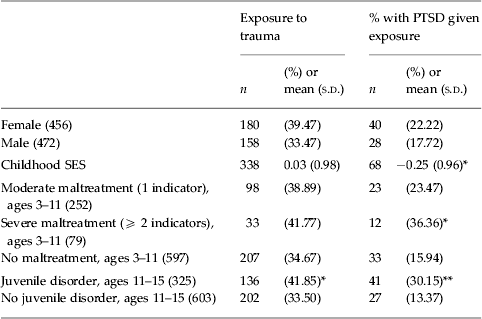
During the 12-year interval period between ages 26 and 38 years, 338 (36.4%) study members experienced traumatic events. Of these 338 participants, 68 (20.1%) met criteria for PTSD. Table 1 presents the percentages of the sample exposed to trauma between ages 26 and 38 and the percentages of PTSD among those who were exposed, according to sex, SES, history of maltreatment and history of juvenile disorders. χ 2 tests were used to test the statistical significance of percentage differences across strata of sex, maltreatment and juvenile disorders, and the t test was used for SES. Exposure to traumatic events did not differ significantly by sex, SES or history of childhood maltreatment. Exposure to traumatic events was significantly higher among those who had been diagnosed with juvenile disorders than those who had not. The percentages of PTSD following exposure did not differ significantly between sexes. They were higher among those with lower SES. The percentages of PTSD differed significantly across the three maltreatment groups. Further testing showed that the percentage with PTSD was significantly higher among persons who experienced severe maltreatment, but not among persons who experienced moderate maltreatment, relative to persons who experienced no maltreatment (p = 0.005 and p = 0.113 respectively). The percentage of PTSD was higher among participants with a history of juvenile disorders than those without.
Descriptive data on exposure to trauma and conditional probability of PTSD from age 26 to age 38 years (n = 928)

PTSD, Post-traumatic stress disorder; SES, socio-economic status; s.d., standard deviation.
* p < 0.05, ** p < 0.005.
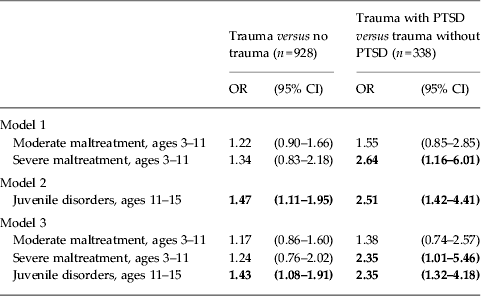
Table 2 presents the results of the three regression models, estimating the influence on trauma exposure and PTSD experienced between ages 26 and 38 of childhood maltreatment (model 1), juvenile disorders (model 2) and juvenile disorders adjusted statistically for earlier maltreatment (model 3).
Results from logistic regressions of trauma exposure and PTSD from age 26 to 38 years predicted by childhood maltreatment (ages 3–11) and juvenile disorders (ages 11–15) (n = 928)

PTSD, Post-traumatic stress disorder; OR, odds ratio; CI, confidence interval.
Moderate maltreatment: 1 indicator; severe maltreatment: ⩾2 indicators.
ORs with 95% CIs that do not include the null value of 1 are significant at α = 0.05 (bolded).
All models are adjusted for sex and socio-economic status (SES).
We describe first the results for PTSD, our core research question. For the null hypothesis that the effects of moderate and severe maltreatment on PTSD among those exposed to adult trauma are simultaneously equal to zero, χ 2 = 5.90 (df = 2, p = 0.052), indicating that the overall effect of maltreatment (at least one of the two categories) is significantly different from zero and that we can proceed to test each category separately.
The results of model 1 show that severe maltreatment, but not moderate maltreatment, predicted PTSD significantly among trauma-exposed persons, compared to no maltreatment [odds ratio (OR) associated with severe maltreatment 2.64, 95% confidence interval (CI) 1.16–6.01; OR associated with moderate maltreatment 1.55, 95% CI 0.85–2.85]. However, to conclude that only severe maltreatment distinctly predicts adult PTSD, it is not enough to find that severe maltreatment differs significantly from no maltreatment, as we do in model 1, it is also necessary to find that severe maltreatment differs significantly from moderate maltreatment. A test of that difference failed to reject the null hypothesis of no difference between the two levels of maltreatment on PTSD (z = 1.19, p = 0.232). Although our findings support the conclusion that severe maltreatment predicted PTSD response to adult trauma (compared to no maltreatment), they leave the question of moderate maltreatment unanswered. Moderate maltreatment was found to be indistinguishable from no maltreatment, but failed to be distinguished from severe maltreatment.
The results of model 2 show that juvenile disorders predicted a significantly increased risk of PTSD response to adult trauma. Model 3, designed to evaluate the independent effect of juvenile disorders from earlier maltreatment, included both childhood maltreatment during the first decade of life and juvenile disorders between ages 11 and 15. The results show that juvenile disorders, independent of earlier maltreatment, predicted the risk of PTSD response to adult trauma significantly (OR 2.35, 95% CI 1.32–4.18). (Note that model 3 does not inform about the maltreatment–PTSD relationship because history of juvenile disorder at age 11 to15 is theoretically and temporally on the pathway between maltreatment during the first decade of life and adult PTSD.)
The results on exposure to adult trauma (Table 2) show that juvenile disorders predicted risk of exposure to traumatic events. Although significant, the estimate was low (OR 1.43, 95% CI 1.08–1.91). Childhood maltreatment bore no significant relationship to exposure to trauma in adulthood.
Discussion
‘Sensitization’ to the PTSD response to stress: previous research
The concept of ‘sensitization’ was initially proposed in the context of the ‘kindling’ effect in recurrent depressive episodes in relation to stressful experiences. Post (Reference Post1992) proposed that depressive episodes cause neurological changes that render patients susceptible to developing subsequent episodes in response to lesser stress, compared to the stress that precipitated the first episode. This model was extended from depressive episodes to stressful life events as the cause that alters biologically the psychiatric response to subsequent stressors, including the PTSD response to trauma (Post & Weiss, Reference Post and Weiss1998). Current ‘sensitization’ models, which concern themselves exclusively with early childhood stressors, especially child abuse, represent a shift from the initial general models, in which age at the prior ‘sensitizing’ experiences was unspecified. As we studied maltreatment in childhood, it is worth mentioning results on prior trauma reported by Ozer et al. (Reference Ozer, Best, Lipsey and Weiss2003) from a comprehensive meta-analysis of risk factors for PTSD. The authors found a statistically significant but small average effect size (r = 0.17) for history of prior trauma. The subgroup of studies with prior trauma occurring in childhood (13 of the 23 studies included in the analysis) had an average effect size identical to the overall analysis. The authors concluded that ‘in general, prior childhood trauma imparts no greater risk than prior adult trauma’ (Ozer et al. Reference Ozer, Best, Lipsey and Weiss2003, p. 57).
Theoretical models of the ‘sensitizing’ effect of child abuse (or childhood maltreatment) on the PTSD response to adult trauma have not been substantiated by longitudinal data. A causal link and a biological mechanism have not been empirically established. The two prospective studies of childhood maltreatment and adult PTSD came to disparate conclusions (Widom, Reference Widom1999; Scott et al. Reference Scott, Smith and Ellis2010). The first reported no significant effect on PTSD (Widom, Reference Widom1999) and the second reported a statistically significant effect (Scott et al. Reference Scott, Smith and Ellis2010).
Summary of key findings
Using prospective data from a longitudinal birth cohort study, we evaluated the effect of childhood maltreatment on the PTSD response to traumatic events occurring during a period of 12 years in adulthood. We found support for that effect among adult trauma victims with a history of severe maltreatment, but failed to find unequivocally that moderate maltreatment had an effect on adult PTSD. Juvenile disorders, any disorder versus none, age between 11 and 15 years, independent of childhood maltreatment in the first decade of life, increased significantly the risk of PTSD in response to trauma during the same time period.
In this study, the ‘sensitizing’ effect of childhood maltreatment on the PTSD response to trauma in adulthood was statistically significant only for the high end of the distribution of childhood maltreatment, that is the top 24% with two or more indicators of maltreatment (79 of the total 331 who were maltreated in childhood). Less severe maltreatment, which characterized the majority of adults who were maltreated as children, was not statistically distinguishable from no childhood maltreatment. Although the effects of moderate and severe maltreatment on PTSD response to adult trauma were not statistically significantly different in our study, we do not recommend combining the two categories into one because it would mask the distinct effect of severe maltreatment observed in this study. Previous reports from the Dunedin study have also found evidence of associations with some adult physical outcomes only for severe maltreatment (e.g. Danese et al. Reference Danese, Pariante, Caspi, Taylor and Poulton2007, Table 2).
A comparison between our study and the two previous prospective studies (Widom, Reference Widom1999; Scott et al. Reference Scott, Smith and Ellis2010) on the maltreatment–PTSD relationship is hampered by substantial differences in the measurement of childhood maltreatment. The New Zealand study by Scott et al. (Reference Scott, Smith and Ellis2010) used agency records of child protective services as a proxy for childhood maltreatment (yes/no), and Widom (Reference Widom1999) used court records of child abuse. The former reported a significant effect whereas the latter failed to find a significant effect. The question of severity of maltreatment was not addressed in either study. Furthermore, both studies reported lifetime PTSD, irrespective of the temporal order between childhood maltreatment and the trauma that caused PTSD. Our study has an important methodological advantage in that there is a clear temporal order among the key variables, childhood maltreatment and juvenile disorders (the predictors), and adult trauma and PTSD.
Juvenile disorders predicted an increased risk of PTSD response to trauma, a finding consistent with previous studies and meta-analyses on history of pre-existing disorders as predisposition for PTSD (Ozer et al. Reference Ozer, Best, Lipsey and Weiss2003; Breslau et al. Reference Breslau, Troost, Bohnert and Luo2013) and the few prospective studies on this question. Breslau et al. (Reference Breslau, Lucia and Alvarado2006) and Storr et al. (Reference Storr, Ialongo, Anthony and Breslau2007) reported that anxiety disorders and emotional problems at the start of schooling increased the PTSD risk in late adolescence and early adulthood. Koenen et al. (Reference Koenen, Moffitt, Poulton, Martin and Caspi2007) identified early externalizing behavior and difficult temperament as risks of adult PTSD. The relationship between pre-existing psychiatric disorders, especially those with juvenile onset, and adult PTSD in the Dunedin longitudinal cohort was demonstrated in a previous report (Koenen et al. Reference Koenen, Moffitt, Caspi, Gregory, Harrington and Poulton2008). None of these studies evaluated the influence of juvenile disorders simultaneously with childhood maltreatment. In the absence of such an evaluation, the possibility that the essential role of juvenile disorders in adult PTSD was largely due to early maltreatment could not be ruled out. Our analysis, which simultaneously considers childhood maltreatment in the first decade of life and juvenile disorders during the subsequent 5 years, rules out that possibility. We show that juvenile disorders, independent of childhood maltreatment, increase the PTSD risk in adulthood.
Limitations
Several limitations should be noted. First, information on child physical and sexual abuse, two of the five indicators of childhood maltreatment, was gathered from the participants retrospectively when they were 26 years of age. Although our analysis examined PTSD in relation to events occurring subsequently, from age 26 to age 38 years, the retrospective reports by adults of child physical and sexual abuse might cast suspicion that these indicators could be influenced by adult perspectives and experiences tied to the subsequent reporting of trauma and PTSD.
Second, the measurement of childhood maltreatment combines heterogeneous indicators. One of the three indicators assessed before age 11 (i.e. at least two changes in primary care givers) is not always an appropriate proxy of childhood maltreatment. Its inclusion as an indicator of maltreatment broadens the concept to signify adverse childhood rearing environment with wide-ranging consequences for development (see references in Caspi et al. Reference Caspi, McClay, Moffitt, Mill, Martin, Craig, Taylor and Poulton2002 supporting online material). On the other hand, the measure does not include child neglect, an aspect of maltreatment as defined in the current literature.
Third, the Dunedin cohort study is one of few longitudinal studies providing detailed information on developmental psychopathology from birth to adulthood. However, the size of the cohort, although relatively large for an intensive longitudinal assessment, does limit the questions that can be interrogated. Thus, sample size precludes an unequivocal answer concerning the status of moderate maltreatment in predicting adult PTSD, as suggested earlier. Sample size also rules out an inquiry of PTSD by number of traumas and trauma type. It might be the case that participants with a history of juvenile disorders experienced more severe traumas involving personal violence, which might in part explain their higher risk of PTSD. It also rules out an investigation of the role of specific juvenile disorders in the PTSD response to adult trauma. In addition, the limited sample size precludes attempts to disentangle the specific effect of childhood maltreatment from the context of family pathology (e.g. parental conflict, domestic violence, parental mental illness) in which it occurs. Finally, it is likely that some common causes of maltreatment or juvenile disorders, on one hand, and exposure to trauma or PTSD, on the other, are omitted in this study. A strategy to examine the robustness of our findings would be to carry out a sensitivity analysis along the line of Rosenbaum & Rubin (Reference Rosenbaum and Rubin1983). However, as the number of persons exposed to trauma in the severe maltreatment group is only 33, and there is limited information at baseline to allow us to find good matches for them, it is unlikely that this would be a strong strategy here. Although we are interested in causal inferences, interpretation of the findings should proceed with caution, given the possibility of lack of complete control of confounders.
A fine-grained analysis must wait for data from larger birth cohorts followed up as intensively as our cohort has been. The contribution of this study is the simultaneous analysis of maltreatment and juvenile disorders assessed in a clear temporal order between them and in relation to adult traumatic events and PTSD.
The generalizability of the findings is limited by the geographic boundaries of the sample and, more importantly, by the age range of the adults during the years in which information on exposure to traumatic events and PTSD were analyzed. The time period between ages 26 and 38 fulfilled our primary methodological objective of clearly separating the childhood predictors from the hypothesized adult outcomes. It is thus an unbiased sample of time, uncontaminated by the hypothesized childhood etiological events and the reporting of such events. The inquiry of traumatic events and PTSD up to age 26 years was collected retrospectively and thus was not used in the analysis. Future research would be illuminating if it covered that age range as well.
Conclusions
Numerous studies have reported that history of childhood maltreatment increases risk of PTSD response to adult trauma. We found clear support only for severe maltreatment, experienced by a minority of adults who had suffered childhood maltreatment. Larger longitudinal studies are needed to resolve the status of moderate maltreatment as a risk factor for adult PTSD, which in this study was equivocal. Furthermore, our study confirmed that juvenile disorders, independent of childhood maltreatment, are important predispositions for PTSD response to adult trauma.
Acknowledgments
We thank the Dunedin Study members, Unit research staff, and Study founder P. Silva. The Dunedin Multidisciplinary Health and Development Research Unit is supported by the New Zealand Health Research Council. This research received support from National Institute of Mental Health (NIMH) Psychiatric Epidemiology Training Grant T32MH017119 (J.A.B., S.S.), NIMH R01 MH093612 (K.C.K.), UK Medical Research Council grant G0601483 (T.E.M.), and US National Institute of Aging grant AG032282 (T.E.M.). T.E.M. had full access to all of the data in the study and takes responsibility for the integrity of the data and the accuracy of the data analysis.
Declaration of Interest
None.