Introduction
Out-of-hospital cardiac arrest (OHCA) has a high mortality rate unless early Basic Life Support (BLS) is initiated by bystanders. Reference Berdowski, Berg, Tijssen and Koster1 Approximately 55/100,000 OHCA cases occur annually in Europe and America, and less than 10% of them survive. Reference Rea, Eisenberg, Sinibaldi and White2,Reference Vaillancourt and Stiell3 It has been shown that immediate initiation of BLS decreases morbidity and mortality of OHCA patients. Reference Hasselqvist-Ax, Riva and Herlitz4,Reference Holmberg, Holmberg and Herlitz5 Despite this information, the rate of early BLS application is low in most countries. Reference Breckwoldt, Schloesser and Arntz6–Reference Hamasu, Morimoto and Kuramoto8 Thus, BLS training for the public is important to increase the rate of BLS application in OHCA. Reference Hamasu, Morimoto and Kuramoto8 Trainers for public BLS education are usually medical staff, and medical staff usually cannot cover the extortionate need of the whole population.
It is easy and effective to educate children on BLS through the community. In 2011, the American Heart Association (AHA; Dallas, Texas USA) issued a statement suggesting that BLS training is compulsory for school children. Reference Cave, Aufderheide and Beeson9 Higher resuscitation rate and survival rate after OHCA were reported by the countries that integrated the BLS training to their education programs. Reference Wissenberg, Lippert and Folke10 Pre-adolescent children are open and enthusiastic for BLS training. It has been shown that only two hours of training per year is sufficient to learn BLS. Reference Bottiger and Van Aken11 There is no definite specification about which age group should be educated, but there are publications showing that the 12-20 age group is more suitable for learning cardiac compression. Reference Lubrano, Romero and Scoppi12,Reference Naqvi, Siddiqi, Hussain, Batool and Arshad13 Providing BLS training to school children is also important because they have the opportunity to teach what they learn to their parents, siblings, and grandparents at home. In this way, many people can be reached at the same time. Reference Bottiger, Bossaert and Castren14
The method that the students help each other and learn by teaching is called the “peer education model.” In a previous study, high school teachers trained as instructors; this model was found to be successful for high school BLS education. Reference Lukas, Van Aken and Molhoff15
In this study, the authors aimed to test the effectiveness of the peer education method on the learning and application of BLS in high school students. They also aimed to test the effectiveness of the peer education model on the BLS instructor training. The success of the peer education model for BLS may eventually arise a possibility of BLS coverage for the whole community.
Method
Hacettepe University (Ankara, Turkey) Ethical Committee approved the study (GO 19/454). The study was conducted in high school, and grade one students were included in the study. Informed consent was obtained from the students and their families for participation in BLS training. A meeting was held with the teachers and school administrators before the study. It was decided to use the peer education model for BLS training. Education content was prepared by using European Resuscitation Council (Niel, Belgium) 2015 BLS Guidelines. Reference Perkins, Handley and Koster16 Slides, videos, and summary information were prepared for use in training. Special abbreviations were used to help students remember the application steps easily. The training consisted of one hour of theoretical and one hour of practical training on resuscitation mannequins.
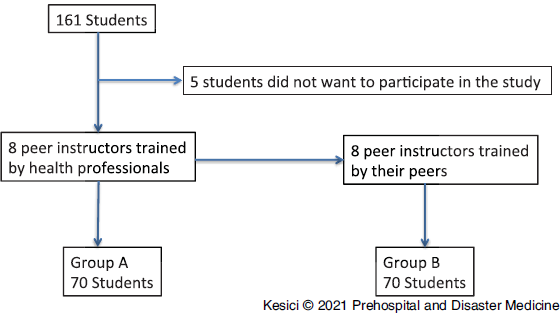
Students were randomized in two groups (Group A and Group B). At the beginning of the study, pediatric emergency and pediatric intensive care physicians trained eight students in Group A. After the training, the success of these students was assessed by practical exam. Subsequently, these eight students were given BLS instructor training. Afterwards, these students trained eight students in Group B with the same method, and those eight students in Group B became instructors (Figure 1).
The Distribution of Peers to the Groups.

The instructor students trained the rest of the students with approximately nine students per instructor. A physician and a teacher supervised every training session. A training session was not intervened unless there was wrong information transferred or unanswered question by instructor students. Physicians evaluated the instructors and noted if an intervention was made during the training session.
Pre- and post-training awareness and knowledge tests were applied to measure the awareness and knowledge of all students. Students’ success in applying BLS steps was evaluated by a practical exam that was coordinated by physicians using a checklist.
Statistical Analysis
To estimate the number of students, the authors performed a sample size calculation. The sample size was calculated as 117 for α = 0.05 and β-1= 80%, and effect size = 0.331. Indeed, 59 students were needed in each group, but by anticipating drop-outs, sample size was increased to 80 students in each group.
Data were analyzed using the SPSS version 21 program (Statistical Package for Social Sciences v.21; IBM Corp.; Armonk, New York USA). As descriptive statistics, the number and the percentage of the students were given. Pearson Chi-Square test and Fisher’s exact test were used, where appropriate, to investigate the association between categorical variables. Two-sided P values <.05 were considered statistically significant.
Results
One hundred fifty-six of 161 high school grade one students were included in the study. All of the students were 14 years old. There were 78 students in Group A and 78 students in Group B.
Questionnaire about BLS Awareness
A pre-training BLS awareness questionnaire was filled out by 73 students in Group A and 78 students in Group B. The pre-awareness questionnaire revealed that 48 students (65.7%) in Group A and 40 students (51.2%) in Group B had heard about BLS. Forty-four students (62.8%) in Group A and 40 students (51.2%) in Group B specified that they frequently used internet for research. Sixteen students (21.9%) in Group A and seven students (8.9%) in Group B previously attended BLS training. Forty-two students (58.3%) in Group A and 32 students (41.0%) in Group B had seen BLS application. The number of students that had witnessed BLS application were 19 (26.0%) and 12 (15.3%) in Group A and Group B, respectively. Nine (12.3%) students in Group A and eight students (10.2%) in Group B took an active role during BLS application.
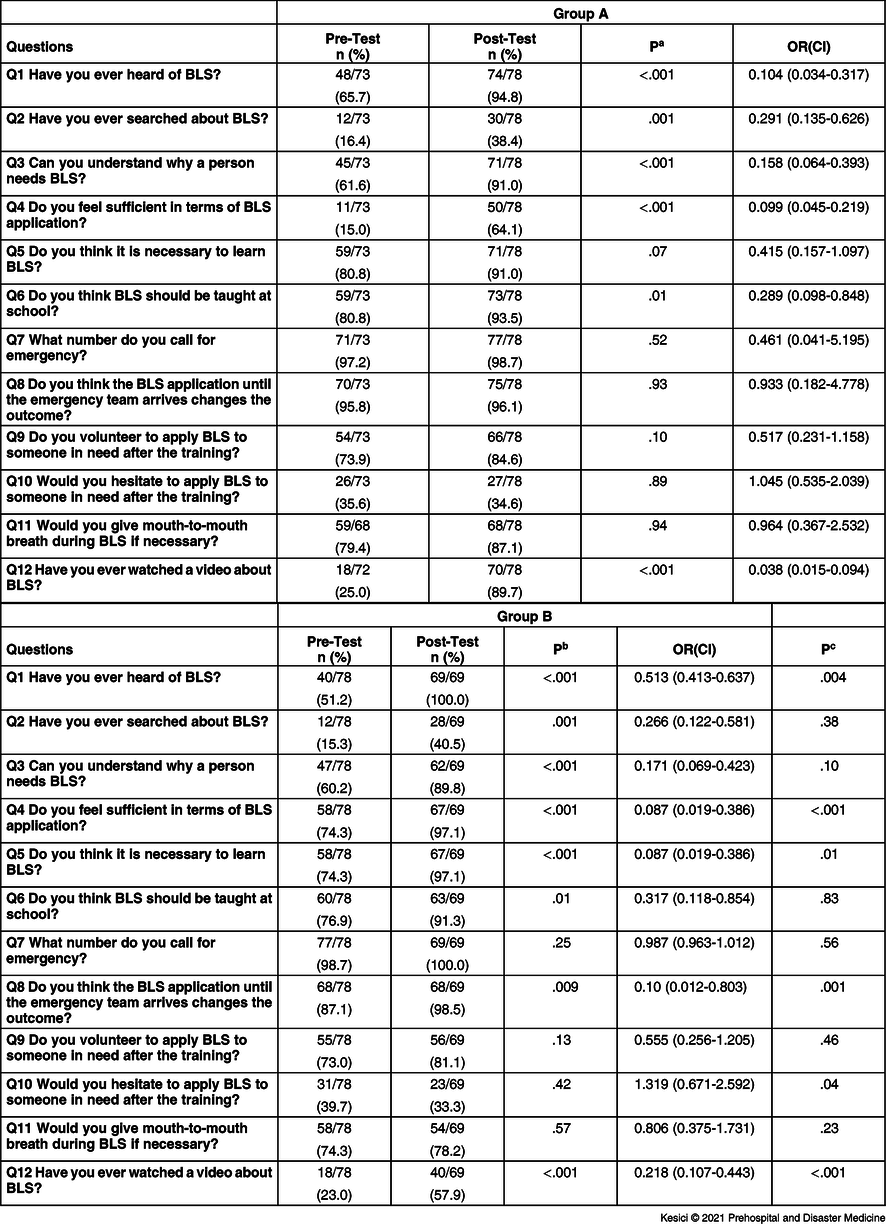
The questions included in the pre- and post-training awareness questionnaires and differences between pre- and post-training tests in both groups, as well as comparison of improvement between groups, are shown in Table 1.
Results of Pre- and Post-Training Awareness Questionnaire

Abbreviation: BLS, Basic Life Support.
a Difference between pre- and post-training in Group A.
b Difference between pre- and post-training in Group B.
c Comparison of improvement between groups.
In the post-training awareness questionnaire, significant improvement was determined in terms of BLS hearing, understanding of BLS need, feeling sufficient to apply BLS, giving BLS training in schools, and watching videos about BLS (Table 1).
In Group A, 26 students in the pre-training questionnaire and 27 students in the post-training questionnaire specified that they would hesitate to apply BLS (Q10; Table 1). In Group B, 31 students in the pre-training questionnaire and 23 students in the post-training questionnaire specified that they would hesitate to apply BLS (Q10; Table 1). Reasons of hesitation were fear of giving damage (Group A: pre-test 20 students, post-test 21 students; Group B: pre-test 22 students, post-test 17 students); fear of wrong application (Group A: pre-test 17 students, post-test 19 students; Group B: pre-test 31 students, post-test 12 students); fear of infection (Group A: pre-test 2 students, post-test 3 students; Group B: pre-test 9 students, post-test 2 students); and embarrassment (Group A: pre-test 5 students, post-test 6 students; Group B: pre-test 6 students, post-test 6 students).
In Group A, nine students in pre-training questionnaire and ten students in post-training questionnaire specified that they would not give mouth-to-mouth breath during BLS if necessary (Q11; Table 1). In Group B, 20 students in the pre-training questionnaire and 15 students in the post-training questionnaire specified that they would not give mouth-to-mouth breath during BLS if necessary (Q11; Table 1). Reasons for not giving mouth-to-mouth breath were fear of infection (Group A: pre-test 4 students, post-test 7 students; Group B: pre-test 9 students, post-test 6 students); embarrassment (Group A: pre-test 4 students, post-test 7 students; Group B: pre-test 3 students, post-test 2 students); and finding disgusting (Group A: pre-test 5 students, post-test 3 students; Group B: pre-test 11 students, post-test 10 students).
Knowledge Test
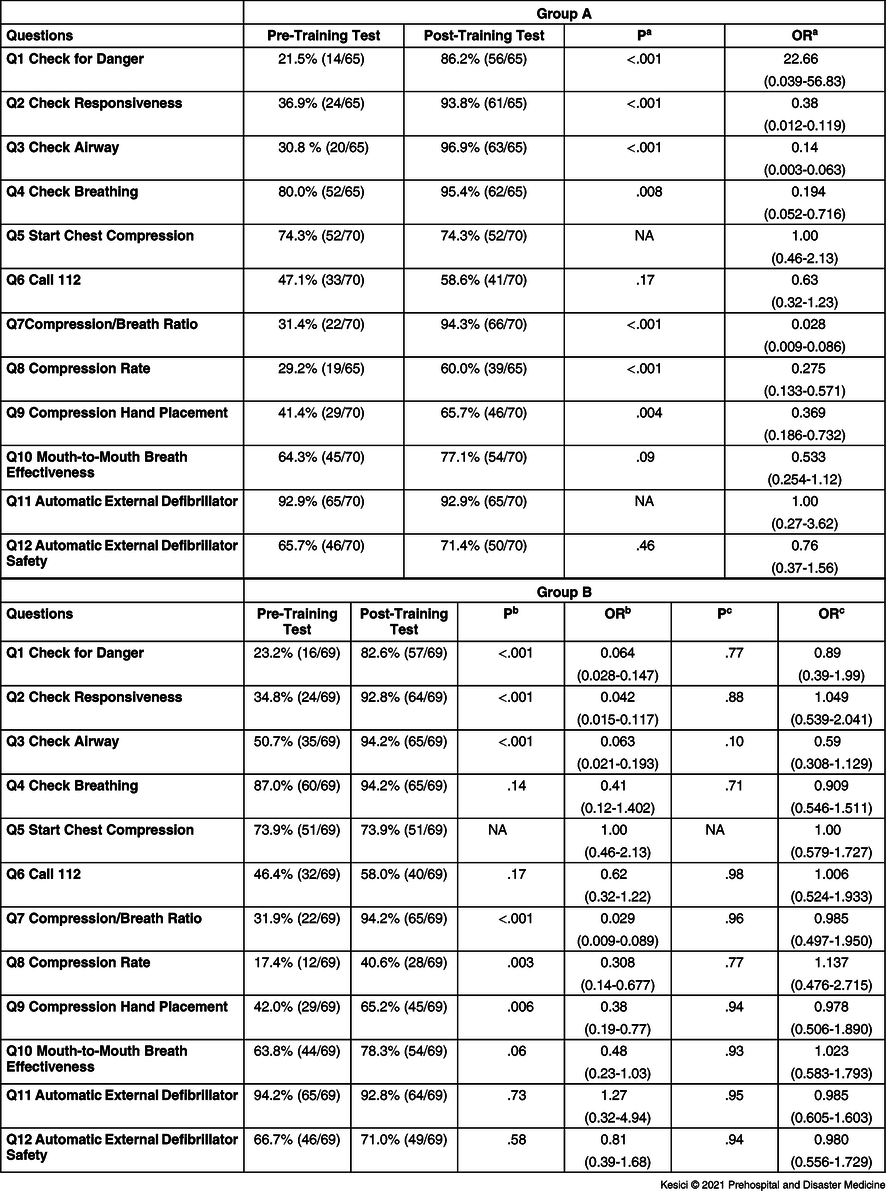
There was a statistically significant improvement in seven questions from twelve questions between the pre- and post-training knowledge tests (P <.05; Table 2). Students were able to give true answers regarding environmental safety, control of the airway and respiration, 30:2 chest compressions, 100 times chest compression, and the hands placed in the middle of the chest in the post-training knowledge test. This situation was similar in the two groups and there was no difference between the two groups in terms of improvement in post-training knowledge test performance (Table 2).
Results of Pre- and Post-Training Knowledge Tests

a Difference between pre- and post-training test in Group A.
b Difference between pre- and post-training test in Group B
c Comparison of improvement after training between groups.
The questions included in the pre- and post-training knowledge test and difference between pre- and post-training tests in both groups, as well as the comparison of improvement after the training between groups, are shown in Table 2.
Practical Exam
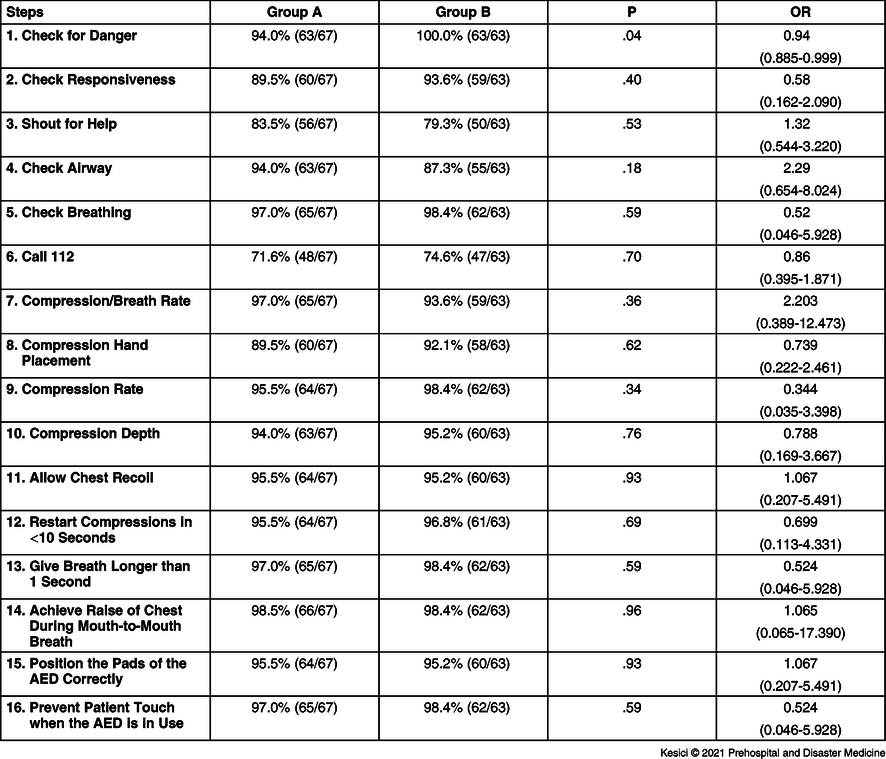
Students were evaluated in terms of BLS application competence. In the 16-step evaluation, the students in Group A applied BLS with a success rate of 90.2% and in Group B with a success rate of 93.4%. There was no difference in terms of success rate of BLS steps between groups.
In Group A, it was found that the most successful steps were respiration control and performing 30:2 chest compressions. Calling emergency call center step was the most forgotten step in Group A. In Group B, the most successful step was to provide environmental safety; the most forgotten step was similarly to call emergency call center.
The steps checked in practical exam and differences between success rates of groups are shown in Table 3.
Evaluation of BLS Application Success among Students After Training

Abbreviations: AED, automatic external defibrillator; BLS, Basic Life Support.
Discussion
In this study, the authors aimed to investigate the effectiveness of the peer education model in BLS education in high schools and the success of the BLS instructor education with the peer education model. It was found that the theoretical and practical success results of the instructors who were trained by professionals and the instructors who were trained by their peers were similar. It was observed that there was an improvement in BLS awareness and theoretical knowledge levels of the students in both groups who were trained by two different instructor groups. In the light of these results, the peer education model is effective in BLS education and also in BLS instructor education in the age group of high school grade one students. Therefore, the peer education model is a promising method to reduce the need of health professionals and the cost for public BLS education. In previous studies, it was shown that the instructors trained by professionals could be able to give successful training to their peers. Reference Beck, Issleib, Daubmann and Zollner17–Reference Iserbyt, Theys, Ward and Charlier19 In the current study, the authors aimed to test whether high school students trained by professionals can be able to give BLS instructor education to their peers. This method was found to be satisfactory because the students in both groups were successful in theoretical and practical applications. With this method, the number of people targeted for BLS training can be reached in a shorter time. Furthermore, this important goal that will affect the prognosis of OHCA can be achieved by using fewer health care professionals and at a lower cost.
During the study, it was observed that the students were willing to receive BLS education. Only five (3.3%) students did not participate in the study. It has been shown in previous studies that high school students are eligible for BLS education. Reference Lubrano, Romero and Scoppi12,Reference Naqvi, Siddiqi, Hussain, Batool and Arshad13,Reference Isbye, Meyhoff, Lippert and Rasmussen20 The current study found that this situation is also valid for the students in this country. Students’ awareness about BLS increased significantly after the training sessions, similarly in both groups. Twenty-eight students stated that they had witnessed BLS application; this finding indicates the high frequency of OHCA in public and the need of public BLS training. Most of the students in both groups (Group A: 97.2%, Group B: 98.7%) had already known the number of the emergency call center before the training. This is an indication of the success of public efforts to raise awareness of the emergency call center number in the country. Despite that 911 is popular in media and cinema as an emergency call number, 112 is in use in this country. But with wisely organization, all calls made to 911 are also directed to 112. In the post-training questionnaire, it was obtained that there was significant improvement in questions regarding BLS hearing, searching about BLS, understanding of BLS need, feeling sufficient to apply BLS, giving BLS training in schools, and watching videos about BLS. In the post-training questionnaire, the proportion of students searching about BLS increased to 38.4% and 40.5% in Group A and Group B, respectively. At the end of training, instructors advised the students to watch videos about BLS and they shared the links of videos on the last slide. In the post-training questionnaire, 89.7% (25.0% in pre-training) of the students in Group A and 57.9% (23.0% in pre-training) of the students in Group B stated that they watched a video about BLS. These results are indicating that BLS training increased the students’ interest in the subject and led them to search BLS. It is known that this age group is intensively using internet, and in pre-training questionnaire, 44 students (62.8%) in Group A and 40 students (51.2%) in Group B specified that they frequently used internet for research. Similar to the previous studies, this study showed that students used internet for research and video suggestions to attract their attention and supports the BLS education. Reference Iserbyt, Charlier and Mols21,Reference Semeraro, Taggi, Tammaro, Imbriaco, Marchetti and Cerchiari22 These findings also confirm the importance of the use of internet and social media to raise BLS awareness of the public. In a previous study including college students, it was shown that voluntariness increased after training. Reference Hamasu, Morimoto and Kuramoto8 In the current study, there was an increase in voluntariness to apply BLS, but this was not statistically significant in both groups. Post-training questionnaire revealed the decrease in hesitation from BLS application and mouth-to-mouth breath, but the difference between pre- and post-training questionnaire was not statistically significant in both groups. Reasons of the hesitation from BLS application were generally fear of giving damage and fear of wrong application in both groups. This situation should be considered in further training sessions, including this age group, and students must be encouraged to apply BLS. It should be frequently emphasized during training that the most harmful thing is to do nothing in case of OHCA. Reasons of hesitation from mouth-to-mouth breath were fear of infection and finding disgusting in both groups. It is important to remind the students that there are only a few recorded cases about infection transmission because of mouth-to-mouth breath giving in the whole BLS history. It is a known situation that sometimes bystanders do not start to apply the other steps of BLS because of hesitation from mouth-to-mouth breath giving; to overcome this confusion, it is crucial to emphasize the benefit and importance of chest compressions with or without breath.
It was obtained with pre- and post-training knowledge tests that knowledge levels of the students in both groups were increased after the training. Statistically significant improvement in seven questions from twelve questions was recorded between the pre- and post-training knowledge tests in both groups. Success rate of the question regarding the timing of chest compression remained the same in both groups. And also, success rate of timing of emergency call was not improved in both groups and remained 58.6% and 58.0% in Group A and Group B, respectively. Despite that the results of the pre-training questionnaire revealed that almost all of the students had known the number of emergency call, the students in both groups confused timing of the emergency call during BLS steps. This situation should be considered in further training sessions and abbreviations regarding BLS steps may be revised to remind and emphasize the timing of emergency call. Success rate of questions regarding chest compression rate and hand placement during chest compression were improved significantly in both groups, but success rate of these questions was not satisfactory in post-training knowledge test. It can be said that only one session of training could not provide an increase in the students’ knowledge level about the steps of BLS. Contrary to the unsatisfactory success rate of the questions regarding chest compression rate and hand placement during chest compression, students in both groups greatly achieved these steps in practical exam. This situation indicates that visuality is more effective than theoretical knowledge in education of this age group. In the light of these findings and consistently with previous studies, it can be recommended that BLS education in schools should consist mostly of visual material. Reference Iserbyt and Byra23,Reference Iserbyt, Elen and Behets24
In practical exam, students in both groups greatly remembered and achieved the BLS steps. Success rate of the steps were >90% in 14 of 16 steps in both groups. Calling emergency call center was the most forgotten step in both groups. Although they knew the number, it was interesting that they confused the timing of emergency call in the knowledge test and forgot to call the number in the practical exam. To improve the application success of this step, the importance of calling the emergency call center should be emphasized during both theoretical and practical training and emergency call step must be more memorable in visual education materials. Besides, simple abbreviations attract students’ interest and facilitate their learning, and they used these abbreviations to remember steps during BLS application. Reference Iserbyt and Byra23
Limitations
This study was conducted in a private school with a restricted number of volunteers who were trained by physicians. So, there appears a need of further and wider studies to verify the current results.
Conclusion
This current method for providing BLS instructor training to a certain number of students carries the capability to initiate a chain reaction, and as a consequence, the domino effect may cause a rapid public spread.
It is known that OHCA prognosis can only be improved if BLS is initiated and continued by bystander until the health workers arrive at the scene. Reference Hasselqvist-Ax, Riva and Herlitz4,Reference Holmberg, Holmberg and Herlitz5 Public BLS training is the crucial point to increase the rate of early BLS application by bystanders. Human resources of all countries in the world are limited in terms of health professionals who will provide BLS education to the public. Because of this situation, novel methods have been tried to give BLS training to the public. The peer education method was found to be effective in BLS training in high schools. Reference Beck, Issleib, Daubmann and Zollner17 In this study, the authors took that method a step further and tested the effectiveness of the peer education method in BLS instructor training. Results of the pre-post training awareness questionnaire, pre-post training knowledge tests, and the practical exam indicated that instructors trained by their peers are as effective as the instructors trained by medical physicians in terms of giving BLS training to high school students.
The goal of BLS training is to cover every single person in the society. But this target requires a huge budget and lots of health care specialists. This novel method of peer education gives an opportunity to overcome the stated shortage in the budget and in trained instructors. Besides, teaching the activity itself is such an efficient way of learning that becomes possible all through the peer education model. Moreover, youngsters interiorize the BLS course when they become a part of its education. Thus, the peer education model is definitely emerging as a way out for spreading BLS among the community in spite of restricted sources.
Conflicts of interest/funding
none