For patients with functional single ventricle after Fontan procedure, the suboptimal functional health status has been variably described,Reference Freedom, Hamilton and Yoo 1 including reports from the Fontan cross-sectional study that was performed by the Pediatric Heart Network.Reference Sleeper, Anderson and Hsu 2 This study enroled 546 Fontan patients aged 6–18 years and included assessment of patient characteristics and medical history, the functional health status, and standardised assessment in terms of cardiopulmonary exercise testing, echocardiography, cardiac magnetic resonance imaging, and measurement of brain natriuretic peptide levels.
Several reports from this study have addressed issues pertaining to the functional health status. Using the parent report form of the Child Health Questionnaire, CHQ-PF50,Reference Landgraf, Abetz and Ware 3 which is a generic assessment instrument, parents scored their children worse than a normal United States population sample in nearly all domains and reported a higher prevalence of non-cardiac health problems.Reference McCrindle, Williams and Mitchell 4 With regard to a subset of patients who were age-eligible and completed the child report form of the Child Health Questionnaire (CHQ-CF87), their parents reported lower scores in many domains compared with those reported by the children themselves.Reference Lambert, Minich and Newburger 5 These parent–child discrepancies were higher in the presence of increased non-cardiac health problems in the child. An independent study has shown that Fontan patients scored themselves lower if they had a normal sibling, perhaps indicating an altered self-perception in the presence of a constant normal comparison.Reference Manlhiot, Knezevich, Radojewski, Cullen-Dean, Williams and McCrindle 6
Disease-specific assessment has been advocated as a more specific and responsive measure of the functional health status for a given disease condition and differs from generic assessment both conceptually and qualitatively. Disease-specific instruments often have different domains that are specific to the disease condition, such as impact of particular symptoms, morbidities, and treatments. In addition, although some domains and items may be similar to those measured by generic instruments, the attribution of the effect is specific to the disease condition. For example, an item from generic instruments might ask, “How often do you experience pain or physical limitation in your daily activities?” A disease-specific instrument, in contrast, might add the qualifier “due to your heart condition”.
We sought to determine the relationships between equivalent conceptual domains from the patient-completed generic Child Health Questionnaire and a patient-completed congenital heart disease-specific instrument, the Congenital Heart Adolescent and Teenage questionnaire,Reference McCrindle, Williams and Mital 7 , Reference Kendall, Lewin, Parsons, Veldtman, Quirk and Hardman 8 administered to Fontan patients aged 10–18 years as part of the Fontan cross-sectional Study. We also sought to determine the magnitude of associations of the identified equivalent physical functioning domains from each questionnaire with regard to patient and medical characteristics and laboratory measures. We hypothesised that the congenital heart disease-specific measure would show stronger associations with medical and laboratory testing characteristics.
Patients and methods
Study design and patients
The Fontan cross-sectional study was performed by the Pediatric Heart Network;Reference Mahony, Sleeper and Anderson 9 the design and methods have previously been described.Reference Sleeper, Anderson and Hsu 2 Written informed consent or assent was obtained from all participants as approved by the institutional review committees at each of the seven North American institutions. Patients aged 6–18 years at enrolment and who underwent a Fontan procedure 6 months or earlier were included. Patients were excluded if they had important non-cardiac or psychiatric conditions precluding or influencing testing, were pregnant or were planning to conceive, were presently participating or were planning to participate in another conflicting research study, or had a primary caregiver who lacked reading fluency in both English and Spanish. All study testing was to be completed within 3 months of enrolment and included medical record abstraction, completion of questionnaires, measurement of serum brain natriuretic hormone levels, echocardiography, cardiopulmonary exercise testing, and cardiac magnetic resonance imaging.
Functional health status questionnaires
The Child Health Questionnaire was used as a generic measure of the functional health status. Only patients aged 10 years and above who had completed the child report version (CHQ-CF87)Reference Landgraf, Abetz and Ware 3 were included in the present analyses. The Child Health Questionnaire assesses the functional health status in 10 scale domains of physical, behavioural, emotional, social, and family well-being and four categorical single item domains. The domain scores range from 0 to 100, with higher scores indicating better function, and distributions tend to be upwardly skewed, with relevant ceiling effects. The instrument has been validated for use in children and adolescents aged between 10 and 18 years. Patients also completed the Congenital Heart Adolescent and Teenage questionnaire as a disease-specific measure of the functional health status. The development, properties, and initial validation of this questionnaire have previously been described.Reference McCrindle, Williams and Mital 7 , Reference Kendall, Lewin, Parsons, Veldtman, Quirk and Hardman 8 The Congenital Heart Adolescent and Teenage questionnaire includes five scale domains on physical, emotional, and social well-being and three categorical single item domains. Scale domains range from 0 to 100, and single item domains range from 0 to 5, with higher values indicating worse functioning, with similarly skewed distributions and relevant ceiling effects. The questionnaire items probe for deficits and impacts specific to the patient's perception of their heart problem.
Medical history and laboratory testing
A detailed medical record review was performed for all study participants. Details on the laboratory testing procedures and variable selection for analysis of the associations with the functional health status have been reported elsewhere.Reference Sleeper, Anderson and Hsu 2 , Reference McCrindle, Williams and Mitchell 4 , Reference McCrindle, Zak and Sleeper 10
Data analysis
Data are described as frequencies, medians with 25th and 75th percentile values, and means with standard deviations as appropriate. Given the skewed distribution of brain natriuretic peptide values, a normalising logarithmic transformation was used. The study population used for analysis was restricted to 325 patients aged 10–18 years who completed both questionnaires. As all laboratory tests were not performed in all patients, we performed separate analyses that were restricted to each individual test data set, similar to a previously reported analysis.Reference McCrindle, Zak and Sleeper 10
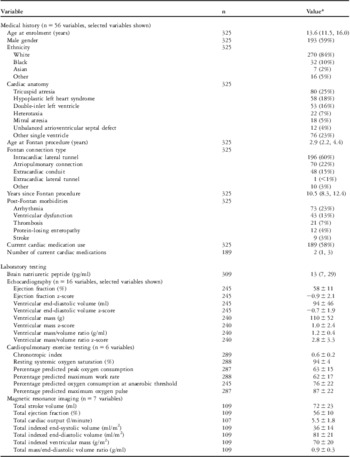
Domain scores from the Child Health Questionnaire were contrasted against values from a normative populationReference Landgraf and Abetz 11 using single sample Wilcoxon signed-rank tests. These values were derived from a suburban school-based normal population of 232 children aged 10–15 years who self-completed the questionnaire in 1995. The distributions of domain scores for both questionnaires were highly skewed, and preference was given to using ranks and non-parametric statistical methods for analysis. To determine which conceptually equivalent domains from the two questionnaires to use in comparisons of associations with medical history and laboratory testing variables, a Spearman correlation matrix was created. Conceptually equivalent domains with higher correlations from each questionnaire were rank-transformed and then explored for an association with medical history and laboratory testing variable groups in multivariable linear regression models. The R2 adjusted for the number of included variables was determined for each variable group, and was taken to represent the proportion of variation in the domain scores explained by all of the variables in each group. A total of six variable groups were created: medical history, non-cardiac conditions, echocardiography, exercise testing, magnetic resonance imaging, and serum brain natriuretic peptide levels. Variables within each group and their values are shown in Table 1. Variable groups for laboratory testing were used to determine the associations that were specific to that test but also because all patients did not undergo all laboratory tests and not all patients who underwent a particular test had key variables assessed. Imputation of missing values was performed as previously described.Reference McCrindle, Williams and Mitchell 4 , Reference McCrindle, Zak and Sleeper 10 Data analyses were performed using the Statistical analysis systems statistical software version 9.2 (SAS Institute Incorporated, Cary, North Carolina). All statistical testing was two-sided.
Selected patient, medical, and laboratory testing characteristics (n = 325).

*Values represent frequency (%), median (25th, 75th percentiles), or mean (±standard deviation)
Results
Study participation
Medical records were screened for 1078 patients who underwent a Fontan procedure as identified from existing institutional databases at each Pediatric Heart Network clinical center, with 831 patients deemed potentially eligible for participation. After being contacted, 637 patients were confirmed to be fully eligible, and informed consent as approved by each centre was obtained for 546 (86%) patients between March 2003 and April 2004. Of these, 354 patients were 10–18 years of age, with 329 completing the Child Health Questionnaire and 326 completing the Congenital Heart Adolescent and Teenage questionnaire. Of the eligible non-respondents, seven could not complete the questionnaires because of severe physical or mental disability. The study population for the present analysis includes the 325 patients who completed both questionnaires.
Patient characteristics
The distribution of patients, medical and laboratory testing characteristics, together with their associations with Parent Report Child Health Questionnaire Physical and Psychosocial Functioning Summary Scores have been reported previously for all patients aged 6–18 years completing the study – the present analysis includes only patients aged 10–18 years who completed the child report version.Reference McCrindle, Williams and Mitchell 4 , Reference McCrindle, Zak and Sleeper 10 Selected characteristics of the 325 patients included in the present analysis are shown in Table 1. The mean age at enrolment was 13.9 years, and the mean interval from Fontan procedure to enrolment was 10.3 years (range 1.8–17.3 years).
Functional health status
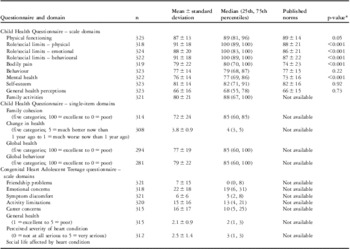
Distributions of scores for both the Child Health Questionnaire and the Congenital Heart Adolescent and Teenage questionnaire are shown in Table 2. Some data from a normal population were available for some domains of the Child Health Questionnaire.Reference Landgraf and Abetz 11 Compared with a normal population,Reference Landgraf, Abetz and Ware 3 , Reference Landgraf and Abetz 11 Fontan patients scored themselves significantly lower for physical functioning but significantly higher for freedom from physical, emotional and behavioural limitations on roles, freedom from bodily pain, and mental health issues. The scores from the Fontan patients were not significantly different from the normal population for the domains of behavior problems, self-esteem and general health perceptions.
Domain scores for functional health status.

CHQ = Child Health Questionnaire
*Wilcoxon signed-rank test was used to compare the distribution of the CHQ scores from the study with the values for a normal population
Associations between the Child Health Questionnaire and the Congenital Heart Adolescent and Teenage questionnaire domains
In order to identify correlated conceptually equivalent domains between the two questionnaires for comparison on the relative strengths of their associations with medical history and laboratory testing characteristics, a Spearman correlation matrix was developed (Supplementary Table S1). There were significant correlations between many of the domains from the two questionnaires. The highest correlations were between the Child Health Questionnaire physical functioning domain and the Congenital Heart Adolescent and Teenage questionnaire domains of symptom discomfort (r = −0.43) and activity limitations (r = −0.58). The Child Health Questionnaire domain of freedom from bodily pain and the Congenital Heart Adolescent and Teenage questionnaire domain of symptom discomfort also showed a higher correlation (r = −0.49). The Child Health Questionnaire domain of general health perceptions was correlated with many Congenital Heart Adolescent and Teenage questionnaire domains, without a predominant pattern suggesting face validity. Likewise, the Congenital Heart Adolescent and Teenage questionnaire domain of emotions correlated with many Child Health Questionnaire domains, without a predominant pattern. For the purposes of further analyses, the Child Health Questionnaire domain of physical functioning was chosen to be contrasted against the Congenital Heart Adolescent and Teenage questionnaire domain of activity limitations, and the Child Health Questionnaire domain of freedom from bodily pain was chosen to be contrasted against the Congenital Heart Adolescent and Teenage questionnaire domain of symptom discomfort.
Associations with medical history and laboratory testing
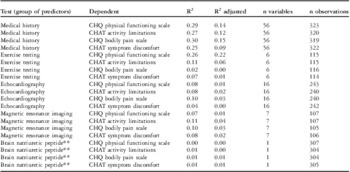
Multi-variable linear regression analyses were performed for groups of variables, medical history and laboratory testing, versus the dependent variable of each of the four chosen domain scores (Table 3). For all four domains, the proportion of variation (adjusted R2) in the scores explained by the medical history and laboratory testing variable sets was low; however, it was highest for the Child Health Questionnaire physical functioning domain and both medical history and exercise testing variable groups. Associations were weak for echocardiography, magnetic resonance imaging, and brain natriuretic peptide level variables.
Full model regression analyses for variable categories for equivalent conceptual domains from the self-report CHQ and the CHAT Questionnaire*.

CHQ = Child Health Questionnaire; CHAT = Congenital Heart Adolescent and Teenage
*After normalizing rank transformation
**After normalizing logarithmic transformation
Discussion
Summary
Except for physical functioning, Fontan patients tended to score themselves better than normal for many aspects of the functional health status. Equivalent conceptual domains could be identified between the generic and disease-specific assessment. Exercise capacity was the strongest factor associated with the physical aspects of the functional health status, with stronger relationships to the generic versus the disease-specific measures. Medical history and non-cardiac health problems also were associated with physical aspects but more weakly and, again, with stronger relationships with the generic measure. Measures of ventricular structure and function and brain natriuretic peptide were very weakly associated with physical aspects of the functional health status. In contrast to our expectation, it would appear that the physical domains of the disease-specific measure were less strongly associated with medical history and laboratory testing than those from the generic measure.
Conceptualisation
With the ongoing reduction in mortality and cardiovascular morbidity related to congenital heart disease and its management, there has been a shift in focus towards other important outcomes, particularly neurodevelopment and quality of life.Reference Bergner 12 , Reference Moons 13 However, present literature on quality of life for congenital heart disease patients is limited by inconsistencies in conceptualisation and definition.Reference Moons, Van Deyk, Budts and De Geest 14 The terms quality of life, health-related quality of life, and functional health status have been used interchangeably.Reference Moons 15 Quality of life entails a conceptualisation of an individual's personal sense or perception on their well-being and may include relative values such as satisfaction and enjoyment.Reference Moons, Budts and De Geest 16 Quality of life, therefore, often means different things to different people, sometimes in intangible ways that makes a strictly quantitative assessment difficult.Reference Moons, Van Deyk, Budts and De Geest 14 Health-related quality of life defines the component of quality of life that is influenced by health. The functional health status differs in its conceptualisation in that it reflects an individual's perceptions on their capacity and participation in roles, behaviours, and activities of daily living. The functional health status defines the impact of health issues on the functional status and is the primary concept being assessed in the majority of reports purported to be studying quality of life in congenital heart disease patients. We have taken the Child Health Questionnaire and the Congenital Heart Adolescent and Teenage questionnaire as measures of the functional health status.
Perspective
A critical appraisal of quality of life assessments in congenial heart disease highlighted the lack of consistency in underlying constructs, the relevance of differing perspectives, and the need to include a qualitative assessment.Reference Moons, Van Deyk, Budts and De Geest 14 Perspective is important for paediatric assessment, as young children may not be able to complete the assessments themselves; hence, the need for proxy reporting, usually from parents. Providers, patients, and parents can differ significantly in terms of the importance each attaches to different aspects of the functional health status or quality of life.Reference Marino, Tomlinson and Drotar 17 Previous studies have shown that Fontan patients tend to perceive themselves as having a higher functional health status than participants from normal control populations.Reference Landgraf, Abetz and Ware 3 , Reference Landgraf and Abetz 11 They also score themselves higher than how their parents would score them.Reference Lambert, Minich and Newburger 5 In contrast, Fontan patients tend to perceive their functional health status lower relative to their normal healthy siblings and patients with siblings rate themselves lower than patients without siblings, indicating that self-perception may be altered when the patient has a constant context for his or her own perception.Reference Manlhiot, Knezevich, Radojewski, Cullen-Dean, Williams and McCrindle 6 Parents have been reported to perceive deficits in their own health-related quality of life, which are influenced by the clinical state of the patient.Reference Arafa, Zaher, El-Dowaty and Moneeb 18
Comparison of generic and disease-specific assessments
Several instruments have been developed to assess the health-related quality of life and functional health status among children. The commonly used instruments include the Child Health Questionniare,Reference Landgraf, Abetz and Ware 3 the Pediatric Quality of Life Inventory,Reference Varni, Limbers and Burwinkle 19 the Toegepast Natuurwetenschappelijk Onderzoek-Academisch Ziekenhuis Leiden (TNO-AZL) Child Quality of Life Questionnaire,Reference Landolt, Valsangiacomo Buechel and Latal 20 , Reference Spijkerboer, Utens, De Koning, Bogers, Helbing and Verhulst 21 and the Health Utilities Index.Reference Raat, Bonsel, Essink-Bot, Landgraf and Gemke 22 The development and use of instruments for assessment with specific disease populations has been advocated. These instruments are developed with the goal of having a greater specificity with regard to relationships with clinical aspects of the medical condition and a greater responsiveness to change with clinical interventions. A cardiac-specific module has been developed for the Pediatric Quality of Life Inventory.Reference Uzark, Jones, Slusher, Limbers, Burwinkle and Varni 23 , Reference Uzark, Jones, Burwinkle and Varni 24 In addition, several congenital heart disease-specific questionnaires have been developed de novo. For children, these include the Congenital Heart Adolescent and Teenage questionnaire,Reference Mahony, Sleeper and Anderson 9 the Pediatric Cardiac Quality of Life Inventory,Reference Marino, Shera and Wernovsky 25 and the Congenital Heart Disease Quality of Life Questionnaire.Reference Macran, Birks and Parsons 26 For adults with congenital heart disease, the Toegepast Natuurwetenschappelijk Onderzoek-Academisch Ziekenhuis Leiden Congenital Heart Disease Adult Quality of Life Questionnaire has been used.Reference Kamphuis, Zwinderman and Vogels 27
Despite advocacy for disease-specific assessments, studies comparing generic and disease-specific instruments have shown variable results in terms of associations with patient and medical characteristics. This may, in part, reflect the differences in conceptualisation and purpose, with greater or lesser overlap of domains, as well as differences in measurement properties. No differences between generic and disease-specific assessments were observed for the relationship with physical activity levels in patients with multiple sclerosisReference Motl, McAuley, Snook and Gliottoni 28 or in a study of children with recurrent otitis media.Reference Brouwer, Schilder and van Stel 29 Other studies have shown stronger measurement properties for disease-specific instruments. These include the higher responsiveness observed in studies on patients undergoing cholecystectomyReference Shi, Lee, Chiu, Chiu, Uen and Lee 30 and on patients with carpal tunnel syndrome.Reference Bessette, Sangha and Kuntz 31 Greater internal consistency and dimensional reproducibility with less factorial complexity and issues with floor and ceiling effects were observed in a study of patients with heart failure.Reference Wolinsky, Wyrwich, Nienaber and Tierney 32 Some studies have shown that the relationships have qualitative differences, being more highly associated with some characteristics and outcomes than others, as observed in a study on patients with diabetes.Reference Huang, Hwang, Wu, Lin, Leite and Wu 33
Uzark et alReference Uzark, Jones, Slusher, Limbers, Burwinkle and Varni 23 , Reference Uzark, Jones, Burwinkle and Varni 24 applied both the generic and cardiac module of the Pediatric Quality of Life Inventory to children with congenital heart disease and observed high correlations between specific domains for the two questionnaires; however, they did not compare associations with disease severity or clinical characteristics. A recent work with the Pediatric Cardiac Quality of Life Inventory involving a broad population of congenital heart disease patients has shown that lower scores were observed for Fontan patients and for patients with increased health care utilisation.Reference Marino, Tomlinson and Wernovsky 34 The disease-specific scores also correlated with scores from the generic assessment using the Pediatric Quality of Life Inventory. It has also been shown that this instrument has external validity when used for children with cardiological problems across multiple sites in the United States.Reference Marino, Drotar and Cassedy 35 Our study showed greater, although weak, associations of patient and medical characteristics with the generic measure compared with the disease-specific measure in a well-characterised population of Fontan patients. Clearly, further research is required in this area.
Study limitations
The results of this study should be interpreted in light of some potential limitations. The patients involved may not be sufficiently representative of the total population of Fontan patients and, likewise, the inability to achieve a uniform laboratory testing across the patients may have also introduced a bias. The threshold at which clinical and laboratory abnormalities have a measurable impact on the functional health status is unknown. The suboptimal performance of the Congenital Heart Adolescent and Teenage questionnaire may reflect deficiencies in this instrument rather than in disease-specific assessments in general. For example, compared with the Pediatric Cardiac Quality of Life Inventory, the Congenital Heart Adolescent and Teenage questionnaire is shorter, has less depth, and has had less rigorous development and validation.Reference Marino, Drotar and Cassedy 35 Both questionnaires used may have unknown limitations with regard to conceptualisation, scoring with floor and ceiling effects, validity, reliability, and responsiveness, and they may also differ on these properties, particularly in the chosen domains that were compared. Although both questionnaires have the advantage of being completed by the patients themselves, the results reflect self-perceptions, are necessarily subjective, and do not incorporate the individual's qualitative, that is, open-ended narrative, assessment, which would highlight issues specific to that individual. The clinical importance of observed differences in the domain scores in relation to the published normal population is not known. Likewise, the clinical importance of observed differences in association with similar domain scores between the generic and disease-specific assessment is not known.
Conclusion
In our cross-sectional study on Fontan patients, greater associations with patient and clinical characteristics were observed for the generic Child Health Questionnaire compared with the disease-specific Congenital Heart Adolescent and Teenage questionnaire for two conceptually equivalent physical domains. Nonetheless, associations of these domains with patient and clinical characteristics were weak. Other disease-specific instruments may be more responsive to treatment-related changes and have greater implications for specific interventions. In the absence of acute or severe cardiac-related morbidities, the impact of Fontan physiology on the overall functional health status may be less than that presently assumed. Further research should explore the conceptualisation of the functional health status and quality of life and the discovery of social, behavioural, emotional, and environmental determinants that may be targeted for novel interventions aimed at improving the functional health status in this specific population.
Acknowledgements
Conflict of Interest
None.
Financial Support
None of the authors have any financial disclosures to make. The study was supported by U01 grants from the National Institutes of Health, National Heart, Lung, and Blood Institute (HL068269, HL068270, HL068279, HL068281, HL068285, HL068292, HL068290, HL068288). The content is solely the responsibility of the authors and does not necessarily represent the official views of the National Heart, Lung and Blood Institute or the National Institutes of Health.