One lively area of research on the mental lexicon in both adults and children concerns the processing of words that contain several morphemes, or the smallest meaningful units of language. For developmental research, there is a particularly active line of investigation examining development in two key types of morphologically complex words: inflected and derived words. Inflected words contain an affix that specifies features such as case, tense, gender, or number but does not affect the syntactic category of the word (e.g., the addition of the suffix -s to the root read to mark the present tense in reads). In contrast, derived words have an affix that generally changes the syntactic category of the word (e.g., the addition of the suffix -er to the root verb read to form the noun reader). As we will see in the literature review that follows, there is a long history of research in the domain of oral language suggesting that there is particular growth in knowledge of derived forms in late childhood and into adolescence. The present study investigated this question through the use of a priming paradigm tapping awareness of the common root within inflected and derived words.
Studies using oral production tasks have long suggested that there might be differences in the developmental time course of inflected and derived words. Preschool children begin to produce inflected words spontaneously in their speech earlier than derived words (Brown, Reference Brown1973; de Villiers & de Villiers, Reference deVilliers and deVilliers1973). For example, the three preschool children studied by Brown (Reference Brown1973) were remarkably accurate in producing simple inflected words (such as present progressive), but derived forms were largely absent from their speech. Other studies have found that the lag in children's mastery of derived forms is not limited to the earliest years of language acquisition. As an example, Carlisle's Reference Carlisle and Feldman1995 work demonstrated that children in kindergarten and Grade 1 performed significantly better on an oral production task (complete a sentence Farm. My uncle is a ____.) with inflected forms than with derived forms, even when these were relatively transparent (e.g., farm-farmer). Berko's (Reference Berko1958) classic pseudoword study is another often-cited example. At 5 to 7 years of age, children were generally able to add basic inflections to nonsense words (e.g., one wug, two wugs), but they appeared to have difficulty adding derivations in the few items designed to address this question (e.g., a man who zibs is a zibber). Although the children's performances on inflectional items were far from uniform, newer work has strengthened Berko's claim by finding that growth in the ability to produce correct derived forms in oral tasks continues into adulthood, even for relatively transparent forms (Derwing, Reference Derwing1976; Derwing & Baker, Reference Derwing, Baker, Fletcher and Garman1979).
Following on this work, there has been considerable attention paid to the particularly rapid growth of derivational knowledge demonstrated in a variety of oral tasks in older children and young adolescents. Anglin (Reference Anglin1993) reported that derived words made up 16% of the vocabulary known by children in Grade 1, and that this increased to 39% by Grade 5. It seems then that derived words make up an increasing proportion of children's vocabulary in the later elementary grades. Further, knowledge of word meaning (e.g., demonstrated by generating or choosing an accurate definition) increased at a faster rate for derived than for inflected or root forms. Using Berko's pseudoword methodology, Selby (Reference Selby1972) found that children reached ceiling levels for most inflectional items by age 12, an age at which there was still room for improvement with the derivational forms. In a slightly different type of task, Wysocki and Jenkins (Reference Wysocki and Jenkins1987) taught children in Grades 4, 6, and 8 a series of unfamiliar words and then asked them to define morphological relatives, specifically the roots or derived forms, of those words. The participants in Grades 6 and 8 were better at morphological generalization than those in Grade 4. Similar results were found by Carlisle (Reference Carlisle1988), who asked participants in Grades 4, 6, and 8 to produce an appropriate word (either by adding or removing a derivation) to complete a given sentence (Four. The horse came in ___. [fourth]). Knowledge of derivational morphology increased significantly with each grade, indicating that the ability to apply derivational knowledge undergoes especially rapid growth between Grades 6 and 8. Across several studies, there has been a resounding conclusion of particular growthFootnote 1 in knowledge of derivational morphology between the fourth and eighth grades.
It is interesting that this growth might not occur across all aspects of derivational and inflectional morphology. In their study of children's appreciation of derivational morphology, Tyler and Nagy (Reference Tyler and Nagy1989) introduced three useful constructs. The first is that of relational knowledge, or the awareness of common morphemes between words (e.g., the connection between the words create and creator). The second is syntactic knowledge, which relies on understanding that individual derivational suffixes mark specific syntactic categories (e.g., word-final -ment is typically used with nouns). The last is distributional knowledge, which underpins the ability to legally combine suffixes and roots (e.g., addition of -ness to adjectives, but not to verbs). Tasks in earlier experiments have often involved the generation of the correct derived form to complete a sentence (e.g., Carlisle, Reference Carlisle1988) or the definition of the derived form (e.g., Anglin, Reference Anglin1993). These could draw on distributional knowledge in identifying the particular suffix to add (in the first case) or syntactic knowledge in relying on word category information held by the affix (in the second). The importance of this syntactic knowledge is supported by the sheer quantity of learning to be done in the domain of derivations. As Anglin pointed out, there are over 100 derivations in English, far more than its relatively meager store of inflections. It is possible that development might occur in syntactic and distributional knowledge, whereas relational knowledge might remain relatively stable across this time period.
There are several priming methods that are widely used in the adult research domain that are particularly well adapted for the examination of relational knowledge (e.g., Rueckl, Mikolinski, Raveh, Miner, & Mars, Reference Rueckl, Mikolinski, Raveh, Miner and Mars1997). These also have the advantage of having relatively low task demands in comparison to many tasks employed with children. For instance, they place relatively little demands on oral pronunciation. This is particularly a concern in that morphologically complex forms are typically long, and they are likely to tax pronunciation abilities even in the naturalistic contexts examined in some prior research (e.g., Brown, Reference Brown1973). These tasks also reduce the linguistic and comprehension demands involved in many tasks, such as the learning of a novel lexical item and production of a definition for its morphological relatives (e.g., Wysocki & Jenkins, Reference Wysocki and Jenkins1987). Implicit measures may lower task demands, thereby permitting an alternative view of children's processing.
Further, such methods are amenable to the examination of inflectional and derivational forms in a comparable manner. To date, studies with children in this age range have focussed almost exclusively on derivational forms without comparable measures of inflectional processing (Anglin's Reference Anglin1993 vocabulary analyses are a notable exception). Instead, the studies have tended to examine differences between types of derived forms (e.g., effects of phonological change; see, e.g., Carlisle, Reference Carlisle1988; Tyler & Nagy, Reference Tyler and Nagy1989). Contrasting appreciation of the shared root between roots and related inflected and derived words would provide further insight into whether the linguistic differences between the two forms necessarily lead to qualitative or quantitative differences in processing.
Feldman, Rueckl, DiLiberto, Pastizzo, and Vellutino (Reference Feldman, Rueckl, DiLiberto, Pastizzo and Vellutino2002; see also Giraudo, Reference Giraudo2001) recently demonstrated that methods typically used with adults to examine morphological processing can be employed with children. In their study, as in research with adult participants (see Rueckl et al., Reference Rueckl, Mikolinski, Raveh, Miner and Mars1997), children were shown a series of primes. Each prime was shown twice, each time for a period of 1 s.Footnote 2 Participants were then, again as in adult work (Rueckl et al.), presented with a series of fragments for completion (e.g., l _ _ t). The researchers found that children were more likely to complete the fragment with the target (e.g., list) when they had been presented with morphologically related primes (primarily inflected words; e.g., listed–list) than with orthographic primes (e.g., listen–list). This work demonstrates that priming approaches typically employed with adults can be successfully applied with child samples.
Rabin and Deacon (Reference Rabin and Deacon2008) recently adapted this approach for the study of both inflected and derived forms with children in Grades 1 to 5. The method provided insight into relational knowledge, as it required the extraction of the root across related forms. As in Feldman et al. (Reference Feldman, Rueckl, DiLiberto, Pastizzo and Vellutino2002), children were first shown a series of primes that included either the target word, an inflected or derived form of the target word, or an orthographic control word (e.g., need, needing, needy, or needle). Children were then asked to make fragments like ne_ _ into words. Children's completion rates of the fragments with the target form were similar following the presentation of inflected and derived primes. Priming in these two conditions was greater than in the orthographic control condition. These results extended earlier findings of morphological priming effects in children (e.g., Feldman et al., Reference Feldman, Rueckl, DiLiberto, Pastizzo and Vellutino2002) by including the two broad morphological categories of inflected and derived forms. Further, Rabin and Deacon (Reference Rabin and Deacon2008) found that the quantity of the priming effects was similar for the inflected and derived forms across the developmental period studied. The findings of equivalent growth in relational knowledge across Grades 1 to 5 provide the impetus to examine the relative growth of derived forms across a more extended time frame.
The priming method could offer a particularly useful way to investigate whether there is particular growth in the representation of roots of derivational in comparison to inflectional forms in the mental lexicon across Grades 4, 6, and 8. We employed the fragment completion task as in Rabin and Deacon (Reference Rabin and Deacon2008) to examine this issue. This permits a direct comparison of relational knowledge of the roots in inflected and derived forms.
The priming methodology is particularly well suited to discovering whether there is growth specific to morphological processing. In the standard metalinguistic or production tasks employed with children (e.g., Selby, Reference Selby1972), growth is typically indexed by overall increase in accuracy with morphologically complex forms. The priming methodology includes a control condition through which we can separate out orthographic (and phonological) effects from those that are morphologically based; this allows us to assess growth that is specifically morphological. As an example, the difference between the orthographic control and morphologically related conditions might increase over time, as might be particularly plausible for derived forms. It is also possible that children's morphological knowledge increases in step with their oral and print lexicons. That is, priming from orthographic controls might increase in line with priming from morphological relatives. Few methodologies offer the possibility for such relative comparisons of growth across different domains (see, e.g., Anglin, Reference Anglin1993, for use of proportion of total vocabulary in this manner). This comparison also has the potential to be particularly informative as to whether linguistic differences between inflected and derived forms are born out in measures of implicit morphological priming that target relational knowledge.
METHODS
Participants
The participants were recruited from rural schools in Nova Scotia, Canada. Consent forms were sent home from school with the children, and only those with completed consent forms signed by their parent or guardian who also assented to their participation were tested. All participants were native speakers of English, and there were no reports of learning disabilities among the sample. There were 88 participants: 32 in Grade 4, 32 in Grade 6, and 24 in Grade 8. The mean ages were 9 years, 9 months (9;9; SD = 3.4 months), 12;0 (SD = 3.6 months), and 14;8 (SD = 4.1 months), respectively. There were 15 boys tested in Grade 4, 15 in Grade 6, and 12 in Grade 8, representing approximately half of the sample in each case.
Materials
The stimuli for the priming task, which are listed in Appendix A, were composed of the 30 quadruplet word sets used in Rabin and Deacon (Reference Rabin and Deacon2008). Each set contained a root word (e.g., harm), an inflected form (e.g., harmed), a derived form (e.g., harmful), and an orthographic control (e.g., harmony). Construction of items in this manner ensured that the same root was used for the inflected and derived forms. Further, the inflected, derived, and orthographic control words of each quadruplet set contained the letters and sounds of the root word, thus controlling for phonological and orthographic similarityFootnote 3 between the morphologically related and control items as emphasized in adult research (Raveh & Rueckl, Reference Raveh and Rueckl2000). Such controls are important given the demonstrations that phonological and orthographic transparency has been shown to affect priming (Gonnerman, Seidenberg, & Anderson, Reference Gonnerman, Seidenberg and Anderson2007; Raveh, Reference Raveh2002; Rueckl et al., Reference Rueckl, Mikolinski, Raveh, Miner and Mars1997). All of the derivational changes used were suffixes, rather than prefixes, to be parallel to the inflectional changes, which in English are always suffixes.
Finally, the overall frequency of the 30 inflected words was similar to the overall frequency of the 30 derived words, as reflected in a word frequency database specifically targeting children's texts (Zeno, Ivens, Millard, & Duvvuri, Reference Zeno, Ivens, Millard and Duvvuri1995). This is an important control given the widespread demonstrations of the effects of frequency on priming rates (Meunier & Segui, Reference Meunier and Segui1999). Frequencies at Grade 6 for each of the words are listed in Appendix A. Frequencies for the inflected and derived forms were similar: t (29) = 0.11, p = .91. It was not possible to balance the frequency of the orthographic control words with those of the inflected and derived forms, given the difficulty of finding quadruplet sets. In each case, frequencies were lower for the morphologically related forms than for the orthographic control items, t (29) = 2.14, p = .04 for the inflected, and t (29) = 2.31, p = .03 for the derived, each in comparison to the orthographic control items. The presence of higher frequencies for the orthographic control words than for either the inflected and derived words ensured that the item balancing biased the task design against the hypothesis that inflected and derived words would show greater priming effects than the orthographic controls. Analyses of Zeno et al. (Reference Zeno, Ivens, Millard and Duvvuri1995) frequencies at adulthood from the same database reveal similar frequencies in each of the inflected, derived, and orthographic control conditions, F (2, 28) = 1.57, p > .25.
Each member of the quadruplet sets (e.g., harm, harmed, harmful, and harmony) was the basis for a condition. The identity word serves as the prime in the identity condition (e.g., harm), the inflected and derived words for the inflected and derived conditions (e.g., harmed and harmful, respectively), and the orthographic control items for the orthographic control condition (e.g., harmony). Only the fifth condition, of no prime, does not have a corresponding word because in that case there was no prime presented. The no-prime condition served as a baseline control.
Five presentation lists were created, each containing six words in the identity, inflected, derived, and orthographic control conditions, as in Rabin and Deacon (Reference Rabin and Deacon2008). To allocate words to lists, the 30 quadruplet word sets were divided into five blocks, each with 6 quadruplet sets. Each word list was created by drawing on the inflected items from one block, derived items from another, and so on. For example, one list would have the identity words from the quadruplet sets in Block 1 (e.g., camp, free, plan, rob, rock, and sum), the inflected words from Block 2 (e.g., adding, forming, furs, harmed, parted, and treated), the derived words from Block 3 (e.g., elective, newly, sadly, singer, starter, and tricky), the orthographic control words from Block 4 (e.g., article, market, paint, passive, pickle, and sandwich), and no words from Block 5. Another list would have the identity words from the quadruplet sets in Block 2 (e.g., add, form, fur, harm, part, and treat), the inflected words from Block 3 (e.g., elected, newest, sadder, sings, starts, and tricking), the derived words from Block 4 (e.g., artist, marker, painful, passage, picker, and sandy), the orthographic control words from Block 5 (e.g., million, needle, wink, restaurant, sweater, and wart), and no words from Block 1.
We used the fragment completion task from Rabin and Deacon (Reference Rabin and Deacon2008). The quantity of exposure time (1 s per presentation of each word, with each word shown twice) was the same as in classic morphological priming experiments with adults (Rueckl et al., Reference Rueckl, Mikolinski, Raveh, Miner and Mars1997), and a recent modification for children (Feldman et al., Reference Feldman, Rueckl, DiLiberto, Pastizzo and Vellutino2002). Word fragments were constructed so that the target word for each of the fragments was the root word from each of the 30 word sets. The fragments were constructed so that the target word as well as several other words could possibly complete each word fragment (e.g., ha _ _ could be completed with the target word harm as well as hall, hail, and hate). We ensured that several of the other possible responses had a Grade 6 frequency in the Zeno Word Frequency Guide (Zeno et al., Reference Zeno, Ivens, Millard and Duvvuri1995). All of the fragments are listed in Appendix A.
Procedure
All testing occurred in a one-on-one session with the participant and the experimenter in a quiet area of the child's school. During the study phase of the fragment completion task, participants were told that they would hear and see a list of words. This list was one of the five lists created for this study. Participants were presented with each word separately on a computer screen while the pronunciation of the word was played simultaneously through the computer speakers. The DirectRT computer program (Jarvis, Reference Jarvis2000) was used to present the words and fragments. The words were centered on the black screen in 40-point Arial Black font. Each word was presented for 1 s. They were asked to listen and look at the words as they were presented. The study words were each presented twice in a continuous list.
Following the priming phase, participants completed a word fragment completion task to measure priming effects. Each participant received 30 word fragments, 1 at a time, on a computer screen. All of these fragments are listed in the right-most column in Appendix A. The participants were instructed to try to make the fragment into a word by saying aloud a word that could be constructed from the word fragment. Before starting the task, the experimenter went over an example (i.e., c_t) to be sure that the participant understood the task. Their responses were recorded using a voice-activated microphone so that their response was recorded on-line by the computer. The experimenter also recorded the responses on paper to provide a second record of responses.
RESULTS
Accuracy scores were calculated based on the total number of fragments completed with the target root word (according to, e.g., Feldman et al., Reference Feldman, Rueckl, DiLiberto, Pastizzo and Vellutino2002; Rabin & Deacon, Reference Rabin and Deacon2008).Footnote 4 For example, if the fragment ha _ _ was completed with the target harm, it was scored as 1; if it was completed with another word, like hall, it was scored as 0.
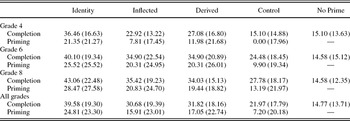
The mean accuracy for each priming condition is provided in Table 1. The priming effects for each condition shown in Table 1 were then calculated by subtracting the mean accuracy score for the no-prime condition from the mean accuracy scores for each of the other conditions. Performance in the no-prime condition represents an estimate of the likelihood of completion of the fragment with the target in the absence of any priming, permitting the priming effects to isolate more precisely the effects resulting from the experimental manipulations. In accordance with the standard established by Rueckl et al. (Reference Rueckl, Mikolinski, Raveh, Miner and Mars1997; and subsequently applied by Feldman et al., Reference Feldman, Rueckl, DiLiberto, Pastizzo and Vellutino2002; and Rabin & Deacon, Reference Rabin and Deacon2008), analyses targeted the priming effects. Analyses by participants are reported as F1. By items analyses are reported as F2 (for which all within-subjects variables become between-subjects variables and vice versa).
Percentage of mean accuracy and priming effects (standard deviation) for word fragment completion task for each priming condition by grade and across grades

Note: The priming effects were calculated by subtracting the no-prime score from the score in each condition.
A repeated-measures analysis of variance was conducted with the priming effects using the between-subjects variable of grade (Grades 4, 6, and 8) and the within-subjects variable of priming condition (identity, inflected, derived, and orthographic control). There was a significant main effect of priming condition, F1 (3, 84) = 15.46, p < .001, F 2 (3, 20) = 6.98, p < .01. This suggests that the priming condition had an effect on the degree of priming in the target word fragment completion. Notably, this main effect did not interact with grade, F1 (6, 81) = 0.49, ns, F 2 (6, 40) = 0.53, ns, indicating that the rates of priming did not increase differentially across the conditions for the three grades examined.
Paired-samples t tests using Bonferroni corrections were used to compare priming effects in the different conditions. As might be expected, priming was greater in the identity condition than in any of the other three conditions: inflected, t1 (87) = 3.54, p = .001, d = .38, F 2 (1, 11) = 3.60, p = .087; derived, t1 (87) = 3.09, p = .003, d = 0.34, F 2 (1, 11) = 4.69, p = .055; control, t (87) = 7.21, p = .001, d = 0.81, F 2 (1, 11) = 22.31, p < .01. This shows that children were more likely to supply the target word if they had been primed with the word itself than if they had been primed with a morphological relative of the word or an orthographic neighbor.
Most important for the emphasis here on morphological processing, further analyses showed that priming effects were significantly greater in both the inflected and derived priming conditions than in the orthographic control condition, t1 (87) = 3.34, p = .001, d = 0.40, F 2 (1, 11) = 4.72, p = .055, and t1 (87) = 3.52, p = .001, d = 0.46, F 2 (1, 11) = 16.89, p = .002, respectively. These differences indicate that orthographic priming on its own cannot account for the high level of priming effects in the inflected and derived conditions. Priming effects in the inflected and derived priming conditions did not differ significantly from one another, t1 (87) = 0.51, ns, F 2 (1, 11) = 0.12, ns. This suggests that the root morpheme is primed equally by inflected and derived words.
Finally, there was a significant main effect of grade, F1 (2, 85) = 3.30, p < .05, F 2 (2, 19) = 12.52, p < .001. Post hoc Tukey tests of the effect of grade revealed a trend toward greater priming effects among older children. None of these differences proved to be significant, although there was a trend toward better performance at Grades 6 and 8 than at Grade 4.
DISCUSSION
In this study we set out to investigate morphological processing in children across Grades 4, 6, and 8. To do so, we made use of the priming method, which has been recently modified from adult research for use with children (Feldman et al., Reference Feldman, Rueckl, DiLiberto, Pastizzo and Vellutino2002; Giraudo, Reference Giraudo2001; Rabin & Deacon, Reference Rabin and Deacon2008). We presented children with either a root, inflected, derived, orthographic control, or no prime (e.g., harm, harmed, harmful, and harmony), and we then asked them to complete a fragment (e.g., ha _ _) with the first word that came to mind. We examined the likelihood of completion of the fragment with the target form (e.g., harm). We sought to address whether there are differences in the development of relational knowledge of inflected and derived words across this period, a key question given the findings of earlier morphological research with production and metalinguistic tasks (e.g., Tyler & Nagy, Reference Tyler and Nagy1989).
The results of the task support the existence of morphological processing in older children and adolescents, albeit not one in which there is differential growth in the size of the priming effect for derived over inflected forms. Our participants in Grades 4, 6, and 8 were equally able to see the harm in harmed and harmful, in that priming effects in the fragment completion task were not significantly different between the inflected and derived conditions. This effect seems to reflect specifically morphological priming; in the analysis by participants, priming effects were greater in the inflected and derived conditions than in the orthographic control condition, suggesting that morphological priming effects are not due to shared orthographic or phonological form.Footnote 5 The same patterns emerged in the analysis by items (p = .055 for the inflected comparison and p < .002 for derived). Despite an overall grade effect, reflecting sharp growth between Grade 4 and Grades 6 and 8, we did not find an interaction between grade and priming condition. This means that there was no differential increase in the quantity of the priming effect for the inflected or derived conditions across Grades 4, 6, and 8; such results do not support differential growth in the representation of the roots of inflected or derived words across this developmental period. The absence of an interaction further reflects the consistency of growth in the orthographic control condition (similar to Rabin & Deacon, Reference Rabin and Deacon2008) that occurs in parallel with growth in the other conditions, including the morphological ones. The results suggest that children are learning a great deal about orthographic and phonological patterns across this time frame, as reflected in the main effect of grade. The results also suggest that children in Grades 4, 6, and 8 are sensitive to the morphological dimensions of words in that the morphological effect itself is present at each grade. This morphological sensitivity to the representation of roots in related words, though, does not increase in a manner that is proportionately greater than general increases in orthographic learning. We see a pattern of overall growth in lexical representation that is not specific to morphological representations of roots.
Divergent predictions from competing developmental models can help us to understand the mechanisms underlying this pattern. There is a prominent class of models in which children are hypothesised to learn about morphology by extracting rules, in both oral (e.g., Pinker, Reference Pinker1991) and written language (Nunes, Bryant, & Bindman, Reference Nunes, Bryant and Bindman1997). This type of learning mechanism would predict an increase in specifically morphological priming across time as children progress toward rule extraction. Our findings cannot be reconciled with this approach, as we see stability in morphological and orthographic priming in our research here and in other recent developmental research (Rabin & Deacon, Reference Rabin and Deacon2008).
Our findings are in concert with the predictions of a second class of models, in which development is driven by children's sensitivity to frequently occurring patterns. These models help to specify a coherent explanation for the mechanisms underlying our pattern of results. Statistical learning models predict gradual extraction of semantic information in tandem with orthographic and phonological information (e.g., Deacon, Conrad, & Pacton, Reference Deacon, Conrad and Pacton2008; Pacton, Fayol, & Perruchet, Reference Pacton, Fayol and Perruchet2005). These models hypothesise that children are sensitive to the co-occurrence of letters, sounds, and meanings. It is our view that greater priming in the morphological than orthographic conditions is explained by the added semantic dimension of the morphological items (as in the contrast between needle and needing). At the same time, we think that children demonstrate orthographic priming because of their sensitivity to the orthographic and phonological dimensions of words (as between need and needle). Morphological priming increases in step with orthographic priming because children have continuing sensitivities to phonological, orthographic, and semantic dimensions of the words to which they are exposed over the course of development. Importantly, sensitivity to any one dimension does not increase over time; instead, consistent sensitivity leads to the stable pattern of results over the grades. It is possible that such sensitivity results in morphology represented by the convergence of codes. Alternatively, it might result in morphologically based representations, as predicted by Schreuder and Baayen (Reference Schreuder, Baayen and Feldman1995). The mechanism is the same in both cases though; children are sensitive to the phonological, orthographic, or semantic patterns present in the input to which they are exposed, and processing does not bias any one of these dimensions.
The growth pattern outlined above needs to be interpreted within the context of the specific task employed here. This is particularly the case in understanding the findings of similarity in priming effects across inflected and derived items and across the grades investigated here. They are surprising given the conclusions of earlier research with older elementary school children and young adolescents (e.g., Carlisle, Reference Carlisle1988). There are several possible explanations for these diverging findings. These are all methodologically driven, but they each have implications for our understanding of children's processing.
First, and perhaps of the most importance, the present study included a task that measured specifically relational knowledge (Tyler & Nagy, Reference Tyler and Nagy1989) or the understanding of a shared morpheme (in this case, the root) across word forms. As we noted in the introductory section, it is possible that relational knowledge remains relatively constant across this time period (as reflected in the results of our study), with specific growth in syntactic and distributional knowledge (as suggested by prior studies, e.g., Selby, Reference Selby1972). This is plausible given that there is a great diversity of learning to do about the nature of suffixes. In contrast, yet roots contribute reasonably reliably to the meaning of the related forms, at least for the transparent items examined here. This might be a particularly important aspect driving the stable sensitivity to phonological, orthographic, and semantic dimensions in words that we outline as the mechanism above. A study incorporating implicit tasks assessing relational, syntactic, and distributional knowledge would help to examine this possibility.
Second, a possible explanation, which is not mutually exclusive, lies in the inclusion of a more direct contrast between inflected and derived forms in this study. Certainly, a number of studies with production and metalinguistic tasks have demonstrated particular growth in children's knowledge of derivational morphology across Grades 4 to 8 (e.g., Carlisle, Reference Carlisle1988; Tyler & Nagy, Reference Tyler and Nagy1989; Wysocki & Jenkins, Reference Wysocki and Jenkins1987). In their examination of differences between different types of derived forms, these earlier studies have not typically included inflected forms for comparison. The inclusion of this condition was made possible by the focus on relational knowledge, and this permitted a more direct contrast between inflected and derived forms.
Third, a possible explanation lies in the use of a priming task. This may have reduced potential impacts of metalinguistic and production demands. For example, pronunciation difficulties with long phonologically complex forms, as derived forms often as, might lead to the appearance of differences in abilities between the two word types. Such differences between comprehension and production have long been highlighted in developmental linguistics research (e.g., Gerken, Landau, & Ramez, Reference Gerken, Landau and Remez1990). The challenges of pronunciation are diminished through the use of a task in which the target (the root) is the same for the inflected and derived form (as in Raveh & Rueckl, Reference Raveh and Rueckl2000). As in all research, we need to keep our interpretation of results within the bounds of the task within which they are uncovered. At least within the paradigm employed here, our results support comparable abilities in extracting the roots from inflected and derived forms across Grades 4 to 8.
The results show robust effects of morphological priming, with a medium effect size for both the inflected and derived conditions. Note that the rates of completion with the target form found in this study are similar to those in a prior study with adults (Rueckl et al., Reference Rueckl, Mikolinski, Raveh, Miner and Mars1997), validating the use of such a measure with children. The standard deviations are relatively large. In principle, this could prevent us from detecting a significant interaction between type of prime and grade. However, the results do not suggest this; the means for the inflected and derived conditions are remarkably similar at each grade level. Unfortunately, we cannot compare the standard deviations in the present study with those of Feldman and colleagues’ work (Reference Feldman, Rueckl, DiLiberto, Pastizzo and Vellutino2002) with children or with Rueckl et al.'s with adults because neither of those studies reported standard deviations. However, they are in line with those in Rabin and Deacon's (Reference Rabin and Deacon2008) study with the same methodology with children in Grades 1 to 5. Future studies could pursue the nature of individual differences, particularly with measures of other aspects of language and reading abilities.
New studies also need to investigate differences based on task and item dimensions to address some of the limitations of the present study. With respect to the task, it would be useful to compare performance with the same group of children on tasks requiring more and less metalinguistic manipulation, particularly taking advantage of the strengths of both priming and production methodologies. Particularly important comparisons lie in the examination of the relationship between morphological processing measures employed here and more traditional morphological awareness measures (see, e.g., Carlisle, Reference Carlisle and Feldman1995; Nunes et al., Reference Nunes, Bryant and Bindman1997). Similarly, it would be important to examine performance across different types of morphologically complex items. For example, some of the earlier studies with production suggested differences between phonologically transparent and opaque derived forms (e.g., Tyler & Nagy, Reference Tyler and Nagy1989). It would be useful to pursue such differences, both in terms of the roots and of the derivations. New investigations also need to examine differences between the individual affixes within each of these two broad morphological classes (see, e.g., Raveh, Reference Raveh2002). The items in this study reflect the natural variation in the English language, in the inclusion of a greater variety in derivational than in inflectional suffixes. In addition, as one reviewer pointed out, there is a difference in the distribution of the number of exemplars per suffix type across the inflected and derived condition. Although the analyses by items confirm the results of the analyses by participants for the inflected-derived comparison, further examinations of individual affixes and their distributional properties (both in empirical studies and in natural language) could be informative. Any such investigations will encounter the challenges faced by the present one: specifically, in identifying appropriate items after taking into account the many factors that we need to control. In the current study, this hurdle resulted in the relatively small numbers of items per condition. This was enough to satisfy the demands of an analysis of variance but relatively small in terms of capturing all aspects of interest in inflectional and derivational morphology.
Examinations of more fine-grained details of items are also motivated by the results of our analyses by items. In all cases, the pattern of results was the same in the analyses by participants and by items. In addition, there were three cases (identity > inflected, identity > derived, inflected > control) in which comparisons that were significant in the analyses by participants did not quite reach significance in the analyses by items (all ps < .09). Although any discovery of trends might lead one to consider effects tentative, there are several reasons to retain some confidence in the findings reported here. First, analyses by items operate on far fewer cases than analyses by participants, substantially reducing power. This is particularly the case with our study with fewer exemplars per condition than is typical in priming research; this was the result of our effort to include comparable controls for each condition through the identification of quadruplet sets with child-appropriate frequencies. Second, statisticians such as Raaijmakers, Schrijnemakers, and Gremmen (Reference Raaijmakers, Schrijnemakers and Gremmen1999) have argued that in experiments with tightly constrained items (such as the one reported here) analyses by items violate the assumption of random selection from a population, and as such, they are not required to reject the null hypothesis. Third, in our own randomization, each item appeared an equal number of times in each condition (due to rotation through the quadruplet sets), limiting the effects of specific items on individual conditions. These arguments do not discourage the further investigation of effects of individual items, especially in the pursuit of understanding the many dimensions that affect morphological processing.
It would also be useful for future studies to dissociate the effects of phonology, orthography, and semantics, as has been a goal in the adult literature (see, e.g., Feldman, Reference Feldman2000; Feldman, Soltano, Pastizzo, & Francis, Reference Feldman, Soltano, Pastizzo and Francis2004; Frost, Deutsch, Gilboa, Tannenbaum, & Marslen-Wilson, Reference Frost, Deutsch, Gilboa, Tannenbaum and Marslen-Wilson2000). The present study attempted to isolate morphological effects in the absence of changes in phonology and orthography, but clearly the effects of such variables are of interest in the developmental domain (see, e.g., Carlisle, Reference Carlisle1988). Perhaps an even more contentious issue that resonates across all studies of morphology lies in specifying the nature of morphological representation. In the present experiment we cannot isolate the effects of the semantic relationship from that of the morphological relationship (see, e.g., Marslen-Wilson, Tyler, Waksler, & Older, Reference Marslen-Wilson, Tyler, Waksler and Older1994, for one such attempt). Recent studies have made some good strides in this direction, for example, in demonstrating graded “morphological” effects in relation to degrees of semantic relatedness (see Gonnerman et al., Reference Gonnerman, Seidenberg and Anderson2007). Another approach would be to include semantically related pairs that do not share phonological and orthographic overlap (such as pledge–vow; as in Feldman, Reference Feldman2000). New developmental studies could also examine the impacts of processing time in the input (see, e.g., Feldman et al., Reference Feldman, Soltano, Pastizzo and Francis2004). Reaction time in the output could also be examined, should methods be developed that would lead to very high target completion (or accuracy) rates. The fragment completion task does not lend itself to such analyses, in that there are several “correct” responses and only target responses provide useful data for reaction time analyses. Future studies could use other approaches (such as lexical decision) to gain the insight offered by response times. Priming research is in its infancy in terms of its use with children, and there are many fruitful new directions for research.
In addition to its application to the developmental literature, this research has implications for examination of the adult lexicon. An active debate in this domain lies in how morphologically complex words are arranged in the mental lexicon. Some studies have shown that inflected words tend to be better primes than derived words for their roots (Feldman, Reference Feldman1994; Stanners, Neiser, & Hernon, Reference Stanners, Neiser and Hernon1979), whereas others have found that inflected and derived words prime their roots equally (Raveh & Rueckl, Reference Raveh and Rueckl2000). These results are particularly relevant here, given that the latter research controlled for form overlap, as we did in the present study where we also found equivalence (see also Deacon & Dhooge, in press). In combination, the results presented support the view of similarity in representation of inflected and derived forms, perhaps suggesting that factors other than the type of morphological transformation (inflected versus derived) determine processing. This is in line with Schreuder and Baayen's (Reference Schreuder, Baayen and Feldman1995) hypothesis that there is no principled distinction between inflected and derived forms. Instead, as they advocate, a combination of factors (e.g., word frequency, and phonological and semantic transparency) might determine morphological representation.
CONCLUSION
The present study examined the morphological processing of inflected and derived words by participants in Grades 4, 6, and 8, specifically targeting relational knowledge. Contrary to research with production and metalinguistic tasks, we found that there was similar growth in priming across the inflected and derived conditions for the Grade 4, 6, and 8 participants. This result supports comparable growth of morphological representation across this age range for the roots of inflected and derived forms. We suggest that future studies need to combine the investigation of different aspects of morphological knowledge with those with different task demands. Such investigations will shed light on the development of lexical representations as children move into mature language processing.
APPENDIX A
The identity, inflected, derived, and control words and their frequencies (Freq.) according to the literaturea and the fragment to be completed (Frag.)

aAccording to Zeno et al. (Reference Zeno, Ivens, Millard and Duvvuri1995).
ACKNOWLEDGMENTS
We are grateful to the many teachers, parents, and children in the Annapolis Valley Regional School Board for their enthusiastic support of our research. We are also thankful to the Social Sciences and Humanities Council and the Natural Sciences and Engineering Research Council for their financial support.