More than 85% of children born today with a chronic medical condition are expected to live into adulthood.Reference Seal, Evans, Blozis, Okinow and Blum1 In the United Kingdom approximately 90 babies are born every week with some form of cardiac disease2 and currently there are around 135,000 young people and adults with congenital cardiac disease living in England.2, 3 Although scientific and technological advances have improved the prognoses for these young people,4 cardiac surgery cannot be regarded as corrective for the majority of patients, but rather definitive palliation.3 Some young people with complex congenital cardiac disease will have continuing care needs as adults which will necessitate life-long management and review. Current international guidelines recommend that just over half of adult patients with congenital cardiac disease should be seen every 12 to 24 months by a cardiologist with specific expertise in congenital heart diseaseReference Warnes, Liberthson and Danielson5–Reference Therrien, Warnes and Daliento9 yet the process of transition from paediatric to adult cardiac services has only recently started to be systematically evaluated.
The time of transition to adult services has been identified as one of increased vulnerability in other disease groups10, Reference Watson11 and within the cardiac population a recent study of patients with congenital cardiac disease found an increase in hospitalisations surrounding the transition to adult programmes.Reference Gurvitz, Inkelas, Lee, Stout, Escarce and Chang12 In a comprehensive evaluation of young adult patients with complex congenital cardiac disease initially treated at a specialist paediatric cardiac centre in Canada, less than half of the patients were found to have transferred successfully to adult care.Reference Reid, Irvine and McCrindle13 Whilst there are a number of generic issues facing young people with congenital cardiac disease who are transitioning to adult services, other issues, such as concerns about body image, delayed physical development and impaired cognitive function, may be specific to subgroups of patients. Involving young people themselves in specialist service development is therefore of paramount importance as they have specific health needs, many of which continue to be unmet.14, 15 Furthermore, if they are to engage with professionals in the adult service it is imperative that their views are sought concerning the process of transition and their requirements from the service.
This study reports the views of young people with cardiac disease about their experiences with paediatric and adult services provided by one London National Health Service Trust in the United Kingdom. Using an exploratory approach our aims were to increase awareness of the service needs and expectations of young people, identify good practice and areas where communication processes and facilities could be improved, and enhance understanding of transition between paediatric and adult services.
Methods
Local Research Ethics Committee approval was obtained for the study. The eligible study population was sixty-three young people aged 17 to 20 years with complex cardiac disease3 and continuing health care needs (annual or more frequent follow up) who had received inpatient treatment during adolescence (aged 13 to 16 years). A postal survey was chosen as the most cost-effective method to generate a preliminary theoretical framework with which to inform a more focused study. One reminder and an additional copy of the survey were sent to the whole sample as responses were anonymous. Open-ended questions asked for views and experiences about facilities in the paediatric and adult areas, perceptions of transition between services and suggestions for improvements. Qualitative data were transferred verbatim into electronic format to facilitate coding and theming. Independent thematic analysis was undertaken by the authors with consequent discussion confirming categories of data and generating higher levels of abstraction themes.Reference Miles and Huberman16, Reference Strauss and Corbin17 Anonymised direct quotations have been used to illustrate these themes. Descriptive statistics were used to report information from Likert scales comparing information about communication and decision-making processes in paediatric and adult areas.
Results
Quantitative data
Thirty-eight (60.3 percent) respondents returned completed questionnaires, 33 (86.8 percent) of which were self reports with the remainder being completed by a carer (in 3 cases) or the patient and carer together (in 2 cases). Preparation for transition generally started between 16 and 18 years of age, with the majority transitioning at 18. However, one third of the sample reported that they would have liked to transfer to adult care at 16 years of age.
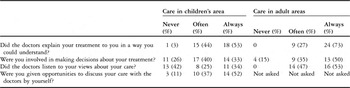
The frequency of views concerning explanations of treatment, involvement in decision making and communication processes are detailed in Table 1.
Frequency of views concerning explanations of treatment, involvement in decision making and communication processes.

In terms of care in the paediatric area, having their own television and video and friendly staff were the two areas most endorsed, whilst the least favourable aspects were the lack of facilities for teenagers, the bathroom facilities and having to share a ward area with younger children. Within the adult areas, friendly staff and their own bathroom facilities and television were the aspects which were most highly valued whilst being with older, sick patients and lack of anything to do were the areas of greatest concern to young people.
Qualitative data
Aspects of the paediatric services
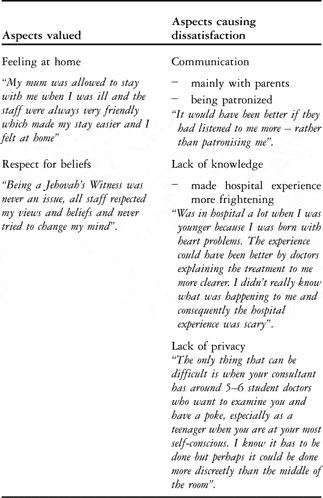
Analysis of qualitative data revealed aspects of paediatric services which were highly valued and those with which patients were most dissatisfied (Table 2). A number of patients also took the opportunity to praise the care and services which they had received in the paediatric areas: “I thought the care was really good so I don’t know how the facilities could be improved – sorry!”
Views of young people concerning paediatric services.

Aspects of adult services
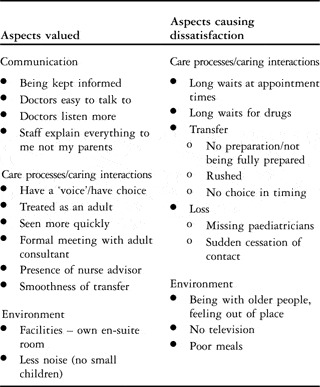
Three main themes were elicited from the data concerning young people’s views on adult services (Table 3), namely communication, care processes/caring interactions and environment.
Views of young people concerning adult services.

Important issues during transition
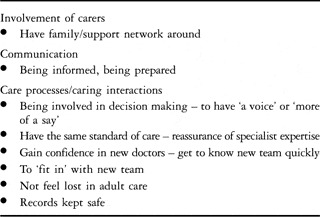
During their transition period respondents perceived it to be important to have their family and support network around and the continuing involvement of their carers (Table 4). Several young people reported that they were still dependent on their parents/carers for activities of daily living and to help them with care and treatments, whilst carer respondents voiced their feelings and concerns about their child’s transition process: “Now that my daughter has moved from paeds to adult care, I feel as if I am now supposed to be redundant – that I am expected to sit back and not be involved in her care anymore. But I can’t do that because I am her carer and she needs extra help with day-to-day living. I sit in with her in clinic appointments (at her request), but I feel as if I’m in the way. I know she has to be responsible for her illness, but her needs are such that she needs the help that I give her. In our case, I feel that (and my daughter does too) her care should be 3 way between her, myself and the team.”
Issues in transition important to adolescents and young people.

They felt that being informed and prepared for the changes in the processes of delivery of care between paediatric and adult areas was also essential: “The most important thing to me when transferring to the adult clinic was that all the decisions were made with me involved and I was able to talk about what was going to happen when I saw the doctors, which I never had a chance to do in the children’s clinic”. In particular, young people talked about “having a voice’ and ‘more of a say’ about being involved in making decisions about their care and treatment, receiving the same standard of care as they had in paediatrics, with reassurance that their care was handed over safely, and the importance of adult doctors also having specialist expertise so that they would quickly gain confidence in them. It was important for them not to ‘feel lost’ in adult services: “To be heard and for my treatment to stay the same”.
“The most important feeling was that I could fit in and that I would still receive the same care”.
Suggested areas for improvement
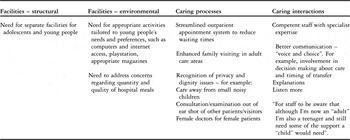
Four major areas of need (Table 5) were revealed when we analysed the data regarding suggestions for improvements in services for young people with complex cardiac conditions.
Improvements in services for adolescents and young people.

Facilities – structural
There was a need for separate facilities designated for adolescents and young people, which was identified from the perspective of both paediatric and adult services: “When I was 13, I was in a side ward with 5 babies, all were very ill and cried all night. It was a very upsetting experience for myself and any visitors. It would have been much better if there was a young adult unit. (The experience was also upsetting for the parents of the babies as they did not have privacy)”.
“It is a bit of a shock when you see all the old men, and you are young. I think we need more wards for young people”.
“To have a separate ward for teenagers and young adults with facilities for a parent to stay and look after me as I am severely disabled”.
Facilities – environment
Respondents wished for appropriate activities tailored to young people’s needs and preferences. For example, being able to use personal computers and have internet access, other facilities such as computer games, magazines and books as well as the need to address concerns regarding quantity and quality of hospital meals. “Bigger meals. More privacy, own television, more varied facilities because the adult age range is from 16 to over 100, and people have very different interests, no matter how old they are”.
Caring processes
The need to streamline the outpatient appointment system to reduce waiting times was identified. Young people wanted enhanced family visiting in adult care areas, and recognition of privacy and dignity issues, with care provided away from small children. The importance of female doctors being available for female patients was also mentioned.
Caring interactions
Fourthly, adolescents and young people moving to adult care wanted the reassurance that they would receive the same high standard of care that they had enjoyed within the children’s areas (although they did reveal some aspects of care were not satisfactory in paediatrics – for example the lack of involvement in decision making and not being involved in their care and not understanding their care and treatment). “Haven’t seen liaison nurse in clinic since transition visit. Feel vulnerable because there doesn’t seem to be the same effort made by the staff to get to know you as there was in paediatrics”.
Discussion
Listening and responding to the needs of young people is an important guiding principal in the National Service Framework for Children.18 Some young people with cardiac disease have unmet needs and have clear views about what would improve both the paediatric and adult services, as well as the process of transition between the services. As has been identified previously,Reference McCurdy, DiCenso, Boblin, Ludwin, Bryant-Lukoslus and Bosompra19 some patients viewed the paediatric service more positively than the adult service, which may be related to different models of care. Within paediatric services a family-centred approach to care is more usually adopted, which is a collaborative model that holds the family as central within a child’s life. A number of young people clearly valued this approach and some found the contrasting patient-centred approach of adult services impersonal and rushed. The family-centred approach, however, also had some drawbacks when young people felt disempowered by their own lack of involvement in their care and decision-making, and when communication focused on their parents, rather than on them. Within the paediatric setting almost half of our patients reported that their views about their care were never listened to, and one quarter never felt involved in making decisions about their treatment.
Although young people valued aspects of both the paediatric and adult service, a number of suggestions for improvement were offered. Four main themes were elicited from the responses, three of which could be addressed without the need for significant resources. Issues regarding the environment, caring processes and caring interactions could be tackled relatively easily, whilst the need for separate facilities is a structural issue and would require significant resources to address. When new services are planned, however, these issues should be considered, so that inpatient services are sensitive to the needs of young people.Reference Hudsmith and Thorne20
Research of this nature highlights the importance of asking young people themselves about what they need from a service, particularly as there can be a discrepancy between what we think we offer them and what they perceive is offered to them. These findings also emphasise the need to support young people moving into adult services, and to recognise the fact that some patients with congenital cardiac disease, although of adult age, do not feel like adults. Chronological age is not necessarily an accurate predictor of emotional maturity and developmental levelReference Tong and Sparacino21 and input needs to be tailored to the adolescent’s current level of development.Reference Tong and Kools22 Likewise, it is important to support parents and carers through the transition process and to facilitate their appropriate involvement within the adult setting. The differences between adult and paediatric services can be difficult for some patients to cope with, and indicate the need for better preparation of young people and their families. Patients’ beliefs about transition and what has been recommended for their adult follow-up have been found to be significantly correlated with successful transfer to adult services,Reference Reid, Irvine and McCrindle13 supporting the need to engage with the young person themselves regarding their beliefs and perceptions about their ongoing care as they move into the adult service.
Although this is a small study, the response rate was acceptable and the extent of rich qualitative data revealed that young people valued the opportunity to record their views. Further research needs to focus on a number of areas, including the development of alternative methods of engaging adolescents and young people in research which are more suited to young people’s lifestyle, such as text message or internet based surveys. Understanding concepts such as patient anxiety around transition, the sense of loss/sadness at leaving the paediatric team and the feelings of uncertainty regarding an unknown and less predictable future in terms of health care services are important steps in facilitating a smooth transition to adult services.
One solution to addressing some of these issues lies in the appropriate training of health professionals involved in the care of young people with cardiac disease and it has been suggested that physicians themselves can be barriers to successful transition.Reference Fox23 A reluctance to “let go”, a perception of transition as being unimportant, and poor communication between paediatric and adult professionals can all impede the process of transition. A number of our findings suggest a need for professionals working with young people to change their own perspective regarding the transition to adult services.
The recurrent theme throughout all of our findings is the importance and need for good communication, and for young people’s views to be taken into account at all stages of the patient’s journey. Young people want an individualised approach to their care which recognises that they have specific needs related to the fact they are in a process of transition from childhood to adult life.Reference Dore, de Guise and Mercier24, Reference Higgins and Tong25 They also want their emotional needs to be understood and validated, such as their sense of loss, anxiety, and need for reassurance and recognition that they may not yet be fully independent adults. As the population of adults with congenital cardiac disease continues to increase, it is evident that services in both paediatric and adult areas need to ensure that a holistic approach to meeting the needs of young people is delivered in order to empower them to make appropriate choices and decisions in adulthood.