INTRODUCTIONFootnote 1
In the summer of 1723 the antiquary Alexander Gordon of Aberdeen traversed the line of the Antonine Wall on a mission to record its standing remains. The results of this fieldwork were published in his Itinerarium Septentrionale (‘Journey over Northern Parts’) in Reference Gordon1726.Footnote 2 Many Roman inscribed and sculptured stones built into farmhouses or kept at country houses along the route of the Wall were recorded for the first time. Gordon was able to reserve several of them for his new-found patron, Sir John Clerk of Penicuik.Footnote 3
Preserved at the National Records of Scotland, Edinburgh, among the Clerk of Penicuik Muniments on deposit there, is a card wallet containing several folded sheets of paper, on four of which are drawings of eleven inscribed and sculptured stones.Footnote 4 Beside each drawing is a note in Sir John Clerk's hand, in the same ink, indicating the whereabouts of the stones. The notes were written between August and November 1723 (see below). It is clear that Clerk intended them to facilitate the removal of the stones to his home at Penicuik House, Midlothian. Some of the stones are well known. Others are alluded to by Gordon in his Itinerarium but not illustrated, so that the drawings being published here are our only visual record of them. All but two (here Nos 2 and 3) are now lost.
In August 1723, soon after he had become acquainted with Sir John Clerk, Gordon appears to have visited many of the forts on the Wall (see below). In September, after a meeting with Sir John at Penicuik, he again travelled along it, this time in the company of James Glen, of a prominent family in Linlithgow, who was shortly to become Provost of this West Lothian town.Footnote 5 In the meantime Sir John Clerk asked farmer Richard Burn, who lived close to the line of the Wall near Polmont, Stirlingshire, to secure the stones seen by Gordon.
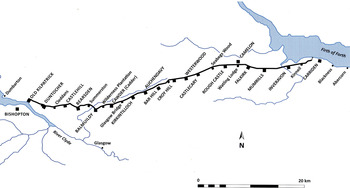
Annotations on these sheets of paper identify individuals with whom Burn would have to deal. Two letters from him to Clerk, dated 28 September and 18 November 1723, detail his efforts, not always successful, to obtain them.Footnote 6 The stones mentioned on the sheets derived from Roman forts on the Antonine Wall ( fig. 1) at Castlecary, Westerwood, Croy Hill, Bar Hill, Auchendavy, Balmuildy and Duntocher, in many cases incorporated into farm buildings constructed within their ramparts.
The Antonine Wall. (From an original drawing by Lawrence Keppie; © Society of Antiquaries of Scotland)

CATALOGUE
First sheet (NRS GD18/5068/4)
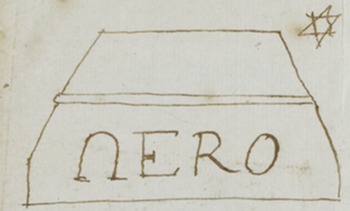
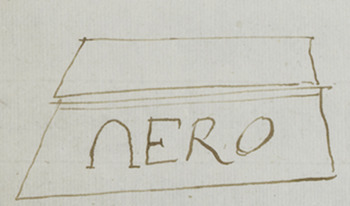
1. Duntocher. A rectangular building stone with the inscription ΩERO, above which is what appears to be a plain moulding or bevelled edge ( fig. 2).Footnote 7 ‘At the mill of Duntocher a mile westward from Kilpatrick. The millar's name is Thomas Laing.’ By ‘Kilpatrick’ Clerk means New Kilpatrick, now Bearsden, north of Glasgow.
Inscribed building stone seen at Duntocher (NRS GD18/5068/4). (Reproduced by permission of Sir Robert Clerk of Penicuik, Bt)

As Gordon reported to Clerk in a letter of 19 September 1723, ‘When Mr Burn or any goes in my name, you will have them for little more than a trifle, viz the Nero at Duntocher, which the miller would not take a farthing for, but absolutely promised to give it when asked for in my name; those at Westerwood you may also have’ (for the latter, see below No. 8).Footnote 8 The lettering on the stone was interpreted by antiquaries in different ways. Gordon evidently read NERO. However, the stone goes unmentioned in the Itinerarium Septentrionale, and there is no illustration of it.
During the preparation of his Britannia Romana, published in 1732, the Revd John Horsley was at Duntocher, and drew the letters OERO or OFRO; his drawing could indicate that the bottom of each letter was cut away. In his text Horsley tentatively suggested the word Vero.Footnote 9 No satisfactory interpretation has since been offered, unless Ω conceals a centurial sign.Footnote 10
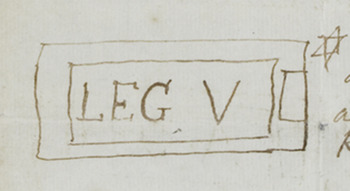
2. Croy Hill. A rectangular building stone with the inscription LEG V set within a rectangular frame ( fig. 3).Footnote 11 ‘At Mr Maxwells a change keeper in Kilsyth.’Footnote 12 Removed to Penicuik in 1723, it is now in National Museums Scotland, Edinburgh.
Inscribed building stone seen at Croy Hill (NRS GD18/5068/4). (Reproduced by permission of Sir Robert Clerk of Penicuik, Bt)

As drawn by both Gordon and Horsley, the inscription was contained within an ansate panel. Gordon read the first line as LEG V, observing that ‘two angular borderings appear on each side of the stone, so close and plain, that it leaves no room to doubt of its being read Legio Quinta; nor is there any space whatsoever, for another letter to have been put in … I found it myself, built up in a cottage, part of it being covered over with clay’.Footnote 13 Horsley, though also reading LEG V, considered that it must have been a record of building work by leg[io] V[ictrix], by which legion VI Victrix Pia Fidelis was meant.Footnote 14 R.G. Collingwood, one of the editors of RIB I, detected an additional numeral concealed in the right-hand side-frame, so allowing the numeral VI to be read.Footnote 15
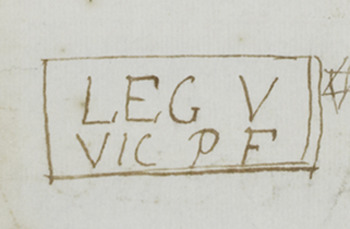
3. Croy Hill. A rectangular building stone with the inscription LEG V / VIC P F ( fig. 4).Footnote 16 ‘This stone is likeways at Mr Maxwells a change keeper in Kilsyth.’ Removed to Penicuik in 1723, it is now in National Museums Scotland, Edinburgh. Gordon, Horsley and all subsequent commentators read LEG VI in the first line.Footnote 17 It is a record of building work, like No. 2 above, by legion VI Victrix Pia Fidelis.
Inscribed building stone seen at Croy Hill (NRS GD18/5068/4). (Reproduced by permission of Sir Robert Clerk of Penicuik, Bt)

In his letter of 28 September to Clerk, Richard Burn reported that he ‘went to Kilsyth and found ther the two Stons left at Maxwels [i.e. Nos 2 and 3], but the other at Duntocher mill [No. 1] was not come that Length. I left a shill[ing] to be given for the carry of the ston that comes from Duntocher to bring it to my howse and I have two here [Nos 2 and 3] which shall be sent when the rest comes here or sooner if yow pleas’.Footnote 18
Second sheet (NRS GD 18/5068/2, recto)
4. Auchendavy. The upper half of an altar, preserving its capital with a bolster at the left ( fig. 5). On the shaft below is a pedimented frame, within which are two letters, P M. ‘These two stones [Nos 4 and 5] at Achindavey.’ The altar was damaged at the edges, especially on the right-hand side.Footnote 19 It is now lost.
Altar seen at Auchendavy (NRS GD18/5068/2 recto). (Reproduced by permission of Sir Robert Clerk of Penicuik, Bt)

In his published account of Auchendavy, Gordon mentions this stone. ‘I saw in the Wall of one of their Houses a small Altar with a Pediment supported by two Pilasters, but defaced and spoiled.’Footnote 20 He does not illustrate it and implies that the stone bore no inscription. Horsley too observed that ‘Roman antiquities have been found here, and some altars may be seen in the walls of the houses of the village [of Auchendavy], but no inscriptions on them’.Footnote 21 Perhaps the altar, if it was in fact inscribed, was dedicated to P (…) M (…),Footnote 22 or erected by P (…) M (…).Footnote 23
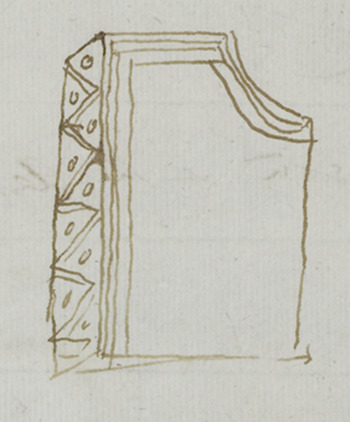
5. Auchendavy. Part of a sculptured panel, with a curving recess at the top, bordered on two sides by plain mouldings with a zig-zag dot pattern on the left ( fig. 6). It is now lost. Gordon may refer to it in his published account of Auchendavy: ‘In another Place was a very curious Stone, about four Feet long and two broad, of a bluish Colour, with several remarkable Wavings cut upon it.’Footnote 24 It could have been part of a decorative screen, or a window-arch.Footnote 25
Sculptured panel seen at Auchendavy (NRS GD18/5068/2 recto). (Reproduced by permission of Sir Robert Clerk of Penicuik, Bt)

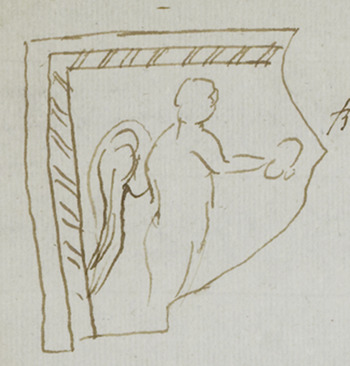
6. Balmuildy. Fragment of a sculptured panel, on which a winged figure of Victory, facing right, holds a small laurel wreath ( fig. 7). The panel is framed by rope mouldings above and to the left. ‘This stone and 3 more inconsiderable are at Bamulie built in a barn 2 miles from the kirk Town of Caldar.’Footnote 26 It goes unmentioned in the Itinerarium Septentrionale, and is now lost.
Sculptured panel seen at Balmuildy (NRS GD18/5068/2 recto). (Reproduced by permission of Sir Robert Clerk of Penicuik, Bt)

This is the left-hand side panel of a slab on which the die containing the inscription was flanked by winged Victories, a common motif on the northern frontier in Britain and elsewhere.Footnote 27 The inscription itself is likely to have commemorated construction of a stone building within the fort or its annexe, or of a gate. The nineteenth-century antiquary John Buchanan, in a footnote added to the posthumous second edition of Robert Stuart's Caledonia Romana (Reference Stuart1852), observed that at Balmuildy ‘finely sculptured stones, one in particular with a human figure in high relief and wreaths of flowers, were visible in the walls of the cottages, but are now all lost’.Footnote 28 Sir John Clerk's testimony indicates that what is presumably the same panel could be seen at Balmuildy already in 1723. The ‘3 more inconsiderable’ stones are not itemised; whether they belonged to the same slab is unknown.
7. Duntocher. A rectangular building stone bearing the letters ΩERO ( fig. 8).Footnote 29 ‘This stone is at the mill of Duntocher where there is a Roman Castellum.’ This is the same stone as No. 1 above, with a different caption.
Inscribed building stone seen at Duntocher (NRS GD18/5068/2 recto). (Reproduced by permission of Sir Robert Clerk of Penicuik, Bt)

Second sheet (NRS GD18/5068/2, verso)
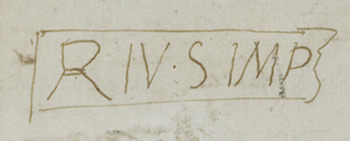
8. Westerwood. A rectangular building stone with the inscription RIVS IMP, broken at the right ( fig. 9). ‘This stone is within the barn of Rob Leeshman Tennant in Westerwood 2 ft long and 6 inches broad.’ It is now lost.Footnote 30
Inscribed stone seen at Westerwood (NRS GD18/5068/2 verso). (Reproduced by permission of Sir Robert Clerk of Penicuik, Bt)

Gordon illustrates the stone in the Itinerarium,Footnote 31 but it is absent from his text, unless included among ‘other Inscriptions [which] have been dug up [at Westerwood], some of which are broke, and built up within their Houses’.Footnote 32 But for Clerk's annotation to the drawing we would not know its provenance or its dimensions, and could easily have supposed it much smaller. In fact this was part of a slab of substantial size, likely to record building work at the fort. The letters RIVS could preserve part of a Roman name such as Valerius or Marius, a military rank such as frumentarius or tabularius, or the name of an emperor […] rius imp (erator), in the nominative case.Footnote 33 In his letter to Clerk of 19 September Burn had promised that ‘those at Westerwood you may also have’ (see above No. 1). He can be presumed to mean this stone together with another, which is conspicuous by its absence from this clutch of drawings, on which was carved in relief ‘a Priapus or penis’ ( fig. 15).Footnote 34 In his letter of 18 November 1723, Burn reported to Clerk, in relation to this second stone, that he had been ‘at Robt Lishmans and saw that stone in his byar gabell [byre gable], and wold have got it, but could not get a masone to take it out & put in another in its place’.Footnote 35 Subsequently he hired a local man who removed it (see below).
9. Netherwood. A rectangular building stone with the inscription ----------E ( fig. 10). ‘This stone is in the barn of William Greenlees in Netherwood.’ It is not mentioned by Gordon in his brief account of Netherwood.Footnote 36 It is now lost.
Building stone seen at Netherwood (NRS GD18/5068/2 verso). (Reproduced by permission of Sir Robert Clerk of Penicuik, Bt)

The present-day Netherwood farm lies some 500 m north of the Antonine Wall, midway between the forts at Castlecary and Westerwood. Antiquarian references could suggest, however, that a predecessor farm building lay further south, close to or astride the Wall itself.Footnote 37 Perhaps tooling on one face of this stone was mistaken for an inscription.Footnote 38 After his visit to Robert Leeshman (or Lishman) at nearby Westerwood (see above No. 8), Richard Burn noted ‘that in his neighbours [presumably No. 9] is not of much valew being no leters on it but m[igh]t also be got if you think proper’.Footnote 39
10. Provenance unknown. A stone bearing the inscription VLC … / RVNE / A CAT / INP A / … VM ( fig. 11). ‘In Lithgow at the Clerk's father.’ This was an upright stone, several centimetres thick, broken away at the bottom and at the right-hand side. It is now lost.
Inscribed stone seen at Linlithgow (NRS GD18/5068/2 verso). (Reproduced by permission of Sir Robert Clerk of Penicuik, Bt)

‘The clerk’ in Sir John's annotation is probably the town clerk of Linlithgow, West Lothian, which lies 5 km south of the eastern terminus of the Antonine Wall. The post of clerk at this Royal Burgh was held in succession by members of one local family, the Bells of Avontoun. Alexander Bell was ‘sheriff and town clerk’ in 1723, jointly with his father William Bell.Footnote 40 The stone is not otherwise reported. We know that Alexander Gordon was twice at Linlithgow in September 1723 (see below);Footnote 41 he might have seen and transcribed the inscription then. Though we could postulate a dedication to the god Vulcan, attested several times in Britain,Footnote 42 a Roman date cannot be assumed. An early Christian date is worth considering, unless this is a gravestone of a much later period.
Third sheet (NRS GD18/5068/5)
11. Bar Hill. A cylindrical pillar with an inscription set within plain mouldings, which reads IMP • CAES / T AE • IADR / ANTONINO / AVG • PI• PP / VEXILATIoVS ( fig. 12).Footnote 43 It was broken away at the bottom. The final two letters in the last line overlap the right-hand border. ‘This is in the garden of Kilsyth & cannot be disposed of without the factor's consent. Bayly Stark is the factor.’ The pillar was removed to Sir John Clerk's house at Penicuik in 1723 (see below), but is now lost.
Inscribed pillar seen at Kilsyth (NRS GD18/5068/5). (Reproduced by permission of Sir Robert Clerk of Penicuik, Bt)

This stone is first mentioned by John Strachey, the Somerset antiquary and geologist, in his journal of a visit to Scotland in 1721;Footnote 44 his friend William Stukeley subsequently obtained a drawing of it from him.Footnote 45 Stukeley described it, on Strachey's authority, as ‘a pillar brought from old Place. In Kilsyth Garden house, probably a milliary [this word scored through] stone for upon some road’. Alexander Gordon states that it was found at Bar Hill fort.Footnote 46 The dedication was to the Emperor Caesar Titus Aelius Hadrianus Antoninus Augustus Pius, Father of his Country, erected by vexillationes (military detachments). Gordon and Horsley believed it to be a pillar dedicated to the emperor Antoninus.Footnote 47 Subsequently it was seen as a milestone, perhaps from the Military Way at Bar Hill.Footnote 48 It is currently interpreted as an inscribed column shaft from that fort's headquarters building.Footnote 49
‘The garden of Kilsyth’, where the stone lay in 1723, belonged to a mansion house in the town owned by the Livingstons, Viscounts Kilsyth, until dispossessed in 1715 after the First Jacobite Rebellion; the house and garden appear on General William Roy's map of the area in 1755.Footnote 50 ‘Old Place’ was a ruined residence of the Livingstons west of the town, near the modern village of Queenzieburn; the circumstances of the stone's transfer to Kilsyth elude us. John Strachey was at Kilsyth in 1721 on behalf of the new owners, the York Buildings Company, which had bought up several estates cheaply in the aftermath of the Jacobite Rebellion, including Kilsyth.Footnote 51 James Stark, previously chamberlain to the Livingston family,Footnote 52 and a bailie (magistrate) in the town, leased the Kilsyth estate from the Company in 1721, but surrendered the lease in 1723, after which he served as its factor until 1728.Footnote 53 Strachey's journal records a meeting with Stark at Kilsyth;Footnote 54 perhaps they met at the mansion house, where Strachey could have seen and drawn this inscription, the only one mentioned individually in his journal.
In his letter to Sir John Clerk of 28 September, Burn reported that ‘I mised balie Stark being at Glasgow and left a leter for him with yor landledie his stepmother who favours that you shall have the ston per fass awt nefas.Footnote 55 … That in the garden of Kilsyth [No. 11] & the one at Awchenvole [ fig. 14]Footnote 56 will make a kart draught; and when they are got safe into a mans Custodie … I go west with a kart and bring them away’.Footnote 57 In his second letter, written on 18 November, Burn was able to write that he had secured the stone ‘which was in the garden of Kilsyth which I got by flatory drinking and other methods of the factor and gardner. For after the factor had given consent that I should have it, I was forced to purches his, the gardners, goodwill’.Footnote 58 The factor is presumably James Stark whom Burn had not succeeded in meeting on his earlier visit.
Fourth sheet (NRS GD18/5068/3)
12. Castlecary. Altar with the inscription IΛVNPV / MILITES / VEX IIIO ( fig. 13).Footnote 59 The first line of the inscription occupies the front face of the capital, with the other two lines on the shaft. Above is a circular focus for receiving offerings. ‘This stone is left at Thomas Bairds a change keeper in Cumbernald.’ It is now lost.
Altar seen at Cumbernauld (NRS GD18/5068/3). (Reproduced by permission of Sir Robert Clerk of Penicuik, Bt)

This is the upper half of an altar first mentioned by Dr Christopher Irvine in 1682,Footnote 60 and shortly afterwards by Sir Robert Sibbald,Footnote 61 as found ‘near to’ Castlecary and held by the Earl of Wigton at Cumbernauld Castle 3 km to the south-west of Castlecary Roman fort. As Irvine's and Sibbald's testimonies make clear, it was an altar dedicated to the Mother Goddesses (the first line read MATRIBVS) by a detachment (vexillatio) of soldiers.Footnote 62 By 1723 the altar was broken in two, and one line lost. Alexander Gordon saw only the upper half, which is the subject of this drawing. As he reports, ‘at this Place [Castlecary Roman fort] was also dug up another small portable Altar, with an Inscription partly obliterated; only in the Middle, beneath the Cornice, are these words, MILITES VEXILLATIO III’.Footnote 63 Gordon offers no explanation of the letters in the first line.
In September 1723 Richard Burn had gone to Cumbernauld where he ‘cald for Thos Baird conforme to orders & desierd the ston spok of in yors [No. 12], offering the half croun; he [i.e. Thomas Baird] wold not give it, at any rate until he acquanted My Lord’, presumably the Earl of Wigton. ‘I went along and he wold at norate let it go.’Footnote 64 It was presumably the Earl to whom Burn had spoken, having gone to the latter's nearby home at Cumbernauld Castle. Burn goes on: ‘I met at Kilsyth fair with My Lord Wigtons factor who told me he heard My Lord say he was sorry he had refused you the stone but he was to be at Ed[inburgh] this winter wher he wold see you.’Footnote 65 Both the upper and lower parts of the altar were seen a few years later at Cumbernauld Castle by the Revd John Horsley who concluded from a study of their dimensions that they derived from separate stones.Footnote 66
DISCUSSION
The sequence of events in 1723 can be tentatively reconstructed from the contemporary correspondence,Footnote 67 from the annotations to the drawings being published here and from Gordon's subsequent account in his Itinerarium Sepentrionale.
On 19 August 1723, Gordon was expecting to ‘go out of Town’ (i.e. Edinburgh) with Sir John Clerk the following day, on what he describes as his ‘antiquary peregrination’, which was to include tracing ‘the Vallum’ between Forth and Clyde.Footnote 68 Whether Gordon saw the Wall and its forts in Clerk's company is unclear; he never claims to have done so, as he did Hadrian's Wall in 1724, and the surviving correspondence suggests that he did not.Footnote 69 However, Gordon must at this time have set in motion arrangements for the stones he had located to be placed in the temporary custody of the change keepers at Kilsyth and Cumbernauld. In September Gordon was again on the Wall, this time travelling with James Glen of Linlithgow (see above); Glen was able to purchase two altars, one of them from Bar Hill fort,Footnote 70 much to Gordon's chagrin, since he had intended to secure them for Clerk. Near Linlithgow, on their return journey, the two travellers unexpectedly met Richard Burn, belatedly only now setting out westwards on the task Clerk had set him. Burn quizzed Gordon about the ‘Nero’ stone and the altar at Auchenvole Castle ( fig. 14), which were among those he had been asked to secure, resulting in an altercation. On 28 September Burn reported to Clerk on the progress of his endeavours.Footnote 71 In November we find Burn making another visit to the Wall, in search of those inscribed stones which had previously remained elusive.Footnote 72 There is no hint that Burn was asked to seek out the relief sculpture at Auchendavy or Balmuildy, neither of which sites he seems to have visited; in general the antiquaries of the time were less concerned to acquire sculptured panels than stones inscribed with Latin texts.
Altar seen at Auchenvole Castle, as drawn by Alexander Gordon, rear and side faces.

From Burn's letters we know that Sir John Clerk had provided him with a ‘Memorandom’, alluded to several times in both letters, which it is tempting to equate with the sheets of paper being discussed here, or which was based on them. It served as an authorisation for him to ask for the stones in Clerk's name, and established his bona fides. Burn left the memorandum with the local man whom he engaged to remove the ‘Priapus’ stone from the farm building at Westerwood (see above No. 8);Footnote 73 perhaps it contained a drawing of that stone, which does not feature here. Clerk had given Burn money to pay out to people holding the stones. Burn's letters detail the sums expended; he spent it all and borrowed more. The correspondence reveals the practicalities of antiquarian collecting in the early eighteenth century: diplomacy and perseverance were both needed, and alcoholic drink could smooth the path to acquisition.
We have a more formal account in Gordon's Itinerarium Septentrionale (Reference Gordon1726). He is economical with the facts: for example, in relation to the ‘Priapus’ stone at Westerwood ( fig. 15), he states that ‘This singular Curiosity I procured and gave it to … Baron Clerk’,Footnote 74 whereas we know from the correspondence that it was Richard Burn who hired a local man to remove it from the farm building at Westerwood and had it delivered to his house for onward transmission to Penicuik.Footnote 75
The ‘Priapus’ stone at Westerwood, as drawn by Alexander Gordon.

The authorship of the various drawings on these sheets is uncertain. Economy of hypothesis might suggest that they were the work of Sir John Clerk himself, at the same time as he penned the accompanying annotations; but it is not at all clear that Clerk himself was at any of the sites. He must therefore have copied them out from a correspondent, most obviously Alexander Gordon.Footnote 76 Of the eleven stones drawn here, six are reported by Gordon in the Itinerarium, one is illustrated by him but not described, and four are absent; perhaps Gordon decided in the end that some were not genuine antiquities. In two cases Gordon's published drawings closely match these ones (Nos 8 and 12), but in other cases they do not (Nos 2, 3 and 11). The two which do match Gordon's were those which Clerk in the end failed to secure; perhaps Gordon subsequently re-examined the others at Penicuik House and drew more polished versions for publication.
By the end of 1723 Clerk had thus acquired the two building stones from Croy (here Nos 2 and 3), the altar at Auchenvole Castle, the ‘Priapus’ stone from Westerwood,Footnote 77 the inscribed pillar from Bar Hill (here No. 11), together with a fragmentary ‘new stone’ from Castlecary.Footnote 78 In March 1724 Richard Burn went at Clerk's request to Linlithgow, where he endeavoured without success to persuade James Glen to part with stones he had purchased in the previous year while travelling with Gordon.Footnote 79 During a visit to the line of Hadrian's Wall in the spring of 1724 Clerk acquired inscribed and sculptured stones from Housesteads and Carvoran.Footnote 80 At much the same time he came into possession of an inscribed centurial stone from Cramond, Midlothian, the estate of his wife's family.Footnote 81 A few years later he secured a broken altar from Castlecary fort, then held at nearby Castle Cary castle.Footnote 82 In 1731, in the course of a journey to Penrith, Cumbria, Clerk purchased a group of inscribed and sculptured stones at Middlebie, Dumfriesshire, from the nearby fort at Birrens.Footnote 83 His collection of antiquities was now well established. They were displayed at Penicuik House, Midlothian, alongside souvenirs of a two-year Grand Tour to Italy, in his study and in his garden.Footnote 84 In 1857 they were presented by Sir George Clerk, 6th baronet of Penicuik, to the then National Museum of Antiquities of Scotland, Edinburgh (now part of National Museums Scotland), where they remain.Footnote 85
ACKNOWLEDGEMENTS
I am grateful to Sir Robert Clerk of Penicuik, Bt, who generously allowed the use here of documents preserved in the Clerk of Penicuik Muniments, of which he holds copyright and which are on deposit at the National Records of Scotland, Edinburgh, where Stuart McMillan and his colleagues in the Historical Search Room facilitated my examination of them. A grant from the Jennie S. Gordon Memorial Foundation covered the cost of photography. A marginal note in William Stukeley's own copy of his 1720 treatise, An Account of a Roman Temple, held by the Sackler Library, Oxford, is cited with permission of Dr Graham Piddock, Librarian-in-charge. I am glad also to thank Laurie Alexander, Elizabeth Bell, Professor Anthony R. Birley, Sybil Cavanagh at the West Lothian Heritage and Information Centre, Linlithgow, Morag Cross, Professor Stephen Driscoll, Dr Fraser Hunter and Dr Roger Tomlin. A draft was read by Morag Cross and Dr Iain Gordon Brown.