INTRODUCTION
Breathlessness, or dyspnea, is a common symptom among patients in primary healthcare (Huijnen et al., Reference Huijnen, van der Horst and van Amelsvoort2006) and has been ranked fifth among the top 10 differential diagnoses in family medicine (Ponka & Kirlew, Reference Ponka and Kirlew2007). The underlying causes are mostly cardiopulmonary diseases such as heart failure (CHF), ischemic heart disease (IHD), asthma, and chronic obstructive pulmonary disease (COPD). However, obesity, anxiety, anemia, and advanced cancer can also cause breathlessness. Breathlessness has been difficult to quantify, and in that respect, it may be compared to pain and fatigue as a highly subjective symptom.
Breathlessness can be measured either using one-dimensional scales such as the Visual Analogue Scale-Dyspnea (VAS-D), Medical Research Council (MRC) Breathlessness Scale, modified Borg scale (Stenton, Reference Stenton2008; Johnson et al., Reference Johnson, Oxberry and Cleland2010; Saracino et al., Reference Saracino, Weiland and Jolly2010) or by means of questions about the degree of breathlessness in connection with activities (Bestall et al., Reference Bestall, Paul and Garrod1999; Mahler et al., Reference Mahler, Ward and Fierro-Carrion2004) or by measuring the impact of breathlessness on health related quality of life (Guyatt et al., Reference Guyatt, Berman and Townsend1987; Jones et al., Reference Jones, Quirk and Baveystock1992). In the latter case, multidimensional scales or questionnaires are often used. Despite all efforts and because of the complexity of breathlessness, it has been difficult to find an accepted method to quantify breathlessness in a clinical setting (Bausewein et al., Reference Bausewein, Farquhar and Booth2007).
Understanding breathlessness from the patients' point of view gives us valuable insight about what impact it has in patients' day-to-day life; furthermore, the fact that it is a subjective symptom makes it a suitable study object in a qualitative investigation. In previous qualitative studies, breathlessness was studied in light of underlying disease (Gysels et al., Reference Gysels, Bausewein and Higginson2007); therefore, we wanted to collect data about breathlessness regardless of any underlying disease (Booth et al., Reference Booth, Silvester and Todd2003; Edmonds et al., Reference Edmonds, Rogers and Addington-Hall2005; Arne et al., Reference Arne, Emtner and Janson2007; Mahler et al., Reference Mahler, Waterman and Ward2007; Roche, Reference Roche2009). The aim of the study was to illuminate how patients suffering from breathlessness experience their everyday life.
METHOD
Design and Participants
The study uses qualitative content analysis. The selection of participants took place at a health center when patients came to their ordinary check-ups asked by their regular physician. Twenty patients were included voluntarily. The inclusion criteria were the presentation of breathlessness and adult age. Patients were excluded if they had a history of malignant disease, dementia, or panic disorder.
Data Collection and Analysis
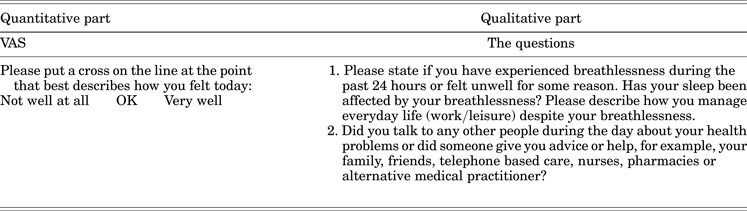
We used an inductive content analysis method by using diaries as a tool for data collection (Elo & Kyngas, Reference Elo and Kyngas2008). Diaries have been used extensively in research (Freer, Reference Freer1980), but not as a qualitative data collection instrument about breathlessness. Therefore, we used a diary as a tool for data collection consisting of two open-ended questions. The participants were instructed to complete the diaries for each day in the evening. They were asked to take notes about their feelings and experience with breathlessness every day for 7 days. The patients were able to free associate when writing about their breathlessness. The two questions were:
1. Please state if you have experienced breathlessness during the past 24 hours or felt unwell for some reason. Has your sleep been affected by your breathlessness? Please describe how you manage everyday life (work/leisure) despite your breathlessness.
2. Did you talk to any other people during the day about your health problems or did someone give you advice or help, for example, your family, friends, telephone-based care, nurses, pharmacies, or alternative medical practitioners (Table 1)?
The model of the diary

We used VAS-D as an instrument for repeated measurements in order to describe the health state of the population on an everyday basis (Parkin et al., Reference Parkin, Rice and Jacoby2004).
The diaries were coded, and only the researcher knew the participants' identities. Diaries were tested on four participants in the beginning of the study. We found that it would be difficult for participants to keep a diary for more than 7 days.
We transcribed all collected diaries in a word processor. When analyzing the diaries, we followed the steps for analyzing qualitative data described by Graneheim and Lundmann (Reference Graneheim and Lundman2004). The diaries were read through repeatedly in order to get a feeling for the whole. Sentences that were relevant to the issue were selected. Meaning-bearing units were identified and coded and then categorization of texts was made. The approach was patient centered and more holistic, not just individual parts of tales. All researchers were involved in the interpretation and categorization of the text, and the process continued until agreement on categories was reached. Two themes emerged when we evaluated the data further.
Ethical Consideration
The Regional Ethical Review Board in Gothenburg (Sweden), Dnr 157/11 approved the study. Instructions and purpose of the study was given to the participants in both written and oral form. The study was conducted in accordance with the Helsinki declaration (Williams, Reference Williams2008). Written informed consent was obtained from all participants.
RESULTS
Twenty patients agreed to participate in the study. However, four of the patients did not continue their participation. Two of the patients reported that they were no longer breathless, and the other two were not able to fulfil the task with recording diaries. They were, therefore, excluded from the study. However, 16 patients: 7 men, mean age 65 ± 7 (range 55–73 years old) and 9 women, mean age 65 ± 9 (range 50–72 years old) completed the study.
Five of the participants had a diagnosis of COPD (four women, one man), six had a CHF diagnosis (one woman, five men), three had anxiety disorder (all female), one had aorta stenosis (male) and one had an asthma diagnosis (female). Five participants were smokers (four had COPD and one had anxiety disorder), whereas two of the patients were former smokers (one had COPD and the other had anxiety disorder).
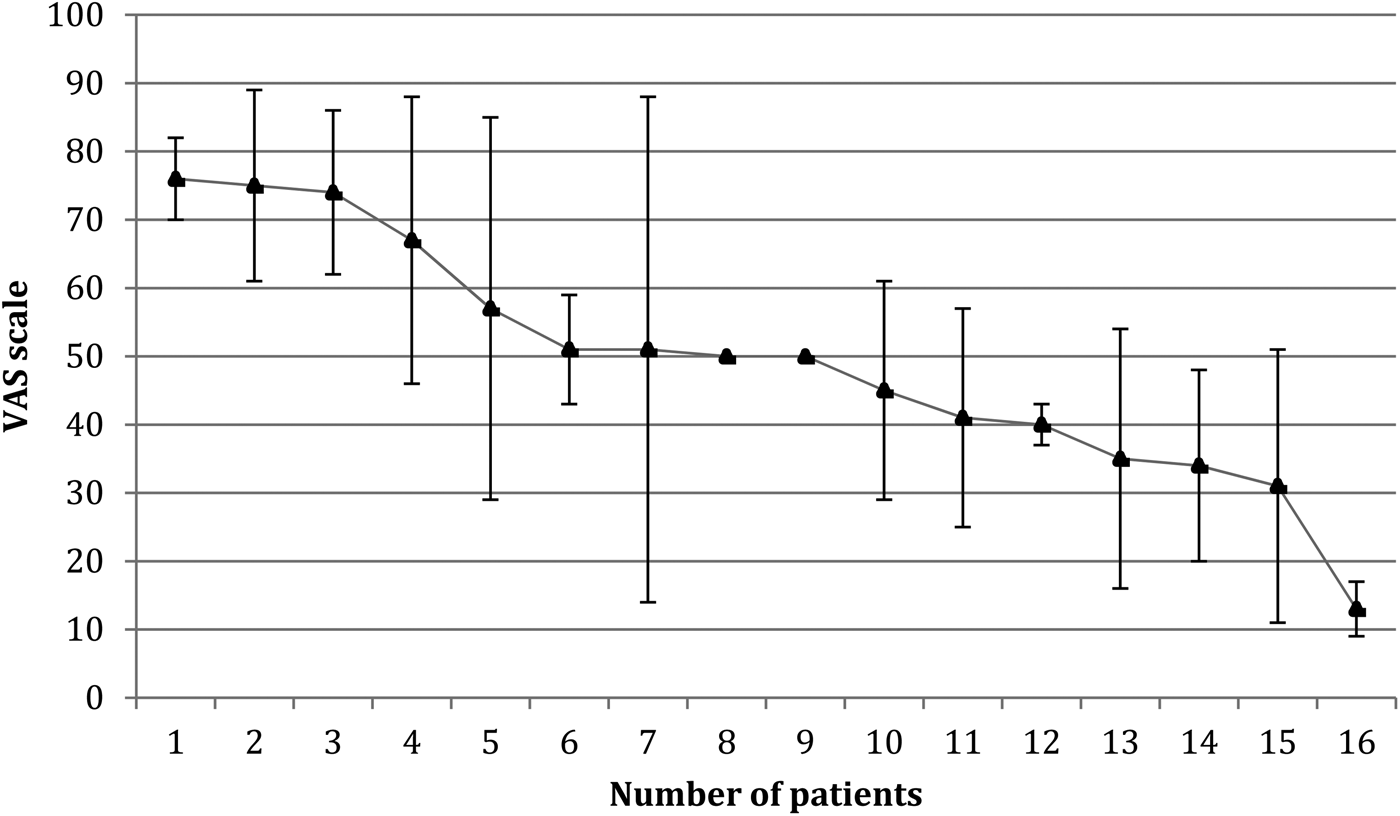
Participants marked the state of their health one time a day on the VAS. Seven observations equal to the number of days they participated were then done.
Minimum, maximum, mean, and standard deviation were calculated as shown in Figure 1.
Daily VAS-D score for participants (n = 16): mean, minimum and maximum values
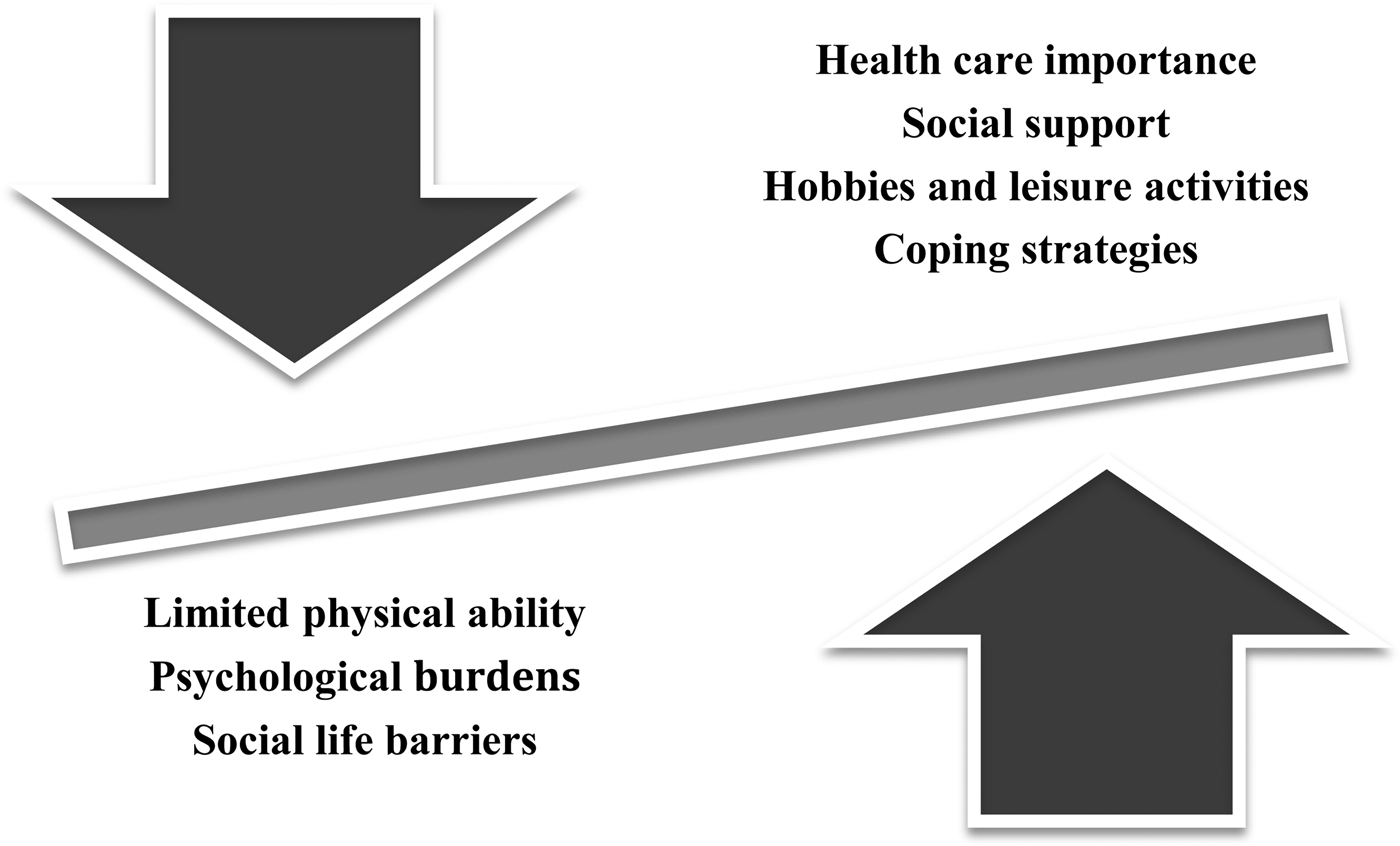
We found 21 subcategories and 8 categories, and after analyzing the content further, two themes emerged: (1) Impaired quality of life and (2) symptom tolerance and adaptation.
Impaired Quality of Life
Breathlessness had a negative impact on how everyday life was experienced by the patients; moreover, they described it in different terms such as weakness, tiredness, fatigue, feeling run-down, having insomnia, stress, or anxiety. They even mentioned problems in their social life such as difficulty talking with others about their problem and inability to play with their grandchildren. All these complications had consequences for their social life. The following categories are included in the theme: limited physical ability, psychological burdens, and social life barriers.
Limited Physical Ability
The most common consequence of breathlessness was activity limitation and tiredness. Participants mentioned weakness doing or inability to do common daily tasks as being major limitations in daily life. Several patients had problems with heavy lifting or performing other physically demanding activities because they could cause breathlessness. One patient said: “I have difficulties to go more than 12 metres sometimes.” Some avoided physical activities because of the burden of the persistent breathlessness.
Psychological Burdens
Breathlessness caused emotional problems and vulnerability. Some participants mentioned sleep disturbances and stress as major psychological burdens. Seven of the participants had some kind of sleeping problems either difficulty in falling asleep or poor sleep quality. One patient said: “I am awake most of the night because of my breathlessness.”
For some patients, their symptoms of breathlessness were characterized by anxiety. The problem could be mild or severe and sometimes caused inability to cope with daily lifès demands. One participant said: “Sometimes I feel that I walk beside myself.”
Social Life Barriers
Breathlessness was an obstacle to the patients' social life and a significant cause of reduced quality of life. The symptoms had a negative influence on social relationships. One participant puts it this way: “Today, I thought life was hard when I could not be with whom I wanted to be with.” Lack of confidence made it difficult for them to participate in many of the activities they most desired. One participant said: “My problem stops me in my social life. I am not sure anymore. Can I do this? Can I do that?” Some participants wrote about their loneliness and the unwanted isolation they had to endure because of their breathlessness.
Symptom Tolerance And Adaptation
The participants indicated that they were able to tolerate the severity of their symptoms with appropriate medication and/or if they had support from their family or if they were involved in some kinds of activities. They had developed different coping strategies. The following categories were finally considered: importance of healthcare, social support, hobbies and leisure activities, and coping strategies.
Importance of Healthcare
Several patients mentioned the importance of medication. Some felt anxious if they did not have their inhalators nearby prior to going out and shopping. Others mentioned the importance of check-ups at the health center. They relied very much on their regular controls. One patient said “Everything is easier and gets a little more positive after my check-up today. It has probably helped a bit with the higher dose of medicine.”
Social Support
The support they got from family members and friends allowed patients to feel better. One patient said: “I have met and spoken with some friends today who know well my problems… . . that simplifies a lot.”
The support could be physical assistance, for example, helping them with cleaning their home or washing dishes, but it could also be emotional support. It could be talking on the telephone with an adult child or going out with relatives or friends.
Hobbies and Leisure Activities
Eight of the patients mentioned the importance of mental and physical activities. Walking alone or with a dog was something that was appreciated by many. Dancing, painting, gardening, and cooking were also activities mentioned by the participants. These activities often helped them to forget their problems. One of the participants mentioned: “Walking with my dog is something I like, easy to breathe and I feel good afterwards.” Another participant said: “Easier gardening today. A positive day.”
Coping Strategies
The patients exhibited various forms of coping that helped them get through everyday life with their breathlessness. Denial, reflection, planning, and adaptation were some of these strategies.
Denial and refusal are examples of negative coping that may be important for some patients. “When I am better I don't want to think about my disease.”
One of the patients put it this way: “When I read what I wrote, I realise that I should work out and begin to exercise more. I have actually wanted to do it for a long time, but it becomes so clear here.”
Some of the participants mentioned how they plan their days in order to be able to get things done. One said: “I plan my actions as good as possible, breathe deeply, resting and so on.” And yet another said: “I have changed my lifestyle slightly and I work less than before, otherwise I cannot handle my situation.” Symptoms get worse gradually, which makes adaptation possible.
As one mentioned: “It is so gradual that you learn to live with it.” And another said: “Living with health problems for a long time makes you eventually get used to it. The abnormal becomes normal in the end.”
DISCUSSION
The findings in our study showed that patients, in spite of considerable difficulties with shortness of breath, found relief in several types of activities, in addition to drug therapy. Hobbies and leisure activities were sources of recreation and vitality. Support from family members and friends were also crucial to enable patients to get through the times when the breathlessness was at its worst[R1]. Patients had a variety of different psychological tools to cope with their symptoms on a daily basis (Fig. 2). The physical, Psychological and social dimensions of patients' lives were affected by breathlessness to different degrees. However, this was compensated for by factors that improved day-to-day life for participants. Some of them developed new ideas about how they experienced life with their symptom. Some patients mentioned that keeping a diary during the study period had helped them to reflect on their situation and that they could see their problems much more clearly as a result.
Categories illuminating how patients suffering from breathlessness experience their everyday life
The strength of our study was that the study engaged all the participants to tell as much about their symptoms as they wanted. We felt that it was valuable for patients with breathlessness to write in diaries. Diaries have demonstrated their research potential in many studies, and it appears that they may have particular value in data collection on common health problems and the psychosocial dimensions of these problems (Freer, Reference Freer1980). Using a diary in the investigation of breathlessness was, to our knowledge, new; both researchers and patients obtained new insights about the participants' day-to-day life with breathlessness.
However, the challenge in our study was the low number of patients who participated in the study. Some participants seemed to lose focus on the issue in longer follow-ups, something we noticed in the beginning of the study. This allowed us to determine on a length of 2 weeks for data collection.
The fact that the daily life of patients was affected in all three areas—physical, psychological, and social—as a consequence of breathlessness could raise the question whether a biopsychosocial model (Engel, Reference Engel1977,Reference Engel1983) could ease the understanding of this highly subjective symptom. Engel highlighted the framework of the biopsychosocial model for a new understanding of a variety of illnesses (Engel, Reference Engel1977). The model has been used for a better understanding of the symptom pain (Lumley et al., Reference Lumley, Cohen and Borszcz2011). The results of the study indicate that the biopsychosocial model described by Engel is an appealing approach, which should be discussed further to gain a better understanding of the symptom of breathlessness.
Restriction in everyday life and limitation in physical activity have been described earlier both in patients with CHF (Edmonds et al., Reference Edmonds, Rogers and Addington-Hall2005) and COPD (Roche, Reference Roche2009). In their article, Baily et al. highlighted the importance of nonpharmacological management of breathlessness (Bailey et al., Reference Bailey, Wagland and Dabbour2010) and in our study we could see how participants told about their different strategies coping with breathlessness in daily life.
Diaries as a data-collecting tool among patients with breathlessness may carry information about the immanent potential patients have to handle the everyday life. It could also be used for monitoring the progression of breathlessness or the effect of medication. More research should be conducted about how diaries could be used in an effective way in primary care as both diagnostic and monitoring tools. Developing a biopsychosocial perspective is important in primary healthcare when meeting with patients with breathlessness.
Efforts should be made to deal with breathlessness from a biopsychosocial perspective when meeting patients with breathlessness in primary care.
This could lead to a better understanding of not only the specific symptoms but also of the patient with the symptom. Use of diaries by patients with breathlessness can lead to greater motivation and ability to reflect by the diary keeper.
Because patients have different types of activity limitation, it is important to offer them activities and exercise in different forms. Cognitive behavioral therapy could also be considered as part of the treatment of breathlessness, especially among patients with anxiety or even other disorders such as underlying diseases.
ACKNOWLEDGMENTS
The authors thank those who took part in the study and the staff at the Carema Health Centre in Henån for their assistance. Researchers Nasser S. Ahmadi (guarantor), Jörgen Månsson, Ulf Lindblad, and Cathrine Hildingh were jointly responsible for the study design. All authors were responsible for the conduct of the study and much of the data analysis. Nasser S. Ahmadi prepared the first draft of the report. Jörgen Månsson, Ulf Lindblad, and Cathrine Hildingh provided feedback and comments on the final document. All authors approved the final version of the manuscript. The study was funded by Carema Research Fund, Sahlgrenska Academy, and the local research and development (R&D) unit in western Sweden.