The Discovery in the Cave
It was 6:30 a.m. on a July morning in 2015 in a church built hundreds of years ago inside a cave by the early Christians who carved the Hallaç Dere Monastery (also known as Hospital Monastery) out of the volcanic stone in Cappadocia, Turkey. The ceiling of the church had partially collapsed. The morning sunshine was kindly filtering in through the holes in the ceiling and the windows partially illuminated the somber interior. I sat quietly on a piece of rock, watching the two men who were practicing an action a few meters away from me. I was the only spectator, and the men were French actors Philippe Dov Cohen and Bastien Ossart, who were collaborating with Ideogram Théâtre on a new work, Yer ve Gök Arasında Köroğlu (Between Earth and Sky Köroğlu, 2015).Footnote 1
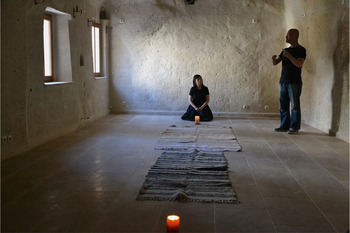
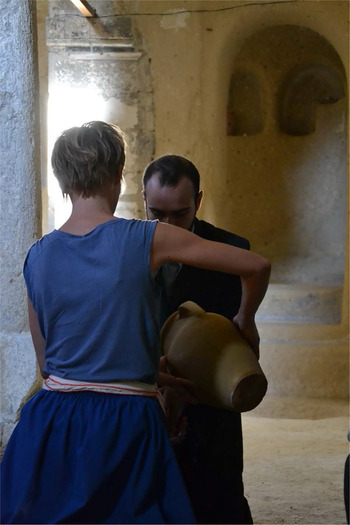
From left: Ori Gershon and Tapa Sudana in rehearsal for Yer ve Gok Arasında Koroğlu, written and directed by Ali İhsan Kaleci. Mustafapaşa, Ürgüp, Nevşehir, Turkey. The Hidden Valley, 2015. (Photo by Ideogram Théâtre)

Ideogram Théâtre is an international group based in Paris at the CRT St. Blaise (Centre de Recherches Théâtrales Saint‐Blaise). Since it was established in 2007 by Ali İhsan Kaleci — a Paris‐based Turkish theatre director and writer originally from Ankara — CRT has conducted various, mostly international projects combining research, training, and production. The current permanent members of CRT and Ideogram Théâtre are Kaleci (artistic director), Erica Letailleur (actor and performing arts researcher), and Ori Gershon (dance artist). The group also collaborates with international artists and researchers in Paris, and at certain times of the year, in Cappadocia, Turkey. To date, Ideogram Théâtre has produced three works, all written and directed by Kaleci: Destan (Saga; 2011–12), Leyla ve Mecnun (Leyla and Mecnun; 2013), and Köroğlu (2015) (see CRT Ideogram Theatre 2016; Ideogram Théâtre n.d.). In 2018, Kaleci directed his play Gün Batımı (Twilight, 2017), not with Ideogram Théâtre, but in collaboration with Turkey’s Ankara State Theatre. In 2020, he started to work in Paris on a new play he wrote: Viyana’da Yeşil Park (Green Park in Vienna, Reference Kaleci2019).
From left: Jeanne Truong and Ali İhsan Kaleci in rehearsal for Leyla ve Mecnun, based on the writings of Fuzuli, written and directed by Ali İhsan Kaleci. Ortahisar, Nevşehir, Turkey, 2013. (Photo by Ideogram Théâtre)

Even though Köroğlu was to be staged within a month, Cohen and Ossart were not rehearsing the play that early morning; rather they were carrying out a task that was given to them by Kaleci. I observed their practice as a part of my fieldwork with Ideogram Théâtre, exploring the existing as well as potential connections of Turkish performance traditions to the actor’s art. The traditions in question range from music, singing, dance (Turkish folk music and dance, Turkish classical music), and old theatre forms (folk theatre, ortaoyunu) to storytelling (meddahlık and âs¸ıklık), shadow puppetry (karagöz), and Islamic rituals (semâ and semah) (Sözer Özdemir Reference Sözer Özdemir2016).
In the church inside the cave, the two men were standing, walking, speaking, contemplating, sitting down, standing up, lying down, running, and singing. They were performing all these actions barefoot on the volcanic dust that covered everything, including their bodies. Their voices, ranging in volume from whispering to shouting, echoed off the floor and walls, reverberating inside the barren space. I took copious notes, but refrained from taking any photographs or videos. I watched, I reflected, and I tried hard to figure out what the actors were doing and why.
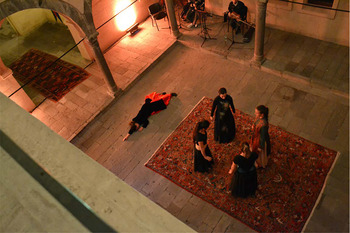
From left: Neslihan Derya Demirel (lying on the floor), Sakine Kaya Ori Gershon, Gökçe Akaşkın, and Erica Letailleur in Destan, written and directed by Ali İhsan Kaleci. Mustafapaşa, Ürgüp, Nevşehir, Turkey. Madrasa of Mehmet Şakir Paşa, 2012. (Photo by Ideogram Théâtre)

The day before I went to the cave to observe Cohen and Ossart, I interviewed Kaleci about Köroğlu, as well as the artistic principles of Ideogram Théâtre. I had known the group for five years, collaborating with them as an actor and a researcher. I was familiar with how they drew on Turkish folk music and dance, Turkish classical music, and Islamic rituals. During our various encounters since I met Ali İhsan in 2011 when I participated in a short‐term workshop offered by Ideogram Théâtre in Cappadocia, he has expressed his view of the artistic kinship among these traditions: they are explicitly or implicitly connected to and shaped by two interrelated religious teachings of Turkey, tasavvuf (Mevlevi Order of Sufism) and the teaching of Alawite Islam (a branch of Shi’a). Kaleci explored these ideas in two books: İnsana Ayna İnsan, Tiyatro (Human as the Mirror of Human, Theatre; 2015a) and Tiyatro İs¸te Bu Ağaç (Theatre Is Indeed this Tree; 2015b). During our conversation the day before I visited the Hospital Monastery, he particularly emphasized the importance of semâ–a Mevlevi ritual in Anatolia, composed of praying, poetry, singing, music, and a whirling movement. The basic aim of semâ is to create spiritual connections between and among Mevlevi dervishes, which turns into a connection with Allah, uniting one’s being or self with the Supreme Being (And Reference And1977:83–86; Ceyhan Reference Ceyhan2009:455–57; Gölpınarlı Reference Gölpınarlı2006:59–123). Kaleci is not the only Europe‐based artist referring to spiritual traditions like Sufism as sources for their work. Such an interest, which parallels the rise of cultural tourism in the homelands of such traditions, has existed in the theatre/dance world for a long time. X. Theodore Barber indicates how in the 1920s choreographers, dancers, and mystics such as Jean Borlin, George Ivanovich Gurdjieff, Mary Wigman, and Ted Shawn were drawn to the Mevlevi semâ as a relatively unexplored movement practice (Reference Barber1986:329). Today, Turkish dancers who live and work in Europe, such as Ziya Azazi and Berrak Yedek, use tasavvuf and semâ as well. Kaleci is suspicious of this interest of theatre/dance artists in spiritual traditions. According to him, such attempts mostly result in separating the spiritual traditions in question from their raison d’être (Reference Kaleci2015a:73–78). Not so with Kaleci, for whom semâ and tasavvuf constitute the essence of his approach to theatre and the art of acting.
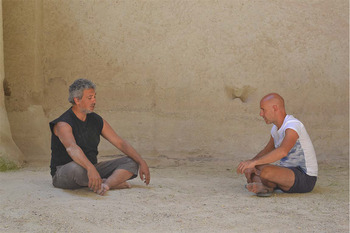
From left: Philippe Dov Cohen and Bastien Ossart in rehearsal for Yer ve Gok Arasında Koroğlu, written and directed by Ali İhsan Kaleci. Ortahisar Nevşehir, Turkey. Hospital Monastery, 2015. (Photo by Ideogram Théâtre)

What the two actors were working on that morning was a poetic monologue that told Cohen’s life story about his family, Tunisian Jews who migrated to France. The monologue started with the words “Je m’appelle Philippe Dov Cohen” and included Cohen’s childhood memories, as well as his recent past and current life as the father of two sons. Cohen had composed an acting structure for this monologue, which started with him standing straight, close to one of the four walls of the church, contemplating the empty space in front of him and then singing a song. After proclaiming his name, he began to move within the empty space, stopping at certain spots that seemed to represent in his mind’s eye the milestones of his life story as narrated in the monologue. During the verses of the monologue that were about the death of his father, Cohen sat on his knees and picked sand from the ground. He brought the sand close to his eyes and softly sang a Hebrew song. Later he asked why his father gave him two names, one Jewish and one Arabic, and whether he was a Jew or not. Another song followed his words. Throughout the monologue, he frequently asked “pourquoi?” (why?). Towards the end of the monologue, he rushed forward to open an imaginary door, behind which he found something important, but we did not know what. Then he sang another song, before ending where he started, contemplating the empty space in front of him.
When Cohen reached the end of his monologue, he started again and again without pause, saying each time “Je m’appelle Philippe Dov Cohen.” An apparently endless cycle. After a while, Ossart, who watched Cohen silently and respectfully, stepped into the space, slowly and gently. In the beginning, I heard some unintelligible words. Ossart whispered while sitting on the floor, his body bent forward. I gradually realized that Ossart was part of Cohen’s acting structure. Although they spoke and acted each in his own way — Cohen sang in Hebrew, Ossart chanted something Christian in Latin — I observed that Ossart mirrored Cohen’s actions. This mirroring created a subtle connection between the two actors and allowed Cohen to see his own life not only in his mind’s eye, but also in a living mirror.
When the two actors felt tired, they stopped working on the monologue. Cohen started teaching Ossart one of the songs of his acting structure. They half sat, one knee on the ground, face‐to‐face, singing together looking directly into each other’s eyes. After a while, singing and with eyes still locked, they stood up and began walking together in a circle, their singing at higher volume. They approached each other and then separated a couple of times, as if about to duel. They also saluted each other many times by sitting on the ground and bowing until their hands and foreheads touched the ground. In this way, Cohen taught Ossart the text of the monologue. Then, they resumed working on Cohen’s acting structure. This time, Ossart participated in the Hebrew song he learned from Cohen. In each cycle, the two actors moved faster and more actively. I began to realize that gradually Ossart’s mirroring began to influence Cohen, who started to mirror Ossart, which meant he was mirroring Ossart’s mirroring of himself. Eventually, the actions of the two men merged in such a way that it became impossible to tell who was mirroring who; who was the original and who the reflection. Then, suddenly, it all fell into place: Ayn! This is the word I wrote repeatedly in my notebook.
Ayn is a significant concept in tasavvuf. Kaleci had emphasized it in our meeting the day before I visited the cave. “Ayn,” of Farsi origin, shares a common etymological root with ayna, mirror.Footnote 2 The dictionary definition of ayn includes “eye,” “spring,” “fountain,” as well as “epitome” or “the very self, the essence of a thing” (Yavuz Reference Yavuz1991:256). In tasavvuf, ayn denotes the very self of the Supreme Being from which all beings emerge, and the ideal state a Mevlevi strives to attain, where they see everything existing in and coming from Allah (Uludağ Reference Uludağ1991:256). Ayan, the plural of ayn, denotes “eyes,” but it also means “clear,” and “evident” (Yavuz Reference Yavuz1991:256).Footnote 3 The idiom “to become ayan” (ayan olmak) means “to be clear,” “to be evident.”Footnote 4 In the early hours of that summer morning watching Cohen and Ossart, I felt as if in a flash it all became ayan to me.
The Meaning and Objective of Semâ
A word of Arabic origin, semâ means “hearing, listening,” as well as “the heard word,” “a pleasant sound,” and “good reputation”; and in tasavvuf it denotes an important Mevlevi ideal: “Hearing of the apparent [zâhirî] and the immanent [bâtınî]” (Ceyhan Reference Ceyhan2009:455). In Islam, zâhir corresponds to the apparent aspects of being and events (Dönmez Reference Dönmez2013:85–87), whereas bâtın denotes the divine secrets behind these (Uludağ Reference Uludağ1992:188–89). The ultimate goal of a Mevlevi is to see both the zâhirî and the bâtınî clearly, as they are (Öngören 2011:120). Semâ is one of the vehicles used for attaining this goal. As a result of listening to prayers, poems, music, and songs and by whirling, the practitioners of semâ (semâzens) experience a state of extra‐daily consciousness, referred to as vecd. Through this specific aesthetic experience, semâ guides its practitioners in getting in touch with an immanent knowledge out of reach in daily life. The dervish leaves their individual self and joins everything and everybody around them, and merges with Allah. A necessary precondition is having one’s heart full of unconditional love for all beings, especially for Allah. This results in directly experiencing both the apparent and the immanent (Ceyhan Reference Ceyhan2009:455–57; Gölpınarlı Reference Gölpınarlı2006:102–03).
Today the word ritüel is used in Turkish as a counterpart for the Western word “ritual.” But before ritüel entered Turkish, another word was used (and is still used interchangeably with ritüel) for denoting ritualistic practices like semâ: ayin, which shares a common etymological root with ayn.Footnote 5 Ayin means “customs,” “morals,” “traditions,” and “ceremony” in Farsi.Footnote 6 Over time, the word came to denote religious ceremony or ritual. Mevlevis use “ayin” also as a term for chanting and performing religious music (Uludağ Reference Uludağ2015:203).Footnote 7 Ayn, ayan, ayin, and ayna (mirror) share a Farsi root with aynı, which means “same” in Turkish.Footnote 8 In addition, semâ has a second name, mukabele, denoting “encounter” (Gölpınarlı Reference Gölpınarlı2006:92). I relate these etymologies because they explain what is at the very heart of semâ. According to the Mevlevi teaching, all beings are not only one and the same (aynı) as Allah, but also act as a mirror (ayna) that reflects on this earth the ultimate truth (ayn) of the Supreme Being. The ritual (ayin) of semâ aims to make its practitioners experience a special spiritual encounter so that they can clearly see and reflect this truth (ayan).
The Performance Structure of Semâ
From the beginning of Islam, semâ has been known and acknowledged as an ecstatic state during which a believer spontaneously talks, yells, prays, weeps, recites a poem, sings, moves, dances, etc. Although the founder of the Mevlevi order, Mevlânâ Celâleddîn‐i Rûmî, and his disciples used to practice semâ in this improvised mode, in the 14th century his followers gave it a fixed, ceremonial form (Gölpınarlı Reference Gölpınarlı2006:61–90). This ceremonial form, which had been practiced in Mevlevi dervish lodges until their closing in 1925 during the Republican Period, is the main model for what is learned and practiced today as semâ. The closing of the lodges ruptured the continuity of the tradition, which has led to some differences in the performance and spiritual approach of different groups. At present, semâ is performed by the members of a number of Mevlevi communities — and may include men, women, and children — under the umbrella of civil foundations or associations and also by the state‐funded Turkish Tasavvuf Musical Group in Konya (birthplace of the Mevlevi order). There are also commercial groups that usually perform a highly modified version of semâ as entertainment and/or as a touristic attraction (Soylu Bağçeci Reference Soylu Bagçeci2017:75–91).
The traditional semâ ceremony starts with prayers followed by a recitation of poetry, singing, and music. The semâzens listen to these silently and inactively, until the music gives them the hint that it is time to stand up and start the collective rhythmic walk, the devr‐i Veledî, which can be translated into English as the “cycle of Veled,” indicating that the semâzens follow Rûmî’s son Sultan Veled, who created this ceremonial form of semâ. Devr‐i Veledî is led by the spiritual leader of the dervishes (the şeyh), who walks to a point on the right‐hand side of the sheepskin mat on the floor, which symbolizes the seat of the departed şeyhs, including Rûmî. The şeyh is followed by the leader of the performers (the semâzenbaşı), who takes his or her place on the left side of the sheepskin.
The devr‐i Veledî is not simply the act of walking, but more importantly a form of salutation. In fact, before, during, and after each semâ performance, the semâzens perform many salutations, to the hall, the sheepskin, their costume, the departed, their leaders, and each other. The Mevlevi form of salutation is not the same as the daily one. The semâzens perform baş kesmek, literally “to cut one’s head” but in the context of the performance it means “to bow,” and ayak mühürlemek, literally “to seal one’s feet,” meaning standing with the big toe of the right foot placed over the big toe of the left. Before taking their places on either side of the sheepskin, the şeyh and the semâzenbaşı salute the sheepskin and each other. Then, other semâzens follow them, walking slowly and attentively. They circle three times. Each time the semâzens pass by the sheepskin, they turn back to face and salute the semâzen that follows (And Reference Nadir and Oerlemans1977:86–88; Gölpınarlı Reference Gölpınarlı2006:91–101).
Each cycle in devr‐i Veledî symbolizes a hierarchic stage of knowing in tasavvuf: “through learning,” “through seeing,” and by “knowing without any doubt, united with God” (Özkan Reference Özkan and Fatih Salgar2008:49). Historian of Mevlevi literature Abdülbaki Gölpınarlı describes the salutations performed three times by all dervishes in pairs during devr‐i Veledî: two dervishes “stand face‐to‐face, look at each other’s face, especially the point between the eyes and eyebrows; then putting their right hand inside their dervish coat on their hearts, they bow, their feet sealed” (Reference Gölpınarlı2006:99).
These details are significant because the salutations in semâ are a nearly perfect manifestation of ayn as poetically expressed in a well‐known verse by the 13th‐century Turkish Sufi poet Yunus Emre: “There is an I in me / Deeper than me / Whose eyes look at me / From inside of me” (in Demir Reference Demir2014:303). The idea is that if a dervish can see Allah in another human being, then they can also see Allah in themself.
When devr‐i Veledî is over, the second part of semâ begins. It is called the selâms, which denote four “salutations” beckoning peace and health (And Reference And1977:88). After kissing the şeyh’s right hand and saluting him, each semâzen starts whirling counterclockwise, first with arms folded over the heart, then opening them, with the right palm facing up and the left down (And Reference Nadir and Oerlemans1977:89–91; Gölpınarlı Reference Gölpınarlı2006:101–02). The selâms are the most spectacular part of the semâ performance, and why it is known globally as the “whirling dervishes.” The selâms are separated from each other by short breaks of collective salutation performed by all dervishes, by stopping the whirling and standing shoulder to shoulder at the four corners of the space, their feet sealed. The music, and consequently the whirling, gets faster in each selâm. At the end of the fourth selâm, the music ends abruptly and the semâzens stop whirling. After final prayers, they leave the hall one by one in silence (And Reference And1977:91–92; Gölpınarlı Reference Gölpınarlı2006:104–09). Like the cyclic devr‐i Veledî, each selâm has a symbolic meaning. The first is one’s “knowing God’s exaltedness and understanding his own status in worship”; the second expresses one’s “adoration of God’s incomparable might and power”; the third turns the adoration into love of God; and the fourth is each semâzen’s complete comprehension of their “own status in worship, seeing God’s greatness” (Özkan Reference Özkan and Fatih Salgar2008:49).
Even though the semâzens are expected to experience a meditative state of mind throughout the performance, they never act as if they are alone, but on the contrary, they have to be attentive to the others. Technically, the physical structure of semâ is strictly specified in detail, with rules regarding when and how one should walk, sit down, stand up, salute, etc. A performer’s slight oversight of any of these can result in spoiling both the progress and the atmosphere of the performance. This becomes really tricky during the selâms, as the performers do not really see or hear each other due to the speed of their whirling. In order to avoid bumping into each other, each performer needs to be aware of all the others. However, the semâzens are not only physically interdependent; they are also interconnected on a different level. Watching a semâ performance, one does not see an external uniformity like in ballet. The whirling of each performer might be relatively slower or faster than the others, the head and arms at a slightly lower or higher position, eyes shut or open, etc. Each performer is both independent and in harmony, as were Cohen and Ossart in the Cappadocia cave church. This is a harmony of inner states, called hâl (Demirci Reference Demirci1997:216–18).
As explained by Turkish theologian Semih Ceyhan, scholars of tasavvuf identify two different types of semâ: (1) semâ with movement, which emerges as raks (dance), an outcome of listening to the prayers, poems, songs, and music; and (2) semâ without movement, which is considered superior to the semâ with movement. The first Sufis deemed the semâ with movement suitable for those at the beginning and middle of the way of tasavvuf, while the semâ without movement is for those who have completed their way of tasavvuf; their cultivated selves no longer possess worldly senses that are pleased by nice sounds and pleasant tunes: “The semâ of the immanent is not listening to the sound, but listening to and comprehending the divine meaning” (Ceyhan Reference Ceyhan2009:456). Embracing the value system of tasavvuf, which places importance on the inner state of the practitioners of semâ rather than specific kinds of movement, Kaleci searches for how hâl is created in semâ so that such experience can be recreated in theatre.
Ayn as an Acting Hâl
Even though Cohen’s monologue is based on his own life story, he does not practice it alone. Instead, the way the practice is designed by Kaleci obliges Cohen to perform it with another actor, a mirror. This results in Cohen creating a distance from his own self because he must perform his monologue while watching someone else perform it too. Later that morning in the Cappadocia cave church, when the two actors took a break and we went outside into the summer sun, Cohen explained to me that the monologue was not written by him, but by Kaleci. Even though it was based on his life story, Cohen believes that the monologue gained an objective quality that lifts it beyond his individual experience. Cohen’s remark is an important clue to Ideogram Théâtre’s approach to acting.
In Tiyatro İşte Bu Ağaç Kaleci redefines art by redefining the artist (Reference Kaleci2015b:17–54). Unsurprisingly, these redefinitions are inspired to a great extent by tasavvuf. Kaleci argues that the poet — who for him is the archetype of the artist, including the actor — experiences hâl, a special inner state of love beyond the five senses. According to Kaleci,
hâl is granted to us as a bestowal, a gift, a dream […] not bound up with our will. One who is in love [aşık] is in a hâl of attraction to/by their beloved one.
The poet cannot be blind to what they see because they see what others do not see. They are in a hâl of attraction by what they see. You can call this inspiration, intuition, or a sensitive spirit. Call it what you want. This being [the poet] is in a hâl of attraction, a hâl of allure by the mystery behind the events, which we do not see, but which gives life to everything. They see and live many things in this hâl. This is a hâl of love. Love makes one speak. So they speak. They describe. They scream. Poetry is in this love. (Reference Kaleci2015b:36–37)
According to tasavvuf, hâl — “the emotion that comes to the heart of sâlik [one who is on the path of tasavvuf] as a divine blessing” (Demirci Reference Demirci1997:216) — is a transitional state experienced by a Mevlevi. As one hâl passes, another arises. Passing through different hâls is a necessary step for a sâlik on the arduous path towards spiritual accomplishment. Semâ induces the emergence of a number of hâls (or emotional states) in the hearts of the Mevlevis and the vecd hâl (ecstasy), the ideal state of a Mevlevi in unison with all beings including Allah, is inseparable from the aesthetic experience of this ritual (Uludağ Reference Uludağ2015:209–10). Etymologically the word “vecd,” of Arabic origin, means “finding” as well.Footnote 9 At the moment of vecd, a human being can discover something unknown to them before. This discovery is called keşf in tasavvuf (Uludağ Reference Uludağ2015:209). The poet described by Kaleci is someone who experiences a hâl that is prone to bring about keşf. Nevertheless, according to tasavvuf, merely experiencing hâls is not sufficient for enlightenment. These temporary states need to become permanent if a Mevlevi is to reach the final goal of the annihilation of self, the merging with Allah (Gade Reference Gade and Corrigan2008:42). The highest permanent state in tasavvuf is emancipation from all hâls — from all emotions (Demirci Reference Demirci1997:217).
Does this mean that the semâzens and the actors of Ideogram Théâtre should refrain from having emotions? No. Neither tasavvuf nor Ideogram Théâtre’s approach to acting forbids or discourages experiencing emotional states. In fact, Mevlevis pay great attention to what the semâzens feel. Nevertheless, performing this ritual demands an appropriate and mature expression of emotions. As Ceyhan indicates, there are five rules for performing semâ: (1) Perform at an appropriate time, in an appropriate space, with appropriate people. (2) Perform when all participants have an appropriate state of mind. (3) Listen attentively and with a peaceful mind to the prayers, poems, songs, and music. (4) Participants holding themselves back from ecstasy while listening at the beginning should not stand up, make sounds, or weep aloud. (5) If, however, one stands up in genuine ecstasy, all should follow this participant and start the performance (2009:456).
During their practice in the cave, I observed that Cohen and Ossart experienced a number of different emotional states: excitement, confusion, gloom, and peace. However, the mirror structure saved them from being attached to these temporary emotional states. While narrating/recollecting/living through events of his own life, Cohen was at the same time watching the reflection of these in Ossart, his mirror. Kaleci explains this state with the polysemic Turkish word seyir, which means both watching and moving, as in a journey or voyage.Footnote 10 During this journey, the actor sees and experiences many things, and passes through many different states. This is why Cohen’s monologue was practiced over and over by the two actors. Like the repetitive cycles in semâ during the devr‐i Veledî and selâms, each repetition of the monologue allowed the actors to experience a new state, different levels of knowing life, as well as their own selves (keşf). That early morning in the cave, I observed that in each cycle, Cohen narrated the death of his father in a different state with different emotions: sorrow, wonder, peace, and wisdom. Cohen was experiencing continuous transformation.
It is important to note that the word “hâl” also denotes “transition” and “transformation” (Demirci Reference Demirci1997:216), and transition and transformation are at the very core of tasavvuf. According to Mevlevis, all beings experience different levels of existence, which proceed in a cyclic form. This is explained by the concept of devir, which means “cycle,” as in devr‐i Veledî, but also denotes in tasavvuf the destined journey of all beings. This journey begins with the separation from Allah and continues with the entity climbing down step by step to the lowest stage of being — matter. When a being reaches this lowest stage, they begin climbing up back to the starting point; all the stages that have been traversed while climbing down are passed through again. This is how the teaching of tasavvuf “explains that all beings come from and return to Allah” through the concept of devir (Uludağ Reference Uludağ1994:231). Turkish musicologist Cenk Güray indicates that this cyclic vision of being in tasavvuf takes form in both the cyclic movements in semâ and the music that accompanies them (Reference Güray2010:136–37). As he explains, these movements and music do not only symbolize, but also aim to realize for the practitioners of semâ the cyclic journey back towards the sacred moment in the beginning, when they were one with Allah.
Striving for transformation is Ideogram Théâtre’s most important goal. Kaleci emphasizes that Ideogram Théâtre does not teach an “acting method.” The only thing an actor can learn is “to have a desire to be a good human being. But this cannot be given from outside. […B]efore anything else, the work can be possible only when one knows one’s self” (Reference Kaleci2015a:107). For Ideogram Théâtre, the art of acting is where one is a “witness” of their own self, as exemplified by the practice of Cohen and Ossart in the church inside the cave.
The Actor as a Witness
A few days after I observed Cohen and Ossart, Kaleci began rehearsing Köroğlu. The play is based on the Epic of Köroğlu, which has been narrated for centuries among Turkic groups (Gumarova Reference Gumarova1997:49) and tells the story of a legendary hero who fights against the injustice of rulers (56). Kaleci interprets the story from the perspective of tasavvuf. Similar to Cohen’s monologue, the play is written in a poetic narrative form. Kaleci explains that this form follows the aesthetics of the tradition of türkü (Turkish folk song), which he also relates to ayn. For him, the narrative form of türküs is very different from theatre texts. Involving no characterization, dialogue, or plot in the conventional sense, they create living images that are “great enough not to fit into a particular human reality, a particular time frame, a particular story, a particular explanation” (Kaleci Reference Kaleci2015a:25). As an example, Kaleci mentions the opening verses of a türkü from the 17th‐century Turkish folk poet Karacaoğlan:
The beautiful how beautiful you have become
Since not being seen since not being seen
Your black sidelock has become stringy
Since not being platted since not being platted. (Reference Kaleci2015a:24)
Kaleci explains how the poem is its own contradiction evidenced by the repetition of phrases that deny what they say. The beautiful becomes more beautiful by not being seen. And the beauty is represented by something unbeautiful, a stringy sidelock, the result of neglected hair. So, he asks, what has happened to that girl? Is she Karacaoğlan’s lover, his daughter, his mother? Is she Karacaoğlan himself? (Reference Kaleci2015a:24–25). Kaleci writes of this poem and other türküs, “[t]here opens worlds that make us turn into our interior and wrap us around. […] A universe that does not limit me to what I live, what I feel, but that does not cast me out as well” (25). Because, according to Kaleci, what is narrated in a türkü is not a story, but a hâl, which mirrors a truth beyond any particular human reality at a particular time (39). As he explains, while you sing a türkü, the images of the people in the verses turn into people you do not know and but you also know, even your dead father, and you suddenly begin speaking with him: “You watch/move [seyrediyorsun] as if you watch/move [seyreder] within a world of dreams in yourself. In other words, you are both the doer and the seer” (40). Following from this, Köroğlu does not narrate the story of a hero, but helps the audience connect with a truth about the human being in the way türküs and the practice of semâ do (Kaleci Reference Kaleci2015c).
During the early stages of the rehearsals, which continued for more than a month, I observed Kaleci severely criticizing the actors for performing “emotionally.” But how could a performance inspired by semâ not be emotional? Even though the final goal in tasavvuf is emancipation from all emotions, on the path towards reaching this ultimate level, one should pass through many different hâls, or emotional states, and semâ is one of the practices that is used to create these hâls in the hearts of the dervishes. So what is wrong with being emotional?
Kaleci also told the actors to not act as if they were at the place and in the time of the story of Köroğlu. One night, at the open‐air rehearsal space in Cappadocia, which is called the Hidden Valley, one of the actresses said these lines:
It was raining. My father Yusuf Seyis, and I, and two foals, and the whole community — we walked together. We crossed rivers, mountains and plateaus. We arrived in a valley. This is the Valley of Cruelty, we were told. (Kaleci Reference Kaleci2015c)
Kaleci warned her against imagining the volcanic rocks of the Hidden Valley “as if” they were the rocks of the Valley of Cruelty in the story. He asked her to see the rocks as they were, the volcanic rocks of Cappadocia. However, she still had to continue telling the story. He also criticized her for performing “emotionally.”
As Kaleci explained regarding Gün Batımı (the play he wrote and directed at the Ankara State Theatre a couple of years after Köroğlu):
This play emerged from the philosophy of “knowing oneself,” which is peculiar to Anatolia. The artist, who is both a witness and a player, invites the audience to this path. Of course, we tried to do this by employing a subtle artistic way. That is why we kept away from all didactic models. Because art is a path that is beyond clichés and questions life anew. In this manner, we attempted to bring a new approach to the works of Shakespeare and Mevlânâ [Celâleddîn‐i Rûmî], and their heroes, by employing the mirror of tasavvuf. (in Gümüş Reference Gümüş2018)
The text of Gün Batımı is again narrative poetry without characterization, dialogue, or plot in the conventional sense. Gün Batımı tells the stories of Hamlet, Macbeth, and Othello interwoven with the parables of Rûmî (Gümüş Reference Gümüş2018). In fact, since the end of the 1990s, Kaleci worked on a number of projects that fuse Shakespeare with Rûmî (Contemplations Project n.d.). He finds an affiliation between these two great poets rooted in their common approach to finding the essence of the human being (Hürriyet 2003).
The double state of the actor demanded by Ideogram Théâtre — being both a witness and a player on the theatre stage — elicits knowledge of one’s essentially human self, and it stems from a fundamental principle in Mevlevi teaching: tevekkül. While the dictionary definition of tevekkül is “resignation,” in the Mevlevi context, the word denotes a state of “putting oneself in the hands of Allah, trusting that Allah will arrange things for the best.”Footnote 11 In this sense, it is based on the notion of submitting to Allah with absolute trust and faith (Cebecioğlu Reference Cebecioğlu2014:494; Gökcan 2018:131–35). As explained by Turkish tasavvuf expert Cemalnur Sargut, a significant outcome of this basic Mevlevi attitude is not being affected by any events in life, good or bad. Because if one agrees that Allah is the only one who acts then all our actions are Allah’s will (TEDx Talks 2018). In the state of tevekkül, the self takes a back seat, becomes a witness, watches events happen from a distance. Events happen and the emotions generated by these events are felt, but one should also be able to see the immanent truth behind what is apparent — that is, the will of Allah. This double state, which is given great value in tasavvuf, is poetically expressed in a verse by the 17th‐century Turkish Sufi, Kul Nesîmî: “At times I climb up to the sky / I watch [seyrederim] the world / At times I climb down to the world / And the world watches [seyreder] me” (Türkiye’nin En Kapsamlı Nota Arşivleri n.d.). In other words, a dervish in this state is both here, living the events and experiencing the emotions of this world; and there, watching/witnessing these events and emotions from the distanced position of tevekkül. Kaleci demands that performers experience such a double state. According to him, if you focus on the events of your own life, you forget to contemplate the hidden reason behind the events (Reference Kaleci2015b:48). Art is about directly knowing and expressing this immanent knowledge (keşf) (49).
Through experiencing ayn, Cohen gets in touch with what is beyond the apparent, that is, the meaning of his life story. He also gets to know his true self. As Kaleci explains in İnsana Ayna İnsan Tiyatro, a book of conversations with imaginary theatre students,
ALİ İHSAN: […] Theatre has a nature of its own. This nature is related with seeing the truth. Here, seeing is not only seeing the body. In its complete sense, it is seeing the spirit. […]
How can a human being see him/herself?
OKAN: In the mirror.
NESLİHAN: In the pupil of another human being’s eye.
ALİ İHSAN: Yes. A different meaning of insan [human being] is the pupil of the eye […] The pupil of a human being’s eye is at the same time a mirror for another human being. […]
NESLİHAN: And it is like knowing yourself by looking at another spirit.
ALİ İHSAN: And seeing there yourself. You see yourself in the pupil of another human being’s eye, and life, and others. (Reference Kaleci2015a:107–08)
This is the core of Ideogram Théâtre’s distinctive approach to acting. In calling this approach “ayn,” I do not mean it as a method, but a desired hâl. While experiencing the acting hâl of ayn, the actors journey towards their own particular immanent knowledge. However, they are not alone. They are accompanied by other human beings who are mirrors of truth for them. In this sense, the performance of ayn is based on a special kind of spiritual exchange inspired by the teaching of tasavvuf, “the transmission of the immanent.”
The Transmission of the Immanent
Cohen and Ossart’s work was not the first time I came across mirroring in Ideogram Théâtre. In September 2011 at the Hidden Valley I attended The Actor via Sufi Tradition, the last section of the Autonomy of the Actor training course (Ideogram Theatre 2012a; Ideogram Theatre 2012b). The course aimed to “bring together the discovery of tasavvuf traditions and the actor’s work” (Ideogram Theatre 2012b). It involved working on an individual acting proposal based on a chosen Mevlevi poem, and physical and vocal work from different Turkish performance traditions (songs, hymns, dances, rituals including semâ, etc.), as well as French songs. The singing sessions were intended to introduce participants to tasavvuf. Towards the end of the course, the focus shifted to preparing a theatre piece based on a Shakespeare monologue, a Mevlevi story, or a Mevlevi poem.
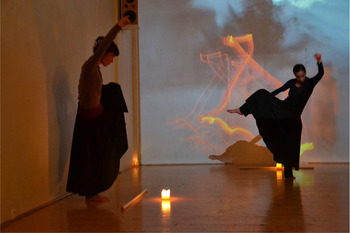
From left: Unknown participant and Ori Gershon in the public performance at the end of the training session, Autonomy of the Actor. Studio of CRT St Blaise, Paris, France, 2013. (Photo by Ideogram Théâtre)

Meanwhile, the participants were also busy learning an action that had been developed over many years by Ideogram Théâtre. This action
was like the circulation in Sema and it was taught to the participants with the purpose of making them understand that the prominent quality of an actor is based on the perception of a unity and repeatability (action, body, space, listening), as it is in Sema. (Ideogram Theatre 2012b)
The action was based on Shakespeare’s Macbeth. Ideogram Théâtre had developed similar actions based on Hamlet and Othello. After staging the play Köroğlu, Kaleci mentioned that he considered developing an action based on that character as well.
To initiate teaching the Macbeth action, an instructor stood close to one end of the rehearsal space at the Hidden Valley, contemplating the empty space in front of her, as Cohen did at the beginning of his monologue. Then she walked forward and at certain points performed some stylized movements. A second instructor started a complementary action. After a while, Kaleci began playing tapes of traditional tunes and songs from Turkey and other parts of Asia. Apparently, two female instructors moving in the empty space in front of us were Macbeth and Lady Macbeth thinking about, communicating, planning, and executing the murder of King Duncan. They performed all these actions using no words and almost no props. In the course of the action, the two instructors sat on their knees next to each other on the dusty Cappadocian ground. One of them turned her head and torso back and looked at something imaginary behind her. Then, she slowly raised her arm and pointed in the direction of what was behind. After looking at this, the other instructor pulled an imaginary sword from the ground, stood up and walked along the empty space towards the imaginary point, where she killed the imaginary king. Then she came back, and washed her hands with water poured by the other instructor out of a terracotta pot. Just as Cohen repeated his action, so the Macbeth action restarted from the beginning in a cycle. Instructed by Kaleci, the participants of the course joined one by one. They were expected to approach one of the instructors and immediately start mirroring her actions. Naturally, at first, those who were new to the course were not very good because they had never seen or worked on this action before. But thanks to the repetitions, the novices gradually became better at performing the action. At different moments, there were one, two, three, and sometimes four Macbeths and/or Lady Macbeths performing. When the space got too crowded, some of the novices left the performance upon Kaleci’s instructions.
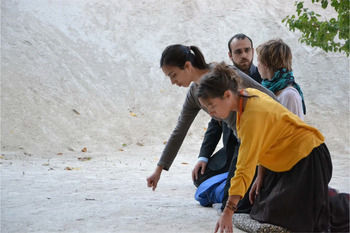
From left: Nina Renaux and Christos Papamichael performing the Macbeth action at the short‐term course Actor via Sufi Tradition given by Ideogram Théâtre in Cappadocia. Mustafapaşa, Ürgüp, Nevşehir, Turkey. The Hidden Valley, 2011. (Photo by Ideogram Théâtre)

Indisputably this action took semâ as its model. It did not involve any texts, but was composed of certain stylized actions accompanied by music and songs. These actions, which were strictly specified in detail with rules regarding what should be done where and when, were repeated in cycles. The action also involved a circulation of the performers in the empty space. This was done with great care in order not to spoil the unity of the performance. Although the learners mirrored the actions of the instructors, they each executed the actions in their own way. Nevertheless, the learners shared the instructors’ self‐possessed hâl, which was reminiscent of semâzens living and expressing their emotions.
This mode of transmission by watching and then imitating is taken from Turkish performance traditions where it is called meşk (Behar Reference Behar2014:15–16). This was how the participants learned the Turkish songs, hymns, dances, and rituals (including semâ) throughout the training. But the term “meşk” implies much more than a teaching method. In Turkish classical music (musıki), the word also denotes gatherings where musicians improvise as an organic form of transmitting the tradition (Gill‐Gürtan 2011:626–28). Ideogram Théâtre embraces this meaning of meşk, which fuses transmitting, performing, and creating.
During my previous collaborations with the group, as well as in my fieldwork, I frequently witnessed Kaleci talking about the importance of executing each particular action with utmost care, whether a training session, a rehearsal, or a performance. Because what is transmitted via meşk is not only artistic techniques and/or traditional repertoire, but also something more. Kaleci explains:
[T]he tradition transmitted and learned here has two dimensions: One can be seen, while the other remains hidden. In other words, the zahiri and the batınî, like in the teaching of tasavvuf. Because all traditions have secrets that cannot be openly spoken. (2015a:71)
Kaleci argues that if batınî does not exist in training and performing, then what is performed is not part of the tradition. His İnsana Ayna İnsan, Tiyatro includes an imaginary conversation with a theatre student on whether or not semâ is a tradition (Reference Kaleci2015a:73–75). Even though the student argues at first that it is a tradition, Kaleci mentions that today there are many semâ performances for tourists that transmit only the superficial qualities of semâ. But what is the difference between a tourist “Dance of the Whirling Dervishes” and semâ? Süleyman Uludağ draws particular attention to the insistence of Mevlevis that “Music is just a specific part of semâ. In tasavvuf, even spiritual truths, secrets, mysteries, intentions and observations that are not related to sound are music, and semâ” (Uludağ Reference Uludağ2015:204–05). In this sense, semâ is more than the music and dance of the dervishes; semâ not only expresses, but also transmits an immanence hidden behind and beyond music and dance.
This immanence cannot be transmitted without a specific face‐to‐face encounter between human beings: ayn. This is why Ideogram Théâtre employed meşk in teaching the Macbeth action. This is also why Cohen and Ossart’s practice in the cave church was based on mirroring. Whether it happens or not, the actors are given an opportunity to view the world and life from a Mevlevi perspective. As it is in semâ, Ideogram Théâtre’s main objective is to provide the actors the chance to get in touch with the hidden meaning, the truth beyond appearances.
From left: Ori Gershon, unknown participant, Christos Papamichael, and Nina Renaux performing the Macbeth action in the short‐term course Actor via Sufi Tradition given by Ideogram Théâtre in Cappadocia. Mustafapaşa, Ürgüp, Nevşehir, Turkey. The Hidden Valley, 2011. (Photo by Ideogram Théâtre)

The staging and acting style in Köroğlu and Gün Batımı followed the aesthetics of ayn and meşk as well. Both were performed in an empty space — Köroğlu in an open‐air space in Cappadocia and Gün Batımı in a black box theatre — filled with the stylized circulations and actions of the performers moving in tandem, as in the Macbeth action, semâ, and Cohen’s monologue. Some of these circulations were adaptations of the actions of Hamlet, Macbeth, and Othello. The movements of the performers were accompanied by music, songs, and/or the vocalization of the play texts either by the performer him/herself or other performers who at certain moments spoke in chorus. Although the actors uttered the words of the characters, one cannot say that they acted characters in the conventional sense. Instead, empowered by using the past tense, they performed as narrators of the stories. In Köroğlu, the words of certain characters were uttered by different performers at different times, and sometimes by a chorus, during which a nonspeaking performer executed the actions of the character. On the other hand, in Gün Batımı, an actress played Hamlet and his mother Gertrude, another played Macbeth and Lady Macbeth, and a third Desdemona and the storyteller child. Similarly, the mother and the father of Köroğlu were played by the same actor who put on a mask when representing the mother and took it off before playing the father. Such staging, which divides a character among the performers and/or has one actor play more than one character, prevents a complete identification of the actors (as well as the audience) with the characters in the stories. Instead, the performers enact the events from a narrative distance. As in the tradition of türkü, the stories of the heroes in the plays of Shakespeare and the Epic of Köroğlu are not limited to a particular human reality, a particular time frame. Such independence allows them to act as the symbols of conflicting aspects that reside in the inner world of human beings. Othello does not kill Desdemona, Hamlet’s mother/Lady Macbeth does not speak to her son/husband, and Köroğlu does not fight against the tyrannic ruler. These so‐called characters, in fact, all exist together in one’s self; they appear onstage only to act as a mirror of truth in the sense the Mevlevi teaching strives for. The text of Kaleci’s latest project, Viyana’da Yeşil Park (2019), which tells the story of an immigrant man in Austria, promises a similar staging, as it maintains the narrative poetic form with no characterization, dialogue, or plot in the conventional sense.
Witnessing the Truth via Theatre
These are the words of the storyteller child from Gün Batımı. In this work, Kaleci uses the stories of these three Shakespearian characters as symbols of the different phases of life: respectively, midnight, darkness, and twilight. But here the aim is not merely representing the events in these stories, but seeing, witnessing, comprehending, and demonstrating what is implied behind and beyond these appearances. Although it was not quoted in Gün Batımı, it is important to remember that after learning of Lady Macbeth’s death, and not long before his own, Macbeth concludes that
Kaleci intends a comprehension that comes after and goes beyond Macbeth’s.
In Gün Batımı, there are three actors representing the kırklar, the 40 holy people in tasavvuf who manage the world according to the will of Allah (Pala Reference Pala2002:466). After Othello kills Desdemona, the kırklar stops him from walking away by surrounding him on all sides. They all sit on the floor, Othello in the middle. Guided by the self‐possessed kırklar around him, the spectators observe Othello gradually freeing himself from his anger and sorrow, and calming down, as if he started to comprehend what is beyond the apparent events in his life. Othello is at the time of twilight, just before the sun rises when one gains direct knowledge of life. Then at the end of the play the child speaks again:
Kaleci creates theatrical actions that might be inspired by Shakespeare, a Mevlevi story or poem, a traditional song, or an actor’s life. Through these actions, performers experience a state of direct, immanent knowledge, and invite the audience to experience it as well. In Kaleci’s words, this is “the witnessing of life. The witnessing of the zahiri and the batınî. You can call this theatre […]. Or you can give it many names. It is a truth that exists beyond names” (Reference Kaleci2015b:44).