How often, at what times, and on what issues do US courts make policy or influence policy making in other branches of government? Public law scholars generally see courts as playing a limited and rarely independent role in policy making. Notably, these views are based on analysis of court cases rather than comparing judicial policy making and influence to that of the other two branches of government. We make the first direct comparison.
We examine the universe of significant domestic policy changes across all branches of government in the post–World War II period and assess how many involve the courts. In so doing, we provide a new kind of “interbranch perspective” on judicial policy making (Miller and Barnes Reference Miller2004; Barnes Reference Barnes2007), offering the first estimate of the extent to which, the times at which, and the issues on which US federal courts directly make policy or influence policy making by Congress, the president, and administrative agencies.
To assess the judicial contribution to US national policy making, we code, aggregate, and analyze information from 231 books and 37 articles on the history of domestic policy making in 14 issue areas from 1945 to 2004. Our study is similar to a meta-analysis, but we use case studies of policy making in particular issue areas as the raw data. From these histories, we extract the judicial contribution to federal policy making.
Public law scholars will be surprised by the extent of significant judicial policy making and influence that we find and that federal courts have made or influenced a significant amount of policy outside the areas of criminal justice and civil rights and liberties. We find that federal courts made or influenced nearly one in four significant federal policy changes.Footnote 1 Courts directly made almost as many significant policies as the executive and indirectly influenced about as many significant policies in other branches as Congress. We also find that judicial policy making and influence are concentrated in a few time periods and issue areas. Federal courts made about one in five of the significant policy changes that occurred during the second Truman and the Nixon/Ford administrations and most influenced other branches during the second Clinton administration. Federal courts made or influenced about half the policy changes in criminal justice and civil rights and liberties, about a third on finance and commerce and social welfare, and about a quarter on education, the environment, and labor and immigration.
We begin by reviewing previous theories and findings regarding judicial policy making. Next we explain how our conceptualization of judicial policy making and influence is similar to and different from those used by others. Then we describe what policy histories are and our method of compiling, coding, and analyzing them. Fourth, we present and discuss our findings regarding the judicial contribution to US national policy making, including differences across issue areas and time periods, both expected and surprising, and offer reasons why policy histories may understate the extent of the judicial contribution. Fifth, we assess the robustness of our findings. In closing, we identify directions and describe methods for further research using our data.
Previous Views of Judicial Policy Making
US courts have long been perceived as relatively weak policy-making institutions, unable to make policy or cause social change on their own. Dahl (Reference Dahl1957) found that the Supreme Court most commonly makes federal policy only as part of national political regimes led by the president and Congress. “By itself,” Dahl concluded, “the Court is almost powerless to affect the course of national policy” (293). This view not only persists but remains dominant today (as discussed, e.g., in McCann [Reference McCann1999], Frymer [Reference Frymer2003], Hall [Reference Hall2011], and Howard and Steigerwalt [Reference Howard2012]). As Rosenberg memorably and provocatively echoed Dahl in 1991, after closely studying judicial efforts to advance civil and women’s rights, and reaffirmed in 2008, after closely studying recent judicial efforts to advance same-sex marriage rights, “US courts can almost never be effective producers of social reform” (Rosenberg Reference Rosenberg1991, 338; Reference Rosenberg2008, 442; emphasis in the original).Footnote 2
Despite the prominent view that courts are relatively weak and inconsequential policy makers, Dahl’s and Rosenberg’s views have been disputed (see, e.g., Casper Reference Casper1976; Gates Reference Gates1992; McCann Reference McCann1992, Reference McCann1994; Melnick Reference Melnick1994, Reference Melnick1996; Canon Reference Canon and Schultz1998; Flemming, Bohte, and Wood Reference Flemming and Schultz1998; Paris and McMahon Reference Paris, McMahon and Schultz1998; Schultz and Gottlieb Reference Schultz, Gottlieb and Schultz1998; Zalman Reference Zalman and Schultz1998; Clayton and May Reference Clayton and May1999; Whittington Reference Whittington2003; Klarman Reference Klarman2004; Pickerill and Clayton Reference Pickerill and Clayton2004; Tushnet Reference Tushnet2006; Keck Reference Keck2009; Swedlow Reference Swedlow2009), and many scholars point to particular areas in which courts have made and continue to make policy (see, e.g., Melnick Reference Melnick1994; Epp Reference Epp1998, Reference Epp2009; Feeley and Rubin Reference Feeley and Rubin1998; Mather Reference Mather1998; Reed Reference Reed2001; Frymer Reference Frymer2003; Keck Reference Keck2009; Swedlow Reference Swedlow2009). The most significant, broad-based challenges are found in two recent studies. Hall (Reference Hall2011) systematically identifies 59 important Supreme Court rulings in 27 issue areas in the period 1954–2005. He finds that the Court was most able to make policy where its rulings could be implemented by lower courts and had popular support, and it was still able to make policy where it had one or the other (see also Hall Reference Hall2014). Similarly, Howard and Steigerwalt (Reference Howard2012) systematically examine long lists of prominent, mostly federal, cases in seven issue areas. They find that “courts can have a huge impact” if they keep their policy making acceptable to the “executive-legislative core” (178). These conditions for judicial policy making share significant common ground with those posited by Dahl and Rosenberg.
Conceptualizing Judicial Policy Making and Influence
Our conception of judicial policy making and influence relies on the judgments of policy historians (as we will explain in greater detail below). These are studies of the most significant policy changes in broad areas of public policy. They are not studies of policy failures or symbolic enactments that got no further than the institutions that announced them. By design, they are studies of policy changes over at least 10 years, which enables consideration of longer-term processes of enacting and entrenching significant policy change. Policy historians study how courts and other institutions and actors participated in these processes and contributed to these significant policy changes.
When policy historians credit national political institutions with making or influencing policy, they are recognizing that these institutions changed policy in ways that had an important impact. That said, these policy histories are not systematic or theory-testing studies of policy implementation or effectiveness. They highlight only policy changes that, from a historical perspective, eventually resulted in significant alterations of practice. Yet they do not consistently analyze how the policies were implemented or had the significant impact that they did.
Policy historians look for the most significant events in the history of public policy in each issue area, including judicial decisions that they judge as important enough to be highlighted alongside landmark laws passed by Congress. With respect to judicial influence, they look for judicial actions that lead to landmark policy changes by Congress or the executive branch. The latter is a form of judicial impact recognized by public law scholars.
Yet our conception of judicial policy making and influence—relying on the judgments of policy historians—is different from Dahl’s and Rosenberg’s and from the conception employed by many public law scholars. Consequently, our conception requires some explanation and justification.
Although Rosenberg builds on Dahl, they rely on somewhat different indicators of judicial policy making and influence. Dahl is interested in the judicial role in a very limited form of policy change. He defined policy change as US Supreme Court invalidation of federal legislation on constitutional grounds within 4 years of its passage because he wanted to see if the Court would challenge the lawmaking majority that passed the law (Dahl Reference Dahl1957, 286–90).
Meanwhile, Rosenberg is interested in the conditions under which judicial policy change affects society. He focused on court invalidation of governmental actions on constitutional grounds that had a nationwide impact on large groups of people (Rosenberg Reference Rosenberg1991, Reference Rosenberg2008, 4–5, 10–13). Dahl theorizes that courts require political support to make policy. Rosenberg argues that courts need favorable constitutional doctrine as well as support for implementation of their policies in order to change society.
In some ways, our conception of judicial policy making and influence is broader than Dahl’s or Rosenberg’s: in contrast to them, we include constitutional and statutory decisions in our policy histories in any federal court that significantly change policy (although we find that 80% of these policy changes are decisions of the Supreme Court, mostly constitutional). In other ways, our conception is more circumscribed than Rosenberg’s: we look for court decisions that change public policy, but we do not systematically assess their implementation or their effects on society.
Congressional and presidential scholars study the passage of major laws and major initiatives of the president and the administration without feeling required to study their implementation or verify the breadth of their impact on society before designating them as significant policy changes. From their perspective, counting policy changes as significant only to the extent that they are fully implemented and have their intended impact on society, as some public law scholars want to do, seems idiosyncratic (as noted by McCann [Reference McCann1992]). For example, like Brown v. Board of Education (347 U.S. 483 [1954]), the Civil Rights Act of 1964 and the Voting Rights Act of 1965 also required executive and judicial enforcement (which was not always forthcoming), but no one thinks that these acts are insignificant policy changes as a result. In the eyes of these institutional scholars, initiation and enactment of policies are significant policy changes, and their implementation and impact are separate subjects to be taken up by policy scholars.
For their part, most policy scholars have abandoned a “policy cycle” view of the policy process in favor of adopting the view that policy making occurs throughout the process (Sabatier and Weible Reference Sabatier and Weible2014). Policy scholars recognize agenda setting, adoption, and implementation, for example, as distinct stages of the policy process for heuristic purposes and perhaps for focusing their research, but they view policy making as a continual process that occurs throughout these stages, moves back and forth between them, and is not the sole province of any particular institution in the US political system. Policy changes can be made throughout this cycle and are never final or untouchable. Policy historians similarly seek to identify the actors and institutions that contributed to significant policy changes regardless of where they are located or when they occurred in the policy process.
Our conception of judicial policy making thus adopts the view of policy making used by other institutional and policy scholars and consequently puts the branches on an equal footing, asking when judicial decisions are analogous to congressional laws, executive orders, and administrative regulations in changing policy. Likewise, our view of judicial influence is comparative: we look at how often the courts influence significant policy changes in other branches, just as we look at how often the other branches influence policy change in the courts.
Thus, our conception allows us to compare the policy making and influence of federal courts with that of other branches, which the more idiosyncratic conceptions of Dahl, Rosenberg, and some other public law scholars do not. We are thus able to assess when and where the judiciary makes or influences policy substantially more or less often than the other branches. This still leaves open the question of whether judicial policy making is less effective than that of other federal policy makers. Whether policy is made by the courts or by Congress, administrative agencies, or the president, it may not be fully implemented, may be unable to achieve the goals of its proponents, and may not have a significant impact on society (Schuck Reference Schuck2014). Comparing the policy-making activity of the courts to that of other branches is a necessary first step in testing theories about relative court capacity.
The focus taken by some public law scholars on identifying the conditions for judicial decisions to be implemented and to have an impact on society is a reaction and important corrective to the practice among some earlier public law scholars of assuming that court decisions are always going to be implemented and necessarily have a significant impact. Consequently, these kinds of studies should continue, and our data set can facilitate additional research to study the extent to which and the conditions under which judicially made and influenced policies were implemented and affected society (as further discussed below). But requiring every study of judicial policy making and influence to study implementation and impact would prevent the kinds of valuable comparisons we can offer here that create a foundation for undertaking such studies.
Compiling, Coding, and Analyzing Policy HistoriesFootnote 3
To estimate the frequency of policy making in the courts and judicial influence on policy making in other branches of government, we use secondary sources of policy history. These sources are authored by policy specialists reviewing extensive case evidence on the political process surrounding policy making in broad issue areas, attempting both to catalog the important output of the political process and to explain how, when, and why public policy changes. These scholars, whom we call policy historians, identify important policy changes in all branches of government and produce in-depth narrative accounts of policy development.Footnote 4
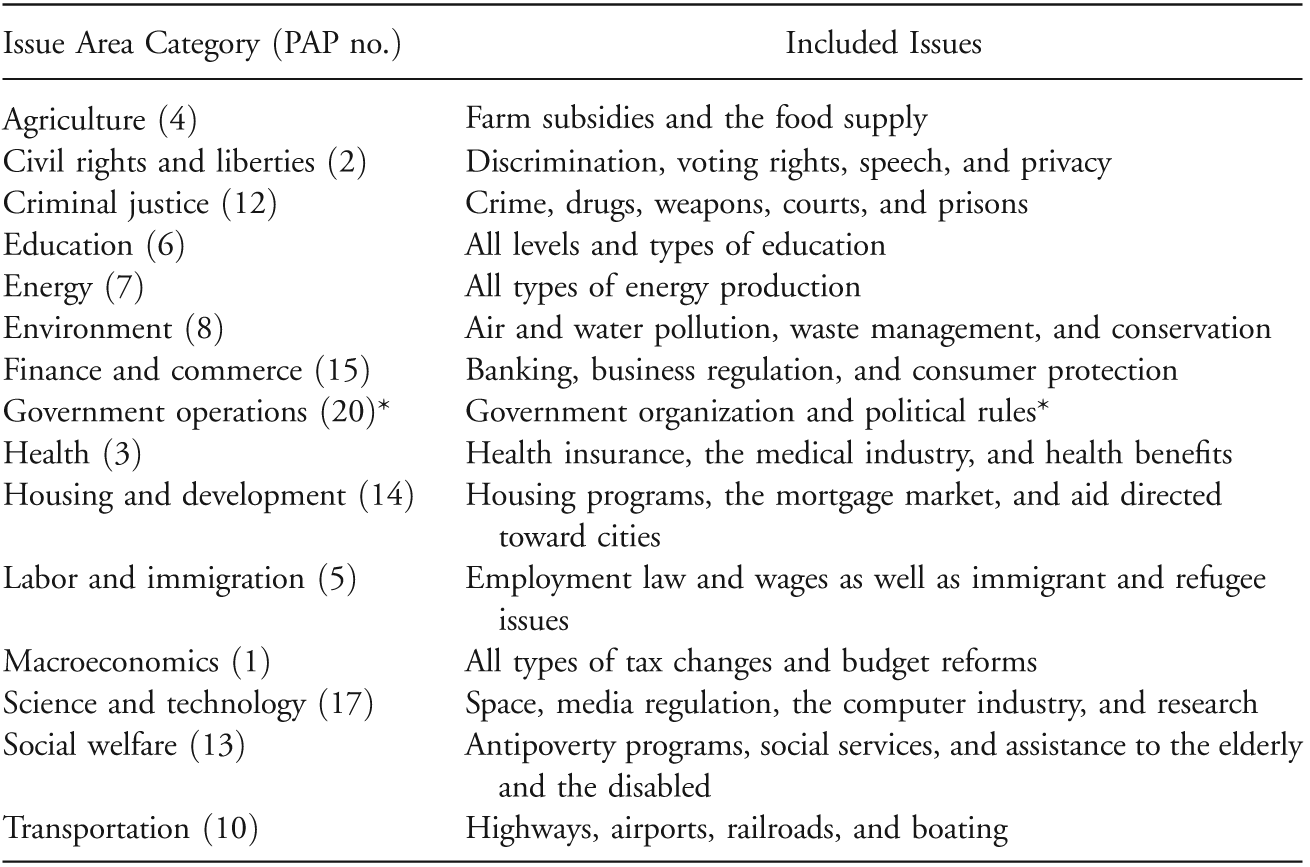
Our analysis is based on information from 268 books and articles that review at least one decade of policy history since 1945. This information was compiled by Grossmann and his research assistants (as fully explained in Grossmann [Reference Grossmann2013, Reference Grossmann2014]). The sources cover the history of one of 14 domestic policy issue areas from 1945 to 2004 (see table 1 for a listing and description of the contents of these issue areas). We identified issue areas and their contents on the basis of the Policy Agendas Project (PAP) coding scheme, available at policyagendas.org. The issue areas that were the subjects of the policy histories included nearly the entire domestic policy spectrum, but not general government operations and defense, trade, and foreign affairs.Footnote 5 Policy historians collectively uncover 790 instances of policy making in these issue areas that they consider significant, primarily laws passed by Congress but also executive orders, administrative agency rules, and court decisions. Even though separate policy histories were consulted for each policy area, some policy changes were identified in multiple policy area literatures (such as Roe v. Wade [410 U.S. 113 (1973)] in health care and civil rights).
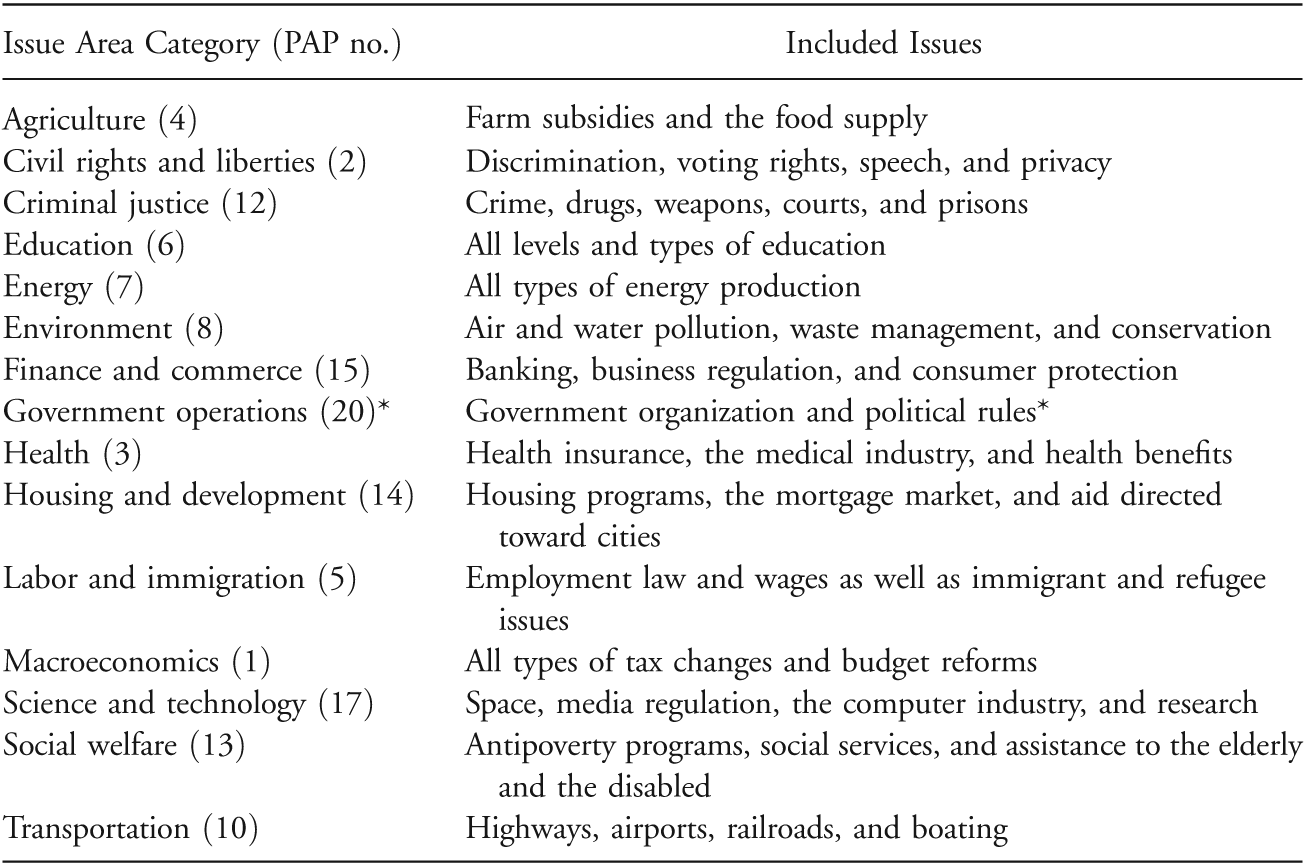
Note.—The table reports the issue area names and descriptions of the common subcomponents covered within each area. The numbers recorded are from the Policy Agendas Project. A full description of each issue area’s contents is available at policyagendas.org.
* We did not search policy histories in the government operations category, so it is not one of the 14 issue areas we discuss. We include it in the table for reference because two of the policy changes covered in other issue areas’ policy histories were coded in that category.
Grossmann and his research assistants compiled published accounts of federal policy change in PAP’s 14 broad issue areas using bibliographic and online searches (as further explained in Grossmann [Reference Grossmann2014]). For each policy area, they used keywords from the PAP topic lists and subcategories available at policyagendas.org (see table 1 for category numbers). They searched multiple book catalogs and article databases for every subtopic mentioned in the PAP description of each policy area. To find additional sources, they then used bibliographies from these initial sources as well as literature reviews. To locate the 268 sources used here, they reviewed more than 800 books and articles. Most of these 800+ original sources did not identify important changes or review the political process surrounding them, even though their titles or descriptions suggested that they might. Instead, many focused on advocating policies or explaining the content of current policy. Consequently, these sources were not included in the database. To focus on broad historical reviews of the policy process, sources that do not identify the most important changes and those that cover fewer than 10 years of policy making are excluded. Sources that analyzed the politics of the policy process from a single theoretical orientation without a broad narrative review of policy history were also eliminated. The sources that remain are true policy histories, covering a significant period of history and providing a narrative analysis of the most important policy changes during the period. Sources discussing judicial policy making are listed in appendix B, while the full lists of sources and policy changes, along with data sets with variables marking changes for whether they occurred in the judicial branch and whether they included any type of judicial influence, are available at Grossmann’s website (http://www.artistsofthepossible.com).
The next step was reading each text and identifying significant policy changes. Grossmann primarily used six research assistants, training them to identify policy changes (although additional assistants coded individual books). They followed protocols established by Mayhew in Divided We Govern (Reference Mayhew2005). He had previously tracked important laws passed by Congress, but they added executive orders, administrative agency actions, and court rulings along with new laws identified by each scholar as significant. They included policy changes when any scholar indicated that the change was important and attempted to explain how or why it occurred. As a reliability check, pairs of assistants assessed the same books and identified 95% of the same significant changes. For each change, Grossmann and his assistants categorized it by issue area on the basis of the PAP codebook. These issue area categorizations were based on the policy changes, not the histories in which they were addressed. Thus, some policy changes discussed in a policy history in one area were coded into a different area (e.g., a criminal justice policy history might address a civil rights policy change). They also coded whether it was an act of Congress, the president, an administrative agency or department, or a court.Footnote 6 Eighty percent of significant policy changes in the courts were made by the Supreme Court.
The cases of direct judicial policy making are varied, but each demonstrates an important potential impact of the courts. For example, a 1974 Supreme Court case, Lau v. Nichols (414 U.S. 563 [1974]), established the principle that antidiscrimination laws applied to linguistic discrimination, expanded schools’ responsibilities regarding bilingual education, and clarified the scope of the Fourteenth Amendment (Moran Reference Moran1988). A 1981 Supreme Court case, Diamond v. Diehr (450 U.S. 175 [1981]), enabled patents for software and helped produce long-term changes in the telecommunications and computer industries (Jaffe Reference Jaffe2000). A 1966 Supreme Court decision, Baxstrom v. Herold (383 U.S. 107 [1966]), proscribed the rights of the mentally ill in the prison system and brought risk assessment methods to court decision making (Frank and Glied Reference Frank and Glied2006). A 1973 lower court decision, Pennsylvania v. Weinberger (367 F. Supp. 1378 D.D.C. [1973]), helped states mount class action lawsuits based on federal appropriations and executive decisions (Davies Reference Davies2007). A 1990 Supreme Court decision, Wilder v. Virginia Hospital Association (496 U.S. 498 [1990]), provided institutional administrators of Medicaid with standing to sue in court. The decision provoked many lower court decisions that ordered higher state spending on Medicaid (Weissert and Weissert Reference Weissert2006, 220). Other instances of judicial policy making included high- and low-profile decisions in many areas.
Grossmann and his researchers also coded each explanation for a policy change in all the policy histories for the factors that influenced it. Most policy historians rely on their own qualitative research strategies to identify significant circumstances. Policy historians select their explanatory variables on the basis of the plausibly relevant events surrounding each policy change with attention to the factors that seemed different in successes than in failures, although they rarely systematize their selection of causal factors across cases. The books that we use quote firsthand interviews, media reports, reviews by government agencies, and secondary sources. We rely on the judgments of experts in each policy area, who have already searched the most relevant available evidence, rather than impose one standard of evidence across all cases and independently conduct our own analysis that is less sensitive to each context.
Our analysis included a search for what we call “judicial influence” on policy making in other branches. The analysis asked whether authors mentioned any of three judicial factors that played a role in policy making in Congress or the administration. The judicial factors were a court ruling that required or influenced action, a fear of court intervention (such as members of Congress believing that the courts would overturn current policy), or a pattern of related lawsuits or threats to sue. Coders of the same volume reached agreement on more than 95% of all codes.Footnote 7 Comparisons of the explanations of different scholars for the same change showed that some recorded more explanatory factors than others. In the results below, we aggregate explanations across all scholars, considering judicial factors relevant when any source considered them part of the reason for a change.Footnote 8
Cases of indirect influence varied but demonstrated that other branches of government sometimes respond to the courts, often in tandem with other factors. For example, the nearly unanimous passage of the Education for All Handicapped Children Act followed from earlier court decisions (Graham Reference Graham1990; Switzer Reference Switzer2003). Court rulings on allowable levels of residues on foods forced Congress to act to avoid significant economic dislocation by passing the Food Quality Protection Act in 1996 (Klyza and Sousa Reference Klyza and Sousa2008, 49). Courts were also credited with influencing administrative agency regulations on air carrier certification, leading to industry consolidation (Rose, Seely, and Barret Reference Rose, Seely and Barrett2006), as well as with the presidential assertion of federal jurisdiction over submerged lands, which led to substantial legislative activity, environmental regulation, and energy development (Vietor Reference Vietor1980). Courts also made decisions that influenced congressional and administrative actions. For example, Nixon proposed emergency school aid programs, and Congress passed this assistance in 1970 and 1972, responding to court desegregation decisions.
These examples are all coded as judicial influence by our method. Judicial influence means that at least one policy historian viewed the factor as relevant to a policy-making action by another branch of government. These scholars did not always systematically conduct a counterfactual analysis to reach the conclusion that a judicial factor was decisive and may not have viewed the judicial factor as the most important driver of policy change. The same methods were previously used to analyze the reported impact of media coverage, public opinion, international factors, and state and local factors on policy change (Grossmann Reference Grossmann2013, Reference Grossmann2014). The frequency of judicial influence on policy making is similar in frequency to these categories of factors. Policy historians normally mention only a few significant influences per policy change, so the citations of judicial influence are not tangential. Rather than citing every court case that influenced congressional policy changes, for example, they discuss only the most significant factors in policy development and enactment, including judicial factors only when they were judged among the most influential determinants of a policy change.
Among the explanations for policy change included in our data set, 84% came from university faculty, with many of the remaining coming from authors working in government or think tanks. Most explanations came from authors with academic training in political science (30%), history (18%), an issue area specialization such as health or the environment (18%), or public policy (10%). There were also some from economists, law professors, and sociologists. The studies used to derive the authors’ explanations used a variety of methods, including quantitative analysis (31%), historical archives (23%), and firsthand interviews (19%). These differences in methods or author types produced only minimal differences in explanations, as discussed below (see also Grossmann Reference Grossmann2013, Reference Grossmann2014). The vast majority of policy histories that we compiled identified more than two policy changes and reviewed a historical period of at least 20 years since 1945.
The Extent of Judicial Policy Making
The key virtue of our analysis of policy histories is that it creates the possibility of cross-branch comparison. Our analysis enables reporting of the frequency of judicial policy making and influence (on changes in other branches) as a fraction of all significant policy changes across all branches in each issue area or time period. This is quite different from most studies of judicial policy making, which focus only on court cases.Footnote 9
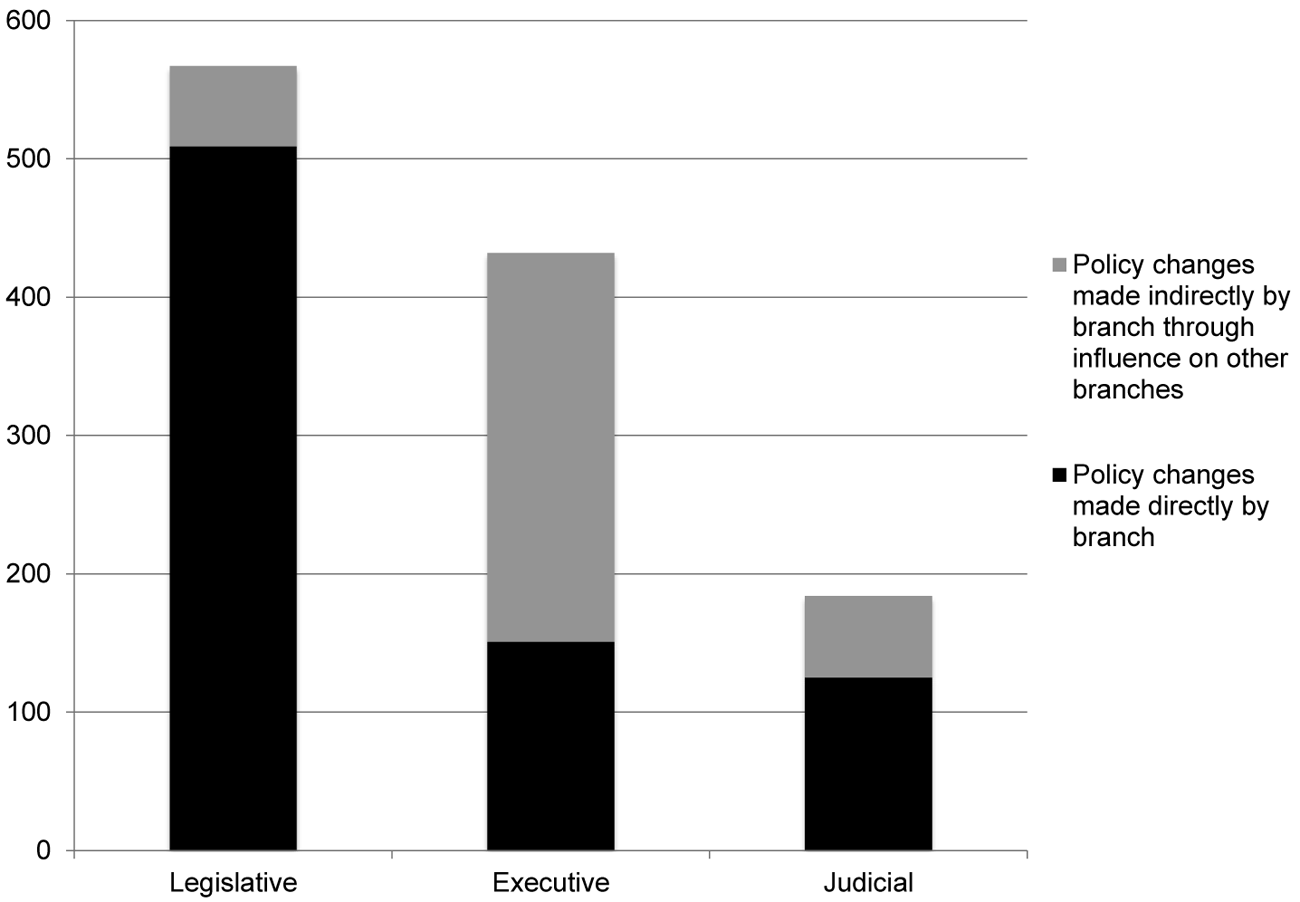
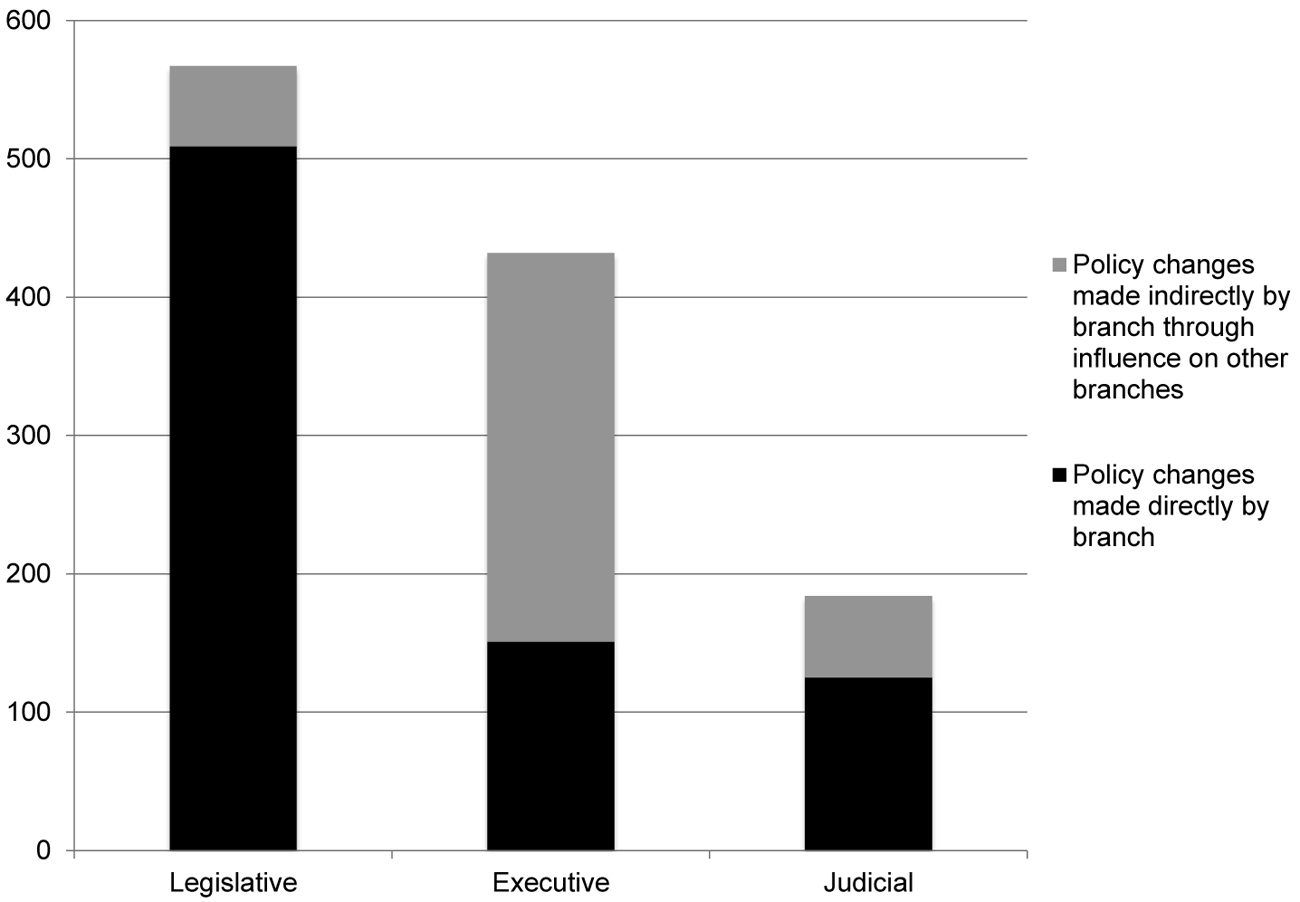
In total, we find that federal courts made policy or influenced policy making by Congress, the president, and administrative agencies in 23.3% of policy changes. This is a combination of direct and indirect policy making, as depicted in figure 1. First, we identified 125 significant instances in the policy histories in which federal courts directly made policy, accounting for 15.8% of all important policy changes during 1945–2004 in the 14 domestic policy areas analyzed here. According to policy historians, the judiciary is capable of making significant new policies through its decisions, about the same amount as the executive, although each made significantly fewer significant new policies than Congress. Second, we also identified an additional 59 policy changes made by Congress or the executive branch in which federal courts indirectly helped make policy by influencing their work. For each branch, figure 1 reports the combined number of policies directly made in that branch and policies made in other branches that involved the branch’s influence. Policy changes influenced by the federal courts but made in other branches were about as frequent as those influenced by Congress but made in the executive branch or the courts. The executive branch was the institution that most influenced policy making in other branches, which is not surprising given the president’s role in Congress.Footnote 10
Judicial policy changes and influence by branch of government. The figure depicts the number of significant policy changes identified by policy histories that took place in each branch of government along with the number in which policy historians credited each branch with influencing another branch. The total in each column is thus the number of changes that took place within each branch or were influenced by that branch out of the total 790 changes.
To an extent not previously recognized in the public law literature, the judicial role in policy making is analogous to what takes place in other branches. Congress also passes many laws that are not recognized as significant policy changes; the same is true of executive orders and administrative agency rules. Policy making is only a small part of the activities of both the executive and judicial branches. Across all branches, only a few actions rise to a level of importance that is later appreciated as a significant policy change.
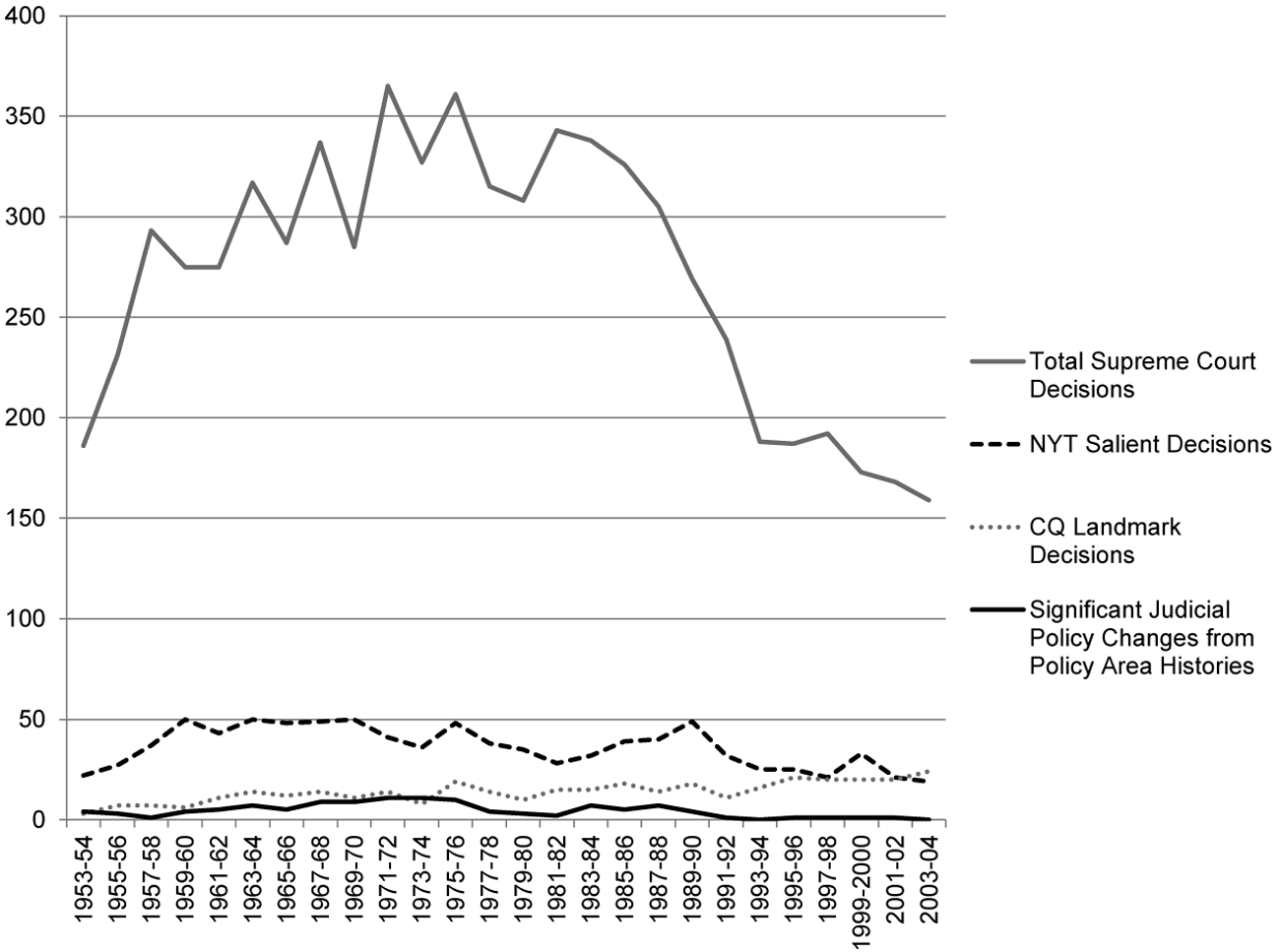
When policy historians credit courts with making or influencing policy, they are being very discriminating. The relationship between judicial decisions that are significant contributions to policy change and other kinds of judicial decisions is captured in figure 2, which shows significant policy changes made by federal courts to be a small percentage relative to all US Supreme Court decisions and consequently a much, much smaller percentage of all federal court decisions. This indicates that policy historians are being conservative in identifying court decisions that have been significant policy changes.
Supreme Court decisions and judicial policy changes. The figure depicts the number of policy changes identified by policy histories, the total number of Supreme Court decisions, the number of decisions appearing on the front page of the New York Times, and the number of decisions declared landmarks in Congressional Quarterly annual reviews per biennium.
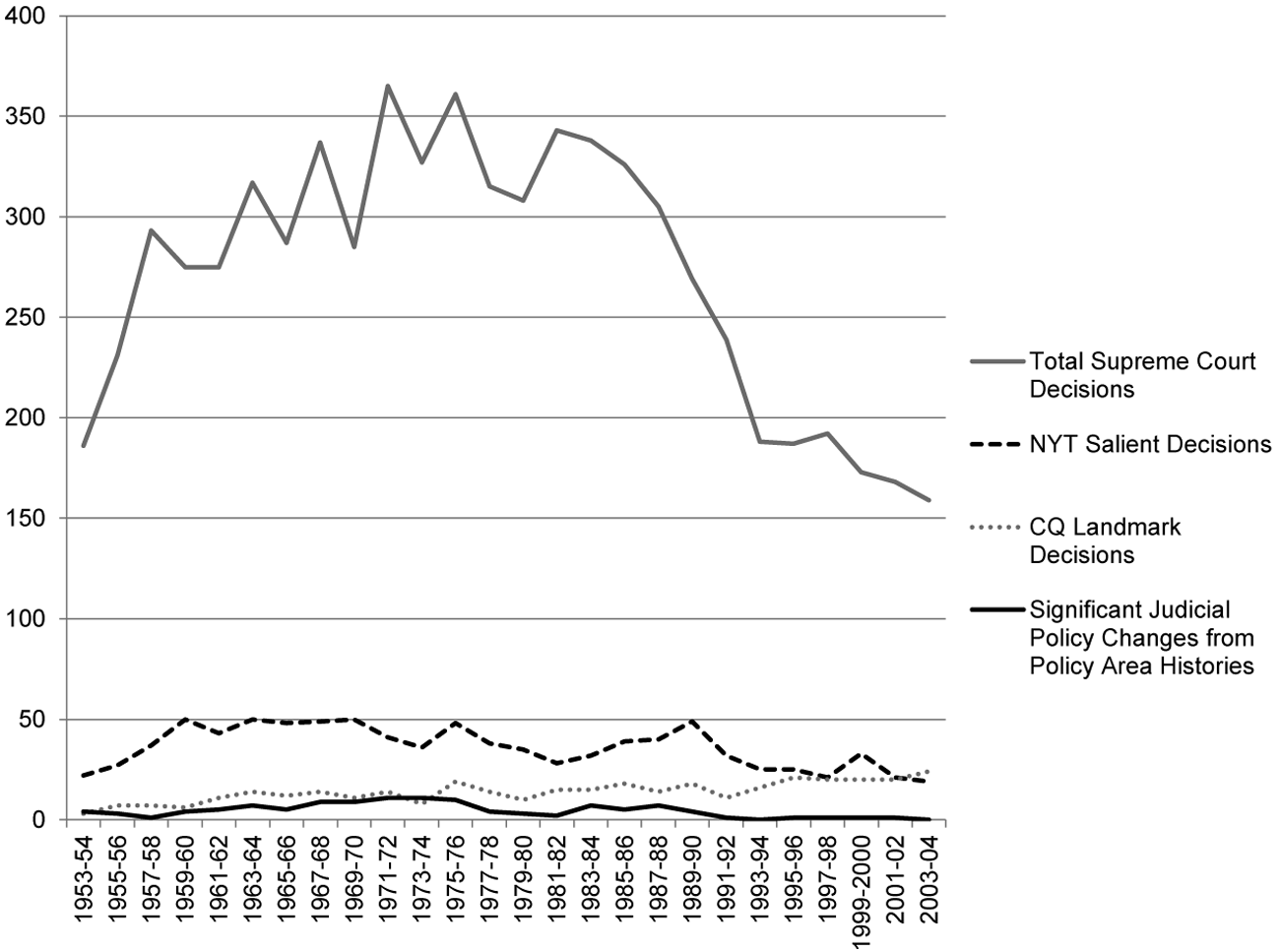
Figure 2 further shows that significant judicial policy changes are also few in number compared to US Supreme Court decisions that are considered particularly salient at the time they are made. These other measures come from Epstein and Segal (2000). Their measure of salience is based on whether there is a story about the Supreme Court decision on the front page of the New York Times on the following day. Their measure of landmarks is whether Congressional Quarterly cited the decisions in its annual lists of landmark decisions. The comparison indicates that policy historians are not handing out the designation of significant policy change at anywhere near the rate that other scholars are handing out the designation of salience. Moreover, policy historians’ judgments of what constitutes a decision that makes or influences a significant policy change is less correlated with the measures of salience than with the total number of decisions. Salience measures capture aspects of decisions that are not necessarily related to policy change, such as whether they have famous parties, a large impact on the participants themselves, or a human interest component, or whether they establish legal process precedent or have political implications. Salience measures classify decisions that are newsworthy; we measure which are important in the history of public policy development.
Judicial Policy Making across Time and Issue Areas
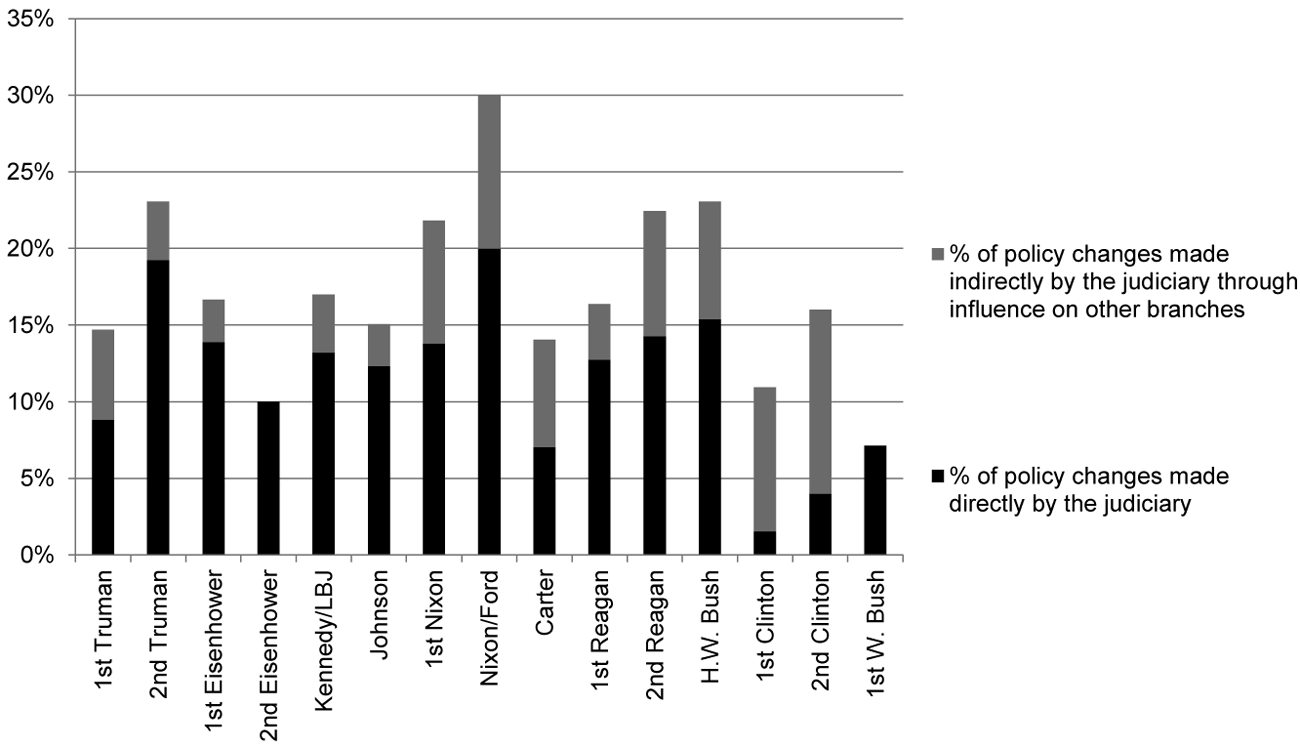
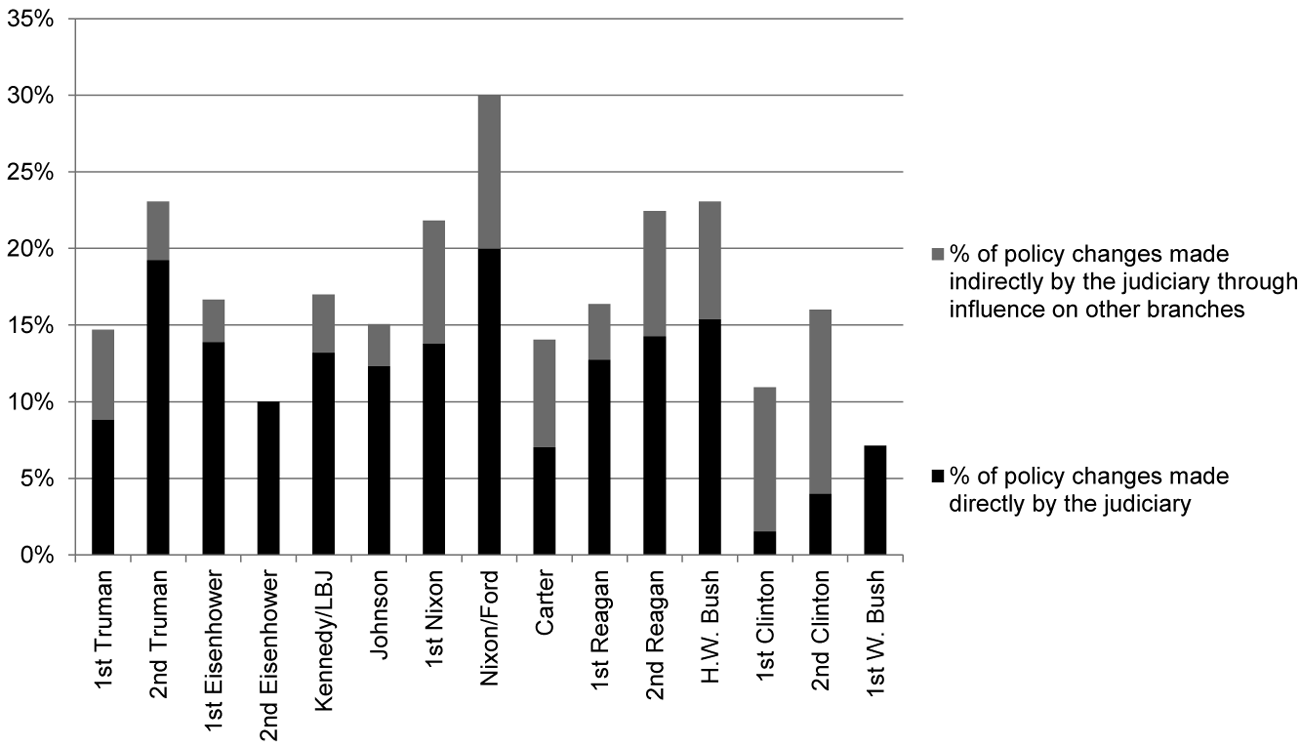
Federal courts made or influenced policy making with significantly different frequencies depending on the time period and issue area considered. Figure 3 depicts the percentage of policies made by federal courts during each quadrennium (we use presidential administrations to aid description) along with the percentage of all policies that were made by other branches of government but influenced by the judiciary. Federal courts made about 20% of policy changes during the second Truman and Nixon/Ford administrations and about 15% in the first Eisenhower, Kennedy/Johnson, Nixon, second Reagan, and H. W. Bush administrations. Judicial influence on other branches was highest during the second Clinton administration, followed closely by the Nixon/Ford administration. During an average 4-year period, federal courts made almost 15% of significant policy changes and influenced another 7% made in other branches.
Judicial policy changes and influence by presidential administration. The figure depicts the percentage of policy changes identified by policy histories in each presidential administration that took place in the courts and the percentage of policy changes that took place in the legislative or executive branch in which policy historians credited court influence.
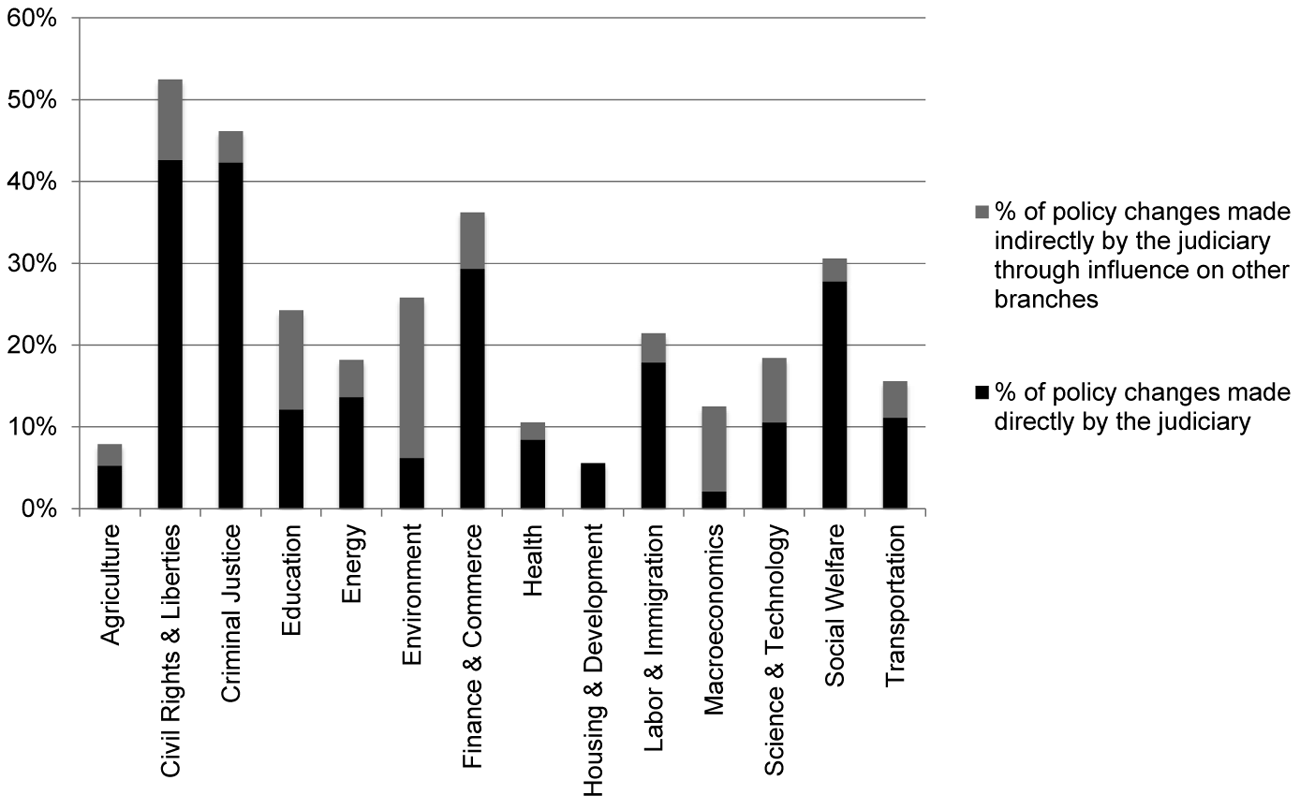
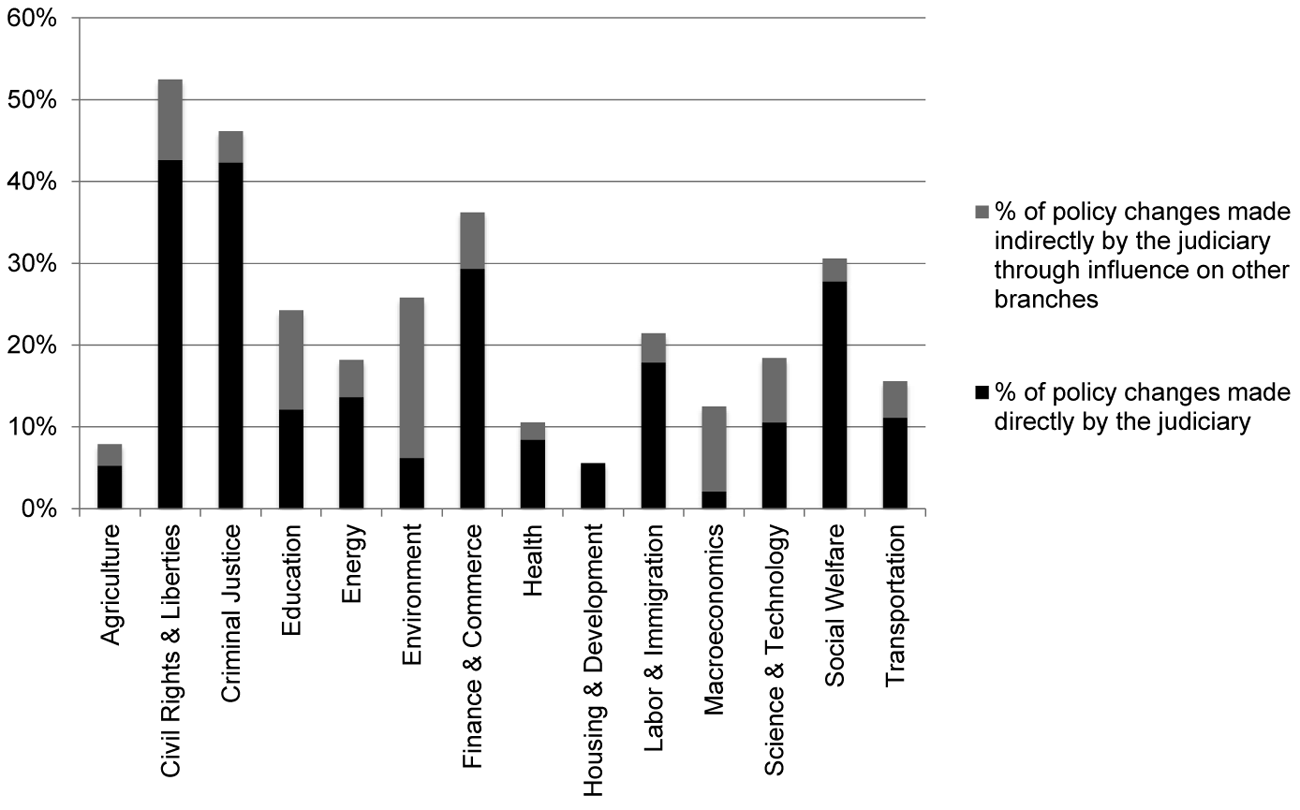
Judicial policy making and influence also varied substantially across issue areas. Figure 4 depicts the percentage of policy changes in each issue area that took place in the judiciary as well as the percentage that reportedly involved judicial influence on other branches of government. Federal courts made more than 40% of criminal justice and civil rights and liberties policy changes and close to 30% of finance and commerce and social welfare policy changes. Even though courts did not directly make much environmental policy, the environment stands out as the issue area in which courts influence policy making in other branches of government, influencing almost 20% of environmental policy changes. Overall, federal courts made or influenced about half the policy changes in civil rights and liberties and criminal justice, about a third on finance and commerce and social welfare, and about a quarter on education, the environment, and labor and immigration.Footnote 11
Judicial policy changes and influence by policy area. The figure depicts the percentage of policy changes identified by policy histories in each policy domain that took place in the courts and the percentage of policy changes that took place in the legislative or executive branch in which policy historians credited court influence.
Robustness of Findings
Several robustness checks confirmed that using qualitative accounts of policy history produces reliable indicators. First, controlling for the number of factors they mention, different policy historians produce substantially similar lists of relevant circumstantial factors in each change. Second, scholars covering policy changes outside of their area of focus (such as health policy historians explaining the political process behind general tax policy) also reached most of the same conclusions about what circumstances were relevant as specialist historians. Third, there were few consistent differences based on whether scholars used interviews, quantitative data, or archival research; whether scholars came from political science, policy, law, sociology, economics, history, or other fields; or how long after the events took place that the sources were published (see Grossmann Reference Grossmann2013, Reference Grossmann2014).
We can use these variations in research approaches and the sources of our evidence to assess potential concerns about our analysis. Although the vast majority of policy histories were books written by academics, we found no significant variation in the tendency to cite judicial decisions as significant policy changes between books or articles or between histories written by practitioners or academics. Authors trained in political science were significantly less likely to find indirect judicial influence on policy making in Congress or the executive branch compared to issue area specialist authors (such as those trained in schools of public health or the environment), although there was no difference in judicial findings between historians, political scientists, and government officials (see Grossmann Reference Grossmann2013, Reference Grossmann2014). Issue area specialist authors also stood out in their tendency to cite other factors, such as research findings, in explanations for policy change; we do not imagine that they have any particular insight on the judicial role compared to other authors, but the source of their unique view is worth additional investigation. Scholars who have spent their lives studying the environment or civil rights may be more attuned to the role of the courts (from knowledge of prominent examples) compared to those who study policy making more broadly, even though both wrote books on those particular issue areas.
Using a more restrictive definition of judicial influence also does not substantially change results. Congressional action influenced by a pattern of lawsuits or threats to sue, for example, may be better conceptualized as interest group influence. Eliminating this measure reduces reported court influence by only a small margin (from 18% to 17% of cases). Most court influence came from judicial decisions that stimulated action in other branches. Nevertheless, approximately half of the cases involving judicial influence also involved interest group influence. Even in the cases in which court decisions helped bring about congressional action, interest groups also often played a role.
Another concern is that our analysis accepts the judgments of policy historians. Although there is almost no direct disagreement between policy historians (where one author says a decision was a significant policy change and another argues that it was not), there are many instances in which one author cites a decision as significant and another covering a similar issue area or time period does not single it out. The average number of authors judging a policy change significant in our data set was 2.2, but many changes rely on only one policy historian for judgments of significance. Policy changes identified by only one historian were somewhat more likely to take place in the judicial branch (22% of the time rather than 16% overall), but there was little difference in citations of judicial influence based on the number of authors who identified a policy change (6.3% of policy changes in other branches for single authors rather than 8.9% overall).
Because some public law scholars traditionally use a higher bar to identify court decisions that constitute policy changes (those that were implemented and had a significant impact on practice on the ground), we can also assess the impact judicial policy changes were thought to have. On the basis of the judgments of policy historians, we categorized our policy changes: small changes were defined as those that had a less substantive impact on broader policy, large changes were defined as those that had a substantial and enduring impact, and those fitting neither category were defined as medium in size and scope. Research assistants coded policy changes as large if they were “non-incremental changes that had a substantial and enduring impact on American policy” and small if they were less significant, likely incremental, or had a less substantive impact.Footnote 12
Judicial policy changes were somewhat less likely to be large than policy changes in Congress and somewhat more likely to be large than those in the executive branch (16% of judicial policy changes compared to 24% overall). Congressional and judicial policy changes were similarly likely to be small in size and scope, with executive branch changes most likely to be small. There were no differences in the size and impact of policy changes that were influenced by the courts and those that had no reported court influence. Courts were not disproportionately influencing either small or large policy changes in other branches of government. Eliminating the small policy changes that had less impact (but were still considered significant) would not influence our results dramatically; limiting the analysis would show less direct judicial policy making, but largely in the same issue areas and time periods.
Discussion
Our analysis of policy histories covering the post-WWII period suggests that many public law scholars’ views that courts contribute little to changing national policy are misleading. The more accurate view permitted by our original comparative analysis of national policy-making institutions is that courts contribute significantly to changing national policy.
Public law scholars will not be surprised that the presidential administrations in which courts contributed most significantly to policy change include ones in which Justices Earl Warren and Warren Burger led the court. Public law scholars will also not be surprised that criminal justice and civil rights and liberties are the policy areas in which the courts made the most significant contributions to policy change. It is well known that these justices led a revolution in criminal procedure and led other national institutions in protecting civil rights.
What has not been previously estimated is how much courts have contributed to national policy change. In their most active periods, these courts were making about one in five significant policy changes, meaning that about 80% of policy change was still arising elsewhere. Similarly, in the policy areas in which courts contributed most significantly to policy change, they were still responsible for less than half of the significant policy changes made. Still, the extent of judicial policy making at its peak is a far cry from the “almost powerless” claim of Dahl and the “almost never” view of Rosenberg.
What is perhaps most interesting about our findings is the extent to which courts have contributed to national policy change during administrations other than those in which Warren and Burger were chief justices and in policy areas other than criminal justice and civil rights and liberties. Courts have made significant policy changes throughout the post-WWII period, in almost every administration. Judicial contributions to policy change during the second Truman administration, before Warren was appointed, almost equal those of the Burger court during the Nixon/Ford administration (in percentage terms). These courts are followed closely by the Rehnquist court during the second Reagan and H. W. Bush administrations, which exceed those of the Warren court during the Eisenhower, Kennedy, Johnson, and early Nixon administrations (see also Keck Reference Keck2004; Howard and Steigerwalt Reference Howard2012, 16–18). In fact, what is perhaps most interesting here is the consistently significant level of judicial contributions to national policy change, with the exception of the Clinton administrations toward the end of the period.
Although it may not be surprising that federal courts made more than 40% of criminal justice and civil rights and liberties policy changes, it should be news to public law scholars that courts made close to 30% of policy changes in finance and commerce and social welfare. Our study reveals these latter policy domains to be almost as significant as the former as sites for judicial policy making, yet they have received far less attention in public law scholarship. It will also likely be news to public law scholars that courts have contributed significantly to changing policy in education, energy, health, labor and immigration, science and technology, and transportation. Though the judicial contribution to national policy change is more variable across policy areas than it is across presidential administrations, our findings suggest that significant judicial policy making occurs in many more times and places than have been the focus of public law scholarship to date.
In addition to direct judicial contributions to policy change, there are of course indirect contributions, where courts have influenced policy change in the other branches of government. Our study adds significantly to understandings of such indirect contributions by providing a parallel comprehensive, comparative analysis of institutional influence since 1945.
Judicial influence has two noteworthy features. One is that significant judicial influence is as pervasive across presidential administrations as significant judicial policy making. Courts significantly influenced policy change in other branches in every presidency except Eisenhower’s second administration and the Kennedy/Johnson and Johnson administrations. Another is that courts significantly influenced policy change in other branches in somewhat different policy domains than where they directly made policy: direct policy making was most apparent in civil rights and liberties and criminal justice, but influence in other branches was most frequent regarding the environment.
When one takes account of the combined direct and indirect contributions, federal courts made or influenced about half the policy changes in civil rights and liberties and criminal justice, about a third on finance and commerce and social welfare, and about a quarter on education, the environment, and labor and immigration. In sum, courts made or influenced copious amounts of significant policy change in half of the domestic policy domains. Of course, that also implies that much policy making occurs outside the courts with limited judicial influence. Congress, the president, and administrative agencies also play important roles; the judiciary should be considered a significant, but not the most central, policy-making branch.
Our findings should be of particular interest to public law scholars because the policy histories on which we rely may underestimate judicial policy making and influence. Owing to the closed nature of their proceedings and the impenetrability of legal doctrine for non–public law scholars, courts are underexamined “black boxes” and are often ignored (Shapiro Reference Shapiro and Finifter1993). To the extent that courts and law have been studied by policy historians, these studies would appear to share another bias that is likely to lead to understatement of judicial policy making and influence. When our policy historians credit courts with a role in policy making, it is usually the Supreme Court that is being credited. This bias toward studying the Supreme Court to the neglect of lower federal courts and state courts is shared by public law scholars in political science and probably by scholars across the social sciences and history. As Shapiro (Reference Shapiro and Finifter1993) and other public law scholars have emphasized (e.g., Melnick Reference Melnick1994; Howard and Steigerwalt Reference Howard2012), much of the judicial contribution to policy making likely occurs outside the Supreme Court. For example, lower federal courts have been very important in making and influencing welfare (Melnick Reference Melnick1994) and environmental policy (Swedlow Reference Swedlow2009; Howard and Steigerwalt Reference Howard2012).
It is also likely that our policy histories understate the influence that courts have on policy making elsewhere. Courts influence the strategies of political actors in ways that influence policy. Courts displace political conflicts, catalyze action, provide leverage or constrain others, as well as provoke counter-mobilization or “backlash” (Graber Reference Graber1993; McCann Reference McCann1994, Reference McCann1999; H. Silverstein Reference Silverstein1996; Klarman Reference Klarman2004; Keck Reference Keck2009; G. Silverstein Reference Silverstein2009). Courts also help constitute political relationships in ways that influence policy: judicial interpretations and rulings play vital roles in constructing, legitimating, and normalizing political ideologies, interests, and identities, including developing a “rights consciousness” in the public (McCann Reference McCann1994, Reference McCann1999; Sarat Reference Sarat1997; Barnes and Burke Reference Barnes and Burke2006; Silverstein Reference Silverstein2009). Only some of these court influences are captured in our coding of the policy histories, and few policy historians seek to assess them.
Directions and Methods for Further Research
There is much work to be done to understand better the significant judicial contribution to policy change that we find here. Appendix A lists the major judicial decisions that caused these changes along with the policy histories in which these judicial contributions are analyzed. As an initial matter, public law scholars who are interested in judicial policy making may want to add these to their reading lists so that they can become familiar with the judicial contribution to policy change in areas understudied in the subfield.
Taking a step further, public law scholars may want to consider collecting additional information on these cases. For example, public law scholars could study cases of judicial policy change further to learn more about the extent to which these policies were implemented. This would allow, for example, a test of Rosenberg’s theory of judicial policy making, which specifies necessary and sufficient conditions for implementation of judicial policy changes (Rosenberg Reference Rosenberg1991, Reference Rosenberg2008; see also Swedlow Reference Swedlow2009; Hall Reference Hall2014). More generally, collecting additional information on these cases guided by theory would allow tests of theories of the conditions under which policy change, including court-caused policy change, occurs.
By connecting our data on judicial policy making and influence with existing data on changing political factors, our data can be used to test the relative ability of different kinds of political influences to explain judicial policy making and influence. This would allow a test of Dahl’s, Rosenberg’s, and other theories about the conditions under which courts contribute to policy change. We have already undertaken preliminary analyses of these kinds and can report that they are feasible and produce interesting results (see Grossmann and Swedlow Reference Grossmann2013, Reference Grossmann2014).
There are several other ways to link future research to our data set. First, theories can be tested on relevant subsets of policy history. For example, most likely and least likely cases from the perspective of different theories can be identified and then collection of additional data can focus on them (as discussed in Swedlow [Reference Swedlow2009]). Or theory-conforming and theory-challenging cases can be identified through nested analysis (Lieberman Reference Lieberman2005), and then additional data can be collected on these cases (as discussed in Swedlow et al. [Reference Swedlow, Hammitt and Wiener2009]).
Many theories could be assessed with random, representative samples of subsets of our cases rather than seeking to collect additional data on all policy histories we have identified. Using the coding of cases that we have already done, one could stratify the universe of cases in different ways and collect samples from each subgroup. For example, one could take a random sample of the 125 cases in which courts directly made policy and a random sample of the 59 cases in which courts influenced policy change in other branches and collect additional information to compare these cases. If one wanted to compare these cases to those in which the courts were not involved in policy making, one could take an additional sample of the remaining cases of policy change.
Contrary to the prominent view that courts are relatively inconsequential policy-making institutions, we find that federal courts made or influenced nearly one in four significant federal policy changes. Courts directly made almost as much significant policy as the executive and indirectly influenced about as much important policy in other branches as Congress. These findings run counter to the conventional wisdom in public law that courts are relatively weak and inconsequential policy makers. Yet there are significant differences in judicial policy making and influence across time and issue area. These variations invite explanation that public law scholars are well positioned to supply. As studies accumulate, we expect to learn more about the conditions under which courts make or influence policy.
Appendix A Federal Court Cases of Judicial Policy Making by Policy Area
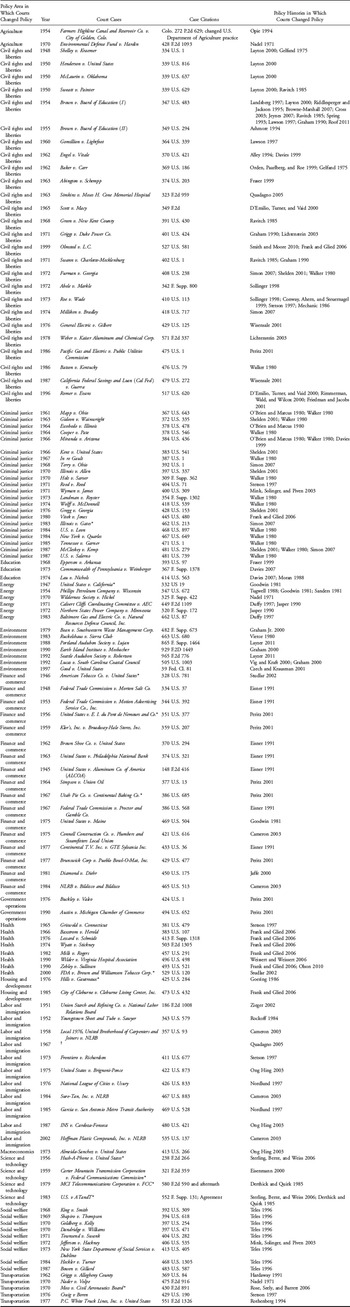
Table A1 lists cases from 1945–2004 found in policy histories in which federal courts changed policy. (The one exception to this is the first case listed, which is a state court case that changed federal policy.) It is not a list of cases in which federal courts influenced policy making in other branches, although some of these cases are among those that had that effect. The first column lists the policy area in which the case changed policy. The second column lists the year the case was decided. The third column lists the cases. The fourth column lists the case citation. The fifth column lists the policy histories in which courts changed policy. Full citations for these policy histories can be found in appendix B.
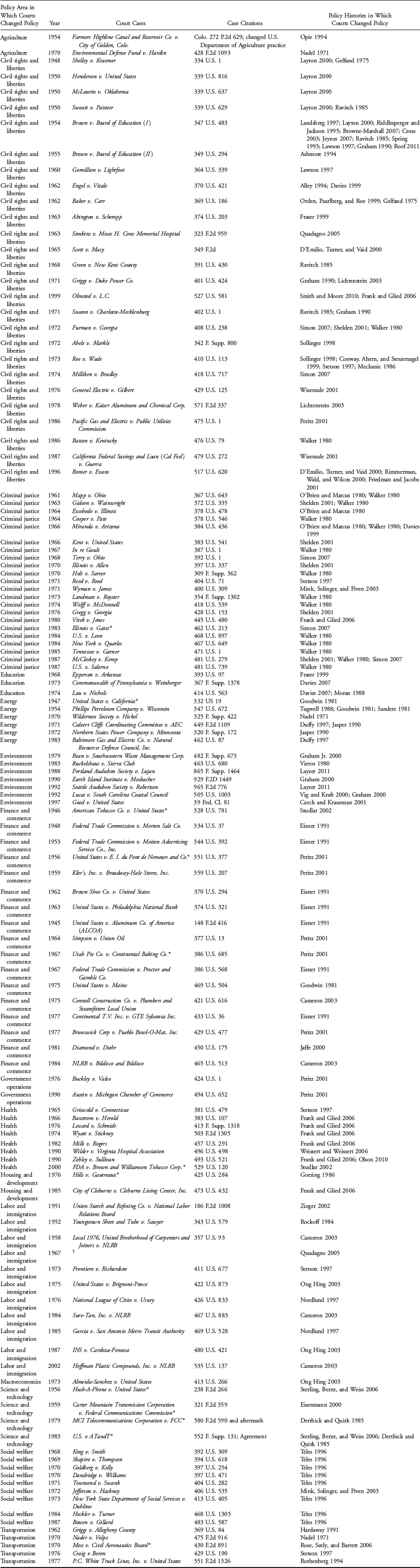
* Cases being referenced for these instances of judicial policy making were not clearly specified in the policy histories. The listed case names thus represent our current best effort to identify the case through additional research.
† This policy history references a 1967 Supreme Court decision regarding age discrimination in the provision of health benefits that we have been unable to locate.
Policy Histories in Policy Areas in Which Federal Courts Changed Policy