Introduction
Since the 1960s, to eliminate existing intramammary infections (IMI) and to control the risk of new IMI during the dry period, a blanket dry cow antibiotic treatment (blanket DCT) was recommended at drying-off for all cows, as a component of the ‘five points mastitis control plan’ (Dodd et al., Reference Dodd, Westgarth, Neave and Kingwill1969; Neave et al., Reference Neave, Dodd, Kingwill and Westgarth1969; Natzke, Reference Natzke1971). Blanket DCT has been challenged for a long time by some researchers, holding that only infected cows have to be treated (for instance by Schultze, Reference Schultze1983) or due to its high cost. Recently, consumers and society’s expectations regarding antibiotic residues in milk or antibiotic resistance have led several countries to contest the blanket DCT (Bradley et al., Reference Bradley, Noone, Townsend and Grubb1985; Berry and Hillerton, Reference Berry and Hillerton2002a). Moreover, the blanket DCT seems possibly no longer necessary in many herds, in view of the reduction of the prevalence of udder-born contagious pathogens, as shown by the improvement in somatic cell counts of milk in almost all countries during the last 20 years (Hillerton et al., Reference Hillerton, Bramley, Staker and McKinnon1995; Makovec and Ruegg, Reference Makovec and Ruegg2003). Researchers have again proposed to limit the use of DCT to cure the existing IMI at drying-off, i.e. the selective DCT where only cows infected at drying-off were treated (e.g. Eberhart, Reference Eberhart1986; Gill et al., Reference Gill, Howard, Leslie and Lissemore1990; Berry and Hillerton, Reference Berry and Hillerton2002a). Unfortunately, this strategy appears to be risky: the incidence of IMI occurring during the dry period is higher in cows from herds using selective DCT than using blanket DCT (relative risk (RR) from 1.31 to 2.23) (Robert et al., Reference Robert, Seegers and Bareille2006a in a meta-analytic review).
An alternative to DCT aimed at reducing new IMI during the dry period or a complementary mean to selective DCT is to avoid the exposure to the risk for new IMI. Risk factors for new IMI during the dry period have already been investigated (e.g. Natzke et al., Reference Natzke, Everett and Bray1975; Dingwell et al., Reference Dingwell, Duffield, Leslie, Keefe, DesCoteaux, Kelton, Lissemore, Schukken, Dick and Bagg2002 and Reference Dingwell, Leslie, Schukken, Sargeant, Timms, Duffield, Keefe, Kelton, Lissemore and Conklin2004; Berry et al., Reference Berry, Johnston and Hillerton2003) but mostly simultaneously in untreated and in treated cows at drying-off. In treated cows, DCT limits a part of the occurrence of new IMI. Enhanced prevention of new IMI during the dry period would therefore be particularly interesting in untreated cows. In selective DCT strategy, untreated cows are mainly uninfected, but some infected cows also remain untreated, depending on the selection criteria used. At drying-off, the uninfected quarters from cows infected in at least one other quarter are more susceptible to new IMI during the dry period than uninfected quarters from uninfected cows (Neave et al., Reference Neave, Dodd and Henriques1950; Schultze and Mercer, Reference Schultze and Mercer1976; Browning et al., Reference Browning, Mein, Barton, Nicholls and Brightling1990). Therefore, the effect of risk factors for new IMI could differ according to the cow infection status at drying-off (CIS: cow infected in at least one quarter v. uninfected). To our knowledge, no previous study has ever investigated the risk factors only in untreated cows or the interactions of CIS at drying-off with other risk factors for new IMI during the dry period. Thus, our study aimed at identifying risk factors for new IMI during the dry period in untreated cows from herds using selective DCT according to CIS at drying-off.
Material and methods
Study sample
Twenty-eight commercial herds using selective antibiotic DCT from western France were enrolled from June 2003 to September 2004 in a prospective survey on a voluntary participation basis. All cows dried-off between 1 June 2003 to 31 May 2004 were included (624 cows). The main breeds were Holstein and Normande. The milk quota ranged from 120 000 to 770 000 l/year (median: 340 000 l/year) with herd average milk yield per cow per lactation from 4700 to 10 400 kg (median: 7700 kg). The herd size ranged from 22 to 100 cows (median: 48 cows). The median days dried off before the expecting calving date was 58 days. Depending on herds, from 21% to 100% of the cows enrolled during the study period were not treated (median: 66%). Each farmer used his own criteria to select treated cows: the individual somatic cell count (ISCC) at drying-off or during the previous lactation, alone or combined either with the individual history of clinical mastitis during the previous lactation or with milk yield at drying-off.
Only quarters uninfected at drying-off from cows untreated at drying-off were included in the analysis (347 cows; 980 quarters).
Microbiological procedure and definition of infection at quarter and cow level
Aseptic milk samples from each quarter were collected by herdsmen after discarding foremilk. Sampling was done at the last milking before drying-off and on day 3 after calving (from 2 to 5 days). Samples were frozen immediately after collection and sent to a laboratory with National Mastitis Council procedures (2004). The quarter milk samples were cultured by streaking 0.025 ml on a half tryptose blood agar plate, which were examined after 24 to 48 h of incubation. A sample was considered as contaminated if more than two different bacterial types were identified (6% of samples). Appropriate tests according to the Gram straining and the morphology of the isolated bacterium were performed. If the Gram straining was negative, the isolated bacterium was further identified using an API 20E (BioMerieux, Marcy, France). If the Gram straining was positive and if the bacteria looked like a coccus, the isolated bacterium was further identified using a catalase test to differentiate streptococci (catalase negative) and staphylococci (catalase positive). Streptococci were further identified using an API Strept (BioMerieux, Marcy, France). A coagulase test was performed to differentiate coagulase-positive (CPS) and coagulase-negative staphylococci (CNS). If the Gram straining was positive and if the bacteria looked like a bacillus, the isolated bacteria were grouped as Corynebacterium spp.
A quarter was considered to have an IMI when more than 40 colony-forming units per ml were identified in a quarter milk sample. A new IMI occurred when the quarter was infected on day 3 after calving and not at drying-off. The absence of new IMI was defined when the quarter was not infected at drying-off and on day 3 after calving.
A cow was classified infected at drying-off if at least one of her quarters was infected at drying-off. A cow was classified uninfected at drying-off if none of her four quarters was infected at drying-off.
Potential risk factor variables
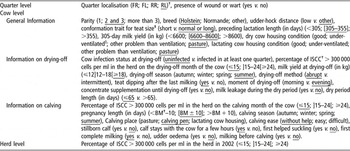
For each cow, the farmer was asked to fill in an individual data recording sheet. A herd questionnaire was also implemented to collect data on the management of the herd, hygiene and other herd characteristics. The potential risk factor variables were relative to three levels (quarter, cow and herd) (Table 1). For quantitative variables, classes were defined in order to convert them into qualitative variables. Classes were made according to the frequency distribution of the variables or according to thresholds recommended. For housing, many primary variables were described (ventilation, housing maintenance, type of lying area, size of lying area, etc.). Two summary four-class variables were created for lactating and for dry cow housing (described in Table 1).
Potential risk factor variables for new intramammary infections during the dry period included in the analysis and their classes classified according to the quarter, the cow and the herd levels (the class used as reference is underlined)

†FR = front right; FL = front left; RR = rear right; RL = rear left; ISCC = individual somatic cell count; BM = breed mean.
‡Short teat, i.e. udder conformation traits for teat size inferior to the breed mean.
§Under-ventilated, i.e. default in air entrance/departure or presence of humidity/ammoniac smell.
Statistical analysis
To assess the risk for occurrence of a new IMI during the dry period in quarters uninfected at drying-off according to the clustering of quarters within cow and of cows within herd, a mixed general linear model was defined using the Glimmix macro with a logit link function and a binomial error distribution in Statistical Analysis Systems (SAS) software version 8.1 (Littel et al., Reference Littel, Milliken, Stroup and Wolfinger1996; SAS Institute, 1999). Herd was considered as a random effect. The cow-within-herd effect was considered by fixing the variance–covariance matrix between quarters of a cow in a herd. The type of matrix used was a matrix that fixed the same variance–covariance between two pairs of quarters (type ‘CS’, i.e. compound symmetry) with the instruction ‘repeated’. A partition of variance components was done in order to assess the contribution of each level (quarter within cow; cow-within-herd; herd) to the variance of the data (variance of the Z variable) by running a model containing only the intercept.
Uninfected quarters from an uninfected cow are less susceptible to new IMI than uninfected quarters from an infected cow (Robert et al., Reference Robert, Bareille, Rousel, Poutrel, Heuchel and Seegers2006b). Then, the effects of the risk factors were assumed to be different according to the CIS at drying-off (cow infected in at least one quarter v. uninfected). Therefore, this variable was forced in the model (whatever its P-value) and its interactions with relevant risk factors were checked. Consequently, the multivariate regression model was designed as

where Logit(Pijkz) is the probability of occurrence of a new IMI during the dry period in a quarter of the cow j in the herd i; α the intercept; CISj the cow infection status at drying-off of the cow j (two levels: infected in at least one quarter v. uninfected); RFk →z the z risk factors for new quarter IMI during the dry period; (RFk →z×CISj) the interaction between each risk factor and CIS of the cow j; HERDi the effect of the herd i (random); εijk →z the residual error term, the deviation εijk →z included the cow effect (repeated) by fixing the variance co-variance matrix as compound symmetry.
Each potential risk factor variable was first evaluated using a univariate regression model. When biologically plausible, interactions between CIS and potential risk factor variables, or associations between two potential risk factor variables were tested. Potential risk factor variables with P < 0.15 were retained for the multivariable regression modelling. In addition, when interactions had P < 0.15, interactions plus the variables implied were retained. Non-parametric tests for correlation between variables were carried out in order to prevent from redundant variables in the multivariate model (Spearman correlation coefficients and Kendall Tau b correlation coefficients). No variable included in the multivariable model was closely correlated (all correlation coefficients <0.30 and >−0.30). Quarters with a missing value for one potential risk factor variable were not taken into account. A backward stepwise procedure was used to select the final multivariate regression model: potential risk factor variables or interactions were excluded one by one if P < 0.05. Odds ratios (OR) derived from the model were converted into RR according to the method proposed by Beaudeau and Fourichon (Reference Beaudeau and Fourichon1998).
Results
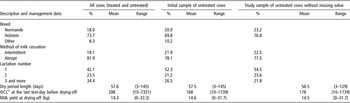
Descriptive data in all cows (untreated and treated cows), in the initial sample (untreated cows only) and in the final study sample without missing values are presented in Table 2. A high proportion of primiparous cows was observed. The mean ISCC at the last test-day before drying-off was lower in the study samples of untreated cows (initial sample or sample without missing value) than in all cows.
Descriptive data for all cows (624 untreated and treated cows from 28 herds), the initial sample (347 untreated cows from these 28 herds) and the study sample without missing value (289 untreated cows from 26 herds out of the 28)

†ISCC = individual somatic cell count (103 cells per ml).
In all cows, 57% of untreated cows were infected at drying-off. IMI were mainly due to CNS (57.0%), Corynebacterium spp. (24.8%), CPS (6.1%), Streptococcus uberis (5.9%) and to a lesser extent to other streptococci (2.6%) and other pathogens (3.6%).
The quarter incidence of new IMI was 22.5% in all untreated cows (980 quarters of 347 cows): 25.1% in infected cows (415 quarters of 200 cows) and 20.5% in uninfected cows (565 quarters of 147 cows). New quarter IMI were mainly due to CNS (41.8%), CPS (17.7%), Corynebacterium spp. (17.7%) and to a lesser extent to Streptococcus uberis (12.3%), coliforms (3.6%), other streptococci (2.7%) and other pathogens (4.2%).
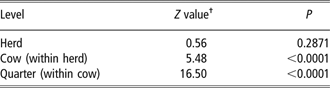
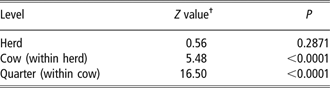
The partition of variance demonstrated that the main level of variance of the risk for new IMI was the quarter within cow (72.7%). The cow-within-herd accounted for 26.0% of the variance. The resulting herd level was not significantly involved in the variation of the risk for new IMI (Table 3). Therefore, the herd-level risk factor variable was no longer considered.
Analysis of variance components of the risk for new intramammary infections during the dry period (n = 980 quarters)
†Estimate/standard error of the Z variable.
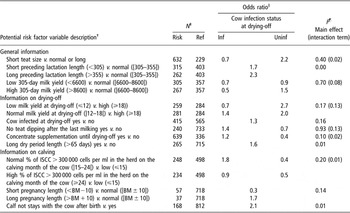
Out of the 32 potential risk factor variables, 11 with a P < 0.15, out of which six were acting in interaction with CIS, were retained for the multivariate modelling step (Table 4).
Univariate analysis – numbers of quarters, odds ratio and P-value of the potential risk factor variables for new intramammary infections during the dry period (P-value inferior or equals to 0.15) (n=980 quarters uninfected at drying-off in cows untreated at drying-off)

†ISCC = individual somatic cell count; BM = breed mean.
‡Risk = number of quarters in the modality at risk; Ref = number of quarters used as reference.
§Odds ratio of the potential risk factor variables for new intramammary infections during the dry period or when the P-value of the interaction with the cow infection status at drying-off was inferior to 0.15, the Odds ratio in cows infected at drying-off in at least one quarter (Inf) and in cows uninfected (Uninf) at drying-off are provided.
¶P-value of the potential risk factor variables for new intramammary infections during the dry period and in brackets the P-value of the interaction term between the potential risk factor variables and the cow infection status at drying-off (cows infected in at least one quarter v. uninfected) when inferior to 0.15.
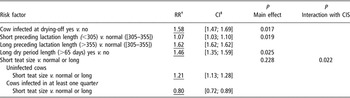
Four risk factors, out of which one was acting in interaction with CIS, were significantly (P < 0.05) associated with the risk for new IMI in uninfected quarters in untreated cows in the final multivariate model (Table 5).
Multivariate analysis – relative risks for risk factors for new intramammary infections during the dry period acting or nor in interaction with the cow infection status (CIS) at drying off (cows infected in at least one quarter v. uninfected) (n = 810 quarters uninfected at drying off in cows untreated at drying off)

†Relative risk (RR) for new intramammary infections (IMI) during the dry period (underlined when significantly different from the reference: RR = 1.00, P < 0.05).
‡95% confidence interval (CI) of the relative risk for new IMI during the dry period.
The risk for new IMI during the dry period (Table 5) was significantly higher in quarters of cows infected in at least one quarter at drying-off (RR = 1.58), with a preceding lactation lasting more than 355 days (RR = 1.62) and a dry period exceeding 65 days (RR = 1.46) compared with quarters of cows uninfected at drying-off, with a preceding lactation lasting less than 355 days and a dry period lasting less than 65 days. Additionally, in cows uninfected at drying-off, the risk for new IMI (Table 5) was significantly higher in cows with short teats (RR = 1.21) when compared with cows with long or normal teats. Conversely, in cows infected in at least one quarter at drying-off, these risks were significantly lower (RR = 0.80).
Some trends were also observed as follows: cows with a concentrate supplementation until drying-off appeared to be more at risk for new IMI than cows with no concentrate supplementation until drying-off (P = 0.06), and, only in cows infected in a least one quarter, cows exposed to more than 15% of ISCC > 300 000 cell per ml in their herd on their calving month were at a higher risk for new IMI than cows exposed to less than 15% (P = 0.08).
Discussion
The aim of our study was to investigate risk factors for new IMI during the dry period in untreated cows according to CIS at drying-off in herds using selective DCT. Contrary to what was done in most of the previous reported studies, we decided to study risk factors specifically in selectively untreated cows and not in randomly untreated cows in order to investigate particularities in such cows. Indeed, untreated cows were chosen based on the farmers’ own criteria: they were mostly young cows (about 50% of primiparous cows) with a low level of ISCC.
The definition of a new IMI was based on microbiological analysis of a single milk sample taken at drying-off and 3 days post calving. The interpretation of consecutive milk samples is classically recommended (Brown et al., Reference Brown, Morse, Newbould and Slanetz1969). This interpretation limits false-negative quarters because of the intermittent shedding of some pathogens (Sears et al., Reference Sears, Smith, English, Herer and Gonzalez1990) and also false-positive quarters only infected in their teat canal end (Rendos et al., Reference Rendos, Eberhart and Kesler1975). Potentially, duplicate sampling generates an increase in sensitivity of the microbiological procedure of about 7% (Buelow et al., Reference Buelow, Goodger, Collins, Clayton, Nordlund and Thomas1996). However, given the cost of consecutive sampling in comparison to the benefits in power gained from using a larger sample, single samples were considered here. On the other hand, the microbiological procedure results could also have been re-interpreted in the light of quarter milk SCCs, if available. However, the sensitivity and specificity of a test based on the quarter SCC for a threshold of 100 000 cell per ml are respectively from 65% to 92% and from 29% to 83% (Lindström et al., Reference Lindström, Kenttamies, Artila and Tuovila1981; Arendt et al., Reference Arendt, Detilleux, Bughin, Leroy and Lomba1997), and is even worse at the end or at the beginning of lactation (Djabri et al., Reference Djabri, Bareille, Poutrel, Beaudeau, Ducelliez and Seegers2002). Therefore, SCC determination at the quarter level was not implemented in this study.
The risk of new IMI was assessed from drying-off to 3 days post calving (from 2 to 5 days). As a consequence, this risk during the dry period also included risk at the very beginning of the lactating period. During this period, cows are highly sensitive to new IMI (Neave et al., Reference Neave, Dodd and Henriques1950; Oliver and Mitchell, Reference Oliver and Mitchell1983) and especially for CNS (for a review, see Oliver and Jayarao, Reference Oliver and Jayarao1997), which was the most prevalent pathogen type found here. Hence, new IMI occurring during the 3 days post calving could have led to overestimation of the true incidence during the dry period strictly defined. The contribution of this period to the risk for new IMI here assessed was also suggested by the trend observed regarding an increase in risk when the percentage of ISCC > 300 000 cell per ml in the herd on the calving month of the cow was superior to 15%. This indicator deals with the prevalence of IMI among the lactating cows and should therefore be mainly related to new infections occurring in the very early days of the new lactation and not in the ‘strict’ dry period. Further research is needed on this effect of the prevalence of IMI in the herd when re-introducing cows in the milking herd, maybe with stratification by pathogen type.
Some previously reported risk factors for new IMI during the dry period were not found here, like the method of drying-off, parity, milk leakage during the dry period and dry cow housing condition (for a review, see Eberhart, Reference Eberhart1986; Dingwell et al., Reference Dingwell, Kelton and Leslie2003; Bradley and Green, Reference Bradley and Green2004). In our study, modalities of these factors were either quite homogeneous between cows or evaluated differently according to farmers and then they were hardly comparable between herds (e.g. assessment of milk leakage).
The suppression of concentrate supplementation until drying-off is one of the recommendations of the mastitis control plans (Dodd et al., Reference Dodd, Westgarth, Neave and Kingwill1969; Neave et al., Reference Neave, Dodd, Kingwill and Westgarth1969; Natzke, Reference Natzke1971). It reduces the milk yield at drying-off and thereby could reduce the intramammary pressure as intermittent cessation of milking (for a review, see Dingwell et al., Reference Dingwell, Kelton, Leslie and Edge2001). In this study, only a trend regarding a higher risk for new IMI in cows with concentrate supplementation until drying-off than in cows with no supplementation was observed.
The segmentation of variance components showed that the quarter and cow effects were predominant. Although the herd incidence ranged from 0 to 58%, the herd effect was not significant, no potential risk factor variable at the herd level was therefore included in the multivariate model, but a herd effect was included as random. In our study, efforts were made to gather information at the cow level that allows description of the precise exposure of the cow to the risk factors. Only a small number of risk factors assessed at the quarter level were available (quarter localisation and presence of wound or wart) and they were not found associated with the risk for new IMI during the dry period. No other variable at the quarter level was collected in our study. However, Dingwell et al. (Reference Dingwell, Leslie, Schukken, Sargeant, Timms, Duffield, Keefe, Kelton, Lissemore and Conklin2004) reported that quarters with a keratin plug (natural teat seal) present at the beginning of the dry period had a lower occurrence of IMI than quarters with a keratin plug appearing later. This was not assessed in the present study.
As it was hypothesised, the CIS was a risk factor for new IMI during the dry period: cows previously infected were more susceptible towards new IMI than uninfected cows (RR = 1.58). This higher susceptibility of infected cows has been previously demonstrated (Neave et al., Reference Neave, Dodd and Henriques1950; Schultze and Mercer, Reference Schultze and Mercer1976; Browning et al., Reference Browning, Mein, Barton, Nicholls and Brightling1990; Berry and Hillerton, Reference Berry and Hillerton2002b). In cows untreated at drying-off or receiving a teat sealer application, Berry and Hillerton (Reference Berry and Hillerton2002b) reported a significantly higher risk for new IMI in cows infected at drying-off by Corynebacterium spp. (OR = 4.35) or by CNS (OR = 2.77) than in uninfected cows. The magnitude of the effect of the CIS at drying-off could depend on the pathogen type.
Even in the selective DCT strategy, infected cows should not be left untreated (e.g. Berry and Hillerton, Reference Berry and Hillerton2002a). In our study, there was a high percentage of infected cows among cows untreated at drying-off (57%). This underlines the fact that the selection criteria used by the farmers were not intended to detect accurately all the infected cows and were thus insufficient. The population attributable fraction of CIS on the risk for new IMI during the dry period was 17% (calculated according to Bruzzi et al., Reference Bruzzi, Green, Byar, Brinton and Schairer1985): if all untreated cows had been uninfected at drying-off, theoretically 17% of new IMI would have been prevented. Improving the criteria to identify infected cows, in order to treat them at drying-off, is therefore needed in order to improve the efficiency of the selective DCT strategy.
We hypothesised that the effects of the risk factors for new IMI would be different according to the CIS at drying-off and would be more pronounced in the most susceptible cows (infected cows). If the effect of the teat size was, as hypothesised, different according the CIS at drying-off, our second hypothesis was wrong, the effect was not more pronounced in infected cows. This highlighted the fact that other risk factors not taken into account in our study were responsible for the increase of risk for new IMI in cows infected at drying-off. The effect of teat size according to the CIS, was opposed and in cows uninfected at drying-off, the risk for new IMI was significantly higher for cows with short teats than for cows with longer teats (RR = 1.21). Short teats could be more at risk for new IMI due to the small length of the teat canal, which confers a lower protection against bacterial invasion. During the dry period, this hypothesis was experimentally tested by McDonald (Reference McDonald1975) on some cows, but he found no significant effect of teat canal length on the risk for new IMI. During lactation, the effect of teat canal length was investigated but variable results exist (for a review, see Detilleux, Reference Detilleux2002).
An effect of a long preceding lactation has, to our knowledge, never been reported. In our study, the preceding lactation length was not correlated with the dry period length, or to milk yield at drying-off or 305-day milk yield. Cows with a long preceding lactation could be cows that exhibited different reproductive health disorders delaying their next calving date. Its association with a higher risk for new IMI during the dry period needs to be further investigated.
The effect of a long dry period on milk yield in the subsequent lactation was frequently described (for a review, see Bachman and Schairer, Reference Bachman and Schairer2003; Collier et al., Reference Collier, Annen and Fitzgerald2004). But its effect on the risk for new IMI during the dry period has been only rarely investigated, except by Enevoldsen and Sørensen (Reference Enevoldsen and Sørensen1992) and Dingwell et al. (Reference Dingwell, Duffield, Leslie, Keefe, DesCoteaux, Kelton, Lissemore, Schukken, Dick and Bagg2002), with discrepant conclusions, and never in only untreated cows. The biological hypothesis regarding its effect in untreated cows is that the longer a cow is exposed to the risk for new IMI during the dry period, the higher the incidence of IMI during the dry period will be.
Conclusion
The aim of our study was to identify risk factors for new IMI during the dry period in untreated cows in herds using selective DCT. A dry period lasting less than 2 months was associated with a reduction of new IMI.
The CIS at drying-off was also a significant risk factor for new IMI: in our study sample, up to 17% of quarter new IMI would have been prevented if all untreated cows would have been uninfected at drying-off. Criteria to efficiently select cows infected at drying-off, in order to treat them all at drying-off, should be further investigated.
Acknowledgements
The authors thank all the farmers and all staff that participated in this study, the Chambre Régionale d’Agriculture des Pays de la Loire and the Chambre Régionale d’Agriculture de Bretagne for supplying part of the data, the Unit of Infectious Disease and Immunology INRA, and the Unit of Food Safety Veterinary School of Nantes/INRA for performing the microbiological examination.