Scholars of the ancient world are increasingly recognizing the importance of ancient collections for our understanding of antiquity.Footnote 1 In his afterword to Museum Archetypes and Collecting in the Ancient World (2015), Jaś Elsner argues that much of our knowledge of antiquity is based on collections assembled within the ancient world, and that the study of these collections provides us with a unique opportunity to uncover the mentalities of the people whom they surrounded. Pointing out that they ‘packaged the past and the present for its own needs, much as modern museums do now’, Elsner argues that ancient collections may be approached as ‘significant engine[s] for social and cultural self-definition’.Footnote 2
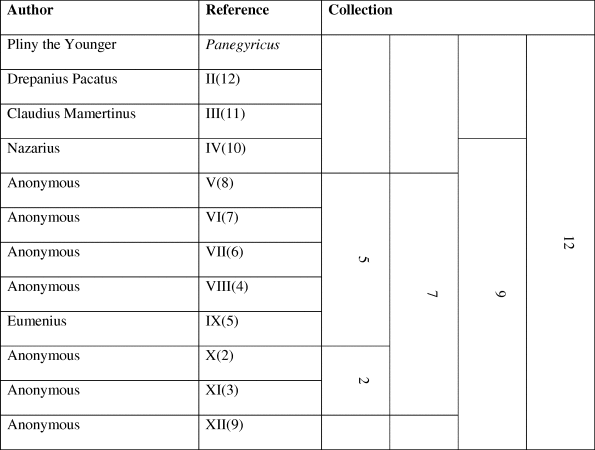
This article applies such an approach to the ancient collection known as the XII Panegyrici Latini. This collection consists of twelve speeches in praise of various Roman emperors between 100 and 389. The original manuscript of the Panegyrici Latini was discovered in Mainz in 1433 and, although it is now lost, its original contents can reliably be reconstructed on the basis of copies made in the fifteenth century (see Table 1 below).Footnote 3
The Contents of the XII Panegyrici Latini

The collection is headed by Pliny's famous Panegyricus from 100. A leap of almost three-hundred years separates Pliny's speech from that of Drepanius Pacatus to Theodosius from 389. Chronological order is then reversed, starting with Claudius Mamertinus’ speech in praise of Julian from 362 and Nazarius’ speech in praise of Constantine from 321, and subsequently moving through four anonymous speeches addressed to Constantine, Constantius and Maximian between 321 and 297. A panegyric by Eumenius from 298 breaks the chronological sequencing, which is then resumed in reverse with two anonymous speeches delivered to Maximian in 289 and 291 and another speech to Constantine in 313.
This seemingly idiosyncratic internal arrangement has puzzled many of the collection's modern editors and commentators.Footnote 4 For example, Ted Nixon and Barbara Saylor Rodgers, the authors of the most accessible and magisterial translation of (and commentary on) the Panegyrici Latini in English, conclude that:
[t]he rationale for the collection was clearly literary: the speeches chosen served as models of their kind for student and practitioners of epideictic rhetoric. The collection's elements are thematically unconnected, except in the broadest sense, and chronologically disordered: it served no political or historical purpose. The corpus is a product of the late Gallic schools of rhetoric.Footnote 5
Without denying a later educational use for the collection, this article argues that the creation of the Panegyrici Latini must be situated within a broader culture of collecting and self-presentation in the fourth century. In order to do so, the article is divided into three parts. The first part considers the main positions regarding the collection's editor and his editorial purpose. The second part situates its creation within a broader culture of collecting in the fourth century, taking late antique letter collections as an analogous case. Not only do such letter collections survive in much larger quantities, several of them are even attributed to contemporaries of the Panegyrici Latini's supposed editor. More importantly, letter collections have gone through similar developments in modern scholarship, and new approaches taking into account their original editorial design are now successfully being applied. The last part applies these approaches to the Panegyrici Latini, providing an innovative reading of the collection as an expression of personal pride and local identity within a larger aristocratic culture.
I. THE EDITOR AND HIS PURPOSE
Since René Pichon's suggestion in 1906, Drepanius Pacatus has widely been accepted as the collection's editor.Footnote 6 This hypothesis appeals both to the fact that he borrows heavily from the other speeches in the collection and also, especially, to the position of his speech in the collection. As the second in the collection's order and the latest in time, Pacatus may have used his editor's prerogative to grant his own speech a privileged position. However, as Roger Rees has pointed out, even if Pichon's suggestion is wrong, and Pacatus is not the editor, the person who put together the speeches clearly admired the Gallic orator.Footnote 7
For a long time, modern scholarship has downplayed the collection's editorial purpose. This can be explained by two developments in the history of the study of the collection. First, rather than being created in its entirety by Pacatus, scholars have pointed out that the Panegyrici Latini is in fact a collection of collections (see Table 2 below). The exact chronology of these earlier collections is impossible to reconstruct, but on the basis of indications in the manuscripts as well as from the order of the speeches in the collection, several phases before Pacatus assembled the Panegyrici Latini may be recognized. It has been suggested that there was originally a pair of speeches from Trier (X[2] and XI[3]) and that, at a later point, a collection of five speeches from Autun joined them (V[8]–IX[5]). This earlier collection, known as the diuersorum uii in the manuscripts, was subsequently enlarged by the addition of two more speeches which framed it (IV[10] and XII[9]), possibly by Nazarius, who put his own speech first. To this collection of nine, Pacatus finally added his own speech (II[12]) along with those of Pliny the Younger and Claudius Mamertinus (III[11]).Footnote 8
The XII Panegyrici Latini as a collection of collections

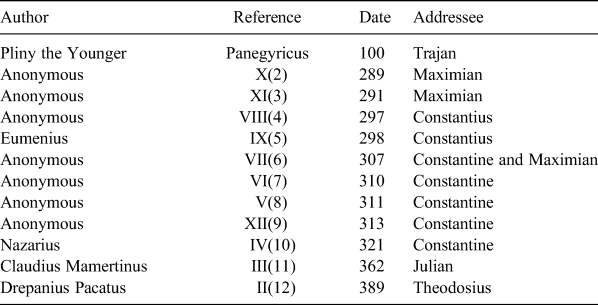
The collection's editorial purpose has also been downplayed by the decision of several modern editors to rearrange the Panegyrici Latini chronologically (see Table 3 below).Footnote 9 A rather confusing remnant of this chronological rearrangement is the way in which we now refer to the speeches, with both a Roman numeral, showing its original arrangement, and an Arabic numeral, highlighting its chronological order. Valuable though such a chronological rearrangement is for showing a historical narrative, it obscures the collection's original design. Perhaps the most distorting result of this rearrangement is that Pliny is the first to speak and Pacatus the last, whereas in the original collection the speeches of Pliny and Pacatus are juxtaposed.Footnote 10 Moreover, in several of the modern editions of the Panegyrici Latini, Pliny's Panegyricus is even excluded, thereby reinforcing the tendency among modern scholars to focus either on the Panegyricus or on the late antique speeches.Footnote 11
The XII Panegyrici Latini in chronological order

The fact that Pliny's Panegyricus is excluded from some modern editions is indicative of the main problem that modern scholars encounter when attempting to address the collection's editorial purpose. Not only is Pliny's Panegyricus separated by nearly two hundred years from the earliest surviving speech in the collection, it moreover lacks any notable connection to what would otherwise unite all other speeches in the collection, as all were delivered in Gaul or by Gallic orators. In the apparent lack of other unifying factors, the traditional response has been to attribute an educational or literary purpose to the collection. This interpretation holds that the collection was used as a handbook for Gallic students of rhetoric, in which Pliny's Panegyricus functioned as ‘le modèle du genre’.Footnote 12
However, recent scholarship has argued that, with the exception of Pacatus’ and Claudius Mamertinus’ speeches, Plinian influence in the collection is relatively minor.Footnote 13 Selected themes and adapted phrases from the Panegyricus are often outnumbered by those of other writers. Moreover, Pliny's name is never mentioned, in contrast to those of Cicero, Virgil and Fronto, for example.Footnote 14 That the Panegyricus was not as widely used as those who treat it as ‘le modèle du genre’ wish to believe may also be grasped from the panegyrics by Symmachus and Ausonius, which are contemporary to the collection, but have survived outside it. These too share only minor textual and thematic connections with the Panegyricus.Footnote 15 But that is not to say that the incorporation of Pliny's Panegyricus in the collection had no political effect. Pliny was certainly conscious about the purpose of his speech: ‘so that good rulers recognize what they have done and bad ones learn what they ought to do’ (ut boni principes quae facerent recognoscerent, mali quae facere deberent, Pan. 4.1).Footnote 16 By placing Pliny's speech at the head of the Panegyrici Latini, then, readers of the collection were (and still are) equipped with the means to judge the later emperors themselves.Footnote 17
Immediate political purposes have also been proposed for the collection. Anne-Marie Turcan-Verkerk suggests that the purpose of the collection may have been to honour Theodosius as a Christian emperor of Spanish origin. Hence, the first speech in the collection is the Panegyricus to the Spanish emperor Trajan, and the last to the Christian emperor Constantine.Footnote 18 Another political reading has been put forward by Roger Rees, who argues that in the wake of Gaul's support for the usurper Magnus Maximus the collection was intended to emphasize Gaul's continuing loyalty to Theodosius and Rome.Footnote 19
As will be demonstrated in the next part, in addition to these literary and political readings, the creation of the Panegyrici Latini can also be situated within a broader culture of collecting in the later fourth century. This becomes particularly clear when considering the analogous case of late antique letter collections.
II. THE EDITOR AND HIS CONTEMPORARIES
Like the Panegyrici Latini, many ancient letter collections have been rearranged chronologically by modern editors to highlight a biographical or historiographical narrative. In 2002, Mary Beard was the first to address the modern dismemberment of the correspondence of Cicero, pointing out that ‘we are missing out on much of the point of the whole collection, as a collection (or series of collections), if we do not take its traditional ordering seriously’.Footnote 20 Inspired by her chapter, Roy Gibson demonstrated in 2012 that ancient letter collections were instead arranged predominantly by addressee or by theme, or on the principle of artful variety and significant juxtaposition. Consequently, he argued that ‘ancient letter collections demand other explanations of their role and purpose’.Footnote 21
Building upon these important contributions, the most recent volume on late antique letter collections from 2017 aims to ‘undo some of that [modern editorial] violence’ and to bring the ‘collection's macrotextual dimension to the forefront of critical analysis’.Footnote 22 The concept of the ‘macrotext’ was developed by Italian semioticians in the 1970s to study modern anthologies of short stories. It highlights that a collection as a whole may convey a different and sometimes even contradictory meaning from that disclosed by its individual parts read in isolation. In other words, a collection is more than—and different from—the sum of its parts.Footnote 23
In the 2017 volume on late antique letter collections, self-presentation emerged as one of the most important macrotexts. In this case, letters were consciously selected and deliberately arranged to provide a portrait of how the epistolographer wanted to be seen by his contemporaries and by future generations.Footnote 24 The volume moreover suggests that letter collections with such self-fashioning purposes were greatly encouraged by the political and cultural conditions of the late fourth and early fifth centuries, in which the determining factor was the rise of leading provincial aristocracies.Footnote 25
Michele Salzman has demonstrated that, with the dramatic expansion of the imperial bureaucracy from Constantine onwards, new men from the provinces increasingly entered the senatorial elite.Footnote 26 This rapid increase and differentiation of the empire's aristocracy had a profound impact on elite identity. In order to cope with these changes, both the traditional and the provincial elites attempted to (re)affirm their identity by turning to the past, using old aristocratic models to frame their own careers. Thus, both groups became increasingly unified through their literary pursuits, a development which was reinforced by the cultivation of friendships between them.Footnote 27 Indicative of such friendships between the traditional senatorial aristocracy and the rising provincial nobility in this period is the relationship between two of Pacatus’ contemporaries: the Roman senator Symmachus and the Gallic poet Ausonius.
Standing at the beginning of his political career, Quintus Aurelius Symmachus arrived at the court of Valentinian I in Trier as part of a senatorial delegation in the winter of 368/9. He remained in Gaul for about a year, accompanying the emperor on one of his campaigns along the Rhine, and delivering three panegyrics to Valentinian and his son Gratian.Footnote 28 It is during this period that Symmachus became particularly close with Decimus Magnus Ausonius, a professor of the prestigious school of rhetoric at Bordeaux who was recruited in the mid 360s as the tutor of Gratian.Footnote 29 His service as Gratian's teacher earned him an outstanding political career: he received the rank of quaestor in 375, served as a praetorian prefect of Gaul in 377/8 and in 379 even attained the consulship. The friendship must have been beneficial for both parties: for Symmachus, Ausonius provided an influential connection at the court of a distant emperor; for Ausonius, Symmachus served as an important entry into the traditional senatorial elite.Footnote 30
The two aristocrats had already been in contact before they met at the court in Trier, however. A letter by Symmachus to Ausonius indicates that it was Ausonius who initiated the relationship after having read and admired some of Symmachus’ works.Footnote 31 In the letter, Symmachus openly admits that he had long been seeking a friendship with Ausonius, but that he had been prevented from making the first move in order to avoid the impression of trying to ingratiate himself with someone at court. The key to understanding how Ausonius knew Symmachus and why he initiated the contact seems to lie in their shared educational background connected to the school of rhetoric at Bordeaux. Toward the end of his letter, Symmachus recalls with nostalgic affection his old teacher of rhetoric, ‘a nursling of the Garonne’ (Garumnae alumnus). This teacher has been identified as Tiberius Victor Minervius, a professor of rhetoric at Bordeaux and an intimate friend of Ausonius.Footnote 32
After their encounter in Trier, Symmachus and Ausonius probably never saw each other again, but their friendship was kept alive through extensive letter-writing. More than thirty letters in which they shared their love of literature and politics and recommended their friends to each other have survived from the period between Symmachus’ departure from Trier in 370 and Ausonius’ retirement from public life in 380. That these letters have come down to us is not wholly coincidental; they were deliberately selected and arranged in the letter collections of both men: thirty were included in the collection of Symmachus, two in that of Ausonius.Footnote 33
While that of Ausonius is almost certainly a posthumous collection of a much later editor,Footnote 34 the assembling of Symmachus’ letter collection started during his lifetime.Footnote 35 With regard to its editorial design, Michele Salzman has demonstrated that its letters are arranged predominantly by addressee, possibly even in order of their importance to Symmachus. For example, in Book 1, the letters to his real father Avianus are followed by those to his intellectual father Ausonius.Footnote 36 Reading the letter collection of Symmachus on a macrotextual level, Christina Sogno has argued that the collection ‘stands out as a monument to the impressive network of alliances and connections that Symmachus was able to cultivate in the course of his lifetime’.Footnote 37
Among the social network of Symmachus and Ausonius stood also Pacatus, appearing as the addressee of three letters by Symmachus, as well as the dedicatee of three of Ausonius’ works.Footnote 38 Considering the attempts of his contemporaries to enhance their public image by means of displaying their social contacts in relation to other cultured elites, can a similar macrotextual reading of self-definition be applied to Pacatus’ collection of speeches?
III. THE EDITOR AND HIS WORLD
The fact that the Panegyrici Latini includes speeches by different authors does not rule out the possibility of editorial self-presentation. On the contrary, in the case of the Panegyrici Latini, self-presentation works in relation to the other authors included in the collection. Through the conscious selection and arrangement of these speeches around his own speech, the editor is able to craft a powerful statement about his personal identity in a world of competing elites.
If Pacatus is indeed taken to be editor of the collection, then the closest thing to an editorial statement may be found at the very end of his own speech. Here Pacatus draws attention to the celebrity status he will surely hold when he returns to Gaul (Pan. Lat. II[12].47.5–6):
quae reuersus urbibus Galliarum dispensabo miracula! […] ad me longinquae conuenient ciuitates, a me gestarum ordinem rerum stilus omnis accipiet, a me argumentum poetica, a me fidem sumet historia.
What marvellous tales shall I have to tell to the cities of Gaul upon my return! […] Distant cities will flock to me; every pen will receive from me the story of your exploits in due order; from me poetry will get its themes; from me history will derive its credibility.Footnote 39
Such self-awareness with regard to the speech's future appears nowhere else in the collection except in Pliny's Panegyricus. However, where Pliny wanted his speech to be an inspiration to future emperors, Pacatus aspires to become an example for future authors of many genres.Footnote 40 Sandwiched by Pliny on the one hand, and by a number of Gallic orators on the other, this self-conscious statement of personal ambition gains additional strength. By means of this positioning, Pacatus securely roots himself in the past, literally bridging the gap between two elite identities: one based on Rome, the other on Gaul.
Rome and Pacatus
One of the effects of the juxtaposition of Pacatus’ speech with that of Pliny is to invite comparison between the two.Footnote 41 Indeed, both praised an emperor before a senatorial audience in Rome, and both dealt with disgraced rulers they had previously supported. Like Pliny in his speech to Trajan, Pacatus begins by celebrating the return of freedom of speech under Theodosius, the point being that praise of Magnus Maximus had been forced and was therefore untruthful.Footnote 42 Such sentiment not only excused Pacatus and Gaul for their support of Maximus but would also have been welcomed by many Roman senators in the audience and in particular by Symmachus, who had even delivered a speech in praise of the usurper in January 388.Footnote 43
Moreover, as Pliny had done with Domitian, by conceptualizing Maximus as an oppressive tyrant, Pacatus enhanced his praise of Theodosius.Footnote 44 The effect of this comparison is not only to make Theodosius look better but also to cast him as a new Trajan. Similarities such as their Spanish background (Pan. Lat. II[12].4.5) and their extension of the empire (Pan. Lat. II[12].11.6) are traced, and Theodosius is even said to have outdone Trajan in certain areas.Footnote 45 This is for instance the case in Theodosius’ attitude towards his friends (Pan. Lat. II[12].16.1: ‘The one styled Optimus would make you rich, but he would not offer his affection as well; he knew how to act to your advantage but not how to love’ (Optimus ille ditabat, non etiam diligebat; prodesse nouerat, amare nescibat).
Exploiting the connection between the two Spanish emperors further, Pacatus emphasized the virtue of ciuilitas in particular.Footnote 46 This display of ciuilitas reaches its climax in Pacatus’ account of Theodosius’ entry into the city of Rome, which he directly modelled on that of Trajan in the Panegyricus. Both emperors are said to have triumphed over imperial arrogance by deciding to walk (part of) their triumphal parades without guards. As such, they showed themselves as senators among senators or, as Pliny had put it, as ‘one of us’ (unum ille se ex nobis).Footnote 47
Through his use of the Panegyricus, then, Pacatus managed to cast Theodosius as quite literally following in the footsteps of the prosenatorial Trajan, but what has less often been emphasized is that, in the context of the collection, it also presented Pacatus as a new Pliny. Pliny's position at the head of the collection granted literary authority to Pacatus’ speech, but it also framed his own career by means of an aristocratic model from the past.Footnote 48 Both men rose to influential political positions under the emperors whom their speeches praised, and both men eventually published their speeches with the aim of providing a model for posterity.
Pacatus and Gaul
If juxtaposition with Pliny framed Pacatus’ career by means of a traditional aristocratic model, the Gallic speeches that follow his speech in the collection emphasized his provincial background. As we have seen, Pacatus most likely added his own speech and a few others to an already existing collection of speeches in Gaul. This, however, does not mean that Pacatus had no significant editorial role to play; on the contrary, by selecting specific (subsets of) speeches and excluding others, as well as by arranging them in a particular way within the collection, we shall see that Pacatus was able to present himself as the culmination of a rising provincial elite.
Following Pacatus as the third orator in the collection is Claudius Mamertinus. Included in the Panegyrici Latini is his speech of thanksgiving for the consulship addressed to Julian in the Senate of Constantinople in January 362. As has been noted before, this is the third consecutive speech in the collection which praises the emperor for his display of ciuilitas.Footnote 49 For example, Mamertinus describes how he and his colleague Nevitta were received with a kiss and a hand by the emperor himself, and how he subsequently accompanied them on foot to their inauguration ‘in the kind and colour of his own dress not much different from his magistrates’ (non multum differens a magistratibus suis et genere et colore uestitus).Footnote 50
Mamertinus had good reason to praise the emperor for his ciuilis attitude towards his magistrates. While Julian had been born in Constantinople, he had spent most of his life as Caesar in Gaul, where he was proclaimed sole emperor in November 362. When Mamertinus praised Julian in Constantinople, the emperor had only been in the city for three weeks, having replaced many of Constantius’ supporters with men of his own.Footnote 51 Mamertinus was one of them; the Gallic orator served as comes sacrarum largitionum in 360 and was appointed praetorian prefect for Illyricum in 361 (and after the delivery of his speech also for Italy and Africa).Footnote 52
Read in isolation, then, Mamertinus’ speech demonstrates how a Gaul rose to the top of the senatorial class in Constantinople thanks to his intimate connection with Julian. Indeed, the fact that the speech was available to Pacatus indicates that Mamertinus was proud of his speech and chose to publish it.Footnote 53 Flanking Pacatus together with Pliny in the collection, however, Mamertinus provides another precedent for Pacatus’ own career under Theodosius. The groundwork that made such meteoric rises of a provincial possible was laid in the generations before Pacatus, however, and it is to this period that the other speeches in the collection turn.
The fourth speech in the collection was delivered in 321 to Constantine by Nazarius, who is often identified with a professor from Bordeaux mentioned by Ausonius and Jerome.Footnote 54 The main topic of the speech is Constantine's campaign against Maxentius and his arrival in the city of Rome after the Battle of the Milvian Bridge in October 312. But Nazarius also provides an account of the restoration of the Roman Senate by Constantine (Pan. Lat. IV[10].35.2):
sensisti, Roma, tandem arcem te omnium gentium et terrarum esse reginam, cum ex omnibus prouinciis optimates uiros curiae tuae pignerareris, ut senatus dignitas non nomine quam re esset inlustrior, cum ex totius orbis flore constaret.
You felt at last, Rome, that you were the citadel of all nations and of all lands the queen, when you were promised the best men out of every province for your curia, so that the dignity of the Senate be no more illustrious in name than in fact, since it was composed of the flower of the whole world.
On its own, such a statement celebrates Constantine's recovery of Rome and the expansion of its Senate, but within the collection, where it is placed fourth after the speeches of the successful Pacatus and Mamertinus, it marks a vital moment in the rise of a Gallic elite.
This effect is amplified by the twelfth and last speech in the collection. It was delivered to Constantine at Trier in 313 and, like Nazarius’ speech, deals with Constantine's victory over Maxentius and the restoration of the Roman Senate (Pan. Lat. XII[9].20.1):
nam quid ego de tuis in curia sententiis atque actis loquar, quibus senatui auctoritatem pristinam reddidisti, salutem quam per te receperant non imputasti, memoriam eius in pectore tuo sempiternam fore spopondisti.
Now why should I mention your decisions and acts in the curia, by which you restored to the Senate its former authority, refrained from boasting of the salvation which they had received through you, and promised that its memory would rest eternally in your breast.
Sandwiched between these two speeches, the diuersorum uii in turn mark an even earlier stage in the emergence of a Gallic aristocracy. While the speeches were almost certainly delivered at the imperial court in Trier, most of their orators came from the Gallic town of Autun, which housed the most prestigious schools of rhetoric until this function was taken over by Bordeaux in the later fourth century.Footnote 55
With the exception of Pan. Lat. VII(6), all the orators touch upon their personal careers, either highlighting their past relationship with the imperial court, or attempting to establish one in the future.Footnote 56 In the fifth speech of the collection, a local senator thanks the emperor for a tax relief, recalling the emperor's compassionate attitude towards the municipal council (Pan. Lat. V[8].1.2, 9.4–6). In the sixth speech, a teacher who had served at court commends his children to the emperor and expresses his hope for another post at court (Pan. Lat. VI[7].23.1–2). In the eighth speech, a retired orator recalls how an earlier speech led to a post at court and allowed him to participate in an imperial expedition (Pan. Lat. VIII[4].1.4–5, 2.1). In the ninth speech, Eumenius looks back to his position of magister sacrae memoriae, mentioning that, while he attempted to secure a position for his son, the emperor appointed him professor of rhetoric instead (Pan. Lat. IX[5].6.2, 11.2). In the tenth speech, an orator commends himself as teacher for the emperor's son (Pan. Lat. X[2].14.1). And finally, in the eleventh speech, another orator refers to an honour bestowed upon him by the emperor that far exceeded his expectations (Pan. Lat. XI[3].1.2).Footnote 57
The fact that these speeches were available to the editor of the diuersorum uii (and through them to Pacatus) indicates that their orators found them important enough to publish. While each of these speeches may be read as an attempt of self-presentation, collectively, they document the rise of a provincial elite. Sandwiched by two speeches celebrating the entrance of provincials into the Roman Senate, the diuersorum uii provide Gallic precedents from the early fourth century for the careers of Mamertinus and, of course, Pacatus himself.
IV. CONCLUSION
Read as a collection, the Panegyrici Latini offers a window into the mentality of the editor and his world. I have argued that the collection can be read as an attempt at socio-cultural self-definition on behalf of the editor Pacatus. By means of consciously selecting specific (subsets of) speeches and deliberately arranging them around his own speech, Pacatus was able to cast himself as standing at the nexus of a traditional Roman identity, on the one hand, and a provincial Gallic one, on the other. Including multiple speeches rather than speeches by one and the same author in the Panegyrici Latini, Pacatus’ collection of speeches differs from the letter collections of his friends in that it represents not only the individual who put it together but also the collective he was part of. As such, the Panegyrici Latini constructed an image of Romanitas that encompassed, and even depended upon, the provincial elite.Footnote 58
Interpreted as an attempt at socio-cultural self-definition, the Panegyrici Latini indeed becomes more than, and different from, the sum of its parts. Rather than twelve speeches expressing loyalty in relation to the imperial regime, the collection as a whole may be read as an expression of identity on behalf of the editor and the people he represented in relation to other cultured elites. Taking into account this macrotext, it is tempting to note that, after the delivery of his speech in 389, Pacatus ended up in Constantinople as Theodosius’ comes rei priuatae.Footnote 59 Whether he returned to Gaul is uncertain, but an assertive claim for the merits of Gallo-Roman culture in the form of the Panegyrici Latini would certainly have been understandable in the shadows of Greek aristocrats such as Themistius and Libanius.