Introduction
Selective herbicides are an essential component of commercial weed control strategies in North American corn production. Providing selective weed control, 4-hydroxyphenylpyruvate dioxygenase (HPPD)–inhibiting herbicides have been part of weed management programs for corn since the 1990s (Edmunds and Morris Reference Edmunds, Morris, Krämer, Schirmer, Jeschke and Witschel2012; Mitchell et al. Reference Mitchell, Bartlett, Fraser, Hawkes, Holt, Townson and Wichert2001). This class of herbicides consists of three families: triketones, isoxazoles, and benzoylpyrazoles. The lethal activity after application of an HPPD-inhibiting herbicide in sensitive plants begins with competitive inhibition of the HPPD enzyme, preventing the synthesis of homogentisic acid, required as an intermediate for biosynthesis of plastoquinone (PQ) and tocopherols and a co-factor in the synthesis of carotenoids (Hawkes Reference Hawkes, Krämer, Schirmer, Jeschke and Witschel2012). Without the antioxidant activity of tocopherol and PQ and the quenching ability of carotenoids, reactive oxygen species cause degradation of lipids, proteins, and the photosynthetic complex, causing bleaching of the leaf tissue, a characteristic injury symptom caused by the HPPD-inhibiting herbicides (Hawkes Reference Hawkes, Krämer, Schirmer, Jeschke and Witschel2012; Hess Reference Hess2000; Kakidani and Hirai Reference Kakidani and Hirai2003). In most cases, HPPD-inhibiting herbicides are co-applied with photosystem II (PSII)–inhibiting herbicides. PSII inhibitors are commonly tank-mixed with HPPD inhibitors because of the complementary nature of the two modes of action, often referred to as synergy––meaning that the combined activity of the herbicides is greater than the additive effect of both herbicides applied individually. To quantify synergy, Colby’s equation is used (Colby Reference Colby1967). The two modes of action are complementary when applied together, because the HPPD inhibitors reduce PQ production and the PSII inhibitors displace PQ, potentially accentuating herbicidal activity (Armel et al. Reference Armel, Hall, Wilson and Cullen2005). Armel et al. (Reference Armel, Hall, Wilson and Cullen2005) found that Canada thistle [Cirsium arvense (L.) Scop.] control was increased 27% when mesotrione was tank-mixed with atrazine compared to mesotrione applied alone at the same rate. The addition of atrazine increases the rate of bleaching and phytotoxic symptoms on Canada thistle compared to mesotrione used alone (Armel et al. Reference Armel, Hall, Wilson and Cullen2005). Likewise, Metzger et al. (Reference Metzger, Soltani, Raeder, Hooker, Robinson and Sikkema2018) reported that the addition of atrazine to tolpyralate increases the speed of herbicide activity and expands the spectrum of weed species controlled. Weed species such as velvetleaf (Abutilon theophrasti Medik.), common ragweed (Ambrosia artemisiifolia L.), common lambsquarters (Chenopodium album L.), redroot pigweed (Amaranthus retroflexus L.), and green foxtail [Setaria viridis (L.) P. Beauv.] could be controlled >90% with tolpyralate (15.5 g ai ha–1); in contrast, ladysthumb (Persicaria maculosa Gray), wild mustard (Sinapis arvensis L.), and barnyardgrass [Echinochloa crus-galli (L.) P. Beauv.] required the addition of atrazine for ≥90% control (Metzger et al. Reference Metzger, Soltani, Raeder, Hooker, Robinson and Sikkema2018). Tolpyralate + atrazine provides control of many of the common annual grass and broadleaf weeds in Ontario with an adequate margin of crop safety (Metzger et al. Reference Metzger, Soltani, Raeder, Hooker, Robinson and Sikkema2019a, Reference Metzger, Soltani, Raeder, Hooker, Robinson and Sikkema2019b).
In contrast to synergism, antagonism occurs when the combined activity of the herbicides is less than the additive effect of both herbicides applied individually (Colby Reference Colby1967). Reduced herbicidal activity has been observed for tank mixes of HPPD inhibitors and other herbicides like ALS inhibitors (Kaastra et al. Reference Kaastra, Swanton, Tardif and Sikkema2008; Schuster et al. Reference Schuster, Al-Khatib and Dille2007). Schuster et al. (Reference Schuster, Al-Khatib and Dille2007) found that when sulfonylurea herbicides such as nicosulfuron were tank-mixed with HPPD inhibitors, there was reduced control of green foxtail and yellow foxtail [Setaria pumila (Poir.) Roem. & Schult.]. Kaastra et al. (Reference Kaastra, Swanton, Tardif and Sikkema2008) also reported antagonism between ALS and HPPD inhibitors for the control of barnyardgrass, green foxtail, and giant foxtail (Setaria faberi Herrm.). Choosing an appropriate tank mix partner with the HPPD inhibitors is essential to maximize weed control efficacy.
If an herbicide is to be useful in commercial crop production, it must selectively kill the target weeds while leaving the crop unharmed. Field corn generally exhibits good tolerance to HPPD-inhibiting herbicides; however, some sweet corn hybrids exhibit increased injury levels from POST applications of mesotrione and topramezone (Bollman et al. Reference Bollman, Boerboom, Becker and Fritz2008; O’Sullivan et al. Reference O’Sullivan, Zandstra and Sikkema2002). In field corn, Johnson et al. (Reference Johnson, Young and Matthews2002) reported that POST applications of mesotrione (70, 105, 140 g ai ha–1) alone and with atrazine (253 g ai ha–1) caused <15% corn injury 7 d after application, which decreased to <8% by 28 d after application. Similarly, Metzger et al. (Reference Metzger, Soltani, Raeder, Hooker, Robinson and Sikkema2018) observed low levels of crop injury [<12% at 1 wk after application (WAA)] from tolpyralate + atrazine (40 + 1,000 g ha–1) applied POST. In contrast, some HPPD inhibitors such as isoxaflutole, applied PRE, can cause significant crop injury to field corn (Ahrens et al. Reference Ahrens, Lange, Mueller, Rosinger, Willms and Van Almsick2013). The safener, cyprosulfamide, has been added to isoxaflutole formulations in Canada to reduce corn injury. Cyprosulfamide increases the speed of herbicide breakdown to a less active form in the plants, resulting in reduced corn injury (Ahrens et al. Reference Ahrens, Lange, Mueller, Rosinger, Willms and Van Almsick2013; Sprague et al. Reference Sprague, Penner and Kells1999). Numerous factors influence the level of corn injury with HPPD-inhibiting herbicides, such as environmental conditions, soil characteristics, application timing, and hybrid selection. Mesotrione uptake has been shown to be reduced in corn along with the ability of corn to rapidly metabolize the herbicide (Mitchell et al. Reference Mitchell, Bartlett, Fraser, Hawkes, Holt, Townson and Wichert2001); in addition, sensitivity of the HPPD enzyme can vary among plant species (Hawkes Reference Hawkes, Krämer, Schirmer, Jeschke and Witschel2012). Likewise, topramezone exhibits excellent selectivity in corn as a result of rapid herbicide breakdown and reduced sensitivity of the target HPPD enzyme (Grossmann and Ehrhardt Reference Grossmann and Ehrhardt2007).
Tolpyralate, belonging to the benzoylpyrazole herbicide family, is the most recently developed HPPD-inhibiting herbicide used in field, seed, sweet, and popcorn hybrids, applied POST from corn stages V1 through V6 (Anonymous 2019). The registered use rate for tolpyralate is 30 to 40 g ai ha–1, and the label recommends a tank mix with atrazine and the addition of methylated seed oil (MSO) concentrate and urea ammonia nitrate for improved weed control efficacy (Anonymous 2019). Excellent weed control is achieved from applications of tolpyralate + atrazine for various annual weed species, such as multiple-resistant horseweed [Conyza canadensis (L.) Cronquist] and waterhemp [Amaranthus tuberculatus (Moq.) Sauer] (Benoit et al. Reference Benoit, Soltani, Hooker, Robinson and Sikkema2019; Metzger et al. Reference Metzger, Soltani, Raeder, Hooker, Robinson and Sikkema2018, Reference Metzger, Soltani, Raeder, Hooker, Robinson and Sikkema2019a). Previous research indicates that applications of tolpyralate + atrazine at the field rate (40 + 1,000 g ai ha–1) cause minimal crop injury, exhibiting a wide margin of crop safety up to a 3× rate (120 + 4,000 g ai ha–1) (Metzger et al. Reference Metzger, Soltani, Raeder, Hooker, Robinson and Sikkema2018). However, Metzger et al. (Reference Metzger, Soltani, Raeder, Hooker, Robinson and Sikkema2019b) reported that two sequential applications of tolpyralate + atrazine (40 + 1,000 g ai ha–1) applied POST resulted in up to 32% corn injury. Hybrid sensitivities were observed from applications of tolpyralate + atrazine, and injury was associated with various environmental factors including temperature and time of day of application, diurnal temperature fluctuation the day prior to herbicide application, and precipitation during the 7 d after herbicide application (Metzger et al. Reference Metzger, Soltani, Raeder, Hooker, Robinson and Sikkema2019b).
Corn injury with HPPD inhibitors can occur when applied to sensitive hybrids. In studies conducted by Metzger et al. (Reference Metzger, Soltani, Raeder, Hooker, Robinson and Sikkema2019a, Reference Metzger, Soltani, Raeder, Hooker, Robinson and Sikkema2019b), some corn hybrids exhibit greater crop sensitivity at 1 and 2 wk after POST applications of tolpyralate + atrazine (40 + 1,000 or 80 + 2,000 g ha–1). However, differences in injury among hybrids was no longer apparent by 4 and 8 WAA and had no impact on yield. Similarly, sweet corn hybrids showed increased levels of injury with applications of mesotrione and topramezone (Bollman et al. Reference Bollman, Boerboom, Becker and Fritz2008; O’Sullivan et al. Reference O’Sullivan, Zandstra and Sikkema2002); however, Soltani et al. (Reference Soltani, Sikkema, Zandstra, O’Sullivan and Robinson2007) did not observe differences in injury levels among hybrids to topramezone.
Glyphosate is a widely used broad-spectrum herbicide used to control glyphosate-susceptible weeds. In the literature, it has been reported that some herbicide tank mixes with a commercial glyphosate formulation may cause crop injury (Soltani et al. Reference Soltani, Shropshire and Sikkema2018). Research by Soltani et al. (Reference Soltani, Shropshire and Sikkema2018) reported accentuated corn injury from applications of 2,4-D when tank-mixed with glyphosate, resulting in a 12% yield loss (Soltani et al. Reference Soltani, Shropshire and Sikkema2018). It is suggested that the aggressive adjuvant system present in many commercial glyphosate formulations may increase the uptake of the herbicide tank-mix partner, resulting in increased levels of crop injury (Soltani et al. Reference Soltani, Shropshire and Sikkema2018). Roundup Ready® hybrids account for 96% of corn hectares planted in eastern Canada (M. Reidy, personal communication); consequently, tolpyralate + atrazine will commonly be in a tank mix with glyphosate for control of a range of weeds.
The literature currently contains no research that has evaluated the effect of the addition of a commercial glyphosate formulation with tolpyralate + atrazine on corn injury. Previous research has reported that glyphosate can influence herbicide characteristics, in particular, increasing levels of crop injury with glyphosate tank mixes, warranting the investigation of its effects with tolpyralate + atrazine, as that will be a common tank mix (Soltani et al. Reference Soltani, Shropshire and Sikkema2018). Therefore, the purpose of this research was to determine the effect of addition of a commercial glyphosate formulation to tolpyralate + atrazine on tolerance of four field corn hybrids.
Materials and Methods
Experimental Methods
A series of six field experiments were carried out over 2 yr (2018, 2019) at the University of Guelph, Ridgetown Campus (42.445oN, 81.879oW), Ridgetown, ON, and Huron Research Station (43.316 oN, 81.507 oW) Exeter, ON, Canada. Trials were separated spatially and temporally to ensure a range of environmental conditions. At both locations, trial areas were moldboard plowed in the fall and fertilized according to soil test results. Two passes of spring cultivation prepared the seedbed prior to planting. Trials were kept weed-free with S-metolachlor/atrazine (2,880 g ai ha–1) in 2018 and pendimethalin (1,000 g ai ha–1) + atrazine (500 g ai ha–1) in 2019, applied PRE, with subsequent hand weeding as needed.
The experiment was designed as a factorial (7 × 5): Factor 1 was herbicide treatment, composed of seven levels, and Factor 2 was corn hybrid, composed of four levels. In the field the experiment was organized in a split-block design, with herbicide treatment designated as the main plot factor and corn hybrid designated as the subplot factor. The herbicide treatments were laid out in the field as a randomized complete block design. Within the main plots, two rows of each corn hybrid were seeded and not randomized. Seeding pattern remained uniform across all four replicates (blocks) at all site-years because of limitations associated with machinery.
The four corn hybrids used in this study were selected during experimental planning and kept consistent across all 6 site-years. The selected hybrids were ‘Pioneer P9998AM’ and ‘Pioneer P9840AM’ from Pioneer Hi-Bred International (Johnston, IA) and ‘Dekalb DKC42-60RIB’ and ‘Dekalb DKC43-47RIB’ from Monsanto (St. Louis, MO). Hybrids were planted at approximately 83,500 seeds ha–1, 4 to 5 cm deep in plots that measured 1.5 m wide (two corn rows, 75 cm apart for each hybrid) and 8 and 10 m long at Ridgetown and Exeter, respectively. Herbicide treatments were as follows: glyphosate (1,800 g ae ha–1), tolpyralate + atrazine (40 + 2,240 g ai ha–1), and glyphosate + tolpyralate + atrazine (1,800 g ae ha–1 + 40 g ai ha–1 + 2,240 g ai ha–1) representing the 1× rate. Herbicides were also applied at the 2× rate to reproduce the effects of an overlap of spray coverage in the field; therefore, the second application was made immediately following the first application. Methylated seed oil (MSO Concentrate ®; Loveland Products Inc., Loveland CO) and urea ammonium nitrate were added at 0.50% and 2.50% v/v, respectively. An untreated control was also included in the trials. Applications were made when corn reached the V3 or five-leaf stage. Herbicide treatments were applied with a CO2-pressurized small-plot sprayer with a spray solution output of 200 L ha–1. Soil characteristics, planting, herbicide application, and harvest dates are presented in Table 1.
Planting dates, herbicide application dates, harvest dates, and soil characteristics for six field trials conducted near Ridgetown and Exeter, ON in 2018 and 2019.

a Average within trial site.
b T1, T2, T4, and T5 represent trials conducted at Ridgetown; T3 and T6 represent studies conducted at Exeter.
c Abbreviation: OM, organic matter.
Visible corn injury was assessed 1, 2, 4, and 8 WAA, and a rating was assigned to each plot on a percentage scale representing average corn injury, with zero representing no visible corn injury and 100% plant death. At 2 WAA, height and stand counts were determined for each hybrid. Corn extended leaf height of 10 arbitrarily selected plants for all hybrids in each plot was measured, and the average was recorded. Corn stand was determined by situating a 2-m measuring device in the center corn rows of each plot and counting the population on each side of the device; the average number of plants per meter of row for each corn hybrid was recorded. Corn yield was recorded after plots were harvested with a research combine; corn grain weight and moisture percentage were documented. Grain yields were corrected to 15.5% moisture. For statistical analysis, corn height, stand, and grain yield was expressed as a percentage of the untreated control plot to minimize confounding environmental variables across site-years.
Statistical Analysis
Data were subjected to PROC GLIMMIX in SAS v 9.4 (SAS Institute, Cary, NC) and analyzed as a two-way factorial. Factor 1, Factor 2, and the two-way interaction between factors were designated as fixed effects. Fixed effects were subjected to an F-test to determine the significance of the factors and their interaction. Random effects included environment, replications within environment, interaction of environment with each fixed effect, the interaction of both fixed effects with environment, interaction of each fixed effect with replication (nested within environment), and the interaction of both fixed effects by environment. An error rate of α = 0.05 was used for all statistical analyses. All site-years were combined in analyses. Assumptions that residuals are normally distributed, are homogeneous, and have a mean equal to zero were tested by examining studentized-residual scatterplots and the Shapiro-Wilk test, using PROC UNIVARIATE. All data were fit to a normal distribution with the exception of crop injury at 1 and 2 WAA that were transformed using arcsine square root. Main-effect comparisons were made if the factor interaction was not significant. When interaction was significant, simple effects were analyzed. Least-square means were used for treatment comparisons, and statistically significant differences are denoted with letter codes in Tables 2 to 4. Corn injury was observed at only 2 site-years at 8 WAA; therefore, only those datasets were analyzed.
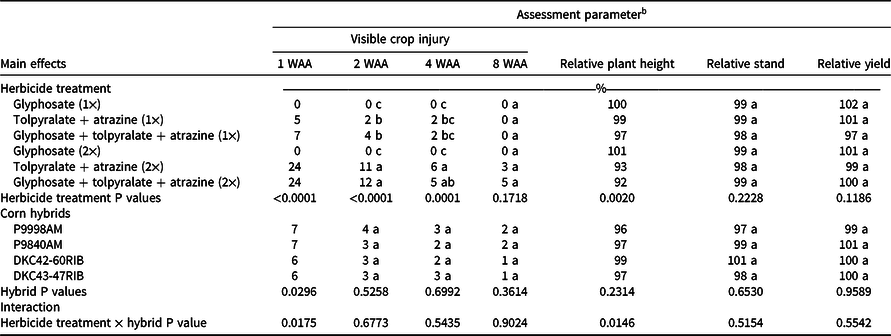
Significance of main effects and their interaction for percent visible crop injury at 1, 2, 4 and 8 wk after application (WAA), and corn height, stand, and yield, relative to the untreated control plots within replications, from six field studies located near Ridgetown, ON and Exeter, ON, in 2018 and 2019.a

a Means within main effects followed by a different letter within a column are significantly different according to Tukey-Kramer multiple-range test (α = 0.05).
b Plant height, stand, and yield are expressed as a percent, relative to the untreated control plots within replications.
Results and Discussion
Variance analysis indicated that the herbicide treatment-by-hybrid interaction was significant for corn injury 1 WAA (P = 0.0175) and plant height (P = 0.0146) (Table 2). There was no significant herbicide treatment-by-hybrid interaction for visible corn injury 2, 4, and 8 WAA, plant stand, or yield (P ≥ 0.5154). Averaged over all hybrids, glyphosate (1,800 or 3,600 g ae ha–1) did not result in any corn injury at any evaluation date.
Within the main effects, herbicide treatment was significant for crop injury at 2 and 4 WAA (P < 0.0001); however, hybrid was not (P ≥ 0.5258) (Table 2). At 2 WAA, tolpyralate + atrazine and glyphosate + tolpyralate + atrazine treatments at the 1× rate caused ≤4% corn injury; however, when applied at the 2× rate, injury increased to 12%. The addition of glyphosate did not increase crop injury of the tolpyralate + atrazine tank mix, results that are in contrast to Armel et al. (Reference Armel, Wilson, Richardson and Hines2003), who observed that mesotrione (105 g ai ha–1) caused ≥18% corn injury applied alone and ≥30% when tank-mixed with glyphosate (560 or 1,120 g ae ha–1). Furthermore, the greater injury reported by Armel following the addition of glyphosate did not translate into yield reductions. Similarly, at 4 WAA, 1× treatments caused minimal corn injury (≤2%), comparable to 0% injury from glyphosate alone (1,800 or 3,600 g ae ha–1). Crop injury appeared as white bleaching on expanded leaves and in the whorl, characteristic of HPPD-inhibiting herbicides (Armel et al. Reference Armel, Wilson, Richardson and Hines2003; Grossman and Ehrhardt Reference Grossmann and Ehrhardt2007; Metzger et al. Reference Metzger, Soltani, Raeder, Hooker, Robinson and Sikkema2019b). At 8 WAA, the main effects of herbicide treatment (P = 0.1718) and hybrid (P = 0.3614) were not significant. Visible corn injury symptoms diminished across evaluations, with up to 24, 12, 6, and 5% corn injury at 1, 2, 4, and 8 WAA, respectively. At 8 WAA, minimal corn injury was observed at 2 site-years; the remaining 4 site-years had 0% and therefore were excluded from analysis, as there was no variance. At 8 WAA, glyphosate + tolpyralate + atrazine (2× rate) caused 5% corn injury, which was similar to the 0% injury from glyphosate applications. Metzger et al. (Reference Metzger, Soltani, Raeder, Hooker, Robinson and Sikkema2019b) reported that tolpyralate + atrazine at the 1× (40 + 1,000 g ai ha–1) and 2× rates caused similar injury levels at 2 WAA (9% and 31%), 4 WAA (4% and 18%), and 8 WAA (1% and 5%, respectively). As corn progressed in developmental stage, injury diminished as new leaves developed, consistent with research by Armel et al. (Reference Armel, Wilson, Richardson and Hines2003) that found decreasing injury levels 2 WAA. Corn stand and yield in this study did not differ among herbicide treatments or hybrids. Similarly, Metzger et al. (Reference Metzger, Soltani, Raeder, Hooker, Robinson and Sikkema2019b) also did not report corn yield losses from a 2× tolpyralate + atrazine treatment.
The herbicide treatment-by-hybrid interaction was significant for corn injury at 1 WAA (P = 0.0175) (Table 2). Within herbicide treatments, all hybrids responded similarly with glyphosate, tolpyralate + atrazine, and glyphosate + tolpyralate + atrazine applied at the 1× rate (Table 3). In contrast, hybrid differences were apparent with tolpyralate + atrazine and glyphosate + tolpyralate + atrazine applied at the 2× rate. In the absence of glyphosate, P9998AM and P9840AM corn hybrids were more sensitive to tolpyralate + atrazine than DKC42-60RIB and DKC43-47RIB corn hybrids. Corn injury was 2% to 5% greater for P9998AM, P9840AM, and DKC43-47RIB compared to DKC42-60RIB when tolpyralate + atrazine was applied with glyphosate. In contrast, research conducted by Metzger et al. (Reference Metzger, Soltani, Raeder, Hooker, Robinson and Sikkema2019b) used three of the same corn hybrids as in this study and reported DKC42-60RIB and DKC43-47RIB to be more sensitive than P9840AM at 1 and 2 WAA to glyphosate + tolpyralate + atrazine. Although increased injury levels were observed for some hybrids at 1 and 2 WAA, injury levels decreased, and yield was not affected. Hybrid sensitivity to HPPD-inhibiting herbicides was not previously reported for the four corn hybrids used in this experiment; however, on the basis of the results from Metzger et al. (Reference Metzger, Soltani, Raeder, Hooker, Robinson and Sikkema2019b), it appears there is a small difference in hybrid sensitivity to tolpyralate + atrazine. Sweet corn hybrids also exhibit hybrid-specific sensitivities to HPPD-inhibiting herbicides like mesotrione and topramezone (Bollman et al. Reference Bollman, Boerboom, Becker and Fritz2008; O’Sullivan et al. Reference O’Sullivan, Zandstra and Sikkema2002).
The influence of glyphosate + tolpyralate + atrazine and hybrid on corn injury 1 wk after application (WAA) from six field studies conducted in Ridgetown, ON and Exeter, ON, in 2018 and 2019.a

a Means followed by the same lowercase letter within a column (a–c) or row followed by the same uppercase letter (Y–Z), are not statistically different according to Tukey-Kramer’s LSD (P = 0.05).
The influence of glyphosate + tolpyralate + atrazine and hybrid on corn height from six field studies conducted in Ridgetown, ON and Exeter, ON, in 2018 and 2019.a

a Corn height was expressed as a percent relative to the corresponding untreated control plot within replication.
b Means followed by the same lowercase letter within a column (a–c) or row followed by the same uppercase letter (Y–Z), are not statistically different according to Tukey-Kramer’s LSD (P = 0.05).
Within corn hybrids, P9998AM, P9840AM, DKC42-60RIB, and DKC43-47RIB responded similarly to herbicide treatment (Table 3). Tolpyralate + atrazine and glyphosate + tolpyralate + atrazine, at the 1× rate, caused 4% to 8% corn injury. Greatest crop injury (27%) was observed in hybrid P9998AM, and the injury ranged between 21% and 25% in P9840AM, DKC42-60RIB, and DKC43-47RIB. Similarly, Metzger et al. (Reference Metzger, Soltani, Raeder, Hooker, Robinson and Sikkema2019b) reported that tolpyralate + atrazine (40 + 1,000 g ai ha–1) applied POST to corn at V1 or V3 caused up to 22% more injury when applied at the 2× compared to 1× rate at 1 WAA. Metzger et al. (Reference Metzger, Soltani, Raeder, Hooker, Robinson and Sikkema2019b) determined that injury from tolpyralate + atrazine applied POST could be attributed to warmer temperatures and wide daily temperature fluctuations 24 h before application, based on stepwise regression analysis. Rainfall following mesotrione applied POST accentuated crop injury in research by Armel et al. (Reference Armel, Wilson, Richardson and Hines2003); however, Metzger et al. (Reference Metzger, Soltani, Raeder, Hooker, Robinson and Sikkema2019b) reported reduced crop injury from increased rainfall 1 wk following herbicide application with tolpyralate.
Crop injury did not increase when tolpyralate + atrazine was tank-mixed with glyphosate (Table 3). Soltani et al. (Reference Soltani, Shropshire and Sikkema2018) reported that the combination of glyphosate (1,800 g ae ha–1) and 2,4-D (560 or 1,120 g ae ha–1) resulted in accentuated visible corn injury and translated to yield loss; however, in the present study, the addition of glyphosate to tolpyralate + atrazine did not accentuate corn injury. The adjuvant in glyphosate formulations was speculated to increase the uptake of 2,4-D, resulting in greater crop injury (Soltani et al. Reference Soltani, Shropshire and Sikkema2018). Adjuvants can alter both physical and chemical characteristics of a spray drop and ultimately enhance herbicidal activity. The addition of MSO to topramezone significantly increased uptake and translocation in velvetleaf and green foxtail (Zhang et al. Reference Zhang, Jaeck, Menegat, Zhang, Gerhards and Hanwen2013). By 8 WAA, no treatment resulted in >5% corn injury, which is within commercially acceptable corn injury levels.
There was an interaction between herbicide treatment and corn hybrid (P = 0.0146) for relative corn height (Table 2). Generally, tolpyralate + atrazine and glyphosate + tolpyralate + atrazine, at the 2× rate caused a reduction in corn height, although the response was different among corn hybrids evaluated (Table 4). Consistent with corn injury at 1 WAA, all hybrids responded similarly to glyphosate (1× or 2× rate), tolpyralate + atrazine (1× rate), and glyphosate + tolpyralate + atrazine (1× rate). However, at a 2× rate, tolpyralate + atrazine and glyphosate + tolpyralate + atrazine reduced P9998AM height up to 11% relative to the untreated control; P9840AM, DKC42-60RIB, and DKC43-47RIB corn height was reduced up to 9%, 6%, and 4%, respectively. Metzger et al. (Reference Metzger, Soltani, Raeder, Hooker, Robinson and Sikkema2019b) reported that tolpyralate + atrazine applied at a 2× rate (80 + 2,000 g ai ha–1) reduced corn height 4% more compared to a 1× rate, which is consistent with the trends observed in this study. Within hybrids, P9998AM and P9840AM responded similarly to herbicide treatments; height was reduced 8% to 11% (relative to the nontreated control) with 2× rate of tolpyralate + atrazine and glyphosate + tolpyralate + atrazine. The herbicide treatments evaluated did not decrease DKC42-60RIB corn height; this was also the least sensitive hybrid based on corn injury 1 WAA. DKC43-47RIB responded similarly to DKC42-60RIB with one exception: tolpyralate + atrazine (2× rate) reduced corn height 7% relative to the untreated control.
Overall, this research furthers our understanding of corn tolerance to tolpyralate + atrazine, applied alone and with the addition of a commercial glyphosate formulation. Glyphosate will commonly be used as a tank mix partner with tolpyralate + atrazine to achieve broad-spectrum control of susceptible weeds emerged at the time of application. The selected hybrids in this study were not known to be sensitive to HPPD-inhibiting herbicides; however, P9998AM and P9840AM hybrids appear to exhibit slightly greater sensitivity compared to DKC42-60RIB and DKC43-47RIB hybrids following an application of tolpyralate + atrazine or glyphosate + tolpyralate + atrazine at the 2× rate. Differences among corn hybrid sensitivity to tolpyralate + atrazine were transient, with differences in corn injury at 1 WAA; however, all four hybrids had similar injury at 2, 4, and 8 WAA, with no impact on final yield. Generally, corn injury levels increased from tolpyralate + atrazine or glyphosate + tolpyralate + atrazine at the 2× rate, regardless of hybrid. The tank mix of glyphosate with tolpyralate + atrazine did not increase corn injury at 1, 2, 4, or 8 WAA and did not have an effect on corn height, stand, or yield. These data suggest that the addition of a commercial glyphosate formulation with tolpyralate + atrazine does not accentuate crop injury and did not influence corn height, stand, or yield on the four hybrids used in the study.
Acknowledgments
Funding for this project was provided by ISK Biosciences Inc. No other conflicts of interest have been declared.