Introduction
Social insects, i.e. ants, bees, wasps (Hymenoptera) and termites (Isoptera), are among the world's most successful species at invading new habitats (Moller, Reference Moller1996). Much of the ecological success of social insects has been attributed to task partitioning with some individuals being specialized in reproduction and others in rearing offspring (Sundstrom & Boomsma, Reference Sundstrom and Boomsma2001). In many settings, imported social insect species such as termites have severely disrupted the ecological system and/or caused significant economic damage (Williams, Reference Williams1994). Although termites are useful recyclers of organic compounds (i.e. cellulose) in their natural habitat, they are highly destructive pests that feed on wooden components of buildings in urban areas.
The genera Coptotermes and Reticulitermes (Rhinotermitidae) are prominent groups of subterranean termite pests that commonly cause extensive damage by infesting man-made structures (Gay, Reference Gay, Krishna and Weesner1969; Su & Scheffrahn, Reference Su, Scheffrahn, Abe, Bignell and Higashi2000). Reticulitermes species nest in the soil and feed on dead wood and other cellulosic materials in or near the soil surface (Thorne et al., Reference Thorne, Traniello, Adams and Bulmer1999). As a result of their large colony size, strong ability to penetrate a variety of materials and veracious appetite for a wide range of wood types, Reticulitermes species have had a severe economic impact wherever they have appeared. In the United States alone, damage and control of subterranean termites cost several billion dollars per year (Haverty et al., Reference Haverty, Nelson and Page1991; Forschler & Jenkins, Reference Forschler and Jenkins1999; Su & Scheffrahn, Reference Su, Scheffrahn, Abe, Bignell and Higashi2000).
Control of Reticulitermes species is a major problem due to their complex life history. Because subterranean termites (Rhinotermitidae) are cryptic insects, their breeding structure is still poorly understood. According to the classic description, a single pair of primary (winged) reproductives initiates a colony with a simple family structure (one queen, one king and their offspring). Primary reproductives are frequently supplemented or replaced by secondary reproductives that develop either from brachypterous nymphs or from workers (reviewed in Lainé & Wright, Reference Lainé and Wright2003). Since these larvae instars, called neotenics, cannot fly, they must mate in the nest. Colonies with secondary reproductives can constitute extended families that continue to grow and expand. Isolated colony fragments can become autonomous and create new colonies (Thorne et al., Reference Thorne, Traniello, Adams and Bulmer1999). This flexibility in caste differentiation probably facilitates colonization and invasion of new environments by subterranean termites.
As a result of human intervention, i.e. transportation and creation of urban heat islands, Reticulitermes species have been able to thrive in cities located in temperate climates where the natural forest habitat is normally too cold. This explains the successful invasion of Paris (France), Rouen (France) or Hamburg (Germany) by R. santonensis, of Toronto (Canada) by R. flavipes and of Devon (Great Britain) by R. grassei (Clément et al., Reference Clément, Bagnères, Uva, Wilfert, Quintana, Reinhard and Dronnet2001; Lainé, Reference Lainé2002).
Termite infestation in Domène, a small town near Grenoble, France (Isère Department, Rhône-Alpes region) was first reported 35 years ago. Initial surveys undertaken for the city by Bagnères et al. (unpublished report) showed that 90% of the old town centre was infested by a new Reticulitermes phenotype that was tentatively designated R. sp. The same phenotype was subsequently observed by Bagnères and coll. in Bagnacavallo (Bologna) in northern Italy (Uva, Reference Uva2002; Uva et al., Reference Uva, Clément, Austin, Aubert, Zaffagnini, Quintana and Bagnères2004). Since these early reports, numerous colonies with the same phenotype have been described in Italy, southeast France, Greece and Croatia (Marini & Mantovani, Reference Marini and Mantovani2002; Uva, Reference Uva2002; Bagnères et al., Reference Bagnères, Uva and Clément2003; Luchetti et al., Reference Luchetti, Trenta, Mantovani and Marini2004; Uva et al., Reference Uva, Clément, Austin, Aubert, Zaffagnini, Quintana and Bagnères2004; Luchetti et al., Reference Luchetti, Marini and Mantovani2007; Leniaud et al., in prep); and R. sp. was elevated to the status of a species named Reticulitermes urbis based on morphological, chemical and molecular markers (Bagnères et al., Reference Bagnères, Uva and Clément2003). Phylogenetic studies indicate that R. urbis is close to R. balkanensis that certainly originated from the Balkan peninsula (Marini & Mantovani, Reference Marini and Mantovani2002; Uva, Reference Uva2002; Bagnères et al., Reference Bagnères, Uva and Clément2003; Luchetti et al., Reference Luchetti, Trenta, Mantovani and Marini2004; Uva et al., Reference Uva, Clément, Austin, Aubert, Zaffagnini, Quintana and Bagnères2004). Its occurrence exclusively in urban areas of France and Italy is probably a consequence of human intervention (Bagnères & Luchetti, personal communication).
Although numerous termite species have successfully thrived in non-native areas, only a few, e.g. Coptotermes formosanus, can be considered as truly invasive, i.e. exogenous species widely established and locally dominant with severe economic and/or ecological impact (Husseneder et al., Reference Husseneder, Messenger, Su, Grace and Vargo2005). In Europe, R. santonensis that may have been imported from North American populations of R. flavipes (Bagnères et al., Reference Bagnères, Clément, Blum, Severson, Joulie and Lange1990; Clément et al., Reference Clément, Bagnères, Uva, Wilfert, Quintana, Reinhard and Dronnet2001; Marini & Mantovani, Reference Marini and Mantovani2002; Austin et al., Reference Austin, Szalanski, Scheffrahn, Messenger, Dronnet and Bagnères2005; Dronnet et al., Reference Dronnet, Chapuisat, Vargo, Lohou and Bagnères2005) can be considered as invasive. Dronnet et al. (Reference Dronnet, Chapuisat, Vargo, Lohou and Bagnères2005) reported several features of R. santonensis colony structure that may have facilitated this invasion, i.e. expensive colony, reduced intraspecific aggression, enhanced polygyny and colony expansion by budding. Similar features have been observed in invasive ant species (Holway et al., Reference Holway, Lach, Suarez, Tsutsui and Case2002; Tsutsui & Suarez, Reference Tsutsui and Suarez2003; Corin et al., Reference Corin, Abbott, Ritchie and Lester2007).
The opportunity for this two-phased study, designed to gain insight into termite establishment and spreading processes, arose when a large sampling program was undertaken on the imported population of R. urbis in the city of Domène in the Alps. In the first phase of study, we used behavioural tests to estimate the level of aggression between collection sites. Using the triple mark-recapture technique, we estimated the density of the population and its ability to spread in the ground. In the second phase of study, we investigated colony and population structure and characterized the breeding system using ten microsatellite markers. Genetic markers are powerful tools for inferring colony breeding structure in social insects (Thorne et al., Reference Thorne, Traniello, Adams and Bulmer1999; Ross, Reference Ross2001), and there have been an increasing number of genetic studies on the colony social organization of termites (Atkinson & Adams, Reference Atkinson and Adams1997; Thompson & Hebert, Reference Thompson and Hebert1998; Goodisman & Crozier, Reference Goodisman and Crozier2002), especially subterranean termites (Clément, Reference Clément, Howse and Clément1981; Bulmer et al., Reference Bulmer, Adams and Traniello2001; Clément et al., Reference Clément, Bagnères, Uva, Wilfert, Quintana, Reinhard and Dronnet2001; Husseneder & Grace, Reference Husseneder and Grace2001; Vargo, Reference Vargo2003a, Reference Vargob; Vargo et al., Reference Vargo, Husseneder, Grace, Henderson and Ring2003; DeHeer & Vargo, Reference DeHeer and Vargo2004; Dronnet et al., Reference Dronnet, Chapuisat, Vargo, Lohou and Bagnères2005). Presuming that R. urbis was an invasive termite species, we were particularly interested in determining if it exhibited the invasive features described by other authors.
Material and methods
Specimen collection and description of the location
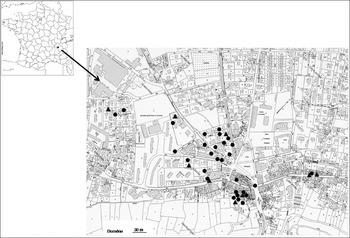
Termite samples were collected from 34 sites using artificial feeding stations placed throughout the city of Domène, France. Twenty-nine collection sites were used for genetic study. Behavioural tests were carried out in four of these collection sites and in five other sites (n=9) (fig. 1). The infested area was estimated to cover 6.8 hectares and appeared to comprise a single population. This population was so well delimited that we could not find infested tree stumps or houses outside the area. Recently, a site infested by R. urbis was found in Grenoble (6 km east of Domène), but this point could not be added to the present data set due to insufficient sampling.
Map of Domène showing location of the collection points for samples used for (•) genetic analysis and (▲) behavioural tests.

Behavioural tests
To take into account possible seasonal variations in aggressive behaviour as observed by Clément (Reference Clément1978), samples were collected after swarming in the summer of 1999 and during swarming in the spring of 2000. Given the limited number of termites, a total of 20 series of five assays confronting 20 workers from paired nine collection points were carried out. The Ag index between two collection points was calculated according to the following formula, Ag=(M+(m/2))×2.5, where M is the average number of dead workers and m is the average number of injured workers. As previously described (Clément, Reference Clément1986), Ag index can range from 0 (no aggression) to 100 (all termites dead after 24 h).
Estimation of population density
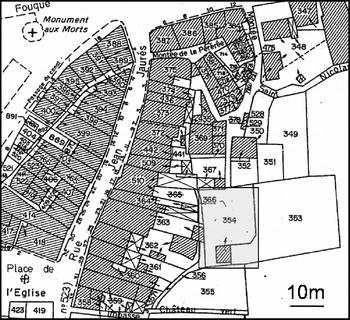
Population density was estimated using the triple mark-recapture (TMR) technique that has been used previously for non-destructive study of animal populations (Lebreton et al., Reference Lebreton, Pradel and Clobert1993) and insect colonies (Easey & Holt, Reference Easey and Holt1989; Su & Scheffrahn, Reference Su and Scheffrahn1993; Su et al., Reference Su, Ban and Scheffrahn1993; Paulmier et al., Reference Paulmier, Vauchot, Pruvost, Lohou, Tussac, Jéquel, Leca and Clément1997; Evans et al., Reference Evans, Lenz and Gleeson1998). Estimation was carried out in a 150 m2 area near the old town centre in Domène (fig. 2). This area was chosen because it was the most heavily damaged, thus suggesting that the termite population was old and stable. A network of 20 wooden stakes and TMR stations consisting of a perforated Falcon tube (length=11 cm, ø=3 cm) with a piece of wet cardboard inside were installed.
Location of parcel E354 where the triple mark-recapture technique was performed to estimate the density of the foraging population.

The TMR technique involves three cycles of mark and recaptures (Lindberg & Rexstad, Reference Lindberg, Rexstad, El-Shaarawi and Piegorsh2002). During the first cycle, termites collected from TMR stations were counted, stained with Nile Blue for four days (Bagnères, Reference Bagnères1989) and finally released through the same station from which they were collected. During the next two cycles, termites collected from stations containing marked termites were counted and stained again before being released through the same stations. At the end of the three cycles over a five-week period, the size (N) of the foraging population and associated standard deviation (SD) were estimated according to the formula of Begon (Reference Begon1979).
Molecular genetics
A total of 20 individuals (mainly workers) from each of the 29 collection points were placed in 95% ethanol and stored at 4°C. Total DNA from the whole body was obtained using the Chelex® 100 extraction technique (Walsh et al., Reference Walsh, Metzger and Higuchi1991). Samples were placed in liquid nitrogen for 20 s and then thoroughly crushed with a disposable pestle. After crushing, 200 μl of 5% Chelex® solution and 3 μl of 1% proteinase K solution were added and the samples were vortexed for 10 s and centrifuged for 15 s. After incubation at 56°C for 1 h with constant agitation, samples were vortexed for 10 s, boiled at 96°C for 15 min and vortexed for another 10 s. Following a 3-min centrifugation at 8000 g, 100 μl of the supernatant was transferred into an Eppendorf tube and purified with chilled pure 100% ethanol.
To study genetic diversity, a 664-bp fragment of the mitochondrial COII gene from the total DNA of 29 individuals (one per collection point) was amplified using the B-tLys (5′ GTTTAAGAGACCATTACTTA 3′) and modified A-tLeu (5′ CAGATAAGTGCATTGGATTT 3′) primers (Simon et al., Reference Simon, Frati, Beckenbach, Crespi, Liu and Flook1994; Miura et al., Reference Miura, Roisin and Matsumoto2000). Amplification was performed using a Biometra 96 T1 with an initial 5-min melting step at 94°C, followed by 35 iterations of the following cycles: 94°C for 30 s, 45°C for 1 min, and 65°C for 3 min, with a 6-min final extension at 65°C. The PCR templates were cycle-sequenced using an automated AB 3100-Avant sequencer. Sequences were aligned using the ClustalW algorithm (Thompson et al., Reference Thompson, Higgins and Gibson1994) within the Bioedit program (Hall, Reference Hall1999) and corrected manually.
For microsatellite genotyping, PCR amplification was performed as previously described (Dronnet et al., Reference Dronnet, Bagnères, Juba and Vargo2004). PCR products were separated by electrophoresis on 6% polyacrylamide gel in a LI-COR 4000L sequencer. Alleles were scored using GENE PROFILER 4.03 software (Scanalytics, Inc.). The genotypes of 580 termites from the 29 collection points were determined using ten microsatellite loci, i.e. Rf6-1, Rf5-10 and Rf21-1 originally isolated from R. flavipes (Vargo, Reference Vargo2000), Rs62, Rs10, Rs43, Rs16, Rs33, Rs15 characterized in R. santonensis (Dronnet et al., Reference Dronnet, Bagnères, Juba and Vargo2004) and Rs2, (TA)6; (CA)5, F: TCAGTCCTGTCATGACGTT; R: GGAGTCCTACCGTGTGTGTGT also characterized in R. santonensis.
Colony affiliation
To determine if the collection points belonged to the same colony or not, genotypic frequencies at all collection point pairs were compared using a log-likelihood (G)-based test differentiation from the GENEPOP software package available at http://genepop.curtin.edu.au/ (Raymond & Rousset, Reference Raymond and Rousset1995). Overall significance was determined using the Fisher's combined probability test. A Bonferroni correction was applied to account for multiple comparisons. Samples from two collection points were considered to belong to different colonies if genotypic differentiation was statistically significant (α<0.00017 after the Bonferroni correction) (Vargo, Reference Vargo2003a, Reference Vargob; Vargo et al., Reference Vargo, Husseneder, Grace, Henderson and Ring2003; DeHeer & Vargo, Reference DeHeer and Vargo2004; Dronnet et al., Reference Dronnet, Chapuisat, Vargo, Lohou and Bagnères2005).
Classification of colonies
The colonies defined in the previous step were classified based on dividing the breeding system into two general types, i.e. simple families headed by a monogamous pair of reproductives or extended families headed by multiple kings and/or queens (neotenics). Classification was made by comparing the genotypes observed in workers within the colonies with the genotypes expected for each family type using standard criteria for termites (Bulmer et al., Reference Bulmer, Adams and Traniello2001; Goodisman & Crozier, Reference Goodisman and Crozier2002; Vargo, Reference Vargo2003a, Reference Vargob; Vargo et al., Reference Vargo, Husseneder, Grace, Henderson and Ring2003; DeHeer & Vargo, Reference DeHeer and Vargo2004). Colonies were considered as simple families if worker genotypes were consistent with those expected for a single pair of parents and if the ratios of the observed genotypes did not differ significantly from the expected Mendelian ratios as determined by G-testing. An overall G-value was obtained for each colony by summing all the locus-specific G-values. Colonies were considered as extended families if worker genotypes were not consistent with a single pair of reproductives (e.g. one or more loci with five or more genotypic classes or three classes of homozygotes) or if worker genotypes were consistent with the presence of a single pair of reproductives but the observed frequencies of the genotypes deviated significantly from the values expected for simple families (p<0.05, G-test).
Analysis of isolation by distance
Isolation by distance was calculated in a two-step analysis. First, the pairwise FST for all collection point pairs was computed. Second, the correlation coefficient between FST/(1−FST) and ln of geographic distances (Slatkin, Reference Slatkin1993; Rousset, Reference Rousset1997) was calculated using the Mantel test in the web-based GENEPOP (Raymond & Rousset, Reference Raymond and Rousset1995). The correlation between geographic and genetic distances was calculated according to the Spearman's rank correlation (i.e. rho), since Spearman's rank correlation coefficient does not require the assumption that the relationship between the variables is linear. The significance of the correlation (rho) was assessed with permutation test. A significance threshold of p<0.05 was used to reject the null hypothesis (i.e. ‘geographic and genetic distances are not significantly correlated’).
Results
Behavioural testing
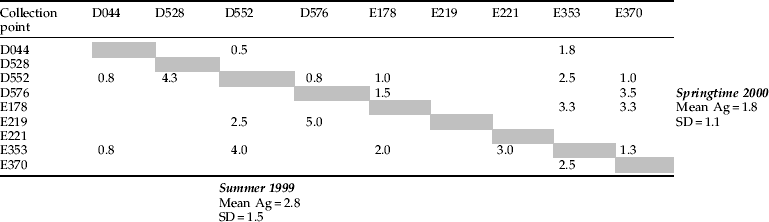
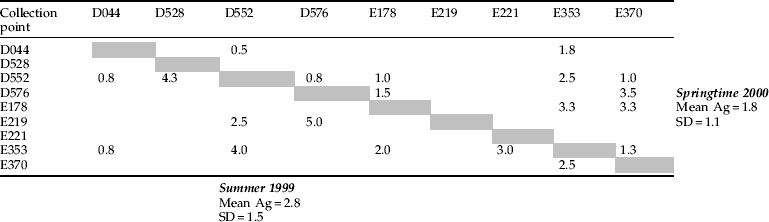
The mean Ag index was 1.8 (SD=1.1) before swarming in the spring and was 2.8 (SD=1.5) after swarming in the summer (table 1). Termites from one station would accept termites from another station. No significant difference was observed between collection times (t-test p-value=0.13).
Mean intraspecific aggression (Ag) index values measured between R. urbis workers collected at different points in Domène after swarming in summer and before swarming in springtime. Five replicates of 20 workers per collection point were confronted (200 workers per series) and Ag index was measured according to the method of Clément (Reference Clément1986). Ag index can range from 0 (no aggression) to 100 (all termites dead after 24 h). The column headings correspond to represent property codes used in the city's official register.
Triple mark-recapture technique
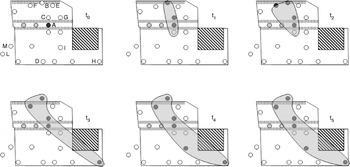
Based on TMR, the foraging population was about 330,000 individuals per 150 m2, with an average density of 2200 termites m−2 (SD=250). Density was probably underestimated since sampling from the feeding stations may have missed a large part of the population. Details of TMR analysis are shown in table 2 and fig. 3. Tunnelling capacity was also high. Termites were able to cover up to 50 m within one month. This was the maximum distance between two interconnected collection points.
Termite progression during the measurement of population density using the triple mark-recapture technique (summer 1999). A ‘termite trap’ contains unmarked termites, a ‘blue termite trap’ contains marked termites and a ‘termites free trap’ contains no termites. The time between t0 and t5 is five weeks. Letters correspond to the trap name ( , wall;
 , built; ○, termite trap;
 , blue termite trap;
 , termites free trap).

Estimation of termite population density using the triple mark-recapture technique. The estimated population size in Domène, France was 329,000 individuals over a total surface of 150 m2. The average density was 2200 termites m−2 (SD=250). The letters in the trap column refer to fig. 3. The numbers in parenthesis indicate the number of marked termites in each cycle in relation to the total number of termites (workers and/or soldiers) collected.

Genetic analysis
There were no more than four alleles per microsatellite locus and only one COII haplotype in the entire city of Domène (based on analysis of the 29 collection points). This extremely low genetic diversity suggests that reproductives were closely related.
G-test of differentiation between paired collections points showed that none of the samples from the 29 stations in Domène were genetically differentiated, i.e. displayed significantly different microsatellite genotypic frequencies (p>0.00017). This finding indicates that all workers belonged to the same colony, i.e. a unicolonial population covering an area of almost seven hectares.
More than four genotypes were observed in the population. This finding is inconsistent with the presence of a single pair of reproductives and suggests that the colony formed an extended family with several reproductives. This assumption is further supported by the fact that each collection point usually had a range of genotypes (i.e. more than four genotypes or non-mendelian distribution of the genotypes frequencies) consistent with an extended family.
Isolation by distance
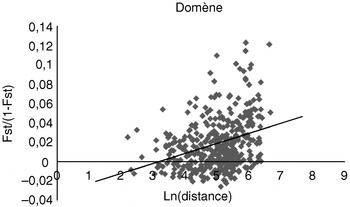
Analysis showed significant isolation by distance between collection points in Domène. A significant positive correlation was observed between the geographical distance and genetic differentiation of sample pairs (Fst) (fig. 4; n=29, r=0.31, Mantel test p<0.0001). This finding indicates high viscosity and nonrandom mating in the colony. These features are characteristic of dispersion by budding.
Results of isolation-by-distance analysis in Domène. The relationship between pairwise estimates of FST/(1−FST) and geographical distance (m) is shown for paired collection points (r=0.31, Mantel test p-value <0.0001).

Discussion
Reticulitermes urbis probably originated from the Balkans (Marini & Mantovani, Reference Marini and Mantovani2002; Uva, Reference Uva2002; Bagnères et al., Reference Bagnères, Uva and Clément2003; Luchetti et al., Reference Luchetti, Trenta, Mantovani and Marini2004; Uva et al., Reference Uva, Clément, Austin, Aubert, Zaffagnini, Quintana and Bagnères2004). Except for one forest located not far from an urban area in southern France (Sophia Antipolis) (Uva et al., Reference Uva, Clément, Austin, Aubert, Zaffagnini, Quintana and Bagnères2004), R. urbis has never been identified in a natural setting in France or Italy. The hypothesis that R. urbis was introduced into western Europe by human activity (importation of infested materials) is further supported by recent genetic data showing lower genetic diversity and fewer COII haplotypes in France and Italy than in Balkan areas (Leniaud et al., in prep.).
In this study, colony or population size was estimated only by the indirect TMR technique. Excavation is, in general, not practical since the nests are spread out over such an extensive foraging area that it would be too destructive (Husseneder et al., Reference Husseneder, Messenger, Su, Grace and Vargo2005). The termite density in Domène was about 2200 termites m−2. Previous studies using the TMR for estimation of population density of the same species and of R. santonensis (table 3: Paulmier et al., Reference Paulmier, Vauchot, Pruvost, Lohou, Tussac, Jéquel, Leca and Clément1997; Ferrari et al., Reference Ferrari, Marini, Tiglié and Zaffagnini1998) indicated much lower densities. Physical conditions, mediated by abiotic factors, have been shown to increase the abundance of pest insects in North America (Swetnam & Lynch, Reference Swetnam and Lynch1993; Williams & Liebhold, Reference Williams and Liebhold1995). The foraging population was estimated at about 329,000 individuals, but this estimation could be an underestimation since individuals may be distributed unequally within the entire foraging area (Evans et al., Reference Evans, Lenz and Gleeson1999). The dispersion capacity of the termites in Domène was about 50 m per month. This dispersion rate is in agreement with previous studies, i.e. 45–50 m for the same species in Bagnacavallo (Ferrari et al., Reference Ferrari, Marini, Tiglié and Zaffagnini1998), 40 m for R. santonensis in Paris (Paulmier et al., Reference Paulmier, Vauchot, Pruvost, Lohou, Tussac, Jéquel, Leca and Clément1997) and 7–70 m for R. flavipes in Florida (Su et al., Reference Su, Ban and Scheffrahn1993).
Termite population density measured in various locations and species using the triple mark-recapture technique.

Termites from different collection points in Domène showed no aggressive behaviour. Individuals tolerated each other even when collection points were mixed. Based on this finding, it can be assumed that interchange between individuals was free. Similar findings were reported by Ferrari et al. (Reference Ferrari, Marini, Tiglié and Zaffagnini1998) for R. urbis in Bagnacavallo (Italy). Absence of aggression may promote the colonization process by allowing exchange of food and individuals. Non-aggressive behaviour may also facilitate coping with stressful conditions, e.g. isolation of a small group of individuals and disturbances caused by human intervention. As in several studies on the Argentine ant, reduced intraspecific aggression and absence of competitors could contribute to the elevated population densities directly responsible for the widespread success of invaders (Holway et al., Reference Holway, Suarez and Case1998) and in particular of R. urbis.
In this study, genetic analysis showed that the termites in Domène belonged to a single genetic entity. The low genetic diversity, no more than four microsatellite alleles (compared with the higher diversity in Balkan areas: Leniaud et al., in prep) and the single COII haplotype in the population, suggests that this extended family colony may have descended from closely related females or even from a single pair of reproductives. Based on these findings, it seems probable that the presence of R. urbis in Domène resulted from a limited number of introduction events. Indeed, it may even be possible that the invasion originated from a single location. These findings would mean that a small number of termites were sufficient to infest the entire city in less than 50 years. This is consistent with one previous study (Pichon et al., Reference Pichon, Kutnik, Leniaud, Darrouzet, Châline, Dupont and Bagnères2007), showing that only 30 R. santonensis workers were sufficient to produce a new generation via formation of neotenics. In a recent study, Zayed et al. (Reference Zayed, Constantin and Packer2007) showed that the solitary bee, Lasioglossum leucozonium, invaded North America through the introduction of a very small number of propagules. R. santonensis, which was probably imported from the USA, is known to create vast colonies in introduced ranges and exhibits lower genetic diversity in introduced ranges than in the original area of distribution (Dronnet et al., Reference Dronnet, Chapuisat, Vargo, Lohou and Bagnères2005). This is, however, the first study documenting a unicolonial population in termites, i.e. a single entity covering 6.8 ha that developed in a previously unoccupied range less than 40 years after introduction.
Although we have no genetic information from the native range of R. urbis, we could speculate that, as observed in Argentine ants (Tsutsui et al., Reference Tsutsui, Suarez, Holway and Case2000; Giraud et al., Reference Giraud, Pedersen and Keller2002; Corin et al., Reference Corin, Abbott, Ritchie and Lester2007), a population genetic bottleneck during or subsequent to the introduction may have promoted the formation of this unicolonial population. Tsutsui et al. (Reference Tsutsui, Suarez, Holway and Case2000), Holtzer et al. (Reference Holtzer, Chapuisat, Kremer, Finet and Keller2006) and Thomas et al. (Reference Thomas, Payne-Makrisa, Suarez, Tsutsui and Holway2006) defined a supercolony as a group of nests exhibiting no intraspecific aggression. Given the absence of aggression, the nests in Domène fit this definition, despite the possible existence of several ‘physical units’, i.e. groups of foragers and/or members of satellite nests isolated from the rest of the colony. These units develop neotenics from existing workers and sometimes become independent nests. Field analyses and TMR in Domène confirmed the difficulty of defining nest limits. This study found significant isolation by distance among the collection points within the extensive colony in Domène. This finding indicates that the workers were not genetically homogeneous and suggests that there are spatially separated reproductive centres among which exchange of termites is limited. In a recent study on Coptotermes formosanus, Husseneder et al. (Reference Husseneder, Messenger, Su, Grace and Vargo2005) found some genetic differentiation in a large extended family, suggesting the presence of separate reproductive centres. Isolation by distance would be expected if dispersal over the spatial scale was relatively limited as a result of the short range of mating flights and/or frequent colony reproduction by budding. Termites in the supercolony in Domène may have been introduced in a single location from which they gradually propagated all over the old town by budding and/or human dispersion. Colony budding is an advantageous process that may provide several adaptive benefits. By producing nearby colony buds, colony budding can lead to polydomous colonies (having multiple nest sites), increased kin recognition and cooperation, fusion of colony boundaries and ultimately formation of supercolonies (Abbott, Reference Abbott2006).
Recent studies on invasive social insect populations have demonstrated that introduction is accompanied or followed quickly by dramatic changes in behaviour, social organization, reproductive biology and population genetics. The best documented models for such changes remain the invasive ants (Linepithema humile, Wasmannia auropunctata, Solenopsis invicta etc.), but similar findings have been observed in other social insects including Vespula germanica, Bombus terrestris and Apis mellifera scutellata (reviewed in Moller, Reference Moller1996; Chapman & Bourke, Reference Chapman and Bourke2001; Schneider et al., Reference Schneider, DeGrandi-Hoffman, Scott and Roan Smith2003). In a recent genetic study on R. santonensis, Dronnet et al. (Reference Dronnet, Chapuisat, Vargo, Lohou and Bagnères2005) found several similarities with L. humile that forms non-aggressive populations in its introduced range. In North America, R. flavipes colonies are small and well delimited with variable levels of aggression (Bulmer & Traniello, Reference Bulmer and Traniello2002; DeHeer & Vargo, Reference DeHeer and Vargo2004), and Vargo (Reference Vargo2003a, Reference Vargob) found that R. flavipes colonies exhibit a variable and flexible breeding system with simple and extended families headed by a small number of inbred neotenics. In contrast, in France, Dronnet et al. (Reference Dronnet, Chapuisat, Vargo, Lohou and Bagnères2005) found that 100% of the R. santonensis colonies were spatially extensive, headed by numerous neotenics with separate reproductive centres and restricted movement of neotenics and workers.
A termite colony structure involving extended families with many neotenic reproductives and non-aggression would facilitate colonization in urban areas. Human activity could also enhance the spread of this type of colony. These findings have important implications for control of R. urbis using termicides transmitted by contact or food exchange (trophallaxis). Acceptance of a contaminated termite in another nest would promote propagation of the toxin. However, treating only a small area of a large supercolony would probably be insufficient, since termites can move freely from one nest to another and, thus, can quickly re-colonize treated parcels. Based on this assumption, a wide-scale termite eradication program using baiting techniques was initiated in the old-town centre of Domène in 2004 and in the rest of the city in 2005. In 2007, 95% of the 6.8 contaminated hectares were already free of termites. The unicoloniality of the Domène population was certainly a factor in these spectacular results, since this single introduced population probably had similar sensitivity to the IgR toxin.
Since there are currently no studies available on the social organization in R. urbis colonies in their native setting, we cannot know whether introduction events affected colony structure in this species and played any role in its invasive success. Further investigation on the behaviour and genetic structure of populations in the native range will be needed. Comparative studies with other introduced populations of this species will also be helpful to identify common features in colony breeding structure and to determine what role they may play in invasion success.
Acknowledgements
AGB wishes to thank the city of Domène, particularly Michel Savin (mayor) and Patrick Gerby (city official in charge of the eradication process) for providing financial support for P. Uva's PhD and for granting permission to use data and samples for this study. We also wish to thank Jean-Luc Clément and the CNRS for assistance in negotiating with the city of Domène and the Rhône-Alpes Region. We are grateful to Simon Dupont and Nese Kaplan for their technical assistance, to Andy Corsini for the English revision and to Michel Chapuisat for fruitful discussions and comments on the manuscript. We would like to thank two anonymous referees for their helpful comments.