In the archaeology of southeastern North America, research into the economic activities of post-AD 1200 non-Mississippian societies has been relatively uncommon, but it has been productive when undertaken (e.g., Cobb and Garrow Reference Cobb and Garrow1996; Rogers Reference Rogers1993, Reference Rogers1995; Woodall Reference Woodall1990, Reference Woodall1999, Reference Woodall2009). In contrast, archaeologists have extensively studied several aspects of Mississippian economic systems, from household production to interaction patterns within and between polities (e.g., Blitz Reference Blitz1993; Brown et al. Reference Brown, Kerber, Winters and Smith1990; Muller Reference Muller1997; Pauketat Reference Pauketat1987, Reference Pauketat1989, Reference Pauketat, Pauketat and Emerson1997; Peregrine Reference Peregrine1992; Prentice Reference Prentice1985; Welch Reference Welch1991). Late precontact non-Mississippian societies are an important part of the cultural landscape and can contribute to our broader understanding of the economic and social organization of small-scale societies. In addition, we use our results to challenge current theorizing of core-periphery models in the region. Building on Parker's (Reference Parker2006) definitions, we suggest a new term, boundarylands, which describes areas with no clear border between societies and lack evidence of influence of complex societies on those around them.
To accomplish these goals, we build upon studies by Rogers (Reference Rogers1993) and Woodall (Reference Woodall1990) to describe and explain economic and social interaction patterns among Piedmont Village Tradition communities in the upper Yadkin River Valley during AD 1200–1600, when they lived adjacent to Mississippian societies. We characterized economic behaviors by analyzing the acquisition and distribution of nonlocal rhyolite to test three competing models. We first determined the relative concentrations of local and nonlocal lithic materials at four settlement sites in the valley dating from AD 1200 to 1400 and compared our data to an existing dataset of 10 sites examined by Rogers (Reference Rogers1993) dating to the same period and two sites examined by Woodall (Reference Woodall1999, Reference Woodall2009) dating from AD 1400 to 1600. We also assessed the range of reduction activities at sites, using Andrefsky's (Reference Andrefsky1986) experimental archaeological work. These data served as a measure of a community's access to unworked or lightly worked material based on the idea that the more sites the material travels through, the more reduced it will be (Beck et al. Reference Beck, Taylor, Jones, Fadem, Cook and Millward2002). We then examined what types of tools were made from local and nonlocal materials to compare lithic industries and assess the value Piedmont Village Tradition people placed on different materials. To describe social interaction patterns, we compared ceramic attributes using the Brainerd-Robinson analysis of stylistic properties from the four aforementioned sites and two others.
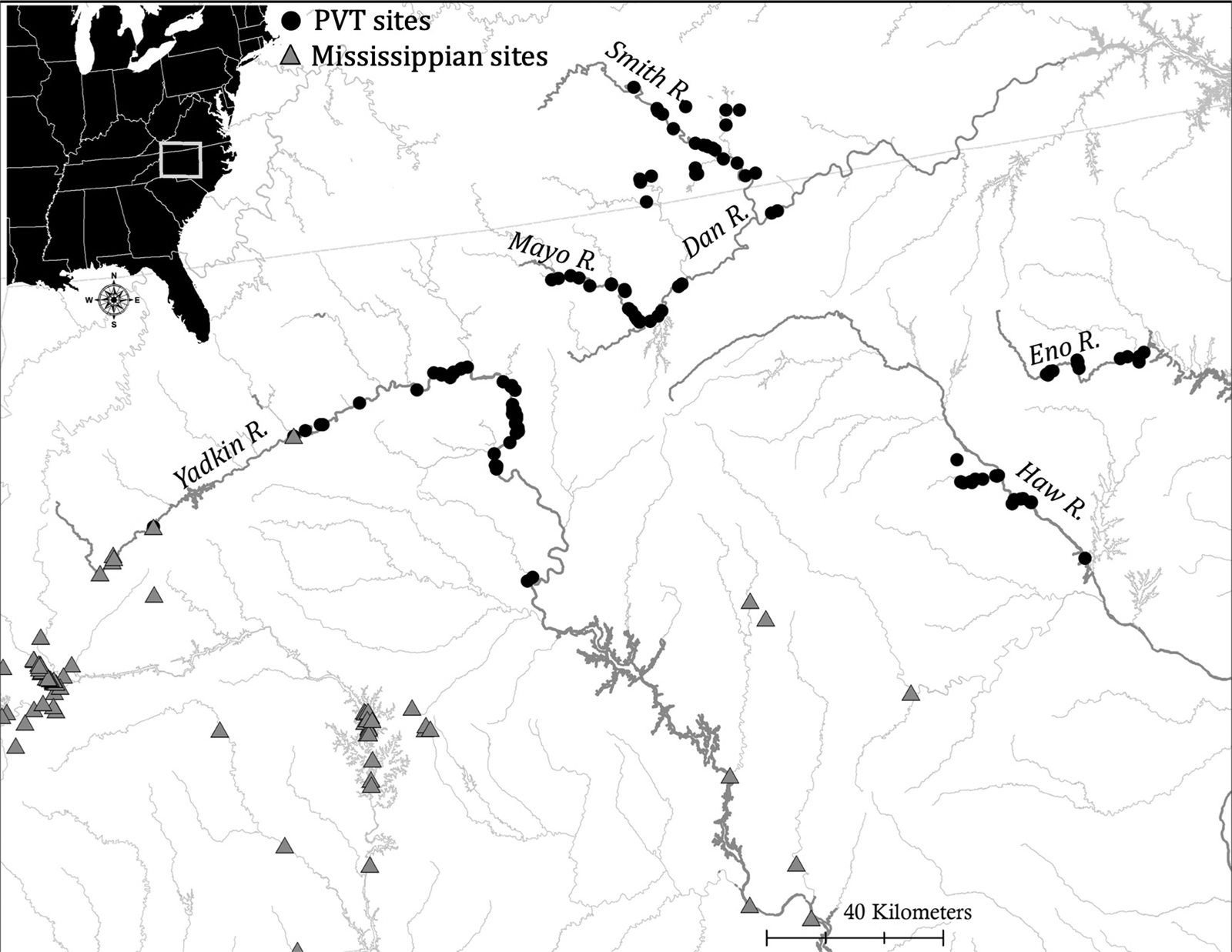
After AD 1200, Piedmont Village Tradition communities in the upper Yadkin River were adjacent to Mississippian societies and have been described as peripheral by King and Meyers (Reference Meyers2002:114; Figure 1). Examining their economic and social interactions is beneficial for several reasons. First, non-Mississippian exchange networks in the Southeast during that period are often only broadly discussed without analyses of specific activities, such as acquisition and distribution of materials. Similarly, studying exchange in Late Woodland reciprocity-based economies is underrepresented. Second, as research has intensified in the cultural processes and historical events on the edge of the Mississippian world (King and Meyers Reference King and Meyers2002; Meyers Reference Meyers2002, Reference Meyers, Gougeon and Meyers2015), there is an increased need to examine the non-Mississippian side of that boundary to keep pace with the Mississippian research. This last point has broader appeal to the study of core-periphery models in general. Finally, the causes behind and processes of coalescence have recently gained significant interest among North American archaeologists (Birch Reference Birch2010; Birch and Williamson Reference Birch and Williamson2013, Reference Birch, Williamson, Thompson and Birch2018; Drooker Reference Drooker, Ethridge and Hudson2002; Hill et al. Reference Hill, Clark, Doelle and Lyons2004; Jeffries Reference Jeffries, Thompson and Birch2018; Rodning Reference Rodning, Ethridge and Hudson2002). Piedmont Village Tradition communities did not spatially coalesce when many of their neighbors did (Jones Reference Jones, Thompson and Birch2018), and this offers an opportunity to explore some cultural dimensions of this phenomenon.
Map of the northern Piedmont showing the location of all identified Piedmont Village Tradition (PVT) and Mississippian settlement sites.

Background
Late Woodland Piedmont Village Tradition
Beginning around 200 BC and extending to around AD 1200, the general Piedmont Village Tradition cultural pattern was egalitarian, semisedentary forager-farmers living in one-to-five-household communities in larger floodplains and usually aligned linearly and parallel to a river. After AD 1200, we begin to see coalescence of communities into villages of eight to 15 households in the Dan River valley. Similar villages also appear in the Eno and Haw River valleys after AD 1500 but were likely constructed and inhabited by migrants or a combination of local residents and migrants (Davis and Ward Reference Davis and Ward1991; Dickens et al. Reference Dickens, Ward and Stephen Davis1987; Jones and Ellis Reference Jones and Ellis2016; Simpkins Reference Simpkins1985; Ward and Davis Reference Ward and Davis1993).
In the upper Yadkin River valley, we have yet to identify evidence of coalescence or village formation (Jones Reference Jones, Thompson and Birch2018; Woodall Reference Woodall1990). From AD 800 to 1200, there were a few medium-sized settlements (i.e., three to five households) with several dispersed households in the nearby floodplains (Newkirk Reference Newkirk1978; Woodall Reference Woodall1984). Jones (Reference Jones, Kellett and Jones2017) proposed that only the dispersed household pattern is seen after AD 1200, but this has yet to be tested. The evidence for incorporation of Mississippian cultural characteristics into Yadkin Piedmont Village Tradition communities dates after AD 1500 and is limited to the two sites closest to Mississippian settlements (Woodall Reference Woodall1999, Reference Woodall2009).
The most common flaked stone tools at Late Woodland Piedmont Village Tradition sites are small triangular projectile points. Drills, end scrapers, side scrapers, and expedient flake tools were made only in small quantities (Woodall Reference Woodall1984, Reference Woodall1990, Reference Woodall1999, Reference Woodall2009). Local lithic materials include quartz, quartzite, and small quantities of jasper (Rogers Reference Rogers1993). Nonlocal materials (i.e., those sourced at least 60 km from the valley) include rhyolite, chert, and, farther afield, jasper. Rhyolite is the most common nonlocal material found at AD 1200–1400 sites and originates mainly from two different sources: Morrow Mountain and Asheboro (Daniel and Butler Reference Daniel and Butler1996).
The Late Woodland Piedmont Village Tradition ceramic industry is essentially a complex of various surface and interior treatments and tempers with no clear chronological trends (Rogers Reference Rogers1993). However, types have been defined in the past, and we discuss them here to show the problematic nature of the current typology. The Uwharrie type, which is the earliest Late Woodland ceramic style dating AD 800–1200, features coarse net impression on exterior surfaces. The Dan River type is usually dated AD 1200–1600 and is tempered with crushed quartz. The interior surfaces are heavily scraped, and most vessel exteriors are also net impressed. To complicate the issue further, some also feature cord marking, smoothing, corncob impressing, and brushing. Other treatments included notches along the lip, incised or brushed lines around the neck, or sometimes fingernail pinches or punctations in the neck (Ward and Davis Reference Ward and Davis1999). Furthermore, there are a number of slight regional variations on this type that are specific to the Yadkin and Dan River valleys (Ward and Davis Reference Ward and Davis1999). The chronology of Piedmont Village Tradition pottery types is also problematic, as they are found in a number of different strata at different sites. Finally, some attributes of earlier types are also found on later types, meaning that an earlier design choice, such as cord marking, is not strictly tied to chronology. Thus, it is more effective to focus on the co-occurrence of specific attributes rather than types (Rogers Reference Rogers1993:144).
Previous Research
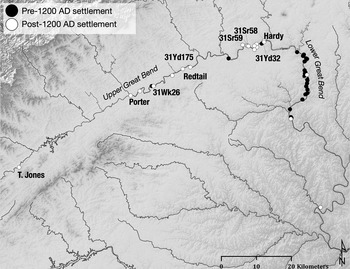
Woodall's (Reference Woodall1984, Reference Woodall1990, Reference Woodall1999, Reference Woodall2009) work at settlement sites along the upper Yadkin River recorded percentages of local and nonlocal lithics at each. At the Porter (31Wk6) and T. Jones (31Wk33) sites, which are the farthest upriver (Figure 2) and were occupied AD 1400–1600, Woodall (Reference Woodall1999, Reference Woodall2009) recorded the percentages of Knox chert in the total lithic assemblages as 24% and 31%, respectively. Knox chert is located 60 km west of the Piedmont in the Ridge-and-Valley area of eastern Tennessee, an area inhabited by Mississippian communities at that time. Moving downstream (eastward), and thus away from the source, percentages of chert decrease, and artifacts indicate previous bifacial reduction and tool resharpening, indicating a down-the-line system (Woodall Reference Woodall2009).
Map of the upper Yadkin River valley showing the upper and lower Great Bend areas, sites used in this study, and general chronology.

For rhyolite distribution, Woodall proposed two separate processes. In the upper Great Bend area of the Yadkin River (Figure 2), he hypothesized a down-the-line exchange system based on relative proportions of rhyolite and quartz (Woodall Reference Woodall1990:116). In this model, the farthest downriver site, Hardy (31Sr50), functioned as a “procurement locus for the region,” where rhyolite from the east was collected and then distributed upriver. In the Lower Great Bend area, Woodall (Reference Woodall1990) proposed a community gateway model based on Hirth's (Reference Hirth1978) economic model in highland Mexico and his own finding that there was no recognized distance-decay pattern (see Renfrew Reference Renfrew, Earle and Ericson1977). Similar to patterns in the Dan and Eno River valleys (Simpkins Reference Simpkins1985), Woodall (Reference Woodall1990:113) identified a positive correlation between site size and the percentage of rhyolite in the debitage inventory. He concluded the larger settlements directly acquired nonlocal rhyolite and distributed it to smaller neighboring communities. Noting findings by Ammerman and colleagues (Reference Ammerman, Matessi, Cavalli-Sforza and Hodder1978), Woodall (Reference Woodall1990) concluded, based on stratigraphic distribution of the material, that access to the rhyolite was regular, and he found there was little evidence that rhyolite was hyperflaked in an attempt to conserve or reuse it. Thus, the higher proportion at larger sites was not simply a result of longer occupations. There may also be temporal trends in these data, as Jones (Reference Jones, Kellett and Jones2017) suggested that upper Great Bend sites tend to date from AD 1200 to 1600, whereas lower Great Bend sites date from AD 800 to 1200 (Figure 2).
The gateway model was first applied from geography (Burghardht Reference Burghardt1971) to archaeology to examine complex societies with redistributive or market economies (e.g., Hirth Reference Hirth1978; Kelly Reference Kelly, Emerson and Lewis1991). Hirth (Reference Hirth1978:37) described the function of gateways as settlements that “satisfy demand for commodities through trade,” and he further stated that “the location of these communities reduces transportation costs involved in their movement.” He also added that they are often located along natural transportation corridors, at critical passages between resources and populations, and at economic shear lines, and they acted as “commercial middlemen.” Kelly (Reference Kelly, Emerson and Lewis1991) focused on the role of gateways in long-distance trade and expansion of influence in his discussion of Cahokia. Woodall (Reference Woodall1990) applied Hirth's model to the small-scale, egalitarian Piedmont Village Tradition. We agree that the gateway model is not confined to complex societies, particularly given that Piedmont Village Tradition settlements in the upper Yadkin River valley fulfill all of Hirth's requirements above. Although they may not have been expansionist as Kelly (Reference Kelly, Emerson and Lewis1991) described, they were taking a resource centrally located among Piedmont Village Tradition societies to the edge of that area and distributing it to nearby communities.
In contrast to Woodall's models, Rogers (Reference Rogers1993) proposed a direct acquisition model for the entire valley. She found no clear distance-decay pattern and no noticeable difference in primary or secondary flake frequencies among sites (Rogers Reference Rogers1993:182). She also found that sites with high proportions of rhyolite do not necessarily have more flakes with cortex (Rogers Reference Rogers1993:183). She concluded that each site had equal access to raw rhyolite and that households may have obtained it during foraging expeditions (Rogers Reference Rogers1993:187). Rogers (Reference Rogers1993) also conducted a Brainerd-Robinson analysis of combined exterior surface treatments and temper from survey-collected sherds at 29 sites in the upper Great Bend area and found similarities between sites 31Yd32, 31Sr58, 31Sr59, and the Redtail site (31Yd173). However, 31Yd175 was dissimilar.
Rogers used her lithic and ceramic results in combination with mortuary, settlement pattern, and ethnohistoric data to characterize the social organization of the upper Yadkin River valley as follows:
A group of villages formed a nexus of cooperation, sharing land, food produced from the land and hunting resources, and perhaps engaged in a tributary relationship. Some sort of sociopolitical apparatus linked such villages together into emically recognized cooperative units [Reference Rogers1993:73].
She concluded that the system was heterarchical in structure, where associations and cooperative units varied in location and size over time, depending on the environmental, social, political, or economic situations. Her work shows how the combined analysis of the technical and spatial properties of several complementary lines of material evidence can help to reconstruct broad patterns of past interaction.
Rogers (Reference Rogers1993) applied chaîne opératoire theory to her ceramic analysis to connect attributes to social behaviors, and we followed her method here. Many researchers have demonstrated the suitability of this theory in a variety of ceramic analysis contexts (Berg Reference Berg and Scarcella2011; De La Fuente Reference De La Fuente2011; Gosselain Reference Gosselain2000; Minar Reference Minar2001; Sassaman and Rudolphi Reference Sassaman and Rudolphi2001). Chaîne opératoire proposes that the process of crafting a material or object indicates the culture and ideology of the individual creating that product. Throughout the manufacturing process, a multitude of decisions must be made regarding the technological and decorative elements to incorporate into the object. These decisions are inherently influenced by the sociocultural identity of the individual, as described by Roux (Reference Roux and Hunt2016:3):
At the collective level, transmission occurs within groups made up of individuals linked by social ties. These ties determine the social perimeter into which ways of doing are transmitted and, by the same token, the boundaries beyond which there are other networks with other ways of doing.
If similar decisions regarding pottery are represented at multiple sites, we assumed this indicated a similar social network of cultural transmission for pottery. The most likely candidates for this interaction would be the women responsible for crafting and teaching pottery-making methods (Rogers Reference Rogers1993). Conversely, a lack of correlation between features did not necessarily indicate a lack of interaction. While similar styles may have represented similar ideologies and social interaction, members of different groups may have preferred individual styles even if interaction took place. Furthermore, certain attributes of the ceramics, such as pottery shape or size, may indicate other factors, such as environmental pressures or utility. Thus, the presence of comparable features is not proof of group interaction but is strong evidence for it.
Excavations at the Redtail site and surveys of several nearby sites (Jones Reference Jones, Kellett and Jones2017, Reference Jones, Thompson and Birch2018; Jones et al. Reference Jones, Gattis, Wardner, Morrison and Frantz2012) over the past eight years produced larger assemblages for several upper Great Bend sites. In addition, they created the first assemblage for the 31Wk26 site, which has the density of artifacts to be a potential location for a larger three-to-five-household settlement similar to those occupied before AD 1200. Given these new sources of data and the competing models for lithic acquisition and distribution, we felt it would be productive to revisit Woodall's and Rogers’ hypotheses for lithic acquisition and ceramic similarity between sites.
Methods
Hypotheses
We focused on sites in the upper Great Bend area as a discrete unit because of Jones's (Reference Jones, Kellett and Jones2017) findings that this part of the valley was the primary settlement area from AD 1200 to 1600. We hypothesized the following:
1. If a down-the-line exchange system existed, then we should see a gradual decrease in rhyolite proportions in the total lithic assemblage as one moves upriver from the Hardy site (Figure 2).
2. If a down-the-line exchange system existed, then we should see a higher proportion of later-stage reduction rhyolite flakes to earlier-stage reduction rhyolite flakes at upriver sites (e.g., 31Wk26) than those downriver (e.g., Redtail).
3. If a down-the-line exchange system existed, then we should see the use of rhyolite for a wider range of tools at downriver sites compared to upriver sites, assuming that with more access, people would have been more likely to use it for more expedient tools, as well as projectile points and formal tools.
4. If gateway community distribution existed, then we should see larger sites (as evidenced by the presence of middens), larger surface areas, or higher artifact densities with higher proportions of rhyolite artifacts.
5. If gateway communities correlated with larger settlements, then we should see a higher proportion of early stage reduction flakes in the flake assemblages at larger sites when compared with smaller sites.
6. If gateway communities correlated with larger settlements, then we should see more use of rhyolite for a range of tools at larger sites.
7. If direct acquisition of rhyolite occurred, we should see similar flake properties at sites, regardless of distance from the source, site size, or rhyolite proportions at a site.
8. For the ceramic attribute analysis and its implications for social interactions, we hypothesized that if communities were interacting regularly, then we should see higher Brainerd-Robinson coefficients across multiple independent comparisons, using variable ceramic attributes in each.
9. Finally, if economic and social interactions were interconnected as has been proposed (Woodall Reference Woodall1990), then we should see communities with similar ceramic stylistic patterns also being part of the same economic interaction networks as outlined in the above hypotheses.
The Sites
The Redtail, Hardy, T. Jones, and Porter sites serve as our models for settlement in the upper Great Bend area. These are floodplain sites that have been subjected to agricultural plowing for well over 100 years, but all four still have undisturbed strata below the plow zone. Redtail has radiocarbon dates of AD 1285–1415 (Jones Reference Jones, Kellett and Jones2017:35). Excavations there have identified a housefloor with 17 adjacent pit features and two special use areas 50 m and 100 m east of the dwelling (Jones Reference Jones, Thompson and Birch2018). We have excavated approximately 75%–80% of the housefloor and associated features and 20%–30% of the special use areas, providing a representational view of the range of activities at the site. Dates from Redtail, T. Jones, and Porter (Woodall Reference Woodall1999, Reference Woodall2009) suggest typical one-to-three-household sites were occupied for approximately 150–200 years at a time. The diversity of artifacts and ecofacts at those sites compares favorably to sites in the Dan, Eno, and Haw River valleys that have been determined to represent small, permanent settlements (Dickens et al. Reference Dickens, Ward and Stephen Davis1987). These findings suggest that upper Great Bend sites were contemporaneously occupied from AD 1200 to 1400. This conclusion is supported by previous ceramic and settlement pattern analyses (Barnette Reference Barnette1978; Jones Reference Jones, Kellett and Jones2017; Rogers Reference Rogers1993).
Sites that were occupied longer, such as the Donnaha site, may have been occupied for 500–800 years during the Middle and early Late Woodland periods (Woodall Reference Woodall1984). The existence of such sites after AD 1200 is still unclear, but the Hardy site is a strong possibility given its 300–400-year occupation and evidence for at least three dwellings (Woodall Reference Woodall1990). Additionally, the 31Wk26 site is represented only by a systematic surface collection (Jones et al. Reference Jones, Gattis, Wardner, Morrison and Frantz2012) but might be another location for a long-term settlement in the upper Great Bend area, as there is an obvious surface midden, a feature usually seen only at larger sites.
Lithic Analysis
We used descriptions from Daniel and Butler (Reference Daniel and Butler1996) and Woodall (Reference Woodall1999, Reference Woodall2009) to identify rhyolite and chert types. We counted and weighed the entire lithic assemblage from Redtail, 31Yd175, 31Wk26, and 31Sr58 by material type. The latter three sites are only represented by surface assemblages. We examined the material in broad nonlocal (rhyolite) or local (quartz and quartzite) categories. We compared these sites to one another through both weight and count, and we inserted our count data into Rogers's (Reference Rogers1993) distance-decay model.
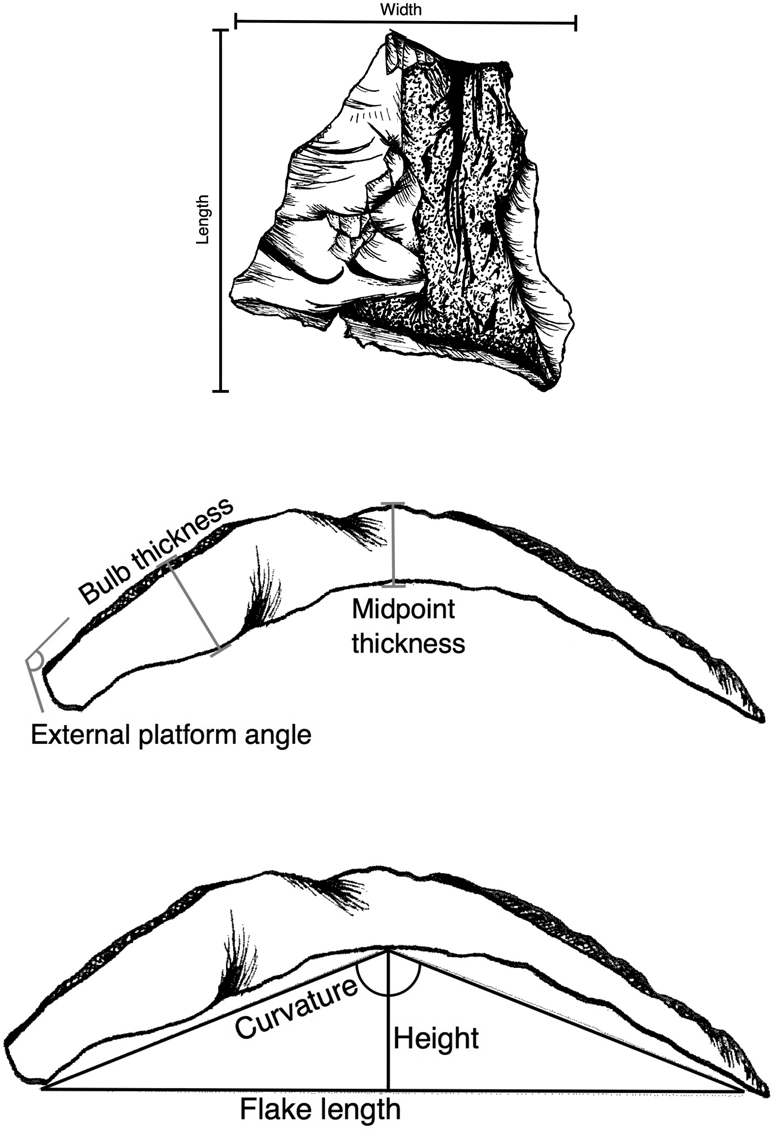
We examined flake attributes from 100% of the surface lithics found at 31Wk26 and 31Yd175 and 11% (810/7,164) of Redtail, sampled from all excavated contexts and surface collections. We measured the following flake attributes: length, width, midpoint thickness, bulb thickness, height, external platform angle, and percentage of cortex and weathering present (Figure 3). We then calculated flake curvature according to Andrefsky (Reference Andrefsky1986:50). If a modified or utilized flake had recognizable platforms and bulbs, we included it in the examination. We understand that flaking or use could shorten the length of the flake, influencing the calculation of curvature. However, we included them because early reduction flakes are more likely to become tools because of their larger size. Thus, we did not want to skew our results from the earlier portions of the reduction sequence.
Diagram of flake measurements used in this study. Drawings by Maya B. Krause.

We recognize that comparing survey assemblages from some sites to excavated assemblages from others could create comparability issues. However, Woodall (Reference Woodall1990) compared surface to excavated assemblages at the Hardy site and found virtually no differences in both the types of artifacts and the proportional counts of the types of lithic materials. We found similar patterns at Redtail with proportional weights (11.5% rhyolite and 86.9% quartz on the surface and 10.3% and 89.1% in excavated contexts). However, we found proportional counts were not consistent between these contexts (54.4% and 43.3% on the surface and 40.8% and 57.7% in excavated contexts). We are inclined to trust Woodall's results because the surveys at Redtail were conducted by undergraduates at field schools. Distinguishing quartz artifacts from nonartifacts is difficult and often resulted in undercollecting; additionally, students were instructed to collect all rhyolite. During excavations, all lithics were collected and sorted in laboratory settings by more experienced researchers. We believe these factors created a bias toward rhyolite in the surface collections.
Rogers (Reference Rogers1993) found similar percentages of flakes with cortex and ratios of primary to secondary flakes across the sites and concluded that each site had direct access to the rhyolite sources. We examined flake assemblages with more categories of reduction to see whether our results varied from Rogers's when we account for more complexity in the reduction process. To do so, we measured curvature for each flake and used Andrefsky's (1984) descriptions of flakes divided into four stages of triangular point production.
Ceramic Analysis
We examined 300 ceramic sherds from Redtail, 50 from 31Sr58, 50 from 31Wk26, 35 from 31Sr59, 32 from 31Yd32, and 20 from 31Yd175. The Redtail sample comes from all contexts, and the samples from the other sites are sherds that met our size requirements. For easier treatment identification, only sherds 3 cm or longer were considered from Redtail. Because plowing breaks pottery into smaller pieces, we included sherds 2 cm or longer for sites with only surface assemblages. For each sherd, we measured the following stylistic attributes: placement on the pot (e.g., neck, lip, or base), weight, length, width, height, diameter, thickness, temper, and exterior and interior treatments. We identified eight types of temper: large quartz (>4 mm), small quartz (<4 mm), soapstone, small quartz and soapstone, large quartz and soapstone, grit/sand, biotite, and small quartz and biotite. We assigned grit/sand temper when no visible temper was apparent.
We then compared exterior treatments to the photographic examples provided by Coe (Reference Coe1964:30–31), Ward and Davis (Reference Ward and Davis1993:21), Woodall (Reference Woodall1984:77–78), and, more generally, Rice (Reference Rice1987). Treatments included plain, smoothed (achieved using both hands and tools), scraped (using tools), net impressed, simple stamped, fabric marked, and cord marked. Treatments were cumulative, with multiple on many of the sherds. Often, scraping or smoothing was performed over impressing. Smoothing and scraping can be difficult to distinguish, as serrated tools were used for both processes. We distinguished them thusly: smoothing left little to no grooving on the surface, whereas scraping left a parallel peak and trough pattern with a 0.5 mm or greater amplitude.
We used the Brainerd-Robinson coefficient of agreement as the statistical test for our attribute occurrences (Brainerd Reference Brainerd1951; Cowgill Reference Cowgill1990; Robinson Reference Robinson1951). We constructed six models, each differing in the attributes (i.e., temper, exterior decoration, and interior decoration) used to define each type. Model 1 did not distinguish small and large quartz temper, included interior and exterior treatment, and distinguished smoothing from scraping. Model 2 was similar to Model 1 but did not distinguish smoothing from scraping. Model 3 did not distinguish small and large quartz, included exterior but not interior treatment, and did not distinguish smoothing from scraping. Model 4 distinguished small and large quartz, included exterior and interior treatment, and distinguished smoothing from scraping. Model 5 did not include temper, included exterior and interior treatment, and distinguished between smoothing and scraping. Model 6 was similar to Model 5 except interior treatment was not included. We then assigned sherds a type based on these attributes for each model run and analyzed the raw data. Our goal was to use a variety of typological classifications so that a single attribute would not sway the comparison and thus provide a test of the significance of our results. Rogers (Reference Rogers1993:140) described it as follows:
The Brainerd-Robinson coefficient of agreement was initially devised as a method for seriating archeological sites, though the logic inherent in the method makes it equally useful for assessing similarity (and hence connectedness).
Because we assumed the sites were roughly contemporaneous, a high coefficient of agreement suggested a similar ceramic assemblage, meaning a similar ideology for the agreeing sites.
The Brainerd-Robinson coefficient relies on creating a typology of the ceramic sample. We relied on empirical, taxonomic classification (Hill and Evans Reference Hill, Evans and Clarke1972:235) because focusing on the obvious characteristics of the sherds leads to statistically highly nonrandom results. A typology based on the most obvious attributes also agrees with the chaînes opératoire approach, as each design choice indicates the designer's ideology, and each obvious attribute represents one of these design choices. To avoid creating biased typologies (Whittaker et al. Reference Whittker, Caulkins and Kamp1998) and to provide a more convincing statistical comparison, we defined types differently among the six aforementioned models and assigned sherds accordingly. Every potsherd that exactly matched the variables used in each model was placed in one category until all sherds were assigned. We did not use the same attribute combinations Rogers did, but we followed the same methodology. We also subjected the ceramic data collected from this project to a secondary random sample reevaluation, which returned no unacceptable difference between measurements.
Results
Lithic Fall-off Curves
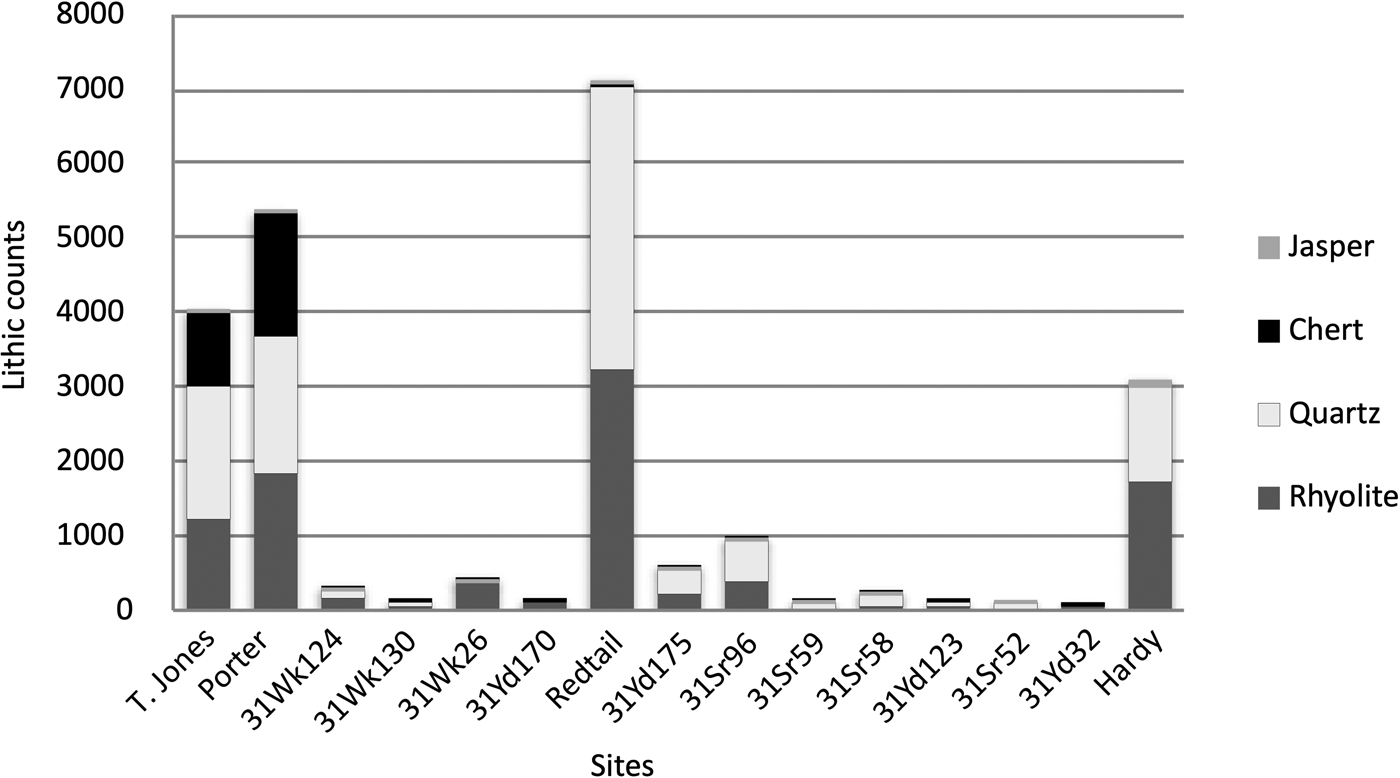
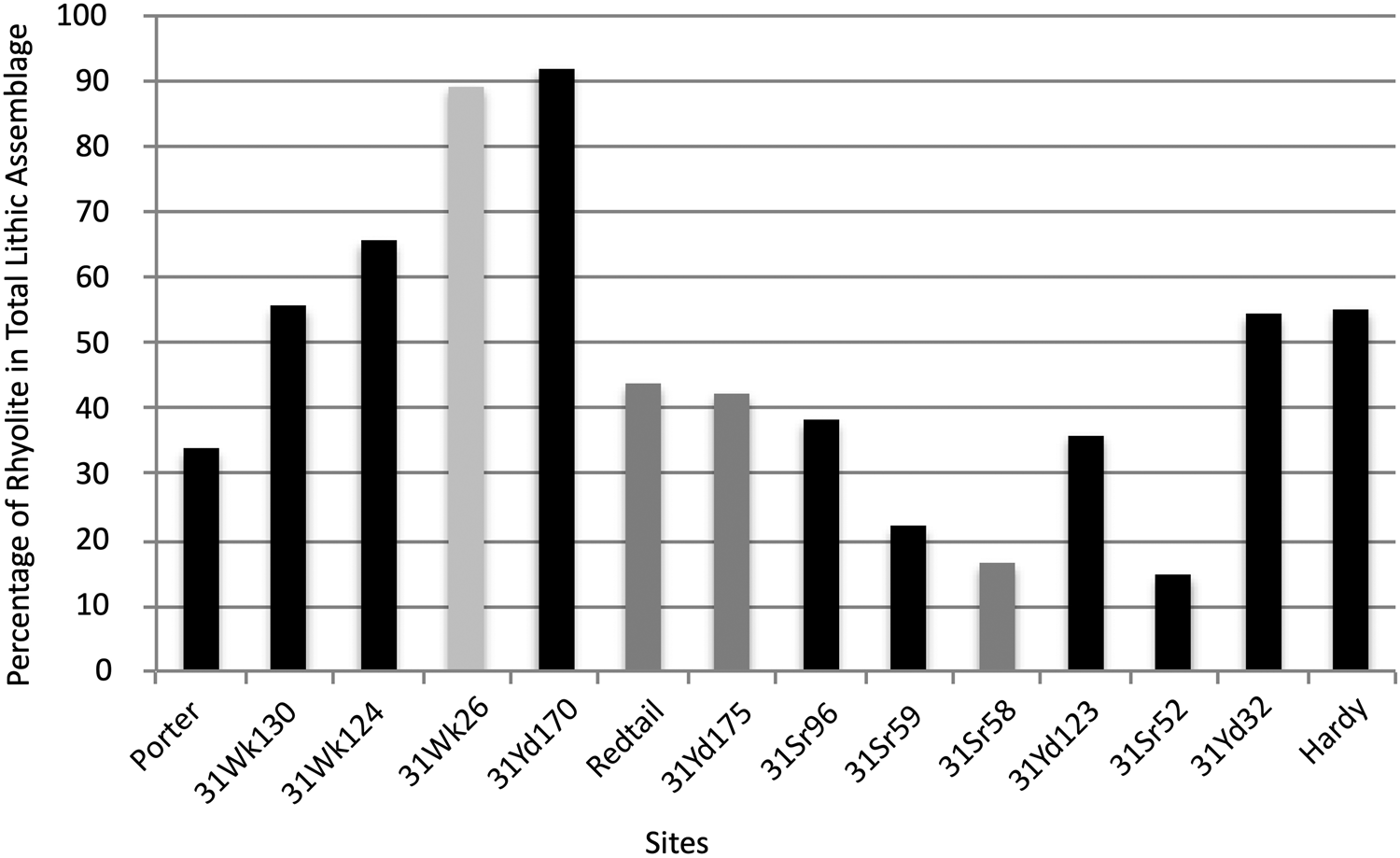
Figure 4 shows the combined assemblage sizes from Rogers's (Reference Rogers1993) and our work. Chert occurs only in significant concentrations at the Porter and T. Jones sites, which are the latest and two closest to the chert sources to the west (Woodall Reference Woodall1999, Reference Woodall2009). Figure 5 shows the percentage of rhyolite as the total assemblage at the upper Great Bend sites. As one moves upriver, there is a decrease from Hardy to 31Sr58, then an increase to 31Yd170 and 31Wk26, and finally a decrease to Porter. Site size does not appear to correlate with rhyolite proportions. Sites with larger surface scatter areas do not have higher percentages of rhyolite. In fact, smaller sites tend to. If we examine surface artifact density, which we think may be a better measure of population size given similar occupation times, the denser sites tend to have a higher percentage of rhyolite, but it is a weak positive correlation.
Lithic material counts from each site used in this research.

The proportion by count of rhyolite to the total lithic assemblage at each site used in this research. The sites in black are data from Rogers (Reference Rogers1993). The sites in light gray are from our research. The sites in medium gray are a combination of data from Rogers (Reference Rogers1993) and our work.

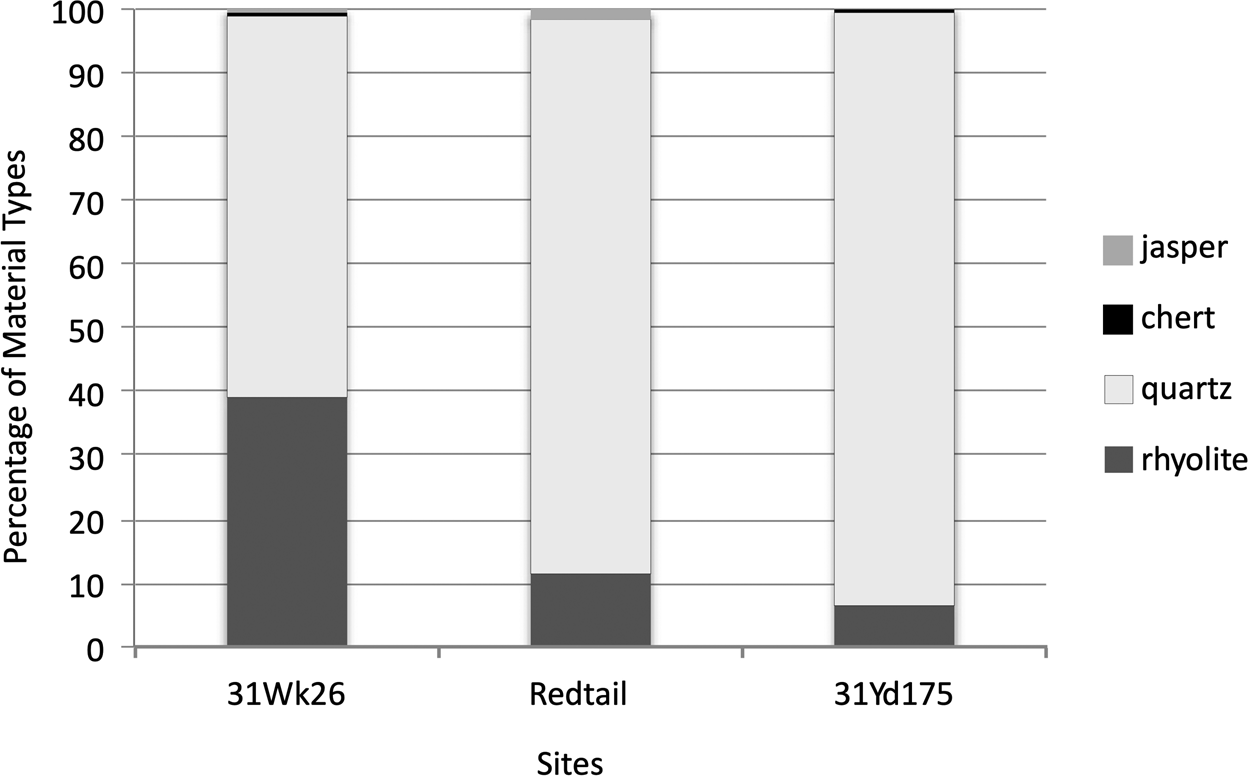
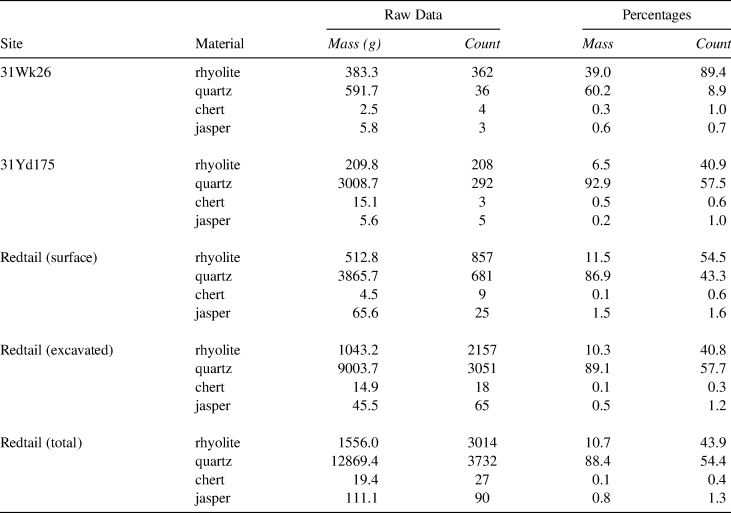
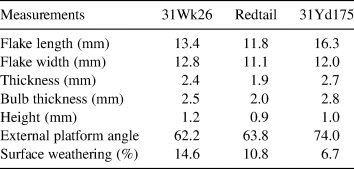
Both Hardy and 31Wk26 were likely occupied the longest, and they are at peaks in the fall-off curve. We do not have access to the Hardy assemblage, but using proportion by weight in addition to count at 31Wk26 helps us assess the extent to which occupation length may be behind rhyolite proportions. Figure 6 and Table 1 show that the proportion of rhyolite by weight for 31Wk26 is almost four times that at Redtail, whereas the proportion by count is only twice as much. In addition, the average flake weight is twice as high at 31Wk26, indicating that the concentration of rhyolite at 31Wk26 is likely not from hyperflaking or retouching the same amount of rhyolite compared with other sites. Thus, like Woodall, we do not believe site size or occupation length strongly influences these results.
Bar graph of the proportion of lithic materials by weight at three of the analyzed sites.

Counts and Weights of Different Lithic Material Types from 31Wk26, 31Yd175, and Redtail.

Lithic Industries
At Redtail, 105 of 113 projectile points (92.9%) are made from rhyolite, and quartz flake tools outnumber rhyolite tools by over 3:1. Utilized rhyolite flakes outnumber quartz utilized flakes 6.5:1. Quartz flakes are also much larger on average and have higher external platform angles, suggesting more early-stage reduction. If we compare assemblages across sites, tool types are similar between 31Wk26 and Redtail and match descriptions from other sites (Woodall Reference Woodall1984, Reference Woodall1990), suggesting a similar lithic industry throughout the valley. One difference between these two sites is that rhyolite was used more often for scrapers, drills, and cutting tools at 31Wk26, whereas quartz was used more often for these tools at Redtail.
Curvature and Reduction Profiles
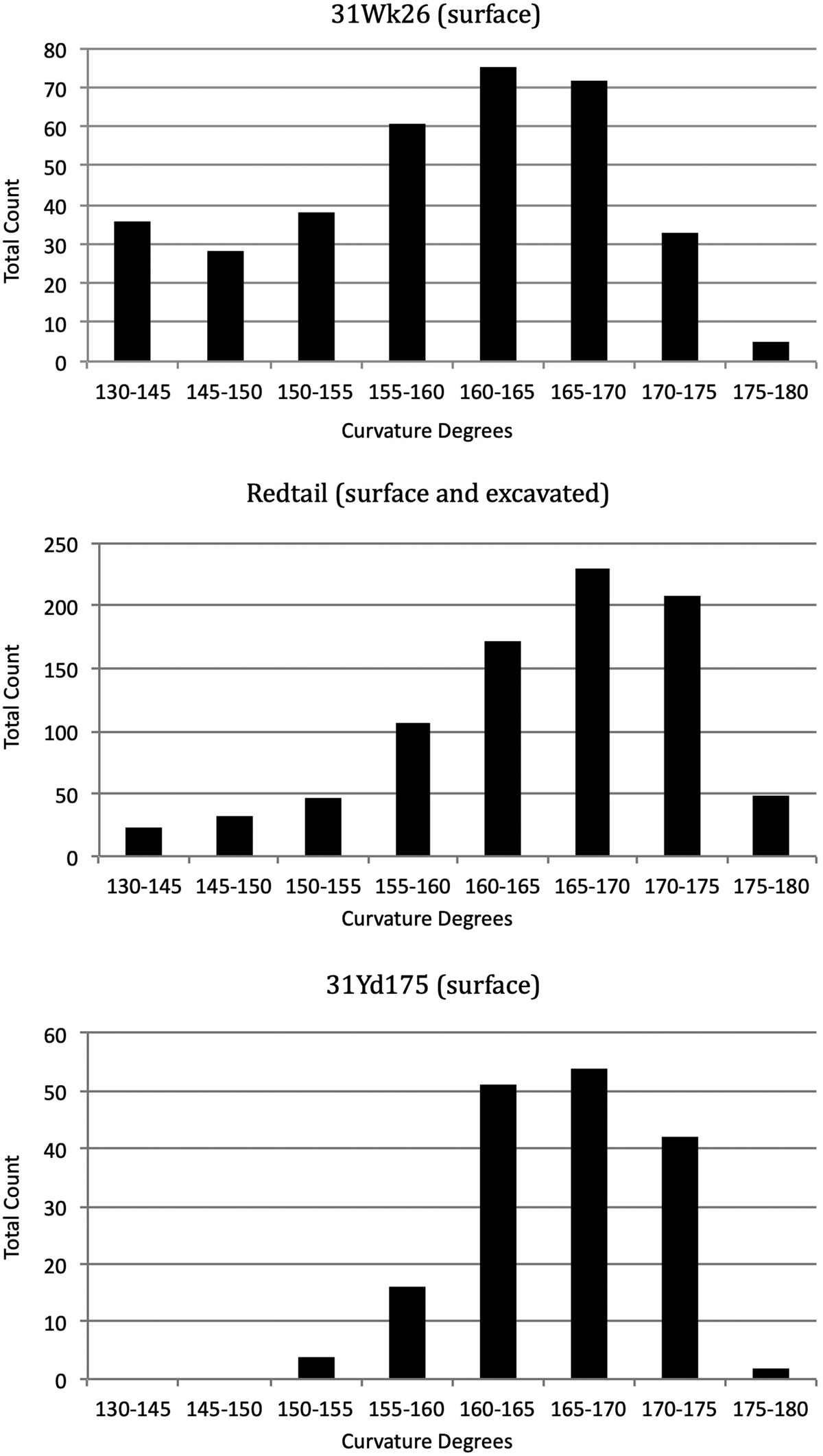
In comparing Redtail and 31Wk26, we found the former's assemblage had significantly smaller flake width, thickness, bulb thickness, and percentage of weathered surface, as well as a higher external platform angle (Table 2). Site 31Yd175 generally shows larger flakes but much fewer flakes with cortex. These data provide an initial indication that there were different reduction activities at these three sites. Figure 7 shows the curvature results from 31Wk26, Redtail, and 31Yd175. As shown by Andrefsky (Reference Andrefsky1986), flakes with a curvature range of 150–165 degrees are produced during the first quarter of the reduction process; 165–170 degrees, during the second quarter; 170–175 degrees, during the third quarter; and 175–180 degrees, during the last quarter. Site 31Wk26 has a higher proportion of flakes less than 160 degrees than Redtail and 31Yd175, and Redtail has a higher proportion of flakes less than 160 degrees and greater than 175 degrees than 31Yd175. Site 31Wk26 and Redtail have flakes with curvatures less than 150 degrees, which are not discussed by Andrefsky (Reference Andrefsky1986). He did not describe the beginning condition of his material. If his was already in flake form and knappers at our sites began with less reduced material, that could explain the presence of flakes with lower curvature values in our study. As support for comparing excavated and surface assemblages, we saw the same pattern when just the surface assemblage at Redtail was examined.
Bar graphs of the number of flakes of particular five-degree ranges of curvature at 31Wk26, Redtail, and 31Yd175.

Comparison of Average Values for the Attributes Measured across Three Sites.

Our results do not support the first three hypotheses related to the down-the-line model, nor do they indicate that these communities were all connected through one distribution system. Our results support Woodall's gateway model. We interpret the higher ratio of rhyolite flake tools at 31Wk26 as indicating that knappers had greater access to rhyolite and the relatively low proportion of high curvature flakes at Redtail as indicating rhyolite arrived already reduced. Because of this greater accessibility, the residents of 31Wk26 also had the ability to use rhyolite for tools other than projectile points, for which the rhyolite—as a higher quality material than the local quartz—was preferred. Given that there is no indication that different lithic industries existed among these sites, we interpret our findings as support for a scenario in which 31Wk26 was a gateway community for rhyolite acquisition and distribution in the upper Great Bend area. Thus, the distribution may have been a combination of gateway and down-the-line methods, with the latter describing how material moved from the gateways to nearby communities.
Ceramic Attribute Patterns
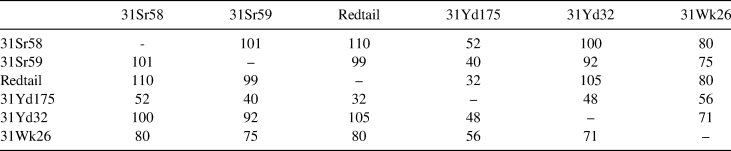
Table 3 shows the results of the Brainerd-Robinson tests for Model 4. Models 1–3, 5, and 6 showed the same patterns of similarity among sites. In most studies involving Brainerd-Robinson (Robinson Reference Robinson1951; Plog Reference Plog and Flannery1976), coefficients of agreement are in the 180s or the 190s. Like Rogers's (Reference Rogers1993:148), ours are smaller; however, the coefficients are highly sensitive to the total number of ceramic types in each model, with more types producing lower coefficients. We have many types in each model given the variability in attribute combinations for Piedmont Village Tradition pottery. This statistical effect occurred across our models, as those with the most variables (i.e., 1 and 4) showed lower coefficients than the model with the least variables (i.e., 6). Therefore, relative values within each model rather than absolute values are important.
Matrix of Brainerd-Robinson Results for Model 4.

Note: P-values were below 0.05 for all results except the Redtail comparisons to 31Sr58, 31Sr59, 31Yd32, and 31Wk26, the 31Yd32 comparison to 31Sr58, and the 31Sr58 comparison to 31Sr59.
One reason for running six models was to measure significance. Changing variables across several models and achieving the same results, which occurred with our models, strongly suggest significant results. As an additional test of significance, we ran Monte Carlo tests in accordance with a methodology developed by DeBoer and colleagues (Reference DeBoer, Kintigh and Rostoker1996) and operationalized by Peeples (Reference Peeples2011). Research (Greenland et al. Reference Greenland, Senn, Rothman, Carlin, Poole, Goodman and Altman2016; Halsey Reference Halsey2019) is increasingly showing that p-values alone are unreliable in assessing significance, so we evaluated significance using both our approaches. From the Monte Carlo tests, only Model 4 produced a large majority of results (nine out of 15) most likely to not result from random effects. This model has the most attributes and is thus the most likely to accurately reflect past ceramic production decisions. In addition, when we compared our findings to Rogers's (Reference Rogers1993), we found agreement in the same sites (31Sr58, 31Sr59, Redtail and 31Yd32) she did. Site 31Yd175 had a low coefficient of agreement in both studies. Rogers did not examine 31Wk26. Finally, samples of about 50 ceramics from each site were reanalyzed by an independent researcher and produced the same coefficient patterns. Together, these significance tests suggest our analyses are showing real patterns. The one caveat is that the site with nonsignificant p-values in Model 4 was Redtail, so its similarity to other sites can be questioned. However, it is likely a result of Redtail having a much larger sample size because the independent analysis showed significant p-values for comparisons with all but two sites. In addition, it is important to note that the coefficient patterns for this site are similar across all our models, to Rogers's results, and to the results of the independent analysis.
Discussion
Heterarchy and Gender Roles
Our results combined with Woodall's (Reference Woodall1990) model for earlier sites suggest a consistent rhyolite gateway acquisition and distribution strategy throughout the Middle and Late Woodland periods. Cobb and Nassaney (Reference Cobb, Nassaney, Nassaney and Sassaman1995) found evidence that Late Woodland communities were preserving old exchange patterns to retain interactions with socially close communities during times of cultural upheaval. As mentioned, there was an increased Mississippian presence in the Piedmont after AD 1200, which may have caused Piedmont Village Tradition people to migrate upriver in the Yadkin Valley to a less productive environment (Jones Reference Jones, Kellett and Jones2017, Reference Jones, Thompson and Birch2018). Comparisons with Middle and early Late Woodland sites downriver (e.g., Newkirk Reference Newkirk1978; Woodall Reference Woodall1984) suggest this move may have necessitated smaller settlements with shorter occupations. Despite these changes, our findings suggest that existing interaction networks remained unchanged until around AD 1500.
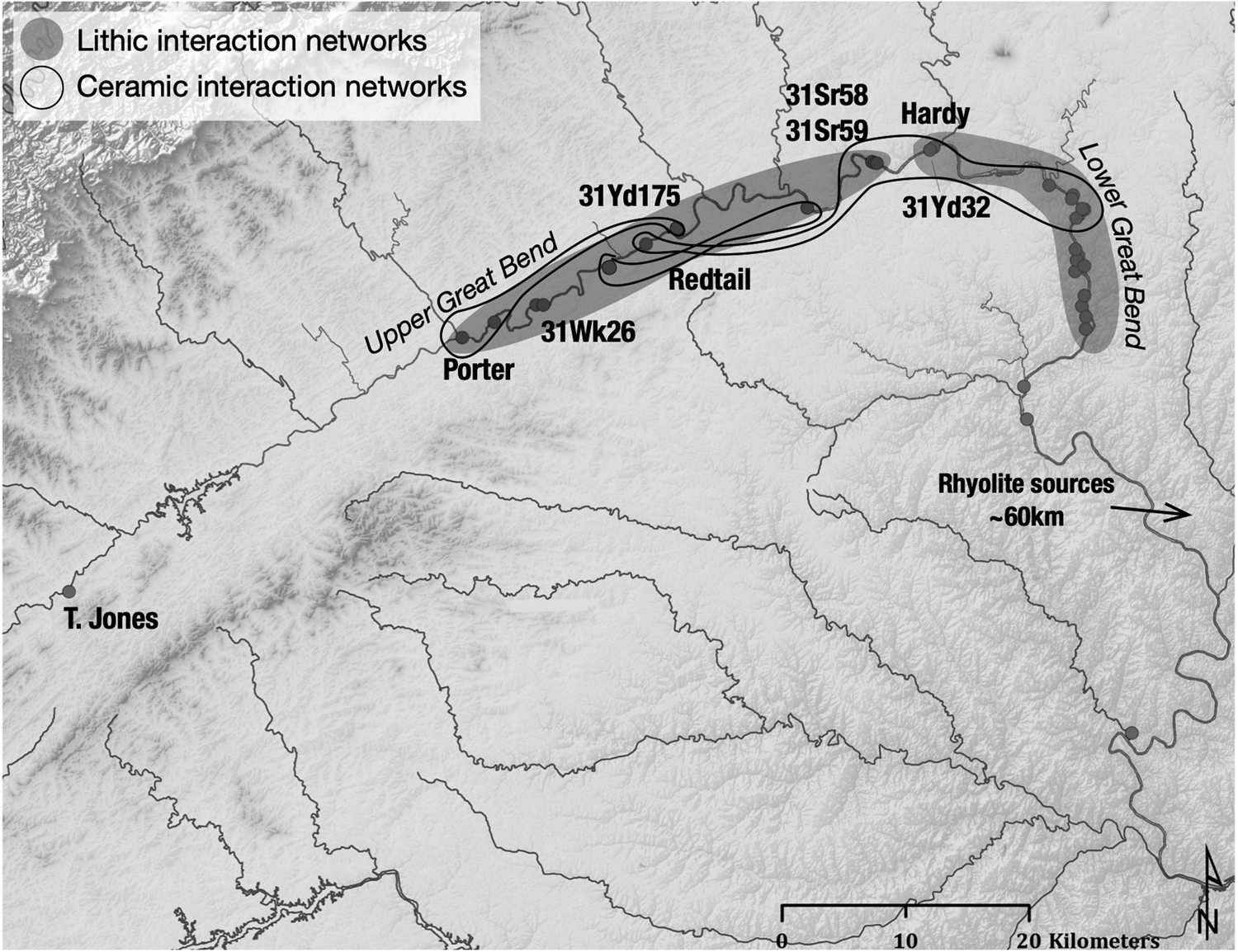
Quartz, the most abundant local lithic material, is poorly suited for making small triangular projectile points, which were the focus of the Piedmont Village Tradition lithic industry. Gateways may have existed primarily to acquire rhyolite as a necessary—or at least highly advantageous—raw material. While gateways could have also served social, political, and religious functions, our ceramic results combined with Rogers's (Reference Rogers1993) show that interactions involving pottery did not include the same groups of households as lithic interactions did (Figure 8). This suggests gateways were not the focus of all activity, contradicting the traditional cultural ecological models for the Piedmont Village Tradition that assumed most or all interactions were outgrowths of economic interactions (Woodall Reference Woodall1990).
Map of proposed lithic and ceramic style interaction networks. This is based on a combination of our results and those of Rogers (Reference Rogers1993:154).

Given that our proposed gateways appear to have had more access to less-worked rhyolite compared to other sites, it is likely the associated interaction network integrated several dispersed households into a larger group with gateway communities as the organizing entity, as Rogers (Reference Rogers1993, Reference Rogers1995) discussed. However, we do not see patterns in these data that suggest the relationships were tributary in nature. Thus, in this dispersed settlement system, a multihousehold organizational structure may have formed to obtain a necessary and nonlocal resource. It seems less likely that ceramic styles were distributed or dictated by more centralized communities, given that Rogers's (Reference Rogers1993) and our results show that potters did not interact primarily with nearby households.
While rhyolite exchange may have been organized and carried out by gateway communities that linked several nearby households, we interpret the lack of spatial proximity in ceramic attribute patterns to an exchange of stylistic ideas at the household level and was strongly connected to social relationships. Rogers (Reference Rogers1993, Reference Rogers1995) suggested that interactions and community composition were fluid and kin based, and this may explain the ceramic patterning. In particular, it is likely that women were the primary Piedmont Village Tradition potters (Eastman Reference Eastman, Eastman and Rodning2001; Rogers Reference Rogers1993) and that residence patterns were patrilocal (Rogers Reference Rogers1993). Thus, related women were potentially moving more widely throughout the valley and taking their pottery-making methods with them. Perhaps just the pots were moving among households, but we think our first explanation is the stronger of the two given the aforementioned residence patterns.
We should more explicitly examine the gender component to these patterns as well. If men were the primary flintknappers as mortuary data from other Piedmont Village Tradition sites suggest (Eastman Reference Eastman, Eastman and Rodning2001), an alternative or addendum to the heterarchical model is that the spatial distribution of rhyolite reflects the spatial pattern of related men. Men established new households near their male kin in the same floodplain or one nearby. Married women moved to their husbands’ residences regardless of the location of their consanguineal kin. In this scenario, women were responsible for the spatial patterning of ceramic styles, and gateways were tied to patrilocal communities where men were responsible for moving rhyolite to nearby male relatives.
The patterns of nonlocal lithic acquisition and distribution changed with the shift toward more interaction with Mississippians after AD 1500. The T. Jones and Porter sites (Woodall Reference Woodall1999, Reference Woodall2009) located farther upriver were occupied after AD 1400 and had a much higher proportion of western-sourced chert. Woodall (Reference Woodall2009) proposed T. Jones was a Lamar phase Mississippian outpost in the valley established by migrants from the mountains looking for warmer, lower-elevation locations during the Little Ice Age. As Mississippians migrated into the upper Yadkin Valley, the Piedmont Village Tradition communities could have had two reactions. First, Piedmont Village Tradition people may have shifted from the existing gateway network toward more interaction with Mississippian communities. This change could have been similar to the increased interaction between Mississippian and local, nonhierarchical communities observed by Meyers (Reference Meyers, Gougeon and Meyers2015:236) in southwestern Virginia. She proposed that the settlement at the Carter-Robinson site was built specifically to take advantage of the frontier trade and that power dynamics at frontier Mississippian sites may have been less rigid, allowing for more individually directed interaction (Meyers Reference Meyers, Gougeon and Meyers2015, Reference Meyers2017). Second, Piedmont Village Tradition people may have mostly left the upper Yadkin Valley as Mississippians moved into upriver locations. T. Jones and Porter are the only sites with dates after AD 1400, and the artifact styles suggest they were occupied by Mississippians and Piedmont Village Tradition residents. It is possible that a few Piedmont Village Tradition people may have remained in the valley and established communities with the newcomers.
Woodall (Reference Woodall1999, Reference Woodall2009) describes women buried with Mississippian items and projectile points at the T. Jones and Porter sites. These could be Mississippian women who married into these Piedmont Village Tradition communities. However, future work should test the alternative hypothesis that Piedmont Village Tradition women began to take on more significant roles in economic exchange as interaction shifted toward Mississippian societies to the west. In other similar situations, men buried in such fashion have been interpreted as local leaders adopting Mississippian ideology to strengthen their positions (Cobb and Garrow Reference Cobb and Garrow1996). Piedmont Village Tradition women may have been doing the same in the upper Yadkin River valley, and this pattern of women as traders and liaisons may have arisen with the change in trade partners or may have grown out of their earlier roles as primary ceramic producers.
Boundarylands and Frontiers
Archaeology in the southeastern United States regularly employs core-periphery models to discuss relationships between Mississippian and non-Mississippian societies (e.g., Comstock and Cook Reference Comstock and Cook2018; King and Meyers Reference King and Meyers2002; Lambert Reference Lambert and Lambert2000; Meyers Reference Meyers2002). Few scholars have discussed this relationship for Piedmont Village Tradition societies, with King and Meyers (Reference King and Meyers2002) generally labeling the area as a periphery and Woodall (Reference Woodall1999) calling it a frontier after AD 1500. Given our data and the aforementioned changes that occurred in Piedmont Village Tradition lithic exchange patterns, our results provide an opportunity to evaluate application of these labels in the context of more specific cultural processes.
The influence of Mississippian societies on Piedmont Village Tradition communities does not appear to have been uniform across time and space. From AD 1100 to 1200, the lower Great Bend fits the commonly used definition of a periphery, given the evidence for the political influence exerted on Piedmont Village Tradition communities by Mississippian migrants to the south of this area. Around AD 1200, Piedmont Village Tradition people moved upriver into the upper Great Bend area as a result of violent interactions with their new neighbors (Jones Reference Jones, Kellett and Jones2017). From AD 1200 to 1500, there is little archaeological evidence to suggest that the presence of Mississippians in the region impacted the economic, social, or settlement activities of Piedmont Village Tradition people. Thus, we feel their general characterization as a periphery should be reassessed. King and Meyers (Reference King and Meyers2002) define peripheries as the physical margins of Mississippian dominated areas, and societies there may or may not have interacted with Mississippians. By that definition, the upper Yadkin River valley certainly is a periphery. However, we disagree with the definition because it is Mississippian-centric. Labeling non-Mississippian societies as peripheral solely because of their proximity to Mississippians marginalizes them, which has a tendency to devalue research and precludes examinations of demographic, political, social, ideological, and economic interactions from their perspective. If we conceptualize and use terms with cultural processes in mind, then given a lack of evidence for Mississippian influence or interaction between these two groups, we do not see justification for labeling Lamar Mississippians as the core and Piedmont Village Tradition communities as the periphery during this 300-year span. Perhaps Piedmont Village Tradition people thought of themselves as the core and Mississippians as their periphery.
Drawing on Parker (Reference Parker2006), we characterize the upper Yadkin River valley from AD 1200 to 1500 with a new term—“boundarylands.” It is tempting to follow Parker's lead and call this area a borderland—the region around or between political or cultural entities—particularly given the complexity the term encompasses. In fact, we do not strongly object to this term. However, Parker (Reference Parker2006:80) himself identifies that borderlands are based on the concept of borders, which may have been quite rare in the ancient world. There does not appear to be a clear line in this Piedmont Village Tradition-Mississippian case. Furthermore, his examples of ancient borderlands all involved state-level societies, and it is conceivable that something similar to modern notions of borders did exist. Finally, Parker correctly identifies that borderland studies are becoming an important part of modern cultural anthropological discussions of national borders and migration and thus have a specific meaning tied to the processes involved in them that might not be applicable to ancient cases.
How, then, do we describe boundaries while researching less sedentary, geographically dispersed, and more sociopolitically fluid groups like the Piedmont Village Tradition who might not have had a strong notion of territorial borders? Parker defines a boundary as an unspecific divide between two groups of people distinguished by different cultural practices and language. This is a good start for our example, but something needs to be added to account for the human settlements around such a divide. Thus, we define boundarylands as the areas of settlement near the unspecified divide between two cultural groups. Our proposed term is similar to borderlands in that it can accommodate a wide range of interactions—including demographic, political, and economic—but takes out the problematic border requirement. It also does not assume primacy for either group. We suggest that boundarylands may be considered as an alternative to borderlands in archaeological cases where borders as we know them today almost certainly did not exist and where the power dynamic between groups is unclear, nonexistent, or predicated on equal standing.
After AD 1500, Mississippians likely started migrating into the upper Yadkin River valley. Piedmont Village Tradition communities either began living with their new Mississippian neighbors or migrated out to avoid them (Woodall Reference Woodall2009). At that time, it would have been a mixture of Mississippian and Piedmont Village Tradition people, ideas, and objects, which best characterizes the valley as a frontier, as Woodall (Reference Woodall1999) did. This label also agrees with definitions by both King and Meyers (Reference Meyers2002:114), geographic areas along the edge of an advancing or retreating wave front of Mississippian forms of organization, and Parker (Reference Parker2006:79–80), a zone of interaction with various types of boundaries.
The interaction dynamics between complex and small-scale societies should drive any theorizing. From AD 1100 to 1200, the upper Yadkin River valley is best characterized as a periphery because of the political influence Mississippians were exerting on Piedmont Village Tradition communities without inhabiting those communities themselves. From AD 1200 to 1500, the upper Yadkin River valley was not a periphery to Mississippians in the sense that the Piedmont Village Tradition people were not a margin to a core. By migrating upriver, they removed themselves from Mississippian influence. They were certainly geographically adjacent to one another, but without strong evidence for interaction, we hesitate to automatically assign Mississippian societies a central demographic, political, social, ideological, or economic position on the cultural landscape. Finally, once Mississippians begin migrating into the valley after AD 1500, the area became a frontier.
Coalescence
In eastern North American archaeology, non-Mississippian societies are often described and explained using general trends observed for the Late Woodland period. For many areas of the Southeast, Mid-Atlantic, and Northeast, this was a time of coalescence and increasing regional exchange (e.g., Birch and Williamson Reference Birch and Williamson2013, Reference Birch, Williamson, Thompson and Birch2018; Drooker Reference Drooker, Ethridge and Hudson2002; Jeffries Reference Jeffries, Thompson and Birch2018; Rodning Reference Rodning, Ethridge and Hudson2002). For the Piedmont Village Tradition, the former trend appears to have only occurred along the Dan River (Dickens et al. Reference Dickens, Ward and Stephen Davis1987; Jones Reference Jones, Thompson and Birch2018). However, the lack of physical coalescence of households or communities does not necessarily mean that social, political, or economic networks were not expanding to include more people. In fact, we believe our results show that even though communities in the upper Yadkin River valley remained small and dispersed, social and economic interactions may have encompassed 5–10 households spread over 15–20 miles of river valley with populations of 50–100 people, similar in size to other coalesced Piedmont Village Tradition settlements. Such settlement patterns may require us to expand our definition of coalescence in the Eastern Woodlands. If coalescence is about identity and interaction, it is possible that Piedmont Village Tradition households were forming a unified identity and increasing interaction within that group without living proximate to one another.
Conclusion
This research constructed a model for economic and social interaction among Piedmont Village Tradition communities in the upper Yadkin River valley based on a heterogeneous distribution of nonlocal lithic materials across sites and based on patterns of ceramic stylistic similarities that fail to map onto patterns of lithic distribution. Our findings suggest that interaction networks constructed and maintained by small, egalitarian, and dispersed households and communities could be organized on different sociopolitical levels, depending on the type of interaction. In particular, multiple communities may have coordinated when acquiring and distributing rare and necessary materials. Conversely, the movement of objects like ceramics made from local materials may have been handled on the household or even individual level. These social and economic processes may have also been linked to gender roles. Finally, given the types of lithic materials and ceramic styles, it appears that they had little interaction with nearby Mississippian neighbors from AD 1200 to 1500, which challenges labeling them as a Mississippian periphery.
Continuing to examine interaction on a large scale will help us better understand the Piedmont Village Tradition-Mississippian dynamic and the scope of Piedmont Village Tradition interaction networks. We propose adding smaller scales and creating a multiscalar model to better describe and explain particular types of interaction. Intracommunity lithic and ceramic patterns at proposed gateway communities can help us determine other functions they may have served. Household-level analyses within and among sites might also further highlight who was making and moving projectile points and pottery and through what mechanisms. For example, exploring the quality of lithic and clay materials and the conditions of their production may help to evaluate Rogers's proposal of tributary relationships between Piedmont Village Tradition communities. Finally, in regions with both complex and small-scale societies, we should perform the exercise of decentering any one society based on sociopolitical complexity alone so that we can explore alternative models about interactions between and within particular groups. Research focusing more specifically on demographic, political, social, ideological, or economic interactions in these cases will help to create a more nuanced view that is not captured when small-scale societies are labeled as peripheral solely based on their proximity to a more complex society.
Past small-scale societies that existed alongside more complex societies have traditionally been either an afterthought within American archaeology or have been thought of as having limited applicability to other periods or regions. As such, they have not been a significant part of theory building. However, over the past 2,000–3,000 years, complex and small-scale societies inhabiting the same region have been relatively common in many areas of the world. As such, any society in this situation has the potential to inform us about a past when societies of drastically different sociopolitical organization existed contemporaneously. Furthermore, they may help us understand recent and modern state–nonstate interactions, which are becoming increasingly important in world politics and economics.
Acknowledgments
This work was partially funded by a National Science Foundation grant (BCS-1430945). This article grew out of two honors theses projects by Krause and Watson that became a paper presented at the 2017 Society for American Archaeology Annual Meeting in Vancouver, British Columbia, and a third honors thesis project by O'Saile. We thank Rachel Horowitz and Nathan Goodale for the invitation to that session that inspired us to begin analyzing the lithics at Redtail. We thank a number of Wake Forest undergraduates who helped with data collection and interpretation during this research: Melissa Pouncey, Lindsay Gilliland, Brittany Ezer, Emma Sandifer, Ellie Logan, and Garrett Toombs. Alyssa Walton conducted the independent resampling of the ceramics, and we thank her for her expertise. This work benefited from conversations with Chris Judge, Randy Daniel, Chris Rodning, and K. Pierce Wright and from comments from four anonymous reviewers. Thanks to Sharon DeWitte for comments and editing. Finally, the first author thanks Tom Jones and Charlotte Beck for their mentorship for more than 20 years and for passing on their passion for and knowledge of lithic analysis. As always, any errors or omissions are the responsibility of the authors.
Data Availability Statement
The lithic and ceramic assemblages we analyzed and all statistical and spatial data used in this research are housed in the Anthropological Geographic Analysis Laboratory at Wake Forest University and can be accessed by contacting the first author.