1 Preliminaries
1.1 Overview
It is a central tenet of Optimality Theory (OT; Prince & Smolensky Reference Prince and Smolensky2004) that robust cross-linguistic markedness generalisations arise because speakers of all languages share a system of well-formedness constraints that includes constraints penalising marked structures. In the core case, an implicational universal of the form ‘any language that admits value M on structural dimension d also admits value U on dimension d’ is claimed to be a consequence of markedness constraints that assign a higher well-formedness penalty to M than to U, present in all speakers' grammars: a language L that admits M must do so via faithfulness constraints preserving structure on dimension d which in the grammar of L outrank the markedness constraints violated by M; these faithfulness constraints must then, by transitivity of constraint domination, outrank the constraints violated by U, admitting U into the language as well (Prince & Smolensky Reference Prince and Smolensky2004: ch. 9). In the case relevant to the present study, d is the dimension of sonority cline in onset clusters, M, the marked value, is decreasing sonority and U, the unmarked value, is increasing sonority (§1.2). In its most straightforward interpretation, the OT explanation of universals entails that even speakers of a language banning both M and U must possess markedness constraints that assign a higher penalty to M than to U – despite the lack of direct evidence pertaining to the M/U distinction. It is this prediction that we seek to test in the present work.
How can we evaluate whether a speaker of a language possesses such knowledge of relative markedness? Like most grammatical theories, OT is fundamentally formulated to specify a ‘production’ rather than a ‘perception’ function: given an underlying form as input, an OT grammar determines the corresponding output, a surface form. It is therefore most direct to assess grammatical knowledge by examining production: one asks whether speakers of a language will reveal, in production, their knowledge that M is more marked than U, even when both are absent from their language (§1.3). Of course, under the most straightforward interpretation of OT, a speaker of such a language should simply fail to produce both U and M. Stochastic formulations of OT can, however, yield the prediction that production of U will sometimes succeed, and more frequently than production of M, revealing the speaker's knowledge of the markedness of M relative to U (§1.4.4).
Since failure to produce an ungrammatical form may be due to factors other than grammar (say, simple lack of practice executing the required articulatory programs), it is useful to complement such production-directed studies with perception-directed studies. As in production, failure to correctly process an ungrammatical form in perception may be due to factors other than grammar (say, simple lack of practice processing the required acoustic cues) – but these factors are arguably less severe than in production and at the very least different from them, so that particular limitations of production studies may potentially be overcome by perception studies, and vice versa.
That ungrammaticality reduces the predicted accuracy of perception as well as production follows from an extension of OT to phonological perception which we sketch in §1.4 below: it is a form of analysis-by-synthesis (i.e. a generative model of perception), and as such preserves much of the fundamental ‘synthesis’ orientation of OT. Previous experimental work suggests the empirical soundness of the proposition that ungrammaticality reduces perceptual accuracy (§1.3), and lays the groundwork for the perception experiments that form the primary contributions of this article (§§2–3).
These experiments, we argue, provide new evidence supporting the premise of OT that speakers possess systems of markedness constraints that distinguish the degree of markedness of structures U and M even when neither is present in their language. Specifically, U is instantiated as the rising-sonority nasal-initial heterorganic onset clusters ml and nw, and M as the typologically more marked falling-sonority nasal-initial heterorganic onset clusters md and nb. The case of primary interest is English-speaking participants, for whom all nasal-initial clusters are absent from their language; a comparison group is Russian-speaking participants (§§3.1–3.2), whose language includes both sonority-increasing and sonority-decreasing nasal-initial onset clusters.
That the knowledge distinguishing the U from the M clusters takes the form of general constraints on sonority sequencing is consistent with previous perceptual experiments examining a range of other cluster types in speakers of English, Russian and Korean (§1.3). We do not, however, make any particular claim about the exact form of the knowledge which informs speakers that the M clusters are more marked than the U clusters.
Whether English speakers can acquire from their linguistic experience the knowledge that the falling-sonority M onsets are marked relative to the rising-sonority U onsets is a further question about which we make no particular claim. At the segment level, we cannot exclude the possibility that learners form empirical generalisations such as ‘stops are not second elements in onset clusters except following s’, which specifically targets our falling-sonority clusters. The present results do, however, add to the challenge of precisely formulating a falsifiable theory of phonological learning, contributing further evidence that the learner must end up formulating just those generalisations that coincide with sonority-sequencing principles and not others that contradict those principles. Several explicit proposals in the literature for accounting for perceptual accuracy via segment- and feature-co-occurrence statistics of the English lexicon can be examined: through a series of regression analyses, we show that they fail to account for our experimental results (§§4.1–4.2).
Our results do show that the relevant knowledge resides at the phonological level, rather than at lower phonetic or acoustic levels, as the preference for U over M emerges irrespective of the modality of the stimuli, for both auditory and printed words (§3.2).
1.2 Onset cluster markedness and sonority sequencing
A number of universals concerning the sequencing of consonants in word-initial and word-final clusters (Greenberg Reference Greenberg, Greenberg, Ferguson and Moravcsik1978) can be subsumed under the principle that in unmarked cases the sonority of these consonants increase in initial and decrease in final clusters (e.g. Kiparsky Reference Kiparsky1979, Steriade Reference Steriade1982, Selkirk Reference Selkirk, Aronoff and Oerhle1984, Clements Reference Clements, Kingston and Beckman1990, Parker Reference Parker2002, Zec Reference Zec2007; see also de Saussure Reference Saussure1916, Vennemann Reference Vennemann1972, Hooper Reference Hooper1976). Examples for initial clusters include Greenberg's universals 17 (languages admitting a (falling-sonority) liquid–obstruent sequence as in lba also admit a (rising-sonority) obstruent–liquid sequence as in bla) and 24 (the presence in a language of (falling-sonority) liquid-nasal sequences such as lma entails the presence in that language of (rising-sonority) nasal-liquid sequences like mla).
Whether sonority provides the best explanation for such universals has been disputed on the basis of phoneticians' failure to identify clear measurable correlates of sonority as well as the alleged circularity of sonority-based argumentation (e.g. Ohala Reference Ohala1990). It has also been proposed that explanations be based directly on the acoustic and articulatory covariates of sonority rather than on sonority per se (Ohala Reference Ohala1990, Kawasaki-Fukumori Reference Kawasaki-Fukumori1992, Wright Reference Wright, Hayes, Kirchner and Steriade2004, Oudeyer Reference Oudeyer2005). Nonetheless, the explanatory value of sonority has frequently been defended in accounts of syllable structure (Vennemann Reference Vennemann1972, Hooper Reference Hooper1976, Steriade Reference Steriade1982, Selkirk Reference Selkirk, Aronoff and Oerhle1984, Prince & Smolensky Reference Prince and Smolensky2004, Smolensky Reference Smolensky2006), syllable contact (Vennemann Reference Vennemann1972, Gouskova Reference Gouskova2001, Reference Gouskova2004), stress assignment (de Lacy Reference de Lacy2007a), reduplication (Pinker & Birdsong Reference Pinker and Birdsong1979, Steriade Reference Steriade1982, Reference Steriade1988, Morelli Reference Morelli1999, Parker Reference Parker2002) and the choice of repair strategy for marked structures (Hooper Reference Hooper1976).
Sonority has also proved explanatorily valuable in accounts of external evidence. The sonority of consonants correlates with their production accuracy in first-language (Pater Reference Pater, Kager, Pater and Zonneveld2004, Barlow Reference Barlow and Eddington2005) and second-language acquisition (Broselow & Finer Reference Broselow and Finer1991, Broselow et al. Reference Broselow, Chen and Wang1998, Broselow & Xu Reference Broselow and Xu2004), developmental phonological disorders (Gierut Reference Gierut1999, Barlow Reference Barlow2001), aphasia (Romani & Calabrese Reference Romani and Calabrese1998, Stenneken et al. Reference Stenneken, Bastiaanse, Huber and Jacobs2005), speech errors (Stemberger & Treiman Reference Stemberger and Treiman1986), word games (Treiman Reference Treiman1984, Treiman & Danis Reference Treiman and Danis1988, Fowler et al. Reference Fowler, Treiman and Gross1993, Treiman et al. Reference Treiman, Bowey and Bourassa2002) and reading tasks (Levitt et al. Reference Levitt, Healy and Fendrich1991, Alonzo & Taft Reference Alonzo and Taft2002). As discussed in §1.3, sonority sequencing has also accounted for phonological perception data of direct relevance to the present work.
For the purposes of the experiments reported here, what is crucial is that sonority sequencing entails the markedness of the nasal–stop sequences md and nb relative to the nasal–approximant sequences ml and nw. Any comprehensive account of onset-cluster sequencing entailing this markedness relation (and all those figuring in the evidence referred to above) would serve our immediate purposes equally well.
Turning from the question of the particular form of speakers' knowledge of consonant sequencing to the question of the origin of this knowledge, it is notable that most of the existing evidence involves knowledge that could in principle be projected rather directly from linguistic experience because the clusters involved are present in the speaker's language. The present studies instead examine clusters unattested in the speaker's language; the systematic behaviour we observe is therefore dependent on the speaker's knowledge of general principles that extend considerably beyond direct experience.
1.3 Production and perception of unattested onset clusters
Only a handful of previous studies have examined the markedness of unattested onsets. The results suggest that unattested onsets that are relatively marked are judged as less frequent (Pertz & Bever Reference Pertz and Bever1975), are less accurately produced (Broselow & Finer Reference Broselow and Finer1991, Davidson Reference Davidson, Gleitman and Joshi2000, Reference Davidson2006, Davidson et al. Reference Davidson, Jusczyk and Smolensky2006) and are less accurately perceived (Moreton Reference Moreton2002).
Most relevant to the present work is a recent set of experiments by Berent et al. (Reference Berent, Steriade, Lennertz and Vaknin2007) investigating English speakers' perception of a range of unattested two-consonant onset clusters containing stops, including clusters with rising and falling sonority (e.g. bn vs. lb). These experiments exploited the well-known finding that speakers often misperceive phonological structures that are unattested in their language (e.g. Massaro & Cohen Reference Massaro and Cohen1983, Hallé et al. Reference Hallé, Segui, Frauenfelder and Meunier1998, Dupoux et al. Reference Dupoux, Kakehi, Hirose, Pallier and Mehler1999, Dupoux et al. Reference Dupoux, Pallier, Kakehi and Mehler2001):Footnote 1 an utterance produced by a speaker for whom the target form is well-formed is perceived as having a different form by a hearer for whom the target form is ungrammatical. Thus ebzo as produced by a French speaker is often perceived as ebuzo by Japanese speakers (Dupoux et al. Reference Dupoux, Kakehi, Hirose, Pallier and Mehler1999). As in this example, such misperceptions tend to ‘repair’ the unattested form, rendering it well-formed in the hearer's language. When the unattested structure is an onset cluster, the repair often takes the form of inserting a vowel between the consonants (e.g. tla→təla; Pitt Reference Pitt1998): perceptual epenthesis.
Berent et al. (Reference Berent, Steriade, Lennertz and Vaknin2007) find that the likelihood of perceptual epenthesis depends on the grammatical markedness of the onset: falling-sonority onsets (e.g. lba) are more likely to elicit misperception (e.g. lba→ləba) than rising-sonority onsets (e.g. bna→bəna). The use of a large number of matched items allowed Berent and colleagues to demonstrate the statistical reliability of the effect of sonority cline across items. Additional experiments suggested that the misperception of marked onsets is not simply due to listeners' inability to detect the relevant phonetic cues (unattested onsets are perceived accurately given conditions that encourage closer attention to their phonetic properties; see their Experiments 5–6). Furthermore, additional analyses showed that the effect cannot be explained by a number of statistical properties of the English lexicon putatively relevant to perceptual accuracy (see also Albright Reference Albright2007). Indeed, subsequent research has replicated the contrast between rising- and falling-sonority onset clusters among speakers of Korean – whose lexicon arguably lacks onset clusters altogether (Berent et al. Reference Berent, Lennertz, Jun, Moreno and Smolensky2008).
Thus speakers of English and Korean systematically differentiate among onset clusters unattested in their language, treating those that are typologically more marked – with falling sonority – as more ill-formed, or dispreferred, in the sense of having a greater likelihood of ‘repair’ by a kind of perceptual epenthesis. An empirical limitation of these studies, however, is that they involve only clusters containing stops. For English speakers, at least, a preference for stop–sonorant sequences (a general type attested in English) over sonorant–stop sequences (unattested in English) would suffice to account for the results.Footnote 2 If speakers' knowledge truly pertains to sonority sequencing more generally, however, it should apply to other types of sequences further removed from the English inventory; in particular, among nasal-initial onset clusters – entirely lacking in English – such general knowledge would favour increasing over decreasing sonority.
The new experiments reported here test this specific prediction. To isolate the markedness of sonority sequencing from markedness related to the Obligatory Contour Principle (OCP; Leben Reference Leben1973, Goldsmith Reference Goldsmith1976, McCarthy Reference McCarthy1979), we examine here only sequences obeying the OCP for manner and place. The former restriction eliminates nasal–nasal sequences (manifesting a sonority plateau that would be expected, absent OCP effects, to be intermediate in markedness between rising- and falling-sonority clusters). Because of the prohibition of ŋ from onsets in English, another constraint not under study here, the nasal consonants were restricted to n and m. The OCP-place respecting sequences we studied were ml/nw (rising) and md/nb (falling). At a first approximation, these are equated for place-markedness in the sense that all involve one labial and one coronal; they also respect the markedness constraint against the sequence voiced–voiceless in an onset (Greenberg Reference Greenberg, Greenberg, Ferguson and Moravcsik1978).
In light of the results of Berent et al. (Reference Berent, Steriade, Lennertz and Vaknin2007), the hypothesis of central interest here – that English speakers possess general knowledge of the markedness of falling- relative to rising-sonority onsets – will be taken to predict a greater likelihood of perceptual epenthesis for falling-sonority onsets. To complement this empirically driven prediction of greater accuracy for less marked forms, in the next section we offer a brief sketch of an OT-based account of phonological perception that provides a theoretical basis for such a prediction.
1.4 Phonological perception in Optimality Theory
The extension of standard OT that we sketch here is a modest one, intended only to link the grammaticality of phonological structures to the accuracy of their perception. Space limitations necessitate a number of omissions and simplifications. For more extensive proposals, the reader is referred to Smolensky (1996), Tesar (Reference Tesar, Hughes, Hughes and Greenhill1997, Reference Tesar1998, Reference Tesar1999), Boersma (Reference Boersma1998, Reference Boersma2007), Pater (Reference Pater, Kager, Pater and Zonneveld2004) Pater (Reference Pater, Kager, Pater and Zonneveld2004),Moreton (Reference Moreton2007) and Boersma & Hamann (Reference Boersma and Hamann2008).
1.4.1 Representations and knowledge
For our purposes it is useful to consider four levels of representation: the standard underlying form /uf/ and surface form [sf] of generative phonology, plus two additional levels. Whereas /uf/ and [sf] are discrete representations, the other two levels are continuous. One of these we'll call ‘phonetic form’, |ϕf|, understood here as an encoding of acoustic-phonetic and articulatory-phonetic structure. The other continuous level we'll call ‘auditory form’, {af}, a low-level auditory encoding of speech, perhaps something like a cochleogram. The ‘input’ to the speech-perception system will be taken to be {af}, the external stimulus as pre-processed by the auditory system.
A full linguistic representation then will be a 4-tuple (/uf/, [sf], |ϕf|, {af}); whenever we refer to a ‘candidate’ representation, we will always mean such a 4-tuple. Each consecutive pair of representations constitutes a component of the overall system (see Fig. 1). The (/uf/, [sf]) component we take to be standard OT phonology, encoding grammatical knowledge: a ranking of markedness constraints M[sf] evaluating [sf] and faithfulness constraints F/uf/,[sf] evaluating the identity of /uf/ and [sf]. For the remaining components, for our purposes we assume knowledge to take a form roughly corresponding to faithfulness constraints (for similar proposals, see Pater Reference Pater, Kager, Pater and Zonneveld2004, Boersma & Hamann, Reference Boersma, Hamann, Boersma and Hamannto appear). The knowledge in the ([sf], |ϕf|) component will be taken to correspond to constraints F[sf],|ϕf| that evaluate whether the phonetic structure of |ϕf| matches the speaker's realisation of [sf]. Similarly, in the remaining component, knowledge corresponds to constraints F|ϕf|{af} evaluating whether the auditory structure of {af} matches the phonetic structure |ϕf|; this includes language-specific knowledge of the acoustic correlates of phonetic features as realised in the hearer's language.
The proposed phonological processing architecture.

For a given surface form such as [mlɪ f], the corresponding phonetic form for the speaker's language L will be denoted |mlɪ f|L, although it should be kept in mind that, like all our phonetic forms, this is a continuous representation, not one with discrete segmental structure. The pair ([mlɪ f], |mlɪ f|L) incurs no violation of the faithfulness constraints F[sf],|ϕf|. Similarly, given this phonetic form |mlɪ f|L, there is a continuous auditory representation which we denote {mlɪ f}L, such that the pair (|mlɪ f|L, {mlɪ f}L) satisfies F|ϕf|,{af}. Henceforth L will not be notated explicitly.
The different cognitive tasks we deploy in our experiments differentially depend on various levels of representation. Our syllable-count task (‘does mlɪ f consist of one syllable or two?’) presumably depends on the level at which syllables are encoded: [sf]. Our transcription task requires the information to be present at [sf] as well. An AX identity judgment (‘is mlɪ f identical to məlɪ f?’) can in principle tap into any level of representation; task parameters – such as the time interval between presentation of the two forms to be judged – will modulate the relative magnitudes of the contributions of the various levels. Long inter-stimulus time intervals will favour those levels for which non-immediate memory is most robust, decreasing the role of {af} and |ϕf| and increasing the role of [sf] (see §2.3).Footnote 3
What we are proposing is a generative model of perception (‘analysis-by-synthesis’): the computation that the perceptual system must perform is to find the best multi-level representation of a /uf/ that generates a [sf] that generates a |ϕf| that generates the input {af}. We next make precise what we mean by ‘best’.
1.4.2 Evaluation
The evaluation of linguistic representations by the constraints embodying the knowledge in the three components can be recorded in the form of a kind of highly schematic tableau, as in (1). The only constraint violations of candidate (a) (= /mlɪ f/, [mlɪ f], |mlɪ f|, {mlɪ f}) are violations of markedness by [mlɪ f]: it is a globally faithful candidate in that it satisfies the faithfulness constraints in all three components.
(1)


Candidates that are not globally faithful are shown in tableau (2), which adopts a number of abbreviations. The horizontal location of an ‘F’ between columns for two levels of representation conveys that it denotes the faithfulness constraints between those particular levels, so we omit the subscripts of M and F. The heading of each column shows the level of representation of each form, so we omit from the forms the redundant delimiters distinguishing the levels. Since we will only be interested in the onset clusters here, we write only that part of each form. As before, candidate (a) is globally faithful. (b) is a candidate with epenthesis in [sf], incurring a violation of faithfulness between /uf/ and [sf]. (b) has the phonetic form |ml|, which is faithful to [ml], not to [məl], so it also incurs a violation of faithfulness between [sf] and |ϕf|. Candidates (c) and (d) each incur faithfulness violations, but in different components.
(2)
In our model of perception, the auditory representation {af} plays the role of the ‘input’. In this context, candidates (b) and (c) exhibit ‘phonological perceptual epenthesis’: the globally faithful candidate (a) has [sf]=[ml] (the auditory representation is {ml}), but candidates (b) and (c) have [sf]=[məl] and the faithful phonetic form |ml|. Candidate (d) exhibits ‘phonetic perceptual epenthesis’: the phonetic form is |məl|, which would be faithful to the auditory input {məl}, but is unfaithful to (d)'s actual auditory form {ml}.
We presume a continuum of degrees of faithfulness violation in components involving continuous representations, but for our very limited purposes here we can simply denote non-zero violation by a ‘*’ in tableaux. When a candidate X violates F[sf],|ϕf| to a lesser degree than candidate Y, we write X≻[sf],|ϕf| Y, with ‘≻|ϕf|,{af}’ defined analogously. X≻/uf/,[sf] Y means that in the (/uf/,[sf]) component, either X is optimal and Y is not, or that both are suboptimal and X has higher harmony than Y, as standardly defined in OT.
1.4.3 Perception
We adopt a conservative approach to component interaction, and assume nothing about the relative importance of constraint satisfaction in the three components. The intuition is that a possible percept can be suboptimal in one component, but only if that is required to make it optimal (or less suboptimal) in another. This is just like constraint violation in a standard OT grammar, except that because the components are ‘unranked’, it is not required that suboptimality in one component enable greater harmony in a ‘higher-ranked’ component. The key point is that when an auditory form (say, that of an unattested onset cluster) would require a fully faithful percept a surface form that is ungrammatical – and only then – there is simply no candidate (with the given auditory form) that is globally optimal: the best candidates all have suboptimality in some component.
To formalise this explanation, for perception, we define a partial harmony order ‘≻’ among candidates – our four-level representations – as in (3). (The order is partial in that for many pairs X, Y neither X≻Y nor Y≻X.)
(3) Definition
This partial harmony order is the basis of our perceptual account (4).
(4) Perceptual principle
When more than one percept is possible for {x}, (4) makes no assertions about the relative probabilities of the alternatives. Nonetheless, the theory has something pertinent to say about the relation between grammaticality and perception (candidates (a′), (c′) and (d′) correspond to the respective candidates in (2)).Footnote 4
(5)
To apply this account to onset clusters, suppose that the auditory input is {mlɪ f}, which we abbreviate {ml}; the phonetic form faithful to this is |ml|, the phonetic representation of an onset cluster. According to (5), for a speaker of a language (like Russian) for which ml is a grammatical onset, the only possible percept type is one in which the cluster is represented as such at both surface and phonetic levels. For a speaker of a language (like English) for which ml is not a grammatical onset, this type of percept is also possible, but there are other possibilities, which, according to (5b), depend on which grammatical surface form is most faithful to the phonetic form of the input, |ml|. For concreteness, let us assume this to be [məl]. Then, in addition to the globally faithful percept X, a possible percept for the English speaker is (/məl/, [məl], |ml|, {ml}): although the phonetic features of the cluster are faithfully perceived (|ml|), the underlying and surface forms that are perceived have the form məl. The other possible percept type is (/məl/, [məl], |məl|, {ml}); the phonetic features constitute a representation |məl| that is not faithful to that auditory form {ml}, but is faithful to the perceived surface form [məl].
At this point, then, the prediction concerning an auditory cluster stimulus {ml} is that Russian speakers will perceive it as a cluster at phonological and phonetic levels (because [ml] is grammatical for them), while English speakers' perceptions will be a mixture of ml and məl at all non-auditory levels: underlying, surface and phonetic form (see also Boersma & Hamann, Reference Boersma, Hamann, Boersma and Hamannto appear).
An important feature of the present account is that even when the unfaithfulness of a percept is in the lowest-level component, between the phonetic and auditory representations, this unfaithful percept is only made possible by the ungrammaticality in the highest-level component of the globally faithful candidate. This ungrammaticality is the source of all types of unfaithfulness, for without it, the globally faithful candidate provides the only possible percept.
1.4.4 Probabilistic grammars
We have assumed so far that the grammars of Russian and English simply declare [ml] as grammatical and ungrammatical respectively. The insufficiency of this straightforward assumption for accounting for graded performance observed experimentally has led to the adoption of various stochastic forms of OT. For example, to account for graded production accuracy for ungrammatical clusters, Davidson et al. (Reference Davidson, Jusczyk and Smolensky2006) propose that while the ‘base’ position of faithfulness constraints in the grammar of English is such as to render a cluster like [ml] ungrammatical, speakers can promote faithfulness constraints to higher positions by allocating additional cognitive resources; in some of these higher positions, [ml] becomes grammatical. The differential probabilities of success at producing marked clusters can be explained by rankings of markedness constraints in the grammar of English which, while normally ‘hidden’ because all these constraints outrank faithfulness and equally block output of the correspondingly marked forms, become visible as faithfulness is stochastically promoted during production.
The same account of graded performance through stochastic OT can be applied to perception. In our case, the relevant hidden rankings are universal ones: the sonority-sequencing violations of [md] are higher ranked than those of [ml]. In English, the base position of faithfulness is lower than the markedness constraints violated by both clusters, but when the relevant faithfulness constraints are promoted to some degree, they can outrank the lower markedness constraints violated by [ml], rendering it grammatical. With still higher promotion of faithfulness, both [ml] and [md] become grammatical. Regardless of the relative probabilities of the different degrees of promotion, the probability that [ml] is grammatical must exceed that of [md]: every ranking that renders [md] grammatical also renders [ml] grammatical. Thus exactly the same formal structure of OT that explains implicational typological universals can explain relative accuracy rates in performance.
Combining this stochastic OT account of the English grammar with our perceptual theory (5), we can derive the following result: the probability that English speakers will necessarily perceive a cluster as such (because it is grammatical) – i.e. act like Russian speakers – is greater for the input {ml} than for {md}. For those rankings of the English grammar for which {ml} is ungrammatical, (5) asserts that the globally faithful percept is one possibility, despite the violation of *M[ml] that renders it ungrammatical. The same is true for {md}, but now the fatal violation *M[md] is even higher ranked; if this means that the globally faithful percept for {md} is less likely than that for {ml}, it follows that {md} is less likely to be perceived as a cluster than {ml} across all the stochastic grammars of English.
While the details of the stochastic perception account remain to be fully fleshed out, it is reasonable to conclude that the theory sketched here predicts a higher probability that English speakers will perceive a cluster at the level of surface form for {ml} than {md}. We now proceed to review the experiments we used to test this prediction.
1.5 Experimental tasks and predictions
The experimental paradigms we use to test the prediction of greater accuracy for less marked onsets are as follows. Experiment 1 (§2.1) uses a syllable-count task (e.g. ‘Does mdɪ f consist of one syllable or two?’); Experiment 2 (§2.2) investigates speakers' ability to distinguish monosyllabic forms from their disyllabic counterparts in an AX task (e.g. ‘Is mdɪ f identical to mədɪ f?’). If sonority falls are more likely to trigger perceptual epenthesis than sonority rises, then onsets of falling sonority should be more likely to be perceived as disyllabic (in Experiment 1) and to be judged as identical to their disyllabic counterparts (in Experiment 2). To seek further evidence concerning whether sonority falls are perceived less faithfully than sonority rises, Experiment 3 (§2.3) examines the accuracy of participants' orthographic transcription of these onsets.
To test the possibility that the misperception of sonority falls is not due to artefacts of our materials that prevent extraction of the phonetic cues for these clusters, Experiments 4 and 5 (§3.1) use syllable-count and AX tasks to examine whether the same items can be perceived accurately by speakers of Russian – whose language allows such cluster types. If the materials are artefact-free, we predict high accuracy for these speakers. To test whether difficulties processing the relevant acoustic cues are critical for English speaker's misperceptions, Experiment 6 (§3.2) probes the perception of stimuli presented visually: printed materials. Skilled readers are known to engage phonological representations even when they silently process printed stimuli (Van Orden et al. Reference Van Orden, Pennington and Stone1990, Berent & Perfetti Reference Berent and Perfetti1995). If, as posited by our theory, the source of English speakers' perceptual inaccuracy with the auditory form {md} is ultimately grammatical – a consequence of the correct functioning of grammatical knowledge, not incorrect functioning or inadequacy of knowledge relating phonetic form to either surface or auditory form – then phonological markedness is predicted to have effects on performance with printed materials similar to its effects with auditory stimuli.
Generally speaking, cognitive preferences are often manifest in contrasts in reaction time as well as accuracy. And indeed, Berent et al. (Reference Berent, Steriade, Lennertz and Vaknin2007) and Berent et al. (Reference Berent, Lennertz, Jun, Moreno and Smolensky2008) found that, in addition to accuracy, response time was often observed to correlate with markedness: more marked onsets are perceived less rapidly as well as less accurately. Thus we report response time as well as accuracy measures below.
2 Are marked onsets more frequently misperceived?
2.1 Experiment 1
Experiment 1 compares sonority rises and falls for their likelihood to undergo repair in a syllable-count task.
2.1.1 Participants, materials and procedure
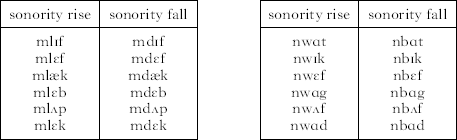
Twenty-six native English participants, students at Florida Atlantic University, took part in the experiment in partial fulfilment of a course requirement. The materials consisted of twelve pairs of monosyllabic non-words and their disyllabic counterparts. Monosyllabic non-words had an unattested onset cluster and were arranged in pairs for which the onsets manifested a rise and a fall in sonority respectively (e.g. mlɪ f, mdɪ f; see Table I). The disyllabic materials differed from their monosyllabic counterparts only in the presence of a schwa between the onset consonants (e.g. mlɪ f–məlɪ f). Experiment 1 (and all subsequent experiments) also included twelve monosyllabic onsets consisting of nasal–nasal combinations and their disyllabic counterparts. These were originally included to explore speakers' perception of onsets with a sonority plateau. However, as discussed in §1.4, nasal–nasal sequences are additionally marked for reasons other than sonority: they violate the OCP for manner.Footnote 5 Because the theory of sonority sequencing alone cannot make predictions concerning their markedness relative to the rising- and falling-sonority sequences, they will not be discussed further here. Thus, each participant was presented with a total of 72 trials: 12 item pairs×3 types (sonority rises, falls and plateau fillers)×2 syllables (mono- vs. disyllabic).
Materials used in the experiments.

The disyllabic non-words were produced naturally, by a female native English speaker in the sentential context ‘This is X’ (e.g. ‘This is məlɪ f’), with final stress. To equate the items for length, they were produced by aligning the onset of each of the words with a metronome at a rate of 100 beats per minute. The monosyllabic non-words were next obtained by excising the pretonic vowel from the disyllabic counterpart at the zero-crossings – a procedure designed to align the two ends of the spliced waveform in order to avoid acoustic artefacts of splicing (e.g. clicks). The beginning of the vowel was defined using waveform and spectrogram inspection by the increase in the amplitude of F1 (around 660 Hz) and F2 (around 1950 Hz). The ending of the vowel was defined as follows. When the vowel preceded a nasal, the ending was defined by the decrease in energy in F1 (low F1, around 660 Hz) and the decrease in energy of F2 (around 1800 Hz, though this pattern was not consistent across items). When the vowel preceded an approximant, the vowel ending was defined by the increase in F2 (for l) or decrease in F2 (for w). Finally, vowels preceding a stop were defined by the decrease in energy in all formants associated with the stop closure. All inspections were carried out by both eye and by ear, using the waveform and spectrogram. To ensure that differences in responses to the monosyllabic forms were not due to differences in the salience of their counterpart as disyllables, disyllabic forms of rising and falling sonority were equated for the duration of their pretonic vowel (for sonority rises, the mean M=170 ms (SD=16 ms), for sonority falls, M=166 ms (SD=24 ms), F<1). The durations of the monosyllabic forms were M=1005 ms (SD=116 ms) and M=1097 ms (SD=87 ms), for sonority rises and falls respectively.
Participants were seated near a computer screen wearing headphones. They initiated a trial by pressing the space bar, resulting in the presentation of an auditory stimulus. Participants were asked to quickly indicate whether the stimulus contained one syllable or two, using the ‘1’ and ‘2’ keys respectively. To illustrate the task, participants were first given a practice session with existing English words (e.g. polite, plight). In Experiments 1–6, trial order was randomised. Response times are reported from the stimulus onset.
2.1.2 Results and discussion
In this and subsequent experiments we excluded outliers (responses falling 2·5 SD above or below the grand means, fewer than 3% of the total responses) from the analyses of response latencies. Response accuracy was analysed as the proportion of correct responses. The effect of onset type was evaluated using ANOVAs, conducted using both participants (F1) and items (F2) as random variables. Here and henceforth, when reporting statistics, ‘F1’ and ‘F2’ refer to the ANOVA F-scores by participants and by items respectively.
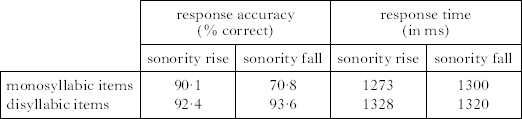
Responses to disyllabic items (see Table II) were not reliably affected by the markedness of their monosyllabic counterpart (all F<1, for response time and accuracy). However onset structure did modulate responses to monosyllabic items (response accuracy: F1(1, 25)=35·61, MSE=0·014, p<0·0002; F2(1, 11)=14·03, MSE=0·016, p<0·004; response time: both F<1): the likelihood of misjudging a monosyllabic item as disyllabic was significantly higher for items including an onset with falling sonority.
Mean response time and accuracy in Experiment 1.

Before proceeding to seek further evidence concerning such misperceptions, we wish to comment briefly on some differences between the present findings and the earlier results of Berent et al. (Reference Berent, Steriade, Lennertz and Vaknin2007). In Berent et al. (Reference Berent, Steriade, Lennertz and Vaknin2007: Experiment 1), falls were mostly misperceived as disyllabic (the mean for correct monosyllabic responses was 14%), whereas in the present experiment, falls were mostly encoded accurately, as monosyllabic (a mean of 71%).
We note two possible explanations for this difference. The first is phonological, and depends on the magnitude of sonority cline: relative to the clusters used in Berent et al. (Reference Berent, Steriade, Lennertz and Vaknin2007), which were mostly liquid–obstruent combinations, the nasal–obstruent clusters used here have a smaller fall in sonority, which may lead to a smaller effect. The second possible explanation is based on phonetic differences in the materials. Unlike the clusters in Berent et al., which were recorded naturally by a Russian speaker, the present materials were produced by splicing from recordings by a native English speaker. The familiarity with the English phonetic categories might have allowed our English participants to better identify the initial consonants as adjacent. The acoustic properties of the present stimuli are considered further in §3.1.
Whether the advantage of nasal-initial falls relative to liquid-initial ones is due to phonetic or phonological sources is a matter for further research. For our present purposes, however, more crucial is the convergence across the two types of materials. In both cases, sonority falls were more likely to trigger disyllabic misperception than rises.
2.2 Experiment 2
Experiment 2 directly examines whether English speakers perceive marked onsets epenthetically by eliciting identity judgments. Twenty-four native English speakers, students at Florida Atlantic University, took part in the experiment in partial fulfilment of a course requirement. The materials were the same stimuli used in Experiment 1. They were arranged in pairs. Pair members were either identical (either monosyllabic or disyllabic) or epenthetically related (mlɪ f-məlɪ f; or məlɪ f-mlɪ f, with the order counterbalanced). The materials were next arranged in two lists, matched for the number of stimuli per condition (target type×identity×order) and counterbalanced, such that, within a list, each item appeared in either the identity or the non-identity condition. Each participant was presented with both lists, with order counterbalanced across participants.
Each trial began with a fixation point (*). Participants initiated the trial by pressing the space bar, triggering the presentation of the first auditory stimulus, followed by the second (onset asynchrony=1500 ms). Participants responded by pressing the ‘1’ or ‘2’ keys, for ‘identical’ and ‘non-identical’ responses respectively. Slow responses (RT>2500 ms) received a computerised warning signal. Prior to the experiment, participants were given a short practice using English words (e.g. plight–plight vs. polite–plight).
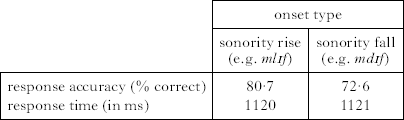
Responses to identity trials were generally accurate (M=95·2%) and fast (M=1129 ms). Our main interest concerns responses to non-identical items (see Table III). Participants were significantly more likely to misperceive monosyllabic items as identical to their disyllabic counterparts for items with sonority falls compared to rises (F1(1, 23)=4·38, MSE=0·018, p<0·05; F2(1, 11)=5·63, MSE=0·007, p<0·04; for response time both F<1).
Mean response time and accuracy to non-identical items in Experiment 2.

2.3 Experiment 3
The greater likelihood of misperceiving onsets of falling sonority is consistent with the hypothesis that the markedness of sonority falls impedes their faithful encoding. As pointed out by Peperkamp (Reference Peperkamp2007), however, the existing results do not strictly demonstrate that such onsets are represented less faithfully: they show that sonority falls are more likely to undergo epenthesis than rises. Although there is every reason to believe that that the rate of epenthesis reflects the rate of unfaithful encoding, a divergence is logically possible – when non-epenthetic misperceptions are taken into account, it is conceivable that they could reverse the conclusion, with less marked onsets being overall less faithfully encoded than more marked onsets. Accordingly, it is desirable to seek converging evidence from tasks that can identify all kinds of unfaithful encoding. To this end, Experiment 3 used a transcription procedure. In each trial, participants were presented with an auditory word, and were asked to transcribe it using English orthography. If the representation of marked onsets is less faithful, then marked onsets should be less likely to elicit correct transcriptions.
Sixteen native English speakers, students at Florida Atlantic University, took part in the experiment in partial fulfilment of a course requirement. The materials were the twelve pairs of monosyllabic non-words used in Experiment 1. To approximate the conditions used in our previous experiments, we presented the monosyllabic items mixed with their disyllabic counterparts, which were treated as fillers (i.e. unanalysed). Participants were seated at a computer, wearing headphones. They initiated each trial by pressing the space bar, triggering the presentation of a single auditory stimulus. Participants were asked to transcribe the item on a piece of paper using English orthography.
Participants correctly transcribed monosyllabic forms on only 45% of the trials. Errors in the transcription of the onset included epenthesis (e.g. mlif→melif; 8·3% of the total responses), prothesis (e.g. mlif→emlif; 2·8% of the total responses), consonant substitution (e.g. mlif→nlif; 13·3% of the total responses), consonant deletion (e.g. mlif→lif; 22·1% of the total responses), and others (omissions, lexicalisations and radical changes to the input, a total of 8% of the total responses). However, the rate of each of these error types was not reliably modulated by onset structure (all p>0·05). The insensitivity of the error patterns to onset type is likely due to individual differences, prompted by the susceptibility of this offline procedure to problem-solving strategies. For example, participants could have discerned that all onsets begin with a nasal consonant, either m or n, and consequently determined the initial consonant by guessing (a possibility supported by the high rate of C1 substitution, e.g. mdif→ndif). Because individual participants might differ in their susceptibility to such strategies and the number of participants is small, the error variance across participants is expected to be high, reducing sensitivity even further.
Despite these limitations, the transcription task was nonetheless sensitive to onset structure. A planned comparison yielded an effect of onset that was significant by items (t2(1, 11)=3·17, MSE=13·5, p<0·007) and marginally so by participants (t1(1, 15)=1·71, MSE=3·88, p<0·06, one tail). Onsets with rising sonority were transcribed correctly in 50·5% of trials, but those with falling sonority in only 40·6%.
3 The representational level of cluster misperception
The results of Experiments 1–3 demonstrate that more marked onsets, with falling sonority, are more likely to be misperceived than less marked onsets, with a sonority rise: such marked onsets are more likely to be misperceived as disyllabic (Experiment 1), such misperception persists even when participants are explicitly asked to discriminate such items from their disyllabic counterpart (Experiment 2) and the reduced probability of faithful perception of marked onsets remains when all types of unfaithfulness are available for report in transcription (Experiment 3). We now turn to the question of the level of representation at which unfaithful encoding occurs. This topic has received considerable attention in the context of loanword adaptation, with some researchers emphasising the role of phonetics (e.g. Peperkamp et al. Reference Peperkamp, Pettinato, Dupoux, Beachley, Brown and Conlin2003, Peperkamp et al. Reference Peperkamp, Vendelin and Nakamura2008), others the role of phonology (e.g. Broselow & Finer Reference Broselow and Finer1991, Silverman Reference Silverman1992, LaCharité & Paradis Reference LaCharité and Paradis2002, Yip Reference Yip2006). Recall that in our account of perception, unfaithfulness can occur at multiple levels, although the possibility of an unfaithful percept, even at low levels, is only made possible by ungrammaticality, at the highest level, of the globally faithful candidate (§1.4.3).
That these misperceptions of unattested clusters are indeed a consequence of the correct functioning of grammatical knowledge – as opposed to incorrect functioning or inadequacy of knowledge relating phonetic form to either surface or auditory form – is examined further in §3.2. But first we wish to deal with another possibility: that what we consider ‘misperception’ is merely a low-level consequence of stimulus artefacts. Perhaps the increased likelihood of perceptual epenthesis for sonority falls reflects our failure to fully remove pretonic vowels when splicing them out of their disyllabic counterparts.Footnote 6
3.1 Is the misperception of sonority falls due to stimulus artefacts?
To assess the possibility that the ‘clusters’ in our stimuli are acoustically defective, failing to provide adequate evidence for a cluster, we turned to speakers for whom ungrammaticality of the relevant cluster types is not the contributing factor that it is for our English-speaking participants. Russian permits nasal-initial clusters of both increasing (e.g. ml) and decreasing (e.g. mg) sonority. Three of the particular clusters we used – nw, md and nb – are not specifically attested in Russian, but as we will see, our Russian participants have no difficulty perceiving these clusters; in our theoretical analysis of §1.4, we thus treat them as accidental gaps rather than the true cases of ungrammaticality we take them to be in English.
If our stimuli are defective in their cues for clusters, Russian speakers should, like English speakers, experience some difficulty in perceiving these stimuli as clusters. To assess this possibility, Experiment 4 uses the syllable-count task and Experiment 5 uses identity judgment.
3.1.1 Experiment 4
Twenty-six native Russian speakers, students at the University of Haifa, took part in this experiment. The materials and procedure are as described in Experiment 1 (§2.1), except for the use of Russian (instead of English) words in the practice phase (e.g. drov ‘log’, darov ‘present’).
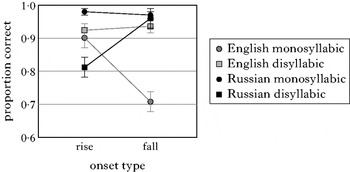
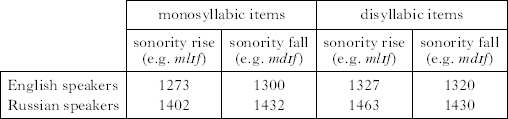
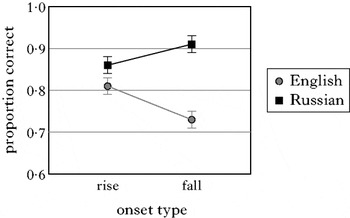
To gauge the effect of linguistic knowledge on the processing of onset clusters, we compared the performance of Russian speakers to English participants (in Experiment 1) separately, for monosyllabic and disyllabic inputs. Response accuracy is presented in Fig. 2 (with error bars reflecting 95% confidence intervals for the difference between the means);Footnote 7 response time is given in Table IV.
Mean response accuracy of English and Russian speakers in the syllable-count task. Error bars reflect confidence intervals, constructed for the difference between the means.

Monosyllabic items. The responses of Russian and English speakers to monosyllabic items were compared by means of a 2 language×2 type ANOVA. The analyses of response time yielded only a marginally significant effect of language (F1(1, 50)=3·66, MSE=120,367, p<0·07; F2(1, 11)=8·13, MSE=1675, p<0·02), suggesting that Russian speakers tended to respond more slowly than English participants, an effect that is likely due to their unfamiliarity with the phonetic categories of the English speaker who produced these recordings. Nonetheless, Russian speakers were significantly more accurate than English participants, resulting in a significant main effect of language in the analyses of response accuracy (F1(1, 50)=30·93, MSE=0·025, p<0·0002; F2(1, 11)=39·59, MSE=0·0045, p<0·0001). Crucially, the analyses of response accuracy yielded a significant interaction (F1(1, 50)=26·79, MSE=0·008, p<0·002; F2(1, 11)=10·22, MSE=0·012, p<0·009), suggesting that the effect of onset type was modulated by linguistic knowledge. We thus proceeded to test the effect of onset type separately for Russian speakers. The response accuracy of Russian speakers approached ceiling, and it was unaffected by onset type (both F<1·1). Thus, unlike English speakers, Russian speakers were no more likely to misperceive onsets of falling sonority epenthetically relative to sonority rises.
Disyllabic items. The ANOVA (2 language×2 onset type) comparing Russian and English participants yielded a significant interaction in the analysis of response accuracy (F1(1, 50)=19·23, MSE=0·006, p<0·0001; F2(1, 11)=15·11, MSE=0·005, p<0·003; for response time, no effect was reliable by participants and items: all p>0·07). Thus, responses to disyllabic items were modulated by language.
Mean response time of Russian and English speakers in the syllable-count task.

A separate analysis of the Russian group showed that the responses of Russian speakers to disyllabic items were significantly affected by onset types: Russian speakers responded more accurately to the counterparts of sonority falls than to the counterparts of rises (F1(1, 25)=28·78, MSE=0·01, p<0·0002; F2(1, 11)=13·65, MSE=0·010, p<0·004). This effect must be due to their linguistic knowledge, rather than stimulus artefacts, as English speakers were equally likely to perceive both types as disyllabic. Indeed, Russian speakers were overall less accurate than English speakers in responding to disyllabic items (F1(1, 50)=3·49, MSE=0·017, p<0·07; F2(1, 11)=12·11, MSE=0·009, p<0·006). The difficulty of Russian speakers in perceiving CəCVC items as disyllabic, a finding that agrees with previous research (Berent et al. Reference Berent, Steriade, Lennertz and Vaknin2007), might reflect the absence of a pretonic schwa in many dialects of Russian (Crosswhite Reference Crosswhite1999).Footnote 8 The unfamiliarity (or ungrammaticality) of such structures might have led to their confusion with monosyllabic forms. Interestingly, however, such confusions were more pronounced with the counterparts of sonority rises – a result consistent with previous results for both Russian and English speakers (Berent et al. Reference Berent, Steriade, Lennertz and Vaknin2007: Experiments 2 and 1 respectively). This may be a result of markedness-driven perceptual competition: since rising-sonority clusters are less marked, as an alternative to the CəCVC percept, CCVC is a stronger competitor when its onset cluster has rising sonority. Alternatively, this effect may be a consequence of the statistical structure of the Russian lexicon – our present results do not allow us to discriminate between these possibilities. Either way, the findings make it clear that our marked monosyllabic stimuli are perceptible as such, suggesting that the misperception of these items by English speakers is due to linguistic knowledge.
3.1.2 Experiment 5
Experiment 5 is the counterpart with Russian speakers of the identity-judgement task of Experiment 2 (§2.2).
Twenty-four native Russian speakers, students at the University of Haifa, took part in this experiment. The materials and procedure are as described in Experiment 2, except for the use of Russian words in the practice phase (e.g. drov–drov, darov–drov).
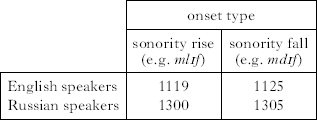
As expected, the responses of Russian speakers in the identity condition were generally fast (M=1315 ms) and accurate (M=95·7%). Our main interest is in the effect of linguistic knowledge on participants' ability to discriminate the monosyllabic forms from their disyllabic counterparts. To assess this issue, we compared the responses of English and Russian speakers to non-identity items by means of a 2 language×2 onset type analysis. The accuracy means are presented in Fig. 3; response-time means are given in Table V.
Mean response accuracy of English and Russian speakers to non-identical items. Error bars reflect 95% confidence intervals, constructed for the difference between the means.

Mean response time of Russian and English speakers to non-identical items in Experiment 5.

The analyses of response accuracy yielded a significant main effect of language (F1(1, 46)=7·87, MSE=0·041, p<0·008; F2(1, 11)=43·77, MSE=0·003, p<0·0001), demonstrating that Russian speakers were overall more accurate than English speakers in discriminating among non-identical items. As in the syllable-count task, however, Russian speakers took longer to respond (F1(1, 46)=12·52, MSE=62898, p<0·001; F2(1, 11)=594·13, MSE=531·72, p<0·0001), an effect we attribute to their unfamiliarity with the phonetic categories of the English speaker who produced these items. Importantly, however, linguistic knowledge modulated the effect of onset type, resulting in a significant interaction in the analysis of response accuracy (F1(1, 46)=9·48, MSE=0·011, p<0·004; F2(1, 11)=19·13, MSE=0·003, p<0·002; in response time, both F<1).
Recall that, for English speakers, the likelihood of misperceiving sonority falls as identical to their disyllabic counterparts was greater than for sonority rises. In contrast, Russian speakers responded with greater accuracy to onsets of falling sonority relative to sonority rises, an effect significant by participants, and marginally so by items (F1(1, 23)=6·90, MSE=0·005, p<0·02; F2(1, 11)=3·84, MSE=0·004, p<0·08). Russian speakers' inaccuracy with onsets of rising sonority may well be due to their difficulty in perceiving the disyllabic form in the pair – a difficulty evident also in the syllable-count experiment. In any event, the results make it clear that our materials of falling sonority are not universally confusable with their disyllabic counterparts.
3.2 The role of phonetic form in the misperception of sonority falls
We turn now to the hypothesis that English speakers' increased misperception of marked onset clusters is due to their inability to extract accurate phonetic representations of these clusters. Berent et al. (Reference Berent, Steriade, Lennertz and Vaknin2007) argued against this hypothesis by showing that English speakers can perceive marked onsets accurately (as accurately as they perceive their unmarked counterparts) under conditions that encourage attention to phonetic detail (their Experiments 5–6).
The next experiment presents yet a stronger test of this hypothesis. Here, we examine whether the increased misperception of marked onsets emerges for stimuli that are devoid of any acoustic properties – for printed stimuli read silently. The materials and task, identity judgment, are the same as in Experiment 2 (§2.2), except that the words are presented visually, in alternating case (e.g. mlif–MELIF). To encourage participants to commit the items to maintenance in phonological working memory – a process that requires the assembly of their phonological structure from print (Baddeley Reference Baddeley1986) – we increased the inter-stimulus interval to 2500 ms, an interval longer than that used in Experiments 2 and 5 (which used an onset asynchrony of 1500 ms). Previous research using this procedure with obstruent–sonorant combinations demonstrated its sensitivity to the phonological structure of the materials (Berent & Lennertz Reference Berent and Lennertz2008): as with auditory materials, participants took longer to distinguish between non-identical items with sonority falls (e.g. lbif–LEBIF) than rises (e.g. bnif–BENIF). Moreover, participants were sensitive to the phonological similarity among the items even when their graphemic overlap was controlled. Specifically, people were quicker to discriminate blim from kelim, items that differ on two letters and two phonemes, than clim from kelim, which differ by two letters but only one phoneme. Thus, despite the use of printed materials, we expect participants in the present experiment to be sensitive to the phonological structure of the printed words. If the increased misperception of marked onsets reflects not a low-level failure in processing auditory input but rather the phonological markedness of these onsets, then similar results might emerge with printed materials.
3.2.1 Experiment 6
Twenty-four native English speakers, students at Florida Atlantic University, took part in the experiment either in partial fulfilment of a course requirement or for payment. The materials were printed non-words corresponding to the items used in Experiment 2 (§2.2). The structure of the materials was as described in Experiment 2.
Each trial began with a fixation point (*), which was presented for 100 ms, followed by the first non-word, presented in lower case for 500 ms, a pattern mask (XXXXXX), presented for 2500 ms, and the second non-word, presented in upper case until participants made their response. The procedure was otherwise as in Experiment 2.
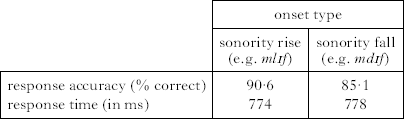
Four participants were excluded because their mean accuracy fell 1·5 SD below the group's mean. Response time and accuracy to the identity trials were M=747 ms and M=89·7% respectively. Our main interest was in the non-identity trials (see Table VI). Readers responded more accurately to onsets with rising sonority than to sonority falls (F1(1, 19)=6·08, MSE=0·005, p<0·03; F2(1, 11)=6·01, MSE=0·003, p<0·04; in response time; both F<1).
Mean response time and accuracy to non-identical items in Experiment 6.

4 The role of lexical knowledge
The experiments we have presented provide evidence that English speakers, for nasal-initial onset clusters, misperceive falling-sonority clusters more frequently than rising-sonority clusters, and that these results are not due simply to stimulus artefacts, nor to hearers' inability to perform the acoustic analysis necessary for accurate perception. This evidence is consistent with predictions based on the OT perceptual account sketched in §1.4, which attribute the effect to grammatical knowledge of the relative markedness of phonological surface forms containing such clusters. But, on an alternative explanation, the difficulties with sonority falls reflect not their grammatical markedness, but rather statistical knowledge of the English lexicon. The hypothesis that hearers' preference for onset clusters obeying sonority-sequencing principles reflects only statistical knowledge is challenged by recent findings replicating this preference in speakers of Korean, a language that arguably lacks onset clusters altogether (Berent et al. Reference Berent, Lennertz, Jun, Moreno and Smolensky2008). Those findings, however, do not rule out the possibility that statistical knowledge might account for the performance of English participants in the present experiments. We next consider this possibility, examining the statistics of the English lexicon at the segmental (§4.1) and featural (§4.2) levels.
4.1 Segmental lexical statistics
To evaluate the possibility that the preference for items like mlɪ f reflects only the co-occurrence of their segments in the English lexicon, we calculated several statistical measures of our materials, including indices of neighbourhood structure, segment/letter co-occurrence and the properties of the first consonant. These measures are briefly summarised below.Footnote 9
Neighbourhood measures included the number of neighbours (the number of words obtained by adding, deleting or substituting one of a target's phonemes) and their summed frequency. Measures of segment co-occurrence were calculated at both the level of the whole word and the onset. Word measures included position-sensitive phoneme and biphone probability (for auditory words) and bigram count and bigram frequency (for printed words); onset measures estimated the probability that the two onset consonants co-occur on the basis of the position-sensitive probability of each of the two consonants. Finally, because fronting is known to affect auditory perception (Byrd Reference Byrd1992, Surprenant & Goldstein Reference Surprenant and Goldstein1998), the status of the initial consonant (m vs. n) was also considered in the analysis of auditory words.
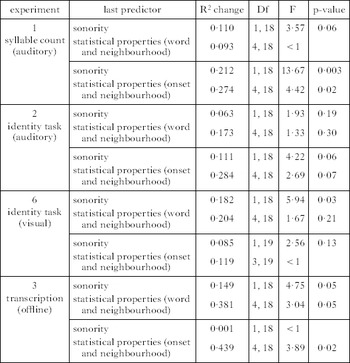
We next assessed the unique contribution of sonority profile and statistical knowledge to performance in the syllable count (Experiment 1), identity (Experiments 2 and 6) and transcription (Experiment 3) tasks by means of multiple stepwise linear regression analyses using response accuracy to each of the 24 stimulus items (averaged across participants) as the dependent measure.
To address the unique contribution of sonority profile, we forced this factor as the last step into the regression analysis, after controlling for statistical properties, entered in the first step. Another analysis addressed the unique contribution of statistical knowledge (entered last) after controlling for the effect of sonority (entered first). To specifically isolate the effect of statistical knowledge concerning onset structure, we also assessed the effect of segment/letter co-occurrence in the onset and in the whole word in separate analyses. Thus, in each experiment, statistical properties were examined using either whole-word and neighbourhood properties or onset and neighbourhood properties, and the effect of these statistical properties was entered either first or last – a total of four analyses per experiment. Because our main interest is in the unique contribution of sonority profile and statistical properties, we only report the proportion of the change in variance associated with the last predictor (indicated as R2 change; see Table VII).
The unique effects of sonority and statistical properties entered as the last predictors in linear stepwise regression analyses of Experiments 1–3 and 6. Word and neighbourhood properties include the number of neighbours, neighbour frequency and either phoneme and biphone probability (for auditory words) or bigram count and frequency (for printed words). Onset and neighbourhood properties include onset probability, the number of neighbours and neighbour frequency; the analyses of auditory words also include the initial phoneme (m or n).

The findings show that participants were sensitive to statistical structure. Statistical properties reliably captured up to 28·4% of the variance in Experiment 2, and 43·9% of the variance in the transcription task. In fact, once the statistical properties of the onset and neighbourhood were controlled, the effect of sonority in the transcription task was eliminated altogether, possibly reflecting the vulnerability of this offline task to guessing. Indeed, statistical knowledge did not subsume the effect of sonority in either of our online experiments (i.e. the syllable-count and identity-judgement procedures). Although the unique contribution of sonority profile was not reliable in all analyses, in no case was the effect of statistical properties reliable without the effect of sonority being either significant or marginally so. These results speak against the attribution of our findings only to the statistical distribution of segments in the English lexicon.
4.2 Featural lexical statistics
It is plausible that learning relevant to sonority sequencing takes place at the level of features, rather than segments. It is unknown how successfully our data could be accounted for by a sophisticated feature-based statistical learning model such as Hayes & Wilson (Reference Hayes and Wilson2008), when trained on the English lexicon (although the study by Hayes (Reference Hayesin press) of a toy lexicon suggests that at least some degree of sonority-informed learning bias might be required). In what follows, we examine two predictions arising from simple facts of the distribution of major class features in English: the first concerns glides following initial nasals and the second sonorants following initial consonants. Could a statistical model that simply tracks such featural distributions capture our results?
Although English lacks onset clusters that begin with a nasal consonant, nasal–glide sequences are nonetheless attested at the beginning of English words (e.g. mule, mute). We follow Giegerich (Reference Giegerich1992), Davis & Hammond (Reference Davis and Hammond1995) and Buchwald (Reference Buchwald2005) in taking the palatal glide [j] to be part of a diphthong in the syllable nucleus rather than part of the onset (the palatal glide can only precede [u], and, unlike [w], does not constrain the preceding consonant, as would be expected if it were in the onset). But regardless of how such sequences are represented, it is conceivable that familiarity with nasal–glide sequences might inform our participants' preference for sonority rises.
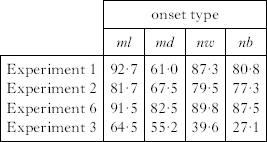
Our materials allow us to evaluate this possibility. Recall that our sonority rises comprise nasal–liquid (e.g. ml) and nasal–glide (e.g. nw) combinations. If the preference for sonority rises reflect familiarity with nasal–glide sequences, then one would expect that (a) nw sequences should be recognised more accurately than ml sequences; and (b) the advantage of sonority rises over falls should be larger for nw-initial compared to ml-initial sequences (a prediction that might also follow from the greater sonority rise for nasal–glide than for nasal–liquid). A 2 (C1 type)×onset type (rise vs. fall) ANOVA comparing the response accuracy with these two types of items indeed yielded a significant interaction in Experiment 1 (F2(1, 10)=12·44, MSE=0·008, p<0·006) and a marginally significant interaction in Experiment 2 (F2(1, 10)=3·82, MSE=0·006, p<0·08; for Experiment 3 and 6, p>0·16), but contrary to the prediction of the statistical account, response accuracy was actually higher for the ml sequence (see Table VIII), and the advantage of sonority rises over falls was likewise larger for the m-initial relative to the n-initial items (possibly due to a fronting effect; see Byrd Reference Byrd1992, Surprenant & Goldstein Reference Surprenant and Goldstein1998).
The effect of sonority profile on response accuracy (% correct) to m-initial vs. n-initial onsets.

Although this result does not lend support to the statistical explanation, the lack of a familiarity effect might be due to the limited experience of English speakers with nasal–glide sequences and their dubious status as onsets. Unlike the small frequency difference between the different types of nasal onsets of rising sonority – those with C2 comprising liquid vs. glides – onsets with rising sonority are in general clearly more frequent than falls, since sonorants are far more frequent than obstruents at the second position of the onset. The preference for sonority rises over falls could reflect this difference in feature co-occurrence.
Although the results presented so far do not rule out this explanation, other aspects of the findings speak against this possibility. As noted in §2.1.1, our experiments included not only onsets with sonority rises and falls but also a group of onsets of level sonority (e.g. mnɪ f, nmɪ f), which were excluded from the analyses reported above because they violate the OCP for manner. Nonetheless, these items have some relevance for addressing the feature-statistical account. Unlike our onsets of falling sonority, whose second consonant is a voiced obstruent, never occurring in second position in English onsets, in onsets of level sonority the second consonant is a nasal, and nasals occur quite frequently in this position in English (e.g. snow, small). If English speakers base their responses only on the statistics of features in English, then it is plausible that they should consistently favour nasal-second onsets like mnɪ f and nmɪ f to the voiced obstruent-second onsets of falling sonority. As it happens, this prediction is consistent with the results of the syllable-count task (M plateau=82·1%, ▵fall-plateau=−11·2%, t1(50)=3·38, p<0·002; t2(22)=2·54, p<0·02). But the advantage of sonority plateaus over falls is not systematic. The difference was not significant in either the transcription or identity task involving orthography (in Experiment 3 M plateau=36%, ▵fall-plateau=4·69%; all t<1; in Experiment 6 M plateau=87·6%, ▵fall-plateau=−2·3%, t(22)=1·18; t(138)=1·23). Moreover, the identity task using auditory materials (Experiment 2) yielded significantly lower accuracy for level relative to falling sonority (M plateau=62·3%, ▵fall-plateau=10·3%; t1(46)=2·76, p<0·009; t2(22)=2·33, p<0·03) – a finding that might be due to the strong violation of the OCP-place by nasal–nasal sequences. A full investigation of the interaction of OCP- and sonority-sequencing markedness is obviously beyond the scope of this research. For our present purposes, suffice it to note that participants did not consistently favour the more familiar mn-type onsets over the less familiar md-type onsets. Thus our results appear to lend no support to the claim that performance in our experiments reflects only statistical knowledge of the distribution of features in English onset clusters.
5 Summary
Psycholinguistic research typically concerns speakers' knowledge of structures attested in their language. Optimality Theory (Prince & Smolensky Reference Prince and Smolensky2004), however, proposes that speakers' knowledge includes universal structural preferences, even concerning structures unattested in their own language. According to our extension of OT to perception, these universal preferences are predicted to be manifest not just in production, but in perception as well, with dispreferred structures being less accurately perceived.
The research reported here probed for such universal preferences regarding unattested structures by examining the perception of nasal-initial onsets by English speakers. Across languages, onset clusters – including nasal-initial ones – with falling sonority are marked relative to those of rising sonority (e.g. Greenberg Reference Greenberg, Greenberg, Ferguson and Moravcsik1978). Our experimental findings are consistent with the prediction that such markedness relations are known by English speakers: compared to those with rising sonority, nasal-initial onsets with falling sonority are more likely to be misperceived as disyllabic and to be misjudged as identical to their epenthetic counterparts (Experiments 1–2). Onsets with falling sonority are also reproduced less accurately than those of rising sonority in transcription (Experiment 3), suggesting that their encoding is less faithful.
The misperceptions of our materials with sonority falls are not due to stimulus artefacts: Russian speakers, whose language allows nasal-initial onsets with falling sonority, were no more likely to misperceive sonority falls than rises (Experiments 4–5). Similarly, these misperceptions are not due to a simple failure of English hearers to process the acoustic cues to falling-sonority clusters, as they emerge regardless of stimulus modality – for both auditory (Experiment 2) and printed materials (Experiment 6).
Examining several statistical properties of the English lexicon, at the segmental and featural levels, we are unable to explain our results using a number of statistical measures that have been previously proposed to account for perceptual accuracy.
The experimental evidence and analysis presented here thus suggest that English speakers possess phonological knowledge of the relative markedness of onset clusters which, for the moment, seems unexplainable purely from their linguistic experience, but which is fully expected on the basis of universal grammar.