New surgical techniques and advances in cardiopulmonary bypass, cardiac intensive care, cardiac catheterisation, non-invasive imaging and medical therapies have significantly lowered mortality rates for children and adolescents with complex CHD.Reference Marino, Lipkin and Newburger1–Reference Jacobs, O’Brien and Pasquali4 The underlying physiology of many children with CHD may make these patients particularly vulnerable to haemodynamic instability which leads to adverse events. As so, CHD remains the number one medical cause of death for children under age 15 years.Reference Benavidez, Gauvreau, Del Nido, Bacha and Jenkins5,Reference Roger, Go and Lloyd-Jones6 With advances in imaging and surgical planning, patients with CHD undergoing surgical intervention have improving outcomes with low mortality rates.Reference Fiorentino, Stickley and Dorobantu7 More recently, the focus has shifted towards minimising morbidity and complications as many patients can have complications ranging from inconsequential to multiple complex complications leading to death.Reference Fiorentino, Stickley and Dorobantu7,Reference Brown, Crowe and Franklin8 A significant complication contributing to morbidity is unplanned reintervention.Reference Fiorentino, Stickley and Dorobantu7,Reference Jacobs, Jacobs and Austin9 The need for an unplanned cardiac reintervention, defined as either an unplanned surgical intervention or cardiac catheterisation, is multi-factorial and may be due to residual anatomic defects, incomplete diagnosis prior to surgery and failed prior interventions.Reference Fiorentino, Stickley and Dorobantu7,Reference Jacobs, Jacobs and Austin9 Better understanding of the risks leading to reintervention may inform clinicians and improve outcomes.Reference Mazwi, Brown and Marshall10,Reference Costello, Mongé and Hill11 Multiple studies have reported unplanned reinterventions ranging from 3.5 to 11%. In a single centre study, Mazwi and colleagues reported up to 11% of neonates needing early unplanned cardiac intervention.Reference Mazwi, Brown and Marshall10 In a large database report by Costello and colleagues, the unplanned reintervention rate was 5.4% in the entire cohort, with neonates having the highest rate 11.8%, followed by infants 5.2% and children 2.8%.Reference Costello, Mongé and Hill11 The United Kingdom’s National Congenital Heart Disease Audit database found an overall 3.5% unplanned reintervention rate.Reference Fiorentino, Stickley and Dorobantu7 In all reports, unplanned reintervention was a strong independent risk factor for death.Reference Fiorentino, Stickley and Dorobantu7,Reference Mazwi, Brown and Marshall10,Reference Costello, Mongé and Hill11 Due to the rate of unplanned reintervention, and the association with death, we aimed to assess the risk factors and outcomes of unplanned reintervention following complete repair for Tetralogy of Fallot at our institution. Our secondary aim was to examine the long-term morbidity and mortality for paediatric patients with Tetralogy of Fallot that underwent unplanned reintervention.
Materials and methods
Cohort selection
This single centre retrospective case–control study included all patients, 0–18 years, who underwent an index cardiac surgery for complete repair of Tetralogy of Fallot between January 1, 2009 and December 31, 2019, at Children’s Healthcare of Atlanta, a free-standing university-affiliated quaternary children’s hospital. Cases were matched to controls 2:1 by age, weight and sex. This project was reviewed and approved by the Children’s Healthcare of Atlanta Institutional Review Board.
Demographics (age, weight, sex and race), clinical characteristics cardiac intensive care unit, post-operative and hospital length of stay, duration of mechanical ventilation, genetic syndrome, chromosomal abnormalities) and operative variables (cardiopulmonary bypass time and cross clamp time) were collected. Surgical procedures were categorised by complexity based on the Society of Thoracic Surgeons and the European Association for Cardio-Thoracic Surgery (STAT) Mortality Scores (23). Reintervention included cardiac catheterisation, reoperation that includes surgical re-intervention, post-operative unplanned reopening of the chest, chest exploration and washout, delayed sternal closure only after a non-planned reopening of the chest post-operatively in the cardiac ICU, and the need for extracorporeal life support. Mortality at discharge was defined as per Society of Thoracic Surgery Congenital Heart Surgery Database definitions as all deaths occurring during the hospitalisation in which the operation was performed, even after 30 days; and all deaths occurring after discharge from the hospital, but before the end of the thirtieth post-operative day.Reference O’Brien, Jacobs and Pasquali12
Statistical analysis
We compared categorical variables for patients with reintervention (cases) versus patients without (controls) using Chi-square and Fisher’s exact tests. The Student’s t-test and Wilcoxon rank sum test were performed to compare continuous variables. Bivariate logistic regression was performed to determine the association of each independent variable with the outcome (reintervention). Multi-variable logistic regression was conducted, and variables that were statistically significant were entered into the second level of model building. A backward elimination approach was used to create the final model and produce odds ratios for reintervention versus non-reintervention. A p-value of 0.05 was considered the cut-off for statistical significance. Statistical analyses were performed in SAS Enterprise Guide version 7.15 (SAS Institute, Inc., NC).
Results
Demographic data and outcomes of entire cohort (cases + controls)
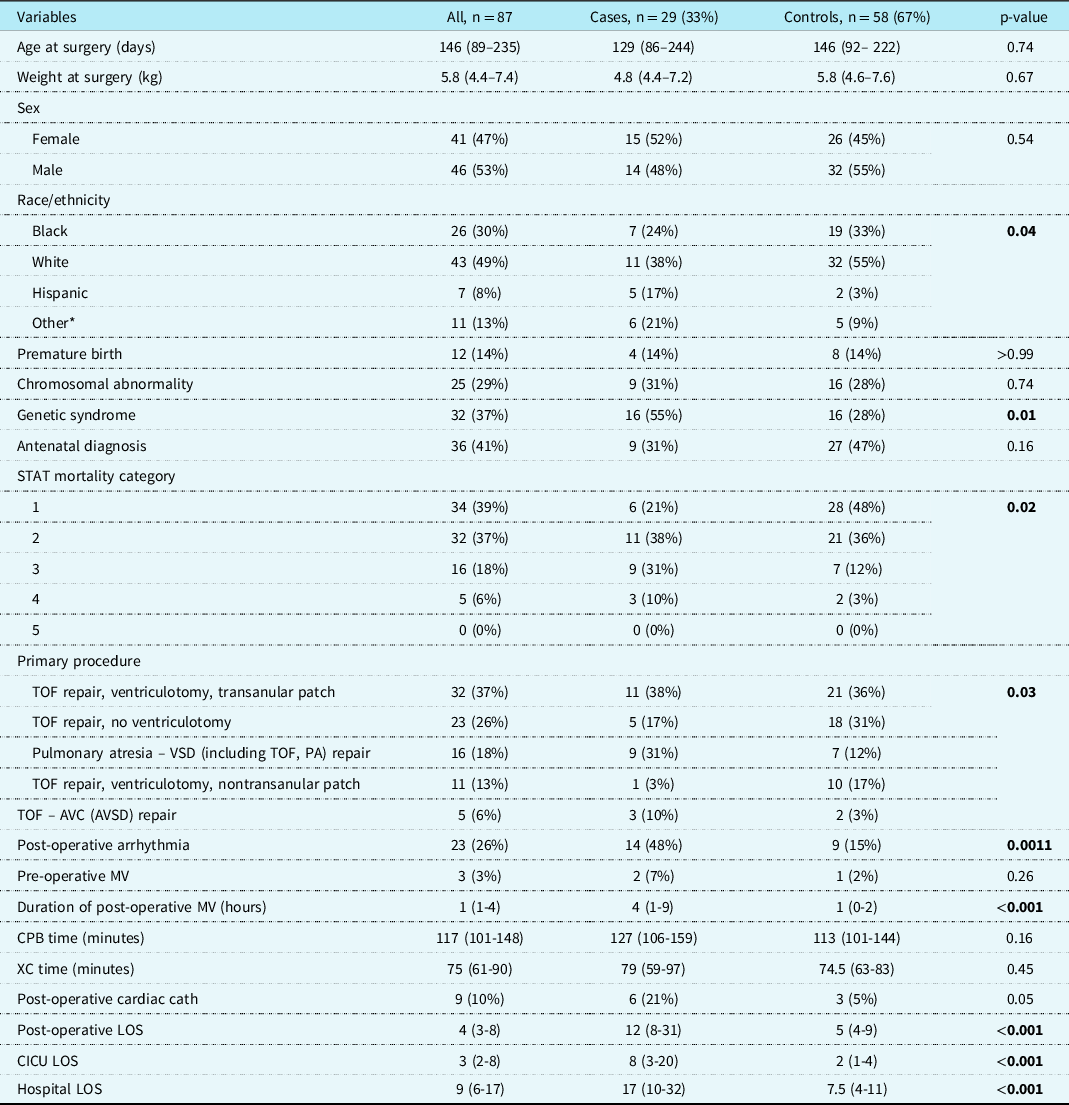
During the study period, 428 patients underwent Tetralogy of Fallot repair in our institution, of which 29 patients had an unplanned reintervention and were eligible to be included as cases, with a reintervention rate of 6.8% (29/428). Cases were matched to 58 patients by age, weight, and sex for a total of 87 patients in the analysis. Patient characteristics are presented in Table 1. The overall median age was 146 days [interquartile range (IQR) 89–235], and median weight was 5.8 kg (IQR 4.4–7.4). Operations with STAT scores of 1 or 2 comprised 87 (76%) of all surgeries. The median duration of cardiopulmonary bypass and cross clamp time were 117 minutes (IQR 101–148), and 75 minutes (IQR 61–90), respectively. The median cardiac intensive care unit length of stay was 3 days (IQR 2–8), post-operative length of stay was 4 days (IQR 3–8) and the median duration of mechanical ventilation was 1 day (IQR 1–4). Chromosomal abnormalities were present in 29% of patients and diagnosed genetic syndromes in 37% of patients. Most common genetic syndromes were DiGeorge Syndrome (22q11.microdeletion) (four in the cases group and three in the control group), and Down’s Syndrome (Trisomy 21) (two in the cases group and five in the control group). The breakdown of primary procedure for index surgery are presented in Table 1. The most common primary procedure was Tetralogy of Fallot repair, ventriculotomy, with transannular patch in 32 (37%) patients, followed by Tetralogy of Fallot repair, no ventriculotomy in 23 (26%) patients. The least common procedure was Tetralogy of Fallot – atrioventricular canal repair in 5 (5%) patients (Table 1).
Patient characteristics of entire cohort.

Results depicted in n (percent), median (interquartile range). Bold indicates the p-values reached statistically significant difference.
AVC: Atrioventricular Canal; CPB: Cardiopulmonary Bypass; LOS: Length of Stay; MV: Mechanical Ventilation; PA: Pulmonary Atresia; TOF: Tetralogy of Fallot, VSD: Ventricular Septal Defect, XC: Cross Clamp.
* Other = Asian, Pacific Islander, Native American.
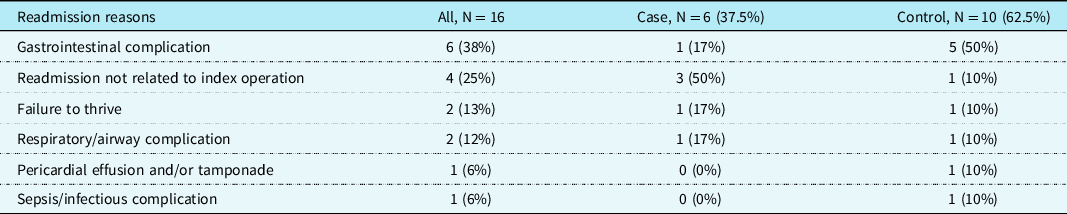
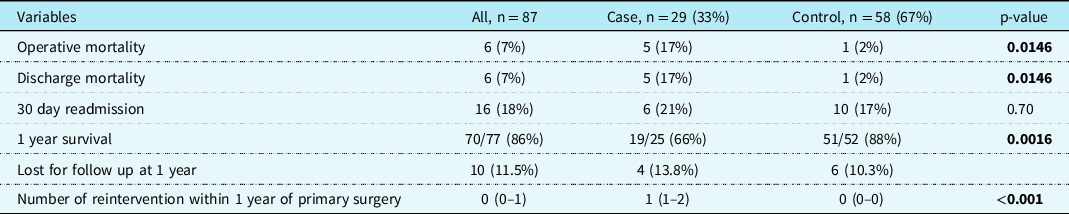
Eighty-one patients survived to hospital discharge with an overall operative mortality rate of 7%. Readmission in the first 30 days after discharge was 18% (n = 16), with gastrointestinal reasons (38%, n = 6), and other reasons were not related to index operation (25%, n = 4). A list of reasons for readmission are presented in Table 2. The post-operative mortality rate in the cases group was 17% versus 2% (p = 0.0146), and the 1-year survival rate was 66% versus 88% (p = 0.0016) for cases versus controls. There was no difference in 30-day readmission and change in functional status score between both groups (Table 3).
Readmission reasons among patients readmitted within 30 days.

Results depicted in n (percent).
Patient outcomes of entire cohort and stratified into cases and controls.

Results depicted in n (percent), median (interquartile range). Bold indicates the p-values reached statistically significant difference.
Factors associated with outcomes
When comparing both groups, Hispanic patients were more likely to have reinterventions (p = 0.04). Cases and controls had similar cardiopulmonary bypass and cross clamp times (127 versus 113 minutes and 79 versus 74.5 minutes, respectively) (Table 1). Patients undergoing unplanned reintervention were more likely to develop post-op arrhythmia (14 (48%) versus 9 (15%), p = 0.0011), have longer duration of mechanical ventilation 4 (IQR 1–9) versus 1 (IQR 0–2) days, p = 0.0002, and have longer duration of cardiac ICU, post-operative, and overall hospital length of stay (p < 0.0001) (Table 1). Patients undergoing unplanned reintervention were more likely to have a higher STAT score (3 and 4) (31% versus 12%, and 10% versus 3%, p = 0.02 respectively), and a diagnosis of a genetic syndrome (55% versus 28%, p = 0.01) (Table 1).
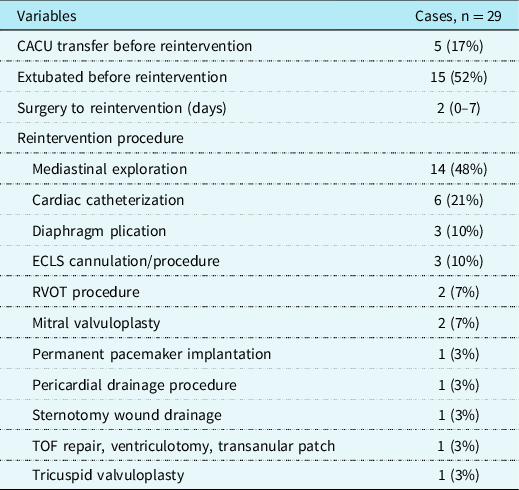
Of the 29 patients undergoing unplanned reintervention, the most common reintervention was mediastinal exploration (48%), followed by cardiac catheterisation (21%), extracorporeal life support cannulation/procedure (10%), and diaphragm plication (10%). The median time from index surgery to reoperation was 2 days (IQR 0–7). The clinical variables among patients with reintervention are presented in Table 4.
Clinical variables among patients with reintervention (cases).

Results depicted in n (percent), median (interquartile).
CACU: Cardiac Acute Care Unit, ECLS: Extracorporeal Life Support, RVOT: Right Ventricular Outflow Tract, TOF: Tetralogy of Fallot.
Logistic regression
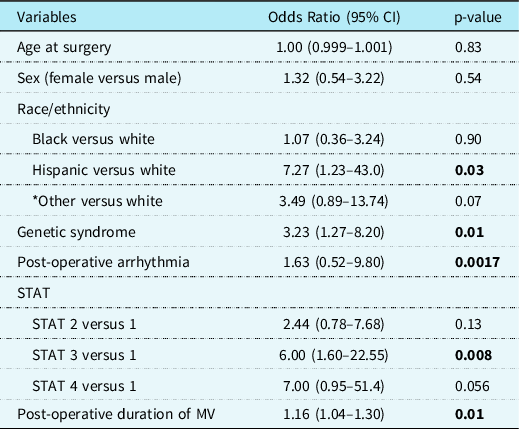
In an unadjusted analysis, patients in the reintervention group were 7.27 times more likely to be Hispanic versus White (OR 7.27, 95% CI 1.23–43.0, p = 0.03), 3.23 times more likely to have a genetic syndrome (OR 3.23, 95% CI 1.27–8.20, p = 0.01), 1.63 times more likely to have post-op arrhythmia (OR 1.63, 95% CI 0.52–9.80, p = 0.0017), 6 times more likely to undergone a STAT 3 versus STAT 1 operation (OR 1.60–22.55, p = 0.008), and have a 1.16 times higher odds of having longer duration of post-operative mechanical ventilation (OR 1.16, 95% CI 1.04–1.30, p = 0.01) (Table 5).
Univariable analysis: odds ratios for patients with versus without reintervention.

* Other = Asian, Pacific Islander, Native American.
MV: Mechanical ventilation. Bold indicates the p-values reached statistically significant difference.
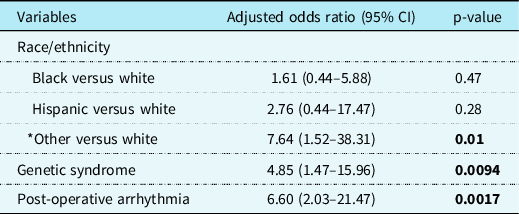
The final model was adjusted for race/ethnicity, genetic syndrome, and post-operative arrhythmia. The adjusted multi-variable logistic regression model showed that patients in the reintervention group were 7.64 times more likely to be of other race/ethnicity (Asian, Pacific Islander, and Native American) versus white (aOR 7.64, 95% CI 1.52–38.31, p = 0.01), 4.85 times more likely to have a genetic syndrome (aOR 4.85, 95% CI 1.47–15.96, p = 0.0094), and 6.6 higher odds to have post-operative arrhythmia (OR 6.60, 95% CI 2.03–21.47, p = 0.0017) (Table 6)
Multivariable logistic regression: odds ratios for patients with versus without reintervention.

* Other = Asian, Pacific Islander, Native American. Bold indicates the p-values reached statistically significant difference.
Discussion
In this analysis of patients that underwent unplanned reintervention for Tetralogy of Fallot repair, our study found that race, genetic syndromes, and post-operative arrythmia were associated with unplanned reinterventions. Additionally, post-operative arrhythmias were independently associated with reintervention, though this was not significant when adjusting for other factors. In addition, patients that underwent reoperation had higher mortality and worse survival than controls.
The findings of our study are similar to multiple studies demonstrating racial/ethnic differences in patient outcomes, specifically that Black patients have higher rates of reinterventions, morbidity and mortality.Reference Benavidez, Gauvreau, Del Nido, Bacha and Jenkins5,Reference Costello, Mongé and Hill11,Reference Benavidez, Gauvreau and Jenkins13,Reference Oster, Strickland and Mahle14 Costello and colleagues reported that Black patients and non-White-non-Black patients had 1.28 and 1.15 higher odds of unplanned reintervention when compared to White patients.Reference Costello, Mongé and Hill11 Similar to other studies,Reference Benavidez, Gauvreau, Del Nido, Bacha and Jenkins5,Reference Benavidez, Gauvreau and Jenkins13,Reference Oster, Strickland and Mahle14 our findings showed an association with Hispanic ethnicity in the crude analysis and Asian, Pacific islander, and Native American in the multi-variable analysis. It is unclear why certain racial/ethnic groups are at higher risk. Some factors in consideration are socioeconomic status, access to healthcare and healthcare facilities, and cultural and religious beliefs to name a few. There has been a renewed focus on healthcare disparities focusing on the increased complications and poor outcomes of various racial and ethnic groups. These disparities have been demonstrated in post-operative analgesia,Reference Goyal, Johnson and Chamberlain15 higher post-operative mortality and illness severity,Reference Tjoeng, Jenkins, Deen and Chan16 and when discussing end-of-life care with families.Reference Fundora, Rodriguez and Mahle17 Related to our findings of race and reoperation, Willer and colleagues studied over 200,000 children after inpatient surgery. They found that among patients requiring unplanned reoperation, Black children were more likely to die than White children.Reference Willer, Mpody, Tobias and Nafiu18 While our study did not demonstrate this finding for Black children specifically, we found that Hispanic and Asian/Pacific Islander/Native American patients were associated with higher chances of reintervention. The former study excluded other racial and ethnic groups in their inclusion criteria, however our study included these groups as a significant and growing proportion of children in the United States of America are neither White or Black.Reference Nasr and DiNardo19 Our study contributes to a growing body of evidence which includes, that studying and addressing healthcare disparities of ethnic and racial minorities is paramount to ensuring healthcare equity and improved outcomes.
In addition to race, our study showed an association with genetic syndrome and post-operative arrhythmia. Post-operative arrhythmia may be an indication of performance of the initial procedure which resulted in inadequate resolution of obstruction or surgical complication resulting in conduction system injury. Interestingly, our study did not show prematurity, prenatal diagnosis, and pre-operative mechanical ventilation to be associated with unplanned reinterventions. Prior studies have shown additional independent predictors of unplanned reintervention included prenatal diagnosis, premature birth, low birth weight, lower weight at surgery, genetic syndromes, need for mechanical ventilation prior to cardiac surgery, and higher STAT scores.Reference Fiorentino, Stickley and Dorobantu7,Reference Mazwi, Brown and Marshall10,Reference Costello, Mongé and Hill11 This difference may have been due to patient population between prior studies and our cohort as our study focused on patients with similar cardiac diagnoses (i.e., Tetralogy of Fallot), while Costello and Fiorentino studied all patients ages 0–18 years, and Mazwi studied all neonates with CHD.Reference Fiorentino, Stickley and Dorobantu7,Reference Mazwi, Brown and Marshall10,Reference Costello, Mongé and Hill11 It is also worth pointing out that the majority of patients with diagnosis of Tetralogy of Fallot present to surgery from home or as an elective case and very rarely require pre-operative mechanical ventilation.
Patients who underwent reintervention had higher post-operative mortality and worse 1-year survival compared to controls, consistent with other studies. A study from the Society of Thoracic Surgery Congenital Heart Surgery database, showed a higher operative mortality in patients who underwent unplanned reintervention (32% versus 4%).Reference Costello, Mongé and Hill11 A similar report from the United Kingdom’s National Congenital Heart Disease Audit database, reported a mortality rate of 60% in those who underwent reintervention.Reference Fiorentino, Stickley and Dorobantu7 Mazwi and colleagues reported that patients who underwent reintervention had a mortality rate of 32%.Reference Mazwi, Brown and Marshall10 Our findings support the strong association between unplanned reintervention and operative mortality.
This study is subject to the typical limitations inherent to single centre retrospective cohort studies. As a single centre study, the demographics, clinical characteristics, as well as surgical and medical management of these patients are specific to our institution and might not be generalisable to other healthcare systems. The specific inclusion criteria of this study may limit the generalisability of the findings. This study included patients with a particular cardiac diagnosis of Tetralogy of Fallot who are managed differently between institutions. Some elect to pursue complete repair when possible and others have a different approach with staged repair. Although we selected a specific patient population with a particular diagnosis of Tetralogy of Fallot, this patient population is known to have higher reoperation/reintervention rates. Despite these limitations, the incidence of cardiac reintervention and the associated mortality rate were similar to prior reports. Although some predictors did not confirm their association with reintervention, this could be due to the small sample size of our study. This points to the need for further multi-centre studies.
In conclusion, unplanned cardiac interventions following Tetralogy of Fallot repair are not uncommon, and are associated with minority populations, genetic syndromes and post-operative arrhythmia. Patients that underwent unplanned reoperation had increased operative mortality and lower 1-year survival. Identification of these higher risk patients in the perioperative period will present an opportunity to deliver higher quality of care and address healthcare disparities. Future studies should focus on the identification of modifiable risk factors in order to minimise unplanned reinterventions thereby limiting operative mortality.
Acknowledgements
None.
Financial support
This research received no specific grant from any funding agency, commercial or not-for-profit sectors.
Conflicts of interest
None.
Ethical standards
The authors assert that all procedures contributing to this work comply with the ethical standards of the relevant national guidelines on human experimentation and with the Helsinki Declaration of 1975, as revised in 2008, and have been approved by the institutional committees (Institutional Review Board at the Children’s Healthcare of Atlanta).