Introduction
Changes in living arrangements and family forms as well as cohorts’ changing experiences of socio-economic environments will shape the experience of old age and have a significant impact on the wellbeing of the older population. Living arrangements have a substantial effect on the availability of and access to social support and integration, informal care and social control, and they are associated with health and long-term institutional care use (Lafreniere et al. Reference Lafreniere, Carriere, Martel and Belanger2003; Martikainen et al. Reference Martikainen, Moustgaard, Murphy, Einiö, Koskinen, Martelin and Noro2009; Wolinsky et al. Reference Wolinsky, Callahan, Fitzgerald and Johnson1992). In particular, before the onset of severe disability, intensive care needs are mostly met by informal care, most of which is provided by co-resident partners, if available. Living arrangements have also significant implications for the financial wellbeing of older people, with widowhood and living alone being among the most significant predictors of financial difficulties. Educational differences in mortality, health and wellbeing are also well established, and these effects continue through adulthood and old age (Mackenbach et al. Reference Mackenbach, Kulhánová, Artnik, Bopp, Borrell, Clemens, Costa, Dibben, Kalediene, Lundberg, Martikainen, Menvielle, Östergren, Prochorskas, Rodríguez-Sanz, Strand, Looman and de Gelder2016; Martikainen et al. Reference Martikainen, Ho, Preston and Elo2013). These effects are likely to be partly due to better material living standards, but also lifestyle choices and the ability to seek timely health care. Furthermore, education is strongly associated with living arrangement transitions, e.g. mortality, partnership formation and dissolution. Understanding past trends and future prospects of living arrangement and educational composition of the older population is thus of increasing scientific and policy importance, especially with the rapid increase in numbers of older people.
In the past three decades, living alone among older people has increased dramatically in many developed countries (Martikainen et al. Reference Martikainen, Murphy, Moustgaard and Mikkonen2016; Dobriansky, Suzman and Hodes Reference Dobriansky, Suzman and Hodes2007). However, with changing mortality and marriage patterns of previous generations, the proportion of women living with a partner has stabilised or started to increase. Simultaneously, other living arrangements – e.g. living in multigenerational households – have decreased dramatically. These trends are most pronounced in North-West European and English-speaking countries (Dobriansky, Suzman and Hodes Reference Dobriansky, Suzman and Hodes2007). Household projections indicate that by 2030–2040 the overall number of households will increase while the average household size will decrease (e.g. Christiansen and Keilman Reference Christiansen and Keilman2013; Organisation for Economic Co-operation and Development 2011). A comparative study of nine European countries on marital status suggests that as the populations of Europe are rapidly ageing, the proportion of women living as married will increase (Kalogirou and Murphy Reference Kalogirou and Murphy2006).
However, only relatively little evidence exists on the past development and possible future prospects of living arrangements among the old-old, those aged 80+. Past and future demographic and social changes may have unexpected and difficult to foresee effects on the living arrangements of older people, e.g. converging male and female life expectancies may lead to a postponement of widowhood and living alone among women but an increase among men. Furthermore, little is known about how education determines and modifies changes in living arrangements in ageing populations either in the past or how these may evolve in the years to come. Incorporating education into the analyses of living arrangement change may be important because of the rapid expansion of educational opportunities in the past 70 years and the strong association of education with the living arrangement transitions. Past trends in living arrangements are not well understood and household projections of living arrangements of older people – particularly at old-old ages when health problems and long-term care needs are most pressing – are not available for most countries. Largely this may be because of lack of reliable longitudinal data on nationally representative samples on older people's living arrangements.
The present study aims to fill these knowledge gaps by evaluating changes in the living arrangements of Finnish men and women aged 65 years and older for a 50-year period. Specifically, we aim to: (a) assess past changes in living arrangements by sex and age from 1987 to the present day, (b) project living arrangements to 2035 using transition probability-based forecasting methods, and (c) to assess educational differences in past trends and future prospects of living arrangements. These analyses are based on annual population registration data on living arrangement transitions broken down by age, sex and education, with large sample size, no self-report bias and practically no loss to follow-up.
Methods
Data
We used a linked register-based 11 per cent random sample of the population permanently residing in Finland at the end of any of the years between 1987 and 2011, obtained from the Statistics Finland population data file. Statistics Finland used unique personal identification codes to link information from administrative registers regarding official domicile, age, sex, marital status, educational attainment and vital status.
Measurement was at the end of each year for 1987–2011. The unit of analysis used for defining living arrangements was the household. We defined living arrangements in the following way: (a) living with a marital or a co-habiting partner (with or without other family members), (b) living alone, (c) living in other kinds of private households (e.g. with children or other adults), and (d) living in non-private households (e.g. institutions). Co-habiters were defined by Statistics Finland as persons living in the same dwelling, aged 18 or over, of different sex, not being siblings or a parent–child dyad and with an age difference not exceeding 15 years. Same-sex couples were not identified.
Educational categories were based on the highest completed educational certificate and were coded into three categories: (a) basic education lasting nine years or less, (b) secondary education lasting 10–12 years, and (c) tertiary education lasting 13+ years. We use educational attainment as the measure of socio-economic status because it is consistently measured for all persons. Furthermore, because educational qualifications are almost exclusively obtained before the age of 40 years, it is also safe to project the educational distribution of the 65+ population for the next 25 years.
Presentation of results
The results for both past trends and projections are presented in three ways. First, we show absolute numbers of persons by age, sex and period for selected characteristics in the form of population pyramids (we truncate the presentation at 99 years as numbers become unstable after that age). Second, we present age-adjusted proportions of people in different living arrangements in two broad age groups (65–79, 80+), sex, period and education. Third, we calculate remaining life expectancy at age 65 and 80 by age, sex and period with multi-state life tables using the observed and the projected transition probabilities as input. We further estimate the number of remaining years spent in each living arrangement state. For more detail of these methods, see Preston, Heuveline and Guillot (Reference Preston, Heuveline and Guillot2001).
Living arrangement projections, 2012–2035
We use a multi-state model for the projections, the LIPRO Model of Van Imhoff and Keilman (Reference Van Imhoff and Keilman1991), which starts with a base population and applies appropriate assumed future transition rates to this population.
Because we concentrate on projections up to 2035 of those aged 65 and over, we have included those aged 40 and over in 2011. We do not need to consider younger ages, since they are not members of the cohorts of interest, although they may have small residual effects in that, for example, the death of a partnered person under age 40 may lead to a change in the living arrangements of the surviving partner who is over age 40. Such effects are likely to be small since our analyses are concerned with populations with average ages of about 80.
For projecting the future population aged 65 and over for the three educational groups by living arrangement status, the base year data required are population numbers broken down by sex, single years of age, living arrangement and education. The second requirement for projections is data on internal transitions between living arrangement states and external transitions of mortality by living arrangement status and how these evolve over time. LIPRO estimates transitions by living arrangement status, sex and age using 2011 populations as denominators and change in living arrangements (or death) measured in the population register 12 months later as numerators. We exclude the small number of cases for which no information was available at the second time-point for reasons such as emigration.
We produce two sets of findings. The first is based on continuing the rates observed in the year 2011 to the end of 2035 (constant transition rates). This projection shows the impact of the unravelling of demographic history, as it quantifies the contribution of the ageing of existing cohorts under current transition rates. The second set uses transition rates that continue the trends observed in the period leading to 2011, therefore also allowing for changes in household behaviour and mortality to occur over the projection period (changing transition rates).
Statistical modelling procedures of transition rates
To obtain our second projection we need to obtain estimates of future transition rates. In each year, about 6,000 separate transition rates are required (16 possible transitions for two sexes, three educational levels and 60 age years), many of which involve small groups so raw empirical rates may be missing or are imprecise due to sampling variability, whereas we expect that the underlying processes in mortality and movements between types of living arrangement to vary smoothly with age, although the precise functional form of dependence is unknown a priori. Therefore, we use a flexible regression modelling approach to estimate the main trends and level in mortality and living arrangement transition rates, which uses the observed data from 1987 to 2011 efficiently and treats all transitions within a single framework. We fitted a series of Generalised Additive Models (GAMs) (Hastie and Tibsharani Reference Hastie and Tibsharani1990) to each transition for those aged 40 and over for each sex and educational group. The GAM model is based on an iterative scatterplot smoothing algorithm, which obtains a preliminary smoothed value and uses this value to fit the model to obtain a better value, until the model converges to a smooth value with optimal statistical properties, based on a Poisson generalised linear model (GLM) rather than a standard linear model. Therefore, the model is an extension of a standard GLM, but with the added flexibility of not pre-specifying the form of the dependence with age or time: it has been used in a number of different areas in epidemiology (Murphy et al. Reference Murphy, Bobak, Nicholson, Rose and Marmot2006; Schimek Reference Schimek2009).
The GAM Poisson regression model is:
 $${\rm log}\left( {n_{at} /p_{at}} \right) = s\left( a \right) + s\left( t \right) + e_{at}, $$
where n at is the number of events and p at is the population at risk at age a in year t; s(a) and s(t) are smooth non-parametric curves with no pre-specified form, and e at is a random error term. We fit the log(p at) term as an offset. The transition rates n at/p at can refer to either living arrangement transition rates or mortality rates. Separate models are fitted in each education group to each sex for mortality (separately for each of the four living arrangement states) and every living arrangement transition type in the period 1987–2011. These derived rates minimise problems of small numbers and some anomalies in occasional years, and therefore provide a better basis for forecasting. We do not use more complex models such as those incorporating interactions between age and time. There was no evidence that these would substantially alter the results and we have no clear theoretical model to expect a departure from constant values across all ages. For example, mortality has been extensively analysed but there is no clear evidence that some age groups are likely to improve more rapidly than others. As with other population projection approaches, we need to make assumptions about future developments in these transition rates. This may be done by using expert judgement, statistical models or producing scenarios to show how living arrangements and numbers will evolve over time. We present two models that show the implications of alternative assumptions. The first is the widely used constant rates assumption using the 2011 base year transition rates. The alternative scenario is based on continuation of trends observed just before the base year. We calculated the annual rate of change of each of these sets of rates over the past five years, 2006–2011, a period chosen to reflect recent trends, but not subject to the potential instability found in year-to-year estimates of change. We assume that these current trends will persist for the next 25 years. In the absence of additional information about future trends, the expectation that future trends will be similar to current ones has been widely used in standard population projections. Comparison of results from these two scenarios shows the sensitivity to alternative futures.
Results
Past trends and future prospects of population structure by education
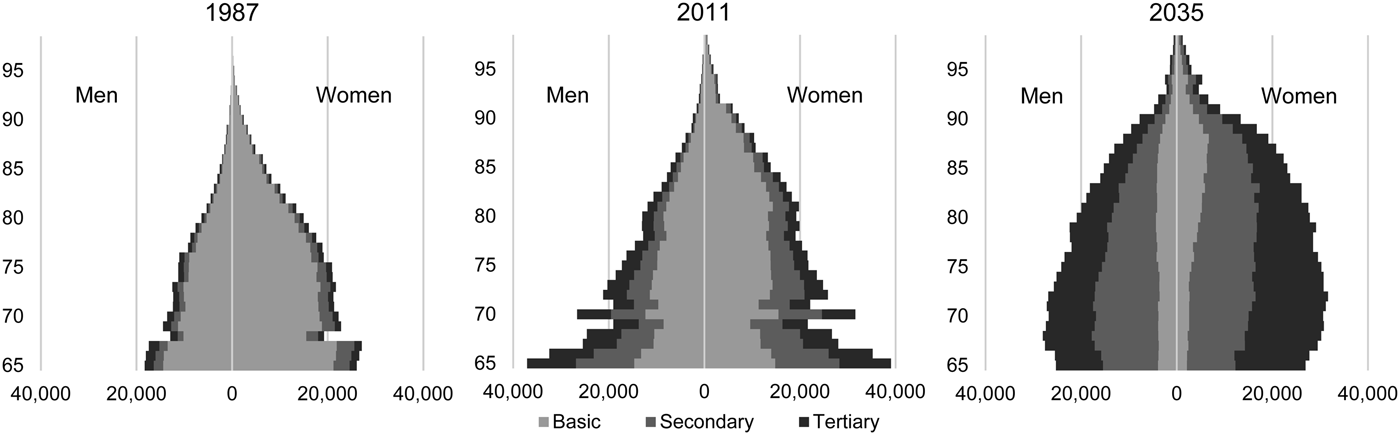
Figure 1 presents past trends and projection of the population by age, sex and education. The numbers of 65–79 year olds and particularly the 80+ year olds have increased rapidly and, according to our projections, will continue to increase rapidly in the next 25 years. The large cohorts, born after 1945, have just entered the 65+ population and will increasingly contribute – together with rapidly declining mortality – to the large increase in the 80+ population after 2025.
Population (N) by sex, age and education for years 1987, 2011 and projected for 2035.

The expansion of the educational system in the post-war period is increasingly reflected in the educational distribution of older Finns. Constant rates projections show a very strong decline in the number of those with basic education only by 2035. If the changing rates that assume that mortality rates will continue to improve were used, the population size would be larger. However, since mortality in all educational groups is likely to continue to improve, the relative sizes of the educational groups are similar to those from the constant rates projection. Our projections indicate that the ageing of more recent and better-educated birth cohorts may first be seen in the educational qualifications of those aged 65–79 and by 2035 also among those aged 80+. At the end of the projection period only a small minority will have only basic education under all plausible assumptions about the future.
Past trends in living arrangements
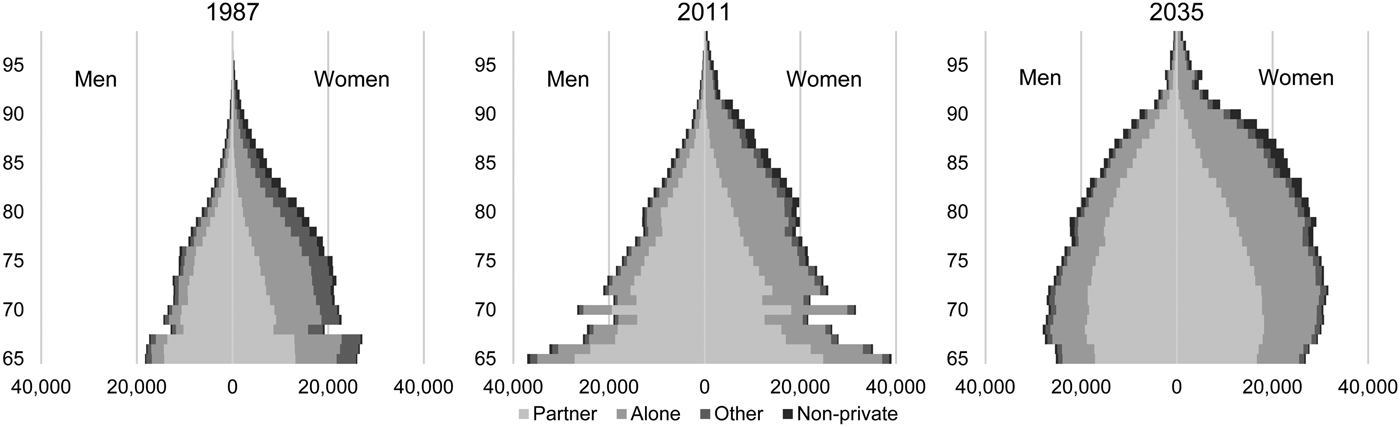
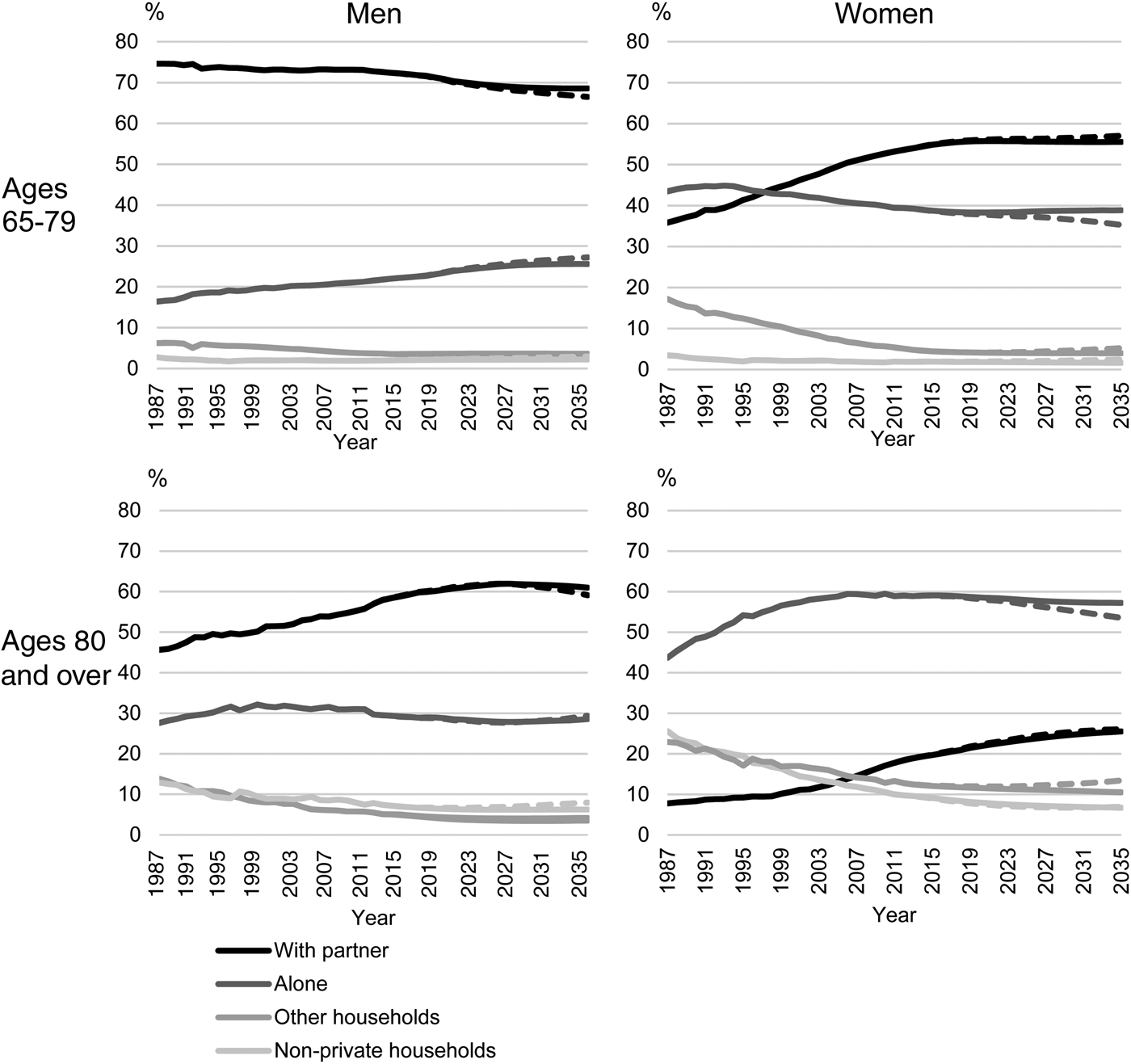
Figure 2 shows the estimated numbers of people in different living arrangements by sex and age, while Figure 3 shows proportions by sex and broad age group. About 75 per cent of men aged 65–79 years lived with a marital or co-habiting partner in 1987–2011, with slow decrease across years. In the same period, living alone increased somewhat while other living arrangements declined. Among women changes have been much more noticeable, with the proportion of those living with a partner increasing from about 35 to 55 per cent. Living alone has declined slowly and living in other households has declined more rapidly. The particularly low levels of women living with a partner in 1987 partly reflects the severe shortage of men due to wartime losses and sex-selective emigration, as well as the usual factors of higher mortality of males and the higher average age of husbands than wives.
Population (N) by sex, age and living arrangement for years 1987, 2011 and projected for 2035.

Change in age-adjusted proportion (%) of different living arrangements by sex and age.

Among men aged 80+, living with a partner has increased to about 57 per cent in 2011. Among women of same age, living with a partner and living alone have both increased. The vast majority of women live alone and the proportion of women living with a partner doubled to about 18 per cent. The proportion living as unpartnered in other household types (mainly with adult children) or in non-private households halved.
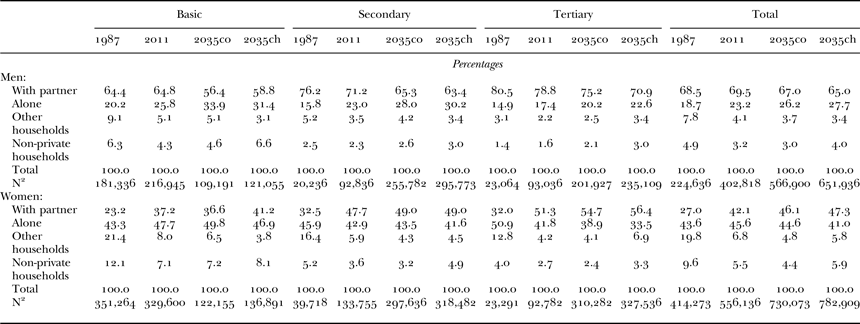
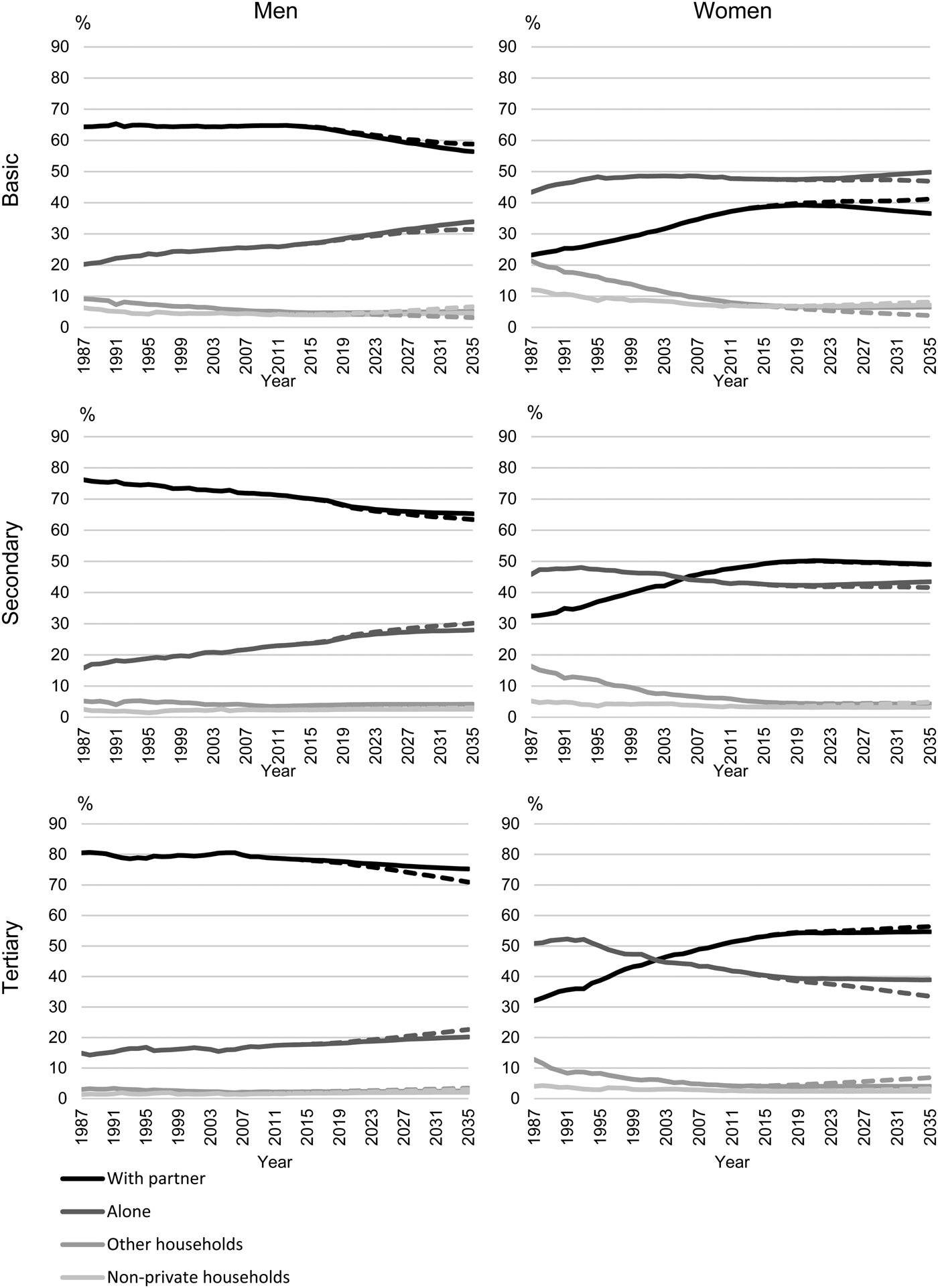
These changes have been fairly similar in all educational groups among both men and women (Table 1). However, better-educated men and women were about 10 percentage points more likely to live with a partner than corresponding basic-educated men and women in the period 1987–2011, with secondary-educated falling in between.
Age-adjusted proportion (%)1 of participants in different living arrangement groups by sex, education and year

Notes: 1. Standard population: population for 2011. 2. Approximate population size (sample N multiplied by the reciprocal of the sampling fraction). co: constant transition rates. ch: changing transition rates.
Constant rates projection of living arrangements
The tables and figures also show the results of our population projections. We first discuss our constant rates projections. These are based on the observed annual transition rates between the private household states, non-private households and mortality for the year 2011. At these ages, the effects of migration are negligible, and migrants have been excluded. Constant rates projections do not incorporate information on past demographic trends, e.g. mortality decline and slowly converging sex differences in mortality that might attenuate further declines in living alone. The future household structure in the constant rates projection is thus largely driven by the replacement of older birth cohorts with more recently born cohorts.
The constant rates projection indicates that from the early 2010s onwards (Figure 3, solid line after 2011) the proportion of women aged 65–79 years living with a marital or co-habiting partner is likely to stabilise to about 55 per cent in the mid-2030s and about 40 per cent will live alone. Among men, partnership proportions are projected to decline in this age group, and the proportions living alone will continue to increase moderately. For women aged 80+, the proportion living with a partner is still likely to increase and the proportion living alone to decrease. However, for men aged 80+ the proportion living with a partner is expected to increase slightly and stabilise at about 60 per cent, although the proportion living with a partner is expected to increase slightly for 80+ men as a whole (Figure 3).
Towards 2020, the proportion living with a partner is likely to increase among women, with better-educated women stabilising thereafter and secondary and lower-educated women possibly experiencing even small declines. For men, the proportion living with a partner is likely to decline in all education groups (Table 1; Figure 4).
Change in age-adjusted proportion (%) of different living arrangements by sex and education.

Changing rates projection of living arrangements
It may be unreasonable to believe that the current transition rates continue into the future. We thus also present the changing rates projection that allows transition rates to change over the projection period and is based on extrapolation of past observed rates (for detail, see the Methods section). For the purposes of this study, the most significant rates influencing the results are those related directly or indirectly to mortality; mortality rates underlie exit from various living arrangements and the death of a partner will strongly influence transitions from living with a partner to living alone. Partnership breakdown and migration rates are of lesser volume and thus of lesser importance. Numbers of older people are very sensitive to future mortality trends. However, differences in population distributions between the constant and changing rates projections are relatively modest (Figures 3 and 4; Table 1). A small difference is that the changing rates projection will lead to a larger decrease in the proportion of older women living alone than the constant rate projection. The changing rate projection also appears to lead to smaller but opposite projected changes in the proportion of men living alone.
The changes in the relative distribution of living arrangements provide a useful metric to demonstrate population change. However, changes in the absolute numbers are also pertinent and are possibly even more important in driving policy responses to the changes in living arrangements. Calculations based on the numbers shown in Table 1 thus show absolute numbers and changes in them. According to the changing rates projection, the 65+ population is expected to almost triple from 1987 to 2035 among men (from about 225,000 to 652,000) and double among women (from about 414,000 to 783,000). However, the absolute number of men living in ‘other’ households is likely to grow only moderately and among women these numbers have declined strongly already from 1987 to 2011. Most of the increase in the number of men and women aged 65+ is likely to be living with a partner; about two-thirds of the total increase of about 800,000 Finns.
Remaining years spent in each living arrangement beyond age 65 and their changes
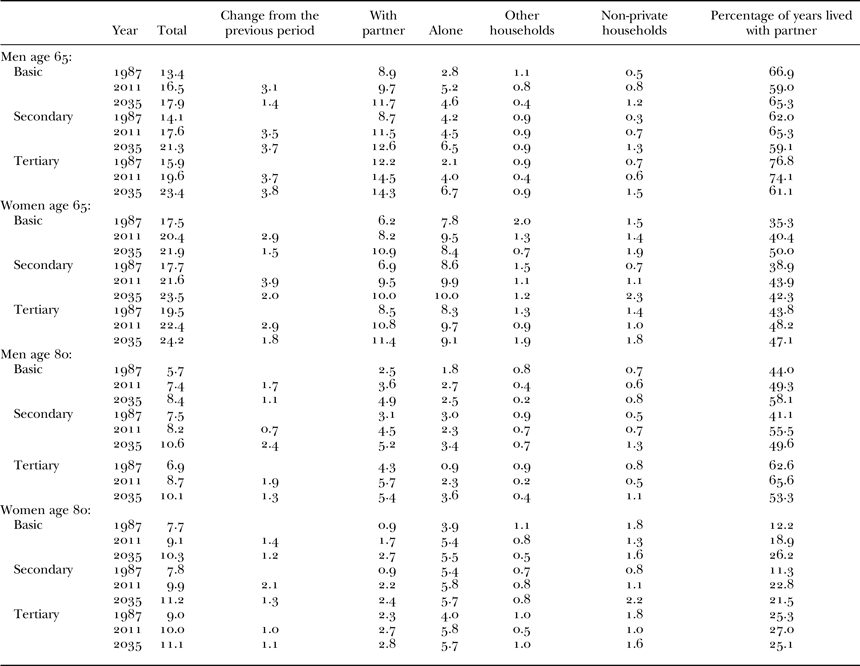
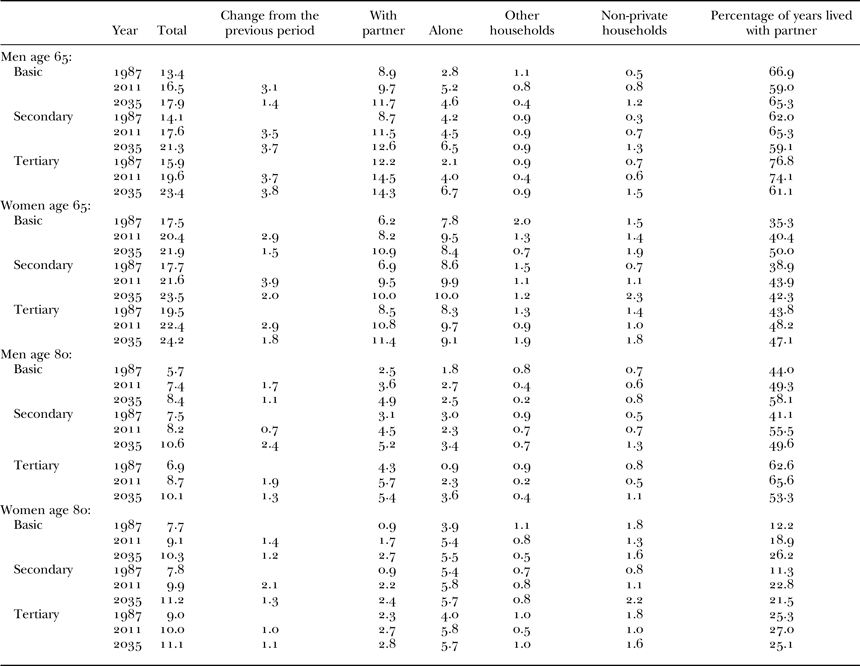
The transition rates in the model also define the number of remaining years spent in each living arrangement state (Table 2). Total life expectancy at age 65 is higher among women than men, but this gap has narrowed from 1987 to 2011, and with the changing rates projection is expected to further narrow. This is mainly because the projected life expectancy increases are smaller among women than men. We also observe well-known educational differences in life expectancy (Martikainen et al. Reference Martikainen, Ho, Preston and Elo2013).
Remaining years of life at ages 65 and 80 in each living arrangement by sex, education and year
Note: Projections for 2035 are based on changing transition rates.
Women could expect to live about 40 per cent of the remaining years of life beyond age 65 with a marital or co-habiting partner if she experienced 1987 rates (a weighted average of percentages over the different education groups in Table 2), with this proportion increasing somewhat for 2011 and 2035. Among men at age 65, these proportions have declined slowly among the basic- and secondary-educated and quite markedly among the tertiary-educated. At age 80 our projections imply a declining proportion of remaining years of life living with a partner among tertiary-educated men and increasing proportion among other men. Past trends and projections imply that the proportion of partnered women aged 80+ may increase threefold between 1987 and 2035, reflecting a more favourable sex ratio at age 65 and reduced sex mortality differentials from age 65 (results not shown here).
Conversely, the difference in number of years living alone between women and men has narrowed slightly. Time spent in other living arrangements – e.g. living with children or in non-household arrangements – is of lesser magnitude in all educational groups and is likely to continue its long-term decline.
Discussion
Summary of the findings
Our analysis consists of a detailed examination of past trends in living arrangements over a 25-year period from 1987 to 2011 and a subsequent projection to 2035. The results show that women more than men live alone at older ages; about 40 and 60 per cent for women aged 65–79 and 80+, respectively, and about 20–30 per cent among corresponding men. These proportions are likely to start to decline slowly among women but increase among men under 80. Because of major educational expansion in the cohorts ageing to 65+, the number of basic-educated older people is declining rapidly. Among women educational differences in living arrangements are small, but living with a marital or co-habiting partner among men has been more common among the higher-educated, although this advantage is likely to decrease. Differences in the patterns of change in living arrangements across educational groups are relatively small. Of the remaining life expectancy at age 65 in 1987, women could expect to live about 40 per cent with a partner; with the proportion increasing to 2011 and according to our projections to 2035. Among men, the proportion of remaining years spent with a partner was much higher in 1987 in all educational groups, but has declined slowly among the basic- and secondary-educated and quite markedly among the tertiary-educated. Conversely, the much greater number of years living alone among women as compared to men has narrowed somewhat.
Comparisons to living arrangement projections from other countries
Living arrangement (i.e. household) projections are routinely produced by only a few countries and methodologies vary. Thus, information comparable to ours is rare. Most household projections provide modest detail on older people's households and often focus on the total number of households and their average size, and are not concerned with the characteristics of household members, sometimes not making a distinction between men and women. Few projections are based on transition probability-based models and there are no projections that are disaggregated by educational level.
Notwithstanding these differences in methodology and aims, certain similarities emerge. Australian projections demonstrate a similar trend as we do of a declining proportion of women – particularly 80+ women – living alone, with a constant or slowly increasing proportion among men. These future trends are likely to be particularly pronounced if past trends in living arrangement propensities continue to the mid-2030s (Australian Bureau of Statistics 2015). Similar sex-specific findings are observed in England (Department for Communities and Local Government 2016), Scotland (National Records of Scotland 2014) and Japan (National Institute of Population and Social Security Research 2013), with Japan having much lower initial levels of living alone than North-Western European countries. Projections for Norway up to 2032 again show similar trends for older women, but somewhat surprisingly also project living alone to increase quite strongly among 80+ men (Keilman and Christiansen Reference Keilman and Christiansen2010). Projections that do not provide results for men and women separately appear to often gloss over these sex-specific future trends. Overall, the share of single-person households of all ages is expected to increase (e.g. Alho and Keilman Reference Alho and Keilman2010; Christiansen and Keilman Reference Christiansen and Keilman2013).
Methodological considerations
Short-term household projections for older people tend to be more reliable than those for the younger or for the total population (e.g. Alho and Keilman Reference Alho and Keilman2010; Christiansen and Keilman Reference Christiansen and Keilman2013). The most important reasons for this are that there is no need to project fertility and partnership formation/dissolution has modest effects on the projections among the older population. In addition, for a projection period of 20–25 years migration has a relatively modest role, as about 80 per cent of migration occurs at ages below 40 years.
The potential for projection error is probably most significant for mortality. Overall, our baseline life expectancies at age 65 are lower than those produced by Statistics Finland (the difference in years between the two sources is 1.0 for women and 0.7 for men), possible reasons include: our data are sample-based; our method is a ‘bottom-up’ approach, with the total obtained by aggregating the individual components; our rates are model-based with fixed patterns across time given the small number of observations in many cases; and we exclude emigrants from our analyses. Our changing rates projection has extrapolated mortality rates for about 25 years to the future, and the life expectancy increase that we obtain for men at age 65 for the year 2035 is broadly in line with the most recent population projection by Statistics Finland (Official Statistics of Finland 2015). However, for women life expectancy at age 65 is increasing somewhat slower in our projection. Both projections show a convergence of sex differences in life expectancy. These patterns are in accordance with past trends and with the population projection for the majority of EU countries by Eurostat (2014). However, the convergence of sex differences in mortality that we project is particularly strong, and may reflect: (a) stagnation of mortality decline among women and particularly strong mortality decline among men in the period 2006–2011 which underlie our mortality projection; and (b) the methodological choice of projecting educational groups separately and obtaining totals by aggregating over the education groups. In general, life expectancy projections may diverge significantly. For example, Eurostat projects slower mortality declines for Finland at these ages than Statistics Finland; a difference of about one year. However, our sensitivity analyses suggest that our main conclusions are robust to differences of such magnitudes.
One of the major forces that may be expected to continue to contribute to the strong trend of converging life expectancies is the ongoing decline of smoking-related mortality among men and increase or stability among women. These trends reflect the earlier maturation of the smoking epidemic among men than women in most high-income countries. As a consequence, sex differences in life expectancy in the United States of America (USA) have converged significantly and this convergence is strongly attributable to smoking (Pampel Reference Pampel2005; Preston and Wang Reference Preston and Wang2006). Similar estimates for the Netherlands also indicate that when sex differences in life expectancy at birth peaked in the early 1980s (6.7 years), smoking accounted for almost 90 per cent of these differentials; sex differences have since converged and are currently about 2.2 years with smoking accounting for about 60 per cent (Janssen and van Poppel Reference Janssen and van Poppel2015). In Finland, at age 50 women outlived men by 6.1 years in 1971–1975 but that gap would have been only 3.1 years without smoking. By 2006–2010, smoking-attributable mortality accounted for only about a fifth, or 1.1 years, of the 5.4-year sex gap in life expectancy. The continuing cohort replacement of male cohorts with lesser exposure to smoking may be expected to contribute to further reduction in sex differences in life expectancy. Mortality projections to assess this possibility have been published for the USA. These indicate that the reduction in smoking will continue to contribute to mortality decline in the decades to come and that, as a consequence, sex differences in mortality will narrow significantly in the coming decades (Pampel Reference Pampel2005; Preston and Wang Reference Preston and Wang2006; Preston et al. Reference Preston, Stokes, Mehta and Cao2014). Preston et al. (Reference Preston, Stokes, Mehta and Cao2014) predict that from 2010 to 2040 men will have gained 1.54 years and women 0.85 years in life expectancy at age 40 from reductions in smoking-attributable mortality. These gains will be partially offset by mortality increases caused by increased obesity, but these will not affect the sex convergence of life expectancy.
We projected men and women separately and did not explicitly allow that some of the processes we observe have repercussions at the couple level. For example, death of a married woman also leads to the widowhood of a married man. Explicitly allowing for this problem (the so-called ‘two-sex’ problem) is exceptionally difficult in population projections and no standard procedure exists (Alho and Keilman Reference Alho and Keilman2010). In our projection, a likely inconsistency would be that the projected increase in the number of 80+ women living with a partner would not be matched with a similar trend in the number of men living with a partner; this does not appear to be the case.
Overall, the reliability of Finnish register data on living arrangements is considered to be high and reliability surveys indicate that more than 98 per cent of information on address is correct (Official Statistics of Finland 2010). Our measurement of non-marital co-habitation does not take into account the perceptions of the subjects as to whether they are partners. However, register-based prevalence estimates of co-habitation in Finland have been similar to those obtained from survey data with self-reported co-habitation (Aromaa and Koskinen Reference Aromaa and Koskinen2004). Our data may underestimate those living in non-private households; at these ages, they consist of various types of long-term care arrangements (nursing homes, supported housing with 24-hour care or health-care wards). This underestimation is probably due to the fact that those who have been residents in such care institutions for a short time only still maintain their home addresses. Comparing the number of non-household individuals in our data to more accurate estimates available from the records of the facilities providing long-term care (maintained by the National Institute for Health and Welfare) indicates that in 2011 we underestimate the number of long-term care residents by about 13 per cent with the underestimate being higher among women than men (National Institute for Health and Welfare 2016).
Overall, our estimates of the non-household population should be considered as representing the demographic pressure on the long-term care sector; numbers of persons in this category will eventually be defined by policy decisions. Many countries are making efforts to restrict the number of long-term institutional places available and facilitate continued home residence for as long as possible. To the extent that these policies are successful, we may have overestimated the number of older people living in non-private households. The current estimates may thus be best viewed as indicating pressure on the institutional care system under the assumption that policy change will not take place in the coming years.
Interpretation and policy implications
Changes in the number of men and women by living arrangement and education as observed and projected in this study are driven by long-term changes in the demographic processes of births and deaths as well as partnership and household choices and secular changes in educational opportunities. In Finland, large post-war baby-boom cohorts were born in the late 1940s and 1950s, and the ageing of these cohorts is likely to influence strongly the ageing of the Finnish population. The excess of women at older ages – and women living alone – is strongly affected by the large gender differences in life expectancy at birth between men and women. This difference peaked at almost nine years in the late 1970s, but has since declined to about six years and is expected to decline further. This long-term trend is likely to affect both numbers of men and women at older ages, but also trends in the proportion of men and women living with a partner.
The rapid expansion of educational opportunities after the Second World War increasingly affected the cohorts born after 1930. As these cohorts age, the educational level of the older population will also increase rapidly; in 1987 more than 80 per cent of the 65+ population had basic education, but our projections indicate that this proportion will fall below 20 per cent by 2035. This distributional change is likely to influence strongly the abilities of the future older population to make better-informed lifestyle choices, and increase their knowledge about health and health-care options.
At the beginning of our study period, 1987, the 65+ population was born before the mid-1920s and by the end of our projection period, 2035, before the mid-1960s. Cohort nuptiality increased for cohorts born from the 1900s onwards and peaked for those born in the 1930s and 1940s, when about 90 per cent eventually married. In later cohorts marriage was increasingly replaced by co-habitation. Union dissolution for marriage cohorts of the mid-1960s approached 30 per cent, and is likely to be around 50 per cent for those marrying in the 1980s (Pitkänen and Jalovaara Reference Pitkänen, Jalovaara, Koskinen, Martelin, Notkola, Notkola, Pitkänen, Jalovaara, Mäenpää, Ruokolainen, Ryynänen and Söderling2007: 151–2). These changes in household behaviour are shared with most high-income countries.
These patterns are evident in our data until 2011 and are consistent with the ageing of cohorts with evolving marriage and union dissolution rates as well as ever higher educational qualifications till the end of our projection period in 2035. We carried out projections with transition rates fixed at their 2011 values and changing rates projections based on extrapolating past trends. These two projections produce relatively similar living arrangement distributions over the projection period. However, the changing rates projection implies a somewhat more rapid decline in living alone among ageing women than the fixed rate projection. The relative similarity in the outcomes of the projections indicates that future living arrangement distributions are mainly driven by the replacement of older birth cohorts with more recent cohorts, e.g. the increasing proportion living with a partner at older ages is partly driven by the ageing of the cohorts with high nuptiality rates.
In summary, our projections indicate that the future older population will be better educated than ever before and is more likely to live with a marital or co-habiting partner. Future living arrangement distributions of older people are strongly determined by past household behaviour and to a lesser extent by future changes in mortality. If sex differences in life expectancy continue to converge, the proportion of remaining years of life spent living with a partner will increase among women and life spent living alone will increase among men. Increasing educational level is simply a consequence of cohort replacement. However, it remains to be seen whether the better educated and partnered future older people will benefit from the same social, functioning, health advantages as the well-educated and partnered older people of today, or whether the benefits of education and partnership are degraded over time. In the past 25 years many of these differences have remained persistent, e.g. despite large distributional shifts the health benefits of education and living with a partner remain (Mackenbach et al. Reference Mackenbach, Kulhánová, Artnik, Bopp, Borrell, Clemens, Costa, Dibben, Kalediene, Lundberg, Martikainen, Menvielle, Östergren, Prochorskas, Rodríguez-Sanz, Strand, Looman and de Gelder2016; Martikainen et al. Reference Martikainen, Martelin, Nihtilä, Majamaa and Koskinen2005). Thus, if the past is a guide for the future, we may expect to see a better-functioning older population as a consequence of these demographic transformations.
Acknowledgements
This work was supported by the Finnish Social Insurance Institution and the Finnish Centre for Pensions (grant numbers 6303822, 4703995) and the Signe and Ane Gyllenberg Foundation. The use of the register data for this study has been approved by the ethical committee of the Statistics Finland. All authors participated in the planning of the paper and revised versions of the paper. PM wrote the first draft. MM and JM carried out the analyses. There are no conflicts of interest.