Introduction
Preterm birth is associated with an increased risk of poor outcome (Saigal & Doyle, Reference Saigal and Doyle2008), with extremely preterm (EP; <28 weeks' gestation) and extremely low birthweight (ELBW; <1000 g) survivors generally at higher risk than moderate to late preterm infants (32–36 weeks' gestation) (Johnson, Reference Johnson2007). Although the focus has largely been on physical and cognitive outcomes, growing evidence suggests that preterm survivors may also be more vulnerable to poor mental health and emotional functioning (Crump et al. Reference Crump, Winkleby, Sundquist and Sundquist2010; Nosarti et al. Reference Nosarti, Reichenberg, Murray, Cnattingius, Lambe, Yin, MacCabe, Rifkin and Hultman2012).
In the early 1990s, the survival of EP/ELBW infants increased dramatically with the introduction of surfactant therapy, which reduced the severity of hyaline membrane disease, a common cause of death of EP/ELBW infants (Victorian Infant Collaborative Study Group, 1997a ). Although childhood disability has fallen in comparison with the pre-surfactant era, neurosensory impairments remain more common in EP/ELBW children than in term (>36 weeks) or normal birthweight (>2499 g) controls, indicating that adverse sequelae of extreme prematurity continue to affect this population (Doyle et al. Reference Doyle and Anderson2005). The oldest EP/ELBW infants of the 1990s are now in late adolescence, a high-risk period for mental illnesses such as mood and anxiety disorders in the general population (Kessler et al. Reference Kessler, Berglund, Demler, Jin and Walters2005; ABS, 2007). Importantly, assessment in the adolescent period can also identify disorders with earlier onset (e.g. attention deficit hyperactivity disorder, ADHD). Adolescent mental health outcomes for the EP population born in the 1990s have not been well described, and are likely to provide insights relevant to more contemporary EP/ELBW cohorts.
It is well recognized that attention problems and diagnoses of ADHD are more common in preterm children than in their term-born peers (Bhutta et al. Reference Bhutta, Cleves, Casey, Cradock and Anand2002; Aarnoudse-Moens et al. Reference Aarnoudse-Moens, Weisglas-Kuperus, van Goudoever and Oosterlaan2009; Johnson et al. Reference Johnson, Hollis, Kochhar, Hennessy, Wolke and Marlow2010; Anderson et al. Reference Anderson, De Luca, Hutchinson, Spencer-Smith, Roberts and Doyle2011). In the general population, ADHD prevalence declines with increasing age (Polanczyk et al. Reference Polanczyk, de Lima, Horta, Biederman and Rohde2007), but reports of ADHD diagnoses or symptoms into young adulthood are relatively sparse for preterm samples (Lund et al. Reference Lund, Vik, Skranes, Brubakk and Indredavik2011). In one study of young adults born before the 1990s, 20-year-olds with very low birthweight (VLBW; <1500 g) were similar to controls on both symptoms of ADHD and diagnosis prevalence (Hack et al. Reference Hack, Youngstrom, Cartar, Schluchter, Taylor, Flannery, Klein and Borawski2004). Although parents reported more inattentive symptoms among VLBW young men, this difference disappeared after excluding those born small for gestational age (SGA; birthweight ⩾2 s.d. below the mean for gestational age and gender) (Hack et al. Reference Hack, Youngstrom, Cartar, Schluchter, Taylor, Flannery, Klein and Borawski2004). Indeed, some data suggest that preterm young adults who were not SGA have similar levels of ADHD symptoms to controls (Strang-Karlsson et al. Reference Strang-Karlsson, Räikkönen, Pesonen, Kajantie, Paavonen, Lahti, Hovi, Heinonen, Järvenpää, Eriksson and Andersson2008). However, the prevalence of ADHD in older adolescents born in the 1990s is unknown.
In general, assessment of emotional functioning in preterm children and adolescents has used pencil-and-paper questionnaires and screening measures, such as the Child Behavior Checklist (CBCL). Parent reports of childhood emotional functioning abound, although the effects described in this population are heterogeneous (Aarnoudse-Moens et al. Reference Aarnoudse-Moens, Weisglas-Kuperus, van Goudoever and Oosterlaan2009). Studies in adolescence allow teenagers to express their own emotional functioning, and indeed, they may have different views to their parents. Our current knowledge of preterm adolescent outcomes by necessity comes from children born before 1990. Some of these studies have found elevated internalizing symptoms by parent report, but not by self-report (Saigal et al. Reference Saigal, Pinelli, Hoult, Kim and Boyle2003; Grunau et al. Reference Grunau, Whitfield and Fay2004; Indredavik et al. Reference Indredavik, Vik, Heyerdahl, Kulseng and Brubakk2005; Hallin & Stjernqvist, Reference Hallin and Stjernqvist2011), although conflicting data exist (Gardner et al. Reference Gardner, Johnson, Yudkin, Bowler, Hockley, Mutch and Wariyar2004; Hille et al. Reference Hille, Dorrepaal, Perenboom, Gravenhorst, Brand and Verloove-Vanhorick2008). Although parents may perceive more mood and anxiety symptoms in their preterm children, it is less clear whether preterm adolescents themselves endorse such difficulties.
Personality traits, such as temperamental affectivity and sensitivity to reward and punishment, are an important component of individuals' social functioning (Eisenberg et al. Reference Eisenberg, Fabes, Guthrie and Reiser2000) and may also be considered risk factors for psychopathology (Krueger, Reference Krueger1999). Differences have been reported on this issue in preterm samples, with very preterm (VP; <30 weeks)/VLBW and ELBW young adults born before the 1990s displaying less extraversion, less openness to experience and more shyness and conscientiousness than controls (Allin et al. Reference Allin, Rooney, Cuddy, Wyatt, Walshe, Rifkin and Murray2006; Pesonen et al. Reference Pesonen, Räikkönen, Heinonen, Andersson, Hovi, Järvenpää, Eriksson and Kajantie2008; Schmidt et al. Reference Schmidt, Miskovic, Boyle and Saigal2008). Preterm samples may also engage less in risk-taking behaviors than their peers (Hille et al. Reference Hille, Dorrepaal, Perenboom, Gravenhorst, Brand and Verloove-Vanhorick2008). This is consistent with reports of greater internalizing and other emotional difficulties outlined previously. Despite this, the picture remains unclear; in a study of youth born <1500 g, the preterm and control groups differed only on some facets of neuroticism and extraversion, but not on those two personality dimensions overall (Pesonen et al. Reference Pesonen, Räikkönen, Heinonen, Andersson, Hovi, Järvenpää, Eriksson and Kajantie2008). Furthermore, data from the same sample suggested similarities in trait inhibition and at least some aspects of reward sensitivity between preterm and control young adults (Pyhälä et al. Reference Pyhälä, Räikkönen, Pesonen, Heinonen, Hovi, Eriksson, Järvenpää, Andersson and Kajantie2009).
Compared with the many studies using questionnaires, studies using psychiatric diagnostic tools are, to our knowledge, non-existent in EP/ELBW adolescents born in the 1990s. A few studies have assessed younger children born since 1990, and there are some adolescent studies in lower-risk subjects (i.e. those more mature or heavier at birth) who were born pre-1990. At a population level, linkage studies using population-wide registers have indicated an increased risk of hospital admission, out-patient diagnosis and pharmacotherapy prescription in preterm youth and adults for psychiatric diagnoses in Scandinavian countries (Lindström et al. Reference Lindström, Lindblad and Hjern2009; Abel et al. Reference Abel, Wicks, Susser, Dalman, Pedersen, Mortensen and Webb2010; Crump et al. Reference Crump, Winkleby, Sundquist and Sundquist2010; Nosarti et al. Reference Nosarti, Reichenberg, Murray, Cnattingius, Lambe, Yin, MacCabe, Rifkin and Hultman2012), but again these subjects were born pre-1990. Meta-analytic evidence from case–control studies of preterm children and youth similarly indicates elevated overall risk [odds ratio (OR) 3.7, 95% confidence interval (CI) 2.7–5.2], including mood or anxiety disorders (Burnett et al. Reference Burnett, Anderson, Cheong, Doyle, Davey and Wood2011). Data from VLBW adults born before the 1990s indicate a smaller (although still significant) increase in current mood disorder (risk ratio 1.4, 95% CI 1.2–1.5), but no difference in other disorders (Westrupp et al. Reference Westrupp, Northam, Doyle, Callanan and Anderson2011). With respect to more recent birth cohorts, parental reports on the Development and Well-Being Assessment (DAWBA) also indicate increased disorder prevalence in preterm children born in the 1990s and 2000s (Johnson et al. Reference Johnson, Hollis, Kochhar, Hennessy, Wolke and Marlow2010; Treyvaud et al. Reference Treyvaud, Ure, Doyle, Lee, Rogers, Kidokoro, Inder and Anderson2013). In a large UK cohort born in 1995, 11-year-olds born <26 weeks' gestation had higher rates of ADHD and anxiety disorders, based on parental report (Johnson et al. Reference Johnson, Hollis, Kochhar, Hennessy, Wolke and Marlow2010). Of note, co-morbid disorders were not more common in the preterm children assessed by Johnson et al. (Reference Johnson, Hollis, Kochhar, Hennessy, Wolke and Marlow2010) and Treyvaud et al. (Reference Treyvaud, Ure, Doyle, Lee, Rogers, Kidokoro, Inder and Anderson2013). As noted earlier, adolescence is a peak onset period for many mental illnesses and is also a time when self-report becomes more reliable in identifying mental disorders. It is unclear whether preterm children born in the 1990s are more at risk of clinically diagnosable disorders as adolescents, and this represents an important extension to assessment using dimensional measures.
In addition to SGA status, a range of variables have been linked with poor behavioral and emotional outcomes in preterm children and adolescents. In studies of EP and VP children born after 1990, infant brain abnormalities, social risk and earlier behavioral or emotional difficulties have been linked with subsequent psychiatric disorder (Johnson et al. Reference Johnson, Hollis, Kochhar, Hennessy, Wolke and Marlow2010; Treyvaud et al. Reference Treyvaud, Ure, Doyle, Lee, Rogers, Kidokoro, Inder and Anderson2013). Pre-1990s data also suggest a link between infant brain abnormalities and later psychiatric symptoms or disorder (Whitaker et al. Reference Whitaker, van Rossem, Feldman, Schonfield, Pinto-Martin, Torre, Shaffer and Paneth1997, Reference Whitaker, Feldman, Lorenz, McNicholas, Fisher, Shen, Pinto-Martin, Shaffer and Paneth2011), although not in all reports (Elgen et al. Reference Elgen, Sommerfelt and Markestad2002). In both pre- and post-1990 cohorts, other infant illness factors seem to be poorer predictors of preterm children's psychiatric outcomes than measures of their behavior and adjustment in the years prior to assessment (Elgen et al. Reference Elgen, Sommerfelt and Markestad2002; Johnson et al. Reference Johnson, Hollis, Kochhar, Hennessy, Wolke and Marlow2010; Treyvaud et al. Reference Treyvaud, Ure, Doyle, Lee, Rogers, Kidokoro, Inder and Anderson2013).
Given the paucity of data relating to long-term outcomes for the post-1990 EP/ELBW population, the current study aimed to characterize self-reported psychiatric outcomes in older adolescents born EP/ELBW in the 1990s, including both diagnostic and dimensional information. Consistent with pre-1990 data, and data from younger children born since that time, we hypothesized that the EP/ELBW group would have higher rates of clinically diagnosable disorders and more symptoms (on questionnaires) than controls. We also expected that EP/ELBW adolescents would endorse less sensitivity to reward, more sensitivity to punishment, lower typical positive affect, higher typical negative affect and less antisocial personality traits than controls. Associations of infant, child behavior/cognition and social variables with EP/ELBW adolescent disorders were also examined. We expected that variables from the neonatal period would not be strong predictors of disorders but that poorer childhood functioning would be associated with disorders at age 18 years.
Method
Participants
Participants were derived from a geographic cohort comprising 298 consecutive survivors born EP/ELBW in the state of Victoria, Australia, during 1991 and 1992, and 262 normal birthweight (>2499 g) controls, matched at the group level for mother's country of origin (English-speaking or not) and health insurance status, and sex of the child. All participants were recruited at birth. The EP/ELBW cohort was born largely after exogenous surfactant was introduced into Australian clinical practice in March 1991. This cohort has been previously assessed at ages 2, 5 and 8 (Victorian Infant Collaborative Study Group, 1997b ; Doyle & Victorian Infant Collaborative Study Group, Reference Doyle2001; Anderson & Doyle, Reference Anderson and Doyle2003; Doyle et al. Reference Doyle, Roberts and Anderson2010). The participants' average age at the present assessment was 18 years, and 215 (72%) EP/ELBW and 157 (60%) control adolescents provided data for the measures of interest. The EP/ELBW group included participants born SGA to facilitate comparisons with previous literature. The Human Research Ethics Committees of the Royal Women's Hospital, Mercy Hospital for Women, Monash Medical Centre and Royal Children's Hospital, Melbourne, provided ethical approval for the original and follow-up studies. All participants provided informed consent; if they were aged <18 years, consent was also obtained from their parents.
Measures and procedure
Mental health in late adolescence was assessed using standardized face-to-face clinical interview and questionnaires. The ADHD module of the Children's Interview for Psychiatric Syndromes (ChIPS; Weller et al. Reference Weller, Weller, Rooney and Fristad1999) was used to assess ADHD (inattentive, hyperactive/impulsive and combined subtypes). The Structured Clinical Interview for DSM-IV Disorders, Axis 1 Non-Patient version (SCID-I/NP; First et al. Reference First, Spitzer, Gibbon and Williams2002) was used to assess lifetime history of major DSM-IV Axis I disorders (mood, anxiety, substance use, psychotic, eating and adjustment disorders) (APA, 2000), and was administered by five trained interviewers blinded to group. Experienced consultant psychiatrists, also blinded to group, were consulted extensively and consensus diagnoses were reached for all participants. These assessments were supplemented by questionnaires examining recent anxiety and depression symptoms: the Beck Anxiety Inventory (BAI; Beck & Steer, Reference Beck and Steer1990) and the Center for Epidemiologic Studies Depression Scale – Revised (CESD-R; Eaton et al. Reference Eaton, Muntaner, Smith, Tien, Ybarra and Maruish2004). Personality traits such as sensitivity to reward/punishment [Behavioral Inhibition/Activation Systems (BIS/BAS) scales (Carver & White, Reference Carver and White1994)], typical positive and negative affectivity [Positive and Negative Affect Schedule (PANAS; Watson et al. Reference Watson, Clark and Tellegen1988)] and antisocial personality traits [a version of the Antisocial Process Screening Device (APSD; Frick & Hare, Reference Frick and Hare2001) adapted to self-report] were also assessed. IQ was estimated with the Wechsler Abbreviated Scale of Intelligence (WASI; Wechsler, Reference Wechsler1999).
Data collected in infancy and middle childhood were also included. In addition to gestational age, birthweight, sex and maternal age at birth, neonatal variables included major brain injury on neonatal cranial ultrasound (grade 3/4 intraventricular hemorrhage or cystic periventricular leukomalacia), postnatal corticosteroid treatment or major neonatal surgery, as we previously identified adverse long-term neurosensory outcomes associated with these three variables in this cohort at age 5 (Doyle, Reference Doyle2001). Demographic and other factors that may be associated with behavioral and emotional outcomes were also included. Specifically, at age 8, parents completed the Behavior Assessment System for Children (BASC), which provides indices for internalizing problems, externalizing problems, adaptive skills and behavioral symptoms [the Behavioral Symptoms Index (BSI), reflecting atypical behaviors and social withdrawal]. Parental occupation was used as an indication of family socio-economic status (SES) and dichotomized into lower/higher groups (Congalton, Reference Congalton1969). Parental education was also recorded. Age-8 major disability was defined as any of an IQ < −2 s.d. relative to controls, moderate or severe cerebral palsy, blindness or deafness.
Data analysis
Group comparisons of background variables were analyzed using χ 2 (categorical data) and two-tailed t tests, or the Mann–Whitney U test, with z scores reported where parametric assumptions were violated (continuous data). Disorder prevalence in the EP/ELBW and control groups was compared using logistic regression (univariable and adjusting for sex and demographic differences). Some participants had missing questionnaire items. Where only a few items were missing (BAI: < 5; CESD-R: < 6; BIS/BAS: < 2/subscale; PANAS: < 4/subscale), the within-subject mean was substituted for the missing item/s. Group comparisons for these data were also conducted using two-tailed t tests, or the Mann–Whitney U, with z scores reported, as above. Within the preterm group, univariable relationships between historical variables and major disorder classes were examined using logistic regression. Data were analyzed using SPSS version 20 (IBM Corp., USA).
Results
Sample characteristics and loss to follow-up
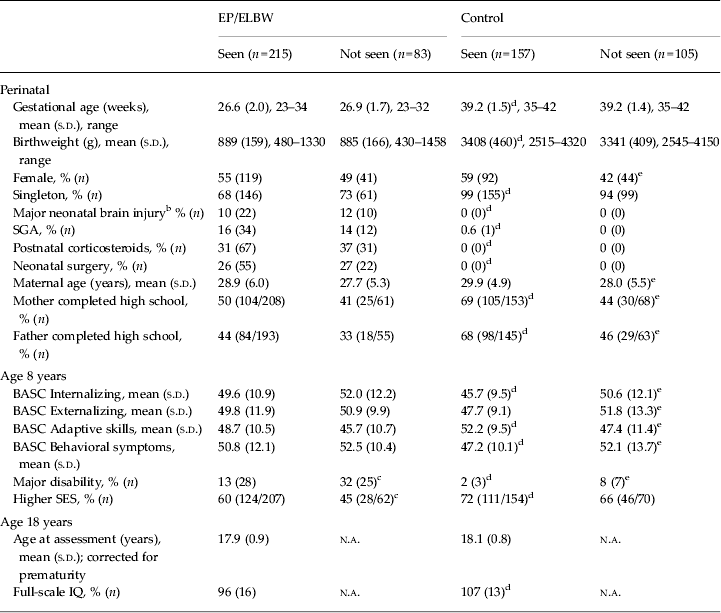
At age 18, EP/ELBW participants and non-participants were similar on perinatal variables (Table 1). Of the EP/ELBW group, those who participated at age 18 had higher childhood SES (χ 2 1 = 4.22, p = 0.04) but similar parent ratings on BASC indices at age 8 compared with non-participants (all p > 0.05). Those who participated also had lower rates of major disability at age 8 than those who did not participate at 18 years (χ 2 1 = 13.84, p < 0.001); some adolescents were unable to complete the interviews because of difficulties understanding the questions (n = 5).
Characteristics of EP/ELBW and control participants and non-participants a

EP, Extremely preterm; ELBW, extremely low birthweight; s.d., standard deviation; SGA, small for gestational age (birthweight ⩾2 s.d. below the mean for gestational age and gender); BASC, Behavior Assessment System for Children; SES, socio-economic status; n.a., not applicable.
a Group ns vary because of missing data.
b Grade 3/4 intraventricular hemorrhage/cystic periventricular leukomalacia.
c Within the EP/ELBW group, participants and non-participants significantly different.
d Within participants, EP/ELBW group and controls significantly different.
e Within controls, participants and non-participants significantly different.
Significance level: p < 0.05.
Among the controls, females were more likely to participate than males (χ 2 1 = 7.02, p = 0.008), as were those whose parents had completed high school (mothers: χ 2 1 = 11.90, p = 0.001; fathers: χ 2 1 = 8.58, p = 0.003). Participants had lower rates of major disability in childhood than non-participants (χ 2 1 = 5.46, p = 0.02). Participants had older mothers (t 260 = 2.89, p = 0.004) and better childhood emotional/behavioral functioning (internalizing: t 213 = −3.17, p = 0.002; externalizing: z = −1.92, p = 0.05; adaptive: t 213 = 3.18, p = 0.002; BSI: z = −2.45, p = 0.01) than non-participants.
Among those who participated at age 18, the EP/ELBW and control groups had similar sex distributions and ages. Compared with controls, EP/ELBW teenagers had a lower mean IQ at 18 years (z = −6.78, p < 0.001), and more often had lower childhood SES (χ 2 1 = 5.76, p = 0.02) and parents who had not completed secondary schooling (mothers: χ 2 1 = 12.55, p < 0.001; fathers: χ 2 1 = 19.29, p < 0.001). At age 8, the EP/ELBW group had more parent-reported internalizing symptoms, poorer adaptive skills and more behavioral symptoms than controls (t 349 = 3.49, p = 0.001; t 347 = −3.26, p = 0.001; and z = 2.70, p = 0.007 respectively).
Disorder prevalence (Table 2)
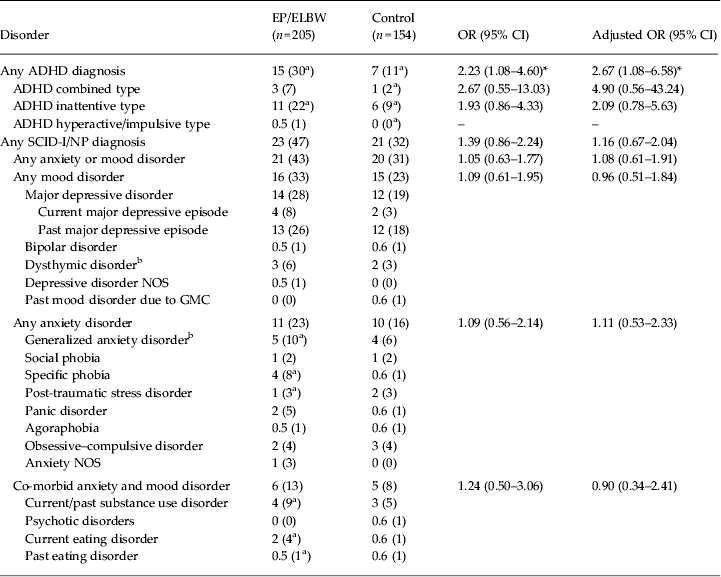
ADHD was more frequent among EP/ELBW adolescents than controls but group differences in specific subtypes did not reach significance, probably because subgroup numbers were small. More than 20% of participants met criteria on the SCID-I/NP for a lifetime diagnosis of one or more mental illnesses, and this overall prevalence was similar across the two groups. Mood and anxiety disorders were most frequent, identified in around a fifth of each group, but individual diagnoses within those categories were less common. Although expected sex differences were apparent (i.e. more females meeting criteria than males; 25% v. 14%, p = 0.009), there was no group-by-sex interaction (interaction p = 0.81). Substance use, psychotic and eating disorders were infrequent in both groups. Co-morbid disorders were not more frequent among EP/ELBW adolescents than controls (44% v. 42% of those with any diagnosis, χ 2 1 = 0.06, p = 0.80). ADHD was frequently co-morbid with other diagnoses, although this was similar in the EP/ELBW and control groups (interaction p = 0.16). Adjustment for gender, parental education and childhood SES did not alter the pattern of results for the key outcomes.
Disorder prevalence in EP/ELBW and control adolescents

EP, Extremely preterm; ELBW, extremely low birthweight; ADHD, attention deficit hyperactivity disorder; SCID-I/NP, Structured Clinical Interview for DSM-IV Disorders, Axis I Non-Patient version; NOS, not otherwise specified; GMC, general medical condition; OR, odds ratio; CI, confidence interval.
Adjusted model includes sex, parental education and childhood socio-economic status (SES) as covariates.
a Data missing for n = 1.
b Current disorder only. No diagnoses of: current mood disorder due to GMC; current/past substance-induced mood disorder; anxiety disorder due to GMC; substance-induced anxiety disorder; adjustment disorder.
Final solution not possible for ADHD hyperactive/impulsive type because of small numbers.
Data given as percentage of group (n).
* p < 0.05.
Dimensional measures of emotional functioning (Table 3)
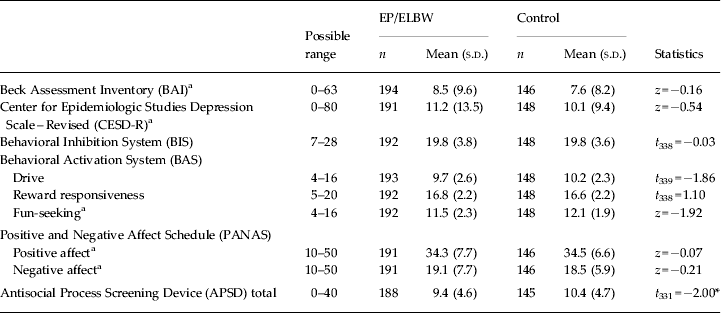
The adolescents' self-reports on dimensional measures of recent depression, recent anxiety and personality traits were similar across groups (all p > 0.05), although scores reflecting antisocial personality traits were lower in the EP/ELBW group than controls (p = 0.047).
Dimensional measures of emotional functioning in EP/ELBW and control adolescents

EP, Extremely preterm; ELBW, extremely low birthweight; s.d., standard deviation.
a z scores for the Mann–Whitney U test.
* p < 0.05.
Associations of 18-year EP/ELBW outcomes with neonatal and childhood variables (Table 4)
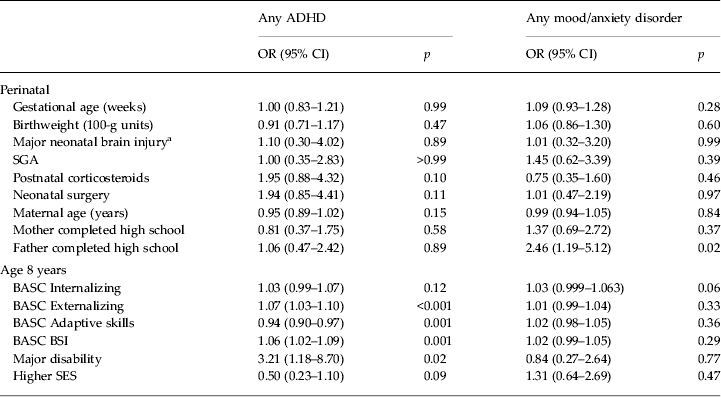
There was little evidence that neonatal medical morbidity was related to disorder at age 18. Childhood variables at 8 years were more relevant to outcome at 18 years; parent-rated externalizing, atypical behaviors and adaptive skills, in addition to major disability, were associated with ADHD diagnosis, although not mood or anxiety disorders. Higher paternal education was associated with higher odds of mood/anxiety disorders at 18 years, although this was not the case for maternal education or family SES.
Association of EP/ELBW 18-year outcomes with historical variables

EP, Extremely preterm; ELBW, extremely low birthweight; ADHD, attention deficit hyperactivity disorder; SGA, small for gestational age (birthweight ⩾2 s.d. below the mean for gestational age and gender); BASC, Behavior Assessment System for Children; BSI, Behavioral Symptoms Index; SES, socio-economic status; OR, odds ratio; CI, confidence interval.
Lower scores on BASC adaptive skills reflect poorer skills.
a Grade 3/4 intraventricular hemorrhage/cystic periventricular leukomalacia.
Discussion
This study describes mental health outcomes in a cohort of EP/ELBW and NBW control adolescents born in 1991 and 1992. As predicted, ADHD was more prevalent among EP/ELBW adolescents, who were around twice as likely to receive this diagnosis as controls. In the EP/ELBW group, childhood behavior ratings and disability were related to 18-year ADHD diagnoses. Other diagnoses identified were predominantly mood and anxiety disorders, but in contrast to previous reports, the EP/ELBW and control groups had similar rates. Both groups had low rates of substance use, eating and psychotic disorders, and rates of co-morbidity did not differ between EP/ELBW and control adolescents. Assessment of recent depression and anxiety symptoms and personality traits did not reveal group differences, with the exception of fewer antisocial personality traits in EP/ELBW adolescents than controls.
The elevated ADHD prevalence found here is consistent with findings in preterm children born pre-1990 (Bhutta et al. Reference Bhutta, Cleves, Casey, Cradock and Anand2002), and extends the limited data on ADHD in older EP/ELBW adolescents. The 15% prevalence identified is in accordance with data from VLBW 20-year-olds born pre-1990 (Lund et al. Reference Lund, Vik, Skranes, Brubakk and Indredavik2011), suggesting that this may be a stable finding among preterm youth despite differences in neonatal medical care, and the higher survival rate of EP/ELBW adolescents. With regard to subtypes, diagnoses were predominantly inattentive-type ADHD. Group differences did not reach significance for subtypes, possibly because of the small subtype samples. Our findings were also similar to other post-1990 cohorts assessed in childhood, including Johnson et al.'s (2010) report of primarily inattentive-type ADHD among EP 11-year-olds. Importantly, the increased prevalence identified in our sample was not predicted by SGA status. This suggests that EP/ELBW survivors born in the surfactant era remain at risk for attention problems, despite having appropriate birthweight for their gestational age.
ADHD in preterm children may differ qualitatively from ADHD in the general population, with less co-morbidity with conditions such as conduct disorder and reports of relationships between infant brain injuries, such as diffuse white matter injury, ventricular enlargement and parenchymal lesions, and later diagnosis (Anderson & Doyle, Reference Anderson and Doyle2004; Johnson, Reference Johnson2007). In the present study, major neonatal brain injury diagnosed by ultrasound was not associated with ADHD at age 18. However, ultrasound is less sensitive to pathologies such as diffuse white matter injury and parenchymal lesions than neonatal magnetic resonance imaging (MRI) (Woodward et al. Reference Woodward, Anderson, Austin, Howard and Inder2006), which was unavailable to this 1991–1992 cohort. In addition, EP/ELBW adolescents who had major childhood disability had around three times the odds of ADHD at age 18. This may reflect the neurodevelopmental sequelae of subtler neuropathology than could be detected in infancy using ultrasound. Furthermore, higher externalizing and behavioral symptoms and lower adaptive skills in childhood were associated with ADHD diagnosis in adolescence for the EP/ELBW group. This is consistent with evidence that childhood behavior and emotional problems predict later psychiatric diagnosis in preterm children (Johnson et al. Reference Johnson, Hollis, Kochhar, Hennessy, Wolke and Marlow2010), and suggests a persistent profile of difficulties likely to affect social and cognitive development in this population.
The similar prevalence of lifetime mood and anxiety disorders between EP/ELBW and control groups is in contrast with much of the published literature, although studies vary in their methodologies (Walshe et al. Reference Walshe, Rifkin, Rooney, Healy, Nosarti, Wyatt, Stahl, Murray and Allin2008; Johnson et al. Reference Johnson, Hollis, Kochhar, Hennessy, Wolke and Marlow2010; Lund et al. Reference Lund, Vik, Skranes, Brubakk and Indredavik2011; Nosarti et al. Reference Nosarti, Reichenberg, Murray, Cnattingius, Lambe, Yin, MacCabe, Rifkin and Hultman2012). Nevertheless, our findings are not without precedent, particularly with respect to questionnaire data (Saigal et al. Reference Saigal, Pinelli, Hoult, Kim and Boyle2003; Hallin & Stjernqvist, Reference Hallin and Stjernqvist2011). Limited self-report data exist for preterm young people, and anxiety and mood disorder prevalence changes substantially from childhood to young adulthood in the general population. In a recent follow-up of 19-year-olds born < 2000 g, overall disorder prevalence was elevated relative to controls, although specific disorder subgroups (e.g. mood or anxiety disorders) did not reach significance (Elgen et al. Reference Elgen, Holsten and Odberg2012). In Lund et al.'s (Reference Lund, Vik, Skranes, Brubakk and Indredavik2011) study, 20-year-olds born < 1500 g had more anxiety than controls, with rates of 19% in the VLBW group. Subjects in both of these studies were born pre-1990. In the present study, prevalence rates were broadly consistent with population estimates from Australia and comparable nations, with about a fifth of control participants meeting criteria for a current or lifetime mood or anxiety disorder (Hankin et al. Reference Hankin, Abramson, Moffitt, Silva, McGee and Angell1998; Patton et al. Reference Patton, Coffey, Posterino, Carlin, Wolfe and Bowes1999; Slade et al. Reference Slade, Johnston, Oakley Brown, Andrews and Whiteford2009; Merikangas et al. Reference Merikangas, He, Burstein, Swanson, Avenevoli, Cui, Benjet, Georgiades and Swendsen2010). This suggests that our control group was not abnormally symptomatic. In addition, most studies in preterm samples have focused on recent disorder histories. However, dimensional assessment of recent depression and anxiety symptoms also revealed similarities between groups. It is therefore unlikely that the groups' similar disorder prevalence is masking a difference in subthreshold symptoms. The limited relationships between historical variables and mood and anxiety disorders were expected, given previous reports of the limited predictive value of these variables as preterm children age (Johnson et al. Reference Johnson, Hollis, Kochhar, Hennessy, Wolke and Marlow2010). It was notable, however, that childhood BASC scores were not significantly associated with later mood and anxiety disorder in the preterm group, suggesting that further research is required to identify precursors to depression and anxiety in this population.
These mood and anxiety findings also contrast with those of Scandinavian register studies suggesting that decreasing birthweight is associated with higher psychiatric morbidity (Lindström et al. Reference Lindström, Lindblad and Hjern2009; Abel et al. Reference Abel, Wicks, Susser, Dalman, Pedersen, Mortensen and Webb2010; Nosarti et al. Reference Nosarti, Reichenberg, Murray, Cnattingius, Lambe, Yin, MacCabe, Rifkin and Hultman2012). Although linkage studies have many strengths, a limitation is the reliance on gross outcomes. Moreover, the birth periods for these linkage studies were all pre-1990. Young people are often unlikely to seek treatment for mental health difficulties (Reavley et al. Reference Reavley, Cvetkovski, Jorm and Lubman2010), suggesting that community prevalence is higher than hospital admissions or treatment records indicate. Some have speculated that preterm survivors may have better awareness of medical conditions or more often interact with clinicians who recognize psychiatric problems, and may therefore be over-represented in health records (Nosarti et al. Reference Nosarti, Reichenberg, Murray, Cnattingius, Lambe, Yin, MacCabe, Rifkin and Hultman2012). The similarities in mood and anxiety disorder prevalence reported here are encouraging findings for the preterm group. Nonetheless, it remains to be seen whether these data are characteristic of broader self-reported mood/anxiety outcomes for adolescents born since the 1990s.
Consistent with the SCID-I/NP results, the two groups self-rated similarly on most personality trait measures. The EP/ELBW group reported similar sensitivity to reward and punishment to the control group, and did not differ in their endorsement of positive and negative trait affectivity. These findings are in contrast to some in the literature, which have identified marked personality differences between preterm and control youth (Allin et al. Reference Allin, Rooney, Cuddy, Wyatt, Walshe, Rifkin and Murray2006; Pesonen et al. Reference Pesonen, Räikkönen, Heinonen, Andersson, Hovi, Järvenpää, Eriksson and Kajantie2008). However, they are also not without precedent from pre-1990 samples; in a study of ELBW and control young adults, BIS/BAS score differences did not reach significance, despite group differences on other measures of personality (Schmidt et al. Reference Schmidt, Miskovic, Boyle and Saigal2008). Although Pyhälä et al. (Reference Pyhälä, Räikkönen, Pesonen, Heinonen, Hovi, Eriksson, Järvenpää, Andersson and Kajantie2009) found lower BAS Fun-Seeking scores in their preterm group, there were no differences on the other BIS/BAS scales. This may reflect the particular methodologies used and conceptual distinctions made between different aspects of personality and emotional functioning. Despite higher ADHD prevalence in the EP/ELBW group than controls, group differences on BAS subscales were not significant. This is not entirely unexpected, given that inattentive-type ADHD predominated in this sample and high BAS scores have been linked with the hyperactive and impulsive symptoms of ADHD (Mitchell & Nelson-Gray, Reference Mitchell and Nelson-Gray2006; Hundt et al. Reference Hundt, Kimbrel, Mitchell and Nelson-Gray2008). In the present study, the EP/ELBW group did endorse fewer antisocial personality traits than controls, in accordance with evidence of greater ‘agreeableness’ in preterm young adults from an earlier birth cohort (Pesonen et al. Reference Pesonen, Räikkönen, Heinonen, Andersson, Hovi, Järvenpää, Eriksson and Kajantie2008).
Given the importance of subjective emotional experience in diagnosing the disorders of interest, this study focused on self-reported outcomes. However, it has been suggested that preterm samples may lack insight into their own well-being, which may explain discrepancies between, for instance, self-reported and other measures of quality of life (Zwicker & Harris, Reference Zwicker and Harris2008). In one study, VP young adults tended to portray themselves in more socially desirable ways than their peers, a difference largely driven by males (Allin et al. Reference Allin, Rooney, Cuddy, Wyatt, Walshe, Rifkin and Murray2006). By contrast, others have reported that ELBW and control teenagers self-rated similarly on depressive symptoms, and although parental ratings differed between groups, teenagers of both groups reported more symptoms than their parents (Saigal et al. Reference Saigal, Pinelli, Hoult, Kim and Boyle2003). Although it would have been useful to have a structured parent interview in the present study, the adolescents' self-report is important in assessing psychopathology, particularly internalizing difficulties (Cantwell et al. Reference Cantwell, Lewinsohn, Rohde and Seeley1997).
This study has notable strengths, including a large geographical sample and prospective design with contemporaneously recruited controls. Moreover, it reports data from the oldest survivors born in the 1990s, providing important contemporary information about outcomes after extreme prematurity. Further replication of these findings in other recent adolescent cohorts will extend our understanding of the impact of medical care improvements in the early 1990s. In addition, we were able to explore outcomes diagnostically and dimensionally, revealing a consistent picture. We also acknowledge the limitations of this study. As mentioned, retention rates were 72% and 60% for the EP/ELBW and control groups respectively. The EP/ELBW participants reflected the original cohort in neonatal morbidities and childhood behavioral ratings. However, we cannot reject the potential influence of attrition in the control group; the disproportionate loss of males, those with more childhood emotional/behavioral symptoms, and those with less educated parents from this group may suggest a higher true disorder prevalence among controls. Importantly, however, group differences in ADHD prevalence persisted when accounting for gender, parental education and SES. Furthermore, attrition does not seem to account for the groups' similarity in mood and anxiety disorders. Although female sex was associated with mood/anxiety disorders, the EP/ELBW and control groups had similar sex ratios. Some aspects of social disadvantage were over-represented in non-participants from both groups. Of the participants, however, the EP/ELBW group more often had lower childhood SES and their parents had less often completed high school than controls. Although paternal education was associated with disorder in the EP/ELBW group, controls with less-educated fathers were also lost to follow-up more often; this suggests that this loss to follow-up is more likely to have decreased the observed mood/anxiety disorder prevalence in controls than the reverse.
The present study could not explore potential contributions of stressful life events, or of parental mental health to outcome, which may relate to the risk of preterm birth (Dole et al. Reference Dole, Savitz, Hertz-Picciotto, Siega-Riz, McMahon and Buekens2003; Grote et al. Reference Grote, Bridge, Gavin, Melville, Iyengar and Katon2010). However, evidence does exist that maternal anxiety and depression, at least during pregnancy, do not fully account for depressive symptoms in early adulthood (Alati et al. Reference Alati, Lawlor, Mamun, Williams, Najman, O'Callaghan and Bor2007). Nonetheless, we could not account for genetic risk for psychiatric disorder, which may have differed across the groups. This is an important avenue for future research.
This study examined mental health in a large, contemporary geographical cohort of EP/ELBW adolescents born post-1990, finding similar lifetime prevalence of self-reported mood and anxiety disorders and dimensional ratings of mood, anxiety and personality to controls. However, elevated ADHD prevalence indicates that EP/ELBW teenagers self-identify attention difficulties that affect their everyday functioning. These findings have important clinical implications and extend the limited data on preterm outcomes into the high-risk adolescent period. Although prematurity was not associated with mood and anxiety disorders, these were relatively common, as was ADHD. Many preterm survivors maintain involvement with clinical services, which provides an opportunity to identify at-risk adolescents. Future research is needed to assess whether these outcomes are maintained as EP/ELBW adolescents transition into adulthood.
Acknowledgments
We acknowledge funding from the Victorian Government's Operational Infrastructure Support Program and the Australian National Health and Medical Research Council (Project Grant 491246 and Senior Research Fellowship to P.J.A.). We thank Victorian Infant Collaborative Study Group colleagues, who were involved in data collection at the various study sites. Convenor: L. W. Doyle. Collaborators: P. J. Anderson, A. Burnett, C. Callanan, E. Carse, M. P. Charlton, J. Cheong, N. Davis, C. R. De Luca, J. Duff, M. Hayes, E. Hutchinson, E. Kelly, M. McDonald, C. Molloy, G. Opie, G. Roberts, C. Robertson, K. Searle, A. Watkins, A. Williamson, M. Wilson-Ching, S. Wood and H. Woods. We also thank the participants and families for their generous contribution to our research.
Declaration of Interest
None.