Implications
The intensive ovine production has required management practices to reduce incidences of neonatal morbidity and mortality and, consequently, economic losses. Feeding lambs with bovine colostrum can be an important management practice to avoid diseases transmitted thorough ovine lacteal secretions and provide a good quality of immune status to the newborn lamb.
Introduction
In ruminants, the complexity of the syndesmochorial placenta, consisting of five layers of tissue, determines the postnatal transfer of passive immunity. The ingestion of quality colostrum is essential for the adequate acquisition of maternal antibodies and newborn survival (Brambell, Reference Brambell1958; Campbell et al., Reference Campbell, Siegel and Knowlton1977). Ingestion of colostrum in the first hours of life is critical for the newborn lamb to acquire adequate initial concentrations of serum immunoglobulins (Ig) (O’Doherty and Crosby, Reference O’Doherty and Crosby1997; Quigley et al., Reference Quigley, French and James2000; Christley et al., Reference Christley, Morgan, Parkin and Franch2003).
Colostrum deprivation increases lambs’ susceptibility to diseases and mortality (Ahmad et al., Reference Ahmad, Khan, Javed and Hussain2000; Nóbrega et al., Reference Nóbrega, Riet-Correa, Nóbrega, Medeiros, Vasconcelos, Simões and Tabosa2005; Nowak and Poidron, Reference Nowak and Poidron2006). Additionally, failure to achieve adequate passive immunity has substantial economic impact and procedures that improve the acquisition of protection are crucial to successful ovine production (Hodgson et al., Reference Hodgson, Moon, Hay and Quirie1992; Ahmad et al., Reference Ahmad, Khan, Javed and Hussain2000; Christley et al., Reference Christley, Morgan, Parkin and Franch2003). Alternative means of providing immunoglobulin G (IgG) to small ruminants have been evaluated (Logan et al., Reference Logan, Foster and Irwin1978; Quigley et al., Reference Quigley, Carson and Polo2002; Castro et al., Reference Castro, Capote, Álvarez and Argüello2005) and a bank of bovine colostrum (BC) is considered an important practice in commercial operations, ensuring supply of adequate quantities of Ig to the newborn lambs and goat kids (Logan et al., Reference Logan, Foster and Irwin1978; Quigley et al., Reference Quigley, Carson and Polo2002). This management practice is also important to protect newborns from contamination by pathogens present in maternal colostrum as lentivirus of small ruminants (Callado et al., Reference Callado, Castro and Teixeira2001; Álvarez et al., Reference Álvarez, Arranz, Daltabiut-Test, Leginagoikoa, Juste, Amorena, Andrés, Lujén, Badiola and Berriatua2005).
The acquisition of passive immunity can be affected by many factors including age at first colostrum feeding and concentration of Ig in this lacteal secretion (Nocek et al., Reference Nocek, Braund and Warner1984; Machado Neto et al., Reference Machado Neto, Packer, Bonila, Figueiredo LA Razzok and Cândido1997; O’Doherty and Crosby, Reference O’Doherty and Crosby1997). Considering the existence of a limited capacity for Ig absorption, a condition verified in bovines by Besser et al. (Reference Besser, Garmedia, McGuire and Gay1985) and Kindlein et al. (Reference Kindlein, Pauletti, Bagaldo and Machado-Neto2007), the supply of colostrum with high concentration of these macromolecules in the first hours of life may reach the limit of transport by enterocytes and interfere with absorptive efficiency during the period of intestinal permeability.
The objective of this study was to evaluate the IgG absorption by Santa Ines lambs under two colostrum management systems usually used by producers. This evaluation refers to two sources of colostrum, colostrum usually obtained in the production of the Santa Ines ovine and alternative colostrum obtained in dairy husbandry with Holstein bovines.
Material and methods
The experiment was conducted on the Intensive System of Sheep and Goats Production (Escola Superior de Agricultura ‘Luiz de Queiróz’/Universidade de São Paulo (ESALQ/USP)). The pools of ovine first milking colostrum were collected before the experiment from multiparous Santa Ines ewes and pools of bovine first milking colostrum from multiparous Holstein cows at the Center for Animal Husbandry Practice (ESALQ/USP) where the management follows concepts of commercial production. The first milking colostrum was collected before newborn suckling. The bovine and ovine pools were distributed into vials of 250 ml, identified and stored at −20°C. Samples were collected and stored for later analysis of IgG concentration.
Twenty-seven newborn Santa Ines lambs were removed from their mothers immediately after birth and before nursing. Lambs were weighed and kept in individual cages measuring 1 m3 of wood floor. The colostrum was thawed out in water bath (54°C) before nursing. The animals received two meals of 250 ml of BC (BC group) or ovine colostrum (OC group) at 0 and 6 h of life by bottle. Without exception, the animals ingested the total volume of colostrum fed in bottles. Following treatment administration, all lambs were fed two meals of mothers’ milk daily.
Blood samples were collected from the jugular vein, approximately 4 ml/animal, at 0, 6 and 24 h of life, and centrifuged at 2000 g for 15 min. The resulting serum was transferred to identify eppendorfs and stored at −20°C.
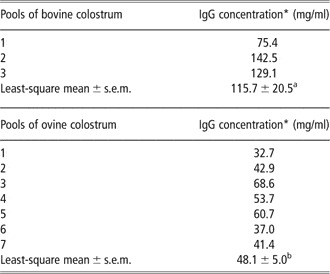
The serum IgG concentration was quantified by the radial immunodiffusion (RID) technique described by Mancini et al. (Reference Mancini, Carbonara and Hermans1965). The IgG concentration in BC and OC were also measured by RID, described by Mancini et al. (Reference Mancini, Carbonara and Hermans1965), and modified by Besser et al. (Reference Besser, Garmedia, McGuire and Gay1985). The average IgG concentration determined in the bovine and ovine first milking colostrum were 115.68 ± 20.49 mg/ml and 48.13 ± 4.98 mg/ml, respectively, similar levels of concentration were found by Pauletti et al. (Reference Pauletti, Bagaldo, Kindlein, de Paz, Lanna and Machado Neto2005) and Loste et al. (Reference Loste, Ramos, Frenández, Ferrer, Lacasta, Verde, Marca and Ortín2008), respectively. These concentrations obtained in the pools represent the average of IgG obtained in a normal commercial operation.
The total apparent efficiency of absorption (AEAtotal) was determined using the formula established by Husband et al. (Reference Husband, Brandon and Lascelles1973) and modified by Besser and Osborn (Reference Besser and Osborn1993).
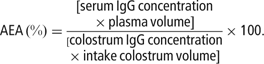
The serum IgG concentration in mg/ml was used in the calculation at 24 h of life and, for the plasma volume, 8% of live weight (Rocha et al., Reference Rocha, Bondan, Marinho, Lopes and Cecim2007). The concentration of specific IgG (mg/ml) of each pool supplied and the total volume of two first meals of colostrum (500 ml) were considered. Specific IgG concentrations (mg/ml) of each pool of BC or OC are presented in Table 1.
Immunoglobulin G concentration in bovine and ovine pools of colostrum obtained from the Center for Animal Husbandry Practice and the Intensive System of Sheep and Goat Production, ESALQ/USP

a,bMeans within column having different superscripts are different by the F test (P < 0.05).
*Concentrations of immunoglobulin regularly found in operations where the study was conducted.
Table 1 IgG concentration in bovine and ovine pools of colostrum obtained from the Center for Animal Husbandry Practice and the Intensive System of Sheep and Goat Production, ESALQ/USP.
The maximum apparent efficiency of absorption (AEAmax) was also determined using the formula established by Husband et al. (Reference Husband, Brandon and Lascelles1973) and modified by Besser and Osborn (Reference Besser and Osborn1993), but it was considered the serum IgG concentration at 6 h of life and only one, and the first, meal of colostrum ingested (Kindlein et al., Reference Kindlein, Pauletti, Bagaldo and Machado-Neto2007). For the calculation, 8% of live weight was used to consider the plasma volume, the specific IgG concentration (mg/ml) of the first pool supplied and the volume of the first meal of colostrum (250 ml). While the AEAtotal represents a wider period of capability of enterocyte absorption that decreases progressively with time; the AEAmax aims to find a more specific enterocyte activity in the potentially highest period of absorption.
Statistical analyses
A completely randomized design was used. The statistical analysis was carried out using SAS software (SAS Institute Inc., 1999). Colostrum IgG concentration, birth weight, plasma volume, total solid intake, total IgG intake and non-IgG material intake were evaluated by ANOVA (α = 0.05). Values were given as least-square means and s.e.m. The IgG serum concentration was analyzed as a repeated measure overtime design, considering treatment, IgG concentration from the pool offered and sampling time as main effects. The AEA was also analyzed as a repeated measure overtime design, with treatment and sampling time considered as main effects; AEAmax representing the sampling time at 6 h of life, whereas AEAtotal the sampling time at 24 h of life. The lamb effect was considered random, and the other effects were considered fixed in the model. Body weight at birth was evaluated as a covariable for serum IgG concentration, contributing significantly to the model. The variables were submitted to analysis of variance using general linear mixed models (MIXED procedure). Means comparisons were made based on differences in least-square means, with P values adjusted for multiple comparisons using Tukey option in the MIXED procedure (α = 0.05). The transformation of the serum variable IgG (square root) and AEAmax and AEAtotal (log base 10) were used. Results are presented with geometric least-square means and 95% CI.
Results
One lamb in the OC group died from pneumonia after 72 h of life but passive immunity transfer was not compromised as the lamb’s serum IgG was 17.0 mg/ml at 24 h of life.
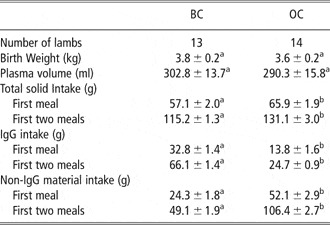
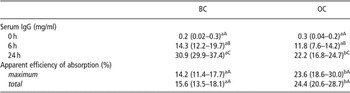
There were no differences (P > 0.05) in birth weight and, consequently, in plasma volume (Table 2). Serum IgG was undetectable in all 0 h samples, which verified lambs, did not nurse from their mothers (Table 3). Lambs receiving BC had greater (P < 0.05) IgG intake.
Least-square means of birth weight, plasma volume, total solid intake, IgG intake and non-IgG material intake in Santa Ines lambs fed Holstein BC and Santa Ines OC (least-square means ± s.e.m.)

BC = lambs that were fed bovine colostrum from Holstein cows; OC = lambs that were fed ovine colostrum from Santa Ines ewes; IgG = immunoglobulin G.
a,bMeans within rows with different superscripts are different by the F test (P < 0.05).
IgG serum concentrations and absorption efficiency by Santa Ines lambs fed Holstein BC and Santa Ines OC (geometric least-square means and 95% CI)

BC = lambs that were fed bovine colostrum from Holstein cows; OC = lambs that were fed ovine colostrum from Santa Ines ewes; IgG = immunoglobulin G.
a,bMeans within rows with different superscripts are different by the Tukey’s test (P < 0.05).
A,BMeans within column in the same variable with different superscripts are different by the Tukey’s test (P < 0.05).
The large amount of Ig available for potential intestinal absorption in the BC group at 24 h of life (66.1 ± 1.4 g of IgG) resulted in higher (P < 0.05) serum IgG concentrations (31.4 mg/ml) compared with the OC group, which had available a smaller amount of IgG, 24.7 ± 0.9 g, and therefore lower serum IgG concentration, 22.2 mg/ml. At 6 h of life, the same serum IgG concentrations in BC and OC, 14.5 and 11.6 mg/ml, respectively, were a result of the IgG mass offered in the first meal of BC and OC, 32.8 ± 1.4 and 13.8 ± 1.6 g, respectively. The AEAmax and AEAtotal were greater for lambs receiving OC than the BC group.
Discussion
Serum IgG concentration in newborn ruminants depends on several factors including, among the most important, age at first feeding and mass of IgG consumed (Nocek et al., Reference Nocek, Braund and Warner1984; Machado Neto et al., Reference Machado Neto, Packer, Bonila, Figueiredo LA Razzok and Cândido1997; O’Doherty and Crosby, Reference O’Doherty and Crosby1997). Lambs fed OC, OC group, had serum IgG concentrations at 24 h similar to previous reports (Boland et al., Reference Boland, Brophy, Callan, Quinn, Nowakowski and Crosby2004, Reference Boland, Guinan, Brophy, Callan, Quinn, Nowakowski and Crosby2005 and Reference Boland, Hayes, Sweeney, Callan, Baird, Keely and Crosby2008). These authors offered OC to newborn lambs with approximately the same amount of IgG used in this study. Results of the BC group indicate that IgG derived from BC are well absorbed by newborn lambs. Logan et al. (Reference Logan, Foster and Irwin1978), feeding newborn lambs with BC or OC, also concluded that heterologous Ig were absorbed with the same facility as homologous ones. Despite the efficiency of passive immunity acquisition and the phylogeny proximity between ovine and bovines, elements of protection acquired with colostrums intake, such as Ig, cytokines, T cells, could act differently in the lamb and further studies are necessary.
At 24 h of life, the AEAtotal showed by lambs, fed BC or OC, varied according to the amount of IgG ingested. In the OC group, the low IgG intake determined higher AEAtotal. Boland et al. (Reference Boland, Hayes, Sweeney, Callan, Baird, Keely and Crosby2008) observed that lambs ingesting amounts of IgG varying from 29.1 to 36.8 g, which cannot be considered a large amount, showed high absorptive efficiency of IgG (15% to 26.4%) at 24 h. Quigley et al. (Reference Quigley, Strohbehn, Kost and O’Brien2001) also verified a negative relationship between the mass of IgG intake and apparent efficiency of absorption at 24 h of life.
In this study, higher concentration of Ig in colostrum does not correspond to proportionally greater absorption, which was also verified by Besser et al. (Reference Besser, Garmedia, McGuire and Gay1985) and Kindlein et al. (Reference Kindlein, Pauletti, Bagaldo and Machado-Neto2007) in newborn calves. As in these two studies, it is suggested that there is a physiological limitation to the rate of IgG absorption by the enterocytes of newborn lambs, determining a nonlinear behavior of passive immunity acquisition.
Besser and Osborn (Reference Besser and Osborn1993) observed that the addition of non-IgG proteins might reduce the absorptive efficiency of Ig. Several authors demonstrated a high correlation between total solids and IgG in colostrum (Foley and Otterby, Reference Foley and Otterby1978; Oyeniyi and Hunter, Reference Oyeniyi and Hunter1978; Fleenor and Stott, Reference Fleenor and Stott1980). Quigley et al. (Reference Quigley, Martin, Dowlen, Wallis and Lamar1994) observed the relation of 0.15 between total solids and IgG in colostrum of Jersey cows, similar to the relation of 0.17 observed in colostrum of very poor immunological quality from Holstein cows (Quigley et al., Reference Quigley, Fike, Egerton, Drewry and Arthington1998). The ratios between IgG and total solids of BC and OC offered to lambs in this study were 0.6 ± 0.02 and 0.2 ± 0.03 in the first meal, respectively, and 0.6 ± 0.01 and 0.2 ± 0.01 in the first two meals, respectively. According to Quigley et al. (Reference Quigley, Fike, Egerton, Drewry and Arthington1998), the mass of non-IgG material may impair IgG absorption by competition. However, in this study, we did not verify the possible interference of non-IgG material in the mechanism of macromolecular transport. In the BC group, the lower intake of non-IgG material did not contribute to the increase of absorptive efficiency. In the OC group, the largest intake of non-IgG material also did not appear to have interfered with the decrease of the AEAtotal. Thus, the total mass of IgG ingested by the newborn lamb was the main determinant in the absorptive efficiency and serum concentration of this Ig. However, it is important to consider that in this study, despite the drastic differences in IgG concentrations from BC and OC, the contribution of Ig and non-IgG material are equivalent, resulting in about the same concentration of total solids.
Machado Neto et al. (Reference Machado Neto, Cassoli, Bessi and Pauletti2004) and Kindlein et al. (Reference Kindlein, Pauletti, Bagaldo and Machado-Neto2007) observed that newborn calves fed colostrum with a high quality of IgG showed AEAmax values higher than AEAtotal. The authors suggested that in the initial phase of the first generation of enterocytes there is a greater intensity of the IgG absorption mechanism. In this study, the AEAmax data were similar to the AEAtotal, indicating that the process of IgG absorption in the first 6 h of lambs’ life did not change. Similar results were found by Hopkins and Quigley (Reference Hopkins and Quigley1997) who offered the same IgG mass to newborn calves in one or two feedings at 10 to 12 h intervals and did not observe differences in the absorptive efficiency of this Ig. During the first hours of life, the lambs’ intestinal epithelium showed continuing ability to macromolecules internalization indicating that the second meal of colostrum, with high concentration of Ig, contributed to the increase of these proteins in serum concentration.
In conclusion, it was observed that there is a limited amount of colostrum IgG that can be absorbed by the newborn lambs’ enterocytes above which absorption becomes non-proportional to the IgG present in the colostrum. Therefore, the results show that the ingestion of a second feeding of quality colostrum can enhance the acquisition of immune protection of newborn lambs.
Acknowledgement
Supported by Fundação de Amparo à Pesquisa do Esatado de São Paulo – FAPESP and Conselho Nacional de Desenvolvimento Científico e Tecnológico – CNPq.