Introduction
The importance of self-rated health in the gerontology and geriatric literature is well established (Maddox, Reference Maddox1962; Maddox and Douglass, Reference Maddox and Douglass1973). This remarkable interest in self-rated health is motivated by two factors: (1) responses to the easy to use, single-item, self-rated health question have been shown to correlate well with the results of more time consuming and expensive measurement approaches, including multi-item self-report batteries, performance-based measures, and clinical assessments; and, (2) the self-rated health question has an uncanny ability to predict subsequent adverse health outcomes, especially mortality (Idler and Kasl, Reference Idler and Kasl1995; Idler and Benyamini, Reference Idler and Benyamini1997; Ferraro and Kelley-Moore, Reference Ferraro and Kelley-Moore2001). Taken together, these factors have led to the inclusion of the self-rated health question in nearly every social and epidemiologic study or randomized controlled trial that has been conducted for the past several decades.
In this paper, we evaluate the effects on self-rated health of three cognitive training interventions in the NIH-funded, multi-site, randomized controlled trial known as ACTIVE (Advanced Cognitive Training for Independent and Vital Elderly) (Jobe et al., Reference Jobe2001). ACTIVE evaluated the effectiveness and durability of three distinct cognitive interventions – memory, reasoning, and speed of processing – against a no-contact control group on a variety of cognitive, functional and health outcomes. In previous published reports we have shown significant protective effects of the cognitive interventions against: (a) cognitive declines (Ball et al., Reference Ball2002; Willis et al., Reference Willis2006); (b) deterioration in basic and instrumental activities of daily living (ADLs and IADLs; Ball et al., Reference Ball2002; Willis et al., Reference Willis2006); (c) global declines in health-related quality of life (HRQoL; Wolinsky et al., Reference Wolinsky2006a; Reference Wolinsky2006b); (d) clinically relevant increases in depressive symptom levels (Wolinsky et al., Reference Wolinsky2009a); (e) increased predicted health expenditures (Wolinsky et al., Reference Wolinsky2009b); and (f) the onset of suspected clinical depression (Wolinsky et al., Reference Wolinsky2009c). In addition, we have recently shown that the speed of processing intervention significantly improved internal locus of control (Wolinsky et al., Reference Wolinsky2009d). Here we extend those analyses by evaluating the effects of the cognitive interventions on self-rated health over time.
We hypothesize that the speed of processing intervention is most likely to have a significant effect on self-rated health. The speed of processing intervention operates through sensory-motor elaboration and repetition. As with other procedural-based tasks, this probably results in a broader pattern of regional brain activation than is the case for the more explicit memory or reasoning tasks used in ACTIVE (Cabeza and Nyberg, Reference Cabeza and Nyberg2000). Such improvements in brain activation and/or structure delay the onset and/or may reduce the risk of cognitive slowing, which is the most significant contributor to overall cognitive decline (Salthouse, Reference Salthouse1996; Reference Salthouse2009). Thus, we expect that the prevention of cognitive slowing brought about by the speed of processing intervention will translate into better self-rated health trajectories. We do not, however, expect either the memory or reasoning interventions to result in better self-rated health trajectories because their etiology involves different mechanisms.
Methods
Study design
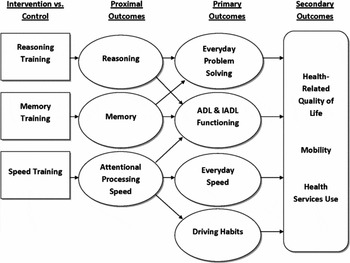
Detailed descriptions of the design of and protocols for the ACTIVE randomized controlled trial are available elsewhere (Jobe et al., Reference Jobe2001). Figure 1 shows the overall conceptual model and hypothesized outcomes between the interventions and the proximal, primary and secondary outcomes. As shown, each of the three treatment interventions – memory, reasoning, and speed of processing – were hypothesized to have direct effects on its targeted proximal outcome (reasoning, memory, or attentional processing speed). It was further hypothesized that the effects of the ACTIVE interventions on both the primary and secondary outcomes would be fully mediated (i.e. indirect only) through the targeted, trained (proximal) outcomes. Among the primary outcomes, the reasoning and memory interventions were expected to affect only everyday problem solving and activities of daily living (ADL) and instrumental ADL (IADL) functioning, whereas the speed of processing intervention was hypothesized to have more diverse effects, including ADL and IADL functioning, everyday speed, and driving habits. All three ACTIVE interventions were expected to affect the secondary outcomes, including HRQoL, mobility, health services use and expenditures.
Conceptual model and hypothesized effects in the ACTIVE model. Adapted from Jobe et al. (Reference Jobe2001).

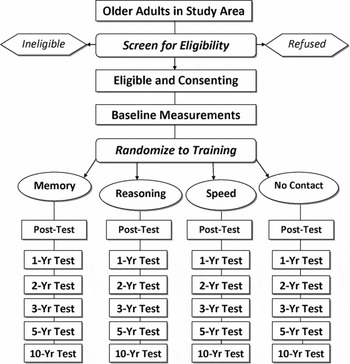
ACTIVE was a duly registered (see www.ClinicalTrials.gov; NCT-00298558) multi-site, randomized, controlled, single-masked clinical trial with four groups. Figure 2 shows the ACTIVE flow chart. Target sample size was set at approximately 3,000 enrolled and randomized subjects based on detailed power calculations for the multiple primary outcomes (see Jobe et al., Reference Jobe2001). All participants in ACTIVE were able to live independently of formal care and were 65 years old or older at baseline. Each of six sites used different recruitment strategies, resulting in 4,970 potential participants identified from March 1998 through October 1999 (Jobe et al., Reference Jobe2001). Of these, 905 (18%) were excluded due to cognitive impairment (Folstein et al., Reference Folstein, Folstein and McHugh1975), poor corrected vision, hygiene or dressing dependencies, Alzheimer's disease, a stroke during the past year, limited life expectancy due to cancer or active chemotherapy or radiation treatment, difficulty communicating, intentions to move out of the area soon, anticipated scheduling conflicts, or prior cognitive training. Another 1,263 potential participants (25%) refused to participate. The 2,802 remaining potential participants were screened, enrolled and randomized using computerized criteria at each site under the oversight of the study statistician with random variation in block size multiples of four. Group assignment was blinded to all outcome assessors. Baseline outcome assessments occurred prior to treatment, and reassessments were obtained at 1, 2, 3 and 5 years post-baseline. The 10-year reassessment is currently underway. Complete data were available for 1,804 (64%) of the ACTIVE participants at the 5-year follow-up assessments.
The ACTIVE study design. Adapted from Jobe et al. (Reference Jobe2001).

Not shown in Figure 2 is the booster training randomization that occurred. At 11 and 35 months post-baseline, participants in the three cognitive intervention groups were randomized to be invited to receive or not to receive 4 hours of booster training. The method of selecting participants to receive booster training, however, was conditioned on participant adherence. That is, only participants who had attended at least 8 of the 10 baseline training sessions were eligible to be randomized. Therefore, we cannot consider the booster effect in our main intent-to-treat analyses, because the booster effect is confounded by an adherence effect. Nonetheless, we will return to this issue from a dose-response effectiveness research standpoint in the discussion section below.
Interventions
Each of the three cognitive interventions consisted of ten standardized sessions of equal length. The first five intervention sessions focused on strategy instruction and practice exercises, and the remainder provided additional practice. All three interventions consisted of laboratory-type and everyday activities that were well-specified in trainer manuals (Jobe et al., Reference Jobe2001). The focus of the reasoning intervention was inductive reasoning, particularly solving problems following a serial pattern manifest in executive functioning. The focus of the memory intervention was verbal episodic memory, principally using mnemonic strategies for remembering lists, sequences of items, text material, and main ideas and story details. The focus of the speed of processing intervention was visual search to identify and locate information quickly in a divided attention format.
Self-rated health
We measured self-rated health at each wave using the traditional question:”how would you rate your health – would you say it is excellent, very good, good, fair, or poor?” Although these responses are commonly coded simply as integers 5 to 1, respectively, this does not adequately represent the non-interval nature of the response set. Therefore, we used the method of Diehr et al. (Reference Diehr, Patrick, Spertus, Kiefe, McDonell and Fihn2001) who used longitudinal data from large studies to transform these responses to the probability of being healthy in the future, conditional on the current observed value. This resulted in values of 95 for excellent, 90 for very good, 80 for good, 30 for fair, and 15 for poor; these can also be thought of as a general measure of health, where 0 is death and 100 is perfect health, although decedents were excluded from these analyses.
Attrition bias
As noted above, only 64% of the original participants had complete data available at the 5-year follow-up, creating the potential for attrition bias. Therefore, we used propensity score models to adjust for potential attrition bias and to maintain an intent-to-treat approach (D'Agostino, Reference D'Agostino1998). We estimated a multivariable logistic regression model of whether complete data were available, and computed the predicted probabilities of inclusion in the analytic sample (Hosmer and Lemeshow, Reference Hosmer and Lemeshow1989). This model included intervention group assignment, demographic, socioeconomic, and cognitive, health and functional status measures at baseline (complete list available on request), and fitted the data well (C statistic = 0.78; Hosmer-Lemeshow statistic p value = 0.73; Hosmer and Lemeshow, Reference Hosmer and Lemeshow1989; Hanley and McNeil, Reference Hanley and McNeil1982). Within each propensity score (predicted probability) quintile we determined the average participation rate (P), and used the inverse (1/P) to weight the data. This gave greater influence to participants in the analytic samples most like those not included. Finally, the propensity score weights were adjusted so that the final weighted N was equal to the actual number of participants in the analytic samples in our intent-to-treat analyses (i.e. 1,804).
Analytic method
After weighting the data to adjust for potential selection bias, we used ordinary least squares regression to conduct residual change-score regression analyses (Kessler and Greenberg, Reference Kessler and Greenberg1981) on the effects of the three intervention groups on changes in the Diehr-transformed (Diehr et al., Reference Diehr, Patrick, Spertus, Kiefe, McDonell and Fihn2001) self-rated health values. That is, in our intent-to-treat analyses, the target or focal value of self-rated health (i.e. at 1, 2, 3, or 5 years post-baseline) was regressed on the three dummy variables contrasting each intervention group with the no-contact control group, as well as the baseline level of self-reported health. In residual change score regression analyses such as this, the interpretation of the baseline value of the outcome is not on change in the outcome but on its stability. However, the effects of all the other terms in the model are on change in the outcome (Kessler and Greenberg, Reference Kessler and Greenberg1981). Therefore, the coefficients for the three dummy variables reflecting the cognitive training interventions may be directly interpreted as changes in self-rated health between baseline and the target (focal) year associated with assignment to the respective cognitive interventions. As noted above, due to conditioning the selection of participants to receive booster training on participant adherence, we do not consider the booster effects in our main analyses, but return to them in the discussion section.
Results
Descriptive
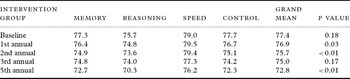
Among the 1,804 participants in the analytic sample, there were 464 in the memory intervention, 451 in the reasoning intervention, 458 in the speed of processing intervention, and 431 in the no-contact control group. The mean age at baseline was 73.5 years, 24% were men, 27% were black, and the average educational attainment was 13.6 years. The mean Mini-mental State Examination (MMSE) score was 27.4 (Folstein et al., Reference Folstein, Folstein and McHugh1975), the mean scores on the Minimum Data Set (MDS) ADL (Morris and Morris, Reference Morris and Morris1997) and IADL (Morris et al., Reference Morris1997) performance measures were 0.3 and 4.21, respectively, and the mean number of chronic conditions was 2.2. Table 1 contains the Diehr-transformed (Diehr et al., Reference Diehr, Patrick, Spertus, Kiefe, McDonell and Fihn2001) means for the self-rated health question overall and by intervention group for all assessment periods. As shown, the grand mean was 77.4 at baseline, and 76.9, 75.7, 75.0, and 72.8 at the 1-, 2-, 3- and 5-year follow-ups, indicating a decline in the grand mean of 4.6 points from baseline to the 5-year follow-up. The 5-year declines, however, varied notably by intervention group, being 2.8 for the speed of processing group, 4.6 for the memory group, 5.4 for the no-contact control group, and 5.4 for the reasoning group.
Diehr-transformed (Diehr et al., Reference Diehr, Patrick, Spertus, Kiefe, McDonell and Fihn2001) self-rated health means at baseline and at 1-, 2-, 3-, and 5-years post-baseline, by intervention group, among 1,804 ACTIVE participants

Notes: Propensity score weights are used to adjust for potential attrition bias. Self-rated health codes: excellent = 95, very good = 90, good = 80, fair = 30, and poor = 15, following Diehr et al. (Reference Diehr, Patrick, Spertus, Kiefe, McDonell and Fihn2001).
Residualized change-score regression
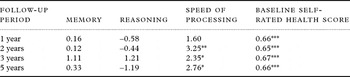
Table 2 contains the results obtained from the intent-to-treat, residual change-score regression analyses (Kessler and Greenberg, Reference Kessler and Greenberg1981) at 1, 2, 3 and 5 years. As noted earlier, in residual change-score regression analyses the interpretation of the baseline value of the outcome is not on change in the outcome but on its stability. The effects of all other terms in the model, however, are directly interpretable as effects on changes in the outcome (Kessler and Greenberg, Reference Kessler and Greenberg1981). Specifically, the coefficients for the three dummy variables reflecting the cognitive training interventions may be directly interpreted as changes in self-rated health between baseline and the target (focal) year associated with assignment to the respective cognitive interventions.
Unstandardized (b) regression coefficients obtained from main effect residualized change-score (adjusted for baseline self-rated health) linear regression analyses of changes in Diehr-transformed (Diehr et al., Reference Diehr, Patrick, Spertus, Kiefe, McDonell and Fihn2001) self-rated health at 1, 2, 3 and 5 years post-baseline among 1,804 ACTIVE participants

* = p ≤ 0.05; ** = p ≤ 0.01; *** = p ≤ 0.001
Notes: Propensity score weights were used to adjust for potential attrition bias. Self-rated health codes: excellent = 95, very good = 90, good = 80, fair = 30, and poor = 15. Regression (b) coefficients interpreted as the mean change in Diehr-transformed (Diehr et al., Reference Diehr, Patrick, Spertus, Kiefe, McDonell and Fihn2001) self-rated health points between baseline and 1, 2, 3 and 5 years post-baseline.
As shown in Table 2, relative to the no-contact control group, only participants in the speed of processing group had statistically significant improvements in their self-rated health. The associated regression coefficients for each focal year (i.e. baseline to “n” years of follow-up) directly reflect statistically significant improvements (or protection against normative decline trajectories in older adults) in self-rated health of 3.3 points (p = 0.006) at 2 years, 2.4 points (p = 0.06) at 3 years, and 2.8 points (p = 0.015) at 5 years. These are fairly large improvements given that the difference between “excellent” and “very good” on the self-rated health measure is only 5.0 points.
Discussion
We have shown that relative to the no-contact control condition, statistically significant improvements in self-rated health accrued for participants in the speed of processing intervention group at 2, 3 and 5 years post-baseline. When compared to the no-contact control group, those differences amounted to an average improvement (or protection against normative decline trajectories in older adults) after adjusting for the baseline value of self-rated health of about 2.8 points. To provide intuitive understanding of the magnitude of these improvements, we note here that the mean 5-year improvement was equivalent to just over half the difference between the excellent vs. very good health responses, even after adjusting for baseline self-rated health. That amount of self-rated health change is both meaningful and clinically relevant, especially in light of the relatively modest nature of the intervention exposure (10 hours or less), and the observed duration of the effect over five years. Moreover, based on the translation table provided in the SF-36 manual (Table 9.7), data from the Medical Outcomes Study (MOS) indicates that a population-based change of this magnitude should result in a 0.8% absolute reduction in the five-year mortality rate (Ware et al., Reference Ware, Snow, Kosinski and Gandek1993).
This raises the question of why only the speed of processing intervention improved self-rated health. Previously, we have argued that the speed of processing intervention was distinctly different from the memory or reasoning interventions in three key ways (Wolinsky et al., Reference Wolinsky2006a; Reference Wolinsky2006b; Reference Wolinsky2009a; Reference Wolinsky2009b; Reference Wolinsky2009c; Reference Wolinsky2009d). First, the speed of processing intervention was procedural rather than declarative. Second, it was computer-based and permitted tailoring so that participants could proceed at their own paces. Third, speed of processing operates through sensory-motor elaboration and repetition, which results in a broader pattern of regional brain activation, which may delay the onset and/or reduce the risk of cognitive slowing. We believe that these differences positioned the speed of processing to be the most robust intervention for preventing overall cognitive decline (Salthouse, Reference Salthouse1996; Reference Salthouse2009), and that this translated into improvements (i.e. protection against age-related normative decline) in self-rated health for the older adults in ACTIVE. This interpretation is supported by additional analyses (not shown) in which the net improvement in the speed of processing between baseline and the 5-year follow-up was added to the model shown in Table 2. In that analysis, improved speed of processing was significantly (p < 0.05) associated with improved self-rated health. Moreover, in those analyses, the effect of being assigned to the speed of processing intervention was not appreciably altered.
On the other hand, it may be that that the amount (dose) of speed of processing training was adequate, but the doses of memory and reasoning training were not. We explored the potential for such dose-response relationships associated with the booster sessions in additional effectiveness analyses. Specifically, we replaced the set of three dummy variables contrasting the intervention groups with the no-contact control group with a set of six dummy variables that separate each intervention group into those who were or were not invited to participate in the booster sessions about a month before the first and third annual follow-ups. Because statistical power was substantially reduced (due to the smaller groups) in these additional analyses, we focused on effect size changes.
The results of these additional analyses (data not shown) revealed no meaningful nor consistent differences between those assigned to the speed of processing intervention who were also invited to participate in the booster sessions vs. those assigned to the speed of processing intervention who were not invited to participate in the booster sessions. This suggests that the baseline intervention for the speed of processing training was sufficient to produce the observed effects. In contrast, for those assigned to the memory and reasoning interventions, there was some effect size evidence that being invited to participate in the booster sessions yielded protection against declines in self-rated health, suggesting from an effectiveness but not an efficacy standpoint that the baseline doses of the memory and reasoning interventions were inadequate. Accordingly, it is possible that larger doses of the baseline memory and reasoning interventions, or an aggressive, recurring pattern of booster treatments, may have resulted in a statistically significant protective effect.
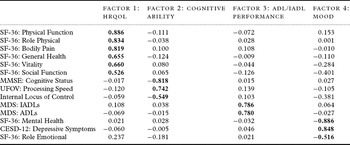
We also conducted additional analyses to explore the meta-structure of the ADL, IADL, depressive symptoms, HRQoL (which is the domain to which the self-rated health item belongs), and internal locus of control measures, which were the principal outcomes of our prior reports. Specifically, we used exploratory factor analysis with oblique rotation (Nunnally, Reference Nunnally1967). To determine how those outcome measures related to cognitive ability, we also included the MMSE as a standard cognitive screening assessment, and the Useful Field of Vision Test (which is coded as the number of milliseconds needed to perform the required task, with higher numbers indicating slower processing speed) as a standard measure of processing speed. These analyses were conducted separately at baseline, and at the 1-, 2-, 3- and 5- year follow-up assessments.
Table 3 contains the resulting factor loadings observed among the 1,804 participants in the 5-year follow-up used in the analyses reported above (we note here that the results at each wave of data collection were fundamentally equivalent). As shown, four factors had eigenvalues greater than unity, and collectively explained 65% of the variance in these measures. The factor structure was pristine, with each measure having a primary factor loading (i.e. > 0.50 and shown in bold in Table 3), and no evidence of factorial complexity (Nunnally, Reference Nunnally1967). The first factor represented HRQoL given that six of the eight SF-36 scales (Ware et al., Reference Ware, Snow, Kosinski and Gandek1993), including the one to which the self-rated health question belongs (general health perceptions) loaded on it. Cognitive ability was the theme of the second factor inasmuch as the MMSE and UFOV processing speed measures principally loaded on it, along with a marginally principal loading for the internal locus of control measure. Everyday activities were the theme of the third factor, with both the ADL and IADL performance measures loading on it. Finally, the fourth factor represented mood, with the SF-36 mental health and CESD-12 depression measures principally loading on it, along with a marginally principal loading for the SF-36 role emotional scale. These results indicate that the cognitive ability factor was fundamentally distinct from the other factors. Indeed, the inter-correlations (not shown) between the cognitive ability factor and the three other underlying factors were quite modest, ranging from 0.14 to 0.27. This leads us to hypothesize that improvements in processing speed raise cognitive ability, and that improved cognitive ability leads to the better health outcomes that we have observed for the ACTIVE participants randomized to the speed of processing training group.
Exploratory factor analysis with oblique rotation of the outcomes that the speed of processing intervention has affected at 5 years post-baseline among 1,804 ACTIVE participants

Notes: Principal factor loadings shown in bold; HRQoL = health-related quality of life; ADL = activities of daily living; IADL = instrumental activities of daily living; SF-36 = the 36-item Short-Form Health Survey; MMSE = Mini-mental State Examination; UFOV = Useful Field of Vision test; MDS = Minimum Data Set; CESD = Center for Epidemiologic Studies Depression scale.
In conclusion, we note several reasons why our findings are especially important and valid. ACTIVE was a large, multi-site, community-based, randomized controlled trial, which strengthens both the internal and external validity of our findings. The self-rated health question is the most widely used health status measure in the world, and the Diehr et al. (Reference Diehr, Patrick, Spertus, Kiefe, McDonell and Fihn2001) coding transformation (95–15) provides an excellent resolution of the non-interval nature of the standard coding (5–1) of the response set (Diehr et al., Reference Diehr, Patrick, Spertus, Kiefe, McDonell and Fihn2001). We used propensity score methods (D'Agostino, Reference D'Agostino1998) to adjust for potential attrition bias in our residualized change-score intent-to-treat regression analyses (Kessler and Greenberg, Reference Kessler and Greenberg1981). Finally, the speed of processing intervention is computer-based, designed to be self-administered, and allows an individual to proceed at her/his own pace, thus increasing the likelihood that maximal effective dosing could be delivered, and making it very easy to deliver this intervention effectively to older adults.
Conflict of interest
None.
Description of authors' roles
Fredric D. Wolinsky conceived the study, designed and executed the statistical analyses, and drafted and revised the paper. Henry Mahncke assisted with the conception of the study, provided advice on the statistical analyses, and read, commented upon, and approved all versions of the manuscript. Mark W. Vander Weg and Rene Martin assisted with the conception of the study, provided advice on the statistical analyses and their interpretation, and read, commented upon, and approved all versions of the manuscript. Frederick W. Unverzagt, Karlene K. Ball and Sharon L. Tennstedt are ACTIVE Site Principal Investigators and members of the ACTIVE Executive Committee. They provided advice on the conception of the study and statistical analyses, and read, commented upon and approved all versions of the manuscript. Richard N. Jones assisted with the conception of the study, provided counsel on the statistical analyses, and read, commented upon, and approved all versions of the manuscript.
Acknowledgments
The ACTIVE Cognitive Training Trial was supported by grants from the National Institutes of Health to six field sites and the coordinating center, including: Hebrew Senior-Life, Boston (NR04507), the Indiana University School of Medicine (NR04508), the Johns Hopkins University (AG14260), the New England Research Institutes (AG14282), the Pennsylvania State University (AG14263), the University of Alabama at Birmingham (AG14289), and the University of Florida (AG014276). Dr. Wolinsky's efforts on the analysis for and writing of this paper were supported in part by a limited consulting arrangement with Posit Science Corporation, of which Dr. Mahncke is Vice President for Research, and a stock holder. In October 2007, Posit Science Corporation acquired ownership of the speed-of-processing intervention used in the ACTIVE Cognitive Training Trial, which was originally developed by Dr. Ball and colleagues. Dr. Ball is a stock holder in Posit Science Corporation, and serves on its Advisory Board. Dr. Wolinsky was a Co-Center PI, and Drs. Vander Weg and Martin are Investigators at the Center for Research in the Implementation of Innovative Strategies in Practice (CRIISP) at the Iowa City VAMC, which is funded through the Department of Veterans Affairs, Veterans Health Administration, Health Services Research and Development Service (HFP 04-149). The opinions expressed here are those of the authors and do not necessarily reflect those of the funding agencies, academic, research, governmental institutions or corporations involved.