

Introduction
Probiotic supplementation is a common feeding practice in farm animals that is increasingly expanding to the pet food industry, as mounting evidence supports its health benefits to the host (Sauter et al., Reference Sauter, Benyacoub, Allenspach, Gaschen, Ontsouka, Reuteler, Cavadini, Knorr and Blum2006; Markowiak and Slizewska, Reference Markowiak and Slizewska2018). As living microorganisms, probiotics have been shown to enhance enteric nutrient utilisation (Swanson et al., Reference Swanson, Grieshop, Flickinger, Bauer, Chow, Wolf, Garleb and Fahey2002; Mountzouris et al., Reference Mountzouris, Tsitrsikos, Palamidi, Arvaniti, Mohnl, Schatzmayr and Fegeros2010) and promote the synthesis of short-chain fatty acids (SCFA) (Hijova and Chmelarova, Reference Hijova and Chmelarova2007). In addition, probiotics exert an inhibitory action on pathogenic bacteria through the acidification of the luminal environment (e.g. via lactic acid production) (De Vuyst and Vandamme, Reference De Vuyst, Vandamme, De Vuyst and Vandamme1994). Therefore, lactic acid bacteria have been widely used in animal nutrition (Swanson et al., Reference Swanson, Grieshop, Flickinger, Bauer, Chow, Wolf, Garleb and Fahey2002; Yang et al., Reference Yang, Hou, Zeng and Qiao2015), as well as bacterial species known to promote the proliferation of beneficial Lactobacilli spp. (Hosoi et al., Reference Hosoi, Ametani, Kiuchi and Kaminogawa2000).
Calsporin® (Asahi Calpis Wellness Co., Ltd.; Tokyo, Japan) is a zootechnical feed additive (gut flora stabiliser) based on viable spores of Bacillus subtilis C-3102, and it is authorised in the European Union for use in dogs as well as in chickens, laying hens, turkeys, minor avian species, sows, piglets and ornamental fish (European Commission, 2018). An interesting aspect of Bacillus spp. concerns their spore forming capacity. Strain C-3102 is able to survive under a range of temperature conditions (up to 105°C) applied in feed production (Kampf, Reference Kampf2012). The reported beneficial effects of Calsporin® include an improvement in health status, a better productive performance in both poultry (Fritts et al., Reference Fritts, Kersey, Motl, Kroger, Yan, Si, Jiang, Campos, Waldroup and Waldroup2000; Jeong and Kim, Reference Jeong and Kim2014) and pigs (Marubashi et al., Reference Marubashi, Gracia, Vilà, Bontempo, Kritas and Piskoríková2012) and improved reproductive performance in pigs (Kritas et al., Reference Kritas, Marubashi, Filioussis, Petridou, Christodoulopoulos, Burriel, Tzivara, Theodoridis and Pískoriková2015). Many studies confirm its ability to improve the gut microbiota by increasing lactic acid bacteria and decreasing pathogenic bacteria in livestock (Maruta et al., Reference Maruta, Miyazaki, Masuda, Takahashi, Marubashi, Tadano and Takahashi1996; Jeong and Kim, Reference Jeong and Kim2014; Guyard-Nicodème et al., Reference Guyard-Nicodème, Keita, Quesne, Amelot, Poezevara, Le Berre, Sánchez, Vesseur, Martín, Medel and Chemaly2016) and in vitro animal models simulating the human gastrointestinal tract (Hatanaka et al., Reference Hatanaka, Nakamura, Maathuis, Venema, Murota and Yamamoto2012).
Available studies in dogs evaluating the effect of different Bacillus spp. other than Bacillus subtilis as a single or as a combined probiotic on food digestibility and the faecal microbiota have shown a reduction in faecal counts of pathogenic Clostridia spp. but no changes in faecal quality or nutrient digestibility (Biourge et al., Reference Biourge, Vallet, Levesque, Sergheraert, Chevalier and Roberton1998; González-Ortiz et al., Reference González-Ortiz, Castillejos, Mallo, Calvo-Torras and Baucells2013). As for Bacillus subtilis C-3102 (Calsporin®), there are two published studies showing the improvement of faecal quality in dogs. Paap et al. (Reference Paap, van der Laak, Smit, Nakamura and Beynen2016) showed that the administration of Calsporin® was beneficial for dogs suffering from chronic diarrhoea. Félix et al. (Reference Félix, Netto, Murakami, Brito, Oliveira and Maiorka2010) showed an improvement in faecal quality and a reduction in faecal ammonia content, suggesting a decrease in intestinal putrefactive processes. However, in their study no significant changes were found in nutrient apparent digestibility in response to Bacillus subtilis supplementation.
The purpose of this current study was to evaluate the efficacy of Bacillus subtilis (Calsporin®) on improving faecal quality and nutrient digestibility in healthy adult dogs. As one of the key aspects of probiotics is to re-establish or improve gastrointestinal function, in this study digestive distress was introduced by transitioning dogs from a high-quality diet with a high ME content to a diet with a low ME energy content.
Materials and methods
Sixteen adult (aged 4 to 8 years old) Beagle dogs, comprising 10 spayed females and six intact males, with an average body weight (BW) of 17.0 ± 0.644 kg and a body condition score (BCS) of 5.75 ± 0.274 (on a 1 to 9 point scale, with 1 for cachectic, 5 for optimal, and 9 for obese; Laflamme, Reference Laflamme1997) were used in this study. Dogs were healthy and underwent regular health care, vaccination and deworming treatments. No medications expected to alter the gut microbiota had been given to the dogs over the previous two months.
Animal housing and experimental procedures were approved by the Ethics Committee for Animal Experimentation of the University of Zaragoza and conformed to the Spanish Policy for Animal Protection (RD 1201/05), which met EU Directive 86/609 on the protection of animals used for experimental and scientific purposes. Dogs were individually housed indoors on concrete floored kennels (2.0 × 2.5 m) with free access to outdoor runs (2.0 × 5.0 m). The indoor temperature was maintained at 16–22°C, and water was provided ad libitum. At the beginning of the trial, dogs were randomly distributed into two groups (control and probiotic) according to their sex, age and BW (n = 8 per dietary group). Dogs in each group were housed in separate areas to avoid cross-contamination between feed and faeces containing Bacillus subtilis spores.
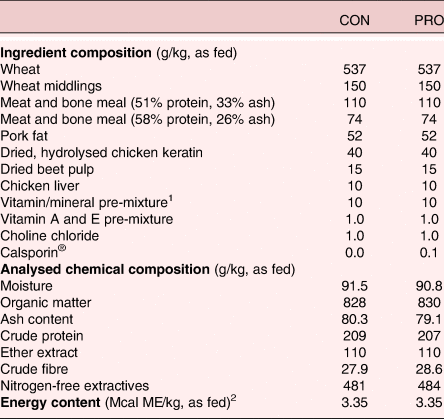
In the first two weeks (pre-test period), all dogs received a high-energy extruded diet (Advance Medium adult, Affinity Petcare®, Barcelona, Spain) with a guaranteed analysis of 270, 185, 20 and 370 g/kg crude protein (CP), fat, crude fibre (CF), and nitrogen free extractives (NFE), respectively, providing 3.81 Mcal metabolisable energy (ME)/kg, estimated by applying the modified Atwater factors (NRC, 2006). Following this, dogs from the control group were switched to a low-energy extruded control diet (CON) manufactured by Jonker Petfood (Spuigweg, Waalwijk, Netherlands), while dogs from the designated probiotic group were switched to the same control diet supplemented with 0.01% Calsporin® (Bacillus subtilis C-3102; Asahi Calpis Wellness Co., Ltd., Gunma Factory, Tatebayashi City, Gunma, Japan) as the probiotic (PRO diet). Bacillus subtilis C-3102 was added post-extrusion to supply 1 × 10⁹ CFU/kg, a dosage previously applied in dog food (Biourge et al., Reference Biourge, Vallet, Levesque, Sergheraert, Chevalier and Roberton1998; Félix et al., Reference Félix, Netto, Murakami, Brito, Oliveira and Maiorka2010). Samples of the CON and PRO diets were collected at various time-points during the manufacturing process before the start of the study and pooled within diet for chemical analysis. The ingredient and chemical composition and ME content of the test diets are shown in Table 1.
Ingredient and nutrient composition of the control diet (CON) and the same diet supplemented with the probiotic Calsporin® (Bacillus subtilis C-3102) (PRO).

1 Containing 18000 IU/kg vitamin A, 1800 IU/kg vitamin D3, 110 IU/kg vitamin E, 65 mg/kg Zinc, 50 mg/kg vitamin C, 50 mg/kg Iron, 35 mg/kg Manganese, 5.0 mg/kg Copper and 1.5 mg/kg Iodine. 2 Estimated by applying the Atwater factors 3.5, 8.5, and 3.5 kcal per g of crude protein, ether extract and nitrogen-free extractives, respectively (NRC 2006).
Dogs received the CON or PRO diets during a four–week test period, including three days of dietary transition, in which the test diets were introduced by increasing the percentage of inclusion by 25% each day. All diets were offered at 09.00 h in an amount adjusted to meet the maintenance energy requirement (MER) estimated for each dog according to the equation proposed by NRC (2006) for laboratory Beagle dogs (132 kcal ME/kg ideal BW0.75). Food refusals were collected daily and dried at 105°C for 24 h for the determination of daily DM intake (DMI).
The BW of dogs was recorded at the start of the pre-test period (day 13) and once weekly thereafter. The BCS of dogs was assessed at the start and at the end of the study. The ideal BW of dogs used for the calculation of the MER was estimated by increasing or decreasing the actual initial BW by 10% per unit BCS below or above an optimum BCS of 5 (German et al., Reference German, Holden, Bissot, Morris and Biourge2009). Food intake adjustments were made in dogs showing BW changes ≥ 5% from starting BW after ruling out any underlying pathological condition.
The faecal consistency score was evaluated on freshly voided faeces (within 15 min of defecation) collected on day 0 (last day of the pre-test period) and on 12 non-consecutive days thereafter (three days per week) based on the Bristol stool form scale, with 1–2 denoting hard and dry, 3–5 normal and 6–7 loose stools (Blake et al., Reference Blake, Raker and Whelan2016).
On days 0, 7, 14, 21, and 28 of the trial, fresh faecal samples were collected for the determination of DM, pH, and NH3 contents. The DM was determined in two aliquots (5–10 g of faeces) by drying at 105°C for 24 h. Faecal pH was measured using a glass electrode pH–52 meter (Crison 507, Crison, Barcelona, Spain). For NH3 analysis, 2 g of faeces were homogenised in 4 ml of HCl (0.2 N) and stored at –20°C until analysed. Faecal NH3 concentration was determined colorimetrically following the method described by Chaney and Marbach (Reference Chaney and Marbach1962). On days 0 and 21, additional subsamples were collected for the analysis of SCFA and lactate. For SCFA, 2 g of faeces were diluted in 4 ml of a deproteinising solution constituted of 20 ml/l of H3PO4 and 1 ml/ of 4-methylvaleric acid (ref. M-7396 SIGMA) as an internal standard. For lactate, 1 g of faeces was homogenised in 4 ml HCl (0.2 N). The resultant solutions were stored at –20°C until analyses. Faecal SCFA content was analysed by gas chromatography in an Agilent 6890 (Agilent Technologies España, S.L., Madrid, Spain) fitted with a capillary column (HP-FFAP polyethylene glycol TPA-treated, 30 m x 530 µm i.d. × 1 µm film thickness) and a flame ionisation detector. Lactic acid was measured based on the colorimetric method proposed by Barker and Summerson (Reference Barker and Summerson1941).
On week four of the test period, a five–day total faecal collection was conducted in six dogs each from the CON and PRO dietary groups for the determination of DM, nutrient, and energy apparent digestibility according to the American Association of Feed Control Officials (AAFCO, 2011). Faeces were collected daily directly from the kennel floor, dried at 65°C for 48 h, and pooled prior to analysis. Chemical analysis of the 5-d faecal pool of faeces and of the CON and PRO diets offered to dogs during this week was performed on samples ground to 1 mm. Food and faeces were analysed for moisture, ash, CP, ether extract (EE), and CF according to the procedures outlined in the Association of Official Analytical Chemists (AOAC, 2005) (Official methods no. 934.01, 942.05, 976.05, 954.02, and 978.10, respectively). The NFE content was calculated as: organic matter (OM) – (CP + EE + CF).
Bacillus subtilis C-3102 counts (CFU/g) were carried out in the pre-test diet and in individual samples of the CON and PRO diets taken at different time points during the manufacturing process as well as in faecal samples from each dog collected on days 0, 7, and 28. Faecal samples (5 g) were collected immediately after defecation and kept refrigerated at 4° C until analysis (within the following 3 days). Bacillus subtilis analysis was done based on the method BS-EN-15784-2008 (British Standards Institute, 2009). Samples were heated at 80°C for 10 min in order to eliminate non-spore-forming bacteria prior to incubation on Trypticase soya broth with 2% agar. Data were analysed using the PROC MIXED procedure of the Statistical Analysis System Software package version 0.2 (SAS Institute, Cary, NC, USA), including the effect of diet (CON and PRO) as a fixed effect and dog subjected to diet as a random effect. For the analysis of DMI, BW, weekly faecal consistency, DM, pH, and NH3 concentration throughout the test period, the factor time (day or week) was included in the model as a repeated measure. For the remaining parameters, the effect of diet was analysed within each sampling time. The effect of starting values on each of the variables studied during the test period was analysed for significance by including them as a covariate. However, this effect was not significant and therefore was not considered in the final model.
Significant differences were established at P ≤ 0.05 and trend towards significance at 0.05 < P ≤ 0.10. When the F value of ANOVA analysis showed significant differences due to studied factors, pairwise comparisons between diets on the same day or week were established using the least significant difference test, whereas the Tukey test was used for multiple comparisons of means (time effect).
Results and Discussion
Bacillus subtilis C-3102 was not detected in either the pre-test diet or the CON diet and reached the intended concentration (1 × 10⁶ CFU/g food) in the PRO diet (1.43 × 10⁶ ± 0.144 × 10⁶ CFU/g food). Bacillus subtilis C-3102 was not detected in the faeces of dogs fed the CON diet throughout the test period, confirming the absence of cross contamination. The count of Bacillus subtilis in the faeces of dogs fed the PRO diet reached 2.92 × 10⁵ ± 0.158 × 10⁵ CFU/g fresh faeces on d 7 and 2.28 × 10⁵ ± 0.164 × 10⁵ CFU/g fresh faeces on d 28 of the test period.
Daily food intake, BW, and BCS
During the two-week pre-test period, both the control and probiotic groups had a similar (P > 0.10) daily DMI (250 ± 6.14 vs 243 ± 11.9 g/d in dogs fed the CON and PRO diets, respectively, on week –1; 241 ± 9.28 vs 246 ± 10.1 g/d on week 0). The BW of dogs remained stable during the pre-test period, with no differences being found between groups on d 0 (16.71 ± 0.974 vs 17.22 ± 0.993 kg BW in dogs assigned to the CON and PRO diet, respectively; P > 0.10). The dietary transition was performed gradually but relatively quickly compared to the five day adaptation period recommended by AAFCO (2011) to highlight the potential ability of the probiotic to improve intestinal adaptation to dietary change. During the test period, the amount of the CON and PRO diets offered to dogs was increased approximately 15% to account for the lower energy density of the test diets compared to the pre-test diet. The daily intake and BW of dogs fed the CON and the PRO diets did not significantly differ over the four-week period (diet and diet × week interaction effects, P > 0.10; Supplementary Materials, Table S1). Therefore, the level of intake approximated to the daily energy requirements of dogs over the study.
The starting BCS was similar (P > 0.10) in both dietary groups (5.81 ± 0.377 vs 5.69 ± 0.422, for dogs on the CON and PRO diets, respectively). At the end of the test period (d 28) the BCS of both dietary groups remained similar (5.75 ± 0.491 vs 5.69 ± 0.365, for dogs on the CON and PRO diets, respectively; P > 0.10).
Faecal characteristics at study start
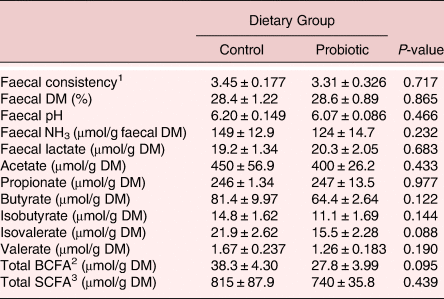
Faecal consistency, DM content, faecal pH, and faecal concentration of NH3, lactate, and total SCFA measured at the start of the study did not differ between dietary groups (P > 0.10, Table 2). However, a trend towards a lower faecal content of branched-chain fatty acids (BCFA) (P = 0.095), primarily of isovalerate (P = 0.088), was found in dogs assigned to the PRO diet.
Faecal parameters in dogs assigned to the control and the probiotic groups at the start of the study (values are means ± standard error of means of eight dogs per dietary group).

1 Evaluated on a 1 to 7 scale, where 1 denotes hard and dry faeces and 7 denotes watery faeces. 2 Branched-chain fatty acids: calculated as the sum of isobutyrate, isovalerate, and valerate. 3 Short-chain fatty acids: calculated as the sum of acetate, propionate, butyrate, and BCFA.
Faecal DM and consistency
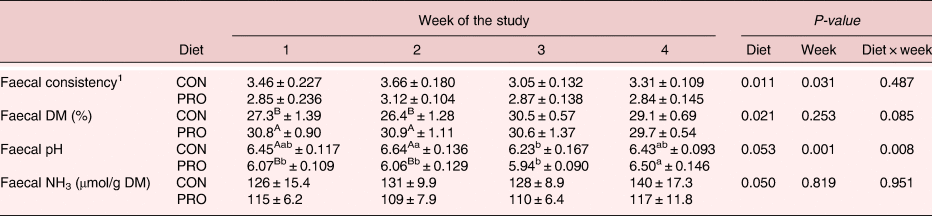
The weekly faecal consistency score was lower in dogs fed the PRO diet than in dogs fed the CON diet (diet, P = 0.011 and diet × week, P > 0.10; Table 3). This was associated with a greater faecal DM content in the PRO diet group over the study (diet, P = 0.021), particularly in weeks one (P = 0.020) and two (P = 0.004) (diet × week, P = 0.085). The improved faecal consistency found in dogs fed the diet supplemented with Bacillus subtilis is in accordance with the study carried out by Félix et al. (Reference Félix, Netto, Murakami, Brito, Oliveira and Maiorka2010) using the same probiotic in younger (7–8 months) dogs. Faecal consistency score reached higher values with both diets during week two (week effect, P = 0.031), although it remained within the acceptable range (3–5) (Blake et al., Reference Blake, Raker and Whelan2016) with average faecal DM values of 26.4 and 30.9% for the CON and the PRO diets, respectively.
Faecal consistency, dry matter (DM), pH, and NH3 concentration in dogs fed a control diet (CON) or the same diet supplemented with the probiotic Calsporin® (Bacillus subtilis C-3102) (PRO) throughout the test period (values are means ± standard error of means of eight dogs per dietary group). 1 Evaluated on a 1 to 7 scale, where 1 denotes hard and dry faeces and 7 denotes watery faeces. Different uppercase letters within a week (column) denote significant (P ≤ 0.05) differences between diets; different lowercase letters within a diet (row) denote significant (P ≤ 0.05) differences between weeks.

Faecal pH and microbial fermentation metabolites
Faecal pH tended to be lower with the PRO diet than with the CON diet (P = 0.053), particularly on weeks one (P = 0.043) and two (P = 0.003) (diet × week interaction, P = 0.008; Table 3). On weeks three and four, the lack of differences between diets was partly related to a decline in faecal pH in dogs fed the CON diet at week three compared to week two (P = 0.046) and to an increased faecal pH in dogs fed the PRO diet at week four compared to week one (P = 0.035), week two (P = 0.027), and week three (P = 0.002). Therefore, although the current results show that Bacillus subtilis decreases faecal pH in dogs, this effect did not seem to persist over time. One possible explanation could be related to the adaptation of the intestinal microbiota to dietary changes to maintain a stable luminal pH. Thus, previous studies in dogs have reported no changes in faecal pH after supplementation with Bacillus subtilis for 25 days (Félix et al., Reference Félix, Netto, Murakami, Brito, Oliveira and Maiorka2010) or with a mixture of Bacillus amyloliquefaciens CECT 5940 and Enterococcus faecium CECT 4515 for 39 days (González-Ortiz et al., Reference González-Ortiz, Castillejos, Mallo, Calvo-Torras and Baucells2013).
Dogs on the PRO diet had a lower faecal NH3 content compared to control dogs throughout the test period (diet, P = 0.050; diet × week, P > 0.10; Table 3). These results are in line with those obtained by Félix et al. (Reference Félix, Netto, Murakami, Brito, Oliveira and Maiorka2010) in dogs supplemented with Calsporin®. Considering that intestinal ammonia is harmful to gut epithelial cells and has been related to a disturbed intestinal cell turnover (Lin and Visek, Reference Lin and Visek1991), its decrease is regarded as a positive indicator of gut health.
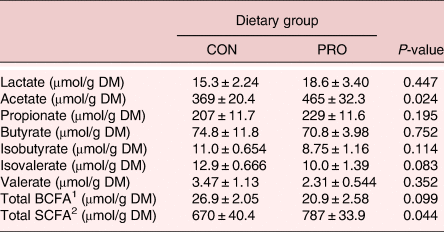
Faecal lactate and SCFA content in dogs after 21 days of feeding the CON or the PRO diets are shown in Table 4. Faecal lactate did not differ between dietary groups (P > 0.10). Although Bacillus subtilis is known to promote the production of lactic acid by enhancing the growth or viability of Lactobacillus spp. (Hosoi et al., Reference Hosoi, Ametani, Kiuchi and Kaminogawa2000), synthesised lactate can be further converted to different SCFA by cross-feeding (Morrison and Preston, Reference Morrison and Preston2016). In the study carried out by Swanson et al. (Reference Swanson, Grieshop, Flickinger, Bauer, Chow, Wolf, Garleb and Fahey2002) in dogs, the addition of Lactobacillus acidophilus to the diet did not result in an increased faecal concentration of lactate.
Faecal lactate and short-chain fatty acid (SCFA) content in dogs fed a control diet (CON) or the same diet supplemented with the probiotic Calsporin® (Bacillus subtilis C-3102) (PRO) for 21 days (values are means ± standard error of means of eight dogs per dietary group).

1 Branched-chain fatty acids: calculated as the sum of isobutyrate, isovalerate, and valerate. 2 Total short-chain fatty acids: sum of acetate, propionate, butyrate, and BCFA.
On day 21, dogs fed the PRO diet had a higher faecal concentration of total SCFA compared to dogs on the CON diet (P = 0.044), primarily due to acetate (P = 0.024). Faecal isovalerate and total BCFA content tended to be lower in dogs receiving the PRO diet (P = 0.083 and P = 0.099, respectively). However, as a similar tendency was observed on day 0, this could not be attributed the change in diet alone. Total SCFA are known to stimulate colonic sodium and fluid absorption (Scheppach, Reference Scheppach1994), therefore, the higher faecal acetate content seen with the PRO diet was consistent with the lower faecal consistency score shown throughout the study. There is mounting evidence supporting the beneficial roles of SCFA on gut health (Hijova and Chmelarova, Reference Hijova and Chmelarova2007). In particular, acetate exerts a trophic effect on the colonic epithelium by increasing mucosal blood flow (Scheppach, Reference Scheppach1994). Intestinal acetate is the greatest contributor to total acetate in the body, which is utilised by most tissues as an energy source (Bleiberg et al., Reference Bleiberg, Beers, Persson and Miles1992).
The increase in total SCFA alongside the decreased ammonia content found in the faeces of dogs fed the PRO diet support the potential beneficial effect of Bacillus subtilis on gut health. This observation may reflect a shift of intestinal microbial fermentation from less proteolytic to more saccharolytic. A major provision of energy derived from a higher utilisation of potentially fermentable carbohydrates by intestinal bacteria could promote microbial growth and lead to higher utilisation of luminal nitrogen sources, such as ammonia, for microbial protein synthesis (Williams et al., Reference Williams, Verstegen and Tamminga2001). Such a phenomenon was observed in another dog study, in which feeding a high fermentable fibre diet was associated with an increased faecal concentration of SCFA and with decreased protein fermentation, denoted by a lower faecal concentration of BCFA and ammonia (Bosch et al., Reference Bosch, Verbrugghe, Hesta, Holst, van der Poel, Janssens and Hendriks2009).
Apparent digestibility of diets
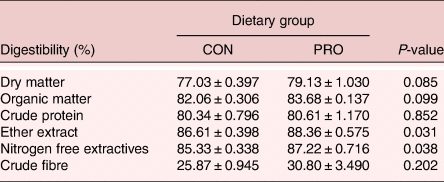
The dogs fed the PRO diet had greater apparent digestibility of EE and NFE compared to dogs on the CON diet (P = 0.031 and P = 0.038, respectively; Table 5) and showed a trend towards a higher apparent digestibility of DM and OM (P = 0.085 and P = 0.099, respectively). The apparent digestibility of CP and CF remained similar in both diets (P > 0.10). The increased apparent digestibility of NFE with the PRO diet could be partly explained by the release of amylases during the germination of Bacillus subtilis (Benjamin et al., Reference Benjamin, Smitha, Jisha, Pradeep, Sajith, Sreedevi, Priji, Unni and Josh2013). Regarding the increase in fat digestibility, it has been shown that diet-induced alterations in the composition of the gut microbiota might stimulate dietary fat absorption via modification of bile salt composition and luminal lipolytic activity (Semova et al., Reference Semova, Carten, Stombaugh, Mackey, Knight, Farber and Rawls2012).
Dry matter and nutrient apparent digestibility for dogs fed a control diet (CON) or the same diet supplemented with the probiotic Calsporin® (Bacillus subtilis C-3102) (PRO) on week four of the study (means ± standard error of means for six dogs per dietary group).

To our knowledge, this is the first study in dogs reporting a positive effect of Bacillus subtilis on nutrient digestion. The discrepancy between this study and the one carried out by Félix et al. (Reference Félix, Netto, Murakami, Brito, Oliveira and Maiorka2010) using the same probiotic strain as a food additive may be related to animal factors (adult dogs up to eight years old in the current study compared to 7–8 month–old dogs in the latter one) as well as to dietary characteristics (DM and protein digestibility 5% greater in the study of Félix et al. (Reference Félix, Netto, Murakami, Brito, Oliveira and Maiorka2010) compared to the current study).
Therefore, the positive effect of Bacillus subtilis on the apparent digestibility of fat and non-structural carbohydrates seems to be particularly evidenced when diet digestibility or dogs' digestive capacity are not optimal.
Conclusions
The addition of Bacillus subtilis C-3102 (Calsporin®) to extruded dog food at a dose of 1 × 10⁹ CFU/kg diet improved the consistency of faeces, promoted the synthesis of SCFA, and decreased faecal ammonia content. These results reflect the potential contribution of Bacillus subtilis to the gut health of dogs through the modification of the microbial fermentation pattern in the gut. Supplementation of Calsporin® over three weeks resulted in an enhanced apparent digestibility of fat and carbohydrates, potentially improving the energy yielded from the diet.
Acknowledgements
This work was funded by Asahi Calpis Wellness Co., Ltd. The authors want to thank the Servicio de Apoyo a la Investigación of the University of Zaragoza for their assistance during the study and to Ana Gordo, Belén Hernando, Jesús Artajona, and Raul Carlos Mainar for their support in carrying out the analyses.
Declaration of interest
The author Noriko Nakamura is an employee of Asahi Calpis Wellness Co., Ltd., the company that owns the product Calsporin®.
Supplementary Material
Supplementary material for this research note is available at https://doi.org/10.1017/jan.2019.2