1. INTRODUCTION
It is sometimes suggested that professional economists behave more self-interestedly and less cooperatively than do non-economists, perhaps because of their exposure to or attraction to standard models of economic rationality (Frank et al. Reference Frank, Gilovich and Regan1993). The empirical evidence seems to favour the conclusion that economists will tend to behave more self-interestedly than non-economists when placed in explicitly game-like situations that invite the application of formal economic models, but it is unclear whether these results generalize to more ordinary, everyday contexts (Marwell and Ames Reference Marwell and Ames1981; Carter and Irons Reference Carter and Irons1991; Frank et al. Reference Frank, Gilovich and Regan1993; Yezer et al. Reference Yezer, Goldfarb and Poppen1996; Selten and Ockenfels Reference Selten and Ockenfels1998; Laband and Beil Reference Laband and Beil1999; Frank and Schultze Reference Frank and Schultze2000; Frey and Meier Reference Frey and Meier2003; Bauman and Rose Reference Bauman and Rose2011).
Ethicists tend to favour normative models that encourage more cooperative choices – for example, acting on a maxim that one can will to be a universal law (Kant Reference Kant1998 [1785]) or acting to promote general happiness (Sidgwick Reference Sidgwick1907 [1874]). One might therefore wonder whether professional ethicists’ behaviour would be complementary to that of professional economists – more cooperative and less self-interested, at least in situations that explicitly call forth the ethicist's special expertise. Recent evidence suggests not (Schwitzgebel Reference Schwitzgebel2009; Schwitzgebel and Rust Reference Schwitzgebel and Rust2009, Reference Schwitzgebel and Rust2010, forthcoming; Schwitzgebel et al. Reference Schwitzgebel, Rust, Huang, Moore and Coates2012). However, the issue remains open. If, indeed, ethicists behave no better than their peers not specializing in ethics, that presents a prima facie challenge to views in philosophy and moral psychology that would valorize philosophical ethics for its positive moral effects on those who study it (as argued in Haidt Reference Haidt2012; Rust and Schwitzgebel in preparation).
The American Philosophical Association used to rely primarily on an honour system for the payment of meeting registration fees. However, this policy was changed due to perceived non-compliance in the mid-2000s – lots of attendees not registering, creating financial challenges for the APA, a fact the organization repeatedly communicated to its members. When increasingly strong exhortations to pay failed adequately to increase registration compliance, the APA shifted, in late 2008, to a policy of enforcing registration compliance by releasing meeting room information only to paid registrants. Participating in a professional conference while failing to pay the registration fee for the conference would appear, on the face of it, to be a morally objectionable form of free-riding. Since ethicists and non-ethicist philosophers participate in APA meetings in similar roles, patterns of non-compliance are a potentially interesting behavioural measure, perhaps especially during the honour-system period. Non-compliance cannot be justified by claiming that registration fees are exorbitant: since the mid-2000s, pre-registration for APA members has been $50–60 (somewhat more for non-members and for on-site registration; $10 pre-registration for students). See Section 4 for a brief discussion of other arguments for morally justified non-compliance.
The research question of this article is: Were professional ethicists less likely than other philosophers to free-ride at APA meetings in the period when the honour system collapsed? For vividness, we might imagine ourselves on a hotel mezzanine in 2007, looking at a registration line full of good citizens/suckers waiting to pay their fee. Those philosophers hurrying past, probably hoping that the others will assume they have already paid – are they disproportionately unlikely to be specialists in ethics? Or are they about to lecture on the nature of virtue and universal law?
2. METHOD
I obtained from the Pacific Division of the American Philosophical Association a complete list of every person who paid registration fees to participate in the Pacific Division meetings from 2006 through 2008, the final three years of the honour system. (The APA has no general national meeting, but rather three divisional meetings, with the Pacific the most popular among philosophers not involved in the job market.) Before this list of registrants was shared with me, an independent organization that was kept ignorant of the nature of the research, the U.C. Riverside Statistical Consulting Collaboratory, converted individuals’ last names and first initials into a numerical string by means of a complex mathematical formula unknown to me. (Rigorous controls for preserving privacy were required both by the APA and by my home institution's ethics review board.) Separately, a research assistant and I generated a list of people appearing on publicly available 2006–2008 Pacific Division meeting programmes, alongside a few demographic and programme-role variables (specified below). The names on that second list were then also converted into numbers, by another research assistant, according to the same formula as was used on the list of paid registrants. The final analysis was conducted by me, using computerized search outputs to compare the two encrypted lists. At no point in the process was I or anyone else outside of the APA administration made aware of any individual's registration status. Any encrypted name that appeared on the meeting programme but not on the registration list for a given year was coded as a free-riding non-registrant. (Occasionally, someone may appear on the programme and then fail to attend, for example due to a health crisis. To judge from personal experience attending meetings, this is relatively rare. I treat such non-attendance as noise unlikely to differ between ethicists and non-ethicists.)
List matches were based on encrypted all-caps surname and first initial only. To reduce the likelihood of errors in computerized list matching, programme participants were excluded from analysis if their surname was among the 100 most common US surnames; if there was more than one person on the program with the same last name and first initial; if the person's name contained a space, a non-alphabetic character such as dash or apostrophe, a mid-word capital other than after ‘Mac’ or ‘Mc’, or a letter with a diacritical mark; or if her full first name was not listed on the programme (since someone listed as ‘H. Mark Goodalot’ might register informally as ‘Mark Goodalot’). Simple misspellings seem likely to be infrequent in the databases, since the registrant's name as spelled in the databases would appear in the same form on her nametag, giving an opportunity and motive for correction. I assume a maximum noise rate of 10% from all sources. We will see one confirmation of this maximum noise estimate in the results section.
The following variables were used as predictors of free-riding:
Ethicist
I coded all participants as either ‘ethics’, ‘non-ethics’, or ‘excluded’, based on the title of the presentation(s) they were giving, commenting on, or chairing, and including political philosophy as a branch of ethics. I excluded topics on the disciplinary boundary between ethics and non-ethics (philosophy of action, religion, gender or race, unless a focus on ethical or political dimensions was evident from the title). I also excluded sessions on issues in the profession (e.g. teaching and technology) and chairs and commentators on mixed sessions. So, for example, the first-listed presentation of the 2006 meeting was titled ‘Privacy, Secrecy, and Government Surveillance’, falling in the subdiscipline of political philosophy and thus classified as ethics. The first presentation in the next-listed session was titled ‘Do all valuable artworks possess aesthetic value?’, falling in the subdiscipline of aesthetics and thus classified as non-ethics. If a participant appeared more than once on the year's programme, that participant was counted as an ethicist if any of her participation was coded as ethics. To help minimize any experimenter effects resulting from these coding decisions, each participant's classification as an ethicist or non-ethicist was irreversibly completed and attached to her encryption code before any of the registration results were known.
To improve the independence of the trials, if a participant had more than one non-excluded year of participation (22% did), only one year of participation, selected at random, was included in the main analysis.
Gender
Gender was coded based on first name. Gender-ambiguous names were excluded from gender analysis, as were names whose gender associations were not obvious to the U.S. coders (11% of the total).
Year
The study covered years 2006, 2007 and 2008.
Programme role
All participants were classified as speaking, commenting or chairing. If a participant appeared more than once on the programme, her highest-level role was used (speaking > commenting > chairing).
Main programme
The ‘main program’ is organized by the divisional Program Committee and generally runs from 9 a.m. to 6 p.m. ‘Group sessions’, typically with lighter attendance, start around 6 p.m. Participants in more than one session were coded as main programme participants if they participated in any role in the main programme. Daytime ‘mini-conferences’ were treated as part of the main programme.
Colloquium session
Within the main programme, sessions were classified as either colloquium or non-colloquium. Talks in ‘colloquium’ sessions are generally submitted and blind refereed. Non-colloquium sessions are generally invited. Participants in more than one session were coded as colloquium participants if their highest-level role was in a colloquium.
Institutional prestige
All participants were classified as either affiliated with an institution with a philosophy Ph.D. programme ranked in the 2006 Philosophical Gourmet Report or as not so affiliated. If a participant was affiliated with a ranked Ph.D. programme, that person was further classified either as a graduate student in that programme or as faculty.
3. RESULTS
Ethicists vs. non-ethicists
Classification as an ethicist was not predictive, either negatively or positively, of appearance on the list of paid registrants. Overall, 74% of ethicists appeared to have paid their registration fees, compared with 76% of non-ethicists (552/744 vs. 674/891; Z = −0.7; p = 0.50; 95% CI for difference −6% to 3%). This general conclusion appears to survive when the other predictors are taken into account, as I will now explain.
Gender
Gender was not predictive of registration: 75% of men appear to have registered, compared with 76% of women (805/1078 vs. 286/376, Z = −0.5, p = 0.59). Thus, although ethicists were more likely to be women (34% vs. 19%, Z = 7.4, p < 0.001), this factor did not appear to have a confounding influence on ethicists’ registration rates. For this and all other predictor variables, possible confounds have also been examined by regression analysis, as reported below.
Year
Year also did not significantly predict registration, with 74% registration in 2006, 74% in 2007 and 77% in 2008 (377/512 vs. 461/619 vs. 388/504; χ2[2] = 1.7, p = 0.44). Thus, although a smaller proportion of ethicists appeared on the relatively long 2007 programme than on the 2006 or 2008 programmes (41% of participants were ethicists in 2007 vs. 48% both other years, χ2[2] = 8.0, p = 0.02), this factor did not appear to have a confounding influence on ethicists’ registration rates. See also the regression analysis below.
Institutional prestige
Institutional prestige was also not predictive of registration: 73% of faculty from ranked PhD programmes registered, compared with 76% of participants not affiliated with a ranked PhD programme (presumably also mostly faculty) (346/475 vs. 746/988, Z = −1.1, p = 0.28). Nor was there a detectable difference, within ranked PhD institutions, between registration rates for faculty and for graduate students: 73% vs. 78% (346/475 vs. 134/172, Z = −1.4, p = 0.18). Excluding graduate students from the analysis does not materially affect the main results, with registration rates at 74% for ethicists vs. 75% for non-ethicists (Z = −0.8, p = 0.45).
Programme role
People whose only programme role was as a chair were less likely to have registered than were people with a speaking or commenting role: 70% vs. 76% (237/338 vs. 989/1297, Z = −2.2, p = 0.03). Also, people who appeared on the main programme were more likely to have paid their registration fees than were people appearing only on the group programme: 77% vs. 63% (1051/1358 vs. 175/277, Z = 4.6, p < 0.001). Among those on the main programme, people whose highest-level role in the programme was in a colloquium session were more likely to have paid registration fees than those whose highest-level role in the programme was in a non-colloquium session: 80% vs. 75% (532/662 vs. 519/696, Z = 2.6, p = 0.01). And among colloquium participants, the ones who appeared as speaker, and thus who had a paper selected through the Pacific Division refereeing process, had the highest rate of registration of all groups: 86% (205/237).
The previous paragraph reveals a pattern in which likelihood of registering appears to correspond with something like debt to the APA Program Committee. One might guess that people not appearing on the programme at all would be least likely to have registered, so that the overall non-compliance rate might substantially exceed 25% among meeting attendees, but unfortunately there seems to be no way to test this hypothesis directly.
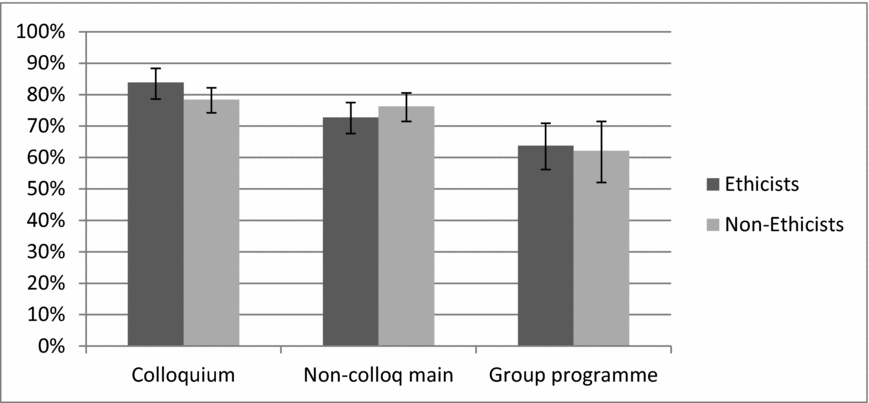
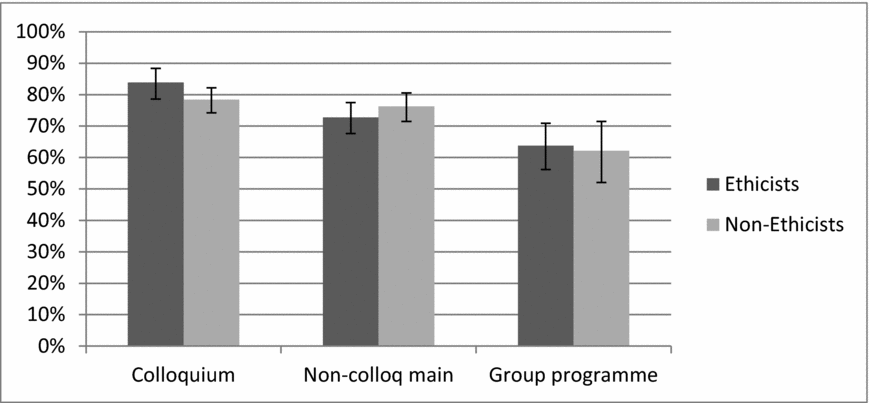
These results are encouraging in that they suggest sufficient data quality and statistical power to detect effects where they exist, including a likely maximum noise level (for missed registrants) of about 14% (the complement of the 86% match rate for colloquium speakers). However, this data pattern also raises the possibility of confounds, since ethicists and non-ethicists were not equally distributed among the programme participation groups. Ethicists were less likely than non-ethicists to serve only as chair: 18% vs. 23% (136/744 vs. 202/891; Z = −2.2, p = 0.03). Ethicists were more likely than non-ethicists to appear only on the group programme: 23% vs. 12% (174/744 vs. 103/891, Z = 6.2, p < 0.001). And among participants appearing on the main programme, ethicists were less likely than non-ethicists to have their highest level of participation in a colloquium session: 41% vs. 54% (236/570 vs. 426/788, Z = −4.7, p < 0.001). This invites the concern that differences in programme role might be masking a real tendency for ethicists to be more likely to register. One way to address this concern is to divide the data into subgroups. Doing so, we continue to see no effect. Among main programme colloquium participants only, 84% of ethicists registered, vs. 78% of non-ethicists (198/236 vs. 334/426, Z = 1.8, p = 0.08, 95% CI for difference −1% to 12%). Among main programme non-colloquium participants 73% of ethicists registered vs. 76% of non-ethicists (243/344 vs. 276/362, Z = −1.1, p = 0.29, 95% CI for difference −10% to 3%). Among participants appearing on the group programme only, 64% of ethicists registered vs. 62% of non-ethicists (111/174 vs. 64/103, Z = 0.3, p = 0.78, 95% CI for difference −10% to 13%). These results are displayed in Figure 1. This and other potential confounds have also been examined through regression analysis, to which I now turn.
Ethicists’ and non-ethicist philosophers’ likelihood of having paid Pacific Division APA meeting registration fees, by participants’ session type. Error bars represent one-proportion 95% confidence intervals.
Regression analyses
As a further check for confounds, I ran a forward conditional stepwise binary logistic regression with registration status as the dependent variable, testing the following dummy variables as predictors: ethicist, female, highest-level role as chair, only on group programme, highest-level role in colloquium session, faculty at ranked institution, graduate student at ranked institution, year 2006, year 2008, and two-way interactions of ethicist by each of the other dummies. In each case, the reference groups were those not matching the category label (i.e. non-ethicist, male . . .). Reference groups were selected entirely on grounds of size, e.g. year 2007 because it had the longest programme. Three variables achieved significance at an alpha level of 0.01 and were thus included in the final regression equation: participation only in the group programme (negatively predictive: β = −0.58, OR = 0.56, p < 0.001), highest-level role as chair (negatively predictive: β = −0.48, OR = 0.62, p = 0.001) and highest-level role in colloquium session (positively predictive: β = 0.39, OR = 1.48, p = 0.003; constant β = 1.17, OR = 3.21, p < 0.001). These results accord nicely with the findings from the simpler analyses above. Regression analysis also confirmed the central finding that being an ethicist was non-predictive of having registered. The estimated effect size is small as well as non-significant: in a binary logistic regression predicting registration from participation only on the group programme, highest-level role as chair, highest-level role in a colloquium session, and ethicist, the regression coefficient for ethicist was β = 0.04, implying an estimated odds ratio of 1.04 (p = 0.75; 95% CI for OR 0.82 to 1.31).
As a final check, the original forward conditional stepwise binary logistic regression was repeated on the full dataset including all years of participation for repeating participants. On this analysis, the significant predictors, all negative, were participation only on the group programme (β = −0.75, OR = 0.47, p < 0.001), highest-level role as chair (β = −0.38, OR = 0.69, p = 0.002), and, perhaps sadly, being a faculty member in a ranked department (β = −0.32, OR = 0.73, p = 0.006; constant β = 1.48, OR = 4.38, p < 0.001). Entering the ethicist variable into the model again yields a low coefficient and a high p value: β = 0.05, p = 0.63, with an estimated odds ratio of 1.05 (95% CI 0.85 to 1.30).
4. CONCLUSION
Ethicists were no more likely to have paid their conference registration fees for the Pacific Division APA from 2006–2008 than were non-ethicist philosophers. Among both ethicists and non-ethicists, approximately three-quarters of participants listed on the meeting programme also appeared on the list of paid registrants. The remaining one-quarter appear to have been free-riders, taking advantage of the lack of registration enforcement to escape contributing to the cost of hosting the meeting, despite appearing on the meeting programme.
While such free-riding might be economically rational according to standard applications of rational choice theory, it is often a violation of one's moral obligations. The present results thus fit with several other recent findings that suggest that professional ethicists behave, on average, no morally better than do socially similar non-ethicists.
In conversation I have heard various arguments for registration scepticism. The two most common are (i) that registration is not morally required if the registration line is long, and (ii) that the APA is unworthy of monetary support. The first argument might be a good argument against the moral duty to register at the beginning of the conference, before one attends one's first session. One might still register mid-conference after the lines have calmed. The second argument might justify declining to pay in excess of what is necessary to host the conference, but in fact the APA's modest registration fees don't even cover the entire cost of the conference (which is subsidized from annual APA membership fees and other sources). It also seems, to me, a suspiciously self-serving form of purism that declines, on moral grounds, to pay participation fees to an imperfect organization and yet does not decline the professional advantages of appearing on the programme hosted by that same organization. Doubtless, sophisticated arguments can be mounted on both sides of the question; that's what we philosophers are good at! Nor would I claim that non-registration is a grave sin or wrong in all cases. Furthermore, even if registration is in general not morally preferable to non-registration, the empirical results might still be interesting. For example, the results might be interpreted as revealing that ethicists are no better than non-ethicists at detecting the non-obligation to register.
It is also sometimes suggested to me in conversation that professional ethicists should not be expected to behave any differently than anyone else – that their job is only to theorize about morality, not to live it. This has always seemed to me an odd view. Carried to its logical conclusion, it seems to imply that we should expect ethicists who advocate vegetarianism, such as Peter Singer (Reference Singer1975/2002), to eat cheeseburgers at the same rate as everyone else. The conflict between advocating vegetarianism in print and consuming large amounts of meat in person seems sharper than does the conflict between lecturing on the need to act on universalizable maxims, or on the virtues of honesty and generosity, or on how to support a well-functioning society, and sneaking past the registration line to do so. But one might have thought that in a substantial proportion of cases there would be some conflict, some felt pressure of irony. As far as I can see, though, any conflict either is not felt keenly enough to influence behaviour or is masked by other influences.